Showing posts with label LOJMS. Show all posts

Monday, 25 September 2023

Lupine Publishers | The Cone of Events in Anthropokinetics

 Lupine Publishers | LOJ Medical Sciences


Abstract

The author presents the physical structure of the light cone, which divides the space-time into two parts. The information and events in the first one is connected with each other and may form the cause-effect chains. The information and events in the other one (dubbed “elsewhere”) cannot influence the run of events under consideration. The same general philosophy might be applied to the motor operation patterns in humans (and other living beings) while taking into consideration temporal constraints of various rungs of the modalities’ ladder. The latter is a mental structure originated in N.A. Bernstein’s “brain skyscraper”. Author shows at the practical manifestations of the application of the mental model termed events’ cone.

Keywords: Anthropokinetics; Modalities’ ladder; Light cone; Events’ cone

Introduction

Let us start from three simply banal statements:

A. Firstly: The only manifestation of any mental activity, and the only way to affect the environment, is the movement. Consequently, there are no other behaviors than the motor ones.

B. Secondly: The main task of the Science (with great “S”) probably most consciously has been expressed by Auguste Comte in the words “To know in order to predict; to predict in order to can” [1]. The first element of this statement may be substituted with the word “understand”. If one wants to predict, it is not enough to simply know; it is necessary to understand the essence of phenomena and processes under consideration and their mutual relations. The accurate prediction causes-nearly directly-the potentiality of realization of actions reliably resulting with desired effects. In general, “to understand” (or, may be, more precisely- “to grasp”) might be regarded as a product of philosophy, “to predict”-a product of science, and “can”-a product of technology.

C. Thirdly: Let us remember that mathematics is the science on relations, which facilitate understanding. In the non-living world, where the things passively obey the laws external against them, establishing of the net of such laws enables predicting the behavior of such things also in the future. On the other hand, in the living world the laws are not external against the entities (no longer “things”!). In biology, just these entities contribute to creation of such relations. More, in psychological processes, where various relations are being actively and sometimes “online”, i.e., consciously shaped by living entities. Not rarely such relations act only in very short periods. Therefore, it is not possible to establish a universal net of relations, reliably governing the behavior of living entities. Therefore mathematics-being the science on relations, which may be described with a “stiff” formalism-is not eligible for description of biological phenomena, where the evolution destroys any “stiffness” of a formalism (or any “formalism-like” structure). The same concerns, more, the psychological processes, which are not prone to any “formalism-like” constraints, external against entities being described and taking no into consideration their internal determinants [2,3].

The term “anthropokinetics” from the title of this paper should be described more precisely. The position of this discipline in the general system of sciences on human motor behavior has been shown in the Table 1. It is worth noting that specific disciplines, which in such a system have been termed “sub-disciplines”, in other systems may play the function of supra-disciplines. Such a flexibility makes one of the aspects of beauty and usefulness of a system. However, in the system of sciences on motor behavior such an order seems to be the most effective.

Table 1: The system of sciences on motor behavior of living beings, especially humans (Petryński, 2019, in print).

Lupinepublishers-openaccess-journals-medical-science-journal

The physical light Cone

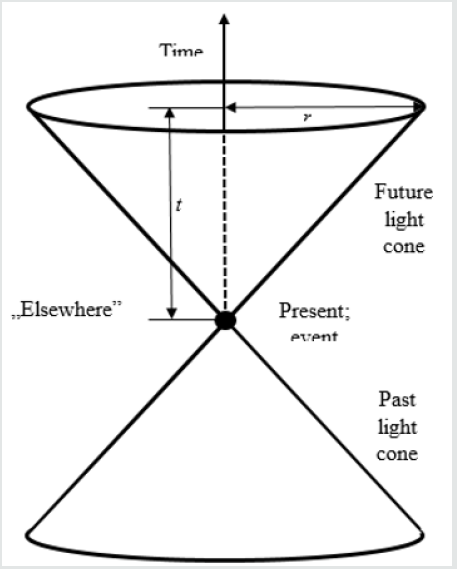
In physics there is known the notion of “light cone” (Figure 1). It is “a surface in space-time that marks out the possible directions for light rays passing through a given event” [4]. Let us look closer at this cone. The basic rule of its construction is the fact that “nothing can move faster than light” [4]. Therefore, if anything lies in the distance greater than that, which during observation might be travelled by light, is located “elsewhere”, i.e., in the space, from which no information may be received by observer. Accordingly, such an information cannot influence the run of events in the spacetime region encompassed by the light cone. And vice-versa. If a given event starts a cause-effect chain, it may act only inside the light cone (Figure 1). Therefore, such a representation of reality divides the whole space-time of events into two parts. Inside the cone, there are some mutually related cause-effect chains, which shape the run of events, but the information from outside the cone (“elsewhere”) cannot influence such a run. On the other hand, the actions inside the cone have no effect on what is going on outside it. The light cone is no doubt a mathematical structure. Therefore, according to earlier statements, it should not be useful in the description of psychical processes underlying human motor behavior.

Figure 1: The light cone. The events from “elsewhere” cannot influence the events inside the cone. It would be possible only when the information from this region would be able to travel faster than light. After time “t” from the moment of event, the light will reach the distance “r” from the place of event.

Lupinepublishers-openaccess-journals-medical-science-journal

Anthropokinetics and physics

However, the anthropokinetics is still young discipline, which searches for its scientific identity. Therefore, it is forced to adopt what might be termed the “Foraminifera-strategy”. The Foraminifera are one-cellular organisms, which build around their bodies the shells of sand. However, they select only such grains that under microscope their tests look as if they were polished [5]. Anthropokinetics should take any suitable “grains of knowledge”, no matter, where they come from, either. Accordingly, let us listen to novelist Jo Nesbø, who wrote: “You can discover new things by changing your perspective and your location (in science their equivalent is the methodology-WP). You can compensate for any blind spots” [6]. Accordingly, let us try to look at anthropokinetics from slightly different perspective. Already in 19th century philosopher, Auguste Comte has divided the whole science into two parts: “physique organique” and “physique inorganique” [7]. The former might be-roughly-identify with the biology, whereas the latter-with physics. The common element is the “physics”. Hence, one may perceive it no as a sum, but as a system. In such a situation justified seems to be the presumption that-may be-some relations are active in both these regions, but in “physique inorganique” they are better visible, whereas in “physique organique” are hidden deeper. In such a context highly illustratively sounds the statement by Niels Bohr that “It is wrong to think that the task of physics is to find out how Nature is. Physics concerns what we say about Nature”.

While coming out from such a “starting point”, one might put a question, whether the physical-mathematical structure of the light cone (or, more precisely, the philosophy underlying its mental construction) might be useful also in description of any psychological processes (in general) and anthropokinetical ones (in particular)? In other words-whether in anthropokinetics we have to do with relations independent of an individual, which executes a motor operation, which are able somehow “from outside” impose specific constraints on potentialities of performing by this individual specific motor actions? And whether to description of such a relation one might-even marginally-use a physical model?

Brain skyscraper and modalities ladder

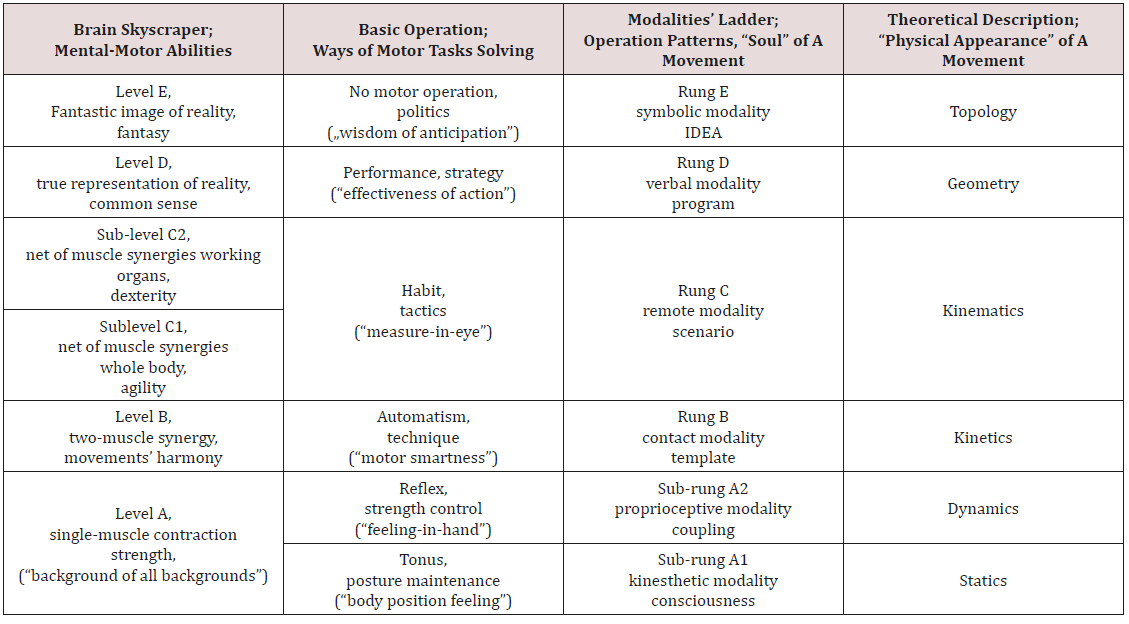
The questions put above may be answered positively. Such external (against, e.g., an individual human) system of constraints is the “brain skyscraper”, shaped by evolution. It has been invented by Nikolai A. Bernstein [8-10], and its “intellectual daughter” is the modalities’ ladder [2,3]. The latter is fully coherent with the “skyscraper”, but devoid of evolutionary and neurophysiological components; it is mainly information-processing structure. Both are hierarchic, systemic structures. The former has five levels, the latter–five rungs. One if the main rules by Bernstein states that each motor operation has its main level of control (“master”), where the attention of the executor is being focused, and the lower ones (“slaves”) play the function of “background” (not “subconsciousness”, whatever this term might mean) and their action does not need attention concentration. Let us emphasize: the main criterion is not a division into “consciousness” and “subconsciousness”, but into elements, which need attention focusing and such ones, which do not need such a concentration. Before comparing the “brain skyscraper” and the modalities’ ladder, let us remember that one and only manifestation of each mental, psychical process in living beings-including humans-is the movement. This is why philosopher Andrzej Wohl wrote: “All that we dispose of, all what constitutes the resource of our culture, all the pieces of art, science and technology-all that results from motor activities” [11]. In short, there are no other conducts than the motor ones. The basis of such a behavior is the consciousness. Before further considerations, let us formulate the two definitions:

A. Motor operation: Motor action of a living being aimed at solving of a given task in environment; it may be evoked either by extrinsic stimulus (trigger; in such a case it is the motor response), or by intrinsic motivation without any contact with environment [12].

B. Consciousness: A dynamically changing component of a quasi-static whole; the multimodal knowledge of an individual, activated at given moment by perception directed by attention, aimed at dealing with a task at hand [3].

Let us add that the consciousness is a multifaceted phenomenon. Knowledge might be described with various codes-e.g., haptic, visual or verbal-but the general term “consciousness” encompasses all these modalities of information processing. It seems worth remembering that the term “modality” includes a specific code of information storing and processing, a logic specific to them, certain scale of phenomena and processes, the definite time period and depth of information processing. The characteristics of the “brain skyscraper” and modalities’ ladder, as well as the phenomena related to them, have been presented in Table 2. In short, the brain skyscraper has been built on structural, whereas the modalities’ ladder-on functional basis.

Table 2: Bernstein’s “brain skyscraper” and the modalities’ ladder.

Lupinepublishers-openaccess-journals-medical-science-journal

As one can see, the divisions in both these structures are not identical. The equivalent of the single A-level in “brain skyscraper” are two sub-rungs (A1 and A2) in the modalities’ ladder. A single C-rung in the modalities’ ladder has two sub-levels (C1 and C2) in the brain skyscraper. Some comment needs the function of the tonus (sub-rung A1) in the structure of any motor operation in a human. The skeleton of Homo sapiens amounts to about 200 bones. Each of them may move against other ones; such movements may be described with the term “degrees of freedom”. In sum, human skeleton disposes of very many degrees of freedom. However, if a muscle should to move a given bone lever, then one its end has to be fixed relatively stiffly. In other words, all bones in a kinematic chain ending with this “stiffly fixed” end of the muscle should be properly immobilized; Bernstein dubbed this process “reduction of freedom degrees”. It makes the main task for the muscle tonus. Thanks to it, non-controllable system has been transformed into a controllable one. Hence, the muscle tonus makes a basis for the all other motor operations. Therefore, Bernstein termed it “background of all backgrounds”. In the modalities’ ladder, the notion of “degree of freedom” has been generalized and encompasses the abstract “information chunks”, related to movements or set of movements, specific to higher rungs of the modalities’ ladder.

The anthropokinetic events cone

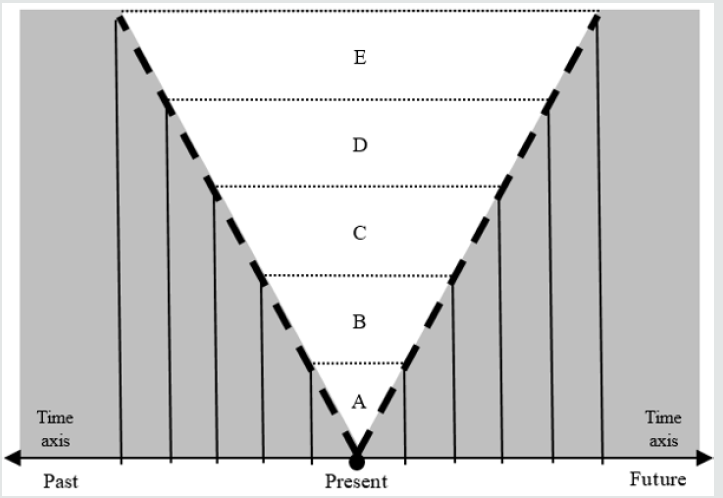
The modality of each rung of the modalities’ ladder includes a specific type of coding, logics of information processing and temporal limits of the phenomena under consideration. Therefore, facing angry grizzly bear somewhere in Alaska, I would prefer company of experienced trapper with Winchester rather, and not ingenious Albert Einstein. Just the temporal limits, peculiar to rungs, may make a structure similar to the physical light cone. Let us term it “events’ cone” (for the sake of simplicity, because it should be named “the cone of abstract representation of real events”). A given modality may effectively “deal” with events, which belong to a specific period. Hence, the events lying beyond these limits should be categorized as being “elsewhere” (Figure 1). Consequently, they cannot influence the information processing inside the events’ cone. It is possible, then, to use the general rule of construction of the physical light cone, i.e., the division of the space of events into two parts. One of them includes such events, which may make parts of cause-effect chain shaping the future, and the other, which are to be found “elsewhere” and cannot influence the run of events (Figure 2).

The structure of the light cone differs essentially from that of events’ cone. In the former the time axis is positioned vertically (Figure 1), whereas in the latter-horizontally (Figure 2). However, the general philosophy-division of events and information into potentially active and unable to any activity-remains the same. It is worth noting that the time axis in Figure 2 should be perceived as a logarithmic scale, and not a linear one. Nevertheless, clearly visible are time periods specific to rungs, and the fact that the higher the rung, the longer the time period for analysis of events and information processing (thinking).

As a result, one might consider the space inside the events’ cone (bold dashed line) makes the room for analyses and information processing, whereas the space outside the cone represents the “elsewhere”. In short, the temporal constraints-specific to rungs of the modalities’ ladder-disable the events from “elsewhere” and make them ineffective in shaping of a given motor operation. The higher rung, the longer “working” period. The price, which inevitably must be paid for its extension, is higher and higher level of abstraction, i.e., getting further and further from reality. Therefore, the processes and phenomena at distant to the “tangible” reality highest rungs of the modalities’ ladder cannot be tested experimentally. Therefore, at those rungs the only tools for scientific description are hypotheses and theories. The techniques of intellectual work, which may be applied in this region of abstraction, are, e.g., the logic of loops by Michał Heller [13] or “inference to the best explanation” (IBE) by Gilbert Harman (Harman, 1965). Otherwise, both of them are nearly identical. Such a “moonshine” way of science creation evokes almost contempt of “genuine scientists”, i.e., the worshippers of arithmetical average and standard deviation. Nevertheless, the science is being composed of theories, and not “new, original experimental data”. Their amorphous ashes may merely fertilize the intellectual ground, on which the theories should grow. This has succinctly expressed by biologist (Nobel Prize winner) Peter Medawar with the words “theories destroy facts” [14]. Unfortunately, as its physicist Edward Teller aptly stated, “A fact is a simple statement that everyone believes. It is innocent, unless found guilty. A hypothesis is a novel suggestion that no one wants to believe. It is guilty, until found effective.”

However, let us look once more at the Figure 2. Let the symbols A, B, C, D and E symbolize rungs of the modalities’ ladder, tightly related to Bernstein’s brain skyscraper levels. The grasping of time is possible only at C-level-at that level appear remote sensory organs, which enable observation of motion in the environment; it is the only phenomenon, which makes possible to shape the notion of time-but it does not mean that it cannot be used to description of phenomena also from the lower rungs. The bold dashed line symbolizes the anthropokinetic events’ cone, including rungs of the modalities’ ladder. Not without reason the borders between rungs are marked with the dotted line. In fact, they symbolize not sharp limits, but fluid zones rather. The information may cross them, indeed, but in the zone between the rungs, its modality is being transformed. This is a non-linear process, i.e., elements from one rung are differently amplified in the other one. This phenomenon is probably responsive, to the main extent, for unpredictable, qualitatively new system effect produced by such a system. Let us notice that such a structure is generally coherent with division of memory into short-term sensory store (STSS), short-term memory (STM) and long-term memory (LTM) by Richard Atkinson and Richard Shiffrin. Roughly, STSS might be associated with the lowest rungs of the modalities’ ladder, STM-with the middle ones, and LTMwith the highest rungs. The vertical relations make the system. The horizontal extension, limited by dashed line, represents the period specific to the information processing modality at a given rung.

Figure 2: The events’ cone in anthropokinetics. White field inside – consciousness; grey field outside – unconsciousness (“elsewhere”); bold dashed line – half-consciousness.

Lupinepublishers-openaccess-journals-medical-science-journal

Consciousness, half-consciousness and unconsciousness

At that moment of our analyses appears the space for mental construction of what might be associated with the phenomenon commonly termed “sub-consciousness”. This term seems to be incorrect, because it not describes the essence of the phenomenon under consideration. It may be regarded as a specific “black box”, where one may put all, what scientists are not able to properly describe scientifically. In such a situation, the item put into black box termed “sub-consciousness” remains not understandable, indeed, but marvelously gains the attribute of “scientificity”. However, one might imagine that the borders of the events; cone are not sharp as the cut of Japanese sword, but they make rather some fluid zones. While approaching the inside of the cone, the image of a given phenomenon or process becomes more and more pronounced, and inside the cone are completely clear. In such a model, each of the rungs-which dispose of its “own” modality of information processing and temporal limits of abstract representations of phenomena and processes-has also its own “zone of twilight of perception”. Such a model would enable description of the phenomenon of gradual forgetting of a particular event. It would transfer from the inside of the events’ cone-in this region, its abstract representation is immediately accessible-to the “twilight zone”. Its retrieving from this zone is possible indeed, but it is more difficult and time consuming. Finally, when it goes out from the zone of “twilight”, it becomes completely forgotten. Such a “twilight zone” from the side of future one might dub “precognition”, and that from the side of past- “shadows of oblivion”. The representations of events in this zone exist, indeed, but they are not precise and indistinct. Therefore, the interior of the events’ cone may be identified with the consciousness, the border zone-with half-consciousness, and the region of “elsewhere”-the unconsciousness.

To avoid creation of a “moonshine” term (like “subconsciousness”), let us try to invent a rationale for what has been roughly dubbed “precognition”. Motor operations are always faced towards future-closer or farther, according to the rung of the modalities’ ladder. The main “processor”, which produces the abstract, mental pattern of a motor operation is the intellect. It may be perceived, roughly as a system consisting of three mechanisms of information processing: intelligence, intuition, and instinct. Intelligence makes the “armed forces” of the intellect. It is responsible for final shape of the motor operation pattern. However, to produce such a pattern, it needs full information necessary to given task solution and knowledge of all the rules of such information processing. We are very rarely in such a luxurious situation; we have not such a complete knowledge. Hence, if an information lacks, it must be guessed to get intelligence going. This makes the task for intuition. Finally, the instinct directs the searching for lacking information towards these regions of memory, where its finding seems to be most probable. The half-consciousness zone faced towards future cannot include the full information about a given task; otherwise, it would be the full consciousness. Hence, the intelligence itself cannot be effective in this region. As a result, here opens the wide field of action for intuition. The term “precognition” might be described, then, as a way of processing of not complete information, where the main tool is the intuition (“I don’t know, but I suppose”), and only marginal role plays the intelligence.

The Events’ cone in practice

The system presented in the Figure 2 may make sense only when the time period, assigned to a given rung, is sufficiently long to enable practical realization of the task related to this rung. Therefore, the lower rung, the simpler operation and the swifter its execution. And vice-versa: the higher rung, the more time-consuming preparation and execution of a specific motor operation. Let us imagine such a situation. During a solemn, international scientific conference, I am presenting my work. I am moving freely in the room and using a pilot for changing slides remotely. Suddenly, I take a pin, hidden in my sleeve, and acutely sting the buttock of a dignified, gray-haired scientist. What will happen? No doubt, the scientist will jump. It is natural reaction in such a situation: to take a distance from the source of pain. Does s/he realize immediately, what happened? For sure-not! Such an event would be so astonishing, so improbable, without any equivalents in the past, to which it might be related. The scientist would have to build the abstract model of the event, what inevitably must be time-consuming. Hence, at the contact B-rung the stimulus is received, response-prepared and executed, before at the verbal D-rung the stimulus is barely identified. However, if it happens, I would be far away.

The content of events’ cone depends not only on information processing modality, but also on the level of pre-preparation of a needed operation pattern. In this respect instructively sound the words by Ben Johnson-mysterious racing driver “Stig” from the BBC program “Top Gear”. In the interview, he stated: What defines a good driver? What attribute is necessary, and what merely useful? The anticipation. Racing driver is a person, who does not look for solutions of the problems that occur in a race. S/he knows those solutions, and when the situation comes, when the reaction becomes necessary, s/he simply performs the operations leading to its successful solving [15]. While seen from the perspective of the modalities’ ladder, in this case we have to do with the D-rung depth of information processing being “pushed down” to the C-rung temporal constraints. In daily language, such a process may be identified with what is commonly termed “experience”. It has been described by Nikolai A. Bernstein [10,16].

On the other hand, if an individual has to his/her disposition C-rung time, one cannot expect the information processing with depth specific to D-rung. In such a situation suitable information processing should be located in the region of “elsewhere”. For example, the analysis of car accident or ships’ collision at sea, where the teams of expert witnesses have plenty of time for D-rung calculations and analyses, cannot be compared to the situation of a driver or captain, who was able to make only C-rung assessments, basing on previous experience, and had to his/her disposal merely seconds or minutes. Such a situation has been brilliantly presented in the movie by Clint Eastwood “Sully”, about landing on 15th January 2009 on the Hudson River of the Airbus 320, in charge of the captain Chesley “Sully” Sullenberger.

Conclusion

Well, is it possible-based on the presented analyses-to formulate the conclusion that the laws of physics in their “pure” form may be applied also in anthropokinetics? For sure-no! One might merely assume that some mental structures, invented by physicists, may be used-after specific modifications-also in anthropokinetics. However, such an analogy reminds the similarity of the shark and the dolphin rather, and not a common law being in force in both these disciplines. It is not possible, then, to perceive it as a rule. In science there are no any well-worn, simple templates-like, e.g., calculations (not mathematics!) or any other commonly accepted methodologies”-which would release scientists from thinking. In this respect highly instructively sound the words by Niels Bohr: “You are not thinking; you are just being logical.”

Philosopher Paul Feyerabend has invented an image of knowledge built by Truth and Freedom. The former has its feet firmly on the ground; the latter flies freely in the sky. Where they meet, the Science (with great “S”) is being born. However, the Truth is harnessed with the stiff constraints; hence, it cannot for long remain in union with the unhampered Freedom. Hence, sooner or later, they must part their ways. Until next meeting. Analogously, also the similarity of the light cone and the events’ cone should be treated as a result of a momentary meeting of the Feyerabend’s Truth and Freedom, and not as a basis for formulation of more general theories.

Read More About Lupine Publishers Journal of Medical Sciences Please Click on the below link :

https://lupine-publishers-medical-sciences.blogspot.com/


Monday, 31 July 2023

Lupine Publishers | Bewilderment amongst Neurologic and Fake Ailments: A Serious Culpability that needs Pedagogical Boost

 Lupine Publishers | LOJ Medical Sciences


Introduction

The incidence of medical mistakes in primary care is not rare and the probability of faults producing grave detriment is great. Medical negligence is a ‘tort’, or ‘civil wrong’. It is a ‘wrong’ resulting from a doctor’s carelessness. Simply put, negligence means failing to do something that should have been done as defined by current medical practice or doing something that a physician with a duty to care for the patient should not have done. Whereas about one percent of hospital admissions result in an adversative event due to negligence, faults are probably much more common, because these studies detect only errors that led to assessable adversative events occurring soon after the mistakes. Moreover, though after heart disease and cancer, medical mistake is the 3rd important reason of death in the USA, maybe the real problem in medical faults is not bad persons in health care; rather it is that good individuals are working in corrupt systems. Poor communiqué , blurred lines of power of doctors, nurses, and other care providers, incoherent recording systems, differences in healthcare provider teaching and practice , failure to recognize the frequency and significance of medical mistakes, overestimation of insufficient data, sleep deficiency and night shifts, doctor’s depression, fatigue, and burnout , unfamiliar settings, diverse patients, and time pressures have been accounted as vital causes of medical error. In the following article, some proven neurologic cases, which have been diagnosed in the beginning by at least one neurologist as conversion disorder and referred to psychiatric facilities, have been described. This article tries to give the reader an awareness regarding the aforesaid dilemma, in the ground of psychological medicine.

Background

Clinical forensic medicine is a term that has become widely used only in recent decades, though the phrase has been in use at least since 1951. The practitioners of clinical forensic medicine have been given many different names thru the years, but the term forensic physician has become more widely accepted. In broad terms, a forensic pathologist generally does not deal with living individuals, and a forensic physician generally does not deal with the deceased. However, worldwide there are doctors who are involved in both the clinical and the pathological aspects of forensic medicine. There are many zones where both clinical and pathological aspects of forensic medicine overlap, and this is reflected in the history and development of the specialty as a whole and its current practice [1]. The current data indicates that medical mistakes kill yearly around 180 000 individuals in hospitals and medical faults may be the fifth foremost reason of death in the United States of America. If these implications are exact, the present health care system can be accounted, as well, as a community health threat [1], and the existing scheme of medical negligence or misconduct does a poor job as regards the wellbeing of patients. Societal and economic powers are changing the structure of health care from the individual doctor to a union of health care specialists, categorized by liable medical groups [2]. On the other hand, enterprise accountability, joined with medical slip communication and corrective platforms, delivers the lawful agenda essential for the ‘patient-centered’ practice of medicine in current situation [3]. The word ‘error’ in medicine is utilized as a term for approximately all of the complications hurting the patients. Also, medical mistakes are often designated as human faults in healthcare [4]. Whether this label is ‘human error’ or ‘medical error’, one description used for it in medicine pronounces that it happens when a healthcare worker selects an unfortunate mode of care or incorrectly performs a proper technique of care. Anyway, a medical fault is an avoidable adversative consequence of care, whether or not it is hurtful or manifest to the patient. This might contain an erroneous or imperfect management or diagnosis of a behavior, syndrome, disease, infection, damage, or other illness [2].

According to a national survey in United Kingdom, each year, medical errors costing in excess of two billion ponds [5]. Another study has found that drug mistakes are among the most common medical errors, hurting as a minimum 1.5 million individuals each year. Likewise, medical faults, globally, affect at least one in ten patients [6]. According to the findings of a new study, after heart disease and cancer, medical mistake is the 3rd important reason of death in the USA. It deserves to be mentioned that The Institute of Medicine (IOM) released “To Err is Human,” in 2000, which stated that the real problem in medical faults is not bad persons in health care-it is that good individuals are working in corrupt systems that should be prepared safer [6]. Moreover, poor communiqué and blurred lines of power of doctors, nurses, and other care providers are among the causative issues [6]. Incoherent recording systems in a hospital may cause disjointed systems in which frequent handoffs of patients ends in lack of harmonization and mistakes [6]. Differences in healthcare provider teaching & practice and failure to recognize the frequency and significance of medical mistakes as well intensify the threat [7,8]. Then again, the supposed ‘July effect’ happens when firsthand residents come to training hospitals and instigating an upsurge in medication mistakes [9,10]. Jerome Groopman, author of ‘How Doctors Think’, has assumed that these are ‘cognitive pitfalls’, or biases which can cloud our judgment. For instance, a physician may overestimate the first data run into his head, influencing his decision. Another drawback is where stereotypical presumptions may skew intelligence [11].

Sleep deficiency has also been mentioned as a causal reason in medical mistakes [11]. According to a study, being awake for above twenty four hours could cause medical interns to ‘double’ or ‘triple’ the number of avoidable medical faults, involving those that had caused harm or decease [11]. Similarly, night shifts are connected with poorer surgeon performance through laparoscopic surgeries [11]. Doctor’s risk factors consist of depression, fatigue, and burnout [12]. Issues related to the clinical setting, too, include unfamiliar settings, diverse patients, and time pressures [11]. All of the following case examples, which have been chosen in this regard, have been diagnosed primarily and unreasonably, by at least one neurologist as conversion disorder and referred to psychiatric facilities. This article tries to give the reader awareness about the aforesaid dilemma, in the ground of psychological medicine. Names, dates and locations have been omitted totally to keep the confidentiality of the cases.

Case 1

A 42 years old male driver had been referred by his general physician to a neurological clinic after observing some tremors in the upper limbs of the patient. The patient had been visited due to sleep problems and nervousness. According to the patient, his problems had been started a few weeks after his divorce from his wife, which had been occurred one year earlier due to various financial and family problems. The care of children also had been transported to him. While the primary prescription of fluoxetine, 20- 40 milligram per day, could only mitigate some of the psychological symptoms like anxiety and dysphoria, the aforesaid tremor got worse, which had not respond to 30 milligram propranolol per day, too. So, he had been referred to a neurologist for further analysis. After primary checkup and based on the personal and family history, since no specific finding was evident at clinical exam, he had been prescribed a series of drugs, in accompany with the aforesaid fluoxetine, like Primidone, 500 milligram per day and Trihexyphenidyl 6 milligram per day, with the primary diagnosis of essential familial tremor, which could be aggravated, too, by means of psychological stresses and maybe small amounts of antipsychotis (Perphenazine, 4-8 milligram per day which had been prescribed by the GP due to his aggressiveness). After another six months, due to intensification of tremor that had interfered with some of his daily activities, and also his anxiousness he had been referred to a consultant psychiatrist. In the initial examination, in addition to a relatively fluctuating tremor, between fine and course, depending on the situation of the limbs, some mild rigidity as well was palpable in the proximal muscles of the upper limb, without any evident cogwheel or clasp-knife rigidity. Due to lack of obvious concern in him regarding his earlier divorce or similar worries, absence of strong or insistent relationship between tremor and psychosocial stresses, unexplained mild rigidity of the proximal muscles of the upper limbs in spite of discontinuation of antipsychotic, and no satisfactory response to the abovementioned medications, so he was referred again for another neurologic evaluation. This time, due to low serum ceruloplasmin level (17 mg/dl), low serum copper (55 microgram/dl), and increased urinary copper excretion (150 microgramm Cu in 24 h) , presence of copper deposition in Descemet’s membrane (Kayser-Fleischer rings) in slit-lamp examination, and slightly enlarged lateral and third ventricles, widened cerebral and cerebellar sulci, and hypodensity of posterior parts of lenticular nuclei in CT Scan , plus bilateral, symmetrical signal hyperintensities in the Basal ganglia, Midbrain, Pons, and Thalamus in T2-weighted MRI, the diagnosis of Wilson’s disease (Hepatolenticular Degeneration) had been suggested for him and thus transferred to a neurologic clinic for further investigation and management.

Case 2

A 38 years old man had been hospitalized in the psychiatric ward due to aggressiveness, suspiciousness, disturbed sleep and some movement problems. When he was 18-year-old, he had been diagnosed as a case of bipolar I disorder due to similar profile of symptoms, except than movement problems, which had been started since two years ago. During the last two decades a number of neuroleptics, mainly first-generation antipsychotics, mood stabilizers like lithium and valproate, and benzodiazepines had been prescribed for him. One year ago he was hospitalized again in another psychiatric hospital for his increasing movement problems, which had been assigned to his antipsychotic medications, and had been treated by dopaminergic drugs like Levodopa – Carbidopa (Sinemet) (750-1000 milligram per day), Amantadine (200 milligram per day), and also Trihexyphenydil (6 milligram per day). The aforesaid problem had been diagnosed as medication induced movement disorder (pseudo-parkinsonism) by a consultant neurologist. But there was lack of effectiveness and worsening of the problem. After the recent admission and disregard to the past and present psychiatric history of anxiety, depression, impulsiveness, dis-inhibition, suspiciousness or paranoid delusions, in the clinical examination a mild-moderate fluctuating rigidity and tremor in the upper and lower limbs was evident, which had made clumsiness and unsteady gait, respectively. Also, there were some problems regarding swallowing solid foods and talking fluently. Also, a fixed stare with a smiling expression and drooling was evident. So, another neurologic consultation had been requested by his psychiatrist; this time also, the antipsychotic induced movement disorder had been confirmed, once more, by the second consultant neurologist, who, moreover, proposed tardive Parkinsonism as a probable differential diagnosis. Due to lack of effectiveness of the aforesaid treatments, in spite of discontinuation of prescribed antipsychotic (Quetiapine 75 milligram per day), Electroconvulsive therapy (ECT) was started, which stopped after five sessions, due to existence of mild fever and lack of significant effect. Nonetheless, due to refractoriness of the movement symptoms against the recommended treatments, their fluctuating course and persistence in spite of discontinuation of neuroleptics, atypical emergence and persistence of the primary psychopathology, and a long gap (18 years) between the first prescription of neuroleptics and subsequent emergence of movement symptoms, an additional neurologic consultation had been requested for the patient. This time, a suspicious serum ceruloplasmin level (23 mg/dl), low serum copper (76 microgram/ dl), and increased urinary copper excretion (153 microgram Cu in 24 h) had been found. MRI scan, too, had showed decreased signal intensity (hypodensity) in the Striatum and superior Colliculi and increased signal intensity in the Midbrain Tegmentum (except for red nucleus) and in the lateral Substantia Nigra (reticular zone). So, diagnosis of Wilson’s disease (Hepatolenticular Degeneration) had been suggested for him and transferred to a neurologic facility for further investigation and management.

Case 3

A forty seven years old father with a at least five percent weight loss in the last year, in spite or normal appetite and sleep, had been examined by an internist, but the primary laboratory examinations and clinical checkups, including thyroid analyses and computed tomographic scan (CTS), had not proved any specific medical diagnosis. So due to slight restlessness, increasing feeling of tiredness and loss of energy in comparison with before, nervousness, irritability and decrease in attentiveness had been referred to a psychiatrist for analysis regarding psychological problems. In the mental state examination, and in addition to the abovementioned complaints, a slight forgetfulness, disturbance in concentration, negative thoughts, minor disturbance of conduct, history of enuresis during childhood, and a past history of mixed anxiety and depressive disorder after his father’s death, were as well detected, which in sum concluded to a diagnosis of mild to moderate major depressive disorder for the present episode of illness. But the primary medicinal management with fluoxetine, 20- 60 mg per day in a two months period, was not effective. So after a consultation with an associate neurologist and based on newly detected anomia, verbal perseveration, small time disorientation, trivial mood swings, score of 17 in Mini Metal State Examination (MMSE), and history of some head traumas with decrease of consciousness in the past, the diagnosis turned to pre-senile dementia and the aforesaid psychiatric complaints had been classified as secondary symptoms due to that. So, treatment with Rivastigmine, 3-6 mg per day, in addition to fluoxetine, started. But ineffective outcomes after another two months and the progressive course of the ailment resulted in an additional consultation with another teammate neurologist. After a new clinical inspection and detection of trivial fasciculation in upper limbs, muscle atrophy and weakness in upper extremities in Electromyogram (EMG), and atrophy of the frontal and/or temporal lobes in Magnetic Resonance Imaging (MRI), the diagnosis turned to Fronto-Temporal Degeneration (FTD) with motor neuron disease (FTD/MND) , and the patient transferred to a neurologic facility .

Case 4

A 23 years old man had been hospitalized due to restlessness, aggressiveness, decreased sleep, increased libido, delusion of grandeur, and obsession. The incessant and fluctuating course of the problems had been started from around four years ago with a series of psychiatric hospitalizations and managements. He had been diagnosed as a case of bipolar mood disorder, schizophrenia, and schizoaffective, or schizo-phreniform disorder during different periods and treated with a series of mood stabilizers, like lithium and sodium valproate, and also antipsychotics, and benzodiazepines. But during the past few years, he was never completely symptomfree, in spite of relative compliance with the prescriptions. During his recent admission, a dystonic reaction, as well, appeared in the neck which was resistant against anticholinergic drug (Biperidene, 6 milligram per day) and decreasing the dosage of antipsychotic (Risperidone). So, he had been referred to a consultant neurologist, who diagnosed medication induced movement disorder, in addition to the formerly diagnosed primary psychiatric disorder, and added Trihexyphenidyl (6-12 milligram per day, instead of Biperidene) and Amantadine (100-200 milligram per day) to the previous prescriptions. After two weeks of current treatment, due to persistence of dystonic reaction, and also lack of suitable response of psychiatric symptoms to prescribed medications, particularly their fluctuating course, firm delusion of grandeur and impaired judgment in spite of the apparently intellectual insight (IV/V) and normal cognitive & sensorium parameters, another neurologic consultation had been asked for the patient. So, based on the extensive bilateral and symmetrical calcifications in the basal ganglia, thalamus, and cerebellum, in CT Scan and MRI, and ruling out Hyperparathyroidism and Pseudo-Hypoparathyroidism , as major differential diagnostic considerations in the evaluation for treatable causes of diffuse subcortical calcifications , the primary diagnosis changed to Idiopathic Basal Ganglia Calcification or Bilateral Striato-Pallido-Dentate Calcification (Fahr’s disease) and the patient transferred to a neurologic facility for further investigation.

Discussion

The Diagnostic and Statistical Manual of Mental Disorders (DSM) (American Psychiatric Association 1994, 2000) contains current standard psychiatric diagnostic nomenclature used for clinical diagnosis, treatment, and research. The development and adoption of DSM diagnoses have been accompanied by a great deal of controversy [12]. Nevertheless, DSM diagnoses are generally accepted and relied on in clinical and research venues, as well as many other venues for which the nomenclature was not intended, including insurance companies, managed care companies, and the courts. The more significant question raised by the acceptance and reliance of the legal system on DSM is whether DSM diagnoses provide an adequate understanding of psychological states for forensic purposes. Legal determinations, whether civil or criminal, typically revolve around issues of impairment [12]. A DSM diagnostic category is not directly relevant to such determinations. Diagnosis and impairment are not equivalent. No diagnosis carries specific information regarding level of impairment or information about whether an impairment associated with that diagnosis is relevant to the legal issue under examination by the court. The use of categorical DSM diagnosis in litigation may result in the examiner missing the most important aspect of the forensic evaluation: the assessment of impairment or legally relevant behavior [12].

Medical negligence is a ‘tort’, or ‘civil wrong’. It is a ‘wrong’ resulting from a doctor’s carelessness. Simply put, negligence means failing to do something that should have been done as defined by current medical practice or doing something that a physician with a duty to care for the patient should not have done [13]. Medical error has been defined as the failure of a planned action to be completed as intended (an error of execution), an unintended act (either of omission or commission) or one that does not achieve its intended outcome, a deviation from the process of care that may or may not cause harm to the patient, or the use of a wrong plan to achieve an aim (an error of planning). Also, patient maltreatment from medical mistake can occur at the individual or system level. Todays, the categorization of faults is getting bigger to better classify avoidable causes and happenings [14]. While about one percent of hospital admissions result in an adversative event due to negligence, faults are probably much more common, because these studies detect only errors that led to assessable adversative events occurring soon after the mistakes [14]. Though independent review of doctors’ management policies proposes that decision-making could be enhanced in fourteen percent of admissions, many of the profits would have late expressions [14]. Even this amount may be an underestimate [14]. Medical faults are connected with inexpert doctors and nurses, innovative techniques, complex or urgent care, and extremes of age. Unfortunate communiqué, unreadable handwriting, inappropriate documentation, insufficient nurse-topatient proportions, and alike named drugs are similarly identified to contribute to the problem [15].

The same problem exists as well as regards the mental illnesses. For example, patients with ‘dissociative identity disorder’ typically have past psychiatric histories that encompass three or more separate mental disorders and prior treatment failures [16]. The skepticism of some physicians about the legitimacy of ‘dissociative identity disorder’ may similarly increase its misdiagnosis [16]. As an additional example, female sexual dysfunction occasionally used to be identified as female hysteria. Or else, food allergies have been repeatedly misdiagnosed as anxiety disorder . Likewise, investigations have found that bipolar mood disorder has often been misdiagnosed as major depressive disorder [16]. While the misdiagnosis of schizophrenia is as well a common problem, there may be long delays before getting an accurate diagnosis [16]. For the same reason, the DSM- Five field trials have included ‘test-retest reliability’, which involved different clinicians doing independent assessments of the same patient - a new method for studding diagnostic trustworthiness [16]. Anyway, back to medical illnesses, according to a meta-analysis the five most usually misdiagnosed diseases are cardiovascular disease, myocardial infarction, infection, neoplasm and pulmonary emboli [17]. On the other hand, while doctor acquaintance with this data is variable [18], faults can have an intensely negative emotional influence on the physicians who commit them [19]. As has been stated before, some researchers believe that adversative consequences from medical mistakes generally do not occur owing to isolated faults and essentially reflect system difficulties [20]. Such an idea is frequently referred to as the ‘Swiss Cheese Model’. This is the impression that there are strata of safeguard for patient and clinicians to avoid errors from happening. So, even if a physician or nurse makes an unimportant fault, this is exposed before it really jeopardizes patient safety (for example, pharmacologist checks the medications and corrects the slip). Such mechanisms include: Systematic safety methods, practical modifications, training programs, and persistent specialized progress courses [21]. On the other hand, medical and, particularly, neurological illnesses happen repeatedly among patients with conversion disorders. What is naturally seen in these co-morbid medical or neurological disorders is an expansion of symptoms arising from the original biological lesion. Somatization disorders, anxiety disorders and depressive disorders are particularly famous for their relationship with conversion disorder. Meanwhile, studies of patients admitted to a psychiatric hospital for conversion disorder, later, disclose that 25% to 50% have a clinically noteworthy mood disorder or schizophrenia. Similarly, personality disorders, too, often accompany conversion disorder, principally the passive-dependent type (9 to 40 percent of cases) and the histrionic type (in 5 to 2 1 percent of cases). The identification of conversion disorder necessitates that clinicians find an obligatory and important link between the source of the neurological symptoms and psychological dynamics, though the symptoms should not result from the factitious disorder or malingering. No doubt, one of the major difficulties in identifying conversion disorder is the problem of absolutely exclusion a medical ailment. Parallel nonpsychiatric medical disorders are common in hospitalized patients with conversion disorder, and evidence of a present or preceding neurological illness or a systemic disease affecting the brain has been reported in 18% to 64 % of such patients. As has been stated before, an estimated 25 to 50 percent of patients classified as having conversion disorder eventually receive diagnoses of non-psychiatric medical or neurological disorders that could have produced their prior symptoms. Accordingly, a systematic neurological and medical workup is necessary in all cases. Neurological disorders [e.g., dementia and other degenerative diseases], basal ganglia disease and brain tumors should be considered in the differential diagnosis. For example, weakness may be confused with multiple sclerosis, poly-myositis, acquired myopathies, or myasthenia gravis. Similarly, optic neuritis can be misdiagnosed as conversion disorder blindness. Other illnesses that may cause perplexing symptoms are Creutzfeldt-Jakob disease, Guillain-Barre syndrome, early neurological manifestations of acquired immunodeficiency syndrome (AIDS) and periodic paralysis. While conversion disorder symptoms occur in schizophrenia, depressive illnesses, and anxiety disorders, these other disorders are related with their specific distinct symptoms that sooner or later make differential diagnosis probable. In both factitious disorder and malingering, the symptoms are under conscious, voluntary control [13]. Because somatoform disorders are positioned at the crossroad between somatic and mental sicknesses, their differential diagnosis tends to be relatively all-encompassing.

However, there are numerous characteristics of these illnesses that can assist the differential diagnosis. For example, the presentation of rather ambiguous and multiple physical symptoms originating from several organ systems should usually propose a somatoform disorder instead of a somatic ailment. As the number of somatic symptoms rises [irrespective of whether they are pathologically clarified or inexplicable], so does the probability that those persons will meet criteria for a psychiatric illness, not a medical sickness. The following features can help in deciding whether idiopathic somatic symptoms may have a psychiatric etiology: 1- The symptoms co-exist with important psychiatric illnesses such as depression or panic disorder, 2- The symptoms strictly occur after traumatic events, 3- The symptoms lead to psychological “gratification” or “secondary gain”, 4- The symptoms characterize anticipated personality traits (coping mechanism)], 5- The symptoms become inflexible, join a conglomerate of other symptoms, and express such approaches as overuse of medical facilities and disappointment with medical care. The more of the abovementioned features that are present, the more likely it is that symptoms can be categorized as somatoform symptoms. In general, differential diagnosis from other psychiatric disorders is also difficult because many of the somatic symptoms may be related to a psychiatric disorder such as depression (e.g., pain symptoms), anxiety (e.g. cardiorespiratory and gastrointestinal symptoms), or even psychotic disorders (somatic delusions). Nevertheless, the existence of a great level of idiopathic somatic symptoms has to be considered even if they appear in the context of what is viewed as another primary disorder such as depression or anxiety because they probably affect symptom strictness, management outcome and level of incapacity [22].

Anyhow, careful medical examination, based on adequate clinical skills and knowledge, is necessary for diagnosis or ruling out of medical problems. Enhanced educational curriculums in medical schools, improvement of skills and knowledge of medical students in the field of ‘somatic symptom disorder’ and consultation-liaison psychiatry, guideline modifications, continuous post-graduation education and system modifications possibly will help to decline the percentage of medical errors [23]. Though no one has considered the total expenses of misdiagnosis of medical illnesses, it is clear that, if the mistake in diagnosis results in the deceases of patients, then the cost is tremendously high. Consequently, it may be wise that the diagnosis of conversion disorder not be seen as an absolute choice between biological vs. psychological symptomatology. However, if the diagnosis of conversion disorder is assumed, the clinician is recommended to prudently monitor current symptomatology to guarantee discovery of a biological pathology.

Conclusion

The incidence of medical mistakes in primary care is not rare and the probability of faults producing grave detriment is great, of which most could be taken as avoidable or fixable, if management could be started almost immediately or at least not too late. Sufficient attention to detailed process of development of patient’s symptoms, their intensity, duration, priority and fluctuation, and, moreover, vigilant medical checkup and thorough documentation of findings are helpful issues for further lessening of medical and diagnostic faults. So, a rigorous work and all-inclusive approach is compulsory for improvement of patient’s safety in primary care clinics. This may contain enhanced educational core curriculums in medical colleges, with an improved emphasis on psychological medicine, strengthening the validity and reliability of available diagnostic criteria, constant post-graduate training, and organizational amendments or revisions based on periodic re-evaluations. Supplementary studies respecting the prevalence, etiology, cultural or societal issues, student, faculty or facility related aspects, curriculum efficiency, and objective self-monitoring mechanisms certainly will help to reduce the problem.


Read More About Lupine Publishers Journal of Medical Sciences Click on the Below Link:

https://lupine-publishers-medical-sciences.blogspot.com/


Monday, 5 June 2023

Lupine Publishers | The Schema in Cognition

 Lupine Publishers | LOJ Medical Sciences


Introduction

The brain of an infant may be the blank tablet envisaged by Locke [1], but as it is shaped by both experience and language it develops into the mind of an adult. As the character of the maturing individual becomes defined, the mind shapes experiences decreasingly according to immediate stimuli themselves and increasingly according to linguistic interpretations of and emotional reactions to perceptions. Thus, the environment does not dictate human behavior but provides a context for its expression. The basis for interpreting environmental stimuli is the schema the cognitive program (Ger: Weltanschauung) which acts as a template for perceptual experience and provides expectations and explanations about objects and their relations to and interactions with each other [2]. It is populated by or constructed of memes [3], which are subjected to selection pressure by the psychocultural environment and thus are not necessarily as true as they are gratifying and popular. Just as a reigning intellectual paradigm defines each of our modern sciences (e.g., atoms in chemistry) [4], a schema defines the mental life of an individual by providing an intellectual frame of reference for information, ideas and behavior. Traceable back to Edmond Husserl’s phenomenological observation of the mind’s tendency to organize experiences [5], like Piaget’s mental structure [6], it comprises the “Cognitive map” of the individual’s reality and determines his

a) worldview,

b) selfconcept,

c) selfideal and

d) ethical convictions

While providing basic notions about principles of nature and theories about how the world works, the schema both fosters and inhibits further learning. It is particularly good at promoting learning of refinement, whereby established expectations are confirmed and reinforced and responses made more subtle. However, learning of novelty is made less probable and more difficult by preset patterns of thought which limit an individual’s range of cognitive adjustment. Thus, the schema encourages selfcorrective, fine tuning of itself even in cases in which it remains a maladaptive behavioral program. The learning process can be broken down into two interrelated steps: assimilation and accommodation [7]. Assimilation is the perception of stimuli and the incorporation of experience into an existing schema; it is accomplished by assigning the percept of an object or phenomenon to an established cognitive category as defined by the individual’s vocabulary [1]. Accommodation is the change or modification of the schema due to the assimilation of new information. Minor adjustments, refinements and modifications of the schema are very common and occur with little or no awareness or emotion. The resulting schema is the individual’s reorganization of his experience into a system which provides both predictability of events and a sound basic strategy for successful behavior. Attitudes: However, as an individual matures, the presence of the schema tends to dominate the process of assimilation by defining perception in progressively restrictive terms and by the formation of attitudes which evaluate perceived data. Attitudes determine whether a given fact is construed favorably or not. This point is easily demonstrated by a play on a standard form of humor: “I have some good news and some bad news: the Yankees won last night”. This is good news to Yankee fans and bad news to a Yankee hater. Laugh or not, there are three factors which may contribute to the formation of attitudes. First of all, attitudes may be rooted in a person’s need to know about the environment. Such attitudes are data based and provide a verbal knowledge system to which incoming bits of information are compared or contrasted. Attitudes may also be adopted because of externally applied social rewards and pressures of normative group influence. Finally, attitudes may be expressions of the value system of the individual and provide him with the selfsatisfaction of selfsustaining internal rewards [8]. Along with their function of evaluating information, attitudes also act to promote the achievement of goals deemed to be worthy, to maintain selfesteem and to express views. Most important of all to students of stupidity, attitudes determine what a person considers to be his “Best interest”. This is crucial if stupidity is deliberate, informed, maladaptive behavior that is, behavior counter to one’s own best interest.

The determination of “Best interest” thus turns out to be quite an arbitrary process. The basic problem with such an evaluation is that judgment is so “Attitudinal”. For example, the extreme case of homicide may variously be considered a crime (murder), necessity (selfdefense), heroic (combat) or simply negligent if not accidental: the evaluation of the act depends very much upon the circumstances and the attitude of the judge. It is by interacting with the environment that people reveal their attitudes the beliefs, values and ideas which the reference group’s language and norms have molded into a schema. Socialization internalizes this system so that it defines who and what a member is and does. As a young person matures or an initiate conforms, external rewards and punishments become anticipated and behavior adjusts to preconceived expectations. It is important to note that the creed of a group functions as a unifying force [9]. Political and economic systems (e.g., democracy, capitalism, etc.) are often misconstrued as descriptive of how societies interact with their environments. Actually, along with behavioral rituals which are also binding, such systems are concrete expressions of ideological creeds which promote group unity. When the system’s values are internalized, the individual feels himself to be part of a homogeneous group of people comfortable with themselves regardless of what they are doing.

One of the inherent drawbacks of intense group loyalty, however, is that it can interfere with logical analysis of problems [10] and corrupt the superego values of the group. The unacknowledged goal of most groups is maintenance of the schema. Reason is used to rationalize, and value-based perception is skewed to favor the schematic/social quo. Conformity is the standard and intellectual integrity a threat to short term, immediate complacence. Unfortunately, the long-term consequences can be disastrous, as happened in the Penn State scandal centered on convicted child molester Jerry Sandusky [11]. To achieve and maintain a healthy balance, there must be a dynamic tradeoff between the short-term social needs of the group and the long-term intellectual imperative of information. This inherent compromise is typical of the human condition and displays itself as emotional conflict, suppressed or expressed, in all but the total conformist. One of the saving graces of a schema is that, consistent with the theory of cognitive dissonance, it can easily make minor adjustments changes which reduce rather than arouse emotional tension. Accumulated minor adjustments can add up to a significant schematic alteration which would be traumatic if forced in one step. This process is comparable to the gradual evolution of one species into another by the accumulation of genetic mutations. Minor adjustment makes it possible to retain the schema while behavior adapts to novel circumstances. This is ideal for a stupid society, as it permits vague and ambiguous leaders to do somewhat more or less than they should while their followers can believe their cause to be sacred. As new behavioral norms emerge, so too may an identity crisis or conflict gradually evolve as traditional values are deemphasized for the sake of group cooperation in new circumstances. The mechanism of successful schematic adaptation to novelty is, usually, largely language dependent, as it is language that provides the basis for our cognitive life, including the expanded mental capacity to be both very intelligent and very stupid.

Language: Language probably evolved as a means of sharing information and promoting group cooperation, but as a correlated side effect, it shaped the human psyche by the very nature of words. These are really audible symbols which represent selected, generalized aspects of the environment. In this sense, language is a code, [12] with each particular language necessarily biased and restrictive as it defines perceptions [13] in terms of the specific culturally determined categories to which the encoded symbols are attached. It is the linguistic requisite for categorizing which makes the human way of experiencing nature different from that of all other species. While making the human psyche unique, our verbal tradition prohibits “Freedom of experience” from the human condition, as only feral children can escape the subjective impact that the specific verbal values of his given reference group imposes [14]. Each language segments the environmental continua (motion, color, sound, etc.) into various arbitrary categories. Collectively, these provide the cognitive context in which members of the language group think, feel and evaluate experience: that is, we live by symbols [15]. Although categorizing permits the streamlining of some perceptions for the sake of mental efficiency, there are drawbacks. For example, every group is somewhat compromised by the very human tendency to indulge in “Stereotyping” [16]. This is a process of “Overgeneralizing” to the point that important discriminable experiences are treated equally [17]. As we go through life, we fill out our verbal categories with discrete items or events. When we deal with people, for example, certain salient characteristics which members of some perceived group share in common (skin color, language, religion, etc.) are considered determining factors in evaluating the group in general. For the sake of expedience, individual variation may then be ignored and generalizing carried to the extreme that all people who can possibly be placed in a given pigeonhole are lumped together mentally under the label for that category. Not only do we lose information to stereotyping, but the many groups of people become separated from each other because their different languages segment the common environment into different categories. Sad to say, when people in “Opposing” cultures experience the same stimuli differently, they often squabble about their perceptions and reactions rather than enlightening each other with complementary views of the world. Only in superficial matters can alternative interpretations be accepted as interestingor humorous without being threatening. On the other hand, most of history’s great religious and military conflicts had their origins in perceptual/philosophical differences of competing groups which found they could not live in both the same and different worlds.

Such conflicts underscore the point that language functions as a “Defining system” for people [18]. It is through words that “Relevance” is determined for each of us by our culture with behavior being shaped by the structuring of our reactions to what we construe to be relevant. What may really be relevant to one’s best interest may not be identified as such by a necessarily if unfortunately, biased language system. This bias of the language system is based on the descriptive categories and labels used to construct a person’s cognitive world. As the schema is formed, accuracy and objectivity of perceptions are sacrificed for and by euphemisms. These enhance self-esteem by giving favorable interpretations of the actions of the individual and his reference group and negative stereotypes to rivals and opponents. This verbal phenomenon can be carried beyond the selection of words even to their pronunciation as happened, for example, with the affected Spanish accent favored among the leftist elites of the United States2 in the 1980’s to show their support for the pro Soviet regime in “Knee-car-AH-gew-ah” [19]. As for terminology, when dealing with Vietnam, the Johnson administration began with a humanistic way of thinking and talking about the war but ended up following the lead of the military. The change to a detached attitude and then to a dehumanizing outlook was facilitated by euphemisms. “Gooks” were to be “Converted” into “Body counts” by “Defoliation” and “Surgical air strikes” itself a misnomer for inaccurate bombing– which were to accomplish “Attrition” which would precede “Pacification”.20 It was as difficult to argue against such strategy as it was easy to misjudge American’s best interest in those terms, as opposed to “Napalm” and “My Lai” [20,21]. A few years later, the Nixon administration had a similar problem judging its own best interest and literally got hung up on the terms “Executive privilege” and “National security”. The Nixonian were also disposed to use derogatory terms for their presumed enemies meaning the press, students, hippies, Jews, Italians, Germans, blacks and liberals in the State Department and Congress [22] and committed to destroying anyone3 who did not support the Nixon team [23].

Along with defining means and experience, words shape the schema by directing attention [24] to certain facets of the environment which are deemed important by the verbal value system. Each language system has an inherent tendency to emphasize certain experiences while others are trivialized. Thus, accuracy of overall perception and objectivity of interpretation are sacrificed to verbal appeal as people focus on particular stimuli at the expense of others [25]. Of course, events of expected significance receive the most attention and analysis particularly if they pose either a serious threat to the schema or an opportunity for a triumphant achievement worthy of the Superego Seal of Approval. Language further serves as a memory system, [26] in that categorized, encoded experiences act as a basis for comparing the present with the past and for projecting future expectations. Naturally, the process of memory formation is systematically skewed off by forgetting some events that happened [27] and including others that did not. Thus, some aviation accidents (and even more so, near misses) can be redefined out of existence while fantasy provides a rosy picture of what self-serving experts at the FAA (Flying Accidents Administration [28]) can trick themselves into interpreting and believing. The worst that can be said about language in this regard is that it allows people to remain firmly in touch with their delusions, or, as Goethe’s Mephistopheles believed: “With words, you can do anything” [29].

While examining the role language plays in the formation and functioning of the schema, we have considered it as a system for encoding, categorizing, stereotyping, defining, focusing and memorizing. We should not forget that it also functions as a communication system, making the individual’s schema a product of and contributor to the group creed. As a means of sharing experiences, language is quite efficient, but as a means of permitting people to talk to and about themselves realistically, it is too biased to allow accurate self-analysis. As a belief system, the schema promotes coping with some problems while limiting the ability to recognize even the existence of others. The schema promotes coping with acknowledged problems if the discrepancy between verbal beliefs and necessary behavior is emotionally tolerable, so in such situations, both individual and group efficiency is enhanced. However, when the discrepancy is so pronounced as to make people self-conscious, and when coping has to be treated as heresy, psychological and social disruption result from the delusive mental set of stupidity. Interestingly enough, living out the expressed creed that is, living up to the ideals can also be aggravating to the devout who flout their beliefs in daily life. Christ was crucified for fulfilling prophesies and embodying ideals. Like most great rebels, he endeavored to live up to stated standards; unlike most, he did. For example, his kicking money lenders out of the temple was an expression of his intolerance for organized impurity [30]. Such a person may be a great model for the dispossessed but is very dangerous for the establishment, so he was betrayed by the leaders of his own community. In this case, they responded in a manner typical of authorities who would be displaced if their promises were realized, and they had no difficulty recognizing what course of action was in their own immediate best interest.4 His crucifixion was an allegorical warning for everyone that the more one lives up to expressed ideals, the more likely he will suffer for the sin of doing so [31].

In the absence of whistle blowers, who are usually persecuted to the degree that they live up to the creed, language maximizes the potential of a social group to cooperate at whatever is accepted as necessary. Ironically, it promotes cooperation among members by inhibiting an appreciation of what it is they are doing or to what extent they may have over or underdone it. Hence, although language normally functions as a screen between people and their environment, it can become a barrier if perception and cognition become skewed off and distorted for the sake of biased values. In the two-dimensional world of the schema, information from the reality of the behavioral environment is often redefined by the social imperative of language. An individual may find himself experiencing momentary cognitive dissonance [32] when finding incoming data from the world of “Doing” contradicting or conflicting with his ideology the system of ideas built on his established beliefs. The usual reaction in such a situation is to “Save the schema” at the expense of learning about the environment. Thus, numerous Freudian defense mechanisms (e.g., rationalization, repression, suppression, etc.) keep individuals’ content with their superego value systems, albeit at the cost of improving their behavioral schemas. Physical reality may be a better source of information, but social values are preferable, [33] as they are comforting and reassuring even while they are misleading. The social world is really a symbolic environment of subjective judgments, all routinely condoned and defined by the prevailing language system. Incoming perceptions are compared to the established schema, and if a way of fitting them in can be found, it will be. If none can be found, the data are usually rejected by the defense mechanisms mentioned above. In more extreme cases, undeniable perceptions may force an uncomfortable awareness on an individual (or discussions in a group) which eventually lead to a new, more inclusive schema. This changing of one’s mind is the last resort, however, particularly if it tends to isolate an individual from his social group. Finally, language extends to matters which are beyond confirmation–that is, matters of the imagination. The universal presence of this facet of human affairs attests to its survival advantage, although there is obviously need for diplomatic caution when evaluating the reality of any such conjured phenomena or processes. Put the other way, there is no monkey dumb enough to give up a real banana now for a promise of all the bananas it can eat after it is dead. If there is some psychological advantage to human individuals who believe stories of an afterlife, there is even more gained by groups which collectively share, and coordinate activities based on myths [34].

Norms: A group is defined as “Individuals who share a common set of norms, beliefs and values” (i.e., a schema). The behavior of any member is usually of consequence to all other members, [35] and for most people, the social support of the group is vital in that it defines existence. A sense of belonging is a most compelling factor in the human experience and the feeling of isolation a tempering sensation unpleasant to most. The vast majority of people do almost all their learning in the immediate presence of others who serve as teachers or role models. Thus, socialization proceeds as initiates learn appropriate behavior and correlated linguistic values which make group members out of an assembly of individuals [36]. Norms function in the formation of the schema by providing social reinforcement (positive and negative) to the development of both the linguistic value system and the behavioral control system. It is group norms which define group values by shaping the language, attitudes, sentiments, aspirations and goals of the members. These give the ingroup a sense of identity and a degree of solidarity proportional to the hostility which may be directed toward conflicting outgroups [37]. Norms function to induce conformity wherever social organization is found. They provide the means group members use to exert subtle and indirect pressure on each other to think and behave appropriately. They are the customs, traditions, standards, rules, fashions and other unofficial criteria of conduct which organize the interactions of individuals into the codified behavior of group members. In fact, the initiate becomes a member to the degree that he focuses on the norms of a specific group and guides his actions according to them [38]. Identification is complete when the norms become internalized and function as subconscious reward systems. They then serve as the criteria that sustain the attitudes and objectives of the group as members’ judgments and interpretations of perceptions tend toward conformity. The result is similarity if not uniformity of thought and action [39] a condition which can be regarded as normal or intellectually depressing [40].

Of particular importance in formation of the schema is the role norms play in shaping the attitudes of group members, since attitudes are the evaluative components of the schema. That is, it is through social norms that words come to be evaluative labels with positive or negative connotations for group identity and survival. Usually, group attitudes are formed as members concurrently share experiences [41]. Such common experiences provide the basis for the formation of attitudes which express the emotional values of and make certain words loaded terms to members (e.g., “Liberty” to revolutionaries, “Good Christian” to the local holy rollers and “Old Siwash” to loyal grads). These loaded terms and the attitudes they signify provide standards of thought, expression and behavior for the individuals who consider themselves group members. Norms and attitudes then become mutually reinforcing because the attitudes of the group, expressing its essential values, provide strong psychological pressure on members to honor the norms by conformity. In fact, norms and the verbal attitudes they engender make it very likely true-blue members will think, feel, believe and behave in socially acceptable, predetermined ways about relevant objects and events [42]. Thus, for example, Joshua commanded his troops to “Devote” the people of Canaan to God under “The curse of destruction”( i.e., execute them) [43].

Groups: When a group determines the set of values an individual use for judging behavior, it is known as his “Reference group” (i.e., what Edmond Burke once referred to as a “Little platoon” [44] an association of citizens pursuing their common interests). By shaping verbal attitudes with emotionally laden terms, the reference group provides a standard of comparison for evaluating one’s own behavior as well as that of others [45]. As identity with a group develops, a self-conscious sense of obedience to expectation is replaced by a devoted commitment to common values. The fullyfunctional member is a collaborating component of the group and contributes to perpetuating group norms by cooperating with colleagues. Of course, a reference group is all the more effective in imposing its values on members if it surrounds their heads with halos and arouses in them a sense of holiness. The emotional attitudes then become even more effective in promoting conformity to norms as they assume the mantle of moral righteousness. Beliefs condition the existence of any social group and become all the more firmly entrenched if they are sanctified as they are inculcated into the schemas of the devout. The most effective beliefs structure both the consciousness and the conscience of group members. Along with shaping verbal attitudes into ethical values, group norms serve to regulate the behavioral actions and interactions of members by providing both a communication network and social support for each individual. The best that can be said for the functional value of norms is that they promote group cooperation. If they do this, the beliefs they promote and sustain will gain the status of sacred ideals. Once a belief is ensconced in the schema to the point of unilateral respect, it defines “Moral realism” which supports and transcends the “Verbal realism” of attitudes expressing its basic values [46]. This process can go to an extreme, as cooperating members sharing the same values reinforce their common belief about reality. With such social support, a new or altered schema may achieve mass acceptance if it once is established in the minds of a simple majority of group members. This self-promotion of a belief system through intensifying reinforcement is known as “The Gold Effect”, having been described by Professor Thomas Gold, F.R.S [47]. The process is akin to genetic drift in that in cultural life, a field is dominated by a factor (an idea rather than an allele) not because it is superior to competing items but simply because it is more common. This fact alone enhances the likelihood that, in cultural life, a self-reinforcing fad will become a posfeed mania. In terms of schemas, a popular belief can become extremely popular even if popularity is not directly dependent upon accuracy or veracity. Such an extreme may be ideal, if the standard of success is group cohesion. A legitimate goal of any society is to keep disputes within reasonable bounds, which is exactly what the common value system of a shared schema renders more probable. Being a human system, it is rarely 100% efficient, but the schema, as formed by common norms, does function to reduce frictional conflicts within a given group. Many cultures provide forums (soapboxes, letters to editors or Congressmen, public hearings, etc.) where the disgruntled can vent their emotions without much likelihood of anything being settled or disturbed. A classic example of this phenomenon is the Song Singing of Eskimos a ritual in which two disputants compose insulting songs which they sing as loudly as possible at each other [48]. Although nothing may be settled by such rituals, they do reduce psychic and social tension by permitting people to express their grievances and release their emotional energy.

If coping with given problems is too difficult within a static, well defined value system, a group may sacrifice its standards for the sake of cohesion. For example, students unqualified to receive diplomas may get them anyway, so as to avoid hurting their feelings. Such inflation of academic symbols does not really address the problem of learning, but it has a positive, short term effect on some images and is therefore good public relations. In general, a lag or tension is characteristic of a dynamic schema as new behavioral norms conflict with a preconditioned, if outmoded, verbal value system in an accepted state of psychic dissonance. Of course, the cultural impact of any particular schema is diluted by the many interpretations it receives from the individuals and subgroups which compose most reference groups. For example, the grand “Western schema” is subject to national variations which define the citizens of the Western nations on the international scene. Further, the American variant is subject to different interpretations on the domestic scene by businessmen and laborers, policemen and preachers, etc. This process of schematic interpretation is somewhat complicated by the dynamic interactions of the given reference group with its environment. When the group is threatened or impacted by external forces (e.g., natural disasters or conflicts with competing groups), the schema serves as a rallying point, commitment to it intensifies and cohesion is enhanced. This occurred with the civil truce (i.e., Burgfrieden) in Germany in 1914 when, class conflict and internal disputes gave way temporarily to a commitment to national unity [49]. Likewise, the rampant patriotism of Americans during WWII exemplified this phenomenon: as called upon by their president, businessmen and bankers, lawyers and laborers (with some “Wildcat” exceptions [50]) emphasized their common nationalistic schema and conformed to patterns of thought and behavior in the best interests of their country [51]. By way of contrast, in 1946, there was a tendency for subgroups and individuals to polarize by perceiving and interpreting events according to their own (i.e. different) best interests even if at the expense of the national supergroup [52].

Although intense cohesion may be entirely appropriate even in democracies during emergencies, the forced, [5] long-term cohesion of totalitarian states is often the arbitrary concoction of leaders committed to themselves. Conjuring up or creating external threats and crises promotes cohesion, justifies repression and calls for a strong leader [53] as personified by Chinese emperor Sui Wendi circa 600, when he began a war with Korea just for the sake of internal cohesion [54]. Cohesion can also be artificially sustained by deliberate attempts of leaders to bypass the rationale of the schema and appeal directly to the emotions of the people by downplaying sound argument in favor of weighted words [55]. Hitler was past master at arousing enthusiasm by the structured use of the irrational56 and his deliberate indulgence in the big lie. His favorite method was the induction of mass hysteria through the use of, symbols, uniforms, marches, salutes and national games prejudices, passions, hatreds, emotions, resentments and biases.58 His goal was the development of an ethnic/racial pride, and his incredible success in achieving that goal was due to his dealing directly with the hopes, fears and attitudes of his followers. He provided something they valued and wanted to believe in their own image [56-58] The logical if violent and demonic implications of the Nazi ideology had their own appeal to some but were largely (dis)missed by most [59]. Nor was Hitler content to craft his own messages to the public but deliberately limited access to any others. Germans in the ‘30’s were punished severely for listening to foreign radio broadcasts or even if, during a household search, the dial was left tuned to a foreign station [60]. Indeed, one Johann Wild of Nuremberg was sentenced to death for two radio crimes: Listening to a foreign station and repeating what he had heard [61].

Roles: If we shift our focus of attention from the schema to the individual, we find that each is partisan to many schemas, as each of us is a member of a number of different reference groups. A person is a member of a family. As a member of each group, the individual has at least one role to play and has an appropriate schema to guide his thoughts and actions as he shifts identity: e.g., a man can be a son to his father while being a father to his son. At each level, from supergroup to subgroup to individual and for each role, there is a schema to be adopted and applied by people cast in roles that shift with issues and circumstances. A classic example of role shifting was given in an analysis of African society in momentary flux: “... most Africans moved in and out of multiple identities, defining themselves at one moment as subject to the chief, at another moment as a member of that cult, at another moment as part of this clan, and at yet another moment as an initiate in that professional guild” [62]. And so, it is with other nonacute societies. For the sake of contrast, the fundamental difference between human roles and insect castes is noteworthy [63]. In highly social insects, an individual is a member of a caste, which is a “Life role”. It is a soldier, a worker, a queen, etc. for all of its adult life. Determination of caste membership may be genetic, as in the case of the haploid drones of bee colonies, or environmental, as exemplified by the queens, which develop under the influence of royal jelly. Also note that in all groups of animals where cooperation is vital, it is accomplished by role playing. Only in herds, flocks and schools (of fish) can masses of equal individuals be found, and such groups are characterized by the lack of differentiation of members, with at most only leader/ follower designations.

Among humans, anarchy and mass riots are the exception and indicate a breakdown of traditional norms. People are peculiar in that they usually compete for sharing. They have roles and rules for this phenomenon of cooperative conflict, and the winners and losers are usually pretty clearly defined in terms of a commonly accepted and disproportionate reward system. The rules are laws and norms which define how the role players should interact. Within a group, the emphasis must be on cooperative role playing. There are leaders and followers, thinkers and doers, rule makers and rule breakers. There may be any number of roles, all usually defined in terms of their mutual interactions [64]. For example, in an educational institution, administrators, faculty members and students all have interacting roles to play relative to each other. Such interactions can be formally defined by laws or rules as well as informally regulated by norms and taboos. In all situations, of course, there is considerable room for individual variation, depending on the personalities of the particular players and their subjective evaluations of each other [7]. However, the basic principle is that all members of a group share a common schema which they interpret according to their specific roles.

These differences in schematic interpretation give the various, interacting role players the sets of guiding expectations they need to gain the rewards and avoid the sanctions of the reference group. Conformity to expectations is usually the best policy, as it promotes cooperation within and among groups. “Rights” and “Truth” usually have little meaning and less impact on decisions about behavior. Most of these are made subconsciously and follow neural paths of least resistance leading to social paths of greatest acceptance. Along with the language of the major reference group, each subgroup has its own identifying jargon to help its members define their place and fulfill their roles. Also, role players have little rituals manners and mannerisms which facilitate communication and cooperation within and between groups at all levels. Thus, the strategy most conducive to successful role playing is one of conformity to reference group norms. “Fitting in” is usually something of a “Lube job” a matter of confirming existing beliefs by telling people what they already know and doing what they expect will be done. A given individual has, of course, many roles. In fact, a person has exactly as many roles as there are groups about whose opinion he cares. Unfortunately, playing roles in different groups can occasionally create dilemmas and contradictions in behavior especially when one tries to be loyal to conflicting reference groups [65]. A common type of role conflict occurs when one role offers immediate, material rewards while the superego value system of another reference group twinges the conscience. An example of this might be the Christian businessman who wrings his hands over the ethics of making a cutthroat move to advance his career in the corporate hierarchy. A person experiencing such a role conflict has to choose or compromise between external rewards and basic morality.

In many cases, an individual may not be aware of the inconsistent or contradictory demands different roles may be making on him, since the human mind has a great ability to compartmentalize roles into particular settings. Thus, a person may be a good Christian on Sunday, a successful businessman during the week and himself on Saturday. Most of the time, distinctive role programs can be separated subconsciously so that psychic duress (i.e., cogdis) is minimal if not absent [66]. Occasionally, an individual may be forced to alternate between conflicting roles. An example of this might be a student who plays teacher for an interim. Generally, this is not much of a problem, as most competing groups are usually distinctly separate with few, if any, common members: not many businessmen are also members of a union; nor are there many Jewish Christians nor many sailors in the army. However, a person trying to alternateconflicting roles does have a problem, as meeting the expectation of one group may cause censure by the other [67]. Such problems may remain potential, however, and not even apparent under routine circumstances. If there is any inconsistency in behavior, it may pass unnoticed as the conflicting roles normally are separated by time and/or space. A business executive who moonlights as a card-carrying musician can play such conflicting roles comfortably enough. On the other hand, a crisis may force a person to choose a role forcing recognition of who he really is. During a disaster, public servants may favor their families over their jobs. Of course, this is a crucial conflict if the job is related to relief efforts and public safety [68] as when hurricane Katrina hit New Orleans in late August 2005, only to have the police force melt away [69].

As a person shifts roles with changing circumstances, certain attitudes and elements of behavior remain constant and define the “Self” [70]. As a manifestation of the individual’s core schema, the self consists of perceptions, motives and experiences fundamental to identity. Moving outward from this central, consistent essence of character, each person has multiple, superficial attitudes and behavioral programs designed for the various roles to be played (e.g., family member, church goer, fellow worker, etc.) each slightly different and each relating to a role in a different reference group. Behavior in any situation is an expression of the self-drawn out by the compounding of given role in specific conditions. Expression of the self by role playing may not always be healthy [71]. Although it is normal for people to play roles, in that most people do so most of the time, it can be distressing. If playing a particular role means hiding one’s real self, then that is the price that must be paid for the social reward of acceptance. While it may be psychologically distressing to hide from a required role, it can be socially deleterious to bury oneself in a role [72]. Roles and situations are often said to dehumanize or deindividuate [73] the people caught up in them, but it is very human for individuals to take narrow roles to uncritical extremes. Even the happy state of “Being oneself” in a congruent environment can be both ideal and injurious, if the role has become limited or the environment artificially contrived. An example might be the archetypical “Pig” policeman who loves to push people around and gets away with it as long as official word of his abuses can be contained within the precinct.

Expression of the self is also affected by the fact that each role has as many dimensions as it has functions. For example, the leadership role has two interrelated functions goal achievement and group maintenance. Goal achievement requires organization, motivation, sanctions and concentration on relevant environmental factors. Group maintenance depends on mutual respect, trust and friendship of members. A responsible leader accomplishes a given task while maintaining or enhancing group identity usually by being a good role model. However, there is a duality intrinsic to many roles and an inherent ambiguity in determining just how effective any leader really is [74]. Of course, personality plays a part in what kind of leader a given individual is, as a comparison of Generals George S. Patton and Dwight D. Eisenhower makes clear. Patton was goal oriented and one of our best combat commanders; Eisenhower was more the diplomat skilled at maintaining group cohesion. It was the Allies’ good fortune in World War II that both found their appropriate niches and played their proper roles. For a group to realize its goals, the leader must coordinate the roles individual members play. One way to succeed in this respect is to build on the fact that members sharing a common schema will tend to assume mutually supporting roles which promote cohesion. Although their specific behavioral roles differ, members will interact effectively if there is common agreement about the desired goal. For example, in team sports, the players at various positions have different roles which will interrelate smoothly as long as everyone is committed to the ideal of winning.

Unlike sports events, when games end and teams disband, many challenges a society faces are eternal [75] and are dealt with by groups which seem as perpetual as the problems they never solve. A potential problem of and for such permanent groups is that they become committed as much to maintaining their roles as they are to be fulfilling them [76]. For instance, disease is certainly older than medicine, but the medical profession is well enough established to have structured ambiguous roles for its practitioners. This was demonstrated by the reaction of the American Medical Association to a rash of malpractice suits which recently plagued its members. A number of possible reforms were suggested to reduce such suits not malpractice, mind you, just malpractice suits. One suggestion, for example, was to shorten the period a patient would have to file such a suit. This would be fine for the doctors, if not their victims, and it shows that one of the roles doctors play is directed toward keeping themselves as healers in business. [8] If there is ambiguity in this kind of role playing, it is because there is ambiguity in life. Ideally, doctors would be acting in their own best interests simply by acting in their patients’ best interests. Of course, most of them do this most of the time, but that is not enough in our legally oriented, profit generating society. There is an inherent ambiguity in the expression “Health profession”. Medicine is a business, so most doctors look after their own wealth as they look after their patients’ health.

For the student of stupidity, the important point is that the ambiguity of “Best interest” is due to the arbitrary nature of role dependent judgment. This can make it difficult to determine whether or not a particular act is stupid or not. A person may act in his own worst interest in one sense while playing out the requirements of a conflicting role. Even within a given role, a person may have to emphasize one aspect of it to the neglect of others. A resultant decision or act may be deemed stupid by a judge who considers that which was sacrificed to be more important than that which was accomplished. Even a person’s intentions provide no reliable standard, as they may be misguided and shortsighted and ultimately work against him. All things considered, “Best interest” turns out to be quite unreliable as a guide for evaluating stupiditySuch a judgment is usually ambiguous because it is invariably based on an arbitrarily selected standard, so stupidity is thus often induced because a person can easily find some emotionally appealing standard to justify his actions to himself and will then persist in behavior which may work to his actual detriment. In the face of ambiguity, one may fall back on a more general schema to find a basis for defining a proper role, reducing perceived conflict and establishing a program for response in confusing circumstances. In American society, the official schema is the law. Laws provide guidelines for behavior and courts arbitrate when conflicts cannot be settled informally. Of course, the law itself is as ambiguous as lawyers can make it, [77] so Americans often fall back on business principles as guides for judging behavior. For example, for hospital administrators, the crucial criterion for admittance is not a prospective patient’s state of health but his ability to pay. When a person goes to a clinic, he needs to take his lawyer and accountant. Treatment begins only after payment is guaranteed and forms for medical irresponsibility are filled out. (It is a Godsend that the law of “Malice of intent” which gives the media license to libel does not also apply to the medical profession.)

Ambiguity is compounded by the fact that, in most cases, a role is shaped by a schematic compromise of means with ends. Most people have general goals (happiness, wealth, etc.), and most behavior toward these goals is guided by general constraints (laws and ethics). That is, as most of us seek to achieve our goals, certain forms of behavior are proscribed, and others condoned. Only in extreme cases is a schema dominated by an “End” to the point that a totally unconscionable person (like a Hitler) would do literally anything to attain it. Likewise, only in exceptional cases (like loving Christians) do people live by a schema which defines success in terms of how they behave rather than what they achieve. If there were less ambiguity in life, people would be clearer about their goals and more easily find appropriate means of achieving them. The schema is a general guide which provides a quasi-religious ethic for behavior. This may or may not be consistent with the goals, which are determined largely by the emotionally loaded terminology of the reference group. For example, in the field of civil rights, the change from discriminating against blacks and women to discriminating9 for them marked a great change in attitude toward the races and sexes but no change in attitude toward discrimination. The goals flipflopped from segregation to integration, while the means, remained the same. In any event, the change in attitudes toward minority groups was accomplished as awareness of the inconsistency between idealized goals and behavioral reality made people uncomfortable with their traditional values and norms. These had been diplomatically articulated on Mar. 12, 1956 in the U.S. Senate by Walter George, who claimed southerners had been “Very diligent and astute in violating the spirit” of any laws that “Would lead the Negro to believe himself the equal of a white man....” [77] The fact that the reasoning supporting racism was unsound had little impact on the strength of the attendant beliefs and fears, leading one to conclude the reasoning was really rationalizing deeper seated beliefs and fears.

Majority group members transcended their psychic inertia when they realized they would be more comfortable with accommodation than with continued resistance to mounting social pressures. The result of such forced integration has led to a new form of racism now based on experience with intermixture rather than ignorance that is, prejudice based on personal contact rather than bigoted theory. Meanwhile, well intended liberals are turning psychological somersaults and performing cognitive handstands to avoid unavoidable un PC conclusions . On the other hand, [10] when values become tarnished by the realization that they have ceased to be serviceable, and problems of the street overcome nostalgia, beliefs change. This occurred in the South in the 1960’s and in eastern Europe in the 1990’s. Norms and attitudes are recast into new molds as schemas are altered in response to problems which can no longer be ignored. A schema provides a set of beliefs (which pass for an understanding about the universe), a program for directing behavior and, most important of all, a sense of identity. As a guide for a person attempting to cope with an uncertain environment, the schema is clearly adaptive.

Read more about Lupine Publishers Journal of Medical Sciences Please click on below link:

https://lupine-publishers-medical-sciences.blogspot.com/