Lupine Publishers | Journal of Organic and Inorganic Chemical Sciences
Abstract
Dextromethorphan, an anti tussive drug belongs to the morphinan
family, and is mostly available in the market as a combination
therapy. Most of the reported preparation procedures involve the use of
racemic starting materials that give lower yields. (S)- Octa
base is one of the key starting raw materials used in our process and
this easy, convenient and eco-friendly preparation (single
step) is reported in this manuscript. This drug, Dextromethorphan is
produced in large volumes annually (> 150 tons/year). Most
reported synthetic procedures make use of huge amounts of volatile
organic solvents which are hazardous for environment. This
will be a major issue in the near future. To overcome this problem, we
have tried using Ionic liquid as a solvent in the preparation
and successfully arrived at best results, thereby decreasing the use of
organic volatile solvents.
Keywords: Dextromethorphan, Morphine derivatives, Alkaloids, Formylation, Ionic liquid
Introduction
Dextromethorphan, a drug of the morphinan family, is having
tranquilizing, dissociative, and restorative properties (especially at
higher doses). It is a cough suppressant (ANTI-TUSSIVE) in several
over-the-counter cold and cough medicines including generic labels
and store brands, Benylin, Mucinex, Camydex 20 tablets, Robitussin,
NyQuil, Vicks, Delsym, TheraFlu, Cheracol D, and others. It has also
found plentiful other uses in medication, extending from analgesic
effect to psychological submissions useful in the treatment of
addiction. It is sold in syrup, capsule, and lozenge forms. In its
unadulterated form, Dextromethorphan ensues as a white powder.
Currently, Dextromethorphan is not registered in the Schedules of
the United Nations 1961 Convention on Narcotic Drug [1].
Dextromethorphan is the dextrorotatory enantiomer of
levomethorphan, which is the methyl ether of levorphanol, both
opioid analgesics. It’s IUPAC name is (+)-3-methoxy-17-methyl-9α,
13α, 14α-morphinan. It occurs as an odorless, opalescent white
powder. It is freely soluble in chloroform and insoluble in water;
the hydro bromide salt is water-soluble up to 1.5g/100mL at 25
°C. It is usually accessible as the monohydrated hydro bromide
salt. However, some newer extended-release formulations contain
Dextromethorphan bound to an ion-exchange resin based on
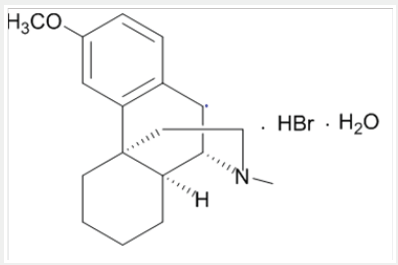
polystyrene sulfonic acid (Picture 1).
Picture 1: Chemical structure of Dextromethorphan Hydro
bromide.
Mechanism of Action
Dextromethorphan is a synthetic compound and acts as a
dissociative anesthetic when taken in higher doses. Its mechanism
of action is via multiple effects, plus actions as a nonselective
serotonin reuptake inhibitor and a sigma-1 receptor agonist [2].
Dextromethorphan and its major metabolite, Dextrorphan, also
act as NMDA receptor antagonist at high doses, which produces effects similar to other dissociative anesthetics such as ketamine
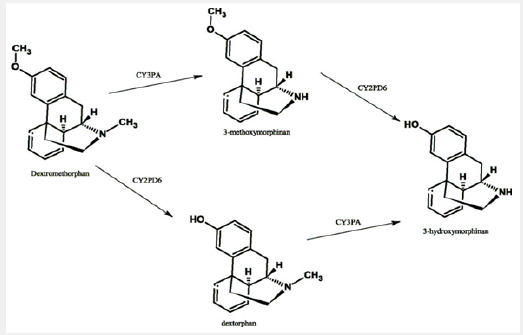
and phencyclidine [3]. The metabolic pathway continues from
dextrorphan to 3-methoxymorphinan to 3-hydroxymorphinan
(Figure 1) [4].
Figure 1: Explains the metabolic pathway of the drug
Dextromethorphan.
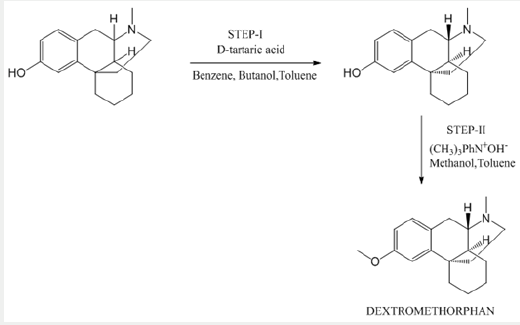
In one of the reported processes for the preparation of
morphinan alkaloids, racemic hydroxy N- methyl morphinan
is used as a starting material, an optically inactive isomer and is
treated with tartaric acid for resolution to obtain selective one
isomer (+) of morphinan. (PATENT- US2676177 (Roche, 1954, CHprior.
1949)) (Scheme 1).
Scheme 1: This scheme explains the reported procedure
that uses a racemic hydroxy N- methyl morphinan as a
starting material along with the use of solvents.
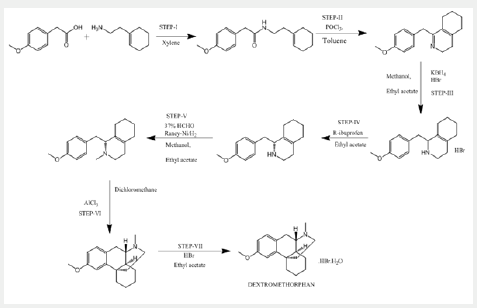
In a similar procedure reported in PATENT- CN102977021 A,
Method for preparation of Dextromethorphan hydro bromide By
Cui, Dapeng et al From Faming Zhuanli Shenqing, 102977021, 20
Mar 2013, Raney Nickel as a reducing agent is replaced by KBH4,
thus, reducing the cost. Also, resolution is done with R-ibuprofen
for the first time. Another advantage is the use of AlCl3 is adopted to
replace H3PO4 to cyclize. Overall, it is a low cost, moderate reaction
conditions, easy in operation and suitable for industrial production
(Scheme 2).
Further, in the search for better preparation methods, which
is easier, lesser preparation steps, cost effective, and also using
chemicals that are easy to handle and can provide higher yields as
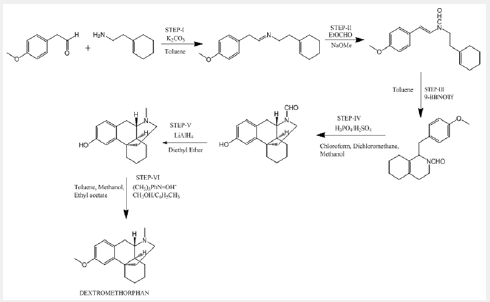
well as purity, it has been found that the critical step of Grewe’s
cyclization is reported in a paper titled, ‘A Novel synthesis of
substituted 1-benzyloctahydroisoquinolines by acid-catalyzed
cyclization of N-[2-(Cyclohex-1-enyl]-N-styryl formamides’ [5]
(Scheme 3).
Scheme 2: Explains another reported procedure, where
alternate reagents like KBH4, R-ibuprofen and AlCl3 have
been used to refine the existing method of preparation of
Dextromethorphan.
Scheme 3: Explains a reported procedure involving the
preparation of Dextromethorphan that involves Grewe`s
cyclization.
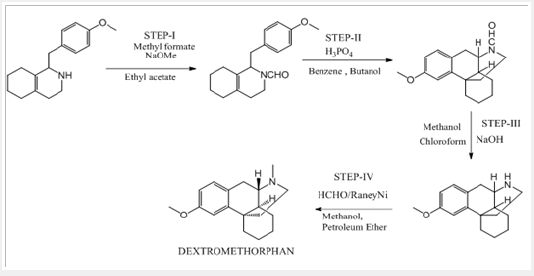
Scheme 4: Explains a reported procedure of Dextromethorphan
preparation, where formylation was done before
the cyclization step to improve the yield.
According to this paper, no cyclization of enamide was
observed with Lewis acid catalyst (AlCl3, AlEtCl2, TiCl4), Two equivalents of BF3-Et2O was used, and complete conversion
was observed. In all cyclization reactions, a side product is
formed that is more polar than the octa hydroisoquinolines and
N-formyl octa hydroisoquinolines synthesized from N-formyl-
2-phenylethylamines and benzaldehyde. Also, reduction of
N-formaldehyde to N-methylated was done using LiAlH4. While
going through literature, it was found that formylation before
cyclisation avoids ether cleavage as a side reaction and higher yields
were obtained than without N-substitution or N-methylation. In
this patent, purification/resolution was done using the formation
of Brucine salt (US3634429 (Jan 11, 1972) Morphinan derivatives
and preparation there of (Scheme 4).
Experimental and Results
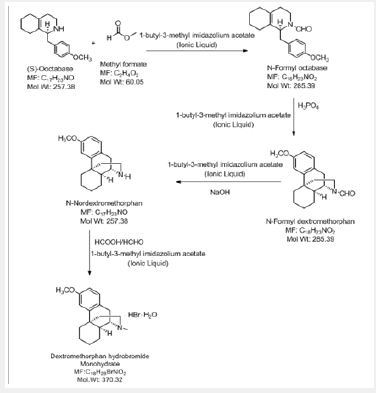
All the above-mentioned processes involve the use of solvents.
So, in the existent investigation, an endeavor is explored to develop
an alternate process wherein use of solvents can be avoided in the
synthesis of Dextromethorphan (Scheme 5).
Scheme 5: Explains a greener preparation of Dextromethorphan
using an Ionic Liquid.
Preparation of Dextromethorphan Hydrobromide using
1-butyl-3-methyl imidazolium acetate (Ionic liquid) as a
solvent
I-step:
a) Stage-IA: In a flask, charge 1-butyl-3-methyl imidazolium
acetate under nitrogen atmosphere. Charge (S)-Octa base under
nitrogen atmosphere. Cool if required under nitrogen atmosphere.
Charge Sodium methoxide solution in methanol under nitrogen
atmosphere. Charge Methyl formate. Raise the temperature of the
reaction mass to little reflux by using hot water not more than
55oC. Stir and maintain the reaction mass till reaction complies (2
hours). Concentrate the reaction mass u/v (Capacity of vacuum
pump should be > 700 mm/Hg) till almost no solvent distills. To
the concentrated reaction mass, charge toluene under nitrogen
atmosphere and water extraction is done. The extracted toluene
layer was concentrated to give N-Formyl octa base and is used as
such.
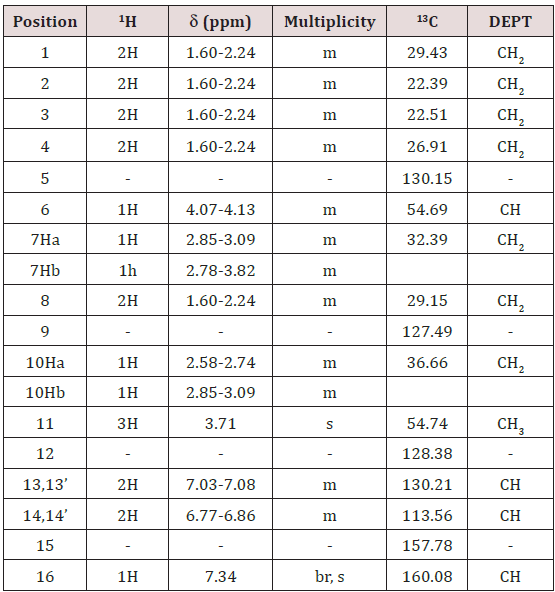
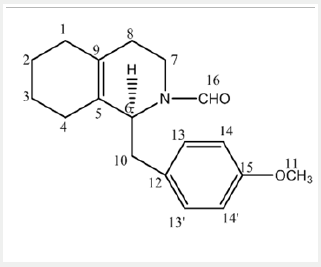
m/z (M+H+) - 286
NMR chemical shift values tabulated below (Table 1) and
(Picture 2).
Table 1: s- singlet, m-multiplet, br-broad.
Picture 2:
b) Stage-IB: In another flask, charge Ortho phosphoric acid
(~ 85.0 % w/w). Charge Toluene and Raise the temperature of the
reaction mass. Reflux and maintain over Dean stark apparatus to
remove water azeotropically. Cool the reaction mass under nitrogen
atmosphere and Charge Phosphorus pentoxide under nitrogen
atmosphere. Reaction is highly exothermic. Charge 1-butyl-3-methyl
imidazolium acetate. Slowly add N-formyl octa base and Raise the
temperature of the reaction mass under nitrogen atmosphere.
Stir and maintain the reaction mass at 65-70oC under nitrogen
atmosphere till reaction complies. Concentrate the reaction mass
under vacuum to remove toluene. To the concentrated mass, charge
ethyl acetate under nitrogen atmosphere and stir. In another flask,
charge water, Cool. Charge ethyl acetate reaction mixture reaction
mass in to chilled water. Stir, settle and separate the layers. Repeat
for back extraction. Wash the organic layer with water again
and then a wash of 7% sodium bicarbonate solution is given.
Concentrate the organic layer u/v till almost no solvent distills.
Degas the concentrate u/v to remove traces of solvents.
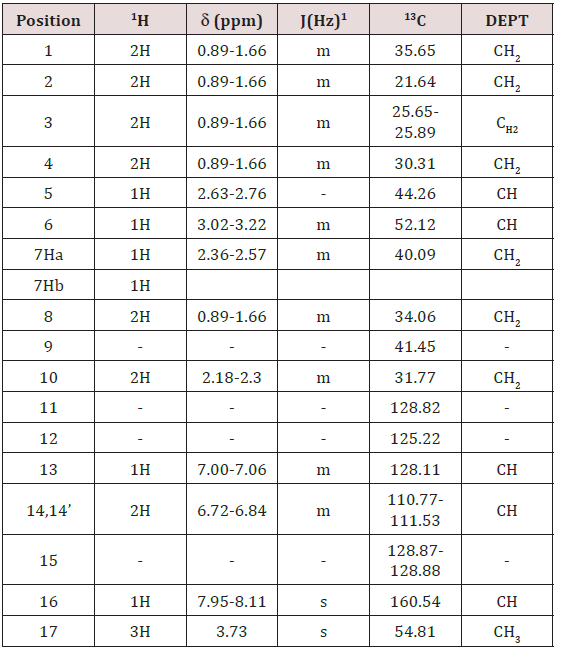
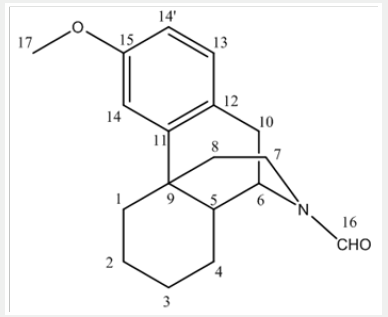
m/z (M+H+) - 286
NMR chemical shift values tabulated below (Table 2) and
(Picture 3)
Table 2: s- singlet, m-multiplet, br-broad.
Picture 3:
c) Stage-IC: To the concentrate mass, charge 1-butyl-
3-methyl imidazolium acetate and methanol under nitrogen
atmosphere. Stir and slowly add sodium hydroxide solution Pre-
Cooled ~15oC (Prepare by using 109 g Sodium hydroxide dissolved
in 200ml Water). Raise the temperature of the reaction mass and
Stir and maintain the reaction mass till reaction complies (~15
hours). Concentrate the reaction mass u/v. To the concentrate
mass, charge toluene under nitrogen atmosphere and water
workup is done. The extracted toluene layer was concentrated to
give N-Nordextromethorphan (Stage-IC).
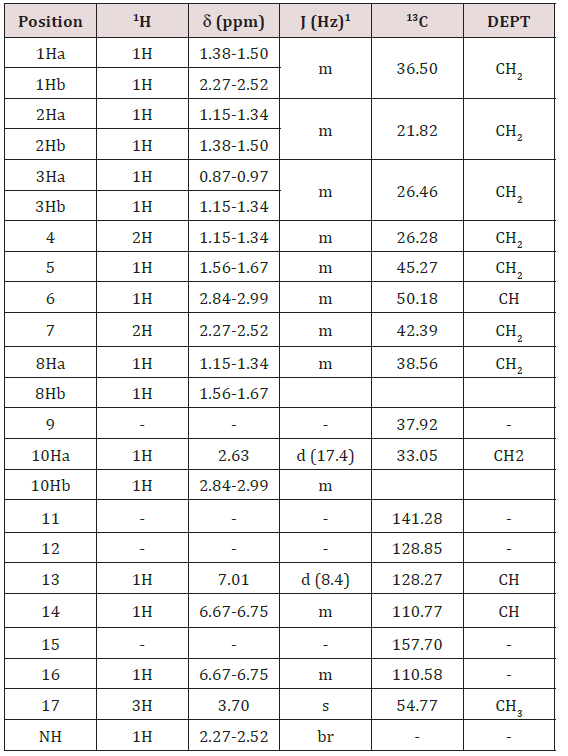
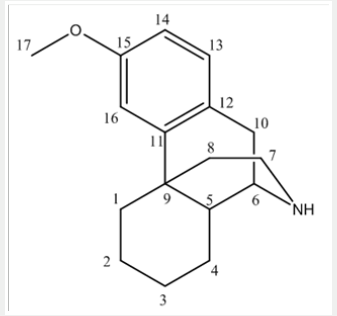
m/z (M+H+) - 258
NMR chemical shift values tabulated below (Table 3) and
(Picture 4):
Table 3: s- Singlet, m-multiplet, br-broad.
Picture 4:
d) Stage-ID: To the mixture of1-butyl-3-methyl imidazolium
acetate and N-Nordextromethorphan (Stage-IC), slowly add Formic
acid solution (Prepare by using 32.1g Formic acid diluted with 5.7ml
water). Charge Formaldehyde solution. Raise the temperature of the
reaction mass and Stir and maintain the reaction mass till reaction
complies (~2 hours). After the reaction is complete, Charge water
and cool the reaction mass if required and then slowly add sodium
hydroxide solution Pre-cool (< 15 oC) (Prepared by using 28.0g
Sodium hydroxide dissolved in 140ml water), extracted the product
into toluene, again charge water, cool, and slowly add Hydrobromic
acid. Raise the temperature of the reaction mass to 70-80 oC and
Stir and maintain to get clear solution. The organic and aqueous
layers separated. Cool the Aqueous layer under stirring to get
precipitate and further cooled to 3-6 oC and wash with pre-chilled
water. Dry the solid under vacuum, to get Dextromethorphan hydro
bromide.
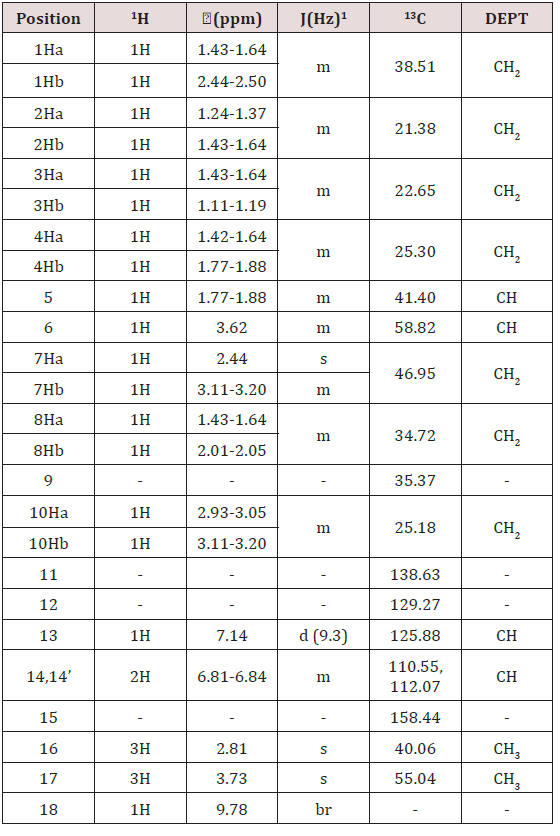
m/z (M+H+) - 272
NMR chemical shift values tabulated below (Table 4) and
(Picture 5):
Table 4: s- Singlet, d- doublet, m-multiplet, br-broad.
Picture 5:
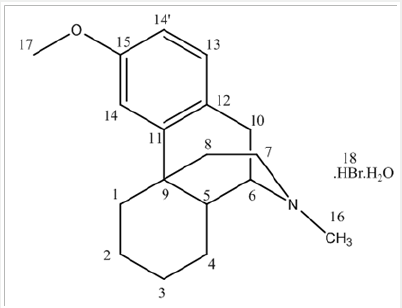
a) 1H-1H coupling constants.
Discussion
As of today, chemical manufacturing process of APIs in
pharmaceutical industry is handicapped without the use of
chemical solvents. However, it is a scientifically known fact that
solvents are dangerously damaging chemical entities, mainly of the
following reasons:
a) Volatile nature of solvents.
b) Storage and handling risks.
c) Usage requirements in large scale.
Apart from their handling risks to human beings, they also
cause significant saturation in chemical pollution levels in the
environment; there has been constant research going-on in
academic field as well as industries to find their suitable alternative
[6].
Ionic liquids are one such alternative that has been found useful
to substitute the commonly used bench solvents. Other than their
obvious “solvent” property that have been discussed in various
publications [7-10], they have also been found to catalyze certain
type of reactions in which they participate [11-13]. Moreover, their
complete recovery from the reaction is an easy job when juxtaposed
with their volatile solvent counterparts. For this reason, an ionic
liquid can be re-cycled for multiple batches of reactions.
Another unique property of ionic liquids is that they can be
“tailor-made” to suit specific reaction types by playing around with
the cation and anion part of them. They are called as “task-specific
ionic liquids”. These tailored [14] and specially synthesized ionic
liquids have more scope of their application in a chemical reaction
than just acting as a green solvent.
Conclusion
A simple, efficient, eco-friendly synthetic route is developed
involving the single-step synthesis of Dextromethorphan
Hydrobromide that is high on convenience and also a cost-effective
procedure. This process is best suitable for the preparation of
Dextromethorphan Hydrobromide and is scalable in plant. This
synthetic route using an ionic liquid adapts a cleaner chemistry
that assures both risk-free handling and reduced environmental
pollution, when scaled-up.
Acknowledgement
Our group would like to thank the Department of Scientific and
Industrial Research India, Dr. Hari Babu (COO Mylan), Sanjeev Sethi
(Chief Scientific Officer Mylan Inc ); Dr Abhijit Deshmukh (Head of
Global OSD Scientific Affairs); Dr Yasir Rawjee {Head-Global API
(Active Pharmaceutical Ingredients)}, Dr Sureshbabu Jayachandra
(Head of Chemical Research) Mr Manoj Pananchukunnath (Head
of Global Injectables Scientific Affairs, Product Development) Dr.
Suryanarayana Mulukutla (Head Analytical Dept MLL API R & D) as
well as analytical development team of Mylan Laboratories Limited
for their encouragement and support. We would also like to thank
Dr Narahari Ambati (AGC- India IP) & his Intellectual property team
for their support.
Read More About Lupine Publishers Journal of Chemical Sciences Please Click on Below Link:
https://lupinepublishers-chemicalsciences.blogspot.com/