Showing posts with label Journal of Cancer Diseases. Show all posts

Friday, 23 September 2022

Lupine Publishers | Carbon Nanotubes: Exploring Intrinsic Medicinal Activities and Biomedical Applications

 Lupine Publishers | Journal of Oncology


Introduction

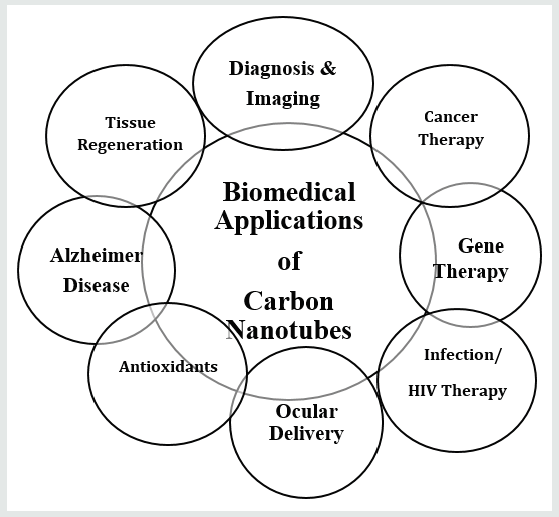
Carbon Nano materials the king of nonmaterial’s have fascinating nanofamily including buckyballs or buckminsterfullerenes [1], multiwalled carbon nanotubes [2], the single-walled carbon naotubes(SWCNTs) [3], Carbon Nanohorns(CNHs), Carbon nanocones, Carbon nanofibers (CNFs), carbon nanothread, Buckypaper, carbon dots, nanodimons, nanoonions, nanorods, nanoribbons. Also called as powerful particles, CNTs (carbon nanotubes) has thus bloomed over the past decade [4,5]. Increasing evidence has shown that certain CNT properties such as nano-sized dimension, high surface energy, and large reactive surface area are directly correlated to their biological activities [6,7]. Great property of loading various biomolecules, diagnostic and therapeutic moieties resulting in diversified biomedical applications of CNTs (Figure 1).

Figure 1: Intrinsic Biomedical Applications of Carbon Nanotubes (CNT).

Lupinepublishers-openaccess-cancer-Oncology

I. Diagonsis and Imaging: CNT act as biosensor or Nanorobots, which helps in diagnosis of disease, their progression level and their pathological condition in quick and better way. CNT biosensor are made up by conjugating different biochemicals with CNTs, like in glucuometer biosensor, glucose peroxidase is conjugated with CNTs that is use for the detection of blood sugar level in diabetic patients. Another example is SWCNTs-DNA biosensor that is use of detection of antigen –antibody comlex, which further helps in molecular diagnosis in pathology [7,8]. Complex of fluorescent agents and CNTs act as radio-opique agent that is use for the detection of cell and biological system in In-vivo organs [9].

II. Cancer Therapy: Carbon nantubes are effective against Pancreatic Cancer, Brain Cancer, Blood Cancer, Breast Cancer, Colon Cancer, Liver Cancer, Lymph Node, Metastasis, Prostate Cancer by using different anticancer drugs like Paclitaxel, Daunorubicin, Amphotericin B, Carboplatin, siRNA, Doxorubicin, Metal halides, Methotrexate etc. Apart from drug delivery route there are another two methods for cancer therapy using CNTs are immunotherapy and anti-tumor hyperthermia therapy [10].

III. Gene Therapy: CNTs and CNHs are used as vector in genetic engineering due to their cylindrical nature, which wrap the desired DNA and deliver it to target site to cure the genetic disorders by correcting misread or missense gene sequence [7].

IV. Infection/HIV Therapy: CNTs itself have antimicrobial activity by oxidising intracellular glutathione and resulted increase the oxidative stress on microbial cell that cause natural death of pathogen. CNTs also used in number of vaccinations to active immune response by triggering MHC-II, which further promote natural antibody production to stop the infection [11]. HIV( human immunodeficiency virus) that attack the immune response and decline the natural immunity, till date we cannot stop it completely but we can suppress or stop virus multiplication and control the disease .In this case conjugation of CNTs with siRNA that further deliver to T-Cell to stop virus proliferation [12].

V. Ocular Delivery: In case of ocular delivery there are number of challenges to deliver the drug to get adequate response with minimizing risk of infection. So therefore, SWCNTs-NH₃+ used as carrier to deliver antigen synthetic vaccination, safely and effectively by avoiding risk of necrosis and tissue degeneration [13].

VI. As Antioxidant: CNTs and CNHs are natural anti-oxidants. They are used in preserving drug molecules in formulation by inhibiting their oxidation. Furthermore, due to this property they are also used in anti-aging cosmetics products that oxidized the skin and stay it healthy and young [7].

VII. Neurodegenerative (ND)/Alzheimer Disease: Graphene sheets, and by extension CNTs, are excellent conductors of electricity, and thus are highly useful in the regeneration of neurons. Neurons can grow successfully on CNT beds, and modifying the surface with 4-hydroxyonoenal, known to be involved with neuron growth, can improve the neuron length and degree of branching over CNTs [11]. CNTs have many small additional sites that provide high surface area for external modification that’s why it is use as carrier to deliver the acetylcholine through blood brain barrier (BBB) and to treat Alzheimer Disease [14-16].

VIII. Tissue/Bone Regenreation: CNTs for the purpose of bone regeneration are being developed, which use negatively charged functional groups with calcium bonded to them. This can provide a scaffold to which hydroxyapatite, the most common inorganic component of bone, can attach. CNTs are very strong, stiff, and flexible which makes them an excellent alternative to the titanium or ceramic bone scaffolds [17,18].

IX. Carbon based nonmaterial by virtue of its therapeutic and diagnostic dual functions have emerged as theranostic nanomedicine. Carbon nanotubes intrinsic medicinal activities along with drug candidates may enhance the effectiveness of drug delivery. Unprecedented growth of patents and publication in last decade has forecasted the future of carbon based drug materials. A precise control for synthesis, purification and tools to increase solubility and further bio-functionality may lead to the development of carbon naotube based formulations. There is a need of clinical investigations for exploring the intrinsic medicinal activities of carbon nanotubes.

Read More About Lupine Publishers Journal of Oncology Please Click on Below Link:
https://lupine-publishers-cancer-journal.blogspot.com/

Saturday, 20 August 2022

Lupine Publishers | Calcium Supplementation: A Review of Oral Calcium Intake on Human Health

 Lupine Publishers | Journal of Oncology


Abstract

Adequate calcium intake is essential for the maintenance of bone health and the preservation of bone mineral density. The lay person believes that calcium is always good for health. Successful marketing and various clinical practice guidelines have made prescribing calcium supplements a billion dollar market in recent years. The aim of this study was to scan the literature and find out whether calcium supplements should be prescribed to all patients with fractures so as to improve their bone healing or should it be restricted to elderly post- menopausal females who have osteoporotic bones. The inference drawn was that dietary calcium is easier to absorb and may have beneficial effects as compared to calcium supplements and it should be limited to the total daily intake to 1000–1200 mg optimally from dietary sources. Calcium supplementation does not significantly reduce fracture risk in postmenopausal women but it reduces the risk of osteoporosis. It increases the risk of urolithiasis. A favourable role of calcium has been seen in postmenopausal women, elderly population, children and adolescents. Calcium is a double-edged sword, which may be both potentially crucial and perilous and hence should be prescribed with caution.

Keywords: calcium; Osteoporosis; Dementia; Kidney stones; Constipation

Introduction

A frequently asked question by a healthy, young lady presenting with a limb fracture being managed conservatively with immobilisation in a plaster is “Should I take Calcium supplementation so that my fracture heals well?.” Adequate calcium intake is essential for the maintenance of bone health during growing phases [1] and the preservation of bone mineral density in elderly individuals [2]. Calcium supplementation is a widespread practice in different age-groups and has been promoted widely to improve bone density [3]. The lay person believes that calcium is always good for health due to successful marketing and various clinical practice guidelines and prescribing calcium supplements has become a billion dollar market in recent years and has been taken by millions of both men and women, children, adults, and the elderly wishing to improve their skeletal health.

Aim

The aim of this review article was to find out whether calcium supplements should be prescribed to all patients with fractures so as to improve their bone healing or should it be restricted to elderly post- menopausal females who have osteoporotic bones.

Discussion

A. Introduction: Osteoporosis is one of the leading causes of disability in the elderly. Because calcium deficiency contributes to osteoporosis, daily dietary calcium intake of 1,000–1,200 mg is recommended [4]. Such a large calcium intake through diet alone can be difficult; therefore, calcium supplements are widely used [4]. Epidemiological studies have demonstrated that a significant number of population throughout the globe fail to achieve the recommended daily calcium intake [5]. In addition to its pivotal role in bone metabolism, the potential role of calcium in non-skeletal tissues has also been investigated, particularly in elderly people [6].

B. Role of Calcium: Calcium is an important and integrative component of human body with 99% of the body’s calcium being contained within the skeleton [7]. Calcium homeostasis plays a major role in maintaining human life activities, such as maintenance of the skeleton, regulation of hormonal secretion, transmission of nerve impulses, and vascular activities [8]. The homeostasis of calcium is mainly maintained by both parathyroid hormone (PTH) and calcitonin [9].

Benefits of Calcium Supplementation

A. Osteoporosis: Osteoporosis is a skeletal disorder associated with aging and characterized by compromised bone strength due to reduced bone mass and reduced bone quality leading to increased bone fragility thereby predisposing a person to increased risk of fracture, notably at the vertebrae, hip, and forearm. It is suggested that Vitamin D and calcium supplementation, either in the form of calcium supplements or dietary calcium, plays a positive role in prevention od osteoporosis in people of different ages and genders. Calcium supplementation plays a protective role for bone health, improving bone mass density (BMD) and decreasing morbidity of osteoporosis and osteoporotic fractures in different genders and age-groups [10].

B. Postmenopausal women: Bone remodelling is accelerated in the peri-menopausal and postmenopausal periods and is characterized by a decrease in estrogen production and an increase in resorption of calcium from bone resulting in a marked decrease in bone density. Calcium supplementation may be recommended in postmenopausal women with a history of osteoporotic fractures, a diagnosis of osteoporosis, vitamin D deficiency, or a high risk for osteoporosis (eg, primary ovarian insufficiency) [11] but are not of any proven benefit in primary prevention of fractures in community dwelling asymptomatic premenopausal women [12].

C. Pregnant and lactating women: Calcium supplementation in pregnant or lactating women for the skeletal health of foetus and mother is of doubtful benefit. In a study in pregnant women in Gambia, West Africa, with low calcium intakes, calcium supplement resulted in significantly lower bone mineral content, bone area, and BMD at the hip throughout 12-month lactation. The women also had greater decreases in bone mineral during lactation at the lumbar spine and distal radius and had biochemical changes consistent with greater bone mineral mobilization [13]. In pregnant and lactating women with low calcium intakes, calcium supplementation is recommended [14].

D. Children: For growing children, bone modeling (i.e., formation over resorption) is the predominant skeletal process which requires mineralization; hence, calcium requirements are increased, particularly during neonatal and pubertal growth spurts. For healthy children, there has been no recommendation for routine calcium supplementation, however children with a high risk of osteoporosis (eg, celiac disease, inflammatory bowel disease, or congenital bone disorder) or low calcium intake may benefit from calcium supplementation. In a study conducted in rural Gambian children accustomed to a low-calcium diet, calcium supplementation resulted in higher bone mineral content and BMD [15].

E. Cardiovascular System: A study conducted among an elderly Chinese population indicated that dietary calcium intake could reduce the risk of death from all causes and cardiovascular diseases [16]. Another study conducted among postmenopausal women revealed that high intake of dietary and supplemental calcium were associated with a decrease in the mortality of ischemic heart disease [17].

F. Gastrointestinal tract: A randomized, double-blind trial performed on people with a history of colorectal adenomas, receiving either 1,200 mg/d elemental calcium or placebo has revealed a significant reduction in the risk of recurrent colorectal adenomas with calcium supplementation6. Calcium carbonate is more often associated with gastrointestinal side effects, including constipation, flatulence, and bloating [18]. The explanation behind those findings is the ability of calcium to combine with bile acids in the intestines, reducing the rectal epithelial proliferation rate [19].

Adverse effects of Calcium Supplementation

A. Cardiovascular System: It is estimated by a metaanalysis (including eleven randomized controlled trials) that calcium supplements have up to 30% increase risk for myocardial infarction [20]. The explanation behind these findings is that calcium supplements potentially contribute to elevated serum calcium levels and possibly accelerated cardiovascular calcification [21].

B. Gastrointestinal Diseases: Calcium supplements may increase the incidence of constipation, severe diarrhoea, and abdominal pain [22].

C. Renal Stones: A major concern regarding the safety of calcium has been the occurrence of kidney stones. An abnormality of urinary super-saturation is one of the main factors for the formation of kidney stones23. Individuals who consumed any amount of supplemental calcium had an increased risk for kidney stones compared with individuals who did not consume supplemental calcium [24].

D. Age Related Macular Degeneration: A recent crosssectional study found that >800 mg/d of calcium consumption in people aged >67 years may increase the risk of age related macular degeneration compared with those who do not take calcium [25].

E. Dementia and Alzheimer’s Disease: Some trials have reported an association between calcium supplementation and increased risk for vascular events [26]. Vascular risk factors are related to vascular dementia and Alzheimer disease [27]. Calcium supplementation might have direct toxic effects on vulnerable neurons, because the increased calcium levels may amplify ischemic cell death and worsen the outcome after cerebrovascular events [19]. calcium influx and intracellular calcium overload have a crucial role in apoptosis and necrosis [28]. The mechanism of calcium supplements in the pathogenesis of dementia could be the steep increase in serum calcium levels caused by the supplements [20]. Calcium plays a central role in the mechanisms of cell death. In necrosis, the transmembrane influx of calcium ions activates proteases that are responsible for degrading critical proteins and disrupting membrane function [29].

F. Dietary Calcium: Dairy products in the form of milk, yogurt, and cheese are rich sources of calcium. About 72 percent of calcium comes from milk, cheese and yogurt and from foods to which dairy products have been added as in pizza, lasagna, dairy desserts. The remaining calcium comes from vegetables (7 percent); grains (5 percent); legumes (4 percent); fruit (3 percent); meat, poultry, and fish (3 percent); eggs (2 percent); and miscellaneous foods (3 percent) [30].

G. Difference between Dietary Calcium and Supplementary Calcium: The difference between dietary calcium and calcium intake by supplements could be explained by variations in corresponding changes in serum calcium concentration. Dietary intake does not increase the serum calcium levels to the same extent as supplements20. In addition, dietary calcium intake involves simultaneous intake of all other components of calciumcontaining foods and much lower dosages of calcium than calcium supplements.

Conclusion

Dietary calcium is easier to absorb and may have beneficial effects as compared to calcium supplements. Calcium from food sources has not been linked to morbidity, so limiting dietary consumption would not be advised. The recommendation should be to limit the total daily intake to 1000–1200 mg, optimally from dietary sources. Different dosages of calcium may induce different results. A favourable role of calcium has been seen in postmenopausal women, elderly population, children and adolescents. Calcium prevents osteoporosis but at the same time, increases the occurrence of cardiovascular diseases and risk of urolithiasis. Calcium supplementation does not significantly reduce fracture risk in postmenopausal women but it reduces the risk of osteoporosis. Calcium is a double-edged sword, which may be both potentially crucial and perilous and hence should be prescribed with caution. The issue of safety in people receiving calcium has long been a matter of debate. There is an abundance of data for beneficial effects and side effects in the literature on the role of calcium. All taken together, it is important to balance the advantages and disadvantages of calcium supplementation on human health [31].

Read More About Lupine Publishers Journal of Oncology Please Click on below Link:
https://lupine-publishers-cancer-journal.blogspot.com/

Tuesday, 31 May 2022

Lupine Publishers | What is beyond the Nivolumab Monotherapy approval for advanced Hepatocellular Carcinoma?

 Lupine Publishers | Journal of Oncology and Medicine


Keywords: Hepatocellular carcinoma; Immune checkpoint inhibitors; Nivolumab; FDA

Editorial

With an estimated 500,000 new cases per year, hepatocellular carcinoma (HCC) represents the third leading cause of cancer death worldwide. The incidence is rising in the west, largely due to an increasing incidence of hepatitis C virus infection [1]. The majority of HCC patients are diagnosed with disease too advanced for curative treatment. Only liver resection and liver transplantation are considered curative, with poor efficiency of other modalities such as radiofrequency ablation (RFA) and transarterial chemoembolization (TACE), although this may provide a modest prolongation in survival; however, the relapse in the majority of these patients is inevitable [2]. An array of translational research and pilot clinical trials have revealed that adoptive immunotherapy's are safe by patients with HCC, but they lack efficacy [3]. Now, we are in the new era of immunotherapy's such as immune checkpoint inhibitors and CAR-T strategies, which would bring benefit to the HCC patients.

On September 22, 2017, the Food and Drug Administration granted accelerated approval to nivolumab (OPDIVO, Bristol- Myers Squibb Co.) for the treatment of HCC in patients who have been previously treated with sorafenib. The approval was based on a 154-patient subgroup of CHECKMATE-040 (NCT 01658878), a multicenter, open-label trial conducted in patients with HCC and Child-Pugh. A cirrhosis who progressed on or were intolerant to sorafenib. Patients received nivolumab 3 mg/kg by intravenous infusion every two weeks. The confirmed overall response rate, as assessed by blinded independent central review using RECIST 1.1, was 14.3% (95% CI: 9.2, 20.8), with three complete responses and 19 partial responses. The response duration ranged from 3.2 to 38.2+ months; 91% of responders had responses lasting six months or longer and 55% had responses lasting 12 months or longer. Adverse reactions occurring in patients with HCC in CHECKMATE-040 were similar to those previously reported in product labelling, with the exception of a higher incidence of elevations in transaminases and bilirubin levels [4].

There are other immune checkpoint inhibitors that are being tested as monotherapy for efficacy and safety in HCC. Nivolumab was the first approved, but others will follow, as it has occurred in other malignancies. There is a bunch of possibilities for the treatment strategy using immune checkpoint inhibitors. Future directions point to various stages of HCC treatment, such as neo adjuvants and adjuvants after resection and ablation, combination therapy with transcatheter arterial chemoembolization, first-and second-line treatments, and all sorts of combinations with other immunotherapies, targeted molecules and novel therapies.

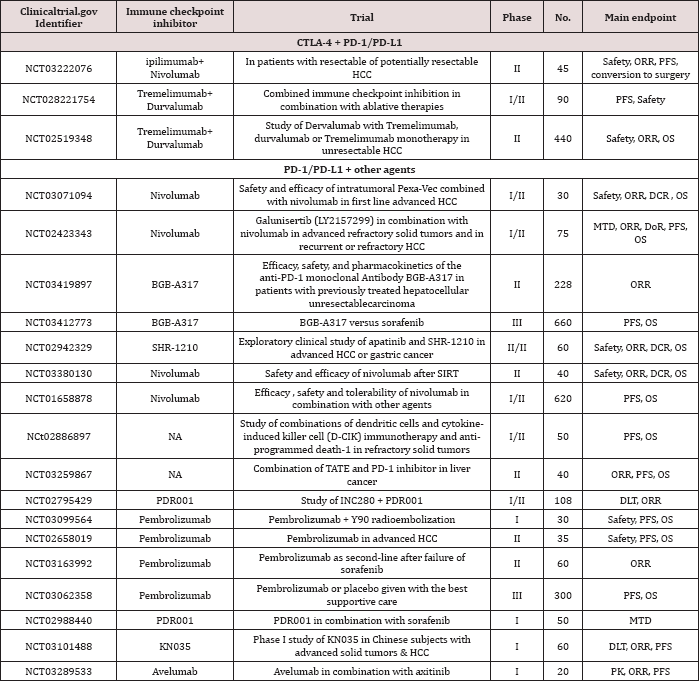
In the table annexed to this editorial you will find a list of ongoing clinical trials combining the immune checkpoint inhibitors with other therapies. At the top of the Table 1 are listed the trials with simultaneous blockage with anti-PD-1/PD-L1 and anti- CTLA-4 antibodies, which are expected to be promising regimens in HCC immunotherapy. The high efficacy of the combination therapy was demonstrated in malignant melanoma [5]. Simultaneous inhibition of the B7-CTLA-4 pathway by an anti-CTLA-4 antibody may increase the number of activated CD8+ T cells in lymph nodes, followed by an increase in the number of activated CD8+ T cells infiltrating the tumour tissues, thereby enhancing the antitumor effects. Their combination with molecular targeted agents (e.g., sorafenib or axitinb) also appears promising.

Table 1: Summary of ongoing trials with immune checkpoint inhibitors in HCC.

Lupinepublishers-openaccess-cancer-Oncology


In particular, the approach combining an immune checkpoint inhibitor with an existing loco regional therapy for HCC is currently under evaluation. TACE or RFA is expected to enhance the effects of immunotherapy by inducing local inflammation, releasing gneoantigens that activate antigen presentation and immune system activation. The results of the combination therapy with anti- CTLA-4 antibody and loco regional therapy in advanced HCC have recently been published [6]. The NCT01853618 study evaluated the efficacy of adjuvant therapy with tremelimumab (anti-CTLA-4 antibody) after RFA or TACE in several, but not all, HCC nodules, with favourable outcomes, including a partial response rate of 26%, time to tumor progression of 7.4 months, and overall survival of 12.3 months.

The results of trials of the immune checkpoint inhibitor- combined strategies are awaited with high expectations by the medical community.

Read More About Lupine Publishers Journal of Oncology Please Click on Below Link:
https://lupine-publishers-cancer-journal.blogspot.com/

Thursday, 28 April 2022

Lupine Publishers | Cancer and Advantages of Immunosuppression

 Lupine Publishers | Journal of Oncology


Abbrevations: NK: Natural Killer; GVHD: Graft-vs-Host Disease; CRS: Cytokine Release Syndrome

Editorial

As oncologists learn to target the immune response to “self and non-self,” a delicate therapy balance will eventually be achieved with predictable outcomes, benefits, and toxicity in the fightThe study of how the immune system recognizes friend and foe, or as the immunologist Sir Macfarlane Burnet phrased it, “distinguishes between self and non-self,” has driven important discoveries that are transforming our ability to treat cancer.

Over the last few clinicians have unraveled the interactions (both innate and adaptive immunity) that lead to the eradication of viruses, bacteria, parasites, and now, cancer. Notable cellular players include T cells, B cells, natural killer (NK) cells, neutrophils, eosinophils, basophils, dendritic cells, and macrophages, along with a host of secreted mediators - antibodies, complement, cytokines, and chemokines - each of which fulfills particular immunologic functions. Processes, autoimmune disease can be a consequence. These diseases also occur if shared. When the immune system fails to regulate these antigens are recognized by the immune system in cells; one example is Lambert-Eaton syndrome. Monoclonal antibodies that target tumour reactive T cells (eg, nivolumab and pembrolizumab) can also cause autoimmune disease; other examples include graft-vs-host disease (GVHD) in allogeneic bone marrow transplant recipients and cytokine release syndrome (CRS), which is associated with adoptive T cell therap.

ute Myeloid Leukemia (AML). Blood 128: 763.