Showing posts with label Robotics Journal pdf. Show all posts

Friday, 12 July 2019

Lupine Publishers - Advances in Robotics & Mechanical Engineering


Abstract


This investigation approaches the artificial neural networks applied to the ore drying process in carbonate-ammonia leaching. To carry out this research, the main variables that characterize the process were identified. Besides, it was collected the data that comprise a whole month of facility´s operation. Furthermore, it was developed a regression analysis backwards, step by step, which allowed to determine that the linear correlation coefficient did not reach values higher than 0,62. In addition, it was pinpointed a two layered feed - forward back propagation neural network to model the temperature. Thins one reached the correlation coefficient values of 0,97 during its training and 0,95 in validation, as well as 0,87 in its generalization.
Keywords: Artificial Neuronal Network; Regression; Feed-Forward Backpropagation; Mineral Drying

Introduction


In a global context, nowadays, modern control systems play a fundamental role when developing solutions to issues or problems presented in domestic and industrial applications. The main contributions of modern control systems at industrial level contribute to technological innovation, profitability and maintainability of the controlled processes. Within the advanced control strategies under investigation to automate complex processes are: adaptive control, predictive control based on models, robust control, and intelligent control, among others. Intelligent control relies on several techniques such as: fuzzy logic, evolutionary algorithms, and artificial neural networks. Artificial neural networks can be used effectively and accurately for modeling systems with complex dynamics, especially for nonlinear processes that vary over time. The growing interest in neural networks is due to its great versatility and the continuous advance in network training algorithms and hardware [1-4]. The nickel producing companies have continuous processes of great complexity that require automation to achieve a greater efficiency in their productions. In the process of ore preparation, it is important to maintain a temperature control at the outlet of the dryer evacuation chamber, in order to obtain the mineral drying with an established humidity level of 4 to 5,5 %. It must also be ensured that the temperature at the outlet of the electrofilters is above the dew point temperature; to prevent the deterioration of electrofilters, which leads to high economic losses, from accelerating considerably. The inefficiencies in the control of the outlet temperature of the dryer evacuation chamber in the ore preparation process are taken as a research problem and as an objective to obtain an artificial neural model for the outlet temperature on the basis of the main input variables, using Matlab as a calculation tool.

Materials and Methods


Description of the Mineral Drying Process

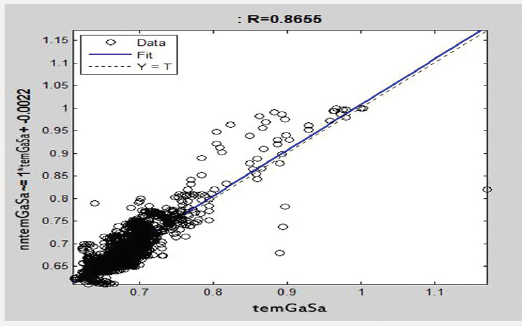
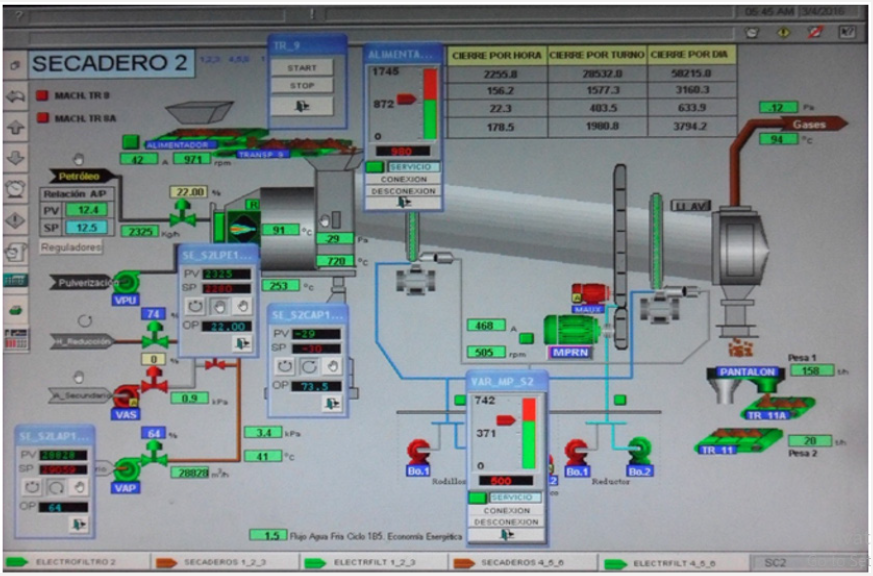
The drying of the ore is carried out in elongated cylinders formed by a combustion chamber where the hot gases that dry the ore are produced, and by the cylinder where the ore will receive the drying process. These drums (Figure 1) have in their interior lifting elements that are responsible for allowing the transfer of heat between the hot gas and the mineral, in addition the dryer drum has a motor system coupled to the body of this which allows it to rotate on its axis. The dryer drum externally rests on two wheels that has two pairs of roller. Internally the dryer is formed near the combustion chamber by guides or baffles welded to the body of the drum that are the ones that direct the mineral towards the outside of the cylindrical part of the drum [5]. The mineral dryer is a complex physical-mathematical modeling object with a large number of input and output parameters which are in a complex interdependence (Figure 2).
Figure 1: Schematic diagram of the dryer.
Lupinepublishers-openaccess-robotics-mechanical-engineering-journal
Figure 2: Structural diagram of the mineral drying process.
Lupinepublishers-openaccess-robotics-mechanical-engineering-journal
The Input Parameters in the Process are:
a) rpmAl - Feed motor speed [rpm].
b) rpmMp - Speed of the main motor [rpm].
c) corrAl - Feed motor power [A].
d) corrMp - Power of the main motor [A].
e) temGaEn -Temperature in incoming gases [ºC] (coming from the Reduction Furnaces Plant).
f) fluPe - Oil flow at the burner inlet [kg/h].
The Output Parameter is:
a) temGaSa - Oulet gas temperature [ºC].
In addition to the input and output parameters, it is important to highlight a specific disturbance of this process that influences it, which is: minAl - Mineral fed to the dryer. It is known that there are other parameters that are involved in the drying process of the ore and that in turn influence the temperature of the exhaust gases in the evacuation chamber (granulometry in the entrance mineral, humidity of the entrance mineral, exact amount of mineral fed to the dryer), but due to the process itself, they are not registered. Due to the automation existing in the process, the values of the process parameters are sensed by the instrument corresponding to each of them and the signal is sent to the computer located in the process control office. The data obtained along 1 month of operation, were recorded every 240s and processed with the Stat graphics Plus V 5.1 software.

Artificial Neural Networks

The determination of the type of artificial neural network, the number of layers and the number of neurons in each layer that best characterize the process of ore drying process was carried out through a trial and error process that plays with the number of neurons and the maximum permissible error. Through Matlab’s Toolbox (nnstart), the performance of artificial neural models was evaluated by using the mean square error and the correlation coefficient between the real values and those obtained by the network [6]. The objective was to provide the network with an adequate number of neurons in the hidden layer to learn about the characteristics of the possible relationships between the sample data. Through the trial and error process, it was identified the feedforward back propagation structure that provided better results. The proposed network consists of two layers: a hidden layer and an output layer. The output layer will only have one unit, which will indicate the value of the oulet gas temperature associated with each input vector presented to the network. The hidden layer will have a variable number of neurons.

Results and Discussion


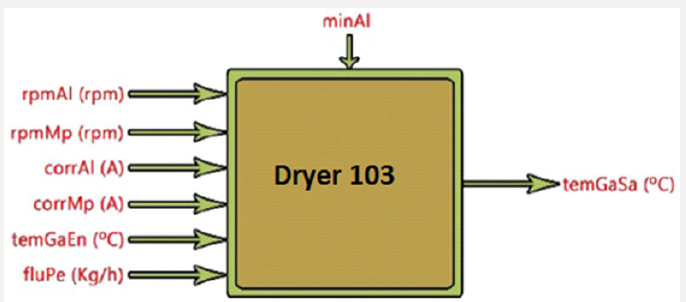
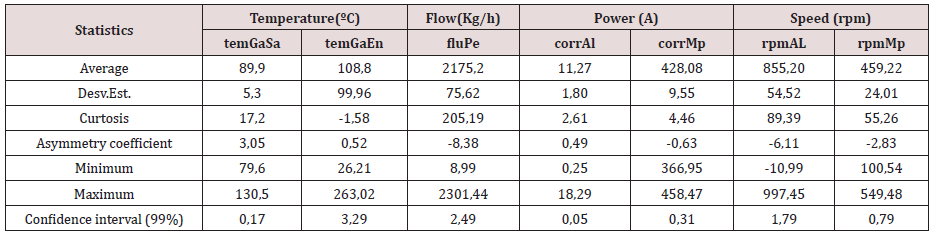
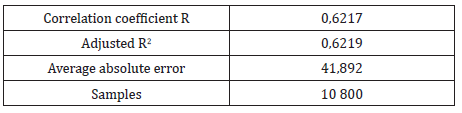
Figure 3 shows the behavior of the exhaust gas temperature in the evacuation chamber, between its minimum and maximum values of 79,59 and 130,51°C, respectively, for the month of work. Once the database was analyzed, the sample functions that evaluate the measures of central tendency and dispersion of the sample were determined through a descriptive statistical analysis (Table 1). The mathematical model that best represents the relationship between the variables analyzed. Table 2 shows the regression analysis for the output pulp density, where a 0,7correlation coefficient is observed.
Figure 3: Control chart for the dependent variable.
Lupinepublishers-openaccess-robotics-mechanical-engineering-journal
Table 1: Summary of the sample´s descriptive statistical analysis for one month.
Lupinepublishers-openaccess-robotics-mechanical-engineering-journal
Table 2: Regression analysis summary.
Lupinepublishers-openaccess-robotics-mechanical-engineering-journal
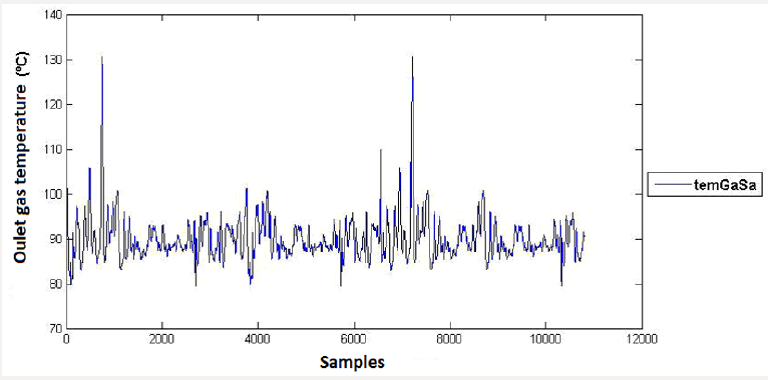
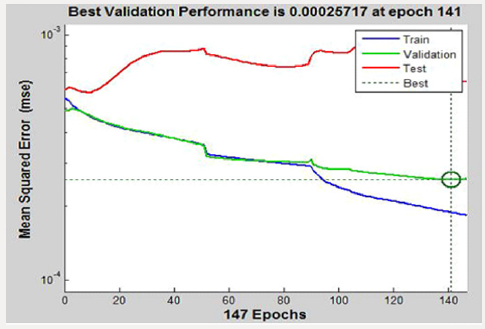
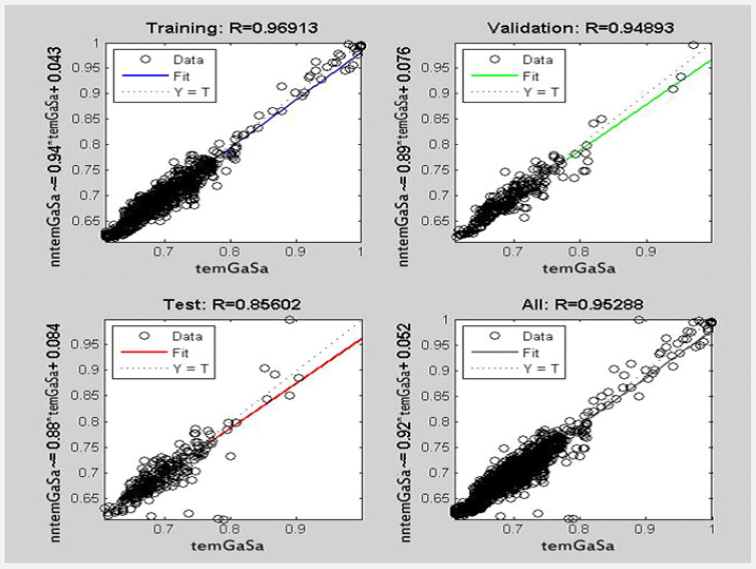
Figure 4 shows the training behavior of the network for the learning process, observing the training, validation and test curves, which converge to the iterations for an error of 0,00026. Figure 5 shows the behavior of the correlation coefficients for the training, validation, testing and adjustment of the artificial neuron network (it is assumed as an artificial neuronal model for the oulet gas temperature in the ore drying process “nntemGaSa” and the real temperature “temGaSa”). Figure 6 shows the generalization of the network with 1767 data not presented during training, where a 0,87correlation coefficient is observed.
Figure 4: Behavior of training and validation of the neural network.
Lupinepublishers-openaccess-robotics-mechanical-engineering-journal
Figure 5: Correlation coefficients of the neural network.
Lupinepublishers-openaccess-robotics-mechanical-engineering-journal
Figure 6: Network Generalization.
Lupinepublishers-openaccess-robotics-mechanical-engineering-journal

Conclusion


The capacity of the feed-forward back propagation network for the simulation of pulp sedimentation processes in the industry was demonstrated. The structure that best characterizes the behavior of the temperature in the exhaust gases of the evacuation chamber is characterized by two layers with 50 neurons in the hidden layer and one in the output layer, with the Levenberg Marquart learning method (trainlm), and the log-sigmoidal (logsig) and sigmoidal hyperbolic tangent (tansig).

For more Lupine Publishers Open Access Journals Please visit our website:

Thursday, 11 July 2019

Lupine Publishers- Advances in Robotics & Mechanical Engineering

Insight Looks to Soft (Continuum) Robotics Advances in Robotics & Mechanical Engineering in Lupine Publishers
Soft Robotics is emerging fresh sub field in Robotics which is very useful in medical, industry, space exploration, deep sea exploration, Nano-robotics and many more likewise applications. The major benefit of Soft Robots as compare to Rigid Robots their excellent flexibility and adaptability to accomplish task. Before to move further I would like to state Soft or Continuum Robots first “Soft Robots are small, medium and big shapes various biological or non-biological body forms robots which are made up using ultra soft and flexible materials, where materials are engineered using Continuum Mechanics and Kinematics. 


For more Lupine Publishers Open Access Journals Please visit our website

Thursday, 27 June 2019

Forces Acting on A Bearing of an Electric Motor for The Railway Carriage Rounding A Curve (ARME)-Lupine Publishers

 
Forces Acting on A Bearing of an Electric Motor for The Railway Carriage Rounding A Curve by Ryspek Usubamatov in ARME in Lupine Publishers


Recent  investigations  in  gyroscope  effects  have  demonstrated  that  their  origin  has  more  complex  nature  that  represented  in  known publications. On a gyroscope are acting simultaneously and interdependently eight inertial torques around two axes. These torques are generated by the centrifugal, common inertial and Coriolis forces as well as the change in the angular momentum of  the masses of the spinning rotor. The action of these forces manifests the inertial resistance and precession torques on any rotating objects.  New  mathematical  models  for  the  inertial  torques  acting  on  the  spinning  rotor  demonstrate  fundamentally  different  approaches for solving of gyroscope problems in engineering. This is the very important result because the stubborn tendency in engineering  is  expressed  by  the  increasing  of  a  velocity  of  rotating  objects.  The  numerous  designs  of  the  movable  machines  and  mechanisms contain spinning components like turbines, rotors, discs and others lead to the proportional increase of the magnitudes of inertial forces that are forming their processes of work. This work considers the inertial torques acting on the on a rotor of an electric railway carriage rounding a curve, which expresses the gyroscopic effects.

https://lupinepublishers.com/robotics-mechanical-engineering-journal/fulltext/forces-acting-on-a-bearing-of-an-electric-motor-for-the-railway-carriage-rounding-a-curve.ID.000104.php


For more Lupine Publishers Open Access Journals Please visit our website


Thursday, 20 June 2019

How to Become a Manufacturing Cell Fully-Automated Without Robots: Case-Study in the Automotive Components Industry

Productivity  is  a  key  factor  for  companies  manufacturing  parts  and  sets  to  the  automotive  industry.  Automation  plays  an  important  role  in  this  matter,  allowing  development  of  entire  manufacturing  cells  without  the  direct  need  of  workers.  Even  in  countries where the labour cost is relatively low, it becomes necessary to improve the level of automation applied to manufacture
cells  and  reduce  the  dependence  of  the  human  labour  unpredictability,  also  increasing  the  quality  and  reducing  the  costs.  This  case  study  was  developed  based  on  an  industrial  request  in  order  to  improve  a  semi-automatic  cell  devoted  to  seat  suspension  mat manufacturing. The original cell allows several automatic operations but it needs two workers for two specific operations not considered  in  the  initial  design.  Thus,  new  concepts  of  wire  feeding  and  manipulation  were  developed  in  order  to  allow  a  better  material flow throughout the cell. The new cell was designed and built with success, allowing obtain a fully-automated system, which leads to a better productivity and reliability of the manufacturing process.


Tuesday, 12 March 2019

Robotics Engineering - #ARME- #Lupine Publishers


The problem of using Blockchain technology in multi-level robotic systems is considered. The management of the robotic systems faces significant difficulties in transferring large amounts of information, securities, metadata, and intellectual contracts. The blockchain technology, based on a decentralized system of distributed registries, allows solving data transfer problems quickly and safely. New digital blockchain-based queuing systems can be effectively used in multi-level control tasks.
For more Lupine Publishers Open Access Journals Please visit our website
For more automation engineering articles Please Click 

Monday, 11 March 2019

Robotics & Automation Engineering Journal- #ARME-#Lupinepublishers


I was started my research only with one thinking “How we feel and understand sadness or happiness of others, why our eyes sometime filled with tears, when we see others crying or sad, why we cheer up when we see others happy, why we bless others, why we care for others, why we become sad when we watch sad seen in movies, why we motivate when we watch something exciting and meaningful in movies, why, why and why?” these are the big questions front of us. My common answer which support to all these questions is “when situation is common between two or more than two people they completely understand each other, because their brains neurons handling same situation. Some time may be feelings for other because of past common situation of us is the present situation of someone or may be some time we think if that situation on me what I would do. Hence common situation either good or bad doesn’t matter but common situation people show strong feelings about each other with respecting emotions and feelings of each other’s and this is because “common situation setup brain-to-brain link between people through which they understand feelings and emotions of each other [1].

For more Lupine Publishers Open Access Journals Please visit our website
For more mechanical engineering journals impact factor  articles Please Click 

Robotics Journal - #ARME - #Lupine Publishers


Identification of the Air Supply System for Combustion, With the Help of Artificial Neural Networks by Deynier Montero Góngora in Advances in Robotics & Mechanical Engineering in Lupine Publishers

The production of nickel in Cuba is one of the main export items in our economy. In recent years, its production costs have risen significantly, with a high incidence of electricity costs, which is why it is necessary to take energy shock measures to reverse this situation. Currently there are deficiencies in the Reduction Furnace plant related to the control of the air supply and the electric power used by the asynchronous motors that drive the centrifugal fans, reducing the efficiency levels of the production process and the plant in general. In order to increase the energy efficiency of the combustion process supply system and reach an optimum control model of the airflow of this plant, variants are designed and simulated based on artificial neural networks that allow to establish the air demand from the drive of the fans by means of variable speed drives.
 

For more Lupine Publishers Open Access Journals Please visit our website
For more Robotics & Mechanical Engineering articles Please Click 
Here: www.lupinepublishers.com/robotics-mechanical-engineering-journal/index.php

Friday, 8 March 2019

Automation Engineering Articles-#ARME-#Lupine Publishers


One of the prominent applications of robots is in assistive therapy using humanoids. Robots are now playing a vital role in our lives as assistants, therapist, companions and much more. Autism Spectrum Disorder (ASD) affects the communication skills and social cues of a person considerably. Recently efforts have been made in the development of communicational, behavioral, motor movements, joint attention and physical behavior of the children suffering from ASD using the humanoid robots. The therapies based on interactive interventions using robots for ASD have proved to be a favorable tool for improving the behavior of children with ASD. There are different ways to identify and improve the behavior in ASD child e.g. psychologists’ sessions, computer vision based bio markers like joint attention measurement and gait analysis, and robot assisted therapies using Autism Observation Scale for Infants (AOSI). In particular the area of robotics is helping a lot in the treatment of ASD as the robot acts as a mediator as well as measures the response of an autistic child.

For more Lupine Publishers Open Access Journals Please visit our website
For more robotics journals impact factor  articles Please Click