Advances in research and evidence-based practice improve the
prevention and treatment of diseases, but the marginalized seems
to be left behind [1]. The purpose of this paper is to conceptualize
a telehealth intervention aimed to improve the health and health
span of older adults. More particularly, we articulate the conceptual
framework underlying our intervention, Telehealth Resilience
Mindfulness (TRM) Intervention, which will be delivered via text
messaging (for those who have phones or smartphones), video
conferencing such as Zoom (for those with internet connectivity),
or in-person (when it is practical) to older adults to enhance
HEARTS (health, experiences of abuse and trauma, resilience,
technology use, and social support). Healthcare is a human right
a resource to mitigate disparities in healthspan, defined as the
portion of life spent in good health [2]-enriching opportunities if
there is collaboration in interdisciplinary education, research, and
practice [1,3]. We propose a telehealth intervention as a resource
for older adults in mitigating disparities in healthspan. A telehealth
intervention is defined as the use of information and communication
technologies for health that encompasses positive emotions,
optimism, and cognitive appraisal [4-7]. Telehealth interventions
have the potential to reduce the psychobiological exposure to abuse
and trauma and their health-related consequences as technology
provides a safe, timely, and flexible space for the target population
compared with traditional face-to-face approaches [7]. Additionally,
interventions for the prevention and reduction of abuse among
women [8-11] had positive health and social outcomes. Some
telehealth interventions were included in these reviews and
showed mixed results [7,12]. For these reasons, we are exploring
and conceptualizing opportunities for enhancing the feasibility and
efficacy of the telehealth resilience-mindfulness intervention in
older adults.
.
Our overall objective is to expand causal pathways underlying
successful aging using PROMIS health indicators predictive
modeling to examine how the HEARTS outcomes by environment
interaction in telehealth resilience mindfulness intervention
impact healthspan [13]. The telehealth resilience mindfulness
intervention could improve health outcomes and increase
healthspan delivering it by text messaging, videoconferencing (e.g.,
Zoom), or in-person (when possible). Once conceptualized, we will
test specifically the feasibility and efficacy of the HEARTS telehealth
resilience and mindfulness intervention by linking objective tests
with subjective tests of health variables and the biobehavioral
attributes of resilience in a future study. We will hypothesize that
the intervention promotes better health outcomes, openness
in sharing experience of abuse and trauma, enhance resilience,
and social support. Our long-term goal is to establish a research
infrastructure for interprofessional collaboration that expands the
evidence-based biobehavioral telehealth resilience interventions
and to improve healthspan (the portion of life spent in good health)
by linking biobehavioral attributes of resilience with technology
use, and social support through predictive modeling technique.
The establishment of an infrastructure for interdisciplinary
collaboration globally will expand the biobehavioral evidencebased
telehealth resilience mindfulness intervention increasing
healthspan.
Today’s telehealth nursing care approaches can serve a wide
range of populations and make a significant contribution to the
efficacy and delivery of health care. However, there is a lack of
research data to support the readiness for adopting the use of
telehealth interventions among a wide variety of clinical situations,
with diverse patients, and in a variety of settings. By examining
the feasibility and efficacy of HEARTS Telehealth Resilience
Mindfulness (TRM) Intervention among older adults, we will
explore older adults’ readiness for adopting the use of technologybased
interventions to improve their health and healthspan. For
a future study, we ascend to De Los Reyes’s [14] suggestion that
a theoretical model framework (Range of Possible Changes [RPC]
Model) to conceptualize, examine, and classify the available
evidence for interventions. We will adopt the RPC Model to theorydriven
hypotheses and conduct a mixed-methods design to test
whether the telehealth resilience mindfulness intervention may or
may not change biopsychological constructs for older adults who
have experienced abuse and trauma.
Significance
The older adult population is growing faster than all younger
age groups as their healthspan (a portion of life spent in good
health) is decreasing. Globally, one in six people of 60 years
and older experienced abuse in their homes, community, and
institutional settings every year, and the annual loss by victims of
financial abuse is estimated to be at least $36.5 billion [15]. The
experience of abuse robs older adults of their dignity, security,
healthspan, and in some cases, their lives, leaving a stubborn
imprint as they age [13,15-17]. Elder abuse and history of abuse
include physical, emotional, sexual, economic, and neglect [15,18].
The risks of leaving the experience of abuse and its consequences
unmitigated are devastating to the survivor (personally), family
(interpersonally), and community [19].
Preliminary studies suggest that experiencing abuse exacerbates
the risks for health indicators, resilience, social support, and
technology use a psychosocial impact on the healthspan of older
adults [20,21]. It is imperative to determine the socio-behavioral
mechanisms that account for older adult’s health disparities
related to their experiences of abuse, resilience, technology use,
and social support. Social determinants of health are rooted in a
system of structuring opportunity and assigning value based on
the social interpretation of how young the person is, and it unfairly
disadvantages individuals and communities, sapping the strength
of persons through the waste of human resources [3,22]. We have
accepted that during this pandemic, that distancing, quarantines,
and social isolation, are perfect deterrents for the COVID-19 virus
to spread, however, it is a risky practice in caring for older adults.
The socio-behavioral interventions such as social support [23],
and self-efficacy and behavioral therapies [24] throughout the lifecourse
are known but certain forms of interventions that enhance
biobehavioral attributes of resilience facilitating reappraisal and
promote social support preserving a sense of purpose in the face
of abuse are not well developed [6,25]. There is a critical need to
explore the biobehavioral processes associated with telehealth
resilience and mindfulness intervention using objective tests and
subjective tests [12,25-26].
Conceptual Framework
The Life Course Health Development (LCHD) framework [27,28]
provides the theoretical foundation of our conceptualization of
health and health trajectory of our target population in our research
- the older adults with experience of abuse and trauma. The LCHD
constitutes comprehensive biological, social, and environmental
aspects of health that influence health outcomes later in life [27]. The
conceptual foundation of LCHD came when Elder [29] developed
an integrated ecological systems model examining changing life
trajectories by leveraging contextual effects that accumulate over
time and influence the individual’s trajectory. There are six key
tenets of the LCHD framework, all predicated by health: 1) health is
a set of capacities that develops over time (older adults); 2) health
constantly develops by interactions between biology (health), and
environment (social support, technology use); 3) health involves a
complex, non-linear system over several dimensions, phases, and
levels; 4) health is responsive to the social structuring and timing
of ecological experiences (experience of abuse); 5) health has an
evolving process that uses resilience and plasticity to adapt to
changing ecological contexts; and 6) health is responsive to the
timing and synchronization of the level of ecological pathways
(personal, interpersonal, community, and society), with molecular
to biological to social and cultural functions [28]. We are using
these tenets with a focus on the ecological pathways and integrating
health, experience of abuse, resilience, technology use, and social
support.
Literature Review
The socio-behavioral interventions in abuse throughout the life
course are known but certain forms of interventions that enhance
biobehavioral attributes of resilience facilitating reappraisal and
promote mindfulness preserving a sense of purpose in the face
of abuse are not well developed [6,25,30]. There is a critical need
to explore the changes and biobehavioral processes associated
with telehealth resilience-mindfulness intervention that has
biopsychosocial underpinnings of resilience [6].
The Health of Older Adults
Despite improvements in current approaches to an aging
population, the health of older adults is not keeping up with
increasing longevity [31,32]. Older adults contribute to society in
diverse ways - through their family, community, and society. The
extent of their contributions to society depends on their health.
One major challenge in assessing the health of older adults is the
sheer diversity of health and functional states they experience
that are loosely associated with chronological age [15]. Diversity,
inequity, stereotyping, and other social determinants of health
must be addressed to transform a comprehensive global public
health response to an actively aging world population. The
need to transform misaligned health systems with the older
adults’ needs, clearly and convincingly requires redefinition
and reconceptualization. Adding healthspan and continuous
improvement of health care systems is crucial. Our proposed study
attempts at redefining the health of older adults more broadly and
diversely including physical function, anxiety, depression, fatigue,
sleep disturbance and sleep-related impairments, the ability to
participate in social roles and activities, pain interference, and pain
intensity.
In our HEARTS study [20], we operationally defined health as
that of the determinants stated in the PROMIS-29 questionnaire
[33,34], which specifically pertains to physical function, anxiety,
depression, fatigue, sleep disturbance, sleep-related impairment,
ability to participate in social roles and activities, pain interference,
and pain intensity. The experience of abuse refers to the different
types of abuse older adults experience, physical, emotional, sexual,
economic, and neglect [18,35]. Finally, resilience in our study is
operationally defined as “personal qualities that enable one to
thrive in the face of adversity” [36, p. 76]. Results showed that all
the PROMIS health subscales are significantly correlated with each
other [20,21]. Resilience is correlated with anxiety, depression,
and pain intensity, such that higher resilience corresponds to
lower anxiety, depression, and pain intensity [20,21]. Additionally,
we find that suspicion of abuse has significant correlations with
depression, pain intensity, and resilience [20,21]. Namely, higher
depression and pain intensity correspond to higher older adults’
abuse suspicion, while higher resilience corresponds to lower
older adults’ abuse suspicion [20,21]. Technology use or without
technology use impacts the experience of abuse and social support
[37]. We also have to be careful that technology could have a bias
because they are created by humans, of humans, and for humans.
Detailed correlation results from regression models indicated
that above and beyond demographic features, resilience had
a significant prediction of anxiety [β = −0.46, p = .014] and
depression [β = −0.54, p = .008]. Our findings on the significant
negative relationship between older adults’ resilience and their
depression and anxiety are consistent with other related studies
exploring correlates of older adults’ resilience [11,38]. Additionally,
our findings on the significant predictive effect of resilience
on depression and anxiety imply the protective properties of
resilience on depression and anxiety among older adults [38,39].
Hence, our findings concur with the conceptualization of resilience
as that of a multidimensional construct comprising of individual
characteristics such as attitudes and behaviors that facilitate
adaptive coping despite adversities [40]. In a review of studies
exploring the characteristics of the resilience of older adults,
MacLeod et al. [41] reported that adaptive coping styles contribute
to building resilience and thereby, reduce high levels of anxiety and
depression.
Experience of Abuse
Elder abuse refers to acts whereby a trusted person (a family
member, close friend, or caregiver) creates a risk of harm to an older
adult [15]. The legal definition of older adult investment in and
return on investment in adding health to years in older adult abuse
varies by state and country but is defined as a person who is or may
be mistreated and who, because of age, disability, or both, is unable
to protect themselves [42]. The World Health Organization [15]
reported that older adult abuse is now recognized internationally
as a public health problem. As a result, older adults’ health as a
pervasive societal concern requires the attention of health care
systems, social welfare agencies, policymakers, researchers,
educators, and the general public [42]. With a global increase in
the older adult population, older adult abuse is expected to become
an even more pressing problem, affecting millions of individuals
worldwide. Older adult abuse is associated with devastating health
consequences and societal costs. The global population of older
persons will triple from 672 million in 2010 to 1.9 billion in 2050
[43]. It is becoming increasingly important to focus on policies and
practices that support and enhance the wellbeing of older adults.
For many, older adult abuse is cause for alarm, albeit their voices
are drowned by poverty, disability, and cultural stereotypes. It is
extremely difficult to quantify the extent of abuse, neglect, and
exploitation because many cases go undetected and unreported
[42].
A study of victimization among older adults and the effects
of two resilience factors (i.e., sense of coherence [SOC] and social
support) reported a negative association between victimization and
health status [18]. In this study [18], victimization was associated
with two resilience factors, SOC and social support. Additionally,
SOC had a positive correlation with health status and social
support moderated the association, i.e.., participants without social
support had lower health scores [18]. Lack of social support and
low SOC was found to be associated with high victimization with
a suggestion that both resilience factors (SOC and social support)
should become targets for future interventions [18].
In another study about the effects of abuse on health, Hui and
Constantino [44] analyzed the data from the 2007 Behavioral
Risk Factor Surveillance System (BRFSS) with a sample size of
n=19,102 from the states of Hawaii, Virginia, and West Virginia.
In this study, about 16.9% had experience with intimate partner
violence (IPV). They also found that those who had experience
with IPV by their sex partner had more mentally unhealthy days
in a month compared with persons who have no experience of IPV
[44]). Additionally, persons who had unwanted sex had at least 72
unhealthy days in a year, negatively impacting their healthspan
[44]. These results appear somewhat consistent with the findings
from the World Health Organization multi-country sample that
found women who reported IPV at least once in their lifetime also
reported significantly more emotional distress, suicidal thoughts,
and suicidal attempts, compared to women who did not experience
IPV [45].
The Resilience of Older Adults
Resilience is the human regenerative capacity that maintains
health and function in the face of loss, disability, or disease [46]
or bending without breaking, transforming failure to growth and
challenges into opportunities, but it is fungible and expendable
[47]. Hoare [25] suggested that the human attribute of resilience
has a lengthy history, with positive adaptation as a marker [48].
The construct of resilience is found in theories of motivation and
self-efficacy [49]. Recently, resilience is considered an attribute
that supports health outcomes for those who had been exposed to
trauma, environmental hazards, or poor caregiving [50]. Resilience
throughout the life course enhances the ability to recover from
adversity, thrive with a sustained purpose, and grow in a world of
trauma, change, and chronic illness [46]. Resilience allows older
adults to adapt to the wear and tear of aging while coping with
problems and crises in ways that leave them feeling stronger and
wiser than they would have been if they had not encountered those
problems [46]. Furthermore, resilience is seen as both a process
and an outcome [48] while others consider resilience a trait or
inborn capability [48] or as a more fluid attribute that comes into
play as one equilibrates after trials and tribulations of life [51].
Anderson et al. [52] conducted a mixed-method study to examine
the resilience and growth in the aftermath of violent experience. The
study elicited that spirituality, religious beliefs, and social support
are crucial in the recovery process by giving them strengths and life
purpose [52]. Survivors from her interviews display resilience by
evaluating and adjusting mindsets, understanding life is not easy,
and achieving greater life purposes by helping other survivors and
sharing their own stories. In another study, the sense of coherence
(SOC) as a factor of resilience had a positive correlation with health
status and social support as well as moderate the association
between lack of social support and lower health scores [18]. Lack
of social support and low SOC was also found to be associated
with high victimization with a suggestion that both SOC and social
support as factors of resilience should become targets for future
interventions [18].
The issue of whether the resilience phenomenon stands on
its own or is the same as longsuffering, endurance, or positive
emotionality [53,54] needs further study. Literature seems
to suggest that resilience is fungible and can be “diminished,”
“replenished,” or “regained” after adversity [55]. Despite its
definition and conceptualization variance, resilience is possessed
throughout the lifespan but varies in levels, therefore, assessable,
and measurable [53,56-57]. Among resilience intervention studies,
cognitive reframing can alter negative perceptions and mastery
development can enhance a sense of achievement [25] in older
adults. Furthermore, collaborations among researchers promise
new resilience-enhancing interventions [6].
Proposed Research Design
We will use a mixed-method sequential, transformative design
to implement and test our proposed intervention, Telehealth
Resilience Mindfulness (TRM) intervention. This design features an
advocacy lens in which the quantitative and qualitative components
of the study vary in order and priority [58]. The quantitative part
will utilize a quasi-experimental method. This design will enable
us to determine the efficacy of HEARTS telehealth resilience and
mindfulness (TRM) Intervention based on objective and subjective
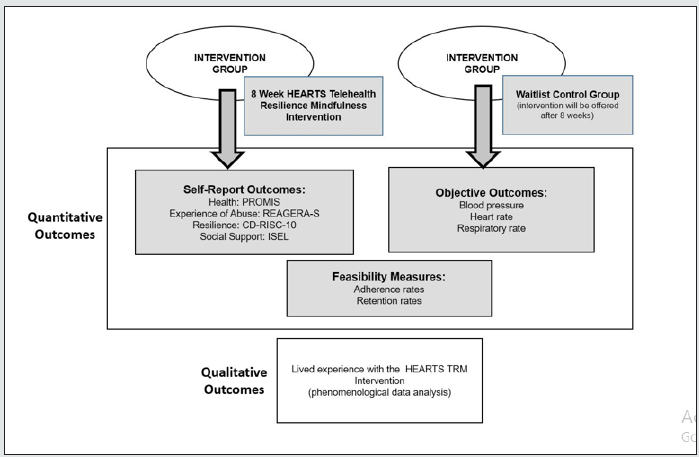
outcomes. The objective outcomes will be measures through blood
pressure readings, heart rate, and respiratory rate, while the
subjective outcomes are measured through their health (PROMIS),
the experience of abuse, resilience, and social support. The HEARTS
telehealth resilience mindfulness intervention will be mainly
delivered by text messaging. A baseline data will be gathered
before the start and after the conclusion of the intervention. For
comparison, there will be two treatment groups in this study: The
Telehealth Resilience Mindfulness (TRM) and the Wait-List Group
(WLG). The phenomenological qualitative design of the study will
focus on the lived experiences of participants on HEARTS Telehealth
Resilience Mindfulness Intervention.
Hearts Telehealth Resilience Mindfulness (HEARTS
TRM) Intervention
We anticipate that the TRM intervention could result in an
observable effect on emotional and physical engagement, attention
to the cognitive organization [5,6]. Furthermore, Emezue and
Bloom [5] suggest that the more communication technologies
(computers or smartphones) are used, the more likely the older
adult will reject abusive and disrespectful treatment. Policymakers
and program planners should consider the potential implications
of information technology access relating to survivors of abuse.
Constantino et al. [10] found that survivors felt that disclosing
their experience was easier and safer through a computer than
face-to-face with a clinician or any “interested” person, and that
advice from a computer or phone was acceptable and accessible.
However, participants may feel skeptical of a computer’s ability
to give empathy, emotional support, or meaningful feedback [20].
For this reason, in this prospective project, we will explore the
feasibility of TRM delivered by text messaging to enhance resilience
and mindfulness to survivors. Emezue and Bloom [5] report that
evidence shows most survivors of abuse prefer the practicality
and confidentiality of technology-enabled interventions and
guided online support as opposed to in-person individual or group
meetings, making this telehealth an opportunity in enhancing
resilience and mindfulness. Hoare [25] focused on cognitive
reframing and reappraisal, showing that reports of reappraisal and
reframing tend to be more flexible and have better social outcomes.
The figure shows our proposed mixed-method study.
Figure 1: Proposed Mixed-Method Study in Telehealth Resilience Mindfulness Intervention.
Description of the HEARTS Telehealth Resilience
Mindfulness (TRM) Intervention
The HEARTS Telehealth Resilience Mindfulness (TRM)
Intervention is comprised of eight weekly sessions, primarily
delivered by text messaging. The focus is on the improvement of
resilience through the development of mindfulness skills. Below
further describe the details of each weekly session.
Week 1
Daily application of one or more of the following mindfulness
exercises: Sit comfortably erect on a chair and feet flat on the floor.
Open your eyes and drop your gaze to the floor beneath your feet
and breathe. Remove as many distractions as you can but keep focus
first on the internal sensations from your body. Notice your limbs,
neck, shoulders, and breathe, then your abdomen, diaphragm, and
chest. Notice your thoughts and feelings. Imagine you are in front
of your door, waiting for your visitors to arrive. They came, and you
greeted them with love, kindness, and compassion. Then focus on
the external sensations that are delivered to your 5 senses. -sight,
smell or its absence, taste, or its absence, hearing or its absence,
and touch-cooler or warm temperature. Then integrate these 2
(internal and external) sensations you have. Thirty 30 minutes.
Weekly journaling of lessons learned and the flow of thoughts and
feelings. Weekly phone or TM (Text Messages) check-in.
Week 2
Exercises-Movement for Week 2 includes the following: (1)
Bend your thumb across the palm as far as you can. Do this 20
times. (2) Place palm flat on the table. Spread them apart and bring
them close together. Do this 20 times. (3) Pick up a pencil or a pen.
Roll it between the thumb and each finger. Do this 20 times [59].
(4) Setup: Begin sitting in an upright position. Movement: gently
squeeze your shoulder blades together, relax, and then repeat 20
times. (5) Setup: Begin in a standing upright position in the center
of a doorway. Movement: With your elbow bent, place your hand on
the side of the doorway. Take a small step forward and slightly rotate
your body until you feel a stretch in the front of your shoulder. Hold
this position for 3 seconds and repeat it 10 times. Imagine your
agility, flexibility, and concentration [60]. Total of 25-30 minutes.
Weekly journaling of lessons learned and the flow of thoughts and
feelings. Weekly phone or TM check-in.
Week 3
Daily application of one or more of the following mindfulness
exercises: Setup in an upright position with your feet flat on the
floor. Movement: Gently draw your chin in, while keeping your
eyes fixed on something in front of you. Do not look down or bend
your neck forward, being mindful of feelings, and thoughts without
judging (10 minutes). Observe yourself (15 minutes) by focusing
on the upper portion of your body, your chest, heart, and lungs, and
diaphragm-observe their function [60]. Total of 25 minutes. Weekly
journaling of lessons learned from these exercises. Weekly phone
or TM check-in.
Week 4
Unscramble these words and put them in a correct sentence
on a clean sheet of writing paper: (1) “almond my cream favorite
chocolate is ice”; (2) “crackers bed should never one eat”; (3) “the
swipe machine card your through”; (4) “picked of peppers Piper
peck Peter a pickled”; (5) “Senate vetoed tax the the both the and
House bill”; and (6) “the 200th States marked birthday 1976 of the
United” [61]. No judgment but focus, concentrate and relax. Weekly
journaling of lessons learned from these exercises. Weekly phone
or TM check-in.
Week 5
Daily application of the following mindfulness exercises: Being
mindful of your feelings. Close your eyes and imagine you are a
leaf on a stream who aims never to be swept to the banks-always
focus and concentrate to float in the middle of the stream no matter
where the wind or the waves from the rocks toss you until you get
to the river and then to the sea and travel to the ocean. The wind
and waves could be the trials and tribulations that you meet in
your journey to life’s stream, river, sea, and ocean; you can mention
them but do not focus on them-they are only distractions. Focus on
your journey and the positive emotions, sensations, memories, and
resilience. 20 minutes. Weekly journaling of lessons learned from
this exercise-- awareness of one’s values, greater resilience, reduce
autopilot, and less reactive. Weekly journaling of lessons learned
from these exercises. Weekly phone or TM check-in.
Week 6
Answer each question with a one-word response on a writing
paper. The number of letters provided is a clue to the answer: (1)
A sound of laughter- 2 letters; (2) To harm or cause pain-4 letters;
(3) Equals 60 seconds- 6 letters; (4) Equals 60 minute- 4 letters;
(5) What you walk on- 5 letters; (6) Between sunset and sunrise-
5 letters; ( 7) What many people live in -5 letters; (8) opposite
of man-5 letters; (9) not this one, but-one- 4 letters; and (10) an
eating utensil- 4 letters [61]. Weekly journaling of lessons learned
from these exercises, following directions, focus, and concentration.
Weekly phone or TM check-in.
Week 7
The following are the activities for Week 7: (1) Listen to the
news show for 5-10 minutes and write down your summary of the
most important information. (2) Read a paragraph in a magazine
or newspaper or online and write down a summary of what you
read. (3) Provide directions to your friend from your airport to
your place house. Weekly journaling of lessons learned from these
exercises, following directions, focus, and concentration. Weekly
phone or TM check-in.
Week 8
Daily application of one or more of the following mindfulness
exercises: Write down specific directions you would like to five to a
friend, from your local church or airport to your house—improved
focus, give/following directions, ability to face challenges, and
cognitive regulation. Weekly journaling of lessons learned from a
video: Cognitive regulation. Weekly phone or TM check-in.
The mindfulness exercises and lessons described above
were adapted from Erin Commendatore, a mindfulness webinar
interventionist at the University of Pittsburgh Mindfulness Series,
from March to April 2021. The resiliency sessions were adapted
from works on the resilience of Feder et al. [6], Hoare [25], and
Reyes et al. [62].
The answers to the Week 4 exercises (unscramble the words
to form into a sentence) are the following: 1) My favorite ice cream
is chocolate almond. 2) One should never eat crackers in bed. 3)
Please swipe your machine card through. 4) Peter Piper picked a
peck of pickled peppers. 5) The Senate vetoed both the tax and the
House bill. 6) 1976 marked the 200th birthday of the United States.
Here are answers to Week 6- One-word response to 10 questions:
1) HA, 2) HURT, 3) MINUTE, 4) HOUR, 5) FLOOR, 6) NIGHT, 7)
HOUSE, 8) WOMAN, 9) THAT, and 10) FORK.
Instruments for Evaluation
A brochure will be distributed to communities where potential
participants gather. Below are the descriptions of each of the
instruments for evaluation that will be used:
Sociodemographic Data Questionnaire (SDQ)
The SDQ will be used at baseline only to document age, race,
education, employment, religion, and income. The SDQ can be
completed in 3-5 minutes.
Health
We will use the PROMIS (Patient-Reported Outcomes
Measurement Information System) version 1.0 short form [33,34]
to assess anxiety to determine health status including, four items
on physical function, anxiety, anger, depression, fatigue, sleep
disturbance, ability to participate in social roles and activities,
pain interference, and pain intensity [33,34]. Testing among over
20,000 individuals from the U.S. general population has resulted in
individual item calibrations that enable one to generate a T-score
(mean = 50; standard deviation = 10). The health subscale can be
completed in 4-5 minutes.
Elder Abuse and Lifetime Experiences
We will use the Responding to Elder Abuse in Geriatric care -
Self-administered (REAGERA-S) [35] will assess elder abuse (e.g.,
has anyone threatened to harm you? and have you experienced
physical abuse before or after you were 18 years old?). Space
will be provided to check the type of abuse the participant has
experienced: emotional, physical, sexual, or economic. The
sensitivity of the instrument, for lifetime abuse, is 71.9% (95% CI
53.3-86.3) and specificity 92.3% (95% CI 79.1-98.4). For current
abuse, the sensitivity is 87.5% (95% CI 61.7-98.5) and specificity
is 92.3% (95% CI 79.1-98.4). REAGERA-S can be completed in 3-5
minutes.
Resilience
The Connor-Davidson Resilience Scale 10-item, CD-RISC-10 [63]
will be used to measure psychological resilience. The CD-RISC-10
comprises 10 items, and each item on the scale is rated on a 5-point
Likert scale from 0 (not true) to 4 (true nearly all the time). The
total score ranges from 0 to 40, with higher total scores indicating
greater resilience. The scale demonstrated good construct validity
and internal consistency (α = .85) during the development of the
scale [63]. The CD-RISC-10 also had a good Cronbach’s alpha level
of .85 [63]. The CD-RISC-10 can be completed in 5¬-7 minutes.
Social Support
The Interpersonal Support Evaluation List (ISEL) is the
instrument we will use to measure social support. ISEL was
originally developed for a standard adult population [64,65].
The scale measures interpersonal support in four dimensions:
information support, spending free time together, instrumental
support, and appreciation - self-esteem. The type of coping strategy
depends primarily on informational support received, and finally,
how a person responds to stress is highly associated with received
social support [66]. Reliability and validity studies of the ISEL using
adult samples reported internal reliability (alpha coefficient) for
the ISEL ranging from 0.88 to 0.90, and between 0.70 and 0.82 for
appraisal, 0.62 and 0.73 for self-esteem, 0.73 and 0.78 for belonging,
and 0.73 and 0.81 for tangible support [65,67-69]. The ISEL can be
completed in 57 minutes.
Feasibility and Acceptability of the Intervention. An interview
guide will be used to explore the feasibility and acceptability of the
intervention and the quality of its administration and accessibility
of the HEARTS Telehealth Resilience and Mindfulness Intervention
among participants. The interview can be completed in 25-35
minutes.
Conclusions
Systemic factors in healthcare and justice services increase
or decrease healthspan (a portion of life spent in good health)
throughout the life course. Lifecourse Health Development [27,28]
is a theory that integrates biological, socioeconomic, justice, and
environmental infrastructure. This conceptualized TRM practice
change can be delivered in-person by text messaging or by video
conferencing (i.e., Zoom). The rationale is to span the digital,
biological, socioeconomic, justice, and environmental infrastructure
divide between the service providers Strategies that will be used
to implement the practice change (TRM) are community-based
participatory research and practice, that emphasize collaborating,
consulting, and where ethics, role and role responsibility and
accountability, communication, and teamwork competencies in
community participants’ engagement are paramount [70].
We are aware that sometimes during our life course we have
been marginalized. Marginalization is a process through which
certain individuals experience multiple social determinants
concurrently placing them in sections and margins, by rejecting
one’s culture, race, age, gender, or sexual orientation by the
dominant host population [1]. Legarde [71] identifies an approach
to empowerment and equality as judging people by their capability
to do the things they value. This approach to empowerment
facilitates the ability to participate in one’s community and
contribute to sustainability in health outcomes. Failed attempts
at integration lead to marginalization expressed in three main
outcomes: the creation of margins, living between cultures,
and the creation of vulnerabilities. The creation of margins is
a process of creating boundaries, sections (intersectionality),
and peripheralized by approximation (not proximation) of the
individual, group, or population. Age and poverty create margins,
sections, and vulnerabilities [71].
The second outcome of marginalization is living between
cultures leading to incomplete integration where the individual
relinquishes characteristics of the parent culture to connect with
the dominant society and fails in both [1]. In the process of living
between cultures, the person lives on the periphery on the verge
of exclusion, and the intersection of multiple ways of distancing.
The third and last outcome of marginalization is the creation of
vulnerabilities. Vulnerabilities are a state of being exposed to, and
unprepared to fight or flee from health, people, and environment’s
damaging circumstances that pose a physical, psychological,
biological, social, and economic threat to the individual, group,
or population. Age disparities are an example of the creation of
vulnerabilities. Globally, older adults make up 60% of the living
on less than a dollar a day, locked out of leadership positions,
underutilized, underpaid, under-appreciated, stressed, abused,
and traumatized [18]. The cumulative outcome of these three
themes of marginalization is toxic stress that leads to maladaptive
coping behaviors, poor self-esteem, lack of self-efficacy, cognitive
dissonance, and increased incidence of substance abuse,
posttraumatic stress, and suicide [3].
The strength of the evidence guiding the change (HEARTS
Telehealth Resilience Mindfulness [TRM] Intervention) in practice
comes from the Range of Possible Changes (RPC) Model that
guides the theory of change in intervention. We are aware that
technology may have some bias, prejudice, and stereotypes because
they are made by, for, and of humans. The stakeholders that will
influence and participate in the change in practice are observable
in institutions’ ethics, role, communication, and teamwork help and
not hinder, catapult and not shackle and cutting away obstacles and
barriers to true human flourishing. The evaluation strategies will
assess the impact of change that are embodied in HEARTS (health,
experiences of abuse and trauma, resilience, technology use, and
social support) in a mixed-methods strategy where qualitative data
are quantified and quantified data are qualified, in the development
of a telehealth resilience mindfulness intervention.
Conflict of Interest Statement
No conflict of interest has been declared by the authors.
Read More About Lupine Publishers Journal of Complementary & Alternative Medicine Please Click on Below Link:
https://lupine-journal-complementary-medicine.blogspot.com/