Showing posts with label CTCSA. Show all posts

Tuesday, 12 September 2023

Lupine Publishers | Review of Recent Applications in 6G Communication Networks: A Descriptive Case

 Lupine Publishers | Journal of Computer Sciences & Applications


Abstract

The world is on the cusp of a new communications revolution. The next generation of communication networks, known as 6G, will enable a wide range of new applications and services that are not possible with current 4G or 5G networks. In this descriptive case, we will review some of the most promising applications of 6G technology. Some of the key applications that are being developed for 6G communication networks include Digital Twin (DT), Holograms, Robot Avatar, High Density (IoT), and AR & VR. The use of these applications in 6G communication networks is not a new concept. These applications have been around for some time now and have seen various improvements over the years. However, with the advent of 6G communication networks, the use of AR and VR is expected to see a drastic change.

Keywords: Digital Twin (DT); holograms, robot avatar; high density (IoT); AR & VR; 6G

Digital Twin (DT)

Digital Twin is a virtual representation of a physical object or system used to monitor, analyze, and optimize performance [1]. It is becoming increasingly popular in a variety of industries and is expected to continue to grow. It can be used to reduce the cost of service migration, make 6G networks more secure, and create a secure, immutable, and transparent digital representation of physical objects. Challenges include the cost of implementation, complexity of data, and accuracy and reliability [2]. 6G networks use DT technology to create a virtual replica of physical objects or systems, allowing them to detect any unauthorized access or changes and take appropriate action to protect them from malicious activity [3]. This technology also makes the network more secure. For example, if a sensor detects a temperature change in a machine, the digital twin can be used to adjust the temperature to ensure optimal operation. Digital Twin in 6G is a complex system that combines the physical and digital worlds. It is composed of hardware, software, and data that creates a digital representation of a physical object or system [4]. This representation is created using data from sensors, cameras, and other sources, and is used to monitor, analyze, and control the physical object or system. The data is then stored and analyzed on a cloud-based platform, which can be used to create predictive models to anticipate future events and take proactive action. Digital twins and blockchain technology can be used together to create a secure, immutable, and transparent digital representation of physical objects [5]. This digital representation can be used to track the performance of the physical object, store and share data related to the object, and create smart contracts that are stored on a blockchain and automatically executed when certain conditions are met [6]. This can help to reduce costs and increase efficiency. Digital Twin technology is a powerful tool, but it comes with a few challenges [7]. These include the cost of implementation and maintenance, the complexity of data collection and analysis, and accuracy and reliability issues [6]. All of these require significant resources and expertise to address. Furthermore, Digital twin technology is a complex process that requires a lot of expertise and resources to collect and analyze data accurately [8]. Despite its potential, there are still issues with accuracy and reliability, and it can be difficult to keep the digital twin up to date. Additionally, the digital twin must be kept up to date in order to remain useful, which can be a challenge.

Holograms

Holograms are a 3D imaging technology used to create realistic images of objects and people [9]. It is now being used to create a more immersive experience for customers, such as allowing them to interact with a customer service representative in a virtual environment [10]. This could be especially useful for customers in remote areas or who have difficulty traveling to a physical location. Furthermore, Holographic Nondestructive Testing (HNDT) is a type of non-destructive testing (NDT) that uses holography to detect flaws in materials [11]. It is used to inspect a wide variety of materials, including metals, plastics, composites, and ceramics, and is used in industries such as aerospace, automotive, and medical. HNDT is a powerful tool for detecting flaws that could lead to failure or malfunction, as well as corrosion, fatigue, and other types of damage [12]. It is an important tool for ensuring the safety and reliability of components and materials. Additionally, Hologauze is a revolutionary new technology that allows for the projection of large scale 3D holograms [13]. It is a lightweight, transparent fabric made up of tiny, reflective particles that create a 3D image when light is shone through it. It is versatile, cost effective, and easy to set up and use, making it a great choice for those on a budget or with limited technical knowledge [14]. Holograms are a new technology with a number of challenges that must be overcome before they can become mainstream. These include the cost of specialized equipment and materials, lack of standardization and compatibility, complexity of the technology, low resolution, and difficulty of interaction [15].

Robot Avatar

Robot avatars are computer-generated characters that can be used to represent a person in a virtual world [16]. They can be used for a variety of purposes, from providing a virtual presence to providing a more realistic representation of a person. They can be programmed to perform tasks such as navigating a virtual world, playing games, or providing assistance to other avatars, allowing for a more realistic interaction between people in the virtual world [17]. The use of robot avatars in 6G for service migration presents numerous challenges, such as creating a realistic avatar that can interact with humans, integrating the avatar into existing services, ensuring security and reliability, and providing a high-quality user experience [18]. These challenges require extensive research and development, technical expertise, security measures, and user testing and feedback [19]. Robot avatars and blockchain technology are two of the most promising advancements in 6G technology, with the potential to revolutionize how we interact with the world.

AI-powered robot avatars can understand and respond to human commands, while blockchain technology can securely store and transfer data [20]. This combination could lead to more efficient and cost-effective services, as well as more secure and transparent transactions.

High Density (IoT)

The Internet of Things (IoT) is a rapidly expanding network of connected devices that can communicate with each other and other networks. High-density IoT solutions are designed to provide a secure, energy efficient mesh network architecture for efficient data transmission between multiple devices [21]. These solutions are ideal for applications that require a large number of connected devices in a limited space, such as smart cities, industrial automation, and healthcare. 6G promises to bring immense potential benefits, such as faster data transmission speeds, more secure data transmission, and more efficient use of spectrum [22]. It will also enable new applications and services, such as smart cities, autonomous vehicles, and the Internet of Things (IoT), to connect millions of devices in a single area for more efficient data collection and analysis [23]. IoT devices are becoming increasingly popular and are being used to provide a variety of services [24]. By integrating these devices with blockchain technology, service providers can create a secure, distributed, and automated system for delivering services, which can provide a number of benefits such as increased security and reliability [25]. The integration of IoT and blockchain in service migration can provide a more efficient, cost-effective, and transparent system for delivering services [26]. Blockchain technology can automate the process of delivering services, reducing time and cost, and ensure that all data related to the service is visible and accessible. Integrating IoT and blockchain technology presents a number of challenges, such as scalability, security, and interoperability [27]. Scalability is a major challenge due to the large amount of data generated by IoT devices, and security is a concern as IoT devices are vulnerable to attack [28]. Interoperability is also a challenge, as IoT devices must be able to communicate with each other and with the blockchain network [29]. To address these challenges, a secure and resilient blockchain network is needed that is able to support multiple protocols and standards.

AR & VR

6G promises to be a faster, more reliable, and more secure wireless technology than ever before, allowing AR and VR applications to take advantage of its increased speed and reliability to provide users with an even more immersive experience. AR and VR have already been used in a variety of applications, from gaming to education to healthcare [30]. 6G networks provide users with a more immersive experience due to increased speed and reliability. This allows for more realistic graphics and smoother gameplay in gaming, virtual classrooms and teachers in real-time in education, and more accurate diagnosis and treatment of patients in healthcare [31]. 6G networks offer increased speed, reliability, and security compared to previous generations, making them ideal for AR/VR applications [32]. The combination of 6G and blockchain technology can enable secure, distributed applications with realtime, immersive experiences [33]. This could be used in a variety of contexts, such as gaming, education, and healthcare, to protect user data and privacy. The potential of 6G and blockchain technology when combined in the AR/VR space is immense [34-37]. This combination can create a powerful platform for applications, as well as new business models and secure, distributed networks for data sharing and collaboration [38]. This could enable developers to monetize their applications and create new revenue streams, as well as leverage the collective intelligence of the network.

Conclusion

In this essay, we reviewed the existing under-developed applications in 6G communication network that have a huge advantages in next years in different area including education, healthcare, technology, economic and businesses. These applications are digital twins, holograms, robot avatar, high density IoT and AR & VR in 6G networks. Furthermore, the characteristics, advantages and possible challenges were included as part of this essay.

Read More About Lupine Publishers Journal of Current Trends in Computer Sciences & Applications Clock on the Below Link: https://computer-sciences-lupine-publishers.blogspot.com/


Tuesday, 18 July 2023

Lupine Publishers | Towards Consensus Algorithm for Healthcare Management Systems in Blockchains

 Lupine Publishers | Current Trends in Computer Sciences & Applications


Abstract

Medical-hospital records produced by computational management systems must ensure confidentiality, integrity, and availability of information. Literature studies point to the Blockchain technology as a promising candidate to accomplish these needs. Among the various functionalities existing in Blockchain-based systems, one of them is the consensus mechanism. Within this context, this article proposes enhancing the H-BFT consensus algorithm. The operation of this new algorithm is demonstrated by exploiting two case studies which briefly address the Brazilian SUS and the US Medicare-Medicaid, respectively. At last, general considerations and suggestions for future work close this article.

Introduction

The systems responsible for managing medical information records from patients must allow adequate conditions for storage and analysis, providing subsidies for a better diagnosis and treatment [1-3]. These systems are complex [4,5] and must implement requirements to adequately provide integrity, confidentiality, and availability of medical records, besides processing large data volumes [6]. Blockchain technology shows great promise in the implementation of systems capable of dealing with common problems in the field of healthcare management [7- 9]. It is defined as a distributed database, where records are stored in blocks [10], embedding elements such as cryptography, ledger, and consensus algorithms [11], besides owning properties such as immutability, integrity, transparency, availability, decentralization, and disintermediation [12]. Systems developed on Blockchainbased platforms need to establish an agreement between network nodes regarding the validity of transactions then carried out. The consensus occurs from the execution of algorithms that allow communication between the nodes of the Blockchain network, allowing unknown elements, or even competitors, to reach to an agreement regarding the previous and current state of the stored data. Within this context, this article proposes an enhancement of the H-BFT consensus algorithm [13] for use in healthcare management systems. Our proposal is the result of a theoretical study on the most important requirements for healthcare management systems based on Blockchain. The operation of this new algorithm is demonstrated by exploiting two case studies which briefly address the Brazilian SUS [14-16] and the US Medicare-Medicaid [17-19], respectively. The remainder of this article is structured as follows. Section “Literature Proposal” succinctly reviews the H-BFT algorithm. Section “Novel proposal” explains the enhancements we herein propose to the H-BFT algorithm, named as EH-BFT. Section “Performance Analysis” presents an overall discussion to highlight the benefits of the enhanced version of the H-BFT algorithm, by especially delving into two real case studies. This enhancement is named as EH-BFT algorithm. At last, Section “Conclusions and Future Work” present final remarks and gives directions for further research.

Literature Proposal

This Section brings the H-BFT protocol’s motivations, briefly explaining its characteristics and advantages of its use in healthcare management systems.

Healthcare Management System based on Blockchain Requirements

In order to understand the biggest concerns in the development of solutions that could meet the needs of a healthcare management system based on Blockchain technology, a plethora of studies were carried out (e.g., [20-26] in which it was found that there was no definition regarding the type of consensus mechanism that could be used, but some characteristics were present in almost all of them. One of those characteristics was the use of private Blockchain networks, resulting from the need to restrict access to this type of information, valuing the privacy of data produced by medical diagnoses. Another feature was the preference for deterministic consensus algorithms over probabilistic models, for reasons such as the number of participants involved and lower computational cost. With the common characteristics identified in the frameworks aimed at healthcare management, five essential requirements were listed, which guided the specification of the H-BFT: confidentiality, integrity, availability, scalability, and security. Confidentiality is the guarantee of protection against undue access to information [27] and was the main focus of concern, both due to constant cyberattacks and legal issues in countries such as Brazil [28,29] and the USA [30].

Another requirement of great importance was that of integrity, which is linked to the impossibility of changing data by unauthorized individuals, in order to avoid losses due to damage to this asset [31]. The concept of availability refers to the guarantee of access to data by people authorized to do so, whenever necessary, and the system needs to guarantee the continuity of its services and timely responses [8]. Scalability can be defined as the ability of a system to preserve quality in the delivery of its services, even if there is an increase in the number of customers [32], and security pivotally relates to protect the system against any type of attack. For instance, the implementation of a system based on Blockchain technology needs to establish implementations that seek to mitigate already identified vulnerabilities, such as those that allow exploitation of the network by Sybil-type attacks [33,34]. where a node maliciously tries to take control of the network by creating other nodes linked to it [35].

H-B FT algorithm features

The Byzantine Fault Tolerance to Health (H-BFT) consensus mechanism was proposed to meet the identified high-level requirements, incorporating features that aim to meet the already established needs of confidentiality, integrity, availability, scalability and security. It is a voting-based and Byzantine faulttolerant algorithm, inspired by the PAXOS algorithm [36]. Three distinct roles are presented during the execution of the H-BFT: leader, acceptors and verifiers. The leader receives the values and proposes them to obtain consensus; acceptors are responsible for choosing the proposed value, and verifiers are responsible for the list of reliable nodes in the network. A feature of H-BFT is the creation of a list of reliable nodes, asynchronously by verifiers, applying a reputation algorithm [37]. The purpose of this is to mitigate possible Sybil attacks by establishing quality control over the nature of the elements that will be able to vote and receive votes.

To meet the scalability criterion and solve a common problem in voting-based consensus mechanisms, the H-BFT brings the concept of continuous slicing to obtain consensus, which was inspired by the idea of quorum slicing in the FBA algorithm [38,39]. This principle establishes that consensus occurs from a minimum quorum of reliable nodes in the network, expressed by the formula [(T – i)/2] +1, where T is the total number of individuals verified and i the individuals already selected. If consensus is not obtained in a round, a new execution is performed, applying the same criteria for obtaining the minimum quorum. Moreover, H-BFT uses the reputation concept described in the dB FT algorithm [40] and, added to the list of verified nodes, proposes a Peer-to-Peer (P2P) classification mechanism dynamically selecting respectable nodes [37]. With this, it is possible to replace the leader after a certain time has elapsed.

Algorithm Workflow

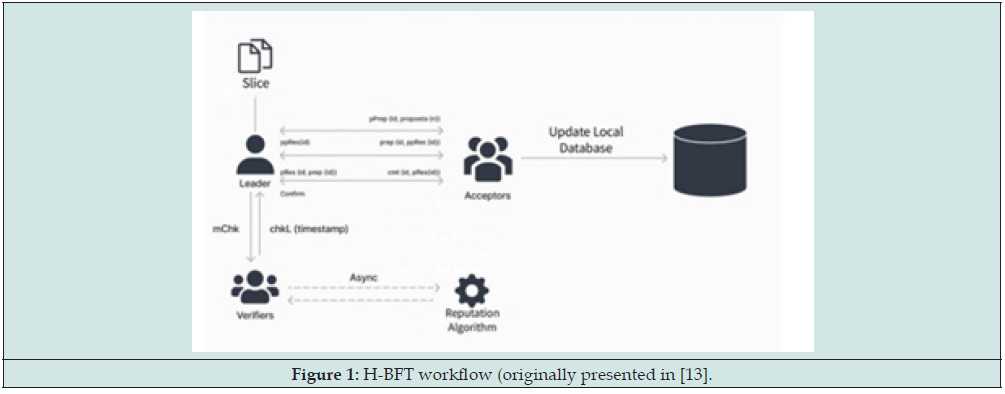
H-BFT is an algorithm with a three-stage flow, which starts when the leader receives a proposal to insert a new record, then messages are exchanged with the verifiers to provide the list of trusted nodes. After the procedures for obtaining the list, the leader sends a preprepare message to the constant acceptors in the quorum slice. The remaining steps may be then noted in the algorithm execution:

a) When an acceptor receives the message, it checks its local database to confirm its integrity, after which it responds to the leader with a pre-prepared response message, informing that it is ready to start the consensus round.

b) The leader evaluates the number of responses received and, if the quorum is still not enough for consensus and there are still honest nodes in the network, it executes the flow from the beginning; otherwise, it sends a prepare message to each acceptor that responded. The acceptors receive the prepared message and acknowledge it to the leader.

c) The leader receives responses from acceptors and sends a commit message to the acceptors that responded. The acceptors confirm the transaction after receiving the commit message sent by the leader, send a response message and update their bases.

Finally, Figure 1 shows message exchanges between network nodes during the execution of H-BFT, representing the routine to obtain consensus among network nodes.

Figure 1: H-BFT workflow (originally presented in [13].

Lupinepublishers-openaccess-computer-sciences-journal
<
EH-BFT Algorithm

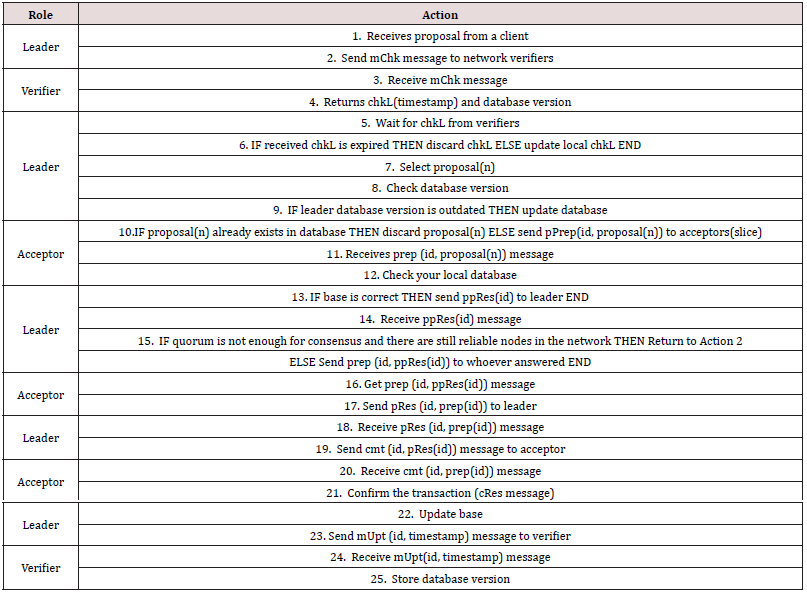
The Byzantine Fault Tolerance to Health Enhanced (EH-BFT) algorithm has two modifications comparing to the H-BFT algorithm. The proposed modifications are associated with the optimization of the database versioning and adjustments in the execution flow to avoid its anomalous functioning during its execution. The two modifications are shown in the following. Additionally, all its steps are detailed in Table 1. One may note that the proposed modifications increase routines, seeking to improve the original algorithm by granting security and consistency of the stored information, without forgetting the original goal of adequately supporting healthcare management systems.

Table 1: H-BFT Algorithm’s Specification.

Lupinepublishers-openaccess-computer-sciences-journal

a) The first modification is in the role played by verifiers, which were originally only responsible for maintaining the list of trusted nodes. With the EH-BFT, they gain one more attribution, which is to maintain the most current version of the database, and with that, together with the message requesting the list of suitable nodes, the most recent version of the database will be sent. In the end of the consensus round, the verifiers will keep the current state of the ledger.

b) The second modification is in the routine executed by the leader to verify the current status of the records, the proposal received with the existing records the database received from the verifier, seeking to mitigate problems like double spending.

Performance Analysis

This Section presents a general discussion, highlighting the benefits presented by the EH-BFT. To this end, we consider two real case studies, namely the Brazilian Public Healthcare System [35] [36][37] and US Medicare-Medicaid [18,19].

Case: SUS

The Brazilian Public Healthcare System (SUS) is a healthcare system designed to guarantee medical-hospital care to approximately 215,491,518 people [41] free of charge, from simple medical appointments, exams or transplant of organs [42]. Its performance is based on three pillars: promotion, protection and recovery of health, with activities ranging from promoting quality of life, reducing/eliminating health risks to early diagnoses for timely treatment [37]. The structure of the SUS is organized into Basic Healthcare Units, for outpatient care, Emergency Care Units, for less complex urgent and emergency care, and Public Hospitals or clinics, which provide any type of care and have resources to perform complex procedures [43]. The SUS still has public laboratories and maintains an agreement with private healthcare institutions, to complement the services [36]. An Electronic Health Record-EHR is created for every citizen in their first consultation [38], which will accompany them throughout their lives and will be accessed during consultations by the medical professional responsible for the care, except in cases where that the consultation is carried out at a private institution with an agreement. The current model adopted by SUS for EHR management has some shortcomings, which generate bottlenecks in access to the platform that manages patient information, cause insecurity in the maintenance of diagnoses and procedures performed, in addition to not guaranteeing consistency of data stored in its bases. The data produced during medical appointments are accessible only at the place of care, that is, if the patient moves to another state, the healthcare professional who will assist him will not have access to his medical history and access to patient information is limited, carried out without the use of more robust security mechanisms, restricting itself to the use of username and password.

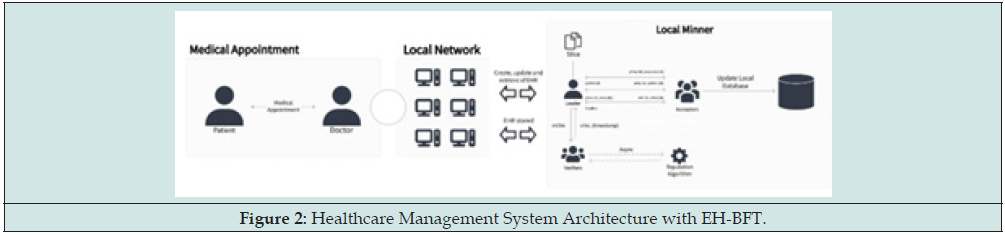
In the context of SUS, the use of the EH-BFT algorithm (Figure 2), would bring the following benefits.

Figure 2: Healthcare Management System Architecture with EH-BFT.

Lupinepublishers-openaccess-computer-sciences-journal

a. The first benefit is linked to the concept of availability of patient information, so that the patient or the healthcare professional responsible for the care can access the medical history quickly, allowing for accurate diagnoses and saving resources, as the treatment would already be more effective, no waste. The decentralized structure, characteristic of Blockchainbased systems, would allow access to the information managed by it anywhere and at any time.

b. Another extremely important factor concerns the integrity of the stored data. The use of EH- BFT would guarantee the consistency and veracity of the records, since the records would be immutable and non-redundant, inserted from the agreement established between the nodes. The consensus mechanism would not only guarantee the veracity of the data, but it would also bring confidence to the professional responsible for the diagnosis.

c. The issue of scalability, something of great impact in a Blockchain network with the size necessary to serve the SUS,is handled by the EH-BFT when it performs the continuous slicing of the quorum necessary for approval of the insertion of the proposed record, which would solve a difficult problem to measure in a healthcare management system of this size.

d. The confidentiality required of the information, through the LGPD [28], would be fully guaranteed, since the data circulating on the network is encrypted, and accessible only to those who need to do so, including the patient himself.

Case: Medicare and Medicaid

In the United States of America, the healthcare service is private [40], however, there are two assistance programs, maintained by the Federal Government. The first of these is Medicare [41], created in 1966 and aimed at people over 65, people with disabilities or those unable to work for some reason. It provides four types of service: Hospital insurance, medical insurance, extension coverage (maintained by companies to serve their employees) and medication coverage. Medicaid [42], on the other hand, was created to serve people below the poverty line, and is maintained entirely by the Federal Government and by the States. Each hospital or independent healthcare professional that provides care to the insured person will receive the reimbursement due, following a specific cost table, which never mirrors the reality of the market.

This model is extremely bureaucratic, since the government establishes different levels of demand, which means that many people do not get the necessary medical care. As there are no public hospitals, all care is provided by professionals and accredited establishments, which exponentially increases decentralization and redundancy in diagnoses. In the two American forms of public healthcare service, there is a large volume of appointments where professionals need to establish new diagnoses at each consultation, without a reliable base of medical histories, without integration between the two healthcare systems, which does not allow the availability of the data, it is not possible to assess the integrity of the records or the confidentiality of the diagnoses.

a) In the context of Medicare and Medicaid, the use of the EH-BFT algorithm (Figure 2), would bring the following benefits.

a. The first benefit of using a healthcare management system based on Blockchain technology would be the integration between the two public models of medical care, allowing the exchange of information produced by diagnoses made by healthcare professionals.

b. The dispersed nature of the services would make each establishment or healthcare professional a node in the Blockchain network, impacting scalability. This problem has already been solved by the EH-BFT during the routines carried out during its execution, in addition to that, the very decentralized model would guarantee availability for access to authorized persons at any time.

c. Keeping a single EHR available to everyone who needs access to it makes the more economical, faster, and more accurate diagnoses, bringing relief to the patient, in addition to savings and efficiency for the Government. This EHR would also be protected by the cryptography used by the Blockchain, which would guarantee the required confidentiality. In both case studies, the implementation of a healthcare management system based on Blockchain, which implements the EH-BFT, would bring performance benefits, cost reduction, accuracy in diagnoses, availability, and integrity of information, bringing benefits to citizens and for governments.

Conclusions and Future Work

This article presents an improvement proposal for enhancing the Byzantine Fault Tolerance to Health (H- BFT) algorithm. This enhancement, called Byzantine Fault Tolerance to Health (H-BFT), is characterized by optimizations in the flow of the algorithm and on its versioning control of the database. The EH-BFT maintains the specifications regarding continuous quorum slicing, role rotation, and generation of the list of suitable nodes, besides, it also assigns to the verifier the responsibility of controlling the version of the database in use by the system, which will be consulted at each necessary round for establishing consensus among network nodes. Additionally, to exemplify the deployment of EH-BFT, two case studies were herein presented, namely the Brazilian Unified Healthcare System and the US public healthcare systems Medicare and Medicaid, respectively. By means of the exploitation of these two scenarios, the effectiveness of the EH-BFT was demonstrated. As future works and being aware of this research’s limitations, we suggest the execution of tests in simulated environments besides the implementation of the EH-BFT algorithm with the goal of validating the processes and results derived herein.

Read More about Lupine Publishers journal of Current Trends in Computer Sciences & Applications Click on the below link: https://computer-sciences-lupine-publishers.blogspot.com/


Wednesday, 27 April 2022

Lupine Publishers| Detecting Distributed Denial-of-Service DDoS Attacks

 Lupine Publishers| Journal Computer Sciences & Applications


Abstract

Since the number of damage cases resulting from distributed denial-of-service (DDoS) attacks has recently been increasing, the need for agile detection and appropriate response mechanisms against DDoS attacks has also been increasing. The latest DDoS attack has the property of swift propagation speed and various attack patterns. There is therefore a need to create a lighter mechanism to detect and respond to such new and transformed types of attacks with greater speed. In a wireless network system, the security is a main concern for a user.

Introduction

Security of information is of utmost importance to organization striving to survive in a competitive marketplace. Network security has been an issue since computer networks became prevalent, most especially now that internet is changing the face of computing. As dependency on Internet increases on daily basis for business transaction, so also is cyber-attacks by intruder who exploit flaws in Internet architecture, protocol, operating systems and application software to carry out their nefarious activities Such hosts can be compromised within a short time to run arbitrary and potentially malicious attack code transported in a worm or virus or injected through installed backdoors. Distributed denial of service (DDoS) use such poorly secured hosts as attack platform and cause degradation and interruption of Internet services, which result in major financial losses, especially if commercial servers are affected (Duberdorfer, 2004).

Related Works

Brignoli et al. [1] proposed DDoS detection based on traffic selfsimilarity estimation, this approach is a relatively new approach which is built on the notion that undisturbed network traffic displays fractal like properties. These fractal-like properties are known to degrade in presence of abnormal traffic conditions like DDoS. Detection is possible by observing the changes in the level of self-similarity in the traffic flow at the target of the attack. Existing literature assumes that DDoS traffic lacks the self-similar properties of undisturbed traffic. The researcher shows how existing bot- nets could be used to generate a self-similar traffic flow and thus break such assumptions. Streilien et al,2005. Worked on detection of DoS attacks through the polling of Remote Monitoring (RMON) capable devices. The researchers developed a detection algorithm for simulated flood-based DoS attacks that achieves a high detection rate and low false alarm rate.

Yeonhee Lee [2] focused on a scalability issue of the anomaly detection and introduced a Hadoop based DDoS detection scheme to detect multiple attacks from a huge volume of traffic. Different from other single host-based approaches trying to enhance memory efficiency or to customize process complexity, our method leverages Hadoop to solve the scalability issue by parallel data processing. From experiments, we show that a simple counterbased DDoS attack detection method could be easily implemented in Hadoop and shows its performance gain of using multiple nodes in parallel. It is expected that a signature-based approach could be well suited with Hadoop. However, we need to tackle a problem to develop a real time defense system, because the current Hadoop is oriented to batch processing.

Proposed System Architecture of Intrusion Detection Based on Association Rule

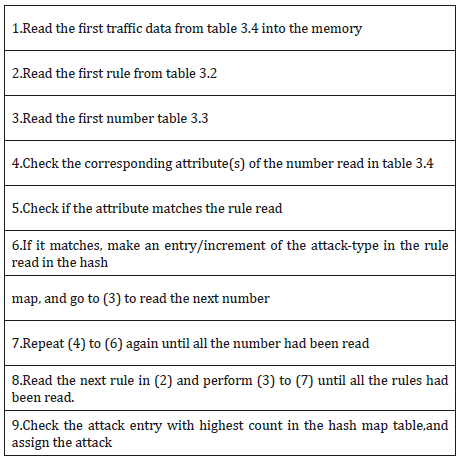
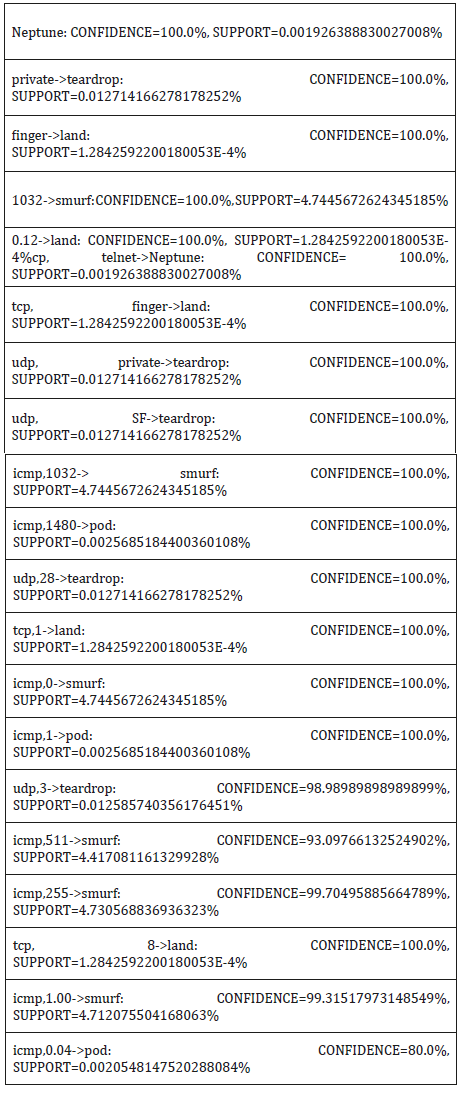
The structure of the proposed architecture for real time detection of Dos instruction detection via association rule mining, it is divided into two phases: learning and testing. The network sniffer processed the tcpdump binary into standard format putting into learning, during the learning phase, duplicate records as well as columns with single same data were expunge from the record so as to reduce operational. Another table Hashmap was created by the classification model to keep track of the count of various likely classmark that can match the current read network traffic, this table will be discarded once the classmark with highest count had been selected. Depicted in Table 1 is the Association rule classifier algorithm (Tables 2-4).

Table 1: Association Rule Mining Classifier Algorithm.

Lupinepublishers-openaccess-computer-sciences-journal

Table 2: Sample Rules.

Lupinepublishers-openaccess-computer-sciences-journal

Table 3: Sampled number combination table.

Lupinepublishers-openaccess-computer-sciences-journal

Table 4: Sample Network Traffic Data.

Lupinepublishers-openaccess-computer-sciences-journal

System Implementation

This chapter presents implementation of Association rule classifier model, documentation of the designed system and the user interfaces. The software and hardware requirement needed for the system and also the testing of the system for verification and validation of functions, as well as the result [3-10].

Read More About  Lupine Publishers Journal of Computer Sciences and Applications Please Click on Below Link: https://computer-sciences-lupine-publishers.blogspot.com/
Tuesday, 26 April 2022

Lupine Publishers| Mini Overview of Key Issues in Routing for OSPF MANETs

 Lupine Publishers| Computer Sciences & Applications


Abstract

Open Shortest Path First (OSPF) is a well known and prominent Internet Protocol (IP) for network routing. By deploying a link state routing (LSR) algorithm OSPF comes under the category of interior gateway routing protocols. In today’s wireless ad hoc Internet, the current routing domain needs to maintain a peak level of service accessibility and availability, thus OSPF must be extended to the wireless ad hoc network for maximizing routing performance in the network by taking into account key routing issues, i.e., optimal Hello Interval, efficient flooding schemes, optimizing the traffic engineering related issues, optimum adjacency creations, connectivity factors, reducing control overhead, and QoS and security challenges. In addition, OSPF is very effective in its adoption of handling the network bandwidth utilization, therefore, wireless capacity planning is of utmost importance for today’s Internet with the possible presence of wireless infrastructure. Improving routing stability in OSPF MANET under topology change(s) due to variation in link connectivity becomes a very demanding challenge for the research community. Given a fascinating volume of review for literature and unavoidable importance relating to OSPF extension to MANETs, there has still persist a need to highlight key issues related with routing in OSPF MANET.

Keywords: MANETs; Routing; OSPF; Traffic Engineering; Connectivity Factors; Capacity Planning; Flooding Schemes

Introduction

Open Shortest Path First (OSPF) is a very well-known and prominent interior gateway protocol (responsible for routing) in the today’s Internet [1]. The routing functionality of such protocols can be seen within the domain, which can be, but not necessarily, is part of or contained within an autonomous system (AS). OSPF as part of the routing protocol comes under the group of link state routing protocol, which generally allows every router present in the network to learn about the complete network topology [2]. However, in order to achieve maximum routing performance, it is now for almost more than 3 decades that the Internet protocols for link state routing has been deployed in the Internet on the regular basis. When we go back in history, the first major and functional link state routing protocol was deployed in the year 1978, called the Shortest Path First (SPF) by replacing the popular distance vector approach in ARPANET at that time.

The OSPF Protocol is now being used by the Internet Service Providers (ISPs) for almost more than 25 years as a link state routing functionality in providing the Internet infrastructure. The maximum years of experience running with the OSPF Protocol and its wide spread deployment has put a lot of confidence in using it as a reliable and stable link state routing and has demanded and motivated the researchers from all over the world to put in the efforts to create room for further improvements and enhancements in its application for extending its operation to wireless ad hoc media in MANETs. As a matter of fact, the quality of service (QoS) requirements and the attributes of the routing infrastructures in MANETs is a demanding challenge as the network topology is frequently changing due to mobility [3,4].

The objective function of the OSPF-MANET Protocol is to provide highly scalable routing functionality and more flexible and robust operation on complex and highly dense networks. The prime concern in today 0 s wireless media is to somehow keep in limit the bandwidth processing requirements of the protocol while recovering from the network failure (Speed of Convergence) in the network topology is the prime concern [3,5]. Whenever there is a triggered event in the OSPF-MANET domain, in such case the protocol may typically required a few tens of seconds for recovering from any sort of router/link failure (network failure). During this ephemeral state, the network quality of service availability would go through a serious degradation or deterioration or in other cases there may be a complete breakdown of the network.

With the establishment of real time operations for certain applications over the Internet, (e.g. online video con-ferencing) or networked voice over IP from almost a previous decade, network service deterioration/ disruption for applications with quick response time, a few tens of seconds (network recovery time) can no more be permitted or accepted. The need to quickly recover from the failure has motivated the research community to present the possible scenarios to improve the OSPF Speed of Convergence and also to provide other proactive approaches and strategies for protecting the network traffic in the interim process [6]. One of the critical and important requirements for the today0 s routing infrastructure has highlighted the need of maximizing routing performance in response to the topology change.

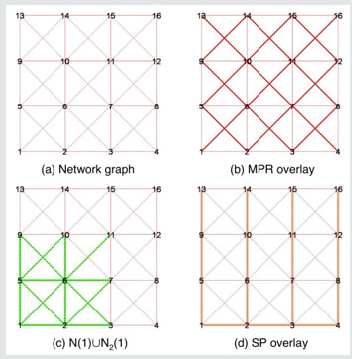
Significantly, reducing the bandwidth/processing requirement of the Internet routing protocol persuades to be the crucial framework as before. As the OSPF protocol being distributed in nature, it incorporates the within limit execution of the certain operations like processing and generation of the Hello packets by the active routers taking part in it [7]. It is important to mention here that the routers may not be highly overloaded, so that it may continuously decline to do/perform these critical network resource management operations. Such failures may contribute to the network failure and eventually result in the complete shutdown of the entire network. Hence, a novel scheme, refereed to as multi point relay (MPR) based MANET is introduced to tackle this issue, as presented in (Figure 1).

Figure 1: MPR based MANET extension. .

Lupinepublishers-openaccess-computer-sciences-journal

Conventionally, OSPF routing protocol has been employed as the network framework including a wired connectivity by exhibiting the largely static regional network topology. However, in the recent times routing infrastructure incor-porates the wireless components of the network too. These chunk subsist of either mobile or static network devices, possibly going out or coming in of each other’s mobile wireless range, or a hodgepodge of both. An illustration/ case of such kind of network can be classified as wireless, mobile ad hoc networks (MANETs) of objects where some objects exhibits mobile wireless connections with one or more conventional wired network(s) running under OSPF routing protocol. In a pragmatic scenario, lots of routing protocols have been devised to operate for the MANET, by using the selected routing protocol for MANET environment; the complex exchange process is required in such case while going through a transition step for the routing information of OSPF between this protocol and the other protocol that is targeted. In such situation, the exchange process might not evade/shun path for sub optimality. In such compelling situations, there is a high demand to enhance routing protocol in MANETs for OSPF domain by providing routing functionality and to intelligently assimilate the wireless and the wired peripherals of a network in the routing world.

This argument presented above incorporates a view of multiple proposals to enhance OSPF for its operation on MANETs. Researches for the last 2 decades have proposed multiple optimized OSPF routing protocols for MANET by suggesting the reduced number of re-transmissions, which are redundant in nature while disseminating a broadcast message throughout the entire network and, thus efficiently reducing the computational overhead of the active control traffic. This proposal eventually enhance the main characteristics of maximizing routing performance by highlighting the precise demands of the MANET networking. A few of those techniques out of the mentioned proposal present in the paper may be applied to the wireless network and has the capability to significantly improving both the Convergence speed and the Scalability factor of the OSPF networks having wireless connectivity.

Introduction to Routing in MANETs

Mobile ad hoc Networks (MANETs), which are also called Mesh Networks, are characterized by the way in which nodes are placed in such a manner that give pathways to data to be routed from the user to the desired destination. In the event that one of the intermediate node were to come up short (e.g. that user leaves the range), the system will naturally reconfigure itself, locating a substitute way from the user to the router [3,6]. Normally, all accessible nodes additionally arrange users, each sharing the aggregate data exchange limit (total capacity) of the operational hardware and operating protocol being incorporated. The network could likewise associate users to different routers straightforwardly, as would be done in a modern control and monitoring network. Since there is no requirement for central organization of the network setup, it is most proficient to outline the framework for independent operation of each node. In a modern domain, a circumstance, for example, an alert would be engendered through the network and reached directly by each node. Each node would be customized to react as per its specific requirement machine control, handle observing, supervisory work force or central office.

MANETs decide their arrangement periodically under topology change in the network. Every node identify the nodes that are accessible for communications, on the basis of signal strength, which is essentially identified with separation between nodes, but on the other hand is influenced by interference or obstructions [8]. A nodes may be remote, others might be perceptible yet have insufficient signal strength for reliable communications. Once the accessible nodes are distinguished, this information is communicated to different nodes, along network topology regarding the desired destination. Incorporating the network configuration algorithms, the system setup calculations to choose a specific route for every user to its destination. This procedure requires system operating software to have better decision making algorithms in light of pragmatic criteria for signal strength, reliability of path over time, and configuration parameters for network [9]. After some time, or even close persistently, the network will change. Users may go back and forth, nodes might be in motion, or changes in the electromagnetic environment may modify the spread between nodes. As these progressions occur, the network will overhaul its design and distinguish new paths from users to destinations [3,8]. This kind of reconfiguration will be rehashed again and again as the network changes. It is important to mention here that this is a similar procedure being incorporated on part of the Internet, where system loading and other hardware issues require redirection of user’s information through different routers [2].

The key advantages of ad hoc network includes autonomy from central administration of network, self-arranging, nodes behave as routers, self-healing through nonstop re-arrangement, scalabilitymake room for the expansion of more nodes and flexibility-like having the capability to get to the Internet from various different areas. While MANETs are normally utilized where they have the best accentuation on its advantages, there are a few confinements: Every node must have full execution, throughput is influenced by system loading, reliability requires an adequate number of accessible nodes. Finally, sparse networks can have routing issues [10].

Large networks can have inordinate latency (time delay), which influences a few applications. Some of these restric-tions additionally apply to traditional hub-and-spoke based networks (like OSPF) or can’t be tended to/by interchange setups. For instance, all networks are influenced by system loading, and networks with couple of nodes are hard to legitimize in hard-wired arrangements [5]. Wireless local area network (W-LAN) is the underlying application that got a deliberate advancement exertion. Shared networks of PC/PDA users have become familiar in this regard. Commercial wireless Internet service providers (WISP) incorporate repeater nodes to extend to large coverage area, while user nodes can extend service in their local area. Control systems (e.g. natural controls) and industrial monitoring of different processes and control are getting to be significant applications for mesh networking. These environments are hard to present with devoted wiring, being spread over a vast area, frequently with troublesome access.

Key Issues with OSPF MANETs

Some of the important issues regarding MANETs are security, routing, hidden terminal problem, bandwidth, power limitation and corroboration of mobile devices. Safeguarding the data communication in MANETs is one of the key aspect to be addressed. It is important to mention here that MANETs are highly dynamic in nature where topology changes, for instance the link breakage happens quite frequently [5,9]. Thus, we need a security mechanism which is dynamic in nature too. Some of the important security requirements of MANETs are certain discovery, isolation of the in-appropriate nodes and some location policy regarding node location and network structure. From security aspect of MANETs, there are basically two types of attacks on the network, i.e., active attack which inserts arbitrary packets and attempts to disrupt the network operation and passive attack which do not disrupt the network operation [7,11]. Another important aspect regarding security in MANETs is that each node in the network relies upon the other nodes to forward the data packets while during communication. Hence, before communication in MANETs one must tackle efficiently with the presented issues.

Routing in Wireless Adhoc Networking

The no presence of fixed infrastructure in MANETs creates certain demanding challenges and difficulties. The biggest challenge among them is routing. Routing is the method of selecting paths in a network along which data need to be communicated to the desired destination through nodes [1,9]. An ad hoc network is a tradition, or standard, routing protocol that controls how routers choose which way to route the data packets between source(s) and destination(s) in MANETs. In MANETs, nodes don’t begin acquainted with the topology of their networks; rather, they need to find it [6,7]. The fundamental thought is that a new node may declare its presence and ought to listen for various announcements broad-casted by its neighbors. In the process each nodes learns about near-by nodes and how to reach them and may announce that it can get to that node as well. The routing procedure normally follows forwarding on the basis of routing tables which keep up a record of route(s) to different network destinations [2,5]. In this way, building routing tables, which are held in the memory of router, is critical for effective routing.

The development of laptops and 802.11/Wi-Fi wireless networking administration has made MANETs a famous look into point since the 1990s. Numerous academic papers assess protocols and capabilities expecting fluctuating degrees of mobility inside a bounded space, more often than not with all nodes inside a couple of hops from each other and typically with nodes sending information at a constant rate. Multiple protocols are then evaluated in view of the packet drop rate, expected routing load, expected end-toend- delay, and other different measures [3,11]. The proposed techniques for routing protocols could be gathered in to three classes: proactive (or table-driven), reactive (or on-request) and hybrid protocols. Indeed, even the reactive protocols have turned into the standard for MANET routing.

MANETs are suited for use in circumstances where network infrastructure is either not accessible on the other hand not trusted. For example, a communication network for military officers in a field, a mobile network of smart phones in a meeting or campus setting, temporary workplaces in a crusade home office, biological research in wireless sensor networks, mobile social networks like Facebook, My-Space and Twitter, and mobile mesh networks for Wi-Fi devices [8,10]. The main challenges in MANETs are taking advantage of wireless mesh nodes to build a robust backbone network for interconnecting all mesh nodes, and probably some external gateways to/from the Internet. Describing a class of MANET routing protocols that, by taking advantage of network backbone can sort out the best path(s) for traffic engineering by solving the Multi Commodity Flow (MCF) problem inside the network to/from the Internet and supporting dynamic user topology and mobility among wireless mesh networks [11]. These challenges are mainly centered on the major areas like, MANETs application scenarios, communication protocols, hardware and software requirements and QoS based optimization techniques.

Read More About  Lupine Publishers Journal of Computer Sciences and Applications Please Click on Below Link: https://computer-sciences-lupine-publishers.blogspot.com/
Wednesday, 19 January 2022

Lupine Publishers| Numerical Solution of Boundary Layer Flow of Viscous Fluid Via Successive Linearization Method

Lupine Publishers| Journal of Computer Sciences & Applications


Abstract

The aim of this work is to obtain the numerical solutions for the boundary layer flow of heat transfer of incompressible viscous fluid. The governing partial differential equations are converted into ordinary differential equation by using a similarity transformation. The nonlinear equation governing the flow problem is modeled and then solved numerically by means of a successive linearization method (SLM). The numerical results are derived in tables for comparisons. The important result of this comparison is to show the high precision of the SLM in solving system of nonlinear differential equations. Graphical outcomes of various parameters such as Prandtl number (Pr) and Eckert number (Ec) on the flow, field are discussed and analyzed. Besides this the present results have been tested and compared with the available published results in a limiting manner and an excellent agreement is found.

Keywords: Viscous fluid; Successive linearization; Boundary layer

Introduction

In the recent years, a great deal of interest has been gained to fluids applications. Some fluids not easy to expressed by particular constitutive relationship between shear rates and stress and which is totally different than the viscous fluids [1,2]. These fluids including many home items namely, toiletries, paints, cosmetics certain oils, shampoo, jams, soups etc. have different features and are denoted by non-Newtonian fluids. In general, the categorization of non-Newtonian fluid models is given under three class which are named the integral, differential, and rate types [3-6]. In the present study, the main interest is to discuss the heat transfer flow of hydrodynamic viscous fluid over a flat plate in a uniform stream of fluid with dissipation effect. The most phenomena in the field of engineering and science that occur is nonlinear. With this nonlinearity the equations become more difficult to handle and solve. Some of these nonlinear equations can be solved by using approximate analytical methods such as Homotopy analysis method (HAM) proposed by liao S [7,8], Homotopy Perturbation method (HPM) it was found by Ji-Huan [9] and Adomain decomposition method (ADM) Q Esmaili et al. [10], Makinde OD et al. [11] and Makinde OD [12].

However, some of these equations are solved via traditional numerical techniques such as finite difference method,shooting method and Keller box method, Runge-Kutta. Recently some studies have presented a new method called Successive Linearization Method (SLM). This method has been applied successfully in many nonlinear problems in sciences and engineering, such as the MHD flows of non- Newtonian fluids and heat transfer over a stretching sheet [13], viscoelastic squeezing flow between two parallel plates [14], two dimensional laminar flow between two moving porous walls [15] and convective heat transfer for boundary layer with pressure gradient [16,17]. Therefore, the effectiveness, validity, accuracy and flexibility of the SLM are verified among of all these successful applications. Presently a new investigation on the heat transfer flow of hydrodynamic viscous fluid over a flat plate in a uniform stream of fluid with dissipation effect is discussed. The numerical solution to the resulting nonlinear problem is computed by using the SLM approach. The embedded flow parameters are discussed and illustrated graphically.

Mathematical formulation of the problem

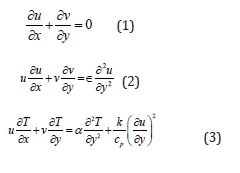
The governing equations are

Lupinepublishers-openaccess-computer-sciences-journal

where (u,v ) are the components of velocity in (x , y) directions, the kinematic viscosity T is temperature of fluid, the thermal diffusivity

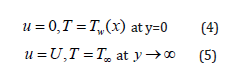
k the fluid thermal conductivity, ρc the fluid capacity heat and cp the specific heat. The relevant boundary conditions are defined as

Lupinepublishers-openaccess-computer-sciences-journal

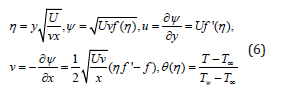
Where , Tw T are constants. Introducing the following dimensionless variables

Lupinepublishers-openaccess-computer-sciences-journal

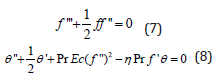
Utilizing equation (6), equation (1) is satisfied automatically and equations (2) and (3) characterize to the following problems statement

Lupinepublishers-openaccess-computer-sciences-journal

The related boundary conditions

Lupinepublishers-openaccess-computer-sciences-journal

Solution of the problem

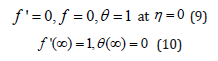
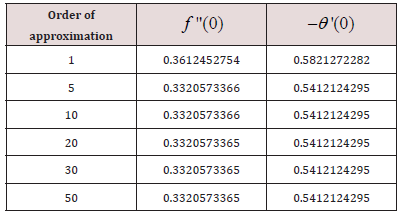
Here successive linearization method (SLM) [14-16] is implemented to obtain the numerical solutions for nonlinear system (8) and (10) corresponding to the boundary condition Eq. (11) – (13) (Table 1). The convergence for numerical values of f "(0) and −θ '(0) for different order of approximation when Ec = 0.01, Pr =1 and n =1.00 (Table 1).

Table 1: The convergence for numerical values of f "(0) and −θ '(0) for different order of approximation when Ec=0.01, Pr 1 and 1.00 Ec n=1.00.

Lupinepublishers-openaccess-computer-sciences-journal

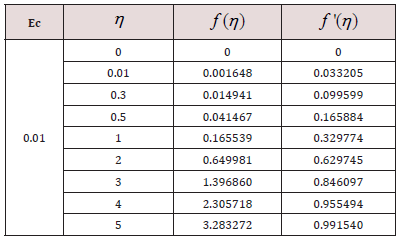
The numerical values of f (η ) and f '(η )when, n =1, Pr =1 for Ec= 0.01. (Table 2).

Table 2: The numerical values of f (η ) and f '(η ) when, n =1, Pr =1 for Ec = 0.01.

Lupinepublishers-openaccess-computer-sciences-journal

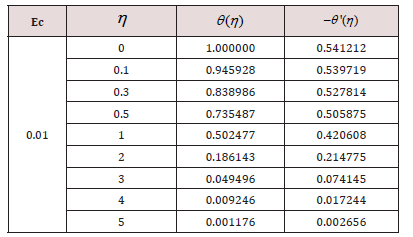
The numerical values of θ (η ) and −θ '(η )when, n =1, Pr =1 for Ec =0.01 (Table 3).

Table 3: The numerical values of θ (η ) and −θ '(η ) when, n =1, Pr =1 for Ec =0.01.

Lupinepublishers-openaccess-computer-sciences-journal

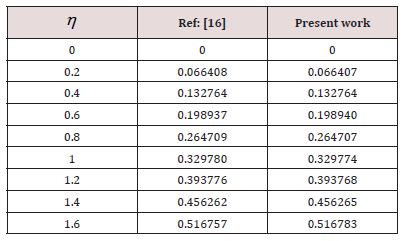
Comparison of numerical values of f (η ) with Ref: [16] when, n= Ec = 0, Pr =1 (Table 4).

Table 4: Comparison of numerical values of f (η ) with Ref: [16] when, n= Ec = 0, Pr =1.

Lupinepublishers-openaccess-computer-sciences-journal

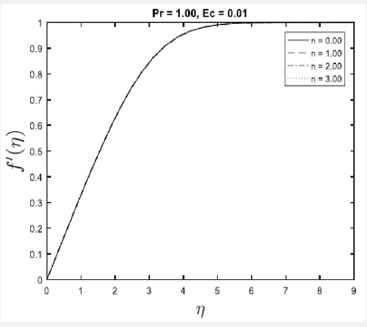
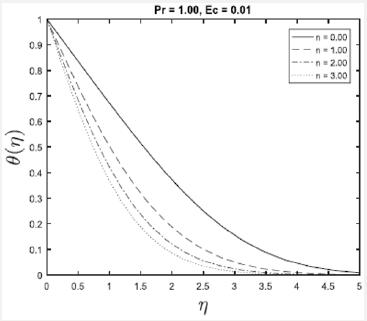
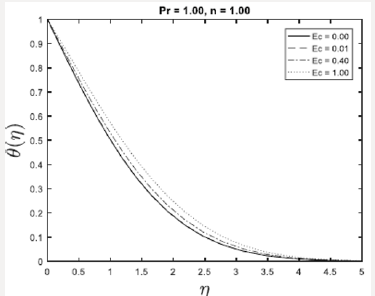
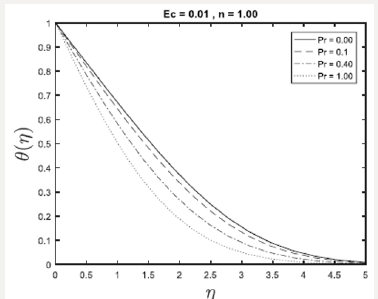
This section concerns with the graphical illustrations obtained by using successive linearization method for velocity, temperature profiles. These profiles show the variations of embedded flow parameters in the solution expressions for heat transfer analysis for an incompressible viscous fluid. The physical interpretation of the problem has been discussed in Figures 1 – 4. These figures are plotted in order to illustrate such variations. Here the graphs have been determined for the heat transfer flow of steady Newtonian fluid. Figures 1 & 2 shows the effects of the parameter on the velocity profile for f '(η ) and θ (η ) when Ec, Pr are fixed. It is worth noticing that by increasing the parameter η reveals that buoyancy because of augments of gravity which boosts on the velocity. Figure 3 is sketched for the variation of Prandtl number Pr on θ (η ) . It is noted that for lager Pr ,the thermal field is lower and then this reduce the temperature. In fact law Prandtl number Pr assist fluid with higher thermal conductivity and this create thicker thermal boundary layer than that for lager Pr. Finally, Figure 4 shows the effect of Ec on velocity and temperature profiles over the plate, and we note that by increasing in Ec parameter is seen that the effect is very big for the temperature.

Figure 1: Effects of n and f '(η ) .

Lupinepublishers-openaccess-computer-sciences-journal

Figure 2: Effects of n and θ (η ) .

Lupinepublishers-openaccess-computer-sciences-journal

Figure 3: Effects of Ec for θ (η ) .

Lupinepublishers-openaccess-computer-sciences-journal

Figure 4: Effects of Pr for θ (η ) .

Lupinepublishers-openaccess-computer-sciences-journal

Conclusion

In this research, the problem of heat transfer of an incompressible viscous fluid over flat pate is solved numerically. The numerical solutions are well established by SLM. The influence of various parameters is shown through different graphs. The present results have been tested and compared with the available published results in [16], in a limiting situation shown in tables v and an excellent agreement is found [17].

Read More About Lupine Publishers Journal of Computer Sciences & Applications Please Click on Below Link https://computer-sciences-lupine-publishers.blogspot.com/