Showing posts with label Gynecology and women health Journals. Show all posts

Saturday, 22 May 2021

Lupine Publishers | Agroecological Situation in Wintering Pastures in Azerbaijan, Problems and Solutions (in the Gobustan district)

 Lupine Publishers | Journal of Gynaecology and Women's Healthcare

Keywords: Pasture lands; Pastures; Pastures; Surface improvement measures; Climatic elements; Agroecological evaluation

Editorial

Annotation: Natural and anthropogenic impacts of natural soil, grass cover and mainly pasture (degradation areas), degradation and desertification of forest ecosystems have led to a dramatic decline in the feed base for animal husbandry development. For a well-known purpose in the country of strategic importance, the assessment of existing natural and cultural pasture areas in the country from their agroeconomic security perspective, using scientifically-based research in the field of approach and the use of effective methods is a problem that is relevant to agrarian science. Here is a summary of Gobustan analyzes the modern agroecological situation of the pastures, evaluates land and agroechemical grouping and so on. it is emphasized that it is important to carry out comprehensive measures to improve the quality of the area in the affected areas.

Introduction

The fact that agriculture has been degraded by important degraded lands in the Republic of Azerbaijan, including the natural pasture and mowing areas, is a consequence of their lack of productivity due to the use of animal breeding for their development purposes. On the other hand, the structure of the oath is low in the high nutritional concentrates causing excessive loading of natural forage areas, erosion and salinization of land as a result of their uncontrolled exploitation, serious damage to the country’s forest resources, water resources and the environment as a whole. Efficient utilization of land resources, improving fertility, restoration, protection and productivity management are essential for the development of agrarian sector in Azerbaijan and should be carried out on a day-to-day agroecological basis. In addition to the development of agriculture in the country, the development of livestock and grazing agriculture, which is one of the main directions of agriculture, requires the expansion of the pastureland and pasture areas and increase the production of feed for internal resources.

From this point of view, the object of the research confirms that the severe degradation processes observed in winter grazing in the selected Gobustan district cause the occurrence of less productive land areas to endanger crop rotation. From this point of view, research is being carried out in order to increase productivity through more progressive methods in the country, to improve the protection of summer pastures and mowers, to increase their use and to preserve biodiversity [1-9]. Rationale for Research: The main reason for irrational changes in natural resource potential is pasture plowing, large-scale agromeliorative work, excessive livestock grazing and strong man-caused effects. Thus, the problem of increasing the number of livestock is the irreversible stages of overgrazing as pasture degradation. Herbaceous degradation leads to a reduction in biodiversity, fragmentation of the biosphere structure and the inability of the ecosystem to control and regenerate itself. The creation of a solid feed base, which is the basis for the improvement of our pasture ecosystems, which is the main habitats for the flora and fauna of the region, as well as the basis of the capacities of the country’s economy, is a part of the well-known State Program. Along with these, the research merit is a problem of relevance to the needs of the day in the current market economy and expects its own scientifically-researched research with researches.

Object of research: The main purpose of the research was to expand the pastures and grazing areas through the application of the results, using the latest research methods in the complex approach of agroecological features of the country’s winter pastures in Gobustan region. Object of research: The winter grazing areas located in the territory of Qobus region as their object of research were their main soil and vegetation cover. Research Methodology: Conducting soil erosion surveys accompanying the practice of grassland landscapes, monitoring of dangerous gray-brown soils of widespread erosion in the study site, and analyzing the results, agroecological assessment based on academician GS Mammadov’s common methodology [5]. Analyzes have been made of [2,7] methodologies taken from soil and plant samples taken from the field of soil research and field studies studies for laboratory studies in selected field of practice. The main criterion for evaluation of grazing lands was the objective indicators affecting their genetic and agrochemical quality: total humus, nitrogen, phosphorus, potassium, total absorbed bases: 0-20 cm; 0 to 50 cm; Reserve 0-100 cm. Reserves of the selected agrochemical indicators (t / ha) were calculated on the generally accepted formula for soil layers. During the research, the same plot of land, plant, landscape, geobotany maps and archive map fund of ANAS Institute of Soil Science and Agrochemistry were used [4,8].

Research progress and analysis of results

It was noted that the total area of the land area of the cadastral region is 601.0 hectares and covers the flat and foothills of the district. The main types of landscapes are semi-desert and mediumsized dry steppes. Depending on the degree of moisture (Md-0.10- 0.15), the terrain belongs to the zonal zone. The average annual precipitation is 250-450 mm. The district is completely heated. The total of temperatures above 100 is 4700-38000. The winter is soft here. The length of the vegetation period is 226-211 days [1,4,5]. Mainly gray-brown (brown), light gray-brown (chestnut), common gray-brown (chestnut), grass-gray, gray gray, light gray, primrose, grass-grass, forest grass, wet grass soils have spread. Grass-brown, grass-gray and gray soil types are widely used in agriculture. However, in the pastures, the soils of these lands are widespread and saline, clay, and heavy-grained soils.

In general, winter pastures spread over the cadastral plains cover 119.3 thousand hectares, which is distributed in administrative districts as follows: Yevlakh (left bank) - 7,700 hectares; Agdash - 9,5 thousand ha; Goychay - 6.6 thousand ha; Ujar - 19,5 thousand ha; Zardab - 19.5 thousand ha; Kurdemir - 51,0 thousand ha. The distributed lands in these districts were evaluated with the following points [4]: dark-brown-brown-100 points; gray-brown-85; light gray-brown-73; dark gray-meadow-90; gray-meadow-71; gray grass-60; grass-boz-88; grass-gray-brown -75; Subasar meadow-67; gray-63; open-gray-54; elementaryboz- 54; meadow-forest-86; wet grass-58; gray-brown - 57 points. These points are according to the type and semi-type of land on the main bonitet scatter of the land allocated by Academician G.Sh. Mammadov [6].

These lands, which are widely spread in the pasturelands, include erosion, salinity, salination, aridization, desertification and so on. an open skyscraper was established, taking into account the correlation coefficients on the indicators, so that it was possible to divide the land into qualitative groups. It has been found out that in the main grazing areas of the cadastral region, saline, saline, clay, heavy gilles, soils have been widely spread. For the known purpose, the soil erosion research carried out by the Institute of Soil Science and Agrochemistry in our field shows that the erosion process is widespread in this region [3,4] (Table 1). Here, the eroded soil loses its structure, the soil is mixed, the carbonates grow, the amount of absorbed bases is reduced, the mother liquor goes to the surface, and the food is washed away.

Table 1: Economic Burden of COPD in India.
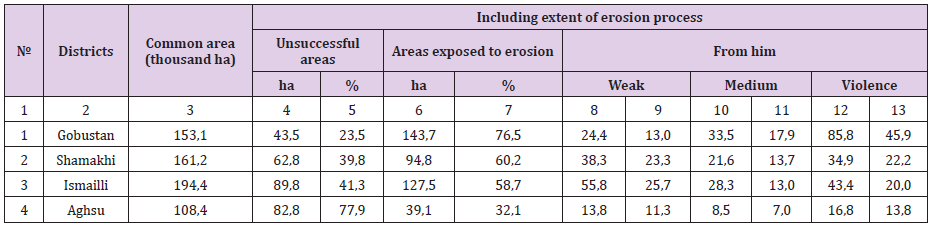
From the morphones of the cuttings of the area, it appears that significant changes have occurred in the genetic layer of eroded soils. Here, the volume and specific weight of water-physical properties of eroded soils significantly increased in heavily soaked soils: 1.15 g / cm3; 2,62 g / cm3 and porosity 55,20%. It was found out in the study that in the average degree of soils, 1,09 g / cm3, 2.57 g / cm3; the porosity was 53.45%. It has been noted that the humus, the total nitrogen content of the erosioned soil has dropped significantly in the heavily soaked soils: 1,50% humus; 0,084% of total nitrogen. On average, this figure is 4,29%; 0.225%. The mechanical composition of these lands we are researching is clay soils: the amount of physical clay has been 75.20% -63.60%. Because of the erosion process, the erosion process has become much worse in the structural and aggregate composition of soils. In the heavily soiled soils, the size of 1 mm large aggregates is 52.68%, and water-resistant aggregates are 21.20%; these figures are 60.85% in moderately soiled soils; 33.80%. The ability to absorb gray-brown soils has also declined as a result of the erosion process. The amount of bases absorbed here has reached 17.5 mg / sq. / 13.0 mg / eq, and 37.0 mg / eqw-26 mg / eV in moderate wash. It should be noted that in these eroded soils, the quantity of mesopharynphous phosphorus has diminished, and the nitrogen forms - water-soluble ammonia, absorbed ammonia, nitrates have been reduced.

From the analysis of our research results, it is concluded that by applying complex agro-meliorative measures, it is possible to increase the productivity of pastures in the reserve. Thus, various plants (phytomeliorants, clover, rye, raspberries, rye, etc.) have a positive impact on soil fertility, aggregation intensity of nutrients in soil, physical-chemical and agrophysical properties of soil. In many respects, it has been proven that the application of the fertilization system under the clover plant (with different norms and proportions) plays an exceptional role in improving soil fertility parameters, water-physical properties and improving the food regimen of the cultivated plant, impacts the effect [2,4,9]. In accordance with the recommendations of Prof.B.H.Aliyev, mineral fertilizers are delivered more effectively to the localized root system, not to the whole area, in order to increase the economic efficiency of fertilizers and reduce the negative impact of their application on the environment.

This method basically yields more fruit and viticulture. The author believes that the use of progressive irrigation methods in the current shortage of water is unavoidable for the fertilizers to be supplied with irrigation water, which increases the productivity of the nutritional components of the plant, increases productivity, improves its water-physical properties and improves soil fertility , which is, in its turn, one of the most crucial methods of struggle for the development of the erosion process, and is a broad-spectrum practice, as an urgent measure. From these recommendations, it can be concluded that the cadastral region can be substantially improved by means of surface improvement aimed at the prevention of winter pastures soils erosion [3,8,9].

Results

a) The 40% of our researchers are eroded, salty, and salty. it is necessary to use perennial herbs to improve the fertility of these clay and heavy-clay soils. It is possible to improve the soil fertility by giving it mineral fertilizers under the grass, taking clover sage and mixed sowing.

b) Leguminous herbs are indispensable in the fight against erosion. This grazing soil enriches with organic residues, and its roots extend to the surface by absorbing calcium from the lower layers of the soil, improves soil structure, improves water resistance, enriches soil erosion elements, and improves soil fertility.

c) Through the use of erosion control measures, the complex surface improvement in winter pasturelands will allow for the recovery and expansion of natural pastureland, resulting in the availability of cheap and high-quality feed, which is essential for the development of livestock breeding in the country, is achieved.

Read More About Lupine Publishers Journal of Gynecology Click on Below Link:"
https://lupinepublishers-gynecology.blogspot.com/

Friday, 26 February 2021

Lupine Publishers | On Mammography and Hormone Replacement Therapy

 Lupine Publishers | Journal of Gynaecology


Introduction

About 250 years ago, French philosopher Francois-Marie Arouet Voltaire, wrote:

“Doctors prescribe medicine of which they know little, to cure diseases of which they know less, in human beings, of which they know nothing”.

Has this state of affairs changed very much since then? I believe so. However, many would argue “hardly”, aside from new technological advances and certain heroic surgical procedures. Our model continues to be population-based (also known as “mass medicalization”) rather than patient-centric. Further, notwithstanding the current dogma on “evidence-based” medicine, meaning that the health care provided is based on solid scientific evidence of utility, a large proportion of tests and prescriptions used frequently have little or no such supportive evidence. Another flaw of today’s “evidence-based” medicine is what has been termed “eminence-based” medicine wherein experts make recommendations or “guidelines” for a large proportion of decisions for which no or minimal data exists. These guidelines have a pronounced impact, as they are believed to represent the standard of care, even though they are based on opinion with a paucity of facts. Actually, even the prestigious U.S. Institute of Medicine concluded that “any valid evidence supports “well below half” of the practice of medicine (!)”. Examples abound such as, statins and statin combinations, prostate specific antigen tests, mammography, hormone replacement therapy, etc., I will discuss here mammography and hormone replacement therapy, which are of particular importance in women’s healthcare.

Mammography

Mammography for breast cancer screening for women parallels the prostate specific antigen (PSA) test in men. This imaging test uses low-energy X-radiation to examine the human (female but also male) breast. It is used both as a screening and a diagnostic test. The goal of any screening procedure is to examine a large population of patients to find that small number most likely to have a serious condition. These patients are then referred for further, usually more invasive, testing. Thus a screening exam is not intended to be definitive, rather to have sufficient sensitivity to detect a useful proportion of cancers. The cost of higher sensitivity is a larger number of results that would be regarded as suspicious in patients without disease. In mammography, the goal is the early detection of breast cancer through the detection of characteristic masses and/or micro-calcifications. Its use as a screening tool for the detection of early breast cancer in otherwise healthy women without symptoms is controversial. Like all X-rays, mammograms use doses of ionizing radiation (lower than those employed in bone radiography) to create images that are subsequently analyzed for any abnormal findings.

A. Adjunct procedures to mammography are:

a. Ultrasound: For further evaluation of masses, including palpable masses not seen on mammograms;

b. Ductography (not generally used): For further evaluation of questionable findings as well as for screening pre-surgical evaluation in patients with known breast cancer to detect any additional lesions that might change the surgical approach, for instance from breast-conserving lumpectomy to mastectomy;

c. Magnetic resonance mammography: For greater spatial resolution of mammographic tissue imaging;

d. Positron emission mammography; and

e. New procedures, including breast tomosynthesis.

B. Currently recommended guidelines for having mammography screening tests for the average woman are:

a. U.S. Preventive Services Task Force (2009): Screening of women aged between 40 and 49 should not be routine but based on individual’s risk factors and values (because the benefits of screenings do not outweigh the risks). Every two years between the ages of 50 and 74;

b. American Cancer Society, American College of Radiology, American Congress of Obstetricians and Gynecologists: Annually beginning at age 40;

c. National Cancer Institute: Every one to two years for women ages 40 to 49;

d. American College of Physicians: Individualized screening plans as opposed to wholesale biannual screening of women aged 40 to 49;

e. Canadian Task Force on Preventive Health Care (2012): Every 2-3 years between the ages of 50 and 69. It found that for women aged 50-69, screening 720 women once every 2-3 years for 11 years would prevent 1 death from breast cancer. For women age 40-49, 2100 women would need to be screened at the same frequency and period to prevent 1 death from breast cancer; and

f. European Cancer Observatory (2011): Every 2-3 years between the ages of 50 and 69.

The reports from the above task forces note that the risks of more frequent mammograms include a small but significant increase in breast cancer induced by radiation, a risk that is greater for younger women. On the other hand, the Cochrane Collaboration (2011) analysis of screening further concluded that: “Mammograms reduce mortality from breast cancer by an absolute amount of 0.05% or a relative amount of 15%, but also result in unnecessary surgery and anxiety such that it is not clear whether mammography screening does more good than harm... and that universal screening may not be reasonable”. It also states that “the best quality evidence does not demonstrate a reduction in mortality generally or a reduction in mortality from all types of cancer from screening mammography”. In addition, the Nordic Cochrane Collection (2012) states that “advances in diagnosis and treatment make mammography screening no longer effective today in decreasing deaths in breast cancer, and therefore no longer recommend routine screening for healthy women at any age as the risks might outweigh the benefits... and warns of misleading information on the internet”. Further, their analysis showed that “one in 2,000 women will have her life prolonged by 10 years of screening, however, another 10 healthy women will undergo unnecessary breast cancer treatment. Additionally, 200 women will suffer from significant psychological stress due to false positive results”.

Repeated mammography starting at age 50 saves about 1.8 lives over 15 years for every 1,000 women screened. This result must be gauged against the negatives of errors in diagnosis, overtreatment and radiation exposure. Also, screening mammography does not reduce death overall, but causes significant harm by inflicting cancer scare and unnecessary surgical interventions. About 7% (more realistically, 10%-15%) of women screened with mammography will be called back (with great distress) for a diagnostic session. However, most of these recalls will result in “false positive” results. For 1,000 recalls, about 60 will have benign growths and 10 will be referred for a biopsy (of which about 3.5 will have a cancer of which about 2 will be a low stage cancer that will be essentially cured after treatment, and 6.5 will not). Mammography may also produce “false negatives” (not seeing the cancer), usually around 10%-30%, and due to

(a) observer error,

(b) cancer hidden by other dense tissue in the breast, and

(c) Cancer overlapping normal tissues.

Furthermore, one form of breast cancer, lobular cancer, has a growth pattern that produces shadows on the mammogram which are indistinguishable from normal breast tissue. A meta-analysis review of programs in countries with organized screening found 52% over-diagnosis. Women whose breast cancer was detected by screening mammography before the appearance of a lump or other symptoms commonly assume that the mammogram “saved their lives”. In practice, the vast majority of these women received no practical benefit from the mammogram. There are four categories of cancers found by mammography:

i. Cancers that are so easily treated that a later detection would have produced the same total cure (that is, the woman would have lived even without mammography);

ii. Cancers so aggressive that even “early” detection is too late (the woman dies despite detection by mammography);

iii. Cancers that would have receded on their own or are so slow-growing that the woman would die of other causes before the cancer produces symptoms (mammography results in overdiagnosis and over-treatment); and

iv. The small number of breast cancers that are detected by screening mammography and whose treatment outcome improves as a result of earlier detection. Clinical trial data suggest that 1 woman per 1,000 healthy women screened over 10 years falls into this category. Screening mammography produces no benefit to any of the remaining 87% to 97% of women.

C. In summary

The guidelines for screening mammography advocated by the several professional associations or/and governmental organizations are conflicting and even confusing. Would it not be helpful for patients if these entities were to agree to a uniform set of guidelines (even though these would still be “guidelines”)? Further, because mass screening as a tool for the detection of early breast cancer in otherwise healthy women without symptoms is controversial, shouldn’t this screening be conducted on an individual basis and only in case of significant risk? Still further, since the radiation sensitivity of the breast in women under age 35 is greater than in older women, should it not be generally imperative that these women be screened only if there is a significant risk of cancer (such as, BrCa positive, very positive family history, palpable mass) and even in these circumstances to employ ultrasound or magnetic resonance for imaging? Also, and likewise, should screening of women aged between 40 and 49 not be routine but based on individual’s risk factors and values (because the benefits of screenings do not outweigh the risks)? Additionally, beyond age 50, should screening not be conducted systematically and only infrequently at appropriate time intervals to be defined? Lastly,based on the important Cochrane Collaboration and the Nordic Cochrane Collection, should not routine screening be discouraged for healthy women of any age as the risks might outweigh the benefits? The above provides more evidence that population medicine (in this case, mass screening) disregards individual variability and promotes considerably more unnecessary medical testing and procedures.

Conclusion

a. Since the guidelines for screening mammography advocated by the several professional associations or/and governmental organizations are conflicting and even confusing, this screening should be conducted on an individual basis and only in case of significant risk.

b. Since the radiation sensitivity of the breast in women under age 35 is possibly greater than in older women, it would be generally imperative that these women be screened only if there is a significant risk of cancer (such as, BrCa positive, very positive family history, palpable mass), and even in these circumstances the screening should employ ultrasound or magnetic resonance for imaging.

c. Screening of women aged between 40 and 49 should not be routine but based on individual’s risk factors and values (because the benefits of screenings do not outweigh the risks).

d. Beyond age 50, screening should not be conducted systematically but only infrequently at appropriate time intervals to be defined.

e. Based on the important Cochrane Collaboration and the Nordic Cochrane Collection, routine screening should be discouraged for healthy women of any age as the risks might outweigh the benefits. Whereas much more could be said about the mammography test, I would now like to proceed to the example of hormone replacement therapy.

Hormone Replacement Therapy

Hormone replacement therapy (HRT) refers to any form of hormone therapy wherein, in the course of medical treatment, the patient receives hormones, either to supplement a lack of naturally occurring hormones or to substitute other hormones for naturally occurring hormones. We are here interested solely in HRT for menopausal women. The idea is that treatment may prevent the discomfort caused by diminished circulating estrogen and progesterone hormones or, in the case of the surgically or prematurely menopausal women, that it may prolong life and may reduce the incidence of dementia. It involves the use of one or more of a group of medications designed to artificially boost hormone levels. The main types of hormones involved are estrogens, progesterone or progestins, and sometimes testosterone. It is often referred to as “treatment” rather than therapy.

Many studies on the effects of HRT have been conducted on rats. Overall, the results of these studies are non-conclusive and more research in this area is needed. Nonetheless, some important results can be gathered:

a. Differing brain regions may respond in a variety of ways to HRT;

b. Timing of the therapy is integral to the chances of success; and

c. How the hormones are administered, either chronically or cyclically, may make an important difference in their effectiveness.

As recently as 2005, women have had a positive and overly optimistic attitude towards HRT. Currently, however, most women do not find HRT to be an effective solution: It is initially helpful but, if used for a long period of time, it loses its effectiveness, and there are times when it is not only ineffective but actually detrimental to people. In the case of menopausal women, HRT has had the following adverse effects:

a. Impaired hearing including decrease in the functionality of many regions of the ear,

b. Reduction of the effectiveness in parts of the central nervous system used for hearing, and

c. Increased chance for cardiovascular disease (particularly in the case of women caregivers who experience more acute stress in their lives).

However, HRT can have beneficial effects:

a. Positive effects on the prefrontal cortex by boosting the working memory,

b. No additional weight gain compared to women who do not use HRT, and

c. Positive effects in their sex life (mainly increasing their sex drive and sexual sensitivity) that can dissipate after receiving HRT for extended periods of time ... but the effects are inconsistent across women. For decades, HRT was widely recommended to women to reduce heart disease.

However, the Women’s Health Initiative (WHI) trial (over 16,000 post-menopausal women) compared the combination (estrogen + progestin) to placebo. The findings included significant increases in breast cancer, heart disease and heart attacks, strokes, and dangerous blood clots. These findings far over-rode the alleged benefit of less colon cancer and fewer hip fractures. The results of the WHI trial were so negative that it was stopped prematurely at 5.6 years (instead of the planned 15 years) of follow-up. New results released in 2011 continue to engender confusion, suggesting disparate outcomes with hormone replacement as a function of what age the treatment was initiated.

Nonetheless, after a slowing period following the announcement of the trial’s negative results, the practice continues under the guise (true perhaps for some women) that HRT (estrogen and/or progestin) palliates the unpleasant “hot flashes” post-menopausal women experience. But, this latter “benefit”, even if true, is not the premise on which HRT was advocated and sold. Of last note, a recent report in the Archives of Internal Medicine revealed that “post-menopausal women who were treated with statin drugs to lower their cholesterol had a nearly 48% increased risk of developing diabetes compared to those who were not given the drug. This is even more critical when we consider that becoming diabetic doubles the risk for Alzheimer’s disease. The combination (HRT + statins) is of serious concern.

Summary

Whereas initially helpful, HRT loses its effectiveness when used for a long period of time, and there are times when it is not only ineffective but actually detrimental. In the case of menopausal women, HRT has multiple adverse effects (impaired hearing including decrease in the functionality of many regions of the ear, reduction of the effectiveness in parts of the central nervous system used for hearing, and increased chance for cardiovascular disease particularly in the case of highly stressed women). However, it can also have beneficial effects (boosting the working memory, no additional weight gain, and positive effects in the sex life) that unfortunately can dissipate after receiving HRT for extended periods of time. Whereas significant increases in breast cancer, heart disease and heart attacks, strokes, and dangerous blood clots were found in a large and important clinical trial, HRT was discontinued for a time period but is witnessing resurgence for alleged other benefits (palliation of hot flashes). Again, even when the surrogate end point is no longer tenable, another surrogate end point is found to justify the continued use of the therapy (a common marketing ploy). What then is the key to the change in this population medicine paradigm? It resides in the 6 rights: “right” doctor, “right” screen test, “right” patient, “right” drug, “right dose”, and “right” cost. This should be tackled and hopefully implemented.

Read More Gynaecology and Women's Health Care Lupine Publishers Articles:
https://lupinepublishers-gynecology.blogspot.com/

Friday, 28 June 2019

Lupine Publishers-Gynecology Journals


Implantation of pregnancy outside the normal endometrial cavity called an ectopic pregnancy, which accounts for about 10% of all pregnancy-related deaths, despite improved diagnostic methods leading to earlier detection and effective treatment [1]. Also, it increases the chances of secondary infertility as well as incidence of the subsequent ectopic pregnancy [2]. The percentages of the women with ectopic pregnancy go to an emergency department with first trimester bleeding, pain, or both about (6 to 16%) [3]. Which is strongly associated with an increased incidence of pelvic inflammatory disease [4]. Symptoms may present in both ruptured and enraptured cases [5]. Ectopic pregnancy should be suspected in any woman of reproductive age with these symptoms, especially those who have risk factors for an extrauterine pregnancy [6]. The diagnosis is usually made clinically, based upon results of the imaging studies (ultrasound) and laboratory tests (hCG). The diagnosis can also be made by observation of the ectopic gestation at surgery or histopathological examination [7]. Transvaginal ultrasound (TVUS) is the principle approach used for sonographic evaluation of pregnancy of unknown location. TVUS allows for earlier and more reliable detection of an intrauterine or ectopic pregnancy (abdominal pregnancies are an exception) and for more reliable detection of a fetal heartbeat compared with transabdominal ultrasound (TAUS) [7]. A pseudosac can be seen in up to 20 percent of women with an ectopic pregnancy [8]. An extraovarian adnexal mass, seen in 89 to 100 percent of women with ectopic pregnancy, is the most common.com finding in tubal pregnancy.

This is a descriptive, prospective hospital-based study .It was conducted in Omdurman Maternity Hospital and Omdurman New Hospital. Sudan, during the period from August 2014 to Jan 2015 all women diagnosed clinically and by ultrasound with ectopic pregnancy attended study area were included in the study. Time-frame sample size was be taken in a period of six months from August 2014 to Jan 2015. Variables assessed were: sociodemographic data, previous ectopic pregnancy, contraceptive usage, tubal pathology and surgery, PID, clinical presentation, ultrasound findings and intra-operative findings. Intra-operative findings were correlated with clinical presentation, examination, and ultrasound findings. Sensitivity and specificity was calculated. The data was collected by direct interview using predesigned questionnaire. Abdominal ultrasound, and/or vaginal ultrasound were done to all the patients according to clinical presentation. Ultrasound was done by senior obstetrician and radiologist. The data was analyzed by computer program; statistical package for social science (SPPS), results presented in tables and graphs. The test of significance was be calculated by P value (0.05: 95% confidence). Written consent was obtained from SMSB provided to the hospital administration. Women consent was obtained verbally. Privacy of data collected was considered.


For more Lupine Publishers Open Access Journals Please visit our website: https://lupinepublishers.us/