Showing posts with label OAJBEB. Show all posts

Tuesday, 3 October 2023

Lupine Publishers | Evaluation of the Physicochemical and Thermal Properties of Antimony: Influence of the Energy of Consciousness Healing Treatment

 Lupine Publishers | Journal of Biomedical Engineering and Biosciences


Abstract

Antimony and its compounds are mainly used in the preparation of paints, flame-proofing materials, ceramic enamels, pottery, and glass as well as in the treatment of leishmaniasis. This study analyzes the effect of the Trivedi Effect®-Consciousness Energy Healing Treatment on the physicochemical and thermal properties of antimony in comparison to the untreated sample. The sample was divided into control and treated parts. The control part has not received any treatment; while the treated part was received the Trivedi Effect®-Consciousness Energy Healing Treatment by a renowned Biofield Energy Healer, Dahryn Trivedi, remotely. The particle size distribution of the treated antimony powder at d10, d50, d90, and D (4,3) was significantly altered by 4.05%, -1.40%, 11.92%, and 7.69%, respectively, compared to the control sample. Therefore, the treated sample showed a significant decrease in the specific surface area by 20.24% than the control sample. The powder X-ray diffraction peak intensities of the treated sample altered ranging from -58.50% to 10.38%; while the crystallite sizes were reduced ranging from of 14.07% to 48.70% compared with the control sample. The average crystallite size of the treated sample was also significantly reduced by 28.90%, compared to the control sample. The total weight loss was decreased during thermal degradation of the treated sample by 2.68%; however, the residue weight was significantly increased by 8.75% compared to the control sample. The maximum thermal degradation temperature was significantly increased in the treated sample by 11.49% (~60ºC) compared to the control sample. The overall study indicated the reduced surface area, altered crystalline properties, and improved thermal stability of the antimony sample after the Trivedi Effect®-Consciousness Energy Healing Treatment. Therefore, the Biofield Energy Treatment could be considered as a novel approach for generating a new polymorph of antimony that might help in improving its appearance, bioavailability, flowability, and thermal stability in comparison to the untreated sample. The Biofield Energy Treated antimony might be proved as beneficial in developing more efficacious nutraceutical/pharmaceutical formulations as well as in the heavy industries for the production of alloys, fire retardant, solders, electrical cables, microelectronics, bullets, plain bearings, etc.

Keywords: Antimony; Consciousness Energy Healing Treatment; The Trivedi Effect®; Particle Size; Crystallite Size; Weight Loss

Introduction

Antimony (Sb) is a silvery white metal in appearance and its compounds are mainly used in the preparation of paints, flame-proofing materials, ceramic enamels, pottery, and glass. However, its compounds have also been used medically after they were introduced in the 14th century by the alchemist John of Rupescissa [1]. The antimony compounds have main pharmacological use in the treatment of the parasitic diseases, leishmaniasis, and schistosomiasis. In 1631, the compound of antimony, potassium antimony tartrate, has been introduced by the German alchemist, Adrian Von Mynsicht; however, after that, the antimony compounds lost their value due to their toxic properties [2]. Later on, during 1918-1920, the interest in such compounds revived after the establishment of the medicinal value of tartar emetic by Christopherson and Rogers [3]. Since then, the antimony compounds have been used for the treatment of schistosomiasis and leishmaniasis. The examples of antimony compounds used in the treatment of schistosomiasis include sodium antimony dimercaptosuccinate, sodium antimony tartrate (astiban, stibocaptate), and sodium antimonyl gluconate, etc. [4,5]. Nowadays, the medicinal use of antimonials has been largely restricted to the treatment of leishmaniasis [6,7]. The antimony compounds that have been used in chemotherapy can be broadly divided into two classes:

a) carbon-antimony bond containing compound such as 4-acetylaminobenzenestibonic acid (Stib-acetin) and 4-aminobenzenestibonic acid (Stibamin);

b) antimony-oxygen or antimony-sulphur bonds containing compounds that further form an antimoniate ester.

The examples of such compounds included the trivalent and pentavalent antimonials, e.g., triostam, meglumine antimonate (glucantime), pentostam, stibocaptate, urea stibamine, stibophen, sodium antimony dimethylcystein, and MSb B, etc. [8]. Besides, the use of antimonials has also been evident as emetics [9]. The antimony compounds are also used in various veterinary preparations as a skin conditioner in ruminants, e.g., lithium antimony thiomalate and anthiomaline. It has a nourishing effect on the keratinized tissues in animals [10]. It was also reported that the compounds of Sb (III) might show antitumor activities with amino polydentate carboxylic acids for some metal ions coordinates such as, O, Ba, Bi, Co, Mn, Cu, Ni, Sn, Pb, and Zn [11]. The scientific studies reported that the in vivo application of such compounds showed an increase in the life span of mice induced with Ehrlich ascites tumour and spindle sarcoma [12,13]. The ADME profile of any drug has been decided mainly by its physicochemical properties such as melting point, solubility, partition coefficient, and crystalline properties, etc. play Thus, the scientific researches these days focus those approaches that might help in enhancing the efficacy and biological activities of drug by altering the physicochemical properties [14]. The Consciousness Energy Healing Treatment is such kind of approach that is used these days to modify the physicochemical, crystalline, and thermal properties of drugs for improving their role in the body [15-18]. The concept of Biofield Energy Healing is widely accepted as an alternative integrative approach due to its ability to correct the root cause of the diseases and thereby improve the quality of life [19- 21]. In the same manner, the Trivedi Effect®- Consciousness Energy Healing Treatment has also been reported for its beneficial impact in various fields. A human has the ability to transmit the energy to any living organism(s) or nonliving object(s) around the globe by harnessing it from the universe. The object or recipient that receives the energy always responds in a useful way. This process is known as the Trivedi Effect® - Biofield Energy Healing Treatment [22,23]. Various research studies reported the beneficial impact of The Biofield Energy Treatment in the field of biotechnology [24,25], antimicrobial activity [26-28], nutraceuticals [29,30], agriculture and productivity [31,32], bone health [33], cancer research [34], skin health [35], and metals, chemicals, ceramics and polymers [36- 38], etc. This study has the objective to establish the impact of the Trivedi Effect® on the physicochemical and thermal properties of antimony by using various analytical techniques.

Materials and Methods

Chemicals and Reagents

The test sample antimony was purchased from Parshwamani Metals, Mumbai, Maharashtra, India and the other chemicals used in the experiments were purchased in India.

Consciousness Energy Healing Treatment Strategies

The antimony sample used in the study was first divided into two parts. The first part of sample was not received the Biofield Energy Treatment and considered as the control sample. Besides, the second part of sample was received the Trivedi Effect®-Energy of Consciousness Healing Treatment under standard laboratory conditions for 3 minutes and known as the treated antimony sample. This Biofield Energy Treatment was provided remotely through the healer’s unique energy transmission process by the well-known Biofield Energy Healer, Dahryn Trivedi, USA, to the test sample. Later on, the control sample was treated with a “sham” healer for comparison purpose, who did not have any awareness about the Biofield Energy Treatment. Finally, both the samples were kept in sealed conditions and characterized using PSA, PXRD, and TGA/DTG analytical techniques.

Characterization

The particle size distribution (PSD) analysis of antimony powder was performed with the help of Malvern Mastersizer 2000 (UK) using the wet method [39,40]. The powder X-ray diffraction (PXRD) analysis of antimony powder also performed with the help of Rigaku MiniFlex-II Desktop X-ray diffractometer (Japan) [41,42]. The crystallites size was calculated using the Scherrer’s formula (1)

lupinepublishers-openaccess-journal-environmental-soil-sciences

Where G is the crystallite size in nm, k is the equipment constant, β is the full-width at half maximum, λ is the radiation wavelength, and θ is the Bragg angle [43]. Similarly, the thermal gravimetric analysis (TGA) of antimony powder was performed with the help of TGA Q50 TA instruments [44]. The % change in specific surface area, particle size, crystallite size, peak intensity, weight loss and the maximum thermal degradation temperature of the treated antimony powder was calculated compared with the control sample using the following equation 2:

lupinepublishers-openaccess-journal-environmental-soil-sciences

Results and Discussion

Particle Size Analysis (Psa)

The impact of the Biofield Energy Treatment on the particle size distribution and surface area of antimony powder were performed and the results were compared with the particle size data of the control sample (Table 1). The particle sizes at d10, d90, and d (4, 3) of the treated sample were observed to increase by 4.05%, 11.92%, and 7.69%, respectively; while the particle size at d50 was slightly reduced by 1.40%, as compared to the control sample. The significant increase in the particle size resulted in the reduced surface area of the treated sample by 20.24% after the Biofield Energy Treatment, in comparison to the control sample. It was previously reported that the particle sizes of compounds might increase after increasing the thermal energy. Thus, it could be assumed that the Biofield Energy Treatment might increase the thermal energy within the molecules of antimony sample, which helps in decreasing the nucleus densities and thereby resulted in the increased particle size [45,46]. Besides, the increased particle size might be associated with the improved shape, flowability, appearance, and compactibility [47,48] of the treated sample as compared to the control sample.

Table 1: Particle size distribution of the control and treated antimony.

lupinepublishers-openaccess-journal-environmental-soil-sciences

Powder X-Ray Diffraction (PXRD) Analysis

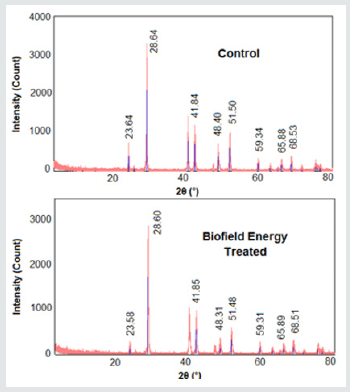
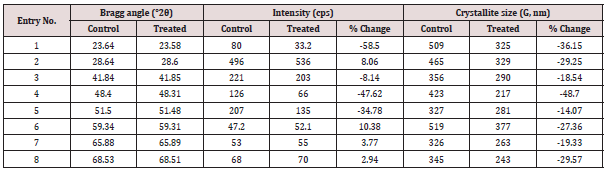
The PXRD analysis was done in both the samples and the corresponding diffractograms are presented in (Figure 1). The diffractogram of the control and treated sample showed sharp and intense peaks that indicated their crystalline nature. The further study analyses the changes in the intensities of peaks, and the corresponding crystallite sizes between the control and treated sample (Table 2). The treated sample showed significant changes in the peak intensities and corresponding crystallite sizes. The intensities of the treated sample were altered ranging from -58.50% to 10.38%; while the crystallite sizes were decreased ranging from 14.07% to 48.70%, as compared to the control sample. Also, the treated sample showed a significant reduction in the average crystallite size (290.63 nm) by 28.90% in comparison to the control sample (408.75 nm). The significant alteration in the intensities and crystallite size indicated the altered crystalline structure and morphology of drug that might be possible due to the new polymorph generation of antimony powder [49,50] after the Biofield Energy Treatment. Moreover, it was reported that the polymorphic form of the compound might be helpful in improving the bioavailability and efficacy profile of the drug [51]. Therefore, the treated sample might show better bioavailability and efficacy than the control sample.

Figure 1: PXRD diffractograms of the control and treated antimony.
lupinepublishers-openaccess-journal-environmental-soil-sciences

Table 2: PXRD data for the control and treated antimony.
lupinepublishers-openaccess-journal-environmental-soil-sciences

Thermal Gravimetric Analysis (TGA)/ Differential Thermogravimetric Analysis (DTG)

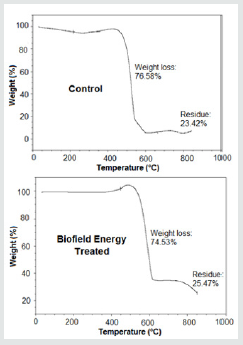
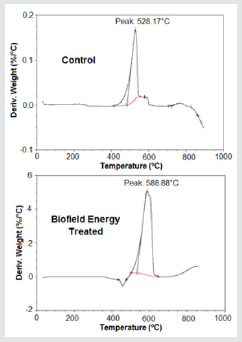
The TGA/DTG technique helps in establishing the thermal degradation and stability profile of the sample. In this study, this technique helps in analysing the difference in the thermal stability profile of the treated sample compared to the control sample. The TGA thermograms (Figure 2) of the control and treated samples showed significant weight loss during their thermal degradation. The data indicated that the total weight loss of the treated sample was reduced by 2.68% after the Biofield Energy Treatment in comparison to the control sample (Table 3). Such a reduction in the weight loss signifies the increase in the residue weight of the treated sample by 8.75% after the thermal degradation, compared to the control sample. Such changes in the thermal degradation pattern might be attributed to the significant increase in the particle size of the treated sample after the Biofield Energy Treatment as the large sized particles might reduce the thermal degradation, compared to the control sample [52]. The DTG thermograms of both the samples, i.e., the control and treated samples were showed a single peak in both the thermograms (Figure 3). The peak present in the thermograms of both the samples (Tmax) denoted the temperature at which maximum thermal degradation has taken place. The results revealed that the Tmax of the treated sample was significantly increased by 11.49% (~60o C) as compared to the control sample. Hence, it could be suggested that the thermal degradation of the treated sample was reduced after the Biofield Energy Treatment in comparison to the control sample. Thus, the overall analysis indicated the improved thermal stability profile of the treated sample as compared to the untreated sample. It would be more important in the pharmaceutical industry as well as in the heavy industries for the production of alloys, fire retardant, solders, electrical cables, microelectronics, bullets, plain bearings, etc.

Figure 2: PXRD diffractograms of the control and treated antimony.
lupinepublishers-openaccess-journal-environmental-soil-sciences

Figure 3: DTG thermograms of the control and Biofield Energy Treated antimony.
lupinepublishers-openaccess-journal-environmental-soil-sciences

Table 3: TGA/DTG data of the control and treated samples of antimony.

lupinepublishers-openaccess-journal-environmental-soil-sciences

Tmax = the temperature at which maximum weight loss takes place in TG or peak temperature in DTG.

Conclusion

In this study, the Trivedi Effect®-Consciousness Energy Healing Treatment has been shown its significant impact on the physicochemical and thermal properties of antimony sample in comparison to the untreated sample. The particle size distribution of the Biofield Energy Treated antimony powder at d10, d50, d90, and D (4,3) was significantly altered by 4.05%, -1.40%, 11.92%, and 7.69%, respectively, compared to the control sample. Therefore, the Biofield Energy Treated sample showed a significant decrease in the specific surface area by 20.24% than the control sample. The powder X-ray diffraction peak intensities of the Biofield Energy Treated sample altered ranging from -58.50% to 10.38%; while the crystallite sizes were reduced ranging from of 14.07% to 48.70% compared with the control sample. The average crystallite size of the Biofield Energy Treated sample was also significantly reduced by 28.90%, compared to the control sample. The total weight loss was decreased during thermal degradation of the Biofield Energy Treated sample by 2.68%; however, the residue weight was significantly increased by 8.75% compared to the control sample. The maximum thermal degradation temperature was significantly increased in the Biofield Energy Treated sample by 11.49% (~60ºC) compared to the control sample. Hence, the overall study indicated the significant impact of the Trivedi Effect®-Consciousness Energy Healing Treatment on the antimony powder that might form a novel polymorph of antimony with improved appearance, compatibility, and flowability along with increased thermal stability as compared to the control antimony sample. Thus, the Biofield Energy Treated antimony could be used in the novel pharmaceutical/ nutraceutical preparations with improved performance and efficacy profile for the treatment of disorders such as leishmaniasis, and other uses such as emetics, veterinary preparations, skin conditioner in ruminants, and anti-tumor agent, etc. Besides, it can be more useful in heavy industries for the production of alloys, fire retardant, solders, electrical cables, microelectronics, bullets, plain bearings, etc.

Acknowledgement

The authors are grateful to Central Leather Research Institute, SIPRA Lab. Ltd., Trivedi Science, Trivedi Global, Inc., Trivedi Testimonials, and Trivedi Master Wellness for their assistance and support during this work.


Read More About Lupine Publishers Journal of Biomedical Engineering and Biosciences Please Click on the Below Link: https://biomedical-sciences-lupine-publishers.blogspot.com/


Tuesday, 8 August 2023

Lupine Publishers | Role of Complementary and Alternative Medicine In Treatment and Prevention of Obesity; Molecular Strategies to Recommended Acceptance

 Lupine Publishers | Journal of Biomedical Engineering and Biosciences


Introduction

The incidence of obesity is increasing at an alarming rate which has led to a surge the obesity-related morbidity in the world. It is now a most evident problem in world’s population therefore, it needs to be addressed [1]. According to WHO, obesity is defined as BMI equals to or greater than 30 kg/m2 which is the accumulation of fat in adipose tissue to such an extent that may be fatal [2]. Obesity is now replacing malnutrition, infectious and contagious diseases as the most vital contributor to ill health. The obesityrelated health problem poses a burden on the health care system and lowers the quality of life of obese people. Particularly, it causes many chronic conditions like hypertension, cardiovascular diseases, diabetes type, kidney stones, respiratory issues, gout, arthritis, stroke, chronic fatigue sleep disorders and certain types of cancer such as breast and prostate cancer [2,3].The epidemic of obesity is due to a sedentary lifestyle, minimal or no physical activity, intake of saturated fatty acid, high calories carbohydrates, carbonated drinks, and preserved food and sometimes genetic involvement is susceptible [4] .Without modifying lifestyles through culture and environment, it would be difficult to attain healthy life patterns. Improved patient health, quality of life and reduced cost of care of patients with obesity and other obesity-related health issues will not be recovered and resolved by clinical interventions alone [5-7]. Obesity or overweight is always perceived to be due to high levels of calories intake and low level of physical activity, therefore, lowcalorie diet and enhance physical activity is presumed to be the foremost treatment for obesity. Although increased physical activity helps obese patients to combat various health problems or even lowers the risk of coronary artery diseases, hypertension, diabetes, and stroke. However, there are some other methods which help patients to fight obesity under restricted or non-restricted diet patterns [8,9]. There is new literature for the chronic care model which integrates both clinical and community system to address chronic problems, for instance, the use of complementary and alternative medicine [10]. National Centre for Complementary and Alternative medicine elaborated the term Complementary and alternative medicine as “a collection of diverse medical and healthcare system, practices, and products which are not considered as a current health care system” [11]. Due to increased public awareness through mass media, advertisement, and internet, people nowadays, are more attractive towards the use of comparative and alternative treatment to reduce weight and to get rid of body fat. Social pressure regarding body weight/size and desire to look smart compels obese subjects to use complementary and alternative medicine and they are massively used due to their short term and early effects [6,11]. In recent years, CAM therapies are widely used in addition to conventional medical treatment and people thought that they are extremely effective. However, until now, there are inadequate researches regarding the effectiveness and efficacy of CAM therapies for reducing weight and most of the current literature have fundamental methodological problems, they have significant health benefits along with major healthrelated risk factors [6]. When it comes to reducing weight and becoming smart, there is a wide range of complementary medicines available in the form of herbal supplements, they have little effect. Moreover, they help to reduce weight and as soon as you left those medicines, you will gain more weight than ever before so, this is one of the serious and alarming side effects of using complementary medicine. Examples include the use of herbal products, dietary supplements and over the counter medicine for shedding weight, although they have adverse side effects significant effect can be achieved when used in combination with allopathic medicine [12]. Furthermore, people are more inclined towards the ancient practices such as dry needling: acupuncture; visits to complementary clinicians like naturopaths, homeopaths, and chiropractors; and meditative and thoughtful practices such as Reiki, yoga, massage, and tai chi. They may have adverse effects and can cause physical injury as well. Therefore, there is the impetus for physician knowledge of CAM strengths versus drawbacks and collaborative integration of CAM in clinical practice of physicians so that maximum benefit could be achieved [13,14]. Although, it is one of the vital factors to teach and educate medical students at universities and hospitals about CAM; which can be assumed as a “bottom-up” approach for preparing the health care system for improved integration of CAM. However, “top-down” changes are required and suggested to enhance patient care and health [15]. The top-down approach proposes to better illustrate CAM’s role in contemporary health care, modifications must originate from governing organizations and administrations in the form of clearer recommendations. There is no clear agreement with the medical community regarding the efficacy of CAM therapies [15,16]. There is a serious need to discuss at social and legislative levels to even include it as an integrated part of the curriculum in the medical syllabus and also as a complementary framework in medicinal and health sciences under specific clear outcomes. It is very important to have approval and commandments for the use for Cams so that physician should recommend CAM in specific circumstances. This inconsistency advocates a lack of consistency in the consideration of therapeutic effects of CAM when publishing these guidelines and may feed underlying negative insights of the validity of CAM within the medical community [17-20]. In such cases where the efficacy of certain medications has proven scientifically should be recommended by the physician based recommended combination of CAM with traditional medicines. For instance, if a plant like Hoodia Gordonii, which is a member of the Asclepiadaceae (the milkweed family), is associated with appetite inhibition and few scientific studies are conducted on chief features (bioactivity of its biological ingredients, clinical application, in vivo biopharmaceutics, and safety) of this anti-obesity plant. Obviously, this has brought about a considerable concern, as H. gordonii is among the most popular organic anti-obesity products. In such cases, where the efficacy of certain medications has evidenced scientifically; should be recommended by physicians a recommended combination of CAM with traditional medicines [21]. Diet and deficiency of exercise are the old reasons for obesity, and in the last two decades, genetic factors are under research and identification to be involved in obesity [22]. Mutations happen in the genes by naturally or hereditary to have a role in the obesity syndromes’ (e.g., Bardet– Biedl syndrome) for example, but there is no clear pathway explaining the role of the intact gene in causing obesity [20,23]. Studies in humans showed the role of specific mutations in intact genes in severe human obesity, for example, Hyperphagia and impaired T-cell–mediated immunity in both mice and humans beside infertility are examples of leptin deficiency hormone under mutations [24,25]. One of the products studied previously to be effective against obesity are green tea leaves derived from Camellia Sinensis has shown to have It has polyphenols (catechins) as main bioactive molecules. These bioactive molecules increase energy consumption, triggering the oxidation, and sympathetic nervous system of fat metabolism, and for the alternative pathway, results in high production of enzymes responsible for hepatic fat oxidation, appetite prevention, and reduced nutrient absorption [26]. Another dietary supplement produces from the dehydrated Garcinia Cambogia fruit rind, which has a hydroxycitric acid, used in southern India. G. Cambogia product manages the sense of satiety and appetite by it is the mechanism of ATP-dependent citrate lyase enzyme, which exchanges the citrate to acetyl-CoA and oxaloacetate [27]. Several previous studies showed the effect of green tea catechins (GTCs) and green tea on the gene and protein expression in obesity. Another study showed that the catechin-rich diet increased the expression of the medium-chain acyl-CoA dehydrogenase (MCAD) and acyl-CoA oxidase (ACO), which decreasing the fat accumulation and enhancing hepatic β-oxidation activity [28,29]. On the other hand, also there are studies showing its role in lipogenesis, including fatty acid synthase (FASN), and adipogenesis, including CCAAT/enhancer-binding protein alpha (C/EBPα), liver X receptor alpha), and (LXR-α peroxisome proliferator-activated receptor gamma (PPAR-γ) [28]. Use of Complementary and alternative therapies are progressively increasing because the general population perceived them to be active in helping to ease some of the health challenges associated with obesity. Patient’s knowledge and involvement, personal attributes, health beliefs, attitude to CAM and medical history are principally accountable for the increased use of cam rather than socio-demographic factors and socio-economic status. CAM therapies for the obese people should be extensively investigated in well-controlled experimental research settings to deliver safety and effective data on treatments, as well as authenticated treatment options for those with obesity-related morbidity [30]. Looking into the current scope of obesity and its high incidence in different populations, there is a need to specify the reported evidence for CAM therapies as per type of obesity and mechanisms involved in obesity [31]. Role of inflammation and genes involved can play a vital role not only in metabolically stabilization of obese subjects but also at the same time to decrease their BMI to make them socially more stable and acceptable [32].


Read More About Lupine Publishers Journal of Biomedical Engineering and Biosciences Please Click on the Below Link:

https://biomedical-sciences-lupine-publishers.blogspot.com/ 


Tuesday, 13 June 2023

Lupine Publishers | Unique Anatomy of the Spleen of One Humped Camel (Camelus Dromedarius): A Review

 Lupine Publishers | Open Access Journal of Biomedical Engineering and Biosciences


Abstract

Over the past years, defensive immunity has been recognized as having an important role as a front-line mechanism and as an integral part of the adaptive immune response. Immunity in One Humped Camel (Camelus dromedarius) exposed too many diseases are spleen-dependent. In this review, we discuss the general aspects of the gross anatomy of the spleen (both internal and external), based on location, position, relation, blood supply and innervations of the organ. The micro-architecture of the camel anatomy was discussed using eosin and hematoxylene stain and the cells visible in the aspect of normal tissue histology. The aim of the write-up is to examine the anatomy of the different sections in the spleen of the one-humped camel (Camelus dromedaries).

Keywords: Defensive Immunity; Camelus Dromedarius; Spleen; Gross Anatomy; Histology

Introduction

Camelids originated in North America, where they are now extinct, and did not reach the Old World until about two million years ago [1]. Camels belong to the suborder Tylopoda of the Artiodactyls (even-toed ungulates, along with pigs). Within their current native range of North Africa and central and western Asia the one-humped camel or dromedary (Camelus dromedarius) is a highly revered species, used for food, fibre, and racing [2]. The species reportedly has no known natural predators throughout this range. Australia is the only country in which camels have established a feral population, and is now the only location where the species lives in natural populations [3]. Spleen, located between the stomach, left kidney and diaphragm, the spleen is the largest lymphoid organ in the body, performing functions for the blood similar to those performed by the lymphnodes for the lymph [4]. It is a soft organ, conforming to the contours of the organs and structures surrounding it. At the hilus on the visceral surface, the splenic artery brings blood into the spleen, the splenic vein takes blood from the spleen to the hepatic portal system, and lymphatic drain lymph from the spleen.[5]. In some domestic species such as the horse and dog, the spleen functions as a reservoir from which blood can be mobilized when needed and in these species, smooth muscle is a prominent feature of the capsule and traberculae of the spleen [6].

Structure

The spleen represents the largest reticulo-endothelial accumulation in the body [6]. It has a thin fibrous capsule, to which the peritoneum adheres intimately. The fibrous tissue of the capsule extends into the spleen to form a series of traberculae between which lies the splenic pulp [5]. The spleen has an extensive blood supply consisting of traberculae arteries, central arteries, penicillar arteries, sinusoids, red pulp veins, and traberculae veins [7]. It is surrounded by a capsule, has traberculae, and is divided into red and white pulp. The spleen is very vascular and has red and white pulp [3].

Embryologically

The spleen develops in the dorsal mesentery of the stomach (dorsal mesogastrium). The spleen arises from cells of the mesentery, which migrate into the plane between the layers of the mesentery [8]. The mesentery covering the spleen becomes the visceral peritoneum of the spleen. The mesentery between the spleen and the gut tube becomes the gastrosplenic ligament. The mesentery between the spleen and the dorsal body wall becomes the splenorenal ligament (most of which subsequently fuses to become parietal peritoneum) [9].

Grossly

The spleen is about the size of the cupped hand. If forms the left lateral extremity of the lesser sac [10]. The spleen is a peritoneal organ in the upper left quadrant that is related to the left 9th, 10th, and II the ribs. Clinically, fracture of these ribs may injured or lacerate the spleen. The Spleen is located in the upper left abdominal quadrant. Unlike the lymph node, the spleen is inserted in the blood stream. The spleen clears the blood of aged blood cells and foreign material. It is the site of an immune response to bloodborne antigens, especially in children. In adults, the spleen is not essential to life.

In general, white pulp is the site of antibody synthesis and lymphocyte production. Red pulp is chiefly concerned with the removal and destruction of worn out erythrocytes. In as much as the spleen lies above the costal margin, a normal-sized spleen is not palpable. Enlarged spleen may be palpated below the left costal margin. The splenic artery and vein reach the hilus of the spleen by traversing the splenorenal ligament. Passing from it are the gastrosplenic ligament to the greater curvature of stomach (carrying the short gastric and left gastroepiploic vessels) and the lienorenal ligament to the posterior abdominal wall (carrying the splenic vessels and tail of the pancreas) [5]. The spleen is a peritoneal organ in the upper left quadrant that is related to the left 9th, 10th, and II the ribs. Fracture of these ribs may lacerate the spleen [5]. In as much as the spleen lies above the costal margin, a normal-sized spleen is not palpable. The enlarged spleen may be palpated below the left costal margin. The splenic artery and vein reach the hilus of the spleen by traversing the spleno-renal ligament.

Relations:

a) Ventrally: The left diaphragm, separating it from the pleura, left lung and the 9th, 10th and 11th ribs.

b) Cranially: The stomach.

c) Dorsally: The splenic flexure of the colon.

d) Medially: The left kidney.

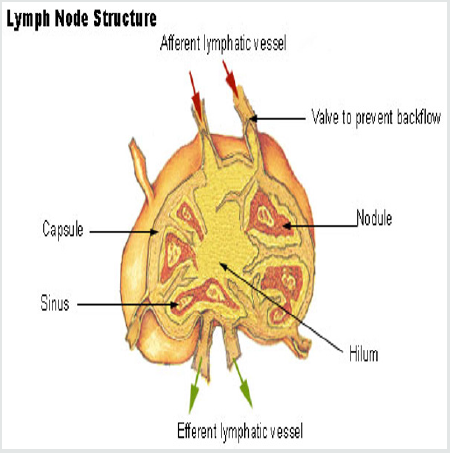
The tail of the pancreas abuts against the hilum of the spleen through which vessels and nerves enter and leave this organ Figure 1.

Figure 1: Lymph Node Structure.

lupinepublishers-openaccess-journal-environmental-soil-sciences


Histologically

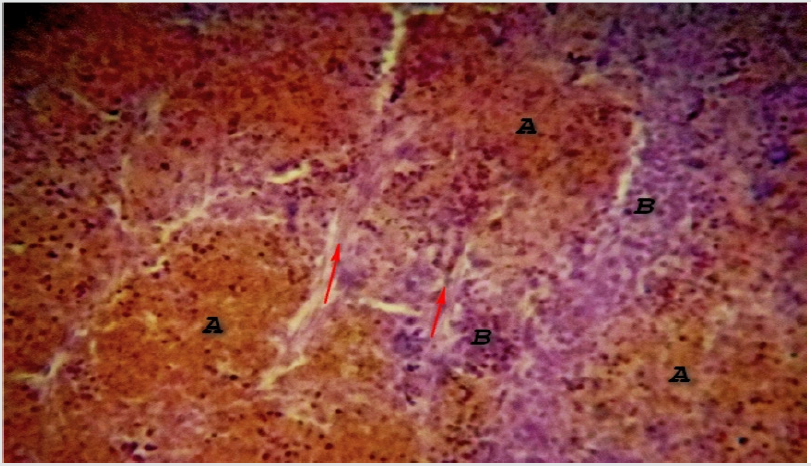
The structure resembles the lymph node except in some anatomical aspect, which includes; only efferent lymphatic drain the spleen. The sinusoids are blood vascular not lymphatic. As a result, all cells entering the spleen do so via the blood. Scattered primary nodules (germinal centers) are found throughout the spleen. These contain abundant lymphocytes and make up the “white pulp” (also known as Malpighian corpuscles). Plasma cells and macrophages are found here as well. Surrounding the white pulp nodules are venous sinuses containing abundant erythrocytes - the “red pulp”. These sinuses are lined with macrophages (RE cells) which are highly phagocytic. Between the sinuses are cords of cells - lymphocytes, monocytes and macrophages - referred to as the Cords of Billroth. The immune function of the spleen is especially important in infancy and early childhood. At these times, the rest of the lymphoid system is somewhat underdeveloped Figure 2.

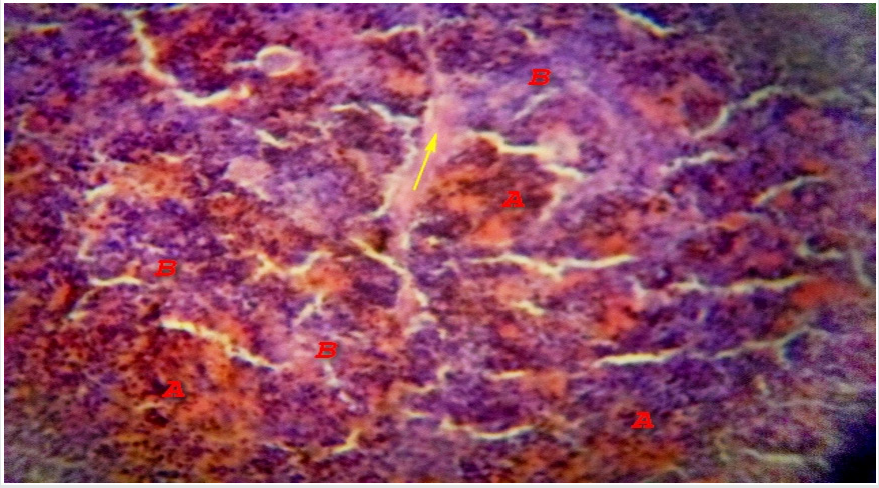
Figure 2: Photomicrograph of Camel Spleen showing clearly differentiated zones of white pulp (A) and Red pulp (B) cells with inter parenchymal traberculae collagen connective tissue fibers (Red arrow) H&E x200.

lupinepublishers-openaccess-journal-environmental-soil-sciences

Microscopically, the spleen appears to consist of discrete 0.5-1 mm white nodules, called the white pulp, embedded in a red matrix called the red pulp. Microscopically, as shown here, the white pulp WP consists of lymphoid aggregations and the red pulp RP, making up the bulk of the organ, is a highly vascular tissue [10]. The spleen has a thin fibroelastic outer capsule C from which short traberculae T extend into the parenchyma Figure 3. The capsule is thickened at the hilum and is continuous with supporting tissues that sheath the larger blood vessels entering and leaving the organ. In dogs and horses the spleen is also a reservoir of blood and these supporting tissues contain smooth muscle to pump blood out, but in humans only a few smooth muscle cells persist Figure 4. The splenic artery divides into several major branches, which enter the hilum and branch to form numerous arterioles. [11].

Figure 3: Photomicrograph of Camel Spleen showing clearly differentiated zones of white pulp (A) and Red pulp (B) cells with communication of paranchymal traberculae connective tissue fibers connective tissue (Red arrow) and thick connective tissue fibers capsule (Yellow arrow) H&E x200.

lupinepublishers-openaccess-journal-environmental-soil-sciences

Figure 4: Photomicrograph of Camel Spleen showing clearly zones of white pulp (A) and Red pulp (B) cells with developed inter-paranchymal traberculae collagen connective tissue fibers (Yellow arrow) H&E x200

lupinepublishers-openaccess-journal-environmental-soil-sciences

An overview of the splenic ultra-structure and circulation is shown in Figure 1 above; blood enters the spleen in the splenic artery which branches repeatedly within the parenchyma [5]. The larger arteries are surrounded by a fibrocollagenous sheath that disappears in the smaller branches. These central arteries A, are so named because they have a cylindrical cuff of lymphoid tissue around them, the periarteriolar lymphoid sheath PALS, consisting mainly of TH cells. The central artery gives off a number of short branches at right angles, which are called penicilliary arteries PALS and these terminate in two to three sheathed capillaries with only one is shown for each penicilliary artery [7]. These unique vessels are small blind-ending capillaries with no endothelial lining but surrounded instead by an aggregate of macrophages. Thus the blood arriving in a sheathed capillary must traverse this wall of macrophages before entering the red pulp RP. The sheathed capillaries therefore form the first part of the filtering mechanism of the spleen [6]. The splenic white pulp is of two types, T cell and B cell, together making up 5-20% of the total mass of the spleen. The functions of these areas appear to be similar to those of the paracortex and superficial cortex of lymph nodes respectively. The non-filtering areas of red pulp parenchyma as probably be considered part of the splenic lymphoid tissue mass also, but its immunological function remains to be elucidated [12].

White Pulp

White pulp consists of lymphoid tissue that unsheathes the central arteries (periarterial sheath) along with the associated nodules and germinal centers. The periarterial sheath is populated mainly by T lymphocytes [9]. The peripheral white pulp and germinal centers are populated mainly by B lymphocytes. In the white pulp, the T cell areas surround the central arteries, forming the periarteriolar lymphoid sheath. In humans, this lymphoid tissue is less well organized than in other animals, but the term PALS persists [12].

Red Pulp

Red pulp consists of splenic cords of Billroth and venous sinusoids [8]. Defective red blood cells resulting from aging or disease (as in sickle cell anemia, hereditary spherocytosis, or thalassemia syndromes) are delayed in their passage from Billroth cords into the venous sinusoids and phagocytosed by macrophages lining the cords. The splenic parenchyma is permeated by an interconnected network of sinuses S that drain in turn into larger sinuses, tributaries of the splenic vein and finally the hepatic portal vein [3]. The sinuses are lined by endothelial cells resting upon a basement membrane with numerous narrow slits. The reticulin fibers of the sinusoidal basement membrane are arranged in a circular fashion and are continuous with the reticulin meshwork of the parenchyma [1].

Blood Supply

The splenic artery is one of the three main branches of the coeliac axis. The splenic vein is joined by the superior mesenteric to form the portal vein [6]. Blood cells entering the parenchyma from the sheathed capillaries squeeze through the walls of the sinuses to drain out of the organ via the splenic vein, an arrangement known as the open circulation [4]. Note that the splenic vessels also provide the principal blood supply of the pancreas. [6].

Read more about Lupine Publishers Journal of Biomedical Engineering and Biosciences Click on the below link : https://biomedical-sciences-lupine-publishers.blogspot.com/


Wednesday, 3 May 2023

Lupine Publishers| A Model for Metastasis for Hybrid Cancer Cells

Lupine Publishers| Journal of Biomedical Engineering and Biosciences


Abstract

Hybrid cancer cells have been recently discovered. They have greater ability to form metastasis. Here a simple mathematical model is given for this phenomenon. Some comments about the possibility of their reaching brain are given.

Hybrid Tumor Cells

Recently [1,2,3,4] hybrid tumor cells have been discovered. They have the following properties:

i. They circulate more than ordinary tumor cells.

ii. They have greater ability to migrate and invade other tumors.

iii. They have greater ability to form metastasis.

The Metastasis Model

Metastasis comprises a sequence of linked steps leading to the dissemination of cancer cells from a primary tumor to other distant tissues the overwhelming majority of cancer-related deaths still result from the progressive growth of metastasis that are resistant to conventional therapies [1,2].

Motivated by this the following model is presented for the metastasis of hybrid cancer cells:

Let T1, H1 be the ordinary and hybrid tumor cells respectively of the first tumor. Let N=T1+H1. The second tumor is assumed to contain ordinary tumor cells T2. Hence the model can be represented by

dH1/dt=a1H1-N-c2H1, dT1/dt=b1T1^(2/3)-N, dT2/dt= (b2-1)T2+c2H1    (1)

where a1,b1,b2,c2 are positive constants. The metastasis term is c2H1.

The reason for the power 2/3 is that ordinary tumor cells grow due to surface cells [3,4].

The equilibrium solution for the coexistence of both tumors is:

H1eq=T1eq/(a1-c2-1)

T1eq= [b1(a1-1-c2)/(a1-c2)]^3    (2)

T2eq=c2H1/(1-b2)

It is locally asymptotically stable if:

b2<1,

[1-(2/3)(a1-c2)/(a1-c2-1)][1+c2-a1]-1>0    (3)

[1-(2/3)(a1-c2)/(a1-c2-1)]+[1+c2-a1]>0

Since hybrid cells have a greater ability to invade other cells, it is expected that they will invade brain cells. Hence brain tumors can be a good source for identifying them. Moreover trying to attract them to less important sites can be a feasible strategy to deal with them. It may be difficult to test this idea experimentally, because the hybrid state, in general, is unstable [5].

Read More Lupine Publishers Journal of Biomedical Engineering and Biosciences Please Click on Below Link:
https://biomedical-sciences-lupine-publishers.blogspot.com/
Wednesday, 22 February 2023

Lupine Publishers| Electro Elastic Actuator for Micro and Nano Surgical Repairs

 Lupine Publishers| Journal of Biomedical Engineering and Biosciences


abstract

The structural scheme and the transfer functions, the characteristics of the electro elastic actuator for micro and nano surgical repairs are obtained. The transfer functions of the electro elastic actuator are described the characteristics of the actuator with regard to its physical parameters and external load.

Keywords: Electro elastic actuator; Piezo actuator; Structural scheme; Transfer function

Introduction

The electro elastic actuator on the piezoelectric, electrostriction effects is used in the mechatronics systems for the micro and nano surgical repairs, for the micro and nano robotics, for the micro and nano manipulators and injectors [1-6]. The mathematical model, the structural scheme and transfer functions of the electro elastic actuator are calculated for designing the control system for the micro and nano surgical repairs [4-11]. The structural scheme and transfer functions the electro elastic actuator based on the electro elasticity make it possible to describe the dynamic and static properties of the electro elastic actuator for the micro and nano surgical repairs with regard to its physical parameters and external load [12-23].

Structural Scheme Electro Elastic Actuator

The method of mathematical physics with Laplace transform is applied for the solution the wave equation. The structural scheme of the electro elastic actuator for the micro and nano surgical repairs is changed from Cady and Mason electrical equivalent circuits [7- 8]. The equation of the electro elasticity [6,8,12] has the following form

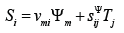
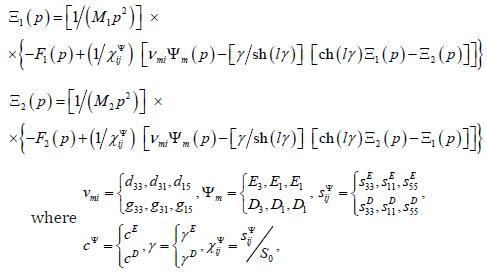
where Si is the relative displacement along axis i of the cross section of the piezo actuator, is the control parameter, Em, is the electric field strength for the voltage control along axis m, Dm is the electric induction for the current control along axis m, Tj is the mechanical stress along axis j, νmi is the electro elastic module, for example, the piezo module, ij sΨ is the elastic compliance for the control parameter Ψ = const , and the indexes i= 1, 2, … , 6; j = 1, 2, … , 6; m = 1, 2, 3. The main size along axis i for the electro elastic actuator is determined us the working length l = {δ , h,b} in form the thickness, the height or the width for the longitudinal, transverse or shift piezo effect.

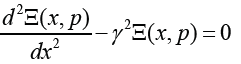
For the construction the structural scheme of the electro elastic actuator is used the wave equation [8,10,14] for the wave propagation in the long line with damping but without distortions. With using Laplace transform is obtained the linear ordinary second-order differential equation. The problem for the partial differential equation of hyperbolic type using the Laplace transform is reduced to the simpler problem [8,14] for the linear ordinary differential equation

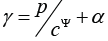
where Ξ(x, p) is the Laplace transform of the displacement of the section of the electro elastic actuator α Ψ = + is the propagation coefficient, cΨ is the sound speed for the control parameterΨ = const ,α is the damping coefficient.

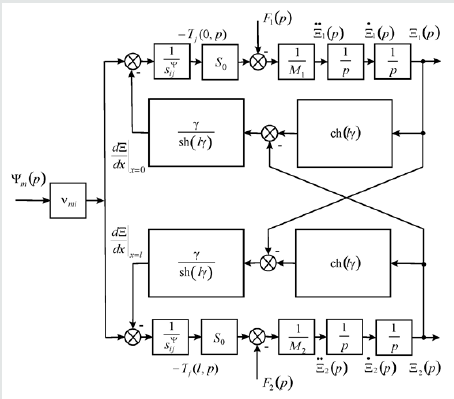
The mathematical model [6, 23] and the structural scheme of the electro elastic actuator for the micro and nano surgical repairs on Figure 1 are determined, using method of the mathematical physics for the solution of the wave equation, the boundary conditions and the equation of the electro elasticity, in the following form

Figure 1: Structural scheme of electro elastic actuator for micro and nano surgical repairs.

lupinepublishers-openaccess-journal-environmental-soil-sciences

vmi is the electro elastic module, is the control parameter, m E is the electric field strength for the voltage control along axis m, m D is the electric induction for the current control along axis m, sΨij is the elastic compliance, dmi is the piezo module at the voltage-controlled piezo actuator, gmi is the piezo module at the current-controlled piezo actuator, S0 is the cross section area, M1 , M2 are the mass of the load, are the Laplace transforms of the appropriate displacements and the forces on the faces 1, 2. For the micro and nano surgical repairs the structural schemes of the voltage-controlled or current-controlled piezo actuator are obtained from its mathematical model.

Transfer Function Electro Elastic Actuator

The matrix transfer function [6,18,21] of the electro elastic actuator for the micro and nano surgical repairs is derived from its mathematical model in the following form

where (Ξ( p)) is the column-matrix of the Laplace transforms of the displacements for the faces 1, 2 of the electro elastic actuator, (W( p)) is the matrix transfer function, (P( p)) the column-matrix of the Laplace transforms of the control parameter and the forces for the faces 1, 2.

Conclusions

The structural scheme, the transfer functions of the electro elastic actuator for the micro and nano surgical repairs, for the micro and nano robotics, for the micro and nano manipulators and injectors are described the characteristics of the electro elastic actuator with regard to its physical parameters, external load.

Read More Lupine Publishers Journal of Biomedical Engineering and Biosciences Please Click on Below Link:
https://biomedical-sciences-lupine-publishers.blogspot.com/
Wednesday, 11 January 2023

Lupine Publishers| Electro Elastic Actuator for Micro and Nano Surgical Repairs

 Lupine Publishers| Journal of  Biomedical Engineering and Biosciences


abstract

The structural scheme and the transfer functions, the characteristics of the electro elastic actuator for micro and nano surgical repairs are obtained. The transfer functions of the electro elastic actuator are described the characteristics of the actuator with regard to its physical parameters and external load.

Keywords: Electro elastic actuator; Piezo actuator; Structural scheme; Transfer function

Introduction

The electro elastic actuator on the piezoelectric, electrostriction effects is used in the mechatronics systems for the micro and nano surgical repairs, for the micro and nano robotics, for the micro and nano manipulators and injectors [1-6]. The mathematical model, the structural scheme and transfer functions of the electro elastic actuator are calculated for designing the control system for the micro and nano surgical repairs [4-11]. The structural scheme and transfer functions the electro elastic actuator based on the electro elasticity make it possible to describe the dynamic and static properties of the electro elastic actuator for the micro and nano surgical repairs with regard to its physical parameters and external load [12-23].

Structural Scheme Electro Elastic Actuator

The method of mathematical physics with Laplace transform is applied for the solution the wave equation. The structural scheme of the electro elastic actuator for the micro and nano surgical repairs is changed from Cady and Mason electrical equivalent circuits [7- 8]. The equation of the electro elasticity [6,8,12] has the following form

where Si is the relative displacement along axis i of the cross section of the piezo actuator, is the control parameter, Em, is the electric field strength for the voltage control along axis m, Dm is the electric induction for the current control along axis m, Tj is the mechanical stress along axis j, νmi is the electro elastic module, for example, the piezo module, ij sΨ is the elastic compliance for the control parameter Ψ = const , and the indexes i= 1, 2, … , 6; j = 1, 2, … , 6; m = 1, 2, 3. The main size along axis i for the electro elastic actuator is determined us the working length l = {δ , h,b} in form the thickness, the height or the width for the longitudinal, transverse or shift piezo effect.

For the construction the structural scheme of the electro elastic actuator is used the wave equation [8,10,14] for the wave propagation in the long line with damping but without distortions. With using Laplace transform is obtained the linear ordinary second-order differential equation. The problem for the partial differential equation of hyperbolic type using the Laplace transform is reduced to the simpler problem [8,14] for the linear ordinary differential equation

where Ξ(x, p) is the Laplace transform of the displacement of the section of the electro elastic actuator α Ψ = + is the propagation coefficient, cΨ is the sound speed for the control parameterΨ = const ,α is the damping coefficient.

The mathematical model [6, 23] and the structural scheme of the electro elastic actuator for the micro and nano surgical repairs on Figure 1 are determined, using method of the mathematical physics for the solution of the wave equation, the boundary conditions and the equation of the electro elasticity, in the following form

Figure 1: Structural scheme of electro elastic actuator for micro and nano surgical repairs.

lupinepublishers-openaccess-journal-environmental-soil-sciences

vmi is the electro elastic module, is the control parameter, m E is the electric field strength for the voltage control along axis m, m D is the electric induction for the current control along axis m, sΨij is the elastic compliance, dmi is the piezo module at the voltage-controlled piezo actuator, gmi is the piezo module at the current-controlled piezo actuator, S0 is the cross section area, M1 , M2 are the mass of the load, are the Laplace transforms of the appropriate displacements and the forces on the faces 1, 2. For the micro and nano surgical repairs the structural schemes of the voltage-controlled or current-controlled piezo actuator are obtained from its mathematical model.

Transfer Function Electro Elastic Actuator

The matrix transfer function [6,18,21] of the electro elastic actuator for the micro and nano surgical repairs is derived from its mathematical model in the following form

where (Ξ( p)) is the column-matrix of the Laplace transforms of the displacements for the faces 1, 2 of the electro elastic actuator, (W( p)) is the matrix transfer function, (P( p)) the column-matrix of the Laplace transforms of the control parameter and the forces for the faces 1, 2.

Conclusions

The structural scheme, the transfer functions of the electro elastic actuator for the micro and nano surgical repairs, for the micro and nano robotics, for the micro and nano manipulators and injectors are described the characteristics of the electro elastic actuator with regard to its physical parameters, external load.

Read More About  Lupine Publishers Journal of  Biomedical Engineering and Biosciences Please Click on Below Link: https://biomedical-sciences-lupine-publishers.blogspot.com/

Monday, 5 December 2022

Lupine Publishers| The Role of Biofield Energy Treated DMEM in Erectile Dysfunction using Detection of Cgmp Levels in Human Endothelial Cell Line

 Lupine Publishers| Journal of Biomedical Engineering and Biosciences


abstract

The study was performed to assess the impact of Biofield Treated test item (DMEM medium) on Human Endothelial Hybrid Cell Line (EA. hy926) for the expression of cyclic guanosine monophosphate (cGMP). The test item was divided into three parts. The first part was received one-time Consciousness Energy Treatment by a renowned Biofield Energy Healer, Mahendra Kumar Trivedi and labeled as BT-I, while second part received two-times Biofield Treatment and is denoted as BT-II. The third part did not receive any types of treatment and denoted as untreated DMEM. The level of intracellular cGMP in the BT-I and BT-II groups showed a significantly (p≤0.001) increased by 296.06% and 339.37%, respectively in Ea. hy926 cells compared to the untreated DMEM group. These results suggest that BT-II group showed a significant improved the level of cGMP with respect to the BT-I group. Therefore, the Biofield Energy Healing Treatment can be used to treat the erectile dysfunction patients along with other associated disorders such as orgasmic disorders, frotteuristic disorder, female sexual arousal disorder, vaginismus, fetishistic disorder, sex addiction, hypoactive sexual desire disorder, premature or delayed ejaculation.

Keywords: Biofield Energy; cGMP; Endothelial Hybrid Cell; PDE-5; DMEM; Erectile Dysfunction

Abbrevations:BT-I: One-time Biofield Energy Treated DMEM; BT-II: Two-times Biofield Energy Treated DMEM; CAM: Complementary and Alternative Medicine; NCCAM: National Center for Complementary and Alternative Medicine; DMEM: Dulbecco’s Modified Eagle’s Medium; cGMP: Cyclic guanosine 3′,5′-monophosphate; FBS: Fetal Bovine Serum

Introduction

Erectile dysfunction (ED) or impotence is the inability to get and keep an erection firm enough for sex. This is the most common sexual disorder in men across the globe [1]. Erectile dysfunction symptoms include persistent trouble in getting and keeping an erection and less sexual desire. Male sexual arousal is a complex process, which includes the coordination of the brain, hormones, emotions, nerves, muscles, and blood vessels [2]. ED might occur due to stress and severe mental health conditions. Besides, the literature data reported that physical cause of ED are heart disease, Parkinson’s disease, multiple sclerosis, atherosclerosis, high cholesterol, peronei’s disease high blood pressure, diabetes, obesity, sleep disorders, use of tobacco, alcoholism, injury of spinal cord and various metabolic syndromes such as high insulin levels, body fat around the waist, etc. [3]. Along with physical and psychological factors, impaired function of arteries and corpora cavernosa within the penis are the primary condition for impotence. While the lack of smooth muscle tone and imperfections in neuronal stimuli can lead to unsuccessful penile erection [4]. ED eventually leads to neuronal and cardiovascular disorders [5,6].

Nitric oxide synthase (NOS) enzymes are the major mechanism involved in ED, and it enhanced the production of cyclic guanosine monophosphate (cGMP), which results in smooth muscle relaxation and vasodilation via NO/cGMP pathway [7,8]. Inadequate level of NO/cGMP leads to ED. Thus, cGMP is the major therapeutically important target to overcome ED by inhibiting the cGMP-specific phosphodiesterase (PDE-5) enzyme [9]. However, sildenafil a PDE5 inhibitor has been used to treat ED, but it has life-threatening sideeffects viz. cardiac arrhythmia and hypotension [10] and vascular or neuronal deficiency like diabetes [11]. Thus, some alternative or complementary therapeutic approach is the best method to treat impotence without any side effects. In recent years, a remarkable outstanding alternative Complementary and Alternative Medicine (CAM) therapies approach known as Biofield Energy Healing Treatment (The Trivedi Effect®) have been scientifically reported in various fields. The human Biofield Energy is a weak electromagnetic field around of the human body. The Trivedi Effect® can be able to transform all the living organisms and non-living materials through a unique energy transmission process [12]

The effects of the CAM therapies have great potential, which include Johrei, Qi Gong, external qigong, Tai Chi, Reiki, therapeutic touch, deep breathing, yoga, polarity therapy, pranic healing, chiropractic/osteopathic manipulation, guided imagery, meditation, massage, homeopathy, hypnotherapy, special diets, progressive relaxation, acupressure, acupuncture, relaxation techniques, mindfulness, Rolfing structural integration, healing touch, movement therapy, pilates, Ayurvedic medicine, traditional Chinese herbs and medicines in biological systems both in vitro and in vivo [12]. Biofield Energy Healing as a CAM showed significant results in biological studies [13]. Also, the National Center for Complementary and Alternative Medicine (NCCAM), well-defined Biofield therapies in the subcategory of Energy Therapies [14]. The Trivedi Effect® has been reported to have created significant changes in the materials science [15-17], agricultural science [18,19], microbiology [20-22], biotechnology [23,24], improved bioavailability [25-27], skin health [27-29], nutraceuticals [30,31], cancer research [32,33], bone health [34-36], human health and wellness. Based on the outstanding benefits of The Trivedi Effect®, the present study was aimed to investigate the effect of Biofield Treated DMEM on the level of cGMP, in order to eradicate the ED using standard in vitro assay in Human Endothelial Hybrid Cell Line (EA. hy926).

Material and Methods

Requirement of Chemicals

Dulbecco’s Modified Eagle’s Medium (DMEM) and fetal bovine serum (FBS) were obtained from Life Technology, USA. Antibiotics solution (penicillin-streptomycin) was purchased from HiMedia, India, while ethylenediaminetetraacetic acid (EDTA) was purchased from Sigma, USA. Sildenafil citrate was purchased from Clearsynth, India. All the other chemicals used in this experiment were analytical grade procured from India.

Cell Culture

Human Endothelial Hybrid Cell Line (EA. hy926) was used as a test system in this experiment. The cells were maintained in DMEM growth medium for routine culture supplemented with 10% FBS. Growth conditions were maintained at 37°C, 5%CO2, and 95% humidity and subcultured by trypsinization followed by splitting the cell suspension into new flasks and supplementing with fresh cell growth medium. Three days before the start of the experiment, the growth medium of near-confluent cells was replaced with fresh phenol-free DMEM, supplemented with 10% charcoal-dextran stripped FBS (CD-FBS) and 1% penicillin-streptomycin [37].

Study Design

The experimental groups consisted of group 1 (G-I) with serumfree DMEM defined as the untreated DMEM. Group 2 (G-II) consisted of positive control (sildenafil citrate) at different concentrations. Further, group 3 (G-III) included DMEM medium (test item group) with the one-time Biofield Energy Treatment and denoted as BT-I, while the group 4 (G-IV) included the test item with the two-times Biofield Energy Treatment and indicated as the BT-II.

Biofield Energy Healing Treatment Strategies

The test item, DMEM was divided into three parts. One part of the test item was treated with the one-time Biofield Energy Healing Treatment by a renowned Biofield Energy Healer (The Trivedi Effect®) and coded as the Biofield Energy Treated DMEM (BT-I), while the second part was received the two-times Biofield Energy Healing Treatment and denoted as the BT-II. Further, the third part did not receive any treatment and defined as the untreated DMEM group. This Biofield Energy Healing Treatment was provided by a renowned Biofield Energy Healer, Mahendra Kumar Trivedi, remotely for~3 minutes. The Biofield Energy Healer was located in the USA, while the test item was located in the research laboratory of Dabur Research Foundation, New Delhi, India. This Biofield Energy Treatment was administered for ~3 minutes through the Healer’s unique Energy Transmission process remotely to the test items under the standard laboratory conditions. Mahendra Kumar Trivedi never visited the laboratory in person, nor had any contact with the test item (DMEM medium). Further, the untreated DMEM group was treated with a “sham” healer for comparative purposes. The “sham” healer did not have any knowledge about the Biofield Energy Treatment. After that, the Biofield Energy Treated and untreated samples were kept in similar sealed conditions for experimental study.

Assessment of PDE-5 Enzyme Inhibition

The cells were counted using an hemocytometer and were seeded at a density of 0.4 X 10⁶ cells/well in DMEM with 10 % FBS in 6-well plates. The details test procedure was followed as per Branton et al. 2018 [38-40]. Increase in cGMP level was determined as the following equation (1)

% Increase in intracellular cGMP level = {(B-A)/A} x 100----- -- (1)

Where, B = OD of cells treated with test item and A is the OD of untreated wells (media treated).

Statistical Analysis

Values were expressed as Mean ± SEM of three independent experiments. For multiple group comparison, one-way analysis of variance (ANOVA) was used followed by post-hoc analysis by Dunnett’s test. Statistically significant values were set at the level of p≤0.05.

Result and Discussion

Detection of PDE-5 Enzyme Inhibition

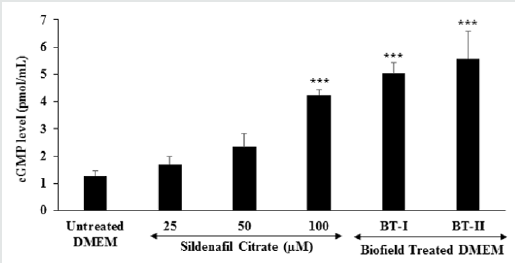
The result of the intracellular cGMP level in Ea. hy926 cells is shown in Figure 1. Sildenafil citrate, used as positive control at 25 μM, 50 μM, and 100 μM exhibited a significant increase in the intracellular cGMP in Ea. hy926 cells by 34%, 84%, and 234%, respectively compared to the untreated DMEM group. The onetime Biofield Energy Treated DMEM (BT-I) group showed 5.03 pmol/mL, while two-times Biofield Energy Treated DMEM (BTII) group showed 5.58 pmol/mL level of cGMP. Thus, BT-I group showed a significant (p≤0.001) increase in intracellular cGMP level by 296.06% in Ea. hy926 cells with respect to untreated DMEM. Similarly, the BT-II group showed a significant increase in the intracellular cGMP levels by 339.37% in Ea.hy926 cells than untreated DMEM. Thus, the data suggest that the two-times Biofield Energy Healing Treatment (BT-II) showed better results with respect to the increased cGMP level as compared with the one-time Biofield Treated DMEM group, which meant that the Biofield Energy Healing Treatment inhibited PDE-5 enzyme; resulting to the higher level of cGMP which can help to treat the erectile dysfunction (ED).

Figure 1: Effect of the test items (untreated and Biofield Treated DMEM) on the expression of intracellular cyclic guanosine monophosphate (cGMP) in human endothelial hybrid (Ea. hy916) cells. BT-I: One-time Biofield Energy Treated DMEM; BT-II: Two-times Biofield Energy Treated DMEM. ***p≤0.001 vs. untreated DMEM group.

lupinepublishers-openaccess-journal-environmental-soil-sciences

The drugs, which are available in the market for the treatment of ED, are having serious side-effects along with short time treatment of ED [41]. Thus, ED can be treated with some alternative mode of treatment without having any type of adverse effects. Biofield Energy Healing Treatment is one of the best CAM approach worldwide to treat various clinical disorders along with a significant change in different scientific fields. The results are outstanding and can be comparable with the marketed synthetic drug, sildenafil citrate. Scientific literature results showed that relaxation in smooth muscles results in improved level of cGMP production leading to penile erection [42]. Increase in cGMP results in decreased level of intracellular calcium, which supports penile erection [43]. However, cGMP activation is regulated by the PDE-5 enzyme, which is abundant in the corpus cavernosum and results in improved blood circulation that leads to penile erection [44]. Biofield Energy Healing based DMEM and Biofield Energy Healing Treatment might work by the relaxation of penile smooth muscles, which could lead to penile erection.

Conclusion

Erectile dysfunction results an unsatisfactory sex life, mental stress or anxiety, embarrassment or low self-esteem, relationship problems, inability to get your partner pregnant, which can produce lot of pathological implications like hypertension, hypercholesterolemia, diabetes mellitus, cardiovascular disease, and depression. Thus, the Biofield Energy Healing Therapy is one of the best approach to treat various sexual disorders and its related diseases. The present study results showed that the Biofield Energy Treated DMEM significantly increased the level of intracellular cGMP in Ea. hy926 cells compared with the untreated DMEM group. PDE- 5 is the predominant phosphodiesterase, while the intracellular cGMP level was significantly (p≤0.001) increased by 296.06% in the one-time Biofield Energy Treated DMEM group (BT-I) in Ea. hy926 cells compared to the untreated DMEM group. Additionally, the BT-II group i.e., the two-times blessed in DMEM also showed a significantly (p≤0.001) increased the level of cGMP by 339.37% compared with the untreated DMEM group. Henceforth, it can be concluded that the Biofield Energy Treated (The Trivedi Effect®) DMEM were found to have a significant impact on cGMP level, which might significantly inhibit the PDE-5 enzyme that leads to the penile erection. Thus, the Biofield Therapy can be used for the treatment of numerous sexual disorders viz. hypoactive sexual desire disorder, fetishistic disorder, dyspareunia, frotteuristic disorder, vaginismus, exhibitionistic disorder, voyeuristic disorder, sex addiction, premature or delayed ejaculation (or sexual malfunction or sexual disorder) improve normal sexual activity, desire, including physical pleasure, arousal or orgasm, preference, and neurological disorders, hormonal imbalances, sexual performance, desire disorders (lack of sexual desire or interest in sex), marital or relationship problems, effects of a past sexual trauma, feelings of guilt, depression, and pain disorders (pain during intercourse).

Read More Lupine Publishers Journal of Biomedical Engineering and Biosciences Please Click on Below Link:
https://biomedical-sciences-lupine-publishers.blogspot.com/
Monday, 17 October 2022

Lupine Publishers| Thermodynamic, HOMO-LUMO, MEP and ADMET Studies of Metronidazole and its Modified Derivatives Based on DFT

 Lupine Publishers| Journal of Biomedical Engineering and Biosciences


Abstract

In this study, Metronidazole (Met) and it’s modified derivatives are optimized by employing density functional theory with B3LYP/6-31g (d,p) level theory to explore their structural and thermodynamical properties. Molecular electrostatic potential (MEP) calculation has performed to calculate their possible electrophilic and nucleophilic attack. ADMET prediction was performed to search the absorption, metabolism and toxic level. Finally, this study can be helpful to design a potent candidate.

Keywords: Metronidazole; Density functional theory; HOMO-LUMO; MEP; ADMET

Abbrevations:Met: Metronidazole; DFT: Density functional theory; HOMO: Highest occupied molecular orbital; LUMO: Lowest unoccupied molecular orbital; MEP: Molecular electrostatic potential; ADMET: Absorption, distribution, metabolism, excretion, and toxicity

Introduction

Metronidazole (Met) is an antibiotic [1] and antiprotozoal drug [2]. It is widely used in the treatment of amoebiasis, trichomoniasis and giardiasis [3,4]. It has some demerits depending on the type and nature of unusual physical condition and on the limit of dose. High and long term dose can cause of leucopenia, neutropenia and peripheral neuropathy diseases [5]. Adverse effect and resistance of drugs indicate the importance of the discovery of new potential candidate. In computer aided drug design system, physicochemical, molecular docking, nonbonding interactions, and ADMET predictions are important criteria to evaluate newly designed molecules [6]. Drug modification is another alternative way to search better agent, which can increase the selective action of drug and reduce the side effect. Recently, it has been seen the trait of modifying drugs using halogens and alkyl group play important role in improving drug performance [7].

Herein, I report the optimization of Metronidazole (Met) and its modified derivatives to investigate their biochemical behavior on the basis of quantum mechanical approach. The free energy, electronic energy, enthalpy, dipole moment, HOMO-LUMO gap, hardness, softness, chemical potential and electrostatic potential have been calculated. All the newly designed derivatives show better thermodynamic properties, and some of them exhibit better chemical reactivity than parent drug. From the regarding quantum chemical studies, it’s assuming that, some of the designed compounds may have profound effect as drug.

Methods and Materials

Computational Details

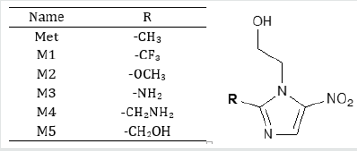
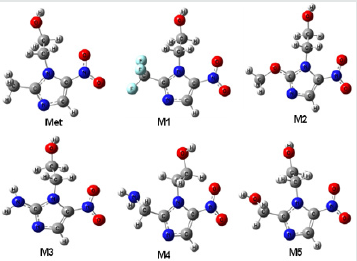
In computer aided drug design, quantum mechanical methods are widely used to predict thermal, molecular orbital, and molecular electrostatic potential properties [8]. Initial geometry of Metronidazole (Met) was taken from the online structure database named ChemSpider [9]. Geometry optimization and further modification of all structures carried out using Gaussian 09 program [10]. Density functional theory (DFT) with Becke’s (B) [11] threeparameter hybrid model, Lee, Yang and Parr’s (LYP) correlation functional [12] under Pople’s 6-31g (d,p) basis set has been employed to optimize and elucidate their thermal and molecular orbital properties [13]. Initial optimization of all compounds was performed in the gas phase. Dipole moment, electronic energy, enthalpy, free energy and electrostatic potential are calculated for all the compounds (Figure 1).

Figure 1: Chemical structure of Metronidazole (Met) and its modified analogues.

lupinepublishers-openaccess-journal-environmental-soil-sciences

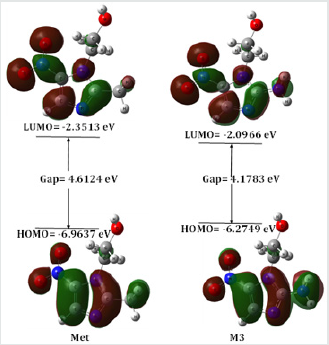
Frontier molecular orbital features HOMO (highest occupied molecular orbital), LUMO (lowest unoccupied molecular orbital) were calculated at the same level of theory. For each of the drugs, HOMO-LUMO energy gap, hardness (η), softness (S) and chemical potential were calculated from the energies of frontier HOMO and LUMO as reported considering Parr and Pearson interpretation [14,15] of DFT and Koopmans theorem [16] on the correlation of ionization potential and electron affinities with HOMO and LUMO energy (𝜀). The following equations are used to calculate hardness (η), softness (S) and chemical potential (μ);

In computer aided drug discovery system, computational predictions are using to explore absorption, distribution, metabolism, excretion, and toxicity (ADMET) which saves on time and investment. AdmetSAR online database was utilized to predict ADMET properties of Metronidazole and its analogues [17].

Result and Discussion

Thermodynamic Analysis

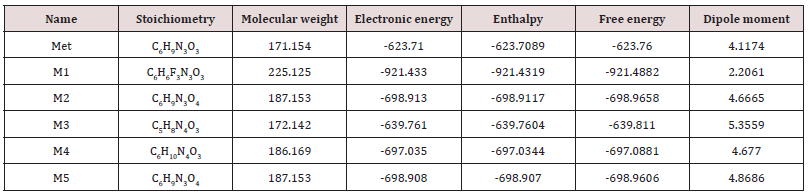
Simple modifications of molecular structure significantly influence the structural properties including thermal and molecular orbital parameters. From the free energy, and enthalpy values, spontaneity of a reaction and stability of a product can be predicted [18]. In drug design, hydrogen bond formation and nonbonded interactions also influenced by dipole moment. Increased dipole moment can improve the binding property [19]. From thermodynamic data (Table 1), the free energy of Metronidazole is -623.7600 Hartree, where M1 shows the highest negative value (-921.4882 Hartree). The –F substitution (M1) influence the free energy significantly. Highly negative free energy is favourable for stable configuration. Again, the dipole moment of Metronidazole is 4.1174 Debye where M3 shows the maximum dipole moment (5.3559 Debye) due to substitution of –NH2 group (Figure 2).

Table 1: The stoichiometry, molecular weight, electronic energy, enthalpy, free energy in Hartree and dipole moment (Debye) of Metronidazole (Met) and its analogues.

lupinepublishers-openaccess-journal-environmental-soil-sciences

Figure 2: Most stable optimized structures of Metronidazole (Met) and newly designed analogues. Optimized with B3LYP/6- 31g (d, p) level theory.

lupinepublishers-openaccess-journal-environmental-soil-sciences

Molecular Orbital Properties

Table 2: Energy (eV) of HOMO, LUMO, gap, hardness, softness and chemical potential of the designed drugs.

lupinepublishers-openaccess-journal-environmental-soil-sciences

The HOMO-LUMO energies, hardness, softness, chemical potential of all compounds is presented in Table 2. The electronic absorption relates to the transition from the ground state to the first excited state and mainly described by one electron excitation from HOMO to LUMO [20]. The chemical hardness, softness, and potential values depend on the energy gap of HOMO-LUMO [21,22]. Kinetic stability decreases with the decrease of HOMO-LUMO gap. As a result, removal of electrons from ground state HOMO to excited state LUMO requires less energy. In our studies, Metronidazole shows the HOMO-LUMO gap 4.6124 eV, where M3 have the lowest energy gap (4.1783 eV) with highest softness (0.4787 eV) which may contribute higher chemical reactivity (Figure 3).

Figure 3: Frontier molecular orbital (HOMO-LUMO) and related energy of Metronidazole (Met) and M3.

lupinepublishers-openaccess-journal-environmental-soil-sciences

Molecular Electrostatic Potential Analysis

Molecular electrostatic potential (MEP) was calculated at B3LYP/6-31G (d,p) level of theory to forecast the reactive sites for electrophilic and nucleophilic attack of all optimized structures [23]. Red color represents maximum negative area which favorable site for electrophilic attack, blue color indicates the maximum positive area which favorable site for nucleophilic attack and green color represent zero potential area. MEP displays molecular size, shape as well as positive, negative and neutral electrostatic potential regions simultaneously in terms of color grading. It is seen from MEP map, region having the negative potential are over electronegative atom (oxygen atoms) and having positive potential are over hydrogen atoms. Here, the maximum negative potentiality is found for M3 is -0.3497 a.u (deepest red) for oxygen atoms and the highest positive potentiality of M1 is +0.3903 a.u (deepest blue) of hydrogen atoms.

Read More About Lupine Publishers Journal of Biomedical Engineering and Biosciences Please Click on Below Link: https://biomedical-sciences-lupine-publishers.blogspot.com/