Showing posts with label Journal of Drug Design and Development. Show all posts

Monday, 28 February 2022

Lupine Publishers| Regulatory Inflation in Pharmaceutical Drug Development?

 Lupine Publishers| Journal of Drug Designing & Intellectual Properties

Opinion

During the last decade, and exponentially over the last three years, numerous pharmaceutical manufacturing plants have closed their doors following current Good Manufacturing Practices (cGMP) audits from various agencies, such as FDA, EMA and Health Canada. Regulatory affairs have been evolving and so should be the audits, auditors and regulations. However, the density and interpretations of regulatory requirements have become increasingly stringent, especially with respect to sterile products, making them more difficult to develop and manufacture within reasonable time and cost. A quick search on Google shows numerous press releases from various pharmaceutical organizations reporting critical/ major deficiencies, leading to temporary or permanent closures of manufacturing plants. Furthermore, it seems that this evolving situation has not only impacted drug shortage, but these events have placed the pharmaceutical industry under a permanent state of siege. The negative impacts of regulatory inflation are a center of attention among pharmaceutical professionals.

This article explores three interrelated components of this regulatory inflation phenomenon.

Regulatory Narrative Leading to Global Inadequacy

The Health Canada (HC) website, more precisely the Drug &Health product inspections section [1] is listing 802 pages of cGMP audit results from virtually all Canadian establishment license holders. Even though compliant, the vast majority of them were listed as having inadequate quality systems. Comments such as: The handling of standard operating procedures for good manufacturing practices was inadequate, the written procedures for recalls were inadequate, the education, experience, and/ or oversight of the individual in charge of the quality control department was inadequate, to name but a few, can be read everywhere across the site. Compliant CMOs complain privately that labeling them as inadequate on the public domain, resulted in drops of direct business revenues and a weakening of their competitiveness. Indeed, foreign clients that would like to export their business in Canada are misinformed through HC website and get the impression that Canadian CMOs are problematic. In contrast FDA and EMA do not publish the same kind of data, through detailed documents and audit reports from compliant organizations. At the FDA cGMP audit reports exist and are on the public domain but recently both EMA and FDA have published the first report from the FDA-EMA pilot program for the parallel assessment of qualityby- design elements of marketing applications [2].

Regulatory Inflation: The Emergence and Growth

Originally, regulatory compliance was an integral part of the pharmaceutical industry. Over the last 20 years compliance has evolved to a separate industry, generating multi-billion dollars of revenues. By definition this new autonomous industry must continue to grow, and this growth is mediated via the creation of new, increasingly sophisticated requirements and guidelines. More over, the costs of compliance audits have all been transferred, directly or indirectly, to the industry. Twenty years ago, regulatory auditors were essentially testing and measuring compliance to operating procedures. Today it is the manufacturers who are paying very competent specialists from the compliance industry to piously prepare risk analysis, gap analysis, trending analysis, CAPA etc., on all aspects of operations, and present them to public or private regulatory agencies (e.g. ISO system) as proof of compliance. In parallel with this regulatory requirement inflation, there was an emerging of regulatory consulting firms [3]. In an ideal world, the compliance industry must help the manufacturers it regulates because they generate the economy, the profitability, and the taxes that drive the country. Nowadays, it looks like the compliance industry has developed in less than 25 years everything but a symbiotic relationship. And let.com be clear, there are no villains or conspiracy here: it is a systemic social problem caused by out-ofcontrol human factors: a form of conflict of interest between two groups that should work together.

Generational Turnover of Inspectors and Auditors

As a professor of drug development, I have been training graduate students in scientific and regulatory affairs for two decades. This training attempts to bridge the gap between the theory of a basic research undergraduate training and the reality that will be faced in the industry. Over the years I have noticed that most of the conformity auditors were people with hands-on experience in the past in their field of expertise, meaning that they had the necessary experience to bridge the gap between theory and reality. During the last decade, a younger and ambitious auditor profile, showing a lower hands-on experience level, a more reactive than proactive behavior, and an apparent a lack of sustainability taught by seasoned colleagues, has become the conformity auditing landscape. This new generation of regulatory enforcers are highly knowledgeable in regulatory requirements. However, the lack of “hands-on” expertise makes more difficult for them to bridge the gap between theory and practice. Most of my ex-students work in the industry and all their testimonies are pointing in that sense, even though, as described in Costanza et al. [4] Meta-analysis showed that “generational differences do exist on work-related outcomes, they are relatively small and the inconsistent pat-tern of results does not support the hypothesis of systematic difference.

The gravity of regulatory inflation is only beginning to be measured. It used to be relatively easy for a group of young and ambitious entrepreneurs to build, with a reasonable amount of money, a pharmaceutical CMO. The density of regulations was lower, and the way these regulations were managed were based on audits, or inspections from regulatory agencies sustained by the states. These entrepreneurs form that generation has been raised with these inflationist regulatory constraints.Today, the cost of managing compliance has become so disproportionate that there is no young company pushing behind: No succession. Our opinions on this problem are very visceral: the fact that young graduates cannot practically do the same thing as we are doing because of regulatory inflation should be deeply studies, dug and understood. As a professor andconsultant in product development, I do think that the primary duty of parents is to keep the context of opportunities they have had and transfer it to their children. The Canadian federal government has passed the law that recognizes the problem and provides solutions, “the Red Tape Reduction Act” but this law is not retroactive to heal the harm already done [5]. At the light of these comments, it is difficult to see how the wave can be modified, since it has already started to be painful, by looking at all the companies that have already closed. However, it should be extremely clear that the definition of the word “culture” is the following: Culture is the body of knowledge, know-how, traditions, customs, specific to a human group, to a civilization. It is transmitted socially, from generation to generation and not by genetic inheritance, and largely conditions individual behavior. It means that people, firms and agencies working directly or indirectly in conformity should be advertised in that regards in order to start a paradigm shift and to make the pharmaceutical industry evolving under a progressive way, where all the actors could benefit of it. It is interesting to note that this regulatory inflation does not only affect the pharmaceutical industry, but several other industries, such as the aviation [6] and as the article is mentioning: As the second most geographically vast nation in the world and with a small, open economy, Canada is dependent on air transportation like almost no other country [7].

Conclusion

The author of this article had the chance to be part of the tail of the “golden age” of the pharmaceutical industry. Indeed, I had the chance, regardless of my “specialty” to share, discuss and see how the development was going, from basic research through all the steps that were needed to develop a drug, making myself “hands on” on all the steps that were, and are still needed to file a new drug product successfully. For that reason, I have been raised “holistically” under a “regulated” way of thinking in non-clinical, clinical, CMC, and regulatory affairs so that it was possible for me to understand, to share the same languages than the auditors, whether they were coming from private firms or government agencies. Things have changed (and not evolved) in that regards. For example, if current auditors have never had the chance of being part of a blending operation, it will be very difficult for them to realize if a speed of 10,000rpm would be realistic for a blender impeller. On the other side, they will know better than all of.com the guidelines saying that this or that should be done according to this or that, as written in the page 5 of the FDA/EMA/EP/JP…. Guidelines.

The cost of managing compliance has become such that it has become virtually impossible to start a business without having a lot of money to build large “quality systems” from scratch.

Of course, we do not have proximity expertise in all the other highly regulated field such as commercial aviation to assert anything, but according to what we have seen over the past ten years, the trend is similar, as in other regulated businesses.

As a professor teaching drug development, the next steps could be:

a) To conduct a confidential survey in the industry on the effect of this HC website that is showing relatively clearly this regulatory inflation on the Canadian exportation potential of pharmaceutical product and services.

b) To monitor if there is a correlation between company closures and regulatory affairs and conformity consulting service companies.

Please note that this article strictly represents the point of view of the author based on his expertise and experience.

Read More About Lupine Publishers Journal of Drug Designing & Intellectual Properties  Please Click on below Link: https://lupine-publishers-drug-designing.blogspot.com/

Monday, 27 September 2021

Lupine Publishers| Breaking into Merck's CCK Patents: the Starting Point of PNB Vesper Life Science to Design and Develop Cholecystokinin(CCK)-Antagonists as Targeted Chemotherapeutics

 Lupine Publishers| Journal  of Drug Designing & Intellectual Properties


Abstract

Early anti-cancer research was dominated by the development of alkylating agents, followed by the discovery of a variety of anti-metabolites, which were useful anti-viral agents at the same time. Current anti-cancer drugs are designed towards molecular targets in order to reduce their toxicity and to enhance the selectivity on the cancer cells. Within an increasingly growing number of molecular targets, the cholecystokinin, as a neuro modulator, became an important anti-cancer target, especially when it was shown that cholecystokinin regulates the invasiveness of human pancreatic cancer cell lines via the protein kinase C pathway. The low potency and the lack of subtype receptor selectivity of those early non-peptide CCK-antagonists, was improved in the following generations of CCK antagonists. These potent and selective antagonists have shown disappointing results in clinical trials due to a poor bioavailability. Initially cholecystokinin was discussed as growth factor, not only in pancreatic cancer, but also for lung, breast, colon and brain cancer, followed by a detailed discussion of over 20 different chemical classes having been developed to date, mainly for the area of neuroscience. Loxiglumide, CI-988, Devazepide, L-365,260 and YM022 are highlighted including in vivo studies and clinical trials. Moreover, CCK antagonists were found useful in the enhancement of the analgesic effects of morphine and the anti-neo plastic effect of cis-platinium. Clinical trials are ongoing. It is concluded that non peptidal cholecystokinin receptor antagonists are modern, non-toxic anti-cancer agents.

Abbrevations: GI: Gastrointestinal: Bt2cGMP:Dibutyryl Cyclic Guanosine Mono Phosphate; Bt2cGMP:Dibutyryl Cyclic Guanosine Mono Phosphate; CCK: Cholecystokinin

Introduction

Several gastrointestinal (GI) hormones, such as gastrin, cholecystokinin, and bombesin, have been reported to affect the development of pancreatic cancer. The receptors for these hormones are found in normal and neo plastic pancreatic cells. Activation of these receptors enhances pancreatic carcinogenesis and promotes the growth of established pancreatic carcinoma either in vitro or in vivo. Studies have shown that these GI hormones may play an inhibitory role in the development of pancreatic cancer. In recent years, increasing emphasis has been placed on the effects of GI hormones on cancer invasion and metastasis. As the transition from non-invasion to the invasive state is the crucial event in cancer development, further investigation of the way in which GI hormones affect the invasion and metastasis of pancreatic cancer may be important for the development of new therapeutic approaches with eventual clinical utility [1].

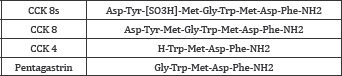
Cholecystokinin (CCK) is produced by I cells of the duodenal and jejunal mucosa and exists most prominently as an eight amino- acid hormone (CCK-8). CCK has been long been recognized as having an effect on the regulation of pancreatic secretion [2] and of gall bladder contraction [3]. Cholecystokinin has also been found in the brain, where it is widely distributed and may therefore have an effect as a neuromodulator or perhaps as a neurotransmitter. CCK is characterized by the a -aminated terminus Trp-Met-Asp- Phe-NH2 aminated sequence. It was initially identified as a 33 amino acid chain [4] and was later synthesized [5]. Subsequent studies have revealed the existence of multiple forms [6,7]. CCK is derived from a primary prepro-CCK polypeptide of 115 residues. After transcription, enzymatic cleavage results in the formation of many different fractions. CCK58, CCK39, CCK33, CCK22, CCK8s (sulphated), CCK8ns (non-sulphated), CCK7, CCK5, CCK4 all of them demonstrate biochemical activity [8]. The predominant circulating form is a sulphated tyrosine residue at position 7. It is important to distinguish between the CCK tetra peptide [9] and octapeptide (Sincalide) [10] as shown in Table 1. Both of them have been extensively studied, particularly in relation to food intake regulation, and have brought a great deal of confusion when it came to anxiety and panic. They have differential affinity for CCK receptors [11,12] different distribution in both the periphery and the brain [13,14] and have various effects on behavior.

Table 1: Amino acid sequence of Cholecystokinin and Penta gastrin fragments.

Lupinepublishers-openaccess-Drug-Designing-Intellectual-Properties


Cholecystokinin and Cancer

Cholecystokinin (CCK) plays an important role in the invasiveness and the production of matrix metalloproteinase-9 (MMP-9) in human pancreatic cancer cell lines. The pathway of the invasiveness may be associated with MMP-9 of those lines regulated by CCK. Two human pancreatic cancer cell lines were treated with CCK-8 alone, CCK-8 and staurosporine, or CCK-8 and indomethacine. The invasiveness and the production of MMP-9 were decreased with staurosporine but not indomethacine. These results suggest that CCK may regulate the invasiveness and the production of MMP- 9 via protein kinase C in human pancreatic cancer cell lines [15]. Cholecystokinin (CCK) receptors play a role in the development and growth of pancreatic cancers. The expression of mRNA encoding CCK-A and CCK-B receptors in eight human pancreatic tumour cell lines was detected using reverse transcription-polymerase chain reaction (RT-PCR), but not by RNase protection assays. The K-ras gene, which can be activated by G-coupled protein receptors such as CCK receptors, was mutated in codon 12 in five of the cell lines. In addition, Mia PaCa-2 pancreatic cancer cells did not respond to CCK or gastrin in cell proliferation or focal adhesion kinase (FAK) phosphorylation assays. In contrast, mouse NIH3T3 fibroblasts transfected with human CCK-B receptor (NIH3T3CCK-BR) showed increased proliferation and phosphorylation to the peptides [16].

The gut hormone cholecystokinin exerts various actions on the gastrointestinal tract, including the regulation of growth. The hormone has been reported to induce hypertrophy and hyperplasia of the pancreas and to enhance chemically-induced pancreatic carcinogenesis in animals. Stimulation of endogenous cholecystokinin secretion through the induction of deficiency of intra intestinal proteases and bile salts by trypsin-inhibiting nutrients, bile salt-binding drugs or surgical intervention is also capable of stimulating growth and tumor development in the rat. In man, factors suggested to increase the risk of pancreatic cancer, such as a high-fat and high-protein diet or gastrectomy, are known to stimulate plasma cholecystokinin secretion. Receptors for cholecystokinin have been demonstrated on human pancreatic adenocarcinomas, and cholecystokinin has been demonstrated to enhance the growth of xenografted pancreatic cancer and to inhibit growth of gastric and bile duct cancer [17].

From CNS Drugs to New Anticancer Agents

Gastrointestinal polypeptide hormones regulate growth of various normal gastrointestinal tissues as well as certain visceral cancers [18]. If Cholecystokinin promotes cell growth, CCK antagonists are ideal chemical anti-cancer targets and many scientists have discovered specific peptide and non-peptide antagonists of CCKB/gastrin receptors up to date, mainly for the area of neuroscience. As a result of extensive research, a number of new chemical classes have been developed with a high potency and selectivity towards the cholecystokinin receptor subtypes.

Amino Acid Derivatives

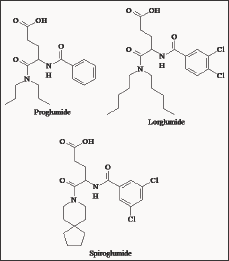
Figure 1: Structures of early amino acid derivatives as CCK antagonist.

Lupinepublishers-openaccess-Drugdesigning-Intellectualproperties


During the 1970's amino acid derivatives (Figure 1) were found to contain anti gastrin activity [19,20]. The chemical similarities of gastrin and CCK made it possible for such derivatives to demonstrate CCK antagonist activity. Proglumide, the first putative gastrin antagonist clinically available, has long been used in the treatment of peptic ulcers, because of its anti secretory and gastro protective activities. Several studies have subsequently demonstrated that proglumide is also a weak CCKA receptor antagonist [21] and despite its low potency, it has been the reference CCK and gastrin antagonist for several years.

Rotta research group produced analogues of proglumide, which showed varying degrees of selectivity for CCKA receptors and even suggested possible sub-types of the peripheral receptors. Some derivatives had a higher affinity for pancreatic CCK receptors mediating gallbladder contraction. Lorglumide showed up to a 26-fold increase in potency for blocking CCK-stimulated gallbladder contraction but only a two-fold increase for blocking CCK-stimulated pancreatic amylase secretion [22]. Intravenous administration of Lorglumide [23] antagonized the CCK-induced reduction of gastric emptying in rats, acceleration of intestinal transport in mice, increase in ileal motility in rabbits, gallbladder contraction in guinea pigs and acceleration of gallbladder emptying in mice but showed reduced activity when orally administered. Further structural modifications to Lorglumide resulted in CR2194 (spiroglumide). Spiroglumide exhibited CCKB/gastrin antagonist in the micro molar range, with excellent oral bioavailability. However, it has poor selectivity for CCKB/gastrin receptor, which raises doubts of its potential therapeutic usefulness. The effect of loxiglumide (LXG) was studied on the invasiveness of two human pancreatic cancer cell lines. Cells were treated with LXG for 24 h, and examined in the invasion assay. Interestingly, the invasiveness of cancer cells and expression of MMP-9 were decreased by LXG in a dose-dependent manner [24].

Read More About Journal of Drug Designing & Intellectual Properties Please Click on Below Link:
https://lupine-publishers-drug-designing.blogspot.com

Tuesday, 17 August 2021

Lupine Publishers| From Merck's CCK- Antagonists Via 4-Amino-2(5H)- Furanones towards 5-Hydroxy-Pyrrol-2-Ones: Design, Synthesis and Evaluation of PNB-001 & PNB-081 as Experimental Therapeutic Agents in Pain Management

Lupine Publishers| Drug Designing & Intellectual Properties International Journal (DDIPIJ)

Abstract

Arylated 5-hydroxy-pyrrol-2-ones were prepared in 2 synthetic steps from muco-chloric acid and were optimised as CCK / CCK2 selective ligands using radio labelled binding assays. A potent CCK selective ligand was identified (PNB-081: CCK1=20nM) as well as a potent CCK2 ligand (PNB-001, IC50= 22nM) during a systematic SAR optimisation. The antagonism was confirmed for both ligands by using isolated tissue preparations with CCK5 and CCK8S. Subsequent in vivo evaluation revealed analgesic activity for the gastrin CCK2 antagonist PNB-001, in the hotplate and tail immersion test at 0.5mg /kg by IP administration in mice. The cholecystokinin antagonist PNB-081 potentiated the analgesic effect of morphine and reversed opiate tolerance in mice from doses >1 mg/kg by oral administration.

Keywords: Phenyl-Pyrolone; CCK Antagonist; Cholecystokinin; Analgesic; Opiate Adjunct

Abbrevations: GIT: Gastrointestinal Tract; TT: Test Thresholds; BT: Base Line Withdrawal Thresholds; ANOVA: Analysis Of Variance

Introduction

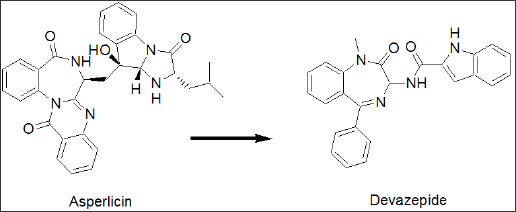
In terms of cholecystokinin-physiology [1], CCK8is the most common peptide hormone, which is extensively found throughout the gastrointestinal tract (GIT) and is also widely distributed through the nervous system [2]. Originally, cholecystokinin was discovered to cause contractions of the gallbladder [3]. It was then rediscovered as pancreozymin, triggering the release of pancreatic enzymes. Finally, it was confirmed that both peptides are identical [4]. Cholecystokinin acts as a neuro modulator as well as gut hormone. CCK-ligands, agonists and antagonists have been extensively investigated as potential drug molecules [5]. Cholecystokinin antagonists have been extensively investigated as potential drug targets [6]. They were studied as growth inhibitors in certain forms of cancer [7], as anxiolytics [8], in the treatment of schizophrenia [9] and satiety [10]. An agonist, the shortened CCK4 was found to induce panic in patients [11] and the CCK2 receptor is known to mediate anxiety [12] and panic attacks [13]. Cholecystokinin does cause proliferation in colon- and pancreatic cancer cell lines and therefore, CCK-antagonists were studied as growth factor inhibitors in certain forms of cancer. Asperlicin was the first non-peptidal lead structure from nature [14] and analogues thereof were studied as CCK ligands [15]. Simplification of this lead structure by Merck led to Devazepide [16], a potent CCK1 selective cholecystokinin antagonist (Figure 1a), containing a 1,4- benzodiazepine template and an indole moiety.

Figure 1a: Discovery; Merck's CCK patents. From the natural product asperlicin to a fully synthetic 1,4-benzodiazepine lead structure.

Lupinepublishers-openaccess-Drugdesigning-Intellectualproperties

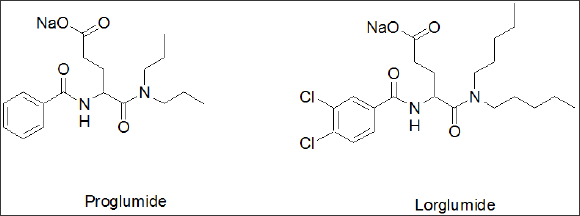
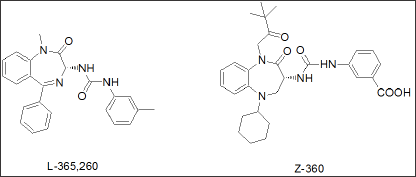
Proglumide [17] was the first glutamic acid based agent, marketed as Milid for the treatment of ulcer. Lorglumide, a derivative of proglumide [18], (Figure 1b) is one of several CCK receptor antagonists [19] and served as experimental standard. The indolyl amide of devazepide was replaced by a urea linkage and Merck's L-365,260 resulted in a CCK2 selective antagonist [20]. Further subsequent SAR optimization led to Zeria's improved Z-360 [21], in which the N-alkyl side chain, the 5- position (cyclohexyl) was optimized for potency and a meta-carboxylic acid on the aryl urea linkage was introduced to enhance water solubility (Figure 1c). Z-360 is a CCK2-gastrin receptor antagonist and progressed into phase 2 trial with pancreatic cancer [22]. Z-360 is the most recent derivative derived from this original lead structure, with improved selectivity and bioavailability.

Figure 1b Cholecystokinin standard-Lorglumide. Rotta Research Labs. Patents based on glutamic acid, agents with little membrane penetration.

Lupinepublishers-openaccess-Drugdesigning-Intellectualproperties

Figure 1c: Merck's SAR optimisation from Devazepide towards a gastrin antagonist L-365,260 with final optimisation by Zeria Ltd and selection patent on Z-360.

Lupinepublishers-openaccess-Drugdesigning-Intellectualproperties

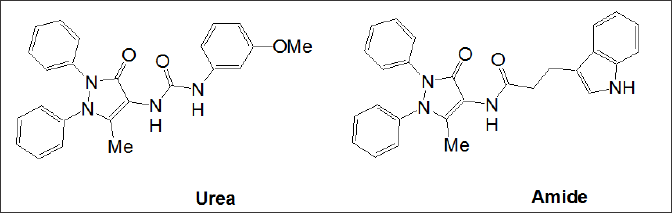
All structural optimisations did only partly address the main underlying problem with respect to poor pharmacokinetic properties, such as a low water solubility and very low membrane penetration, as a result of a large polar surface area of the molecules and a relatively high molecular weight. In our early search for new CCK ligands, in which the 1, 4-benzodiazepine structure [23] was replaced by an achiral diphenyl pyrazolone template, novel CCK antagonists with an indole carboxylic acid [24] and a phenyl urea moiety [25] were found and optimized with excellent animal data on anxiety and depression [26]. The patent was discontinued as structure was part of a Chinese molecular modelling patent application (Figure 1d). The 1,4-benzodiazepine template was varied by a combinatorial solid phase synthesis [27] and it was SAR optimised in terms of CCK binding affinity to a benzodiazepine with a simple propyl group [28]. Again, having realized the poor pharmacokinetic properties these agents, a search for a completely novel, smaller template with a molecular weight <350, a log p about 3 and a polar surface area for membrane penetration of less that 100A, with no urea linkage was initiated. Aim of the drug discovery programme, initiated by PNB Vesper Life Sciences, was to systematically investigate and design the 2(5H)-furanone scaffold [29] in to a hydroxy-pyrolone scaffold with ligands for both CCK pathways (Figure 1e). Molecular pain targets have been reviewed recently [30] and the results are quite disappointing in terms of efficacy and FDA approval rate. Even, this review missed out on CCK antagonists [31] and most importantly on a very positive report, publicised only in form of an abstract [32]. In summary in this study, devazepide at 5 mg was found very efficient in pain management as adjunct to strong opiates in a phase 2 trial carried out at leading UK pain research centres. Initial results for CCK antagonists of the pyrolone scaffold were communicated in the area of cancer therapeutics [33] and GI inflammation [34]. Here, a full biological evaluation of PNB Vesper Life Science's pain moleculesPNB-001& PNB-081, which are covered by an original patent, are reported in detail here with respect to pain management [35].

Figure 1d: Urea / Amide based CCK antagonists covered by Aston University patent replacing the 1,4-benzodiazepine scaffold with a pyrazole.

Lupinepublishers-openaccess-Drugdesigning-Intellectualproperties

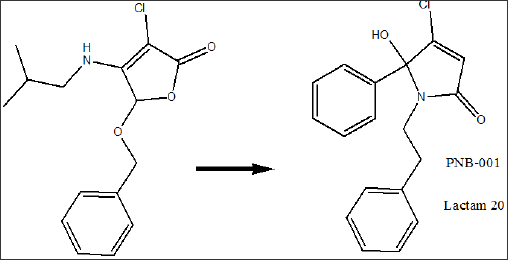
Figure 1e: From lactones to lactams. Discovery of pyrolones as a novel CCK-template. From an Aston University user patent on 4-amino-2(5H)-furanonesto a novel original template.

Lupinepublishers-openaccess-Drugdesigning-Intellectualproperties

Results and Discussions

Chemistry

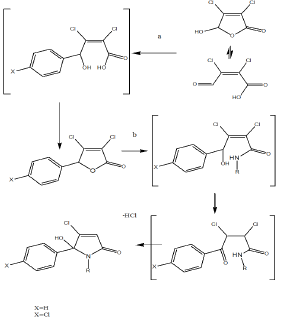
5-arylated dichloro-2(5H)-furanones A and B were synthesised from muco-chloric acid (Scheme 1), which is commercially available from furfural under oxidising conditions with hydrochloric acid. Theses intermediates were evaluated previously as anticancer agents [36]. Muco-chloric acid was reacted with benzene as reagent and solvent at RT under the development of hydrogen chloride gas. Depending on the scale of the reaction cooling with ice was required. For chloro benzene / benzene the powdered or most preferred granulated aluminium chloride served as the best catalyst and during work up with hydrochloric acid on ice the inorganic salts were easily removed from the organic phase. In terms of scope of the reaction arylated 2(5H)-furanones, containing nitro- groups or trifluoro-methyl groups could not be prepared. For the small scale synthesis aluminium chloride worked well as Lewis acid. However, during scale up aluminium chloride was replaced by trifluoroborane in THF as the exothermic reaction become problematic on a kg scale.

Scheme 1: Synthesis and chemical mechanism for the preparation of lactams1-21 from muco-chloric acid.
a) Arene, RT, 10 h, workup: hydrochloric acid; b) amine , excess, ether, RT, 30 min

Lupinepublishers-openaccess-Drugdesigning-Intellectualproperties

Subsequent reaction of the 5-arylated 3,4-dichloro-2(5H)- furanones A and B (Stage 1 intermediate) in diethyl ether with alkyl- and aryl alkyl amines furnished N-alkylated hydroxyl-pyrrolones1- 21(Stage 2 products) in high yields under mild conditions. The general synthetic sequence is outlined in Scheme 1.

Overall, the desired N-alkylated unsubstituted 5-phenyl pyrrolones1-21 was obtained in only a 2 stage process as white crystalline material. The molecule is not present in the ring opened keto form and fully occurred in the 5-membered ring form, as a hydroxy-pyrolone. The 5-arylated 2(5H)-furanones reacted selectively in the ester position and no reaction in the 4-position was observed here. Previously the IPSO substitution (4-position) was described for pseudo- esters [37], and here in Scheme 1, a ring- opening ring-closure mechanism is proposed for the formation of hydroxy-pyrolone. Thus, the first step in the reaction sequence of the dichlorinated 2(5H)-furanone is the ring opening and amide formation from the corresponding lactone. Subsequently, the keto form of the acyclic amide was in situ converted into a lactam under the elimination of hydrogen chloride (middle, scheme 1). The analysis of lactam7 and 20by chiral HPLC showed a 50:50 racemic mixture of both enantiomers in solution in methanol.

Read More About Lupine Publishers Drug Designing & Intellectual Properties International Journal (DDIPIJ) Please Click on Below Link:  https://lupine-publishers-drug-designing.blogspot.com/


Monday, 28 June 2021

Lupine Publishers| Synthesis and Anxiolytic Activity of 2- (Substituted)-5-[(N-Benzotriazolomethyl)-1,3, 4-Thiadiazolyl]-4-Thiazolidinone

 Lupine Publishers| Drug Designing & Intellectual Properties International Journal (DDIPIJ)


Abstract

1,2,3- Benzotriazole (BTA) is a heterocyclic compound with three nitrogen atoms. It is a polar and colourless compound which can be used for its great versatility. The enormous investigations on derivatives of benzotriazole reveal wide applicability of this molecule for tagging and delivering huge number of heterocyclic nuclei. In the present work synthesis of several derivatives of 2-(substituted)-5-[(n-benzotriazolomethyl)-1,3,4-thiadiazolyl]-4-thiazolidinone has been synthesized and are evaluated for their anxiolytic activity. The antianxiety activities of the synthesized derivatives were evaluated using EPM test and Bright and dark box test experimental models of anxiety. All results were expressed as mean± standard error mean (SEM) and analysed by one-way ANOVA. Post-hoc comparisons were performed by applying Dunnefs test. P <0.05 was considered statistically significant

Keywords: Benzotriazole; Thiadiazole; Thiazolidinone; Anxiolytic Activity; Anxiety; Elevated Plus Maize; Bright and Dark Arena

Abbrevations: IP: Intraperitoneally; IAEC: Institutional Animal Ethics Committee; SEM: Standard Error Mean

Introduction

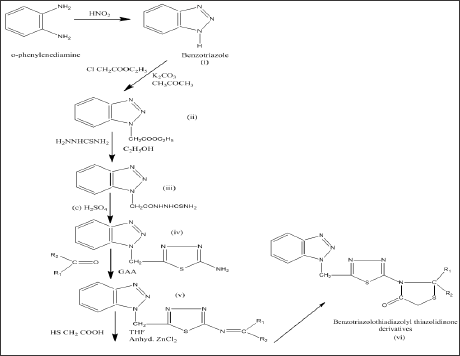
1,2,3- benzotriazoles were reported to have potential fungicidal [1] and antibacterial activity [2]. Similarly 1,3,4-thiadiazole derivatives were also reported to possess fungicidal, herbicidal, bactericidal [3], pesticidal, insecticidal, antihistaminic, antiamoebic [4], CNS depressant, antihypertensive, anticonvulsant, hypnotic, analgesic [5], anti-inflammatory [6] and agonist for 5-Ht receptor [7]. 4-thiazolidinone nucleus has also occupied a unique place in the field of medicinal chemistry due to its wide range of biological activities like antibacterial, anticancer [8], Respiratory, syncytial, virus Inhibitor [9], anticonvulsant [10], sciatic nerve blocking, local anaesthetic, inhibitors of human (CK2) protein kinase [11], hypnotic, fungicidal, cysticidal, anti leukemic and antioxidant activity. In view of potential biological activities of benzotriazole, thiadiazole and 4-thiazolidinone an attempt has made to unite these nuclei together and synthesize some new derivatives of benzotriazole (X^XJ to probe how far these combinations could develop anxiolytic activity. The procedure of synthesis has been outlined in Figure 1.

Anxiety is a normal emotional response which when chronic or severe becomes pathological and can aggravate cardiovascular and psychiatric disorders [12]. Despite the development of new molecules for pharmacotherapy of anxiety, the treatment is challenging as they produce various side effects or exhibit tolerance on continuous use.

Materials and Methods

The chemicals and reagents used in this were of AR and LR grade. They were procured from CDH, Hi-Media, Merck, Sigma Aldrich and Ranbaxy. The melting points of the synthesized compounds were determined by using Thiel's melting point apparatus (open capillary tube method) and all the compounds gave sharp melting points and are uncorrected. Purity of the compounds was ascertained by thin layer chromatography using silica gel-G as stationary phase and appropriate mixtures of the following solvents as mobile phase: n-butanol, glacial acetic acid and water. The spots resolved were visualized using iodine chamber. The IR spectra of the synthesized compounds were recorded on a Fourier Transform IR spectrophotometer (Perkin Elimer BX-II) in the range of 400-4000 using diffuse reflectance system and values of vmax are reported in cm-1. 1H NMR spectra were recorded on Bruker Av- II 400 MHz NMR spectrometer and chemical shifts (5) are reported in ppm downfield from internal reference Tetramethylsilane (TMS). Mass spectra were recorded on Shimadzu LC-MS model 2010A. Elemental analysis of the newly synthesized compounds was carried out using Euro - E 3000 series elemental analyzer. 2-(substituted)-5-[(n-benzotriazolomethyl)-1,3,4-thiadiazolyl]-4- thiazolidinone were prepared as per the method described in the literature [13-15]. The Synthetic Procedure involved the following six steps as stated below.

    i. Step 1: Synthesis of Benzotriazole: In a mixture of 11.5 ml glacial acetic acid and 30 ml water, 0.1M o-phenylenediamine was dissolved and then added a solution of 0.1 M NaNO2 in 15 ml of water, stirred continuously for 15 minutes. The temperature was maintained at 120C, chilled in ice bath and product (i) was collected by filtration. The yield obtained was 85% and M.P. was 990C.

    ii. Step 2: Synthesis of N-Benzotriazolacetate: A mixture of product (i) 0.1M, ethylacetate (0.1M) and 0.3 gm of K2CO3 in 60 ml of acetone was stirred of 10 hrs. The solvent was removed under reduced pressure. A solid m ass was produced which gave needle shaped crystals after recrystallization from the mixture of chloroform and ether (8:2 % V/V). The yield obtained was 70% and M.P. was 400C.

    iii. Step 3: Synthesis of N-Benzotriazol Acetyl Thiosemicarbazide: The crystals obtained from step II (0.08M) and thiosemicarbazide (0.08M) were taken in 50 ml of ethanol, stirred for 6 hrs and then refluxed for 3 hrs. The yellow coloured compound was obtained after recrystallization from the mixture of chloroform and hexane (9:1 %V/V). The yield was 60% and M.P. 1030C.

    iv. Step 4: Synthesis of 2-Amino-5-(N- Benzotriazolomethyl)-1,3,4-Thiadiazole: Compound iii (0.08M) was added in conc. H2SO4 and kept overnight at room temperature, then neutralized with ammonia and extracted with ether. The ether was distilled off and the product recrystallized from methanol, the yield was 52% and M.P. 1210C.

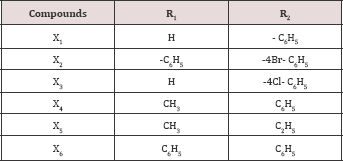
    v. Step 5: Synthesis of 2-Benzylidenylamino-5-(N- Benzotriazolomethyl)-1,3,4-Thiadiazole: Compound iv (0.02M), carbonyl compound (R1R2C=O) (Table 1) and glacial acetic acid (2ml) were refluxed in 50 ml methanol for 8 hrs. Solvent was distilled off and product recrystallised from the mixture of benzene and chloroform (1:6 %V/V). M.P. was 1290C and the yield was 50%.

    Table 1:R1 and R2 values for compound χt to χ6.

    Lupinepublishers-openaccess-Drug-Designing-Intellectual-Properties

    Figure 1:

    Lupinepublishers-openaccess-Drugdesigning-Intellectualproperties

      vi. Step 6: Synthesis of 2-(Phenyl)-5-[(N-Benzotri- azolomethyl)-1,3,4-Thiadiazolyl]-4-Thiazolidinone: The compound (v) 0.01M and mercapto acetic acid (10ml) with a pinch of anhydrous ZnCl2 were added in 30 ml of tetrahydro-furan and refluxed for 12 hrs on water bath. The product was separated and recrystallised from ethanol. The M.P. was 1380C and yield was 58%. The purity of synthesised compounds were established by TLC using 2% silica gel G, n-butanol: glacial acetic acid: water (4:1:5). The M.P. of synthesized compounds χ1 to χ6 was found to be 1380C, 1300C, 1630C, 1560C, 1220C and 1260C respectively (Figure 1).

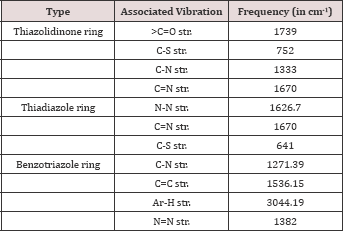
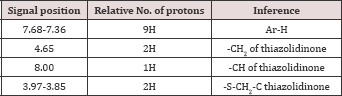
    Structures of the compounds were established on the basis of C, H and N analysis reports, IR and 1H-NMR spectra (Table 2).

    Table 2: Spectra! data of 2-(substituted)-5-[(n-benzotri- azolomethyl)-1,3,4-thiadiazolyl]-4-thiazolidinone.

    Lupinepublishers-openaccess-Drug-Designing-Intellectual-Properties

    (a) Interpretation of IR spectra:

    Lupinepublishers-openaccess-Drug-Designing-Intellectual-Properties

    (b) Interpretation of 1H-NMR spectra:

Determination of Anxiolytic Activity

Methods

Preparation of DMF (Dimethylformamide) Suspension of Synthesized Compounds: All synthesized compounds were dissolved in DMF and used as a suspension in physiological saline containing 2 drops of Tween 80 and produce a final conc. of 0.2 mg/ml. The standard drug used for this study was diazepam. Drugs were administered intraperitoneally (IP) in a constant volume of 1 ml/kg, 60 min before experiments were carried out.

Animals: Adult male Swiss albino mice weighing 25-35g obtained from our animal house. The animals were housed at 24±20C with 12: 12 h light and dark cycle. They had free access to food and water. The animals were acclimatized for a period of 7 days before the study. The experimental protocol was approved by the Institutional Animal Ethics Committee (IAEC) of Institute of Pharmacy, Bundelhand University, Jhansi (U.P.) India. The animals were used according to the CPCSEA guidelines for the use and care of experimental animals.

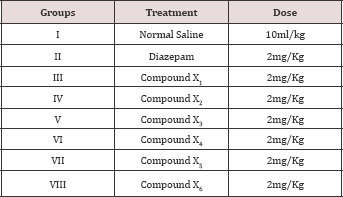
Experimental Design: On the day of the experiment, the animals were divided randomly into control and experimental groups (n=6). Group 1 received the vehicle, normal saline (10ml/kg) and served as the control group, group 2 received the standard drug diazepam (2mg/kg) and group 3 to 8 received DMF suspension of synthesized compounds (X1 to X6) (Table 3). Drugs were administered to the animals 60 minutes prior to the evaluation in acute study, for chronic study once daily for a period of 10 days. Behavioural evaluation was carried out 60 minutes post drug administration on the 10th day. The antianxiety activity of the test drug was evaluated using EPM (elevated plus maze) test and Bright and dark box test experimental models of anxiety.

Table 3: Experimental design.

Lupinepublishers-openaccess-Drug-Designing-Intellectual-Properties

Evaluation of Antianxiety Activity

Elevated Plus Maze Test

According to the method of Kulkarni SK et al. [16] The wooden maze consisted of two open arms (50cmx10cm) and two closed arms of (50cmx10cmx40cm). The arms of same type were opposite to each other with a central square of 10cm.The maze was elevated to a height of 50cm above the floor. Each animal was placed in the centre square of plus maze, facing one of the open arms. The number of entries into and the time spent in open and closed arms in a 5 min period was noted.

Bright and Dark

The apparatus consisted of an open top wooden box. Two distinct chambers, a black chamber (20x30x35cm) painted black and illuminated with dimmed red light and a bright chamber (30x30x35cm) painted white and brightly illuminated with 100 W white light sources, were located 17 cm above the box. The two chambers were connected through a small open doorway (7.5 x5cm) situated on the floor level at the centre of the partition [17].

Behavioural Assessment

Each animal was tested initially in plus maze and, then, in bright and dark arena paradigm in a single setting. In acute study 60 min after and in chronic study 60 min after the last dose on the 10+ day of drug or vehicle administration, each animal was placed in the centre square of the plus maze, facing one of the open arms. The number of entries into and the time spent in open and closed arms and the number of rears in each arm in a five-minute period was noted. Following the elevated plus maze test, the animal was placed at the centre of the brightly lit arena in the light and dark box. The number of entries into and the time spent in the bright arena, the number of rears in the bright arenas were noted. Following each trial, the apparatus were cleaned to mask the odour left by the animal in the previous experiment. Hand operated counters and stop watches were used to score the behaviour of animals.

Statistical Analysis

All results were expressed as mean± standard error mean (SEM) and analysed by one-way ANOVA. Post-hoc comparisons were performed by applying Dunnet's test. P <0.05 was considered statistically significant.

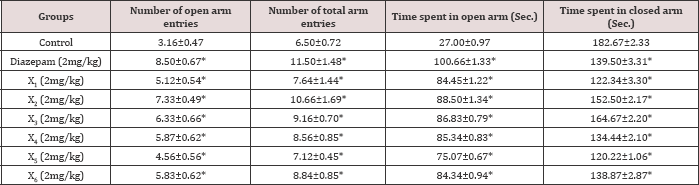
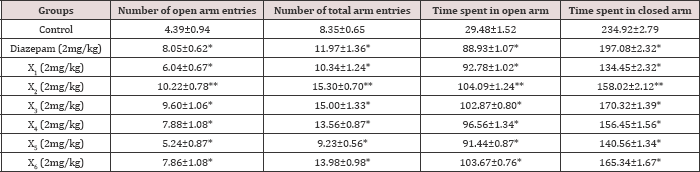
Table 4: Acute effect of synthesized compounds on behaviour of mice in elevated plus maze.

Lupinepublishers-openaccess-Drug-Designing-Intellectual-Properties

Results

Elevated Plus-Maze

A perusal of Table 4 shows that compared to the standard drug, the synthesized compounds X2 and χ3 significantly increased open arm activity, increasing the duration of time spent and number of entries in open arm in EPM test compared to control in acute study but in chronic study the doses of χ2 and χ3 produced a greater increase in duration of time spent and number of entries in open arm in EPM test compared to both control and standard drug diazepam. χ2 had produced better effect than χ3 and Diazepam in chronic study (Tables 4 & 5).

Table 5: Chronic effect of synthesized compounds on behaviour of mice in elevated plus maze.

Lupinepublishers-openaccess-Drug-Designing-Intellectual-Properties

Values represented mean±SEM (n=6), *P<0.05 vs. control, **P<0.05 vs. standard.

Bright and Dark

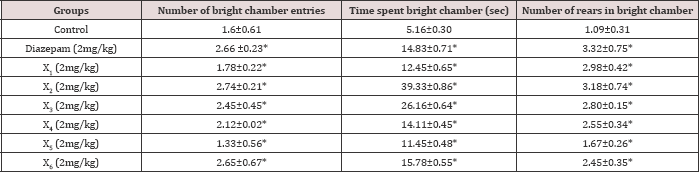
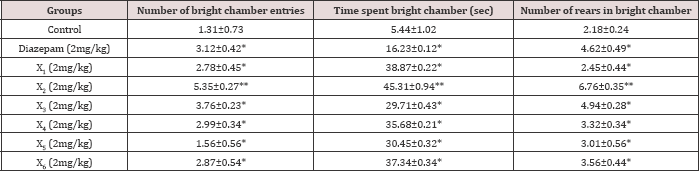
Diazepam (1mg/kg) treated mice significantly increased the number of entries into the bright arena, the time spent and the rears in bright arena. In acute study, both X2 and X3 significantly increased the number of entries into, time spent and rears in bright arena compared to control. X2 and X3 both had shown significantly increased number of entries into, time spent and rears in bright arena when compared to control and diazepam in chronic study (Tables 6 & 7).

Table 6: Acute effect of synthesized compounds on behaviour of mice in bright and dark arena.

Lupinepublishers-openaccess-Drug-Designing-Intellectual-Properties

Values represented mean±SEM (n=6), *P<0.05 vs. control.

Table 7: Chronic effect of synthesized compounds on behaviour of mice in bright and dark arena.

Lupinepublishers-openaccess-Drug-Designing-Intellectual-Properties

Values represented mean±SEM (n=6), *P<0.05 vs. control, **P<0.05 vs. standard.

Discussion

The two experimental models of anxiety, elevated plus maze and bright and dark arena, are based on the assumption that unfamiliar, non-protective and brightly lit environmental stress provokes inhibition of normal behaviour. This normal behavioural inhibition is further augmented in the presence of fear or anxiety like state. In the elevated plus maze, the open arms are more fear provoking than the closed arms. The ratio of entries, time spent and rearing behaviour in open arms to closed arms reflects the safety of closed arms with relative fearfulness of open arms [18]. The reduction in entry, time spent, total arm entries are the indications of high level of fear or anxiety. Anxiolytic drugs increase the proportion of entries, time spent in open arms. In the bright and dark box paradigm, the brightly lit environment is a noxious environment stressor that inhibits the exploratory behaviour of rodents. Reduction in the number of entries, time spent and rearing behaviour in the bright chamber was regarded as markers of anxiety. Rearing reflects an exploratory tendency of the animal that can be reduced due to a high level of fear [19]. In the present study, the compounds X2 and X3 significantly increased the duration of time spent and number of entries in open arm, time spent in closed arm in EPM test indicating anxiolytic activity in both acute and chronic studies. They also showed an increase in the time spent and the rears in bright arena in the bright and dark arena paradigm. Anxiolytic activity of X2 was found to be greater than diazepam in chronic study.

Conclusion

The derivatives of benzotriazole (X1 to X6) were synthesized with the objective to develop better anxiolytic agents with maximum percentage of yield and optimal anxiolytic activity. The results of the present study suggest that the synthesized compounds X2 and X3 have anxiolytic activity better than Diazepam. It was observed that halogen substituted aromatic compounds were more active than unsubstituted aromatic compounds and aromatic compounds were more active than alkyl substituted compounds. Further investigations with appropriate structural modification of title compound may result in therapeutically useful products. Further studies are required to elucidate the possible mechanism of anxiolytic activity and its usefulness in human beings.

Read More About Lupine Publishers Drug Designing & Intellectual Properties International Journal (DDIPIJ) Please Click on Below Link: https://lupine-publishers-drug-designing.blogspot.com/


Wednesday, 19 May 2021

Lupine Publishers| Preparation and Evaluation of Micro particulate Drug Delivery Systems of Gliclazide Employing Starch Acetate

 Lupine Publishers| Drug Designing & Intellectual Properties International Journal (DDIPIJ)


Abstract

Recently much emphasis is being laid on the development of micro particulate DDS in preference to single unit systems because of their potential benefits such as increased bioavailability, reduced risk of systemic toxicity, reduced risk of local irritation and predictable gastric emptying. The objective of the present study is to prepare and evaluate micro particulate drug delivery systems of Gliclazide using starch acetate, a new modified starch for oral controlled release. The starch acetate (DS 2.75) was freely soluble in chloroform and insoluble in several aqueous fluids and organic solvents. Chloroform could be used as solvent for starch acetate in the preparation of micro particles, microcapsules and in film coating Spherical starch acetate- Gliclazide micro particles could be prepared by the emulsification-solvent evaporation method. The method is industrially feasible as it involves emulsification and removal of the solvent, which can be controlled precisely. The emulsification solvent evaporation method was reproducible with regard to size and size distribution of the micro particles. About 65-70% of micro particles in each batch were in the size range 35/50 mesh (398.5μm) Encapsulation efficiency was in the range 96.0-99.3 % in the preparation of micro particles.

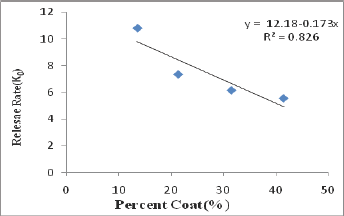
Gliclazide release from the starch acetate micro particles was slow and spread over longer periods of time. The drug release depended on the proportion of core: coat in the micro particles. A good linear relationship (R2=0.826) between percent coat and release rate (ko) was observed. The relationship could be expressed by the linear equation, y=12.18-0.173x where x is percent coat and y is release rate (ko). Gliclazide release from the starch acetate micro particles was by non fickian (anomalous) diffusion. Formulation F2 prepared using a Core: coat ratio of 8:2 gave slow, controlled and complete release (100%) of Gliclazide over 12 hours. As such formulation F2 is considered as a promising micro particulate DDS for oral control release of Gliclazide over 12 hours for b.i.d administration

Keywords: Multi particulate drug delivery systems; Starch acetate; Gliclazide; Oral controlled release

Introduction

The design of micro particulate drug delivery systems is an efficient technique to provide the sustained & controlled delivery of drugs over long periods of time. Micro particulate drug delivery systems [1] consist of small particles of solids or small droplets of liquids surrounded by walls of natural & synthetic polymer films of varying thickness & degree of permeability acting as a release rate controlling substance & have a diameter up to the range of 0.1μm- 200μm. Micro particulate dosage forms [2] are pharmaceutical formulations in which the active substance is present as a number of small independent subunits. To deliver the recommended total dose, these subunits are filled into capsules, encapsulated or compressed into a tablet. Micro particulate drug delivery systems contain discrete particles that make up a multiple-unit system. They provide many advantages over single-unit systems because of their small size. Multi particulates are less dependent on gastric empty time, resulting in less inter and intra-subject variability in gastrointestinal transit time. They are also better distributed and less likely to cause local irritation [3]. Recently much emphasis is being laid on the development of micro particulate dosage forms in preference to single unit systems because of their potential benefits such as increased bioavailability, reduced risk of systemic toxicity, reduced risk of local irritation and predictable gastric emptying [4].

Design of micro particulate drug delivery systems requires a suitable polymer to serve the intended purpose. Several polymers such as benzyl cellulose, cellulose nitrate, cellulose acetate, epoxy resin, ethyl cellulose, polyethylene, polymethyl methacrylate, polystyrene, polyvinyl acetate, Eudragit S-100, chitosan have been used in the design of micro particulate drug delivery systems [5,6]. In the present investigation Starch acetate, a new modified starch was tried for the preparation of micro particulate drug delivery systems of Gliclazide for oral controlled release. Starch acetate is reported [7,8] to have excellent bond forming ability and suitable for coating and controlled release applications. The objective of the present study is to prepare and evaluate micro particulate drug delivery systems of Gliclazide using starch acetate for oral controlled release. Gliclazide is a potential second generation, short-acting sulfonylurea oral hypoglycemic agent widely used for the treatment of non-insulin-dependent diabetes mellitus [9]. In general, rapid gastrointestinal absorption is required for oral hypoglycemic drugs in order to prevent a sudden increase in blood glucose level after food intake in patients with diabetes mellitus. However, the absorption rate of Gliclazide from the gastrointestinal tract is slow and varied among subjects. Slow absorption of a drug usually originates from either poor dissolution of the drug from the formulation or poor permeability of the drug across the gastrointestinal membrane [10] .The dose of Gliclazide is 40-80mg as conventional tablets and 60mg as sustained release tablets. The conventional tablets are to be taken 2-3 times a day to maintain normal plasma glucose levels. Sustained release formulations offer better patient complains by reducing the frequency of dosage administrations and also provide continuous effect. Emulsification- solvent evaporation method was tried for the preparation of starch acetate-Gliclazide micro particles.

Materials and Methods

Materials

Gliclazide was a gift sample from M/s Micro Labs Limited, Starch acetate (DS 2.75) was obtained from M/s Esai Pharma technology Pvt. Ltd. Potato starch (SD Fine chemicals), and acetic anhydride (Qualigens), sodium hydroxide (Qualigens) and chloroform (Qualigens) were procured from commercial sources. All other materials used were of pharmacopoeia grade.

Methods

Estimation of Gliclazide: An UV Spectrophotometric method based on the measurement of absorbance at 227 nm in phosphate buffer of pH 7.4 was used for the estimation of Gliclazide. The method was validated for linearity, accuracy, precision and interference by the excipients. The method obeyed Beer's law in the concentration range of 1 - 10 ng/ ml. When a standard drug solution was repeatedly assayed (n=6), the relative error and coefficient of variance (RSD) were found to be 0.80% and 1.2% respectively. No interference by the excipients used in the study was observed.

Preparation of Starch Acetate-Gliclazide Micro Particulate DDS: An emulsification solvent evaporation method was tried for preparation of starch acetate-Gliclazide micro particulate DDS. Starch acetate (0.2 g) was dissolved in chloroform (10mL) to form a homogeneous solution. Core material, Gliclazide (0.8 g) was added to the polymer (starch acetate) solution (5 ml) and mixed thoroughly. The resulting mixture was then added in a thin stream to 200 ml of an aqueous mucilage of sodium CMC (0.5 % w/v) contained in a 450 ml beaker while stirring at 1000 rpm to emulsify the added dispersion as fine droplets. A Remi medium duty stirrer with speed meter (model RQT 124) was used for stirring. The solvent, chloroform was then removed by continuous stirring at room temperature (28 °C) for 3 h to produce spherical micro particles. The micro particles were collected by vacuum filtration and washed repeatedly with water. The product was then air dried to obtain discrete micro particles. Different proportions of core: coat namely 9:1 (F1), 8:2 (F2), 7:3 (F3) and 6:4(F4) were used to prepare micro particles with varying amount of coat polymer.

Estimation of Drug Content and Encapsulation Efficiency:Four samples of 100mg each were taken from each batch of micro particles prepared and assayed for Gliclazide content at 227nm .Encapsulation efficiency was estimated using the equation,

Encapsulation efficiency (%)=[Estimated drug content, %/ Theoretical drug content%] X100

Size Analysis: For the size distribution analysis, different fractions in a batch were separated by sieving using a range of standard sieves. The amounts retained on different sieves were weighed.

Drug Release Study: Release of Gliclazide from the micro particles of size 20/30 and 30/50 mesh was studied in phosphate buffer of pH 7.4 (900 ml) using an 8 station dissolution rate test apparatus (model Disso-2000, M/s Lab. India) with a paddle stirrer( Apparatus 2) at 50 rpm. A temperature of 37° ± 1°C was maintained throughout the experiment. A sample of micro particles equivalent to 60 mg of Gliclazide was used in each test. Samples (5 ml) were withdrawn through a filter (0.45 μ) at different time intervals over 12 h and were assayed at 227nm for Gliclazide content. The sample (5 ml) taken at each sampling time was replaced with drug free dissolution fluid and a suitable correction was applied for the amount of drug lost in sampling for the estimation of amount of drug released at various times. Each drug release experiment was conducted in triplicate (n=3).

Analysis of Release Data: Drug release data were analyzed as per zero order, first order, Higuchi [11] equation and Korsmeyer- Peppas [12] equation models to assess the release kinetics and mechanism.

Results and Discussion

The starch acetate (DS 2.75) was insoluble in water, aqueous buffers of pH 1.2 and 7.4, methanol, petroleum ether, dichloromethane and cyclohexane. It is freely soluble in chloroform. Hence chloroform was used as the solvent for starch acetate in the preparation of micro particulate DDS. An emulsification - solvent evaporation method was used for the preparation of micro particles of starch acetate-Gliclazide. The method involves emulsification of the polymer (starch acetate) solution in chloroform containing the dispersed drug particles in an immiscible liquid medium (0.5 % w/v solution of sodium CMC) as micro droplets, followed by removal of the solvent, chloroform by continuous stirring to form rigid micro particles. The micro particles were collected by vacuum filtration and washed repeatedly with water. The product was then air dried to obtain discrete micro particles. The micro particles were found to be discrete, spherical and free flowing. The sizes could be separated readily by sieving and a more uniform size range of micro particles could easily be obtained. The sieve analysis of different batches of micro particles prepared indicated that a large proportion,65-70%, in each batch were in the size range of 35/50 mesh(398.5μm).The reproducibility of the method with regard to size distribution of the micro particles was evaluated by preparing three batches of micro particles under identical conditions in each case. Size analysis indicated that about 65-70% of the micro particles are in the size range 35/50 mesh in all the batches. Microparticles of the size (398.5μm) were selected for further evaluation.

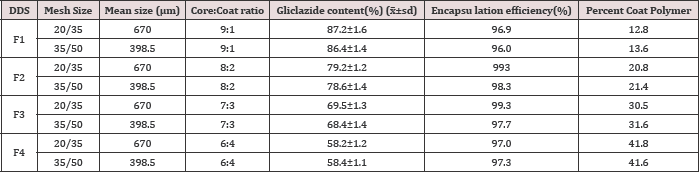
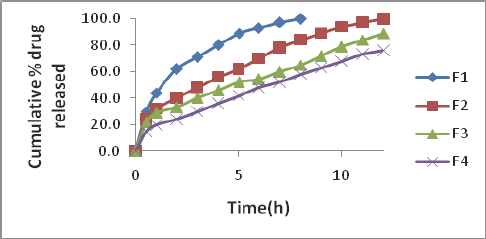
The physical characteristics of the micro particulate DDS prepared are given in Table 1. Low coefficient of variation (cv) in percent drug content (< 2.0 %) indicated uniformity of drug content in each batch of micro particles. The encapsulation efficiency was in the range 96.0-99.3 %. Drug content of the micro particles was found to be the same in the two sizes, 20/35, 35/50 mesh. A t-test of significance indicated that the difference in the drug content of the two sizes in each case is not significant (P>0.05). Table 1 Gliclazide release from the various micro particles of size 3 5/50 was studied in phosphate buffer pH 7.4. The drug release profiles are shown in Figure1. The release data were analyzed as per Zero order, First order, Higuchi [11] equation and Korsmeyer-Peppas [12] equation models to assess the release kinetics and mechanism. The kinetic parameters (r2 values, rate constants and n values) in the analysis of release data as per various kinetic models are given in (Table 2).

Table 1: Physical Characterstics of the Microparticulate DDS Prepared.

Lupinepublishers-openaccess-Drug-Designing-Intellectual-Properties


Figure 1: Gliclazide Release Profiles of Various Micro particulate DDS Prepared

Lupinepublishers-openaccess-Drugdesigning-Intellectualproperties

Gliclazide release from all the starch acetate micro particles tested was slow and spread over longer periods of time. The release depended on proportion of core and coat in the micro particles. As the coat proportion was increased the release rate was decreased. A good linear relationship (R2=0.826) between percent coat and release rate (ko) was observed as shown in Figure 2. The relationship could be expressed by the linear equation, y=12.18-0.173x where x is percent coat and y is release rate (Ko). A comparison of R2 values in various models revealed that the R2 value was higher in the case of korsmeyer peppas model in all the cases. As such the release data of all the micro particles tested obeyed korsmeyer peppas equation model which indicates that the drug release from the (n) in korsmeyer peppas equation model was in the range 0.4540.542 in all the cases indicating that the drug release from the micro particles was by non-fickian (anomalous) diffusion (Table 2). The results of the present study, thus, indicated that starch acetate- Gliclazide micro particles could be prepared by emulsification solvent evaporation method using chloroform as solvent for starch acetate. These micro particles could be used for oral control release of Gliclazide. Formulation F2 prepared using a Core: coat ratio of 8:2 gave slow, controlled and complete release (100%) of Gliclazide over 12 hours. As such formulation F2 is considered as a promising micro particulate DDS for oral control release of Gliclazide over 12 hours for b.i.d administration.

Table 2: Kinetic Parameters (R2 Values, Rate Constants and n values) in the Analysis of Release Data as per Various Kinetic Models.

Lupinepublishers-openaccess-Drug-Designing-Intellectual-Properties


Figure 2: Relationship between Percent Coat and Release Rate (K0) of Micro particulate DDS (Size 398.5μm)

Lupinepublishers-openaccess-Drugdesigning-Intellectualproperties

Conclusion

    a) The starch acetate (DS 2.75) was freely soluble in chloroform and insoluble in several aqueous fluids and organic solvents.

    b) Chloroform could be used as solvent for starch acetate in the preparation of micro particles, microcapsules and in film coating.

    c) Spherical starch acetate- Gliclazide micro particles could be prepared by the emulsification-solvent evaporation method. The method is industrially feasible as it involves emulsification and removal of the solvent, which can be controlled precisely.

    d) The emulsification solvent evaporation method was reproducible with regard to size and size distribution of the micro particles. About 65-70% of micro particles in each batch were in the size range 35/50 mesh (398.5μm).

    e) Encapsulation efficiency was in the range 96.0-99.3 % in the preparation of micro particles.

    f) Gliclazide release from the starch acetate micro particles was slow and spread over longer periods of time. The drug release depended on the proportion of core: coat in the micro particles.

    g) A good linear relationship (R2 = 0.826) between percent coat and release rate (ko) was observed. The relationship could be expressed by the linear equation, y = 12.18-0.173x where x is percent coat and y is release rate (ko).

    h) Gliclazide release from the starch acetate micro particles was by non fickian (anomalous) diffusion.

    i) Formulation F2 prepared using a Core: coat ratio of 8:2 gave slow, controlled and complete release(100%) of Gliclazide over 12 hours. As such formulation F2 is considered as a promising micro particulate DDS for oral control release of Gliclazide over 12 hours for b.i.d administration.

    Read More  Lupine Publishers Drug Designing & Intellectual Properties International Journal (DDIPIJ) Click on Below Link: https://lupine-publishers-drug-designing.blogspot.com/


Tuesday, 23 March 2021

Lupine Publishers| Do You Know Your New Molecular Entity (NME)?

 Lupine Publishers| Drug Designing & Intellectual Properties International Journal


Introduction

During the last decades, life science startup companies have relatively rapidly increased their presence in the pharmaceutical landscape. Pharmaceutical development has evolved because technology (analytical and process development) and clinical development (hybrid design in phase 1, including patients in phase 1B) have evolved in parallel allowing in certain cases to decrease the time to regulatory filings (IND, CTA, NDA, NDA 505 (b)(2),..), which seemed attractive for startup companies. However, new molecular entities have become more complex since polypeptides, proteins, and monoclonal antibodies drug products take more and more place in many therapeutic areas (more than 50% in the 50 best seller drugs) along with the more conventional small molecules. But it is not the end of small molecules; research institutes, startup companies are still busy working hard to develop more powerful small molecules, since the physiopathology has also evolved and helped finding some new targets to enhance their efficacy and decrease their lack of selectivity. Startup companies are mostly driven by high level scientists and few of them are familiar with the drug development process, including its early phases. Scientists do know their NMEs from a scientific point of view however, much less and, sometimes, not at all in terms of potential drug product candidates.

The authors of this paper cumulate more than 50 years in drug development at various phases with different kind of molecules; they will try to illustrate how what you do not know about your NMEs can and will hurt you and also present how to avoid surprises that may occur down the road of drug development.

People do not know their NME.... however the NME is the most important ingredient of a drug

These three (3) main questions should be asked:

    a) Why do we not know our NME?

    b) When and how does it hurt?

    c) What can we do to prevent it?

    a) Why do we not know our NME?

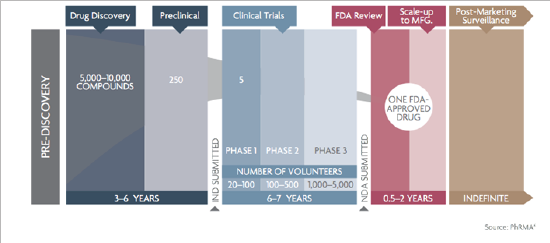
Figure 1: Drug Development Timeline by PhRMA.

Lupinepublishers-openaccess-Drugdesigning-Intellectualproperties

As illustrated in (Figure 1) below and going through different Gantt charts coming from different websites, pharmaceutical development is not a popular topic in the overall drug development scheme and especially for startup companies. Below summarizes somehow most of the drug development pathways as illustrated in pharmaceutical companies and agencies. Two main conclusion scan be extracted from this above timeline:

    a) Things are presented sequentially but that in reality they are done in parallel.

    b) Clinical steps are starting right after the preclinical steps, increasing the statement that PR&D is not something very popular in drug development overall.

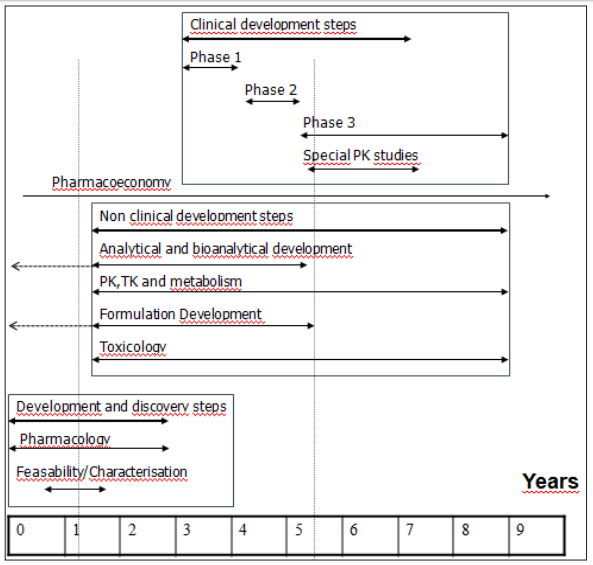
Figure 2: Interaction and timing of the different drug development steps. Adapted and modified from Modern Pharmaceutics (ref...).

Lupinepublishers-openaccess-Drugdesigning-Intellectualproperties

The (Figure 2) above illustrates, in our sense how drug development should be done, regardless of the NME. The following things should be kept in mind then:

    a) Many drug development activities are done in parallel (and not sequentially).

    b) PR&D should start almost during drug discovery, or when lead compounds (and backups) have been selected.

From a regulatory standpoint, according to Pharmaceutical Development ICH Q8 Guideline, the aim of pharmaceutical development is to design a quality product and its manufacturing process to consistently deliver the intended performance of the product. It means that irrespective of the development steps and the scale, both the NME and the dosage form should be reliable, reproducible, stable and develop in such a way thatthe changes (scale-up, fine tuning) through development should not require, in a ideal world, bridging studies. A lot of people working in the PR&D area have noticed that this last ICH Q8 was more than a challenge to achieve. It represents one of the reasons why drug development will hurt. Questions are then the following:

How it can and will hurt- Where does it start?

    a) With the NME: although drug development requires a scientific approach, science should be used to meet regulatory requirements.

    b) The NME needs to be developed into an active pharmaceutical ingredient (API) irrespective of its indication.

    c) Even though outstanding results were obtained during the proof of concept (POC), a NME is not in itself an API, even less a dosage form.

Why do we not know our API?

Typical Biotech/start-up situation:

    a) Licensed technology/molecule from a university or research center, where the scope and objectives (research is oriented to advance science and knowledge) do not totally meet those of the pharmaceutical industry (research is oriented to serve medical needs within the confines of regulations ultimately allowing bringing a drug product to market).

    b) High knowledge of the chemistry, the biology, the proof of mechanism (not necessary the physiopathology).

    c) Lack of knowledge of the pharmaceutical sciences /drug development process.

    d) In the quest for nanomolar binding efficiency and biological potency, there has been a gradual shift of new pipeline compounds biopharmaceutical characteristics into less "druggable" compounds. The result then is a higher challenge to develop and maintain a reliable/reproducible dosage form regardless of the scale and the development steps.

Why do we not know our API?

Typical Biotech/start-up situation

    a) Lack of available funds for several reasons (due diligence, overhead, routes of administration were different during nonclinical steps resulting in lack of reliability/efficacy, poor NME characterization at the gram scale, poor development plan).

    b) Money is kept for what is perceived as absolutely necessary: the clinic whereas the phase 1 clinical trial may not be the most expensive step (depending the indication), CMC, formulation development and nonclinical could be extremely expensive for a sterile biological product.

    c) Need to deliver something quickly.

    d) Public companies are driven by market expectations.

    e) Private companies need results to get financing.

    f) Prepare samples for pre-clinical/toxicological studies with available material.

    g) Most of the time, formulations used in preclinical and toxicological studies are not optimized and do not reflect the formulation to be brought to clinical studies.

    h) Lack of knowledge of the regulatory requirements for drug development and therefore the associated cost.

    i) Drug development is a lengthy process and the regulatory environment changes, so will the cost.

When does it hurt?

    a) Throughout the drug development process.

    b) Typical biotech situation: jumping in the drug development arena without required knowledge and expertise, relying on CMOs and CROs to fill the gap.

    c) When trying to secure a business partner.

    d) Typical biotech situation: licensing after a phase IIA, which needs an un neglect able amount funds.

    e) Usually a Big Pharma with a high knowledge of drug development process.

    f) Due diligence can be deadly: team of experts with high expectations on availability of data, QA audits.

    g) When preparing the market application.

    h) After commercialization middle size pharma are buying products to fill their pipelines where most of the challenges lie in chemistry, manufacture and controls.

    i) Getting out of the laboratory: going to the pilot plant up to GMP facilities.

    j) What works at the gram scale usually does not work at the kilo scale.

    k) Process parameters change (equipment train, operating conditions, crystallization/purification solvents, mass and heat transfers, etc.)

    l) Preparation of the test articles for GLP toxicological studies may not be reliable from the bench to the CRO, root cause being unknown because not investigated.

    m) All these impact the quality attributes of the Apian therefore the rest of the drug development chain.

Due Diligence Topics

NME:

    a) Synthesis: yield and scale-up feasibility.

    b) Analytical development: wet and solid-state chemistry (which is neglected despite the lack of solubility, the high log P of the more recent NME).

    c) Comments on whether there are any correlations between physical characteristics and formulation orbio availability (polymorphism is somehow neglected).

Non-clinical development and GLP toxicology:

    a) How was the proof of mechanism demonstrated (versus gold standard? Route of administration? Reliability?).

    b) There is evidence that most sponsors have a good understanding of the toxicology program that is required to bring a product to Phase I; however, the rest of the early phases of drug development (i.e. the development of the actual drug product in a suitable dosage form) is not given the same level of attention despite the increasing poor "drug ability" properties of modern-day NMEs.

    c) Current Approaches to Fisrt-In-Human Phase I Clinical Supplies.

    d) "Formulated" product approach: Clinical formulation that is a precursor of the desired commercial formulation.

    e) Exploratory formulation approach: Uses the simplest possible formulation (e.g. NME only in bottles or capsules).

    f) Keeping in mind that the focus of Phase I testing is mainly to evaluate safety, which approach is applicable and why?

    g) Phase I-II clinical programs are rarely rejected from a clinical standpoint. But care should be taken with the clinical supplies: was the formulation the same than during non- clinical proof of concept and GLP toxicological studies? If the formulation has changed, has it modified the Maximum Tolerated Dose, the MEC (minimum effective concentration to get a PD effect), and the No Observed Adverse Event Level (NOAEL)?

When and how does it hurt?

    a) If the NME is not well characterized (frequent), the changes that occur are difficult to identify and the basic quality attributes cannot be properly maintained. It will then generate a snow balling effect throughout drug development.

    b) What is the impact of the NME manufacturing (physicochemical characteristics) and formulation development processes (differences in the formulation from non-clinical POC, GLP tox studies, and from phase I to III, scale up) on drug product performance, especially since drug are getting less and less soluble and then "druggable".

    c) CMC: preparation of early phase clinical application documents, and modules 2 and 3 of the CTD.

    d) Happens after years of drug development initiation.

    e) Very often, data was generated way back by people that are no longer in the organization.

    f) Characterizing the impurity profile is important not only from a CMC standpoint but also for toxicology and clinical studies. Impurities present at levels above ICH standards should be qualified.

    g) If the NME is not well characterized, changes that occurred through the various phases of development cannot be identified and the basic quality attributes cannot be properly maintained.

    h) Wet chemical characterization is not enough to portray the complete NME behavior Physical characterization is essential.

    i) If there a relationship between the structure and the activity of an NME, (complex NME and biologics), bioassays are more than recommended (and mandatory for most of the agencies).

    j) Both the NME and the dosage form will go through "Site changes", going from "laboratory" to "pilot" and then to production scale.

    k) Site change: bench top scale to cGMP (kilo and pilot scales) facility.

    l) cGLP non-clinical, phase I/II clinical studies: safety and "exploratory (dose ranging/finding)" efficacy data acquisition.

    m) Impurities? (Safety and CMC are concerned).

    n) Polymorphic forms? (CMC, safety and efficacy are concerned) ite changes: from cGMP pilot to cGMP commercial scales.

    o) Phase III clinical studies: generation of safety and efficacy data.

    p) Pivotal clinical studies.

    q) Should use the « final and best » NME and dosage form.

    r) Surprises are not welcome at this late stage.

    s) When submitting a market application, it is necessary to demonstrate a similarity between the batches used in the clinic and the formula of the proposed commercial product.

    t) This applies to both the NME and the dosage form.

    u) Late surprises can lead to questioning the validity of clinical batches that have generated data and support the safety and efficacy of the commercial product.

Pre clinical and non-clinical sections

a) How has the POC been demonstrated (Which lot? Which physico-chemical characteristics? Versus standard of care? Route of administration? Animal model? Reproducibility and reliability? (Ex: IC50 (in vitro)/Cmax (in vivo) if the formulation may impact the way the NME may be absorbed, the Cmax may change form one formulation/experiment to another, the ratio may become biased.

Clinical

    a) Closely connected with the above mentioned poor "druggability", the current approaches for early clinical phases (I/IIa) in drug development

    b) Approach with formulated products, where clinical batches will be precursors based on commercial formulation (almost 90% of the final formulation).

    c) Exploratory approach: use the simplest formulation: powder in a bottle or capsule.

    d) Keep in mind that the goal of Phase I is safety and pharmacokinetics (even if cohort (s) of patients are part of phase IB).

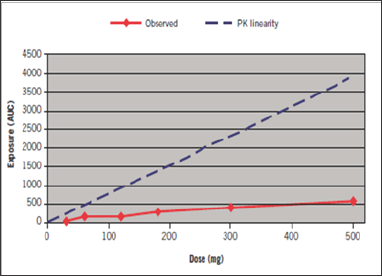
    e) (Figure 3) illustrates the risks of using a non-optimal formulation in phase I/IIa:

    f) Increased nonlinear or proportional AUC due to solubility problems (saturation of absorption).

Figure 3: Observed AUC and PK linearity Vs dose in mg.

Lupinepublishers-openaccess-Drugdesigning-Intellectualproperties

    g) No conclusions can be drawn about MTD (maximum tolerated dose, NOAEL, and safety margin,....p

What can be done to prevent this?

    a) A good knowledge of the drug development process

    b) Get familiar with regulatory requirements at the various stages of development; do not rely only on CROs or consultants.

    c) Get the required expertise and build strategies early for pharmaceutical development.

Evolving Regulatory Requirements

Phase I studies

    a) Brief and focus is on safety, PK and if possible, trend of efficacy (biomarkers, endpoint,..).

    b) Clinical design are evolving: SAD/MAD studies, food effects, patients, Therefore the goal of getting an "almost" final formulation is getting more and interesting to increase the reliability form one phase to another. Sponsors do not want the formulation to be held responsible of unexpected results.

Phase II studies

    a) Evidence to reasonably support the proposed chemical structure of the drug substance should be provided: what is the impact on tox, formulation development, clinical studies (dose ranging-finding) and primary efficacy results.

Phase III studies

    a) Final market image! Biobatches, product monograph and expiry date will be based on this scale.

Late surprises may lead to question the validity of clinical batches to support efficacy and safety of the propose commercial product.

Conclusion

In conclusion, a NME should be developed with complementary people, such as the steps illustrated in (Figure 3) the fact that people get a scientific degree does not make them specialist in all the fields. The regulations will change over time: and so will scientific knowledge and technical/analytical capabilities. It should be kept in mind that Guidance/Guideline documents represent current thinking of regulators and that some are withdrawn and new ones are issued. These documents must be interpreted in the context of the product being developed. There should be a harmonized balance between regulatory and technical/scientific requirements. Knowledge about the NEM should let people streamline their drug product correctly (safety and efficacy) through the whole drug development process, keeping in mind that everything is done in parallel, not sequentially. Since people (from investors to scientists and developers) do not share the same language, it is highly recommended to try to hire the relevant expertise as early as possible, at the early stage, better drug development strategies will be developed planned and well budgeted resulting in a nice risk management position, where "manageable" surprises only may occur down the road, without jeopardizing any launching.

Read more about Drug Designing & Intellectual Properties International Journal please Click on

https://lupine-publishers-drug-designing.blogspot.com/