Lupine Publishers | Open access journal of Complementary and Alternative Medicine
Abstract
Logic thinking is the base of developing TCM and acupuncture
theories. Pattern identification developed with Y-n-Yang and
the Five Element theories should be the key principle in practice,
especially for prescriptions and the scientific research verifying
efficacy of TCM and acupuncture.
Keywords: Yin-Yang; The Five Element; Logic Thinking; Pattern Identification
Abstract
Both Traditional Chinese medicine (TCM) and acupuncture
originated in ancient China and has evolved for more than two
thousand years. However, most of the people generally in Taiwan
present themselves to the medical doctors first when they are in
need of medical treatments. Part of this fact is because there are not
sufficient scientific researches to prove the efficacy and safety of
TCM, acupuncture, moxibustion, acupressure, cupping, Tui na, and
tai chi. In Asia, such as Taiwan, Korea, Japan, Hong Kong, etc., herbs,
acupuncture, moxibustion, acupressure, cupping, Tui na, and tai chi
are often used by TCM practitioners to integrate mind and body to
treat or prevent health issues. Compared to the current TCM and
acupuncture developments in Taiwan, acupuncture and TCM have
gained more and more popularity in the past 40 years and been
considered “essential health benefits” by people in the United States
and the West, seeing and using acupuncture and TCM primarily as
a complementary health approach [1]. TCM and acupuncture have
established its status in the health system in the West, though
they’re totally different from the Western medicine with the
philosophy, diagnosis approaches, and pattern identification for
treatment. Challenges exist at present, which deserves attention for
those who are determined to learn or interested in understanding
TCM and acupuncture. This paper, therefore, tries to present some
issues for the better future of TCM, including acupuncture, and the
Western medicine when there are integrated.
Fundamental Differences between TCM and West
Medicine
TCM, including acupuncture, and Western Medicine have been
viewed as two distinct and divergent medicines for long with the
approaches to physiology and healing techniques. Therefore,
the fundamental differences in both Western medicine and TCM
deserve attention when healthcare providers are considering the
feasible choices in clinical practice to patients [1].
In Theory
The philosophical concepts like Yin-Yang, the Five Element,
pattern identification, and Qi and Blood are, to a certain extent,
unique and abstract for learners to catch the whole picture with the
functions broader than the anatomical knowledge in the Western
medicine and are absolutely different from the theories of the
Western medicine. In terms of relation of the human beings and the
Heaven that can interact with each other in providing solutions to
the health, it is totally different from the Western medicine that TCM
sees the human body as a whole and as a microcosm of the universe
in diagnosis and treatment, bringing the body, mind and spirit into
harmony with Yin-Yang balance. It is believed that the concept of
Yin-Yang balance is the unique concept indicating the harmony
of internal organs and the dominating key of the TCM, which has
served as the foundation and the guideline for the explanation of etiology of diseases, diagnosis, and treatments throughout the
history of Chinese medicine and absolutely distinguishes TCM from
the Western medicine [1]. Based on this concept, a disease thus
refers to the loss of the balance of Yin-Yang [2].
On the other hand, TCM focuses on the “congenital constitution”
of the body that can result in “root” problems in health, which can
scientifically correspond to the core thesis of Precision medicine
(PM), which proposes the customization of healthcare with
medical decisions, treatments, practices, or products tailored to
the individual patient’s genetic content. In TCM, constitutions of
humans are categorized into the five patterns for understanding
the “root” causes and predicting the health conditions in the future,
based on the Five Element theory [1]. Western medicine is seeking
the minor difference from the perspective of etiology and only
concerned about diagnosing and treating the symptoms alone. The
theory develops with seeing the organs separately and treating
parts of the body like a machine. Each part of the organs has its
function, and when a particular part fails, it needs the replacement
or resection [1,3].
In Practice
Treatments by medical doctors directly target at the pathogen
or etiology with the evidence by a large number of modern scientific
instruments, such as blood, urine, and stool tests, X-rays, CT, and
MRI, to check on the human body. In addition to history taking
and physical examination, doctors do not make diagnosis until all
evidence are collected. Without scientific instruments, TCM doctors
or acupuncturists can only make diagnosis, based on symptoms
related to the imbalance of Yin and Yang rather than diseases itself
through analyzing a patient’s tongue, pulse, voice, and whole-body
situation, including reaction, hair, and posture [1,3]. The most
important key to the successful results is that an experienced
TCM doctors and acupuncturists can only rely on four skills for
diagnosis to identify the patterns and write up the prescriptions.
In other words, patterns, which distinguish TCM from the Western
medicine, should be the key concern for the TCM and acupuncture
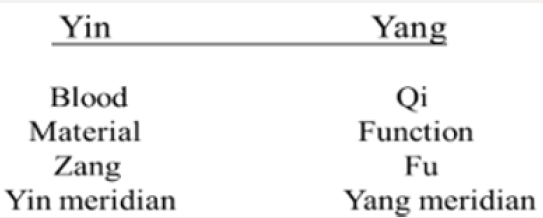
practitioners in making the decisions of treatments. Since diseases
are understood to be a loss of balance between Yin and Yang as
shown in Figure 1, good results cannot be expected without the
positive consideration of Yin and Yang [2,4].
Figure 1: Characteristics of Yin and Yang.
Challenging Issues
Challenging issues for those who are interested in and learning
TCM and acupuncture are presented in this section. These issues
may have been discussed in the previous research, but new
viewpoints are presented to attract more attention.
Language
There is no doubt that cultural decoding relies mostly on words.
It is strongly accepted that “word-for-word” literal translation
method is the way paraphrasing the accurate lexical meaning.
However, this cannot be applied to TCM and acupuncture. Language
is therefore the most challenging issue that needs to be addressed
first. With the popularity of TCM and acupuncture, language barrier
surely needs learners’ attention. The fact in the West currently is
that not all of the TCM and acupuncture classics are translated
into English. On the other hand, correct translation requires good
translators excellent in both Chinese and English. In addition to
the good command of these two languages, the meanings of the
characters used in the ancient time may be different from those at
the present time, which may confuse and frustrate readers. Chinese
characters, different from alphabet languages which only represent
forms and sounds, are called ideographs with three features of
forms, sounds and meanings [5]. The difficulties in understanding
Chinese characters in the TCM and acupuncture classics can be
classified in the following ways [5]:
A. Simplified Chinese is widely used all over the world;
however, traditional Chinese is accepted and used in ancient
classics and areas like Taiwan, Hong Kong, and Macao. For
example, 黃帝內“經” in simplified Chinese is 黄帝内“经” in
writing.
B. Pronunciation changed with usage. “能” is correctly
pronounced neng in the modern Chinese, referring to “can”
in English and. However, this character in Huang Di Nei Jing (
黃帝內經, Yellow Emperor’s Inner Classic) means “state (態)”
and the pronunciation is tai. This condition occurs when the
characters were not enough for use in the ancient time.
C. “內” can be used either as a verb or a noun. It is pronounced
na (equals納) when used as verb and
nee when used as a noun
referring to “inner” or “inside” in the modern use.
D. “平” is pronounced
pin when it is related to an adjective
“flat” in English. With writing mistakes, the pronunciation
of this character is
bian when it is used as a verb to mean
“distinguish” in medical Chinese.
E. Different characters bear the identical meanings. “输”, “
输”, and “腧” are different characters referring to the identical
meaning of acupoint, and all of these three characters are
pronounced
shu.
The ability to understanding Chinese characters deserves
attention as well in learning and understanding acupoints. For
mastering acupuncture, understanding the real Chinese meanings
of the acupoints is required. ST29-Guilai is the typical example for
this aspect because Guilai (歸來) literally in Chinese means “return”
and this acupoint is usually used for prolapse of uterus, menstrual
irregularity, and dysmenorrhea [6]. 神(Shen) is translated
differently into English in acupoints; for example, HT7-Shenmen (
神門,
Spirit gate) refers to the gate for Heart qi to get into and out
of the body, while Heart governs Shen in TCM. Compared with the
DU24-Shenting (神庭,
Shen court), 門refers to gate in Chinese and
庭, court, which suggests that one must go through the “gate (HT7)”
first and then get into the “court (DU24)” to hold or calm Shen.
This difference highlights the importance of choosing acupoints
in calming Shen. An acupoint may have different names with the
historical developments. The nickname of KD3-Taixi (太溪) is呂細
(Lvxi) alternatively used in the acupuncture classics. On the other
hand, the nickname of HT7 is 中都 (Zhongdu) completely identical
with LV6 in Chinese, which may confuses learners.
Figure 2: Protocol matrix in using traditional acupoints
and extra acupoints.
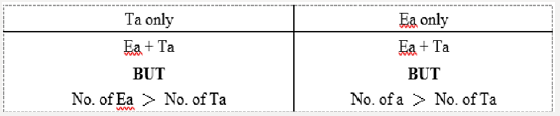
Note: Ea for Extra acupoints and Ta for Traditional
acupoints.
In addition to the names of acupoints, extra acupoints also
deserve close attention in consideration of combining regular
acupoints with extra acupoints. Extra acupoints distinguish
themselves from the regular acupoints on the traditional fourteen
meridians with the unique indications, actions, and the great
effectiveness in acupuncture theory and treatment, even though
some of extra acupoints have not been verified with scientific
evidence [7]. Pattern identification which derives from the Yin-
Yang theory is surely the key concept of TCM. Unfortunately, this
concept cannot apply to extra acupoints because they are not
incorporated into the traditional meridians with the lack of Yin-
Yang. The challenge acupuncture practitioners face is when it is the
best time to consider extra acupoints in a protocol. The historical
developments of extra points show that an extra point can surely
play an essential role in acupuncture and be used alone or with the
traditional regular acupoints for the treatment. Unfortunately, the
actions and indications of extra acupoints have not be scientifically
researched and verified as traditional regular acupoints. In
strategy, a practitioner may take the principle of “Least needling
for best results” into consideration to keep patients from pain, fear,
or worry. The goal can be achieved with the following four choices
shown in Figure 2 when it comes to the tactic [8].
Characterizations of Chinese Material Medica
The use of Chinese herb must be based on the patient’s
conditions with accurate diagnosis, following the principles of
pattern identification. Channels, properties, indications, and
actions of the Chinese herbs in the different material medica
classics are not always discussed in the same ways. The actions of
Radix Ledebouriellae Divaricatae (Fangfeng) in Compendium of
Materia Medica (Bencao Gangmu, 本草綱目), for example, are night
sweat, migraine and headache, and constipation. However, actions
like aversion to Wind, sweating, blurry vision, and vertigo are
presented in The Classic of Herbal Medicine (Shennong Bencaojing,
神農本草經).
Licorice root (Gancao, 甘草) with properties of sweet and
neutral to tonify and strengthen the Spleen qi is effective for sore
throat, bronchitis, cough, and infections caused by bacteria or
viruses. This herb is the good example that highlights the time
to collect herb is an attention that cannot be ignored. Literature
shows the best time to collect and dry Licorice root is in the autumn
two to three years after planting [9], but no detailed information
is found for the reasons. The possible explanation for harvest
time and cultivation time may be much to do with the compound
differentiation, which can vary with moisture, temperature, and
sunshine. The Chinese term 木瓜 (Mugua) refers to both Chinese
herb Fructus Chaenomelis and papaya. In other words, confusing
situation like this Chinese herb occurs quite often to TCM and
acupuncture learners.
Processing
The nature and indications of Chinese herbs change with
processing for the required actions in treatment.
It is beyond doubt that Radix Bupleuri (RB) is one of the most
popular traditional Chinese medical herbs in terms of treating
diseases related to the Liver. Radix Bupleuri, named “Chaihu (
柴胡)” in Chinese, is derived from the dried roots of
Bupleurum
Chinense DC. (
Pei Chaihu, 北柴胡) and
Bupleurum scorzonerifolium
Willd (
Nan Chaihu, 南柴胡) [10], which is the main ingredient of
the most famous and frequently used preparations Xiao Chai Hu
decoction and Da Chai Hu decoction. The major differences between
Bupleurum Chinense DC. and
Bupleurum Scorzonerifolium Willd
are that the indication of
Bupleurum Chinense DC. is dispersing
stagnated Liver qi while
Bupleurum scorzonerifolium Willd is raising
Yang Qi in the Middle Jiao deficiency pattern.
For clinical use with indications changed to meet the patients’
needs, Radix Bupleuri is commonly selected in crude, fried, and
vinegar-baked [11]. Among the characterizations of Chines herbs
discussed above, dosage and ration are also two of the most
important issues. Historic evolutions in the measurement show
dosage, actually the top secret in learning Chinese formulas, has
changed a lot and been a concern in practice for more than thousands of
years. Quin (錢), the unique unit of weight measurement always
used in TCM herbs, is different from that used in the Han dynasty,
in which the author of
Treatise on Cold Damage Disorders (The
Shanghan Lun, 傷寒論) Zhang Zhongjing was born. In the meantime,
one Quin equals 3.125g in China, but 4g in Taiwan, which suggests
TCM and acupuncture learns need to bear the differences in mind
when doing research. Another attention that should be given to the
clinical use of Chinese herbs is dosage, which should draw attention
with geographical factor. Zhang Zhongjing was born in Henan
located in the south of China, where the temperate climate is humid
subtropical. The climate may be one of the factors affecting his
logic reasoning in the formulas; for example, the most used herbs
in treating gastrointestinal diseases are licorice root, jujube, dried
ginger, ginger, and Guizhi (Ramulus Cinnamomi) for the property
of spicy to disperse stagnated Qi and tonify Yang. In other words,
adjustments must be made, considering geographical factors.
In addition to weight, ration is also the concern that must been
taken into consideration for the ingredient percentage of a formula.
Liu Yi San (Six to One Powder, 六一散) indicates that the ratio of
Talcum and Radix Glycyrrhizae (Licorice root) is 6:1. Actually, for
learners who understand Chinese can easily catch the meaning of
this formulas from the character 六 referring to six and-, 1. Dosages
in practice must be adjusted, depending on the patients’ conditions.
This is the most difficult to learn and understand because it reflects
the experience of a TCM doctor or an acupuncturist. In other words,
there is not golden rule to follow at all, and it is hard to be verified
with quantitative analysis.
Discussion
The logic thinking of the Chinese is inductive reasoning,
compared to deductive reasoning of the Western people. Based on
this logic model, TCM, including acupuncture, features similarities
in theories with Yin-Yang, the Five Element, Qi-Blood, and Pattern
identification. It is noted that most of the scientific researches for
verification of efficacy of TCM and acupuncture only focuses on
diseases, instead of following the Pattern identification of TCM,
which cannot accurately exemplify the TCM and acupuncture
theories to a great extent [11]. The historical developments prove
that there are challenges ahead of TCM and acupuncture learners,
such as when to combine regular acupoints with extra acupoints,
how to decide the accurate dosage and whether or not select dried
herbs, etc. More and more population in the Chinese communities
like China, Taiwan, Hong Kong, and Macao seems to suggest that
TCM and acupuncture benefit public health with its efficacy. This
study may recommend that having a good command of Chinese can
play a key role to learning and mastering TCM and acupuncture.
Unfortunately, it is not easy at all for the Western learners to make
a right decision when it comes to learning traditional or simplified
Chinese characters. The debate on traditional Chinese characters
and simplified Chinese characters has been an ongoing dispute
concerning Chinese orthography among users of Chinese characters
for years with the establishment of the People’s Republic of China
(PRC) in 1949. Looking back at the history of Chinese medicine,
all of the great classics are written in traditional Chinese. This fact
may give the learners the right direction that learning traditional
Chinese enable the Western learners to acquire more profound
knowledge of TCM and acupuncture. It is believed that “Englishword-
for-Chinese-character” translation surely hinders learners
from acquiring accurate understanding of TCM and acupuncture.
However, there is not any Chinese medical terminology curriculum
offered in the West.
Conclusion
Challenges exist before those who are learning or interested
in TCM and acupuncture. Only accurate decoding of Chinese
characters can exactly explain TCM and acupuncture concepts, so
it is highly suggested that learning traditional Chinese characters
must be considered for the Western learners when they really
expect to explore and enjoy the beauty of TCM and acupuncture.
With the natural and human restrictions, there is a long way to go
for the contemporary learners and researchers to verify the efficacy
of TCM and acupuncture with evidence-based research.
https://lupinepublishers.com/complementary-alternative-medicine-journal/pdf/OAJCAM.MS.ID.000103.pdf
Follow on Linkedin : https://www.linkedin.com/company/lupinepublishers
Follow on Twitter : https://twitter.com/lupine_online

 (1)
(1)  (2)
(2)  (3)
(3)