Showing posts with label Material science open access journal. Show all posts

Monday, 12 September 2022

Lupine Publishers| Strength Improvement and Interface Characteristic of Dissimilar Metal Joints for TC4 Ti Alloy to Nitinol NiTi alloy

Lupine Publishers| Journal of Material Science

Abstract

Laser welding of TC4 Ti alloy to NiTi alloy has been applied using pure Cu as an interlayer. Mechanical properties of the joints were evaluated by tensile tests. Based on avoiding the formation of Ti-Ni intermetallics in the joint, three welding processes for Ti alloy-NiTi alloy joint were introduced. The joint was formed while the laser was acted on the Cu interlayer. Experimental results showed that Cu interlayer was helping to decrease the Ti-Ni intermetallics by forming Ti-Cu phases in the weld. The average tensile strength of the joint was 216 MPa.

Keywords: Ti alloy; NiTi alloy; Cu interlayer; Laser welding; Microstructure; Tensile strength

Introduction

TiNi alloy has shape memory and pseudo-elastic properties, excellent corrosion resistance and good biocompatibility, it provides promising solutions to solve the problems in various applications such as aerospace, atomic energy, microelectronics, and medical equipment [1,2]. As we all know, the successful application of any advanced material depends not only on its original properties, but also on its development [3]. People are more and more interested in the combination of TiNi alloy and other materials, especially for the development of devices with different mechanical properties and corrosion resistance. Ti alloy has excellent comprehensive properties, such as high specific strength, high specific modulus, hardness, corrosion resistance and high damage resistance [4,5]. It is widely used in aerospace, marine industry, biomedical engineering, and military industry. The composite materials of TiNi alloy and Ti alloy can not only meet the requirements of heat conduction, conductivity, and corrosion resistance, but also meet the requirements of high strength but light weight [6]. Therefore, it will be widely used in aerospace, instrumentation, electronics, chemical industry, and other fields. Compared with single material property, this material can use the performance and cost advantages of each material to select the best material for each structural component [7]. However, the weldability of dissimilar materials also limits the wide application of these alloys. This leads to the formation of brittle-like intermetallic compounds (IMCs) in the weld zone. For example, Ti2Ni, NiTi, Ni3Ti [8]. The formation of Ti-Ni IMCs in the weld makes the weld brittle, and the mismatch of the thermal expansion coefficient of the two materials, it will lead to the formation of transverse cracks in the weld and the deterioration of mechanical properties [9-11]. In fact, TiNi alloy-Ti alloy joint is one of the most direct and effective methods to increase the use of TiNi alloy, Ti alloy and other lightweight materials in the field of aerospace and engineering manufacturing and to use structural lightweight design to achieve structural optimization, energy saving, environmental protection and safety [12]. Therefore, the effective connection between TiNi alloy and Ti alloy becomes an urgent problem.

At present, the most commonly used method is to insert an intermediate layer to improve the microstructure of the joint, which can improve the mechanical stability between TiNi alloy and Ti alloy and lead to the formation of other phases except for Ti-Ni IMCs [13]. This is because the addition of intermediate layer can reduce the fusion ratio of TiNi alloy and Ti alloy in the joint. This effect reduces the content of Ti and Ni in the weld metal, thus reducing the probability of the formation of Ti-Ni IMCs in the weld metal [14,15]. Elements such as niobium, zirconium, molybdenum, tantalum, and vanadium are recommended interlayers for dissimilar welding of Ti-based alloys, since they do not react with titanium [16]. However, due to the high price and unavailability of these elements, Ag, Cu and Ni are usually used as the interlayer for the welding of these two materials, among which Cu is the most widely used interlayer in the field of dissimilar materials welding [17]. These elements will react with Ti and may form new IMCs, but in a case that the hardness of the new phases are less than that of the primary intermetallic phases formed between base metals elements (Ti-Ni IMCs in here), so it is reasonable to use these metals as the interlayer. Compared with TiNi alloy and Ti alloy, Cu has higher ductility and lower melting point, so it can reduce the influence of thermal stress mismatch caused by solidification of welding pool during welding [18]. In addition, copper is much cheaper than Zr, Ta, Mo, Ni, V and other elements, and is easy to obtain. On the other hand, according to the research of Bricknell et al. [19] on ternary shape memory alloys of Ti-Cu-Ni, nickel atoms can be substituted with copper atoms in lattice structure of NiTi. This substitution leads to the formation of Ti (Ni, Cu) ternary shape alloy at different transition temperatures. Therefore, Cu has a good compatibility with NiTi.

Experimental Procedure

Materials

The base materials used in this experiment were TC4 Ti alloy and TiNi alloy. There are large differences in thermal conductivity and linear expansion coefficient between the two base materials, which would lead to large temperature gradient and thermal stress in the joint during welding process. The base materials were machined into 50 mm×40 mm×1 mm plate, and then cleaned with acetone before welding. 0.3 mm thick Cu sheet (99.99 at. %) were adopted as interlayer and placed on the contact surface of the base material fixed in fixture.

Welding Method

CW laser was used with average power of 1.20 kW, wavelength of 1080 nm and beam spot diameter of 0.1 mm. Schematic diagram of the welding process is shown in (Figure 1). Schematic diagram of the welding process is shown in (Figure 1), where a good fitup between the TC4-Cu-NiTi was required to prevent gaps and ensure adequate heat transfer to form a joint. Laser welding for joint. During welding, laser beams were focused on the centrelines of the Cu interlayer (Figure 1). According to the thickness of the Cu interlayer to adjust welding parameters. At the same time can adjust parameters to change the fusion ratio of the base material. Laser offset for weld of joint was defined as 0 mm. The welding process parameters were: laser beam power of 396W, defocusing distance of +5 mm, welding speed of 650mm/min. Argon gas with the purity of 99.99% was applied as a shielding gas with total flow of 20L/min at top of the joint. Supplementary gas protection device covering the melted zone has been used to minimize the risk of oxidation.

Characterization Methods

The cross sections of joints were polished and etched in the reagent with 2ml concentrated HNO3 and 6 ml concentrated HF. The microstructure of joints was studied by optical microscopy (Scope Axio ZEISS), scanning electron microscope SEM (S-3400) with fast energy dispersion spectrum EDS analyzer, and selected area XRD (X’Pert3 Powder) analysis. Vickers microhardness tests for the weld carried out with a 10s load time and a 200g load. Tensile strength of the joints was measured by using universal testing machine (MTS Insight 10 kN) with cross head speed of 2mm/min.

Results and Discussion

Characterization of Joint

According to the previous research results, the microstructure, and mechanical properties of NiTi alloy/Ti alloy joint can be improved by adding appropriate interlayer materials, but the formation of brittle and hard Ti-Ni intermetallic compounds in the weld cannot be avoided. To further improve the mechanical properties of NiTi alloy/Ti alloy joint, the design idea of laser welding of NiTi alloy and Ti alloy assisted by metal transition layer is proposed in this paper. The purpose is to avoid the metallurgical reaction between Ti and Ni and improve the microstructure and mechanical properties of NiTi alloy/Ti alloy joint.

Macro-Characteristics

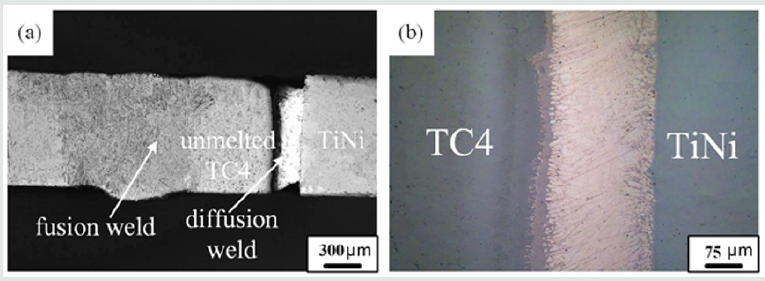
The optical microscopy image of the cross section of the joint is shown in (Figure 2a). The joint can fall into three parts: the fusion weld formed at the Ti alloy side, unmelted Ti alloy and the diffusion weld formed at the TiNi-Ti alloy interface. The fusion weld did not form Ti-Fe intermetallics due to the presence of unmelted Ti alloy. The average width of fusion weld, unmelted Ti alloy and diffusion weld was 1.8 mm, 0.35 mm and 0.17 mm, respectively. Because the microstructure of the fusion weld is quite different from that of the diffusion weld, the diffusion weld becomes black after corrosion. (Figure 2b) presents the optical image before corrosion of the diffusion weld. It does not present such defects as pores and macro-cracks. The unmelted part of Ti alloy acted as a heat sink absorbing a significant amount of energy from the welding pool and transferring it to the TiNi alloy side [20]. Hence, the filler metal of TiNi-Ti alloy interface had a high temperature during welding although it was not subjected to laser radiation. The temperature was high enough to promote atomic interdiffusion. This meets the temperature requirement for diffusion welding. Moreover, the local heating of the Ti alloy side caused uneven volume expansion and thermal stress was produced, which helped to obtain an intimate contact between the TiNi alloy, Cu-based fillers and Ti alloy surface. The high temperature and the intimate contact at the TiNi-Ti alloy interface provided favourable conditions for atomic (Cu, Zn, Ti, Ni) interdiffusion. Therefore, a diffusion weld was formed originated from atomic (Cu, Zn, Ti, Ni) interdiffusion at the Ti alloy-filler metal and filler metal-TiNi alloy interface. Additionally, the unmelted Ti alloy was beneficial to relieve and accommodate the thermal stress in the joint, which could help to improve the mechanical properties of the joints.

Figure 2: Macroscopic feature of the joint: (a) optical image of the cross section of the joint; (b) optical image before corrosion of the Ti alloy-TiNi alloy interface.
Lupinepublishers-openaccess-material-science-journal

Microstructure Analysis

The optical image of the fusion weld is shown in (Figure 3a), and no defects were observed in it. SEM image of the fusion weld is shown in (Figure 3b). The fusion weld mainly consists of acicular structure. The optical image of the diffusion weld at NiTi-Ti alloy interface is shown in (Figure 3c). It can be observed that, the diffusion weld contained three zones marked as Ⅰ, Ⅱ and Ⅲ sorted by their morphologies and colours. (Figures 3d, 3e and 3f)correspond to the three zones in (Figure 3c), respectively. The compositions of each zone (denoted by letter A-C in (Figure 3)) were studied using SEM-EDS. EDS analysis was applied to these zones to measure the compositions of the reaction products and the results are listed in Table 1. Based on the previous analysis, the microstructure of the diffusion weld was mainly composed of Cu-based fillers. The chemical composition of zone Ⅰ was consistent with the Cu-based fillers. Based on the EDS analyses results and Cu-Zn phase diagram, the main microstructure of zone Ⅰ was defined as β-CuZn phase. When the laser beam was focused near the Ti alloy-filler metal interface, the element diffusion occurs immediately between the base materials and filler metal and causes its component to deviate from the original component. The interdiffusion of Cu, Zn, Ti and Ni elements occurred at diffusion welding interface (Ti alloy-filler metal and filler metal-NiTi alloy). At this moment, the dissolution of Ti and Ni into the filler metal occurred under the high concentration gradient, which formed solid-phase reaction layer, and this reaction layer exists only in the smaller region of the NiTi-Ti alloy interface. As shown in, zone Ⅱ and zone Ⅲ were reaction layers formed by element diffusion. Based on Ti-Cu-Ni phase diagram, the microstructure of zone Ⅱ was defined as TiCu2+NiZn. Based on Cu-Ti-Zn phase diagram, the microstructure of zone Ⅲ was defined as Ti3Cu4+Ti2Zn3. Therefore, the main microstructures of diffusion weld were TiCu2+NiZn, β-CuZn and Ti3Cu4+Ti2Zn3.

Table 1: The chemical composition of each phase in joint C (wt.%).

Lupinepublishers-openaccess-material-science-journal

Figure 3: Microstructures of the joint : (a) optical image of fusion zone; (b) SEM image of fusion zone; (c) optical image of the diffusion weld; (b) SEM image of the zone I in Fig. 3c; (c) SEM image of the zone II in Fig. 3c; (d) SEM image of the zone III in Fig. 3c.

Lupinepublishers-openaccess-material-science-journal

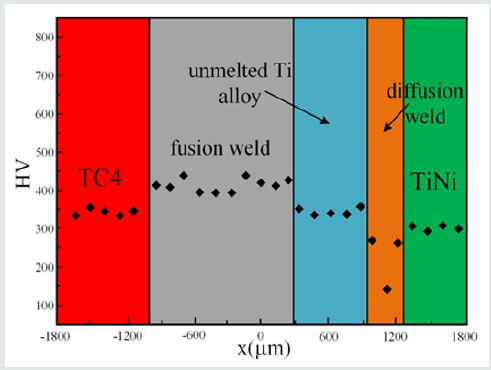
Figure 4: Vickers microhardness measurements at semi-height of joint (zero point situated in the center of joint).
Lupinepublishers-openaccess-material-science-journal

Tensile Tests and Fracture Analysis

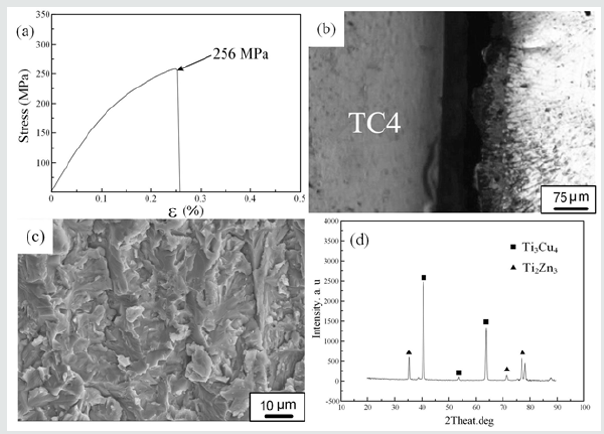
The maximum tensile strength of the joint was about 256 MPa (Figure 5a). The joint fractured in Ti alloy side of the diffusion weld during tensile tests (Figures 5b, 5c)shows fracture surface of the joint exhibiting typical brittle characteristics. Moreover, as shown in (Figure 5d), XRD analyses of fracture surface detected Ti3Cu4 and Ti2Zn3 phases. This confirmed the presence of Ti-Cu and Ti-Zn intermetallics at fracture surfaces. It should be noted that there was no Ti-Ni intermetallics in the brazed weld. Reaction layer at Ti alloy side in diffusion weld became the weak zone of the joint, which led to the failure in the tensile test.Based on the above results, the formation of Ti-Ni intermetallic compounds is avoided due to the presence of unmelted Ti alloy in the joint. Only a small amount of Ti-Cu intermetallic compounds is formed in the reaction layer at the NiTi-Ti alloy interface. Due to the rapid heating and cooling speed of laser welding, the holding time at high temperature is short, and it is easy to form a narrow reaction zone at the NiTi-Ti alloy interface. In addition, higher cooling rate inhibited the growth of dendrite structure in the reaction zone. Therefore, it is easy to obtain fine microstructure in the reaction zone, which is conducive to reducing the brittleness of the reaction layer. The results show that the formation of narrow reaction layer and fine metallurgical structure at the interface is one of the main reasons to improve the joint strength.

Figure 5: Tensile test results of joint: (a) Tensile test curve; (b) Fracture location; (c) SEM image of fracture surface; (d) XRD analysis results of fracture surface.
Lupinepublishers-openaccess-material-science-journal

Conclusion

The possibility of welding processes for connect TC4 Ti alloy to NiTi alloy with Cu-base filler metal was studied. The main conclusions are presented below. without filler metal, For joint with a laser beam offset of 1.2 mm for Ti alloy, the unmelted Ti alloy was selected as an barrier to avoid mixing of the NiTi alloy and Ti alloy which eliminated the formation of brittle Ti-Ni intermetallic in the joint . A diffusion weld was formed at the NiTi alloy-Ti alloy interface with the main microstructure of TiCu2+NiZn, β-CuZn and Ti3Cu4+Ti2Zn3. A great amount of atomic diffusion occurs at the NiTi-Ti alloy interface during welding, and the thickness of diffusion weld can reach hundreds of micrometres. The tensile resistance of the joint was determined by diffusion weld. The maximum tensile strength of joint was 256 MPa.

Read More About Lupine Publishers Journal of Material Science Please Click on below Link: https://lupine-publishers-material-science.blogspot.com/


Wednesday, 27 July 2022

Lupine Publishers| Cyber Hybrid Warfare: Asymmetric Threat

 Lupine Publishers| Journal of Material Science


Abstract

Cyber hybrid warfare has been known since antiquity; it is not a new terminology nor a new practice. It can have an effect even more than a regular conventional war. The implementation of the cyber hybrid war aims to misinform, guide and manipulate citizens, disorganize the target state, create panic, overthrow governments, manipulate sensitive situations, intimidate groups, individuals and even shortened groups of the population, and finally to form an opinion according to the enemy’s beliefs. Creating online events designed to stimulate citizens to align with the strategy of governments or the strategy of the enemy government is a form of cyber hybrid warfare. The cyber hybrid warfare falls under the category of asymmetric threats as it is not possible to determine how, and the duration of the cyber invasion. The success or not of a cyber hybrid war depends on the organization, the electronic equipment, and the groups of actions they decide according to the means at their disposal to create the necessary digital entities. Finally, the cyber hybrid warfare is often used to show online military equipment aimed at downplaying its moral opponent.

Keywords: Hybrid war, Cyber war, Online threat, Cyber warfare, Warfare

Introduction

The cyber hybrid warfare also includes DeepFake, a practice mentioned in Christos Beretas previous research. The cyber hybrid war aims to disrupt and hurt the adversarial state in an organized and targeted manner, mainly regarding the organizational structure of the target state and its functioning. Digital media are used to intimidate citizens, target specific groups of people, disseminate false news between political and military leadership in order to spread hatred and resentment on both sides, to divide the people, and finally the fall of the government, followed by the anger and indignation of the people. The cyber hybrid warfare is not only and exclusively applied during a period of natural war, it is a kind of war that can be waged for years and of course in times of peace. It is difficult for citizens in a cyber hybrid war to understand the truth and lies. A well-organized cyber hybrid war is difficult for people to recognize as the facts presented are so convincing that it is impossible to recognize them as false. The ways to avoid and protect against such a war are numerous and require knowledge, experience, alertness, high morale, courage and professionalism to deal with such a cyber threat from its birth. Sovereign states around the world are using the cyber hybrid warfare to blackmail, trap, mislead, both foreign governments and citizens, achieving remote results without the use of physical violence and natural disasters. The cyber hybrid war has come to stay, and it is an emerging form of war - the pressure of the strong against the weak or better of the organized states against the disorganized. As mentioned above, a great DeepFake video is capable of stirring up enormous panic and hatred in a society. It is an asymmetric threat that is increasing day by day.

Characteristics

The cyber hybrid war is an asymmetric threat that is defined when an entity uses electronic means to disturb the peace or spread panic in the target state and launch hostilities or uproot social groups residing in it. A fake video, for example, that will be sent to targeted social groups is capable of sparking riots in the crowd with demonstrations and violence. By reading this one can easily understand the reader that the cyber hybrid war is the result of an entity preceding its onset. This entity is the digital asymmetric threat which if not handled properly then evolves into a cyber hybrid war. The cyber hybrid war is not tantamount to an isolated practice, that is, it is not a common attack on the adversarial state; rather, it consists of organized methods that are often impossible to identify, such an attack may include social media, online press, videos and hostilities from different events, etc. The difference between a cyber hybrid war and conventional warfare is that except there are no killings and conflicts, there is a constant lowlevel influx of information affecting the target state. That is, it does not follow the logic that an event has occurred, a number of people have risen and then the digital invasion process has ended, on the contrary, the digital presence is continuous and stable at the same level as possible.

Advanced stages of a cyber hybrid war include practices such as misinformation aimed at the financial loss of the target state, intra-country turmoil from pro-country groups that launched the cyber hybrid war to compel its citizens to withdraw. for the purpose of financial loss or even the overthrow of the government. In a cyber hybrid war, the invaders’ practical ways of attacking are not one-sided but two-sided, which means that in one field they can decrease and increase in another, for example a false bent can be seen in social media news and on the contrary the volume of fake videos is growing too. A cyber hybrid war is often won when combine electronic and physical attacks in the target state, which means that in the target state it requires the penetration of disturbing elements in order to revolt and destroy the target state’s infrastructure and economy. This includes increasing crime, which will then be used in the media and social media by the adversary state as a means of corrupting the target country with the ultimate aim of reducing its reputation, spreading fear to other countries. aimed at restricting travelers, other countries’ security reviews, further financial burden, withering and global isolation.

The success or not of a cyber hybrid war in addition to the proper organization, hardware, and staff, requires and sufficient funding for the whole venture, funding is a key success factor, with insufficient funding the result will be the opposite, as it will unprofessionalism has emerged, and it is easy for social groups to understand that this is fake news, which is equivalent to project failure and redesign. Funding can come exclusively from the state that organizes the cyber hybrid threat, it can come from friendly countries in it, as well as from organizations that are scattered around the world, usually when a cyber hybrid war is funded by organizations around the world, the communication takes place through social media or smart phone applications that offer anonymous messaging services. At this point it should be noted that there is no formal single practice or specificity in the form of steps that need to be taken to be considered a threat as a cyber hybrid threat, so there is no legal framework defining the steps that characterize that this is a threat to the target state to take legal actions, the legal framework is incomplete and that is something that countries that are waging such wars are very aware of and they are washed.

As technology evolves, asymmetric threats increase as states with sufficient funding and equipment are able to wage such wars on a large scale, which is why the cyber hybrid wars will intensify. That is why governments and security agencies around the world are trying to organize and shield themselves against the cyber hybrid war, now knowing that its impact is greater than even conventional warfare. Preparing, organizing, and preventing such attacks are the basic prerequisites for dealing with the threat. This entails writing and implementing a cyber security policy that outlines the conditions, steps to be taken, education, definitions, and how to handle such incidents. The security policy should be updated annually and adapted to the needs and the level of risk that exists per period. It must adequately specify how government agencies must act in a period of digital asymmetric threat. Allied countries need to formulate a common cyber policy so that dealing with a digital asymmetric threat is unified. It is of no use to allies and friendly countries not to implement a common strategy against digital asymmetric threats. Friendly organized countries can easily trap the enemy and destroy the plans [1-3].

Conclusion

The cyber hybrid war is made up of several entities that, depending on the smooth functioning of all entities, are judged to be successful or unsuccessful. It is an asymmetric threat, no one can know the length or the size of the area it will take place. It is a kind of war that with the development of technology will see significant development. An important factor in success is financial support and therefore the amount of money each state is willing to spend to design and implement a credit cyber hybrid war. A well-organized and implementable cyber hybrid warfare can cause severe damage to a conventional one. It is not necessary for a cyber hybrid war to be designed exclusively by wealthy and developed countries, such a war can be created by any state that has the knowledge, money, and organization to mount an asymmetric threat. In the cyber hybrid war, the chances of convicting states for war crimes are minimized, as in the cyber hybrid war there is no clear legal framework defining the methods of intruders. Identifying a digital threat is difficult due to the complexity of its actions; identifying and neutralizing a cyber hybrid threat requires knowledge and experience of such threats. Some countries in the world have developed methods and teams to detect and manage such threats, but the measures they take to protect them are found to be incomplete and not fully effective and the reason is the rapid development of technology that new methods and techniques are constantly being discovered. Finally, as has been said above, the best defense is the organization of friendly states to provide a single aid and formulate a unified security policy that will lead to massive isolation of cyber hybrid threats. Unified repression by friendly countries against such attacks is the best organized defense against hybrid threats.

Read More About Lupine Publishers Journal of Material Science Articles Please Click on Below Link: https://lupine-publishers-material-science.blogspot.com/

Monday, 24 May 2021

Lupine Publishers| Groups 4 and 15 and Organotin Condensation Polymers for The Treatment of Cancers and Viruses

 Lupine Publishers| Modern Approaches on Material Science (MAMS)


Abstract

This short review describes the use of group 4 metallocenes, group 15 organometallics and organotin polymers in the treatment of human cancer tumors and viruses. These metal-containing polymers show good inhibition of all the main group solid tumors including pancreatic, lung, brain, breast, prostate and colon human cell lines. They also show inhibition of a variety of viruses including zika, herpes and vaccinia viruses. Synthesis of the polymers is rapid employing interfacial polymerization and commercially available reactants. They offer physicians a new class of drugs for the treatment of a variety of cancers and viruses.

Keywords: Cancer; Viruses; Interfacial polymerization; Brain cancer; Pancreatic cancer; Zika virus; Vaccinia virus; Breast cancer; Herpes virus

Introduction

Use of metal-containing agents to treat various medical problems is well known [1-22]. Here the focus is on activities to supply metalcontaining polymers for the treatment of various cancers and viruses. While we have had extensive experience with platinum and palladium polymers for the treatment of a variety of cancers, the current emphasis is on polymers formed by incorporation of groups 4 and 15 metals and organotin condensation polymers for the treatment of cancers and viruses [23-41]. These two polymer types are different with their own separate biological characterizations [26]. For instance, the platinum and palladium polymers are addition products and not stable for long times in solution. By comparison, the groups 4 metallocene and organotin and group 15 polymers are condensation polymers and exhibit good stability to over 30 weeks in solution so can be treated differently with respect to biological and physical characterizations [26-41].

Synthesis

Synthesis occurs employing interfacial polymerization [42- 46]. It is a rapid polymerization system because high-energy reactants are employed. These high-energy reactants are acid halides. A typical condensation reaction has an activation energy of about 30-40Kcal/mol whereas the activation energy for the acid halide reactions is on the order of 20Kcal/mol. The interfacial polymerization is employed industrially to synthesize aromatic polyamides (nylons) and polycarbonates so industry is familiar with the system [47,48]. These interfacial polycondensation reactions form polymer within less than one minute in decent yield. For the syntheses described here, commercially available reactants are employed allowing ready reproduction and scale-up to ton levels in a somewhat straightforward manner. Rapid stirring is employed, generally about 18,000 rpm. This allows both the rapid polymerizations to occur with an increase in interfacial contact area of over ten thousand compared to non-stirred systems, and good reproducibility. For the systems described here, the reaction vessel is a simple glass reaction vessel, one-quart Kimax emulsifying jar, fitted onto a Waring Blender. To illustrate the overall reactions, products formed for the organotin polymers have a repeat unit described as follows.

R2SnX2+X-R-Y-> -(-SnR2-R-)-

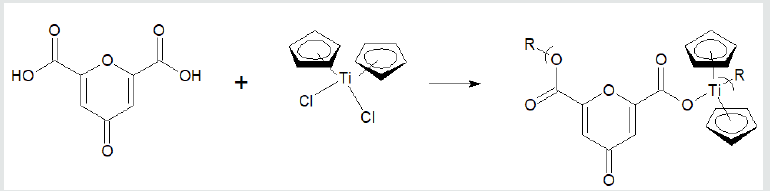
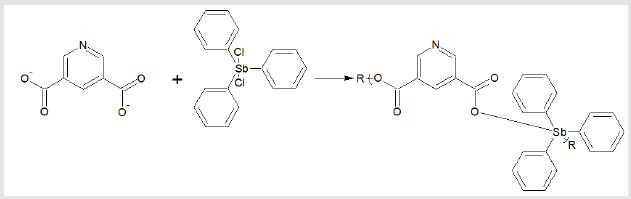
where X and Y are normally Lewis bases such as alcohols, amines, acid salts, thiols, etc. These reaction sites are often varied for a single Lewis base such as an amino acid, shown below, that has both acid and amine reactant sites. Examples of overall reaction products for each of the three condensation polymer groups are given following. Reaction between the amino acid diglycine and dimethyltin dichloride is described (Figure 1). The polymer is described as a poly (amine ester) with the organotin unit considered an organic moiety such as a methylene unit in such naming. For the Group 4 metallocenes, the reaction employing titanocene dichloride as the Lewis acid, the repeat unit for a product formed from titanocene dichloride and chelidonic acid is given (Figure 2). Finally, for reactions involving group 15 metals, the repeat unit formed from reaction between triphenylantimony dichloride and 3,5-pyridinedicarboxylic acid forming a polyester is given (Figure 3). The metal is generally located in the Lewis acid portion while the non-metal reactant is the Lewis base. In certain cases, the Lewis base portion may also contain a metal, usually iron and cobalt. The iron is present as a ferrocene while the cobalt is present as a cobaltocene [32].

Figure 1: Synthesis of organotin poly (amine esters) from reaction of diglycine and dimethyltin dichloride where R represents simple chain extension.

Lupinepublishers-openaccess-material-science-journal

Figure 2: Synthesis of polyesters from reaction with titanocene dichloride and chelidonic acid where R represents simple chain extension.

Lupinepublishers-openaccess-material-science-journal

Cancer

It was initially mistakenly assumed that these metal-containing compounds inhibited cancer by the same mechanism as the platinum-containing drugs as cisplatin and other similar platinum containing drugs [26,50]. (The platinum-containing drugs currently are employed in over 60% of the chemo drug treatments generally as one of the components.) It is now known that this is not true so that they can be coupled with the drugs described here as co-drugs that will affect inhibition of cancer through two distinct avenues. The platinum-containing drugs are quite toxic resulting in the presence of many negative side effects [26]. Our effort is to create drugs that have similar or superior ability to inhibit cancer but without the unwanted side effects. All of the metal-containing drugs operate primarily on the DNA site for inhibition of the cancer cell lines [26,50].

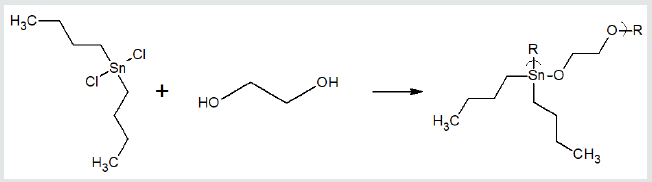
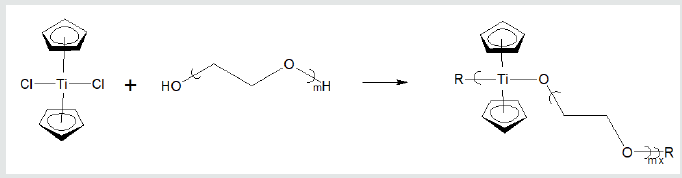
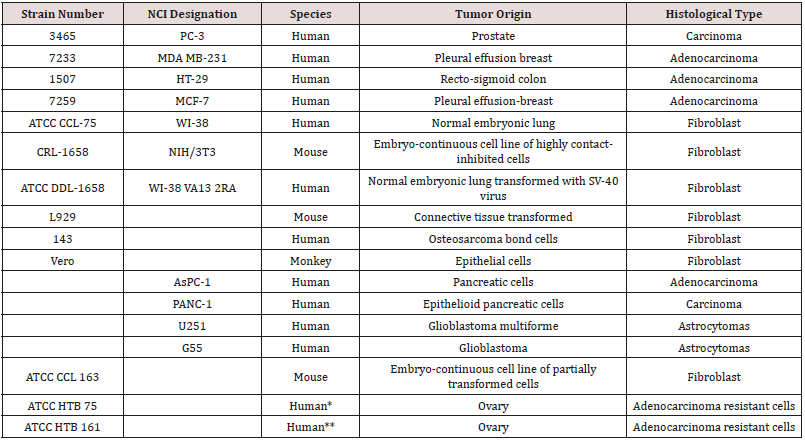
The polymers synthesized by us have shown good ability to inhibit a variety of cancer cell lines Table 1. These cell lines represent all of the major human solid tumor cell lines. These cell lines include resistant cells meaning cell lines that have shown ability to resist treatment with the traditional anticancer drugs [39] (Table 1). Inhibition depends on the metal atom present as well as the nature of the Lewis base. With respect to the metal, in general, inhibition is of the order Hf=Zr>Ti>Sn>Sb, Bi, As. Inhibition is also dependent on the specific Lewis base. A primary measure of the ability for a drug to inhibit cancer growth is the effective concentration, EC. The 50% effective concentration, EC50, is the concentration of a toxicant, drug, or antibody that induces an inhibitory response halfway between the baseline and maximum after a specified exposure time. The desired outcome is to have low EC50 values as this indicates that only a small concentration of the anti-cancer agent is needed to elicit inhibition. For the compounds described here, once inhibition begins, the slope of the dose/concentration curve is high with inhibition being total. Depending on the specific Lewis acid/base the EC50 value is typically between milligrams/mL to nanograms/mL. The metal-containing compounds are often coupled with a Lewis base that exhibits some biological activity hoping for a syngeneic effect. Drugs that have been employed as the Lewis bases include ciprofloxacin, diethylstilbestrol, cephalexin, acyclovir, thiamine, dicumarol, camphoric acid, histamine, 2-ketoglutaric acid, salicylic acid, dipicolinic acid, isomanide, glycyrrhetinic acid, phentolamine, thiodiglycolic acid. Lewis bases that themselves exhibit no ability to inhibit cancer can also exhibit good inhibition when coupled with a metal-containing moiety. These include a wide variety of diols such as ethylene glycol, Figure 4 [29,50]. Recently, water-soluble drugs possessing the metal-containing unit were synthesized [29] employing as the Lewis base poly (ethylene glycol), PEG. The resulting water-soluble polymers exhibit good inhibition of the cell lines. Figure 5 contains the reaction between titanocene dichloride and PEG forming water soluble polyethers (Figures 4 & 5).

Figure 3: Synthesis of triphenylantimony polyesters from reaction with 3,5-pyridinedicarboxylic acid where R is simple chain extension.

Lupinepublishers-openaccess-material-science-journal

Figure 4: Reaction between ethylene glycol and dibutyltin dichloride forming polyethers.

Lupinepublishers-openaccess-material-science-journal

Figure 5: Formation of water-soluble polyethers from reaction of titanocene dichloride and various poly (ethylene oxides) where R represents simple chain extension.

Lupinepublishers-openaccess-material-science-journal

Viruses

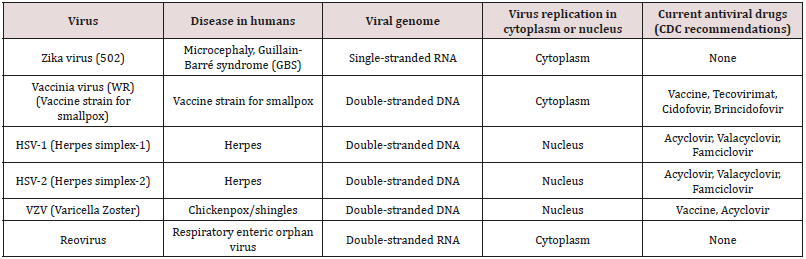
These metal-containing polymers also inhibit a variety of viruses including ones where no current drugs are available for treatment [40,41,49]. Table 2 contains viruses that have been inhibited by our metal-containing drugs including most recently the zika virus. These viruses include both DNA and RNA viruses. They include several that have been identified as possible weapons of mass destruction, namely the vaccinia virus. Three DNA viruses are effectively inhibited by the metal-containing polymers (Table 2). They are the vaccinia virus used to vaccinate humans against smallpox; herpes simplex virus 1, the virus responsible for over 45 million infections yearly in the US, comprising one of five adolescents and adults; and the varicella zoster virus, also a herpes virus and responsible for chickenpox and shingles. Thus, the metalcontaining polymers represent a possible potent approach towards inhibiting unwanted viruses (Table 2).

Table 1: Caner cell lines inhibited by metal-containing polymers described here.

Lupinepublishers-openaccess-material-science-journal

From a cancer patient with ovarian cancer that had previously been treated with cytoxan, adriamycin, 5-fluorouracil, and Fur IV. From a cancer patient with ovarian cancer that had been treated with adriamycin, cyclophosphamide, and cisplatin.

Table 2: Viruses inhibited by metal-containing polymers discussed in this report.

Lupinepublishers-openaccess-material-science-journal

Why Polymeric Drugs?

A critical question is “Why Polymeric Drugs?” What advantageousness do polymeric drugs offer [50-60]. Following briefly describes some advantages. Each of these advantages is related to the size of polymers and what such size offers. First, because of their size, polymers travel through the body, in particular the kidney and bladder, more slowly lessening organ damage allowing the organs to limit the negative effect [50,61]. Second, cancer cells are less cohesive, offering greater porosity, and are not as coherent as normal cells with relatively “rough” exteriors. This allows polymers to have a greater opportunity to be “snagged” by the cancer cells allowing them extended ability to be associated with the cancer cells resulting in a greater ability to inhibit cell growth. This scenario is described as the enhanced permeability and retention effect [50,62-64]. Third, increased size allows for a greater designing of the drug increasing its effectiveness [65-69]. This fine tuning includes attachment of “biological homing agents”. Thus, polymeric drugs offer advantageous over small molecule drugs that can be used to more effectively combat unwanted diseases compared to small molecule drugs.

Summary

Metal-containing polymers show ability to inhibit all the major solid tumor cancers as well as important viruses. They are easily synthesized and offer physicians new drugs to attack these harmful illnesses.

Read More About Lupine Publishers Modern Approaches on Material Science Click on Below Link:

https://lupine-publishers-material-science.blogspot.com/


Monday, 26 April 2021

Lupine Publishers| Palm Oil Fuel Ash as A Cement Replacement in Concrete

 Lupine Publishers| Modern Approaches on Material Science (MAMS)


Abstract

To produce concrete, cement is an essential material that binds together solid bodies but also is the largest producer of carbon dioxide (CO2) emission. Up to 10% of global CO2 emission comes from cement production thus making the sustainability of concrete a major issue that needs addressing. The processes of producing concrete consume heavily on natural resources such as sand, gravel, water, coal and crushed rock, mining of which damages the environment. It is however possible, that energy and cost efficiency can be achieved by reducing on the amount of clinker, and in its place utilizing partial cement replacements/pozzolans that require less process heating and emit fewer levels of carbon dioxide. This study investigates the effectiveness of agro waste ash by-product Palm Oil Fuel Ash (POFA) as an alternative material to replace Portland cement (OPC). Experiments were carried out by supplementing CEM I cement by weight in concrete mixes with POFA at 2.5%, 5%, 10%, 15% and 20% steps at the point of need, with water to cement ratio of 0.5. Results were compared with a control specimen, which was made with 100% cement. The results showed impressive compressive strength, especially at early age; in fact POFA specimens containing 2.5% and 5% POFA replacement displayed greater early compressive strength in comparison to the control, which is similar in behaviour to concrete containing silica fume which is an established partial cement replacement used in high strength applications. The results showed good repeatability and highlight the potential of POFA as an effective pozzolan which could enhance the sustainability and economic aspect of concrete.

Introduction

Sustainability has widely emerged in recent years to resist climate change and pollution caused by ineffective waste management. The cement industry, as one of the fundamental materials industries, plays a very important role in the social and economic development as well as imposes a great challenge in terms of its large consumption of natural resources and energy and the emission of greenhouse gases. Cement is one of the main constituents in concrete and is thus one of most utilized commodities in the world [1]. From an environmental perspective, the production of 1 tonne of cement directly generates about 1 tonne of CO2 [2]. Cement production is therefore responsible for 7-10% of the world’s total CO2 emissions; compare this to the aviation industry, which is 2.8%, three times less than the production that comes from cement industry [3-8]. As a result, the use of supplementary cementing materials (SCMs), like pulverised fuel ash (PFA) and ground granulated blastfurnace slag (GGBS) have been established over the past 30 years as they not only reduce the embodied CO2 of concrete, the long-term strength and durability is improved. Both PFA and GGBS are waste products from the coal and steel industry; due to the recent decline of both these industries, focus has shifted on other alternative SCMs. One potential alternative from agricultural waste is POFA. POFA is ash obtained by incinerating the by-products of palm oil mill. The tall-stemmed oil palm tree belongs to palm family Palmea and the countries that cultivate oil palm are Benin Republic, Colombia, Ecuador, Nigeria, Zaire, Indonesia and Malaysia of which the last one is the largest producer of palm oil and palm oil products [9]. In Malaysia the total solid waste generated by this industry in about two hundred palm oil mills has been estimated at about ten million tons a year. These by- products are commonly used as fuel in the boiler of palm oil mills and become ash. The ash is a waste material the disposal of which poses enormous environmental pollution because the ash is usually disposed of without any commercial return [7,9,10] in the Far East millions of tonnes of waste is generated annually. It has been suggested [11] POFA may have pozzolanic qualities, however, very little research has been done in this area. This paper investigates the plausibility of POFA as a pozzolanic addition in concrete.

Methods

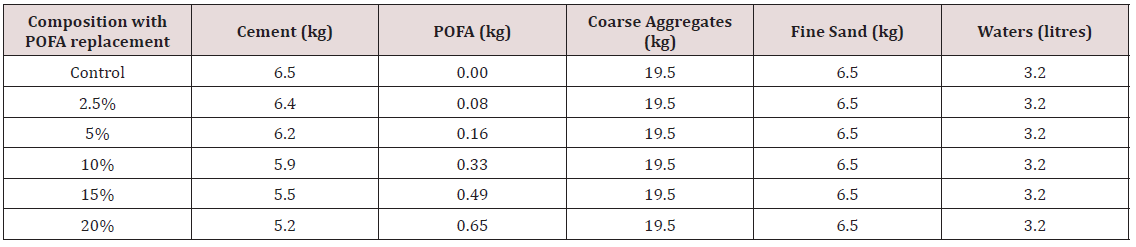
Palm Oil Fuel Ash was sourced from Malaysia. The cement used was Portland cement– CEM I 52.5R (Snow Crete). Cement was replaced with POFA in concrete by volume at steps of 0%, 2.5%, 5%, 10%, 15% and 20%. The 0% replacement, also referred to as the control was taken as the point of reference from which all performance was measured. Water to cement ratio (WCR) of 0.5 was used for the mixes to achieve a good balance of workability and strength in line with Abram’s law which states that the strength of concrete mix is determined by the WCR, with lower WCR having higher strengths and vice-versa [12]. The quantities of each mix were measured as detailed in Table 1. Workability was measured using the slump test method, whose apparatus were a slump cone and a tamping rod conforming to BS EN 12350-2:2009 [13]. Cube moulds for compressive measured 100mm x 100mm x 100mm, whereas cylinder moulds for tensile strength testing were 150mm in diameter and 300mm in height, conforming to dimensional guidelines of BS EN 12390-1:2012 [14]. The method used to make cubes conformed to BS EN 12390-2:2009 [15]. Cylinders conformed to BS EN 12390-4:2000 [16]. The specimens were left on the moulds for 24 hours after which they were stripped, marked and submerged in a water tank at temperatures of 20 °C±2 until their age of testing conforming to BS EN 12390-2:2009 [15]. Specimens were cured for up to 28 days. Compressive strength tests were conducted to BS EN 12390-4:2000 [16]. After the application of an initial load of 0.6±0.2N/mm2.s, which, according to BS EN 12390-4:2000 [16] does not exceed 30% of the failure load, further constant load was applied at a rate of±10% until no further load could be sustained. Compressive tests were carried out at 7 and 28 days. Results were taken as an average of the three cubes per test, and expressed in N/mm2.Tensile strengths were conducted to BS EN 12390-6:2009 [17]. The testing machine conformed to BS EN 12390-4:2000 [16] while packing strips conformed to BS EN 316:2009 [18]. Initial load was applied at a constant rate of stress of 0.04 N/mm2.s, which, according to BS EN 12390- 6:2009 [17] does not exceed 20% of the failure load. Further constant load was thereafter applied at a rate of ±10% until no further load could be sustained. As POFA is a very fine low- density material the cement was replaced by weight and at lower percentage, similar dosage to Silica Fume.

Table 1: Proportions of POFA concrete mix using CEM.

Lupinepublishers-openaccess-material-science-journal

Results and Discussion

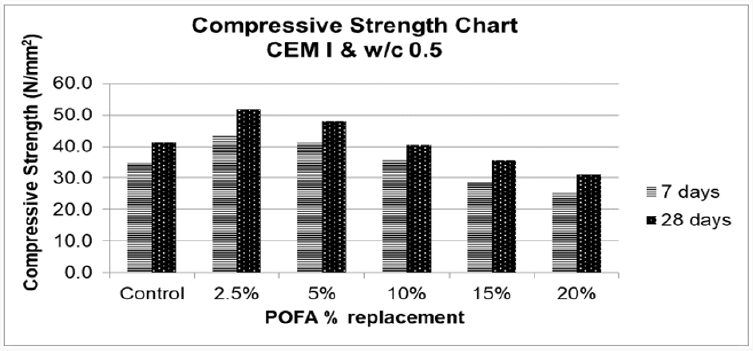
Figure 1: Compressive strength Development Chart (CEM I and w/c 0.5).

Lupinepublishers-openaccess-material-science-journal

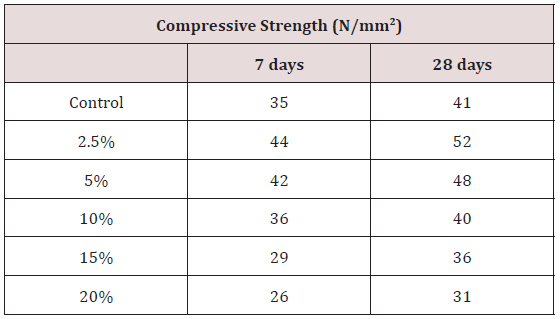
Compressive strength is the most important property of concrete, and it measures how much load concrete structures can sustain before failing. (Table 2) and (Figure 1) show the compressive strengths at 7 and 28 days of hardened concrete with 0%, 2.5%, 5%, 10%, 15% and 20% POFA replacement. Replacements of up to 10% achieved strengths that were above the targeted class C32/40 at 28 days, is among strength classes listed by BS EN 1992-1-1: 2004 [19] and BS 8500-1:2015 [20], as being suitable for structural applications. It is possible to predict the higher replacements could achieve strengths that are far above this class strength at 91 days or longer, due to the fact that pozzolanic concrete continue to gain strength up to and beyond 91 days. Palm Oil Fuel Ash can also be used as an alternative to cement in highway pavement as the minimum 28-day compressive cube strength requirement using pozzolans for highway pavements in the UK is 9.6N/mm2. Therefore 2.5%, 5% and 10% replacement of POFA is sufficient to use in highway pavement and road construction. It is worth noting, as POFA is a very fine and low-density material, a 10% partial cement replacement constitutes a large volume of POFA, similar to silica fume. Like similar fume [21] at low percentage cement substitution of up to 5% POFA yields greater early age strengths in comparison to the control. In limited work reported elsewhere, other researchers [7,9,11] found the optimum level of replacement to be at 15%-20% which are different results from this research. The findings suggest that Palm Oil Fuel Ash is an effective pozzolan to replace cement at low percentages. The 2.5% and 5% POFA replacements had remarkable high early strength concrete compare to the control one. According to [22,23], the early age strength is due to the hydration of cement, with POFA acting as a filler of voids and contributing to the strength gain, while the latter age strength in pozzolanic concrete is associated with the reaction of SiO2 present in the POFA with free lime Ca(OH)2 from the hydration of cement in a secondary reaction over time, to form calcium silicate hydrate (C-S-H). The optimum replacing level of cement by POFA is at 2.5%. This amount of replacement could be effective in large projects where large amounts of OPC are used and an early high compressive strength is required. The replacement of OPC with POFA helps in decreasing the pollution as well as has many economic benefits. Palm Oil Fuel Ash particle size can be compared to that of silica fume and therefore could have similar applications to silica fume especially in terms of mix design. It can be used in high-strength concrete and could include long span bridges, mainly of precast and prestressed girders to allow for longer span in structural bridge design and high-rise sky scrapers by building smaller columns and increasing usable space.

Table 2: Compressive strength for POFA using (CEM I and w/c 0.5).

Lupinepublishers-openaccess-material-science-journal

Tensile strength

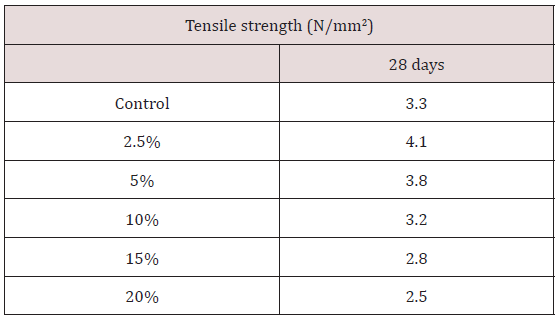
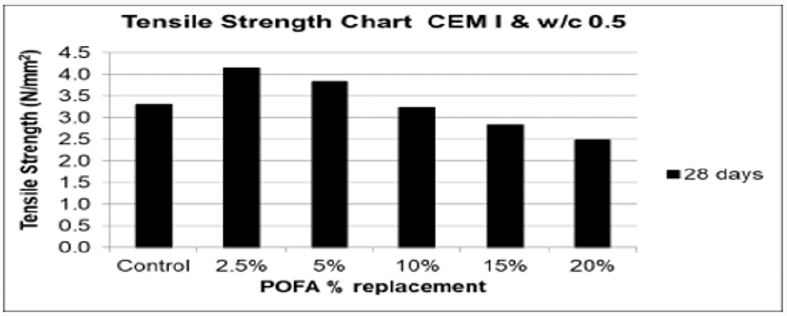
(Table 3) and (Figure 2) show the tensile strength results for POFA concrete at 28 days, the tensile strength initially increases with increasing POFA replacement up to 5% then subsequently decreases at higher levels; this trend is not consistent with the general behavior of PCRs [22-26] whereby the tensile strength decreases with increasing amount of PCRs.

Table 3: Tensile strength for POFA using (CEM I and w/c 0.5).

Lupinepublishers-openaccess-material-science-journal

Figure 2: Tensile Strength of POFA replaced concrete at 28 days.

Lupinepublishers-openaccess-material-science-journal

Workability

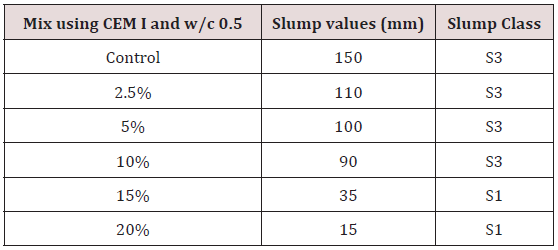
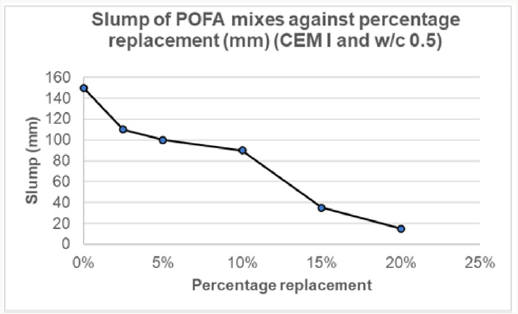
Table 4 and Figure 3 show the slumps of POFA replaced mixes at different replacement levels. One of the basic attributes of any cementitious material is its workability or “consistence”, which is largely determined by how wet the concrete is. This is referred to as “slump”. Basically, the wetter the concrete, the higher the slump. Although slump is often seen as an indication of water content, it is more reasonably interpreted as a measure of consistence. Consistency is a term that describes the state that concrete is when it is delivered on site, how easily can fresh concrete flow. Concrete is said to be workable when it is easily placed and compacted homogenously, however workability is very difficult to assess. Slump test is the most well-known method to examine the characteristics of concrete workability. It is used to measure the consistency of concrete as well. The slump test values depend on a variety of factors such as types and properties of concrete ingredients. Workability of POFA concrete was observed to decrease with increasing replacement; this is due to the high-water demand of POFA which can be countered by the use of admixtures. Like with silica fume [21], the water demand of concrete containing POFA increases with increasing amounts of POFA. This increase is caused primarily by the high surface area of the palm oil fuel ash.

Table 4: Slump readings for POFA mixes.

Lupinepublishers-openaccess-material-science-journal

Figure 3: Workability of POFA replaced mixes.

Lupinepublishers-openaccess-material-science-journal

Conclusion

The usage of partial cement replacements or pozzolans is gaining popularity for a variety of reasons including enhancing concrete performance, reducing the cost of using traditional concrete ingredients and serve the environment. Cement production is one of the highest contributors to CO2 emission. Partial cement replacements not only confer environmental benefits, but they also have a positive impact on concrete properties. This study investigated the effect of Palm Oil Fuel Ash as a pozzolan replacement in concrete and the main findings are:

a) Palm Oil Fuel Ash is an effective pozzolan to replace cement at low percentages with the optimum level is at 2.5%

b) Specimens made with 2.5% and 5% POFA replacement had higher strengths compared to the control at 7 and 28 days; very similar behaviour to silica fume

c) Workability decreases with increased amount of POFA unlike with PFA and GGBS concrete; like silica fume POFA has a high-water demand.

d) Based on strength findings, palm Oil Fuel Ash concrete have the potential to be used in superstructures including long span bridges, mainly for precast and prestressed girders to allow for longer spans in structural bridge design and high-rise sky scrapers by building smaller columns and increasing.