Showing posts with label Materials Science articles. Show all posts

Wednesday, 26 October 2022

Lupine Publishers| The Use of Tin Plague in The Analysis of Pure Tin

 Lupine Publishers| Journal of Material Science


Abstract

Study focuses on the basis of knowledge the mechanism of the process βSn  αSn for use it to analysis of important material for science and technology. The possibility of ultra-high purity Sn to analyse by measuring the rate (V) of the allotropic changing (V βSn  αSn) is investigated. Metals of such high purity are inaccessible to chemical method, so analyzed by method of a residual resistance at temperature (T) of liquid He, inaccessible to most enterprises. The method gives an estimate of the total content of impurities. For Sn with low T of βSn αSn) due to the simplicity of the measuring purity by the V (βSnαSn) is tempting. In high purity Sn with a low content of impurities, this method seems more accessible and convenient than others and probably possible. This paper proposes the affordable and simple method of analysis, high sensitivity, accuracy and reproducibility of the results. not inferior to the complex method of measuring the residual resistance.

Keywords: Residual Resistance; Phase Transition Rate; Impurities

Introduction

The World made 7 metals, according to the 7 planets. (Navoi). In the table of ranks of the ancient Sn is pair to Jupiter, the largest planet. And now Snwith the honorary № 50 in the center of the Periodic Table of Mendeleev. Sn is the oldest to man known metal. Aristotle knew about the Sn plague, but didn’t know that it was a consequence of the allotropic transformation of Sn white to gray, β®α. The nebulous mysteries of Sn plague infection accumulated interests many centuries tothis phenomenon.A main Interest in βSn®αSn appeared after the evidence [1,2]Goryunova semiconductor nature of αSn with covalent bond by changing the metal bond to covalent, the electronic structure s2 p2βSn to sp3,tetragonal structure with

KN=6 to a cubic structure with KN=4 with bonds to the vertices of tetrahedrons ofαSn.These principlescreating of semiconductor compounds ofneeds properties. To turn into metastable αSn except T below 12.4oC,is a necessary [2] seed withthe parameters of the bond and structures related αSn and its contact with tin.The nearest neighbors of Sn give a compounds InSb and CdTe, There, pairs of atoms give in sum of total electrons the same as 2 atoms of Sn and parameters of structures [1] almost the same of αSn. InSb, CdTe, αSn the better seed of Sn®αSn, but in contrast to metastable αSn powder, InSb, CdTe are strong solid crystals. Theinfection is caused by atomic contact with a seed. Tin always covered by protective film of SnO2which don’t allow contact.If the seed is placed on the surface of Sn, there is Infection!? And from inert substances that had contact previously with the seed although it now removed[3]. Solid crystals recognized the past! Infection at a distance is possible too![4]. It was quite misunderstood: what gives an information from the seed? Necessary presence of the air, atmosphere.There is Ic agent,[5-7] Inthe vacuum, dryvessel, or after treatment of the inert substance with any solvent of water, so there is no infection,Ic is a carrier from the seed. Metastable structure Ic in the size of nanoparticles can growing epitaxially on the related structure, penetrate through the microdefects of the protective SnO2. So, it is clear that infection under water which absorbed the Icnanoparticles is impossible.This opinion turned out to be wrong. With a very small probability for a time more a year under moving water, infection occurs, and this valuable phenomenon gives ways to many practical tasks andunderstanding of life processes[7].The source of infection has been found. and yet another unexpected source of infection was found. This is property for practical aim. Tin remember about stay in the αSn phase. There is a βSn®αSn transition and back αSn®βSn, due to a change of .>/<d by 26.6%.volume effect. At each β®αmovedecreased d and at α®βd increased. So without external tools Sn gives pure powder of any size particles[8,9].

Knowing the Icas seed allows to use for solving a row of other practical problems [5-7]with use of the terrible plague by a simple way [10,11] in forms convenient for creating p/n shifts , simple effective purification of Sn without meltingin solid phase [12].Method of zone melting [13] to purification is determined by the difference in the K, ratio of the solubility of impurities at the phase boundary. At melting metal doesn’t change type of the bond on the border ofsolid/liquid, soK is near to 1, the difference is knowingly less than at of the metal /semiconductorboundary with the great differences in the nature of their chemical bonds, CN (coordination number), structures. The cleaning efficiency at the border metal /semiconductor, K far from1. And so was a reason that zone melting became widely used when there was a need in semiconductors of high purity.A knowledge of the mechanism of the solid-phase process of βSn ®αSn [7] land to opinionof possibility to apply it in the analysis of the height purity of Sn.

Theoretical View on The Possibility of Analyzing by V Βsn→Αsn

Analysis of high-purity materials is labor-intensive and often impossible if the sensitivity of classical methods is insufficient [14]. There is a method for measuring the g4.2К, i.e. the ratio R 300K /R 4.2 K, method of residual resistance, which gives an estimate of the amount of impurities in metals [15] of high purity. The residual resistance of Sn at 4.2 K before the transition to the superconducting state depends on its purity and perfection of structure. The R at T of room is almost constant, and the g4.2К, i.e. the ratio R 300K /R 4.2 K, is residual R characterizes the purity of Sn.The purer the metal and more perfect its structure, the lower the R at 4.2 K and the higher the value g4.2К, which serves as a measure of the total content of impurities in metals. But measuringequipment is difficult, and liquid He is rarely available to the most of organizations. Studies of allotropic transformation of Sn [5-7] showed a connection between the purity by g4.2К, and the rate V of its phase transformation into αSn. But also, it seemed unrealistic to use it for analyses after bright experiments [16] showed the impurities in Sn are accelerating, indifferent and inhibiting. Hence, the analysis of the purity of Sn by V βSn®αSnis impossible at it depends on the ratio of concentrations of dissimilar impurities. But the mechanismof distinguishing the role of impurities is not clear at all. If each atom of the impurity violates the g4.2К, of the metal, which theg4.2Кmethod illustrates by analyzingany other metals, why the impurities of different metals differ in their effect on the V βSn®αSntransition. This became clear when we knew the mechanism of infection with the "tin plague" [4]. In [16] was studied Sn not of high purity, there are no errors in experiments. The chaotic nature of the dependences of V on purity is clearly shown [5,7]atstudying the influence of impurities on V of βSn ®αSn. The fact is that the commonly zone melting is powerless to clean from Sb because it has K=1 in Sn. The solubilities of Sb in solid and molten Sn are the same, And the Sb impurity on both sides of the phase boundary is the same and so can’t to be redistributed, as other impurities with K≠1.And in the ores of Sn impurity in the Sb usually dominates. At zone melting cleaning, the Sb impurityalways prevails over the others. And Inhimself like of all metals is inhibitory too by the same reasons, but it was shown as accelerator [16] because In+Sb gives the best seed InSb. And in the Sn of high purity, the impurity of In, like any impurity, individual. But having the knowledge aboutthe dependence of the βSn ®αSnprocess on many factors, it is necessary to observe the requirements 1-4, understood during the experiments for creating a method for analyzes[17].

Experimental Part

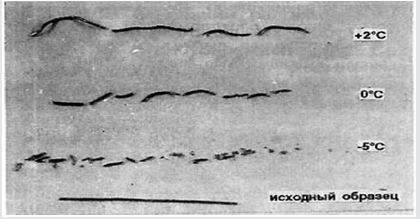
It is possible to create a method for analyzing the purity of V βSn → αSn similar to measurements of residual resistance, suitable for high-purity metals. Previously, it was found [3,5,7] that the dependence of V βSn → αSn on T for any samples has a maximum. This is very easy to understand. At low T with its growth V βSn → αSn grows according to the Arrhenius equation. V cannot grow constantly, because as it approaches the point of the phase transition, it becomes smaller and turns to 0. When infected, Sn crumbles into an arc-shaped powder, making difficult to measure phase shift lengths. Amorphous wires of fast quenching, single crystals of βSn and even annealed wires with slow infection remain almost the original shape but with some bending, and break at V βSn→αSn depending on the T (Figure 1) to parts of different lengths, but almost the same at each T. Accumulation of impurities by the method of residual resistance was recorded in the fracture. It is seen that after the fracture, the sections at each T are close to each other. For analysis, it is necessary that the content of impurities is constant along the length, that is, choose V βSn → αSn for it, V of growth of αSn and V of impurities were now equal, and Sn maintain the solidity too.

Figure 1: Fracture of Sn of different purity with the accumulation of impurities overtaking the phase boundary at its low V. T= +2:0 and -5 ̊С.
Lupinepublishers-openaccess-material-science-journal

Requirements

1) Monoliths are obtained for the growth of αSn [10,11] in the ice shape. The study of a movement of impurities at βSn → αSn allowed us to create a method like of zone cleaning in a solid, but for analysis it is necessary that the content of impurities is constant along the length, that is, choose V βSn→αSn and V of impurities equal and maintain the solid state.

2)Monoliths are obtained by standard preparing a Sn for analysis, so its behavior and structure depends on the previous mechanical and thermal history of Sn. Ins sample in standard quartz formsmelted and cooled under standard vacuum conditions, then Sn melt poured into a SiO2 mold to made identical samples in the form of wire or rod with a spherical surface of one edge of it, then annealed and cooled in vacuum.

3)To create the minimum of seeds by moving of H2O near of the contact Sn of spherical surface of edge with polishedor spherical surface of InSbseed.in thermostat with selected T for analysis.So, to create the minimum of seeds by moving of H2O near of contact Snwith InSb in thetermostat with ice nearly of chooses T.

4)The diagram of calibration dependence of V βSn®αSn / g4.2should be attributed to the same strictly selected T for analysis.

5)The infection V should be measured repeatedly for graphical correction of errors in a visual determination of the length of the infected area. At T, chosenfor aphase transition the impurity does not accumulate, and the concentration along the entire length is constant, which is important for analysis. For the integrity of the sample, it is possible to infect as in [10,11].You can make many measurements V βSn®αSn on length, reducing the measurement error statistically. The sections along the path of the Snwhite – dark border is measured repeatedly over time. After the end of the analyze measurement with standard remelting, the αSn is converted to βSn, especially if the analysis result must be checked by direct measurement g4,2K, which is applicable only f or metals. According to the graph for a given analysis at T V βSn ®αSn from g4,2Kfind the purity of Sn. Measures of V different samples gave 1.37 and 1.41 mm/hour, corresponded to g4,2K47 500 and 55 000. Control analyses of them give g4,2K46,800 and 55,400. Errors of 1.5% and 0.8% within the measurement accuracyof V and g4,2K. And to check the reproducibility of results in 10 standard samples, an infection V was measured on the same day in the same thermostat. The average of a value of V is 1.48 mm/ hour. A maximum deviation V valueof one sample was 1.46 mm / hour, which is 1.3%, all the others gave 1.48, 149, 1.47.

Summary

By using for the practical aims of “terrible tin plague” along with its application to obtain pure powders of a given dispersion, for further purification of high-purity tin, for growing profiled crystal of a unique material αSn even with p/n transition, simple accessible method of purity Sn analysis was created, which seemed fundamentally impossible. The accuracy and reliability of the results of the proposed method with obvious availability, accessibly and simplicity even is not complicated and complex method of residual resistance without using of liquid helium. Here is only whether the method can be considered created until it still not published and not known to researchers, for whom, and not for corrupt officials, this work was done.

Read More About Lupine Publishers Journal of Material Science Please Click on Below Link: 

Wednesday, 22 June 2022

Lupine Publishers| Study the Corrosion and Corrosion Protection of Brass Sculpture by Atmospheric Pollutants in Winter Season

 Lupine Publishers| Journal of Material Science


Abstract

Brass is an important metalloid which is used in construction of sculptures. It is noticed that sculpture of brass is corroding due to interaction of pollutants. The pollutants develop chemical and electrochemical reaction on the surface of base material. Their concentrations of corrosive pollutants are increased in winter season. The air quality becomes very poor in winter season. Inside sculpture different forms of corrosion are observed like galvanic, pitting, stress, crevice etc. The major components of pollutants are oxides of carbon, oxides of nitrogen, oxides of sulphur, ammonia, ozone and particulates. Among these pollutants oxides of sulphur and ammonia are major corroder of brass. Ammonia is observed moist air to form ammonium hydroxide. It produces chemical reaction with brass metal and form complex compounds like [Zn(NH4)4](OH)2, [Zn(NH4)4]SO4, [Zn(NH4)]CO3, [Cu(NH4)4](OH)2, [Cu(NH4)4]SO4, [Cu(NH4)]CO3 etc. Oxides of sulphur react with moist air to exhibit sulphurous and sulphuric acids. They interact with brass to develop corrosion cell zinc metal and it is oxidized into Zn2+ ions and these ions are active to humidity and carbon dioxide to yield Zn(OH)2.ZnCO3.2H2O. Copper is converted into Cu2+ and it reacts with moist air and carbon dioxide to produce Cu(OH)2.Cu(CO3)2 and these complex compound detached on the surface of brass metal by rain water. These pollutants change their physical, chemical and mechanical properties and they also tarnish their facial appearance. Brass’ sculpture is affected by uniform corrosion. This type of corrosion can be control by nanocoating and electrospray techniques. For this work (6Z)-5,8-dihydrazono- 5,8-dibenzo[a,c][8]annulene and TiO2 are used as nanocoating and electrospray materials. The corrosion rate of material was determined by gravimetric and potentiostat technique. The nanocoating and electrospray compounds are formed a composite layer on surface of base metal. The formation of composite layer is analyzed by thermal parameters like activation energy, heat of adsorption, free energy, enthalpy and entropy. These thermal parameters were calculated by Arrhenius, Langmuir isotherm and transition state equations. Thermal parameters results are depicted that both materials are adhered with sculpture through chemical bonding. The surface coverage area and coating efficiency indicates that nanocoating and electrospray are produced a protective barrier in ammonia and sulphur dioxide atmosphere.

Keywords: Brass sculpture; Corrosion; Atmospheric pollutants; Nanocoating; Electrospray; Sulphur dioxide; Composite barrier

Introduction

The sculpture of brass comes in contact of contaminated air thus its deterioration starts for protection various types methods can be applied [1]. Brass [2] has major components is copper and zinc. Zn reacts the hot air to produce ZnO which is active in humidity [3] to convert into Zn(OH)2. In moist air [4], they form CuO, ZnO, Cu(OH)2 and Zn(OH)2. Both metals are active with sulphur to yield Cu2S, CuS and ZnS and these metallic sulphides [5] react with moist air to give Cu(OH)2, Zn(OH)2, CuSO4 and ZnSO4. The hydroxides of these metals interact with CO2 to produce CuCO3 and ZnCO3. Sulphur dioxide [6] is a culprit of brass. It undergoes with Cu(OH)2 and Zn(OH)2 to convert into CuSO4 and ZnSO4. Moist SO2 yields H2SO3 and H2SO4 whereas they create acidic environment [7] for brass and generate corrosion cell on their surface. It accelerates disintegration [8] in metal components of sculpture of brass. Brass is highly sensitive to ambient of ammonia gas [9]. It interacts with humid atmosphere [10] to NH4OH and it deposits on the surface brass metal [11] thus it converts into a complex layer of [Cu(NH3)4] (OH)2 and [Zn(NH3)4](OH)2 that layer erosion starts in rain water. [Cu(NH3)4](OH)2 and [Zn(NH3)4](OH)2 complex compounds [12] come in contact of H2SO4 environment to produce [Cu(NH3)4]SO4 and [Zn(NH3)4]SO4 that complex layer is eroded in rain water. In acidic medium brass outer face has developed CuSO4 and ZnSO4 when dust particulates [13] are deposited on their surface which contains Fe to remove Cu and Zn from outer surface. Dust particulates are possessed oxides of alkali metal in presence of moisture, it produces NaOH or KOH [14] that is create hostile environment for Zn and it forms complex compound [15] Na2[Zn(OH)4]or Na[Zn(OH)3.H2O] or Na[Zn(OH)3.(H2O)3]. The oxides of NO2 reacts with moist air to give HNO3 that acid produces chemical reaction with Cu and it converted into Cu(NO3)2. Some organic acids [16] available in air like acetic acid which develop corrosive environment for Cu and Zn which converts Cu into Cu2(CH3COO)4.H2O and Zn into (CH3COO)6. Zn4O complex compounds [17]. They are eroded by rain water on the surface of brass. Organic compounds [18] like amnio and sulpur increased day by day in atmosphere. They develop hostile environment for brass and corroding it. Corrosive pollutants [19] concentrations like oxides of carbon, oxides of nitrogen, oxides of sulphur, hydride of sulphur and nitrogen, ozone and particulates are enhanced due to industrials wastes, effluents, flues and other factors are like burning of coals, woods and cow dung cakes. Harmful pollutants [20] come into atmosphere through agricultural wastes, human wastes, pharmaceutical wastes, household wastes, food wastes and decomposition of living things. Various types of transports like road, water and air are evolving CO, NO2 and SO2 gases which produce acidic environments for brass. Several types of techniques are used to control the corrosion of brass like metallic coating; polymeric coating, paint coating, organic and inorganic coating of materials but these didn’t give satisfactory results in corrosive medium. Some organic and inorganic inhibitors are applied to protect the corrosion of materials in acidic but they provide good results. Hot dipping, electroplating and galvanization techniques is used as protective tools for brass corrosion in acidic medium but these methods don’t shave base metals. In this work it is to mitigate corrosion of brass corrosion by nanocoating and filler techniques. These materials form composite barrier on the surface base metal and blocked porosities and stop diffusion or osmosis process of pollutants.

Experimental

Brass coupons 15sqcm were taken for experimental analysis. Samples surface were rubbed with emery paper, rinsed with acetone, dry them and kept into desiccators. Sample kept 20meter height of roof in open sky and it observed that colour of brass can be changed. Corrosion rate was determined in winter season by weight loss method. The concentration of SO2 in November 75ppm, December 90ppm, January 105ppm and February 120ppm and temperatures recorded in this period were 298K, 294K, 291K and 295K. Synthesis organic compound (6Z)-5,8-dihydrazono- 5,8-dibenzo[a,c][8]annulene used as nanocoating and TiO2 as filler and corrosion of brass metal calculated in above mentioned concentrations and temperatures in winter season. Both compounds formed a composite barrier on surface of base metal (Figures 1-4). Surface adsorption phenomenon studied by thermal parameters like activation energy, heat of adsorption, free energy, enthalpy and entropy.Potentiostat/Galvanostat model EG&G used for corrosion potential, corrosion current and corrosion current density. Brass sample put between H2|Pt electrode as auxiliary electrode and Hg2Cl2|HgCl2 electrode reference electrode.

Figure 1: .

Lupinepublishers-openaccess-material-science-journal

Figure 2:

Lupinepublishers-openaccess-material-science-journal

Figure 3:

Lupinepublishers-openaccess-material-science-journal

Figure 4:

Lupinepublishers-openaccess-material-science-journal

Synthesis of (6Z)-5,8-dihydrazono-5,8-dibenzo[a,c][8] annulene

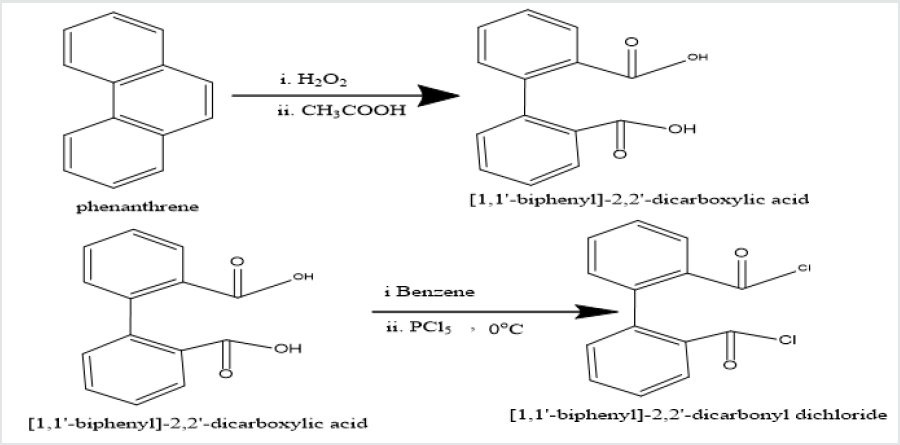
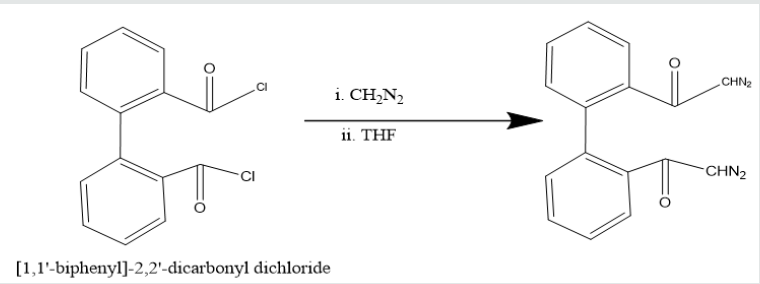
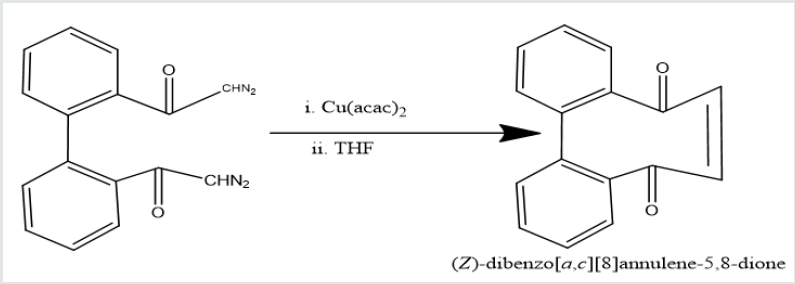
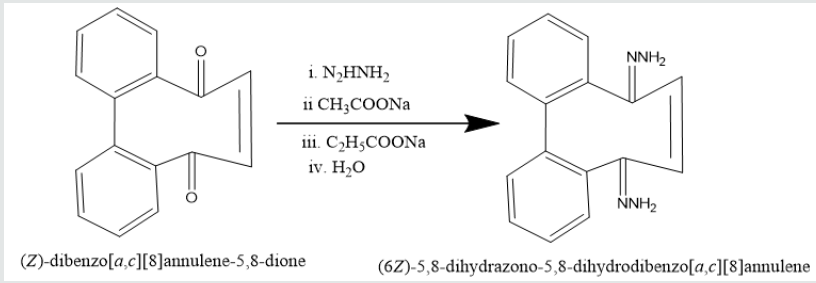
Phenatharene was oxidized into [1,1’-biphenyl]-2,2’- dicarboxylic acid by the use of H2O2 in presence of CH3COOH. When [1,1’-biphenyl]-2,2’-dicarboxylic acid was treated in PCl5 in benzene solution at 0 oC temperature, [1,1’-biphenyi]-2,2’-dicarbonyl chloride was obtained. It reacted with diazomethane to produce yield [1,1’-biphenyl]-2,2’-dicarboxodiazomethan which heated Cu(acac)2 in presence THF to yield (Z)-dibenzo[a,c][8]annulene- 5,8-dione. It was used with hydrazine hydrate in ethyl alcohol to give (6Z)-5,8-dihydrazone-5,8-dihydrodibenzo[a,c][8]annulene.

Results and Discussion

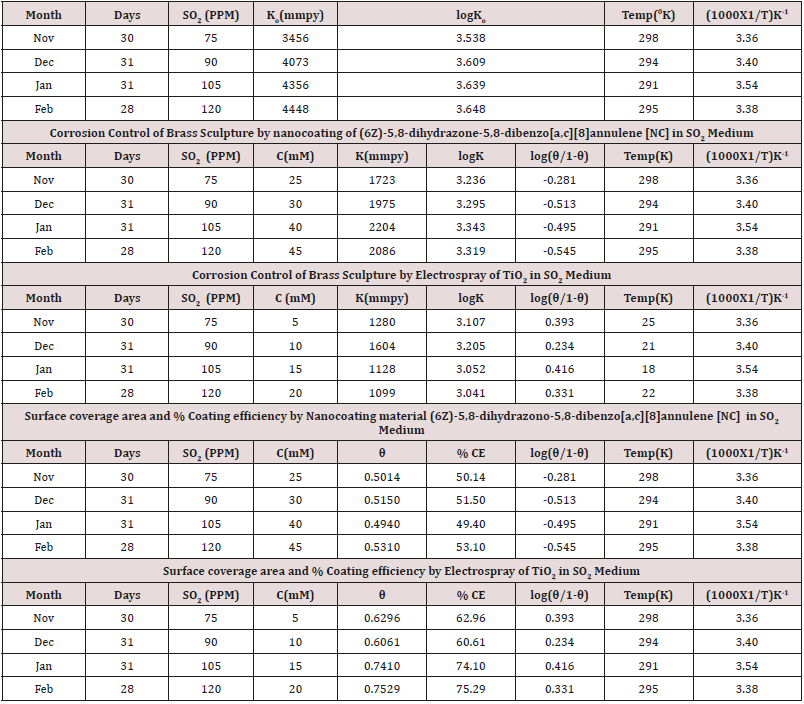
Brass metal was exposed in moist SO2 environment in 75ppm, 90ppm, 105ppm and 120ppm concentrations and 298 0K, 294 0K, 291 0K and 295 0K temperatures. The corrosion rate of brass metal was determined in winter season without coating and with coating (6Z)-5,8-dihydrazone-5,8-dihydrodibenzo[a,c][8]annulene and TiO2 electrospray of by weight loss formula K= 534 W/DAT (where W is weight loss, D is density and T is time) and their values were mentioned in (Table 1)

Table 1:Corrosion of Brass Sculpture in Winter Season in SO2 medium.

Lupinepublishers-openaccess-material-science-journal

The corrosion rate of brass metal was recorded in the months of November, December, January and February, the results (Table 1) was shown that corrosion rate of metal increased in January to February but theses values were reduced with coating and filler materials like (6Z)-5,8-dihydrazone-5,8-dihydrodibenzo[a,c][8] annulene and TiO2. It was clearly noticed in (Figure 5) K versus Month. Brass metal kept into 75ppm, 90ppm, 105ppm and 120ppm of SO2 medium in month of Nov, Dec, Jan and Feb without coating. It was coated with 25mM, 30mM, 40mM and 45mM concentrations of (6Z)-5,8-dihydrazone-5,8-dibenzo[a,c][8]annulene, and again kept into same concentrations of SO2. After coating of (6Z)-5, 8-dihydrazone-5,8-dibenzo[a,c][8]annulene electrospray coating of TiO2 used at 5mM, 10mM, 15mm and 20mM concentrations and same concentrations SO2 Nov to Feb. The corrosion rates of in these three cases were written in (Table 1). These results were shown that corrosion rates without coating increased, it values decreased coating with (6Z)-5, 8-dihydrazone-5,8-dibenzo[a,c][8]annulene but their values more reduced with TiO2 electrospray. These trends were shown in (Figure 6) which plotted K versus C. The corrosion rates of brass metal at different temperatures 298 0K, 294 0K, 291 0K and 295 0K without and with coating were recorded in (Table 1). The addition of nanocoating and electrospray were reduced the corrosion rates as temperatures variation, it noticed in K versus T in (Figure 7).

Read More About Lupine Publishers Journal of Material Science Please Click on Below Link: https://lupine-publishers-material-science.blogspot.com/

Wednesday, 27 March 2019

Materials Science articles-Lupine Publishers


This short review describes the use of group 4 metallocenes, group 15 organometallics and organotin polymers in the treatment of human cancer tumors and viruses. These metal-containing polymers show good inhibition of all the main group solid tumors including pancreatic, lung, brain, breast, prostate and colon human cell lines. They also show inhibition of a variety of viruses including zika, herpes and vaccinia viruses. Synthesis of the polymers is rapid employing interfacial polymerization and commercially available reactants. They offer physicians a new class of drugs for the treatment of a variety of cancers and viruses.To know more click on below link.


For more Lupine Publishers Open Access Journals Please visit our website: http://www.lupinepublishers.com/

For more
Materials Science articles Please Click Here: https://lupinepublishers.com/material-science-journal/


Monday, 25 March 2019

Open access material science journals-Lupine Publishers


To produce concrete, cement is an essential material that binds together solid bodies but also is the largest producer of carbon dioxide (CO2) emission. Up to 10% of global CO2 emission comes from cement production thus making the sustainability of concrete a major issue that needs addressing. The processes of producing concrete consume heavily on natural resources such as sand, gravel, water, coal and crushed rock, mining of which damages the environment. It is however possible, that energy and cost efficiency can be achieved by reducing on the amount of clinker, and in its place utilizing partial cement replacements/pozzolans that require less process heating and emit fewer levels of carbon dioxide. This study investigates the effectiveness of agro waste ash by-product Palm Oil Fuel Ash (POFA) as an alternative material to replace Portland cement (OPC). Experiments were carried out by supplementing CEM I cement by weight in concrete mixes with POFA at 2.5%, 5%, 10%, 15% and 20% steps at the point of need, with water to cement ratio of 0.5. Results were compared with a control specimen, which was made with 100% cement. The results showed impressive compressive strength, especially at early age; in fact POFA specimens containing 2.5% and 5% POFA replacement displayed greater early compressive strength in comparison to the control, which is similar in behaviour to concrete containing silica fume which is an established partial cement replacement used in high strength applications. The results showed good repeatability and highlight the potential of POFA as an effective pozzolan which could enhance the sustainability and economic aspect of concrete.to know more click on below link.


For more Lupine Publishers Open Access Journals Please visit our website: http://www.lupinepublishers.com/

For more
open access material science journals articles Please Click Here: https://lupinepublishers.com/material-science-journal/


Tuesday, 29 January 2019

Open Access Material Science Journals- Lupine Publishers

Palm Oil Fuel Ash as A Cement Replacement in Concrete by Jonida Pone in Modern Approaches on Material Science in Lupine Publishers

To produce concrete, cement is an essential material that binds together solid bodies but also is the largest producer of carbon dioxide (CO2) emission. Up to 10% of global CO2 emission comes from cement production thus making the sustainability of concrete a major issue that needs addressing. The processes of producing concrete consume heavily on natural resources such as sand, gravel, water, coal and crushed rock, mining of which damages the environment. It is however possible, that energy and cost efficiency can be achieved by reducing on the amount of clinker, and in its place utilizing partial cement replacements/pozzolans that require less process heating and emit fewer levels of carbon dioxide. This study investigates the effectiveness of agro waste ash by-product Palm Oil Fuel Ash (POFA) as an alternative material to replace Portland cement (OPC). Experiments were carried out by supplementing CEM I cement by weight in concrete mixes with POFA at 2.5%, 5%, 10%, 15% and 20% steps at the point of need, with water to cement ratio of 0.5. Results were compared with a control specimen, which was made with 100% cement. The results showed impressive compressive strength, especially at early age; in fact POFA specimens containing 2.5% and 5% POFA replacement displayed greater early compressive strength in comparison to the control, which is similar in behaviour to concrete containing silica fume which is an established partial cement replacement used in high strength applications. The results showed good repeatability and highlight the potential of POFA as an effective pozzolan which could enhance the sustainability and economic aspect of concrete.

https://lupinepublishers.com/material-science-journal/fulltext/palm-oil-fuel-ash-as-a-cement-replacement-in-concrete.ID.000102.php

For more Lupine Publishers Open Access Journals Please visit our website: http://www.lupinepublishers.com/

For more Open Access Material Science Journals articles Please Click Here: https://lupinepublishers.com/material-science-journal/

Friday, 25 January 2019

Material science journal- Lupine Publishers

New Materials: Current Development Under Simulation Techniques by Efrén Vázquez Silva in Modern Approaches on Material Science in Lupine Publishers

In the present short communication, a point of view on the contemporary tendencies in the development of the Science of Materials is offered. And for this, the main lines of research (personal criteria) in this area are considered, linked to problems of great importance for humanity: the care and preservation of the environment, renewable sources of energy and the health of people.

https://lupinepublishers.com/material-science-journal/fulltext/new-materials-current-development-under-simulation-techniques.ID.000101.php 

For more Lupine Publishers Open Access Journals Please visit our website: http://www.lupinepublishers.com/

For more Material science journal articles Please Click Here: https://lupinepublishers.com/material-science-journal/