Friday, 3 January 2020

Lupine Publishers-Dirty Linen?

Lupine Publishers | Journal of Textile and fashion Designing


Introduction


Linen used to be the most widely used textile material for apparel clothing for ages during the primordial era. Additionally, owing to its strength, durability and long lasting property, the ancient Egyptians were considered to use it even as a currency. Thus, Linen was an intrinsic and intimate component of human life and it was valued so much that cleaning of household cloths in public place probably led to the popular colloquial term of washing dirty Linen (personal matters that could be embarrassing if made public). Linen which ruled the northern hemisphere garb for thousands of years lost its importance in the last few centuries as another natural fiber "Cotton" also initially marketed as white gold gained prominence during British colonization in Asia and the advent of industrialization. Availability of vast land mass for cultivation of cotton in Indian subcontinent, claimant tropical weather conditions, cheap labor, ease of downstream processing, etc boosted popularity of cotton and it became the most popular textile substrate around the globe within a short time. Linen, which enjoyed a lion's share among the natural farm-cultivated textile substrates until the 17th century, lost its mare and reduced to hardly 1 % of total textile fiber consumption by mid 19th century. However, last few decades have witnessed revival of Linen and usage of this long and thick fiber in apparel and home furnishing segment.
Linen is best grown in cold and moist climatic conditions, the claimant weather of Western Europe is considered to produce best quality of Linen. France, Belgium, Netherlands and other neighboring countries contribute to about 80% of global Linen fiber production of about 1,500,000 MT while remaining 20 % comes mostly from Egypt, Russia and China. Though, the Linen fiber cultivation is less in China, it has the highest Linen yarn spinning capacity amounting to almost 80 % of global production. The largest consumer of Linen made textile material worldwide is considered to be the USA, followed by Europe and India. However, their consumption pattern is different. In the.com and Europe about 30% of Linen is used in clothing and 70% in home furnishing, while in India almost 70% is consumed in clothing and remaining for home furnishing. India is considered to be one of the fastest growing markets for Linen and blended textile material and bout 30,0 MT was consumed last year and is believed to be growing at CAGR of about 15% in last decade. Linen's ability to absorb sweat and keep the body cool makes it a perfect fabric for India's climate.
Further, with the growing awareness about sustainability and various aspects of a textile material in terms of its environment impact, water footprint, biodegradability, long evity, etc the focus is shifting to Linen as it is one of the most eco friendly natural fibers. Cotton and Linen are both natural fibers of cellulosic origin containing hydro glucose units but there are many differences between them in terms of physical, environmental and usage performance. Apart from the use of Linen fiber in textile application, its other parts are also used as varnish for wood preservation and theOmega-3 fatty acid extract from its seeds "Linseed oil" as a nutrient for animal health. Linen has many fold advantages over cotton and other natural fibers as it
    a) Gains strength when wet and strongest among all natural fibers
    b) Provides natural drape due to crispy appearance
    c) Retains shape, does not shrink or stretch owing to nonelastic behavior
    d) Becomes soft and supple after washing
    e) Requires less quantity | thread count due to longer length and high fiber thickness
    f) Appears pleasant due to inherent luster and texture
    g) Wrinkles easily but become smoother through handling and use
    h) Absorbs up to 20% moisture before it begins to feel damp
    i) Enhances wicking property owing to hollow fiber interior
    j) Prevents bacterial growth making it ideal for towels, bed spreads, upholstery, curtains
    k) Retains heat and cold from human body due to insulating property
    l) Keeps cool in the summer and traps warmth in winter
    m) Resists static electricity and avoids danger of static shock during wear
    n) Alleviates arthritis and dermatitis due to hypo-allergenic power
    o) Induces better sleep due to anti-stress property
    p) Enhances usage comfort due to air permeability and breathability
    q) Needs less water, fertilizers and insecticides during farm cultivation
    r) Resists dirt and stains hence easy to wash and clean
    s) Retains physical appearance due to non-pilling tendency and no lint formation
    t) Enhances aesthetic appeal due to presence of slubs or small knots in the yarn
    u) Resists harmful electromagnetic radiation from sunlight
Gleaning from the research articles and review material on Linen, given below is concise information on flax farming, fiber extraction, yarn preparation, mechanical operation, machinery involved, wet processing methods and the end user applications. Cultivation. Linen fiber is extracted from flax plant (Latin name linum). Plant grows about 1 meter within 100 days from sowing to harvesting. A variety of seeds are used for plant breeding based on fiber content, weather tolerance, crop protection and weed control behaviour.
Traditional harvesting is usually done by plucking off the flax plants, tying them in bundles and allowing them to rot in the field to achieve decomposing of stalk and easy separation of fiber. This process is called retting it helps remove gummy substances from the bast fibers. Retting can also be done by other methods like:
    a) Pond retting-leaving the flax plant stalks in tanks of water, it takes about 2-4 weeks
    b) Stream retting-plants are immersed in slow moving streams the quality of the fiber separation is better than pond retting
    c) Chemical retting-involves immersion of the dried plants in a tank in acidic or alkaline solution. Though this process is comparatively economical and time saving it tends to affect color and strength of fiber if not controlled adequately.
    d) Enzymatic retting-fastest and costliest process makes use of pectinolytic enzymes for loosening fibers within few hours
    e) Dew retting-widely used, highly stainable but slow process, the stalks are left in the field for about 6 weeks, considered to provide best result. After retting, to remove the woody matter, the stalks "scotched" to remove woody matter by crushing them between two metal rollers. Then they are heckled and combed to separate out short fibers. The short fibers are collected for making coarser sturdy goods for upholstery usage while the remaining long and fine fibers are used for making apparel clothing. The fibers vary in length from about 25 to 150mm and 12-16 micrometers in diameter. The long fibers are then processed using a 'wet spinning' technique, while the short fibers are spun using a 'dry spinning' technique.
The long Linen fibers are put through machines called spreaders, which combine fibers of the same length and laying them parallel for creating a sliver. Then it is passed through a set of rollers to make a roving. The roving's are drawn out into thread and ultimately wound on bobbins or spools. The yarn is knitted or woven into fabric as 100 % Linen or in blends with other substrates as per the end use requirement.

Chemical composition

The stem of flax is made up of 5 layers-epidermis, cortex, bast, cambium and woody tissues. The outer layer is covered with thin layer of wax during plant growth. The cortex contains pectin and natural coloring components which impart hues varying from of grey to light brown. Linen fiber contains only about 70 % cellulose while remaining is hemi cellulose, lignin, wax and woody matter sprit. Hence, the conventional alkaline scouring and oxidative bleaching results in about 25-30% weight loss and adversely affects strength of the yarn.

Wet processing

The Linen fiber is processed in many of its forms like Rove yarn, packaged bobbins, knitted material or woven fabric depending on the substrate, machinery available and the subsequent processing steps. The pre-treatment is carried out depending on the requirement of whiteness for full white or for bright light | pastel shades, semi bleach (3/4 white) or partial bleach (1/2 white) by a multi-step scour bleach process.
Demineralization is carried out first to get rid of heavy metal ion contamination from the fiber and to help achieve improved whiteness and minimum yarn strength damage. Oxidative bleach with Sodium Chlorite is considered to give best results, however, due to eco concerns non-chlorine bleach like hydrogen peroxide or per acetic acid is preferred. Further, it is considered that a final treatment with reductive bleaching agent helps improve whiteness. In practice it is desired to minimize and control weight loss during pretreatment process to about 10-12% from cost economy as well as yarn strength retention point. Given below is a guideline pretreatment process based on widely used industrial practice
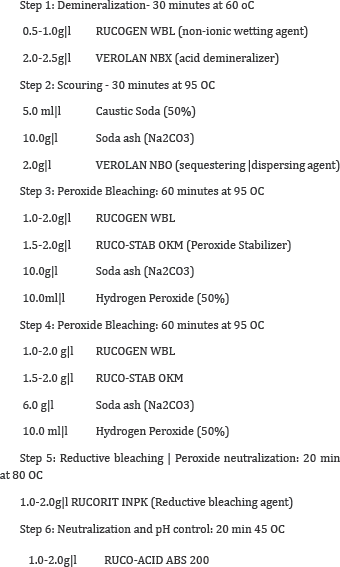
Lupinepublishers-openaccess-journals-Textile-Fashiondesigning

Dyeing being a cellulosic fiber Linen can be dyed with a range of dyestuffs like Direct, Reactive, Sulphur and Vat. Considering the brilliancy of shade and fastness properties, Reactive and Vat dyes are most preferred. Depending on the substrate form and the machinery in use, Linen can be dyed by exhaust, semi continuous (Cold Pad Batch) and continuous (Pad-dry-Pad-steam, Pad-Dry- Cure) methods.
Considering the basic requirement of dye diffusion and uniform level dyeing, the high exhaust, high energy specialty bis-monochlorotriazine based Reactive dyes like TULACTIV XLE are most popular for exhaust application while TULACTIV C dyes for CPB and PDPS application. Linen is known for its long lasting durability, therefore for high end apparel clothing end use application it is desired that the color should also last till the fiber lasts. In this aspect Vat dyes owing to their excellent light, wash fastness properties are highly recommended. NOVATIC MD a micro disperse variety is widely used for both exhaust as well as continuous application and TULACON C a liquid variety is preferred for dyeing of light pastel shades in one step Pad-Dry-Cure process.


Summary

Based on various ecological and superior performance criteria, Linens regaining its lost position. It is used in apparel as well as various home furnishing items like bed spreads, towels, curtains, table cloth, etc, the fashion savvy young generation has realized benefits of Linen in terms of its wearing comfort in any kind of weather, varying climatic conditions, durability, sustainability as Linen is one of the most biodegradable and stylish fabrics in fashion history.


For more Lupine Publishers Open Access Journals Please visit our website:
For more Open Access Journal of Textile and Fashion designing articles Please Click Here:
https://lupinepublishers.com/fashion-technology-textile-engineering/fulltext/dirty-linen.ID.000124.php

To Know More About Open Access Publishers Please Click on Lupine Publishers


Follow on Twitter   :  https://twitter.com/lupine_online

Thursday, 2 January 2020

Lupine Publishers | Effectiveness of Health Education Programmed on Knowledge regarding Management of Orthopedic Appliances among Fracture Patients at RL Jalappa Hospital, Kolar

Lupine Publishers | Journal of Orthopaedics

Abstract

Introduction: Effectiveness of health education programme was evaluated among forty patients diagnosed as having fracture and admitted at RLJH and RC with different types of orthopedic appliances.
Methodology: Using quasi experimental one group pre and post test design, patients were assessed for their knowledge followed by a health education programme was administered on management of orthopedic appliances among fracture patients. After seven days, a post test was conducted.
Findings: The results showed that structured health education programmed was effective in improving the knowledge score among fracture patients on management of orthopedic appliances.
Conclusion: Health professionals should spend some time with fracture patient to educate regarding orthopedic appliances and its related complications. So that, future occurrence of complications related to orthopedic appliances can be prevented.
Keywords: Knowledge; Health Education; Orthopedic Appliances; Fracture Patients

Introduction

Fracture is a disruption or break in the continuity of the bone. It usually occurs as a result of blow to the body, a fall, or accident. Traumatic injuries account the majority of the fractures, although some fractures are secondary to a disease (pathological fractures). The highest incidence of fracture in males is between the age group of 15 to 24 years and in women it is 65 years or above [1]. Majority of patients with injuries of the musculoskeletal system will be managed by bed rest, immobilization and rehabilitation itself without requirement of surgical intervention. Immobilization is achieved by orthopedic appliances. These appliances produce skeletal changes by applying force with the help of plaster cast and braces [2]. The patient with plaster cast may develop cast syndrome due to obstruction of superior mesenteric artery and it can be prevented if symptoms are recognized quickly and treatment instituted in a timely manner. Expected complications of plaster of Paris cast are impaired blood flow, nerve damage, tissue necrosis, infection, cast syndrome and also other complications may arise due to prolonged immobilization like hypostatic pneumonia, foot drop, renal calculi, stiffness of joints, constipation, pressure ulcer etc [3]. A study was conducted to assess the knowledge on fracture among 127 osteoporosis patients with recent fragility fracture at Hamilton Health Sciences hospital. The results showed that, majority of patients were unaware of important risk factors related to fracture. The study concluded that education initiatives are essential in improving knowledge among individuals in fracture clinics, acute care and rehabilitation settings, as these areas are an ideal place to communicate information [4]. Majority of musculoskeletal disorders are relatively long time in nature. The care and management of this condition needs a specialized orthopedic nursing practice5. After going through the related literature it was found that there were no studies either in India or abroad specifically related to management of orthopedic appliances. Hence the researcher felt with an objective to evaluate the effectiveness of structures health education programmed on management of orthopedic appliances among fracture patients.

Materials and Methods

This study was based on Ludwig Von Bertalanff’s general system theory. The design used for the study was quasi experimental one group pre test and post test. Based on the objectives of the study, a structured knowledge questionnaire and a lesson plan of health education on management of orthopedic appliances among the fracture patients was prepared in English and then it was translated to Kannada since the study participants communication and understanding were only in Kannada. Later the tool and health education lesson plan was validated by eight research and subject experts for its adequacy and appropriateness. After obtaining an ethical clearance from an institutional ethical committee, a written consent was obtained from the Medical Superintendent of RL Jalappa hospital and research centre, Tamaka, Kolar. After taking consent from the patients, through simple random sampling technique lottery method, 40 patients were selected who were diagnosed as having fracture and admitted to hospital with different orthopedic appliances, with the age group of 20 to 60 years, able to communicate with kannada or English language and willing to participate in the study. Patients who were critically ill, developed complications during the study period and mentally challenged were excluded from the study. Then the data was collected by using structured knowledge questionnaire on management of orthopedic appliances. Followed by on the same day, a health education on management of orthopedic appliances were administered using chart, flash card, pamphlet and OHP by individually and in groups. After seventh day, post test was conducted using same questionnaire. The data was collected from 26th June 2014 to 30th July 2014 in orthopedic wards.

Results

Socio-demographic variables

Table 1 displays socio-demographic variables of fracture patients. The majority( 37.5%) of fracture patients in this study were in the age group of 20-30 years and 30% of them with age group of 51-60 years, most(55%) of them were males, 70% of them were married, 70% of them were Hindus, 80% of them were belong to rural area, 32.5% of them were studied up to high school, 65% of them were belong to joint family, 52.5% were coolie workers and 40% of fracture patients family income was below Rs.5000/- month.

Knowledge score of fracture patients

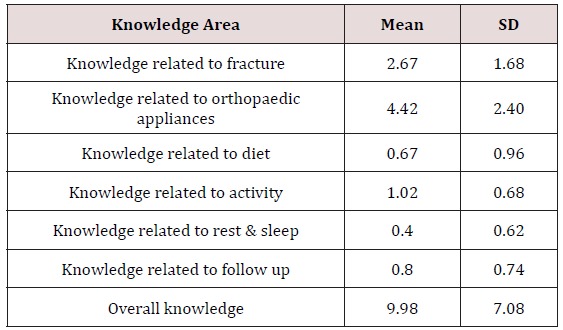
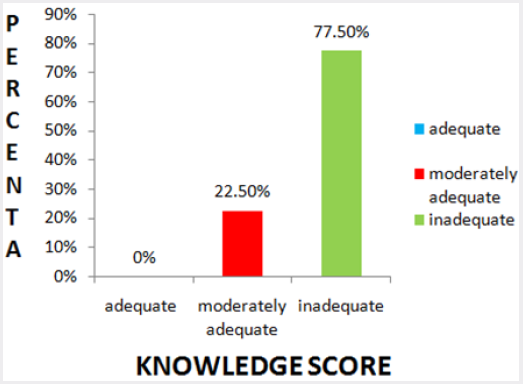
After obtaining socio-demographic data, the fracture patients were assessed for their knowledge score on management of orthopedic appliances and presented in Table 2. Based on overall knowledge score obtained by fracture patients, they were grouped under inadequate knowledge (who scored below 50%), moderately adequate knowledge (who scored 50 to 75%) and adequate knowledge (who scored 76% and above) and presented in Figure 1.
Table 1: The Socio-demographic variables of fracture patients.
Table 2: Area wise pretest mean Knowledge score distribution of fracture patients.
Figure 1: Distribution of fracture patients based on their Knowledge score.

Effectiveness of health education programmed in improving knowledge score

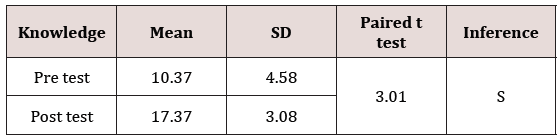
After administering health education programmed, a post test was conducted to know the effectiveness of health education programmed on management of orthopedic appliances and the results revealed that, the pre test mean knowledge score was 10.37 with SD of 4.58 where as the mean post test knowledge score was 17.37 with SD of 3.08, while enhancing the mean knowledge score of 7. The obtain t value was 3.01 which was significant at 0.05 level. This indicated that health education programmed was effective in increasing the knowledge score among fracture patients and the same was presented in Table 3.
Table 3: Comparison of overall pre and post test knowledge scores of fracture patients.

Association of knowledge score with selected sociodemographical variables

The association between post test knowledge score of fracture patients with selected socio demographic variables revealed that, there was no association between gender (x2=0.22), religion (x2=1.13), educational status(x2=0.02), type of family(x2=3.53 ), occupation (x2= 3.52) and family income (x2=0.6) except age in years(x2=7.91) which was significant at 0.05 level.

Discussion

Knowledge regarding management of orthopedic appliances among fracture patients is very essential in preventing complications. Hence the study was undertaken to assess the effectiveness of health education programme on knowledge regarding management of orthopedic appliances among fracture patients and the results showed that, with regard to socio-demographic variables, majority (37.5%) of them were in the age group of 20-30 years and most (55%) of them were males which was contradicted by the study conducted by Swati Kambli [6]. Related to knowledge score, the mean pre test knowledge score was 10.37 with SD of 4.58 where as the mean post test knowledge score was 17.37 with SD of 3.08, while enhancing the mean knowledge score of 7, indicating that health education programme was effective in improving knowledge score among fracture patients and this was supported by the study conducted by Saccone M, Jain AK [7]. With regard to association of knowledge score with selected socio-demographic variables, it was found that there was no association between knowledge with selected socio demographic variables except age.

Limitations

The study was limited to fracture patients admitted at RL Jalappa Hospital and Research centre, with different orthopedic appliances.

Conclusion

The present study concludes that, structured health education programme was effective in improving the knowledge score among fracture patients on management of orthopedic appliances.

Acknowledgement

Researcher expresses her sincere gratitude to all fracture patients who participated in the study and authorities of RL Jalappa hospital for granting permission to conduct the study.

For more Lupine Publishers Open Access Journals Please visit our website:
For more Open Access Orthopedics and Sports medicine articles Please Click Here:

To Know More About Open Access Publishers Please Click on Lupine Publishers


Follow on Twitter   :  https://twitter.com/lupine_online

Wednesday, 18 December 2019

Lupine Publishers | Persistent Wound Leakage After Total Knee And Hip Arthroplasty

Lupine Publishers | Journal of Orthopaedics

Abstract

In this mini-review the pathogenesis, pathophysiology, diagnosis, treatment and course of prolonged wound leakage after total hip and knee arthroplasty are discussed. It appears there is a disconcerting lack of research and knowledge concerning this topic. Wide variations in definition, classification, diagnosis and treatment hamper patient management, early mobilisation and rehabilitation, as well as the function of the operated joint, severely.

Introduction

The diagnosis and treatment of persistent wound leakage is an important and poorly understood topic in the field of joint arthroplasty. Persistent wound leakage after total knee and hip arthroplasty is associated with a higher risk of developing periprosthetic joint infection (PJI) [1-6]. PJI is a seious complication with great impact on a patient’s physical functioning and quality of life. Moreover, PJI is a high financial burden for society. Additional medical costs of PJI are approximately € 30.000 per patient with even higher societal costs because of productivity loss,home care and informal care provided [7,8]. Unfortunately, there are no evidence-based guidelines for the diagnosis and treatment of persistent wound leakage after joint arthroplasty [6].
Numerous issues hamper the development of sound guidelines. First of all, research on wound leakage is hard, as PJI is used as the major endpoint of wound leakage treatment, which has a low incidence (1,5%)- [9]. Secondly, there is no uniformly accepted definition of wound leakage and when to call it persistent. Clinical practices in orthopedic hospitals vary widely therefore. For that reason pathogenesis, pathophysiology, treatment and course of prolonged wound leakage after arthroplasty are discussed in this mini-review.

Pathogenesis

Following Winter’s original research in 1962, it is now widely accepted that a certain amount of moisture in the wound bed is necessary for optimal healing [10]. The difficulty is determining what that certain amount is and how long it should persist. Inflammation is the body’s normal protective response to any injury (including surgery) or foreign bodies.Acute inflammation follows the early stage of the foreign body response ( protein adsorption) [11,12]. Chemotactic agents within the provisional matrix play a key role in controlling the migration of neutrophils from the vasculature. The travelling leukocytes surrounding the implant become activated in response tothe cytokines released by the platelets e.g PDGF (platelet derived growth factor) and betathromboglobulin [13].
After localization and activation of macrophages and neutrophils tothe site of injury, enzymes are released and then the neutrophils mediated phagocytosis occurs. Theoretically, the phagocytosis should include the procedures of firstly recognizing and attaching to the foreign materials, the nengulfing and degrading them. However, due to the materials size, engulfment and degradation are often not possible,although the process of recognition and attachment occurs. Instead, the implants are coated with opsonins such as complement activated fragments C3b and IgG, which aid the adhesion and activation of neutrophils and macrophages [11]. Macrophages assemble at the implant site, leading to further production of chemoattractive-signalling molecules such as PDGF, tumor necrosis factor (TNF-alpha), interleukin 6 (IL-6), granulocyte-colony-stimulating factor (G-CSF) and granulocyte macrophage colony stimulating factor (GM-CSF), leading to further recruitment of macrophages to the implant site [14]. The foreign body response to bulk implant materials is abberant and prolonged.
At the end-stage of the foreign body response,or when the chronic inflammation occurs, mononuclear cells such as monocytes, lymphocytes and macrophages can present at the implant site. These macrophages which are added by the production of IL-4, IL-13 from Th2 lymphocytes, can fuse together to form a multinucleated foreign body giant cell (FBGC) at the implant surface [15,16]. Next the infiltrated fibroblasts, macrophages and neovascularisation will present within the newly formed granuloma tissue, which is a precursor for forming a fibrous capsule [17,18]. This capsule may contnue to grow following inflammation dueto mechanical motions or chemical leaching exerted in the joint. It was thought that the host response to most bulk biomaterials used in THA was identical and followed these main stages. However, the response tothe wear particles released by different biomaterials over time differ greatly [11,18,19]. Alumnium ceramics are the most biocompatible while Cobalt-Chromium and Ultra-High Molecular Weight Polyethylene (UHMWPE) have reduced bioavailability [18].

Pathophysiology

Total hip arthroplasty is a commonly performed operation and yet little information exists about the duration of wound oozing,the factors associated with this and the implications. Wood et al. Studied 62 consecutive patients undergoing total hip arthroplasty (THA). Time to dryness was associated with wound length (p=0,01), body mass index (BMI;p=0,05) estimated volume of blood in dissected tissues (p=0,05) and length of hospital stay (p=0,02). No association was found with duration of surgery or ASA (American Society of Anaesthesiologists) physical grades [20]. Local factors compromising wound healing include extensive scarring, lymphoedema, poor vascular perfusion and excessive adipose tissue. Systemic comorbidities affecting wound healing include diabetes mellitus, rheumatoid diseases, renal or liver disease, corticosteroid medication, poor nutrition HIV and smoking.Since a history of smoking is associated with a statistically significant increased risk of PJI, many centers use formal smoking cessation programs to assist patients n giving up, preferably before surgery [21].
Patel et al. conducted a retrospective study to determine the risk factors associated with prolonged wound drainage after hip and knee arthroplasty [5]. Risk factors included a BMI>40kg/ square meter, the use of low molecular weight heparin (LMWH) prophylaxis,and a high drain output after THAs. High drain output was the only risk factor associated with prolonged wound drainage after TKAs. HIV infection is also a risk factor for prolonged wound drainage after TKAs [22]. Obesity is a risk factor associated with prolonged operation times,and a higher rate of early postoperative complications, including excessive wound drainage and infection [23]. However,optimal peri-operative glucose control is an important factor in decreasing wound complications for all patients, including those without diabetes [24]. demonstrated that non-diabetic patients were three times more likely to develop PJI if the fasting blood glucose was > 140 mg/dl on the first postoperative day [25]. Proper selection, dosing and timing of prophylactic antibiotics are critical. Most commonly, a first generation cephalosporin is administered within one hour prior to the skin incision.In patients with allergies to penicillin or cephalosporins, clindamycin is an acceptable alternative. For patients with methicillin-resistant Staphylococcus aureus (MRSA) or coagulase-negative Staphylococcus colonisation, vancomycin is used [26].

Diagnosis and Management

Wound healing problems can range from superficial incisional, to deep incisional (outside the joint space) to involving the joint space. Gaine et al. reported a 10% incidence of superficial wound problems in primary TKAs [27,28]. Patel et al. [5] found that each day of prolonged wound drainage increased the risk of deep wound infection by 25% following TKAs. Drainage from the incision one to three days after surgery should be managed by immobilisation in extension, and application of a foam or rolled gauze compressive bandage over the incision. Use of immobilisation and observation should not exceed three days. Wound drainage that persists greater than three days is considered abnormal and should be treated surgically to decrease the chance of subsequent PJI [2,5,22,29].
Aspiration of the joint is necessary if there is a high level of suspicion. The synovial fluid should be analysed for white blood cell (WBC) count and differential.Cultures should also be obtained. There is some consensus with regard to the cell count. In patients with TKAs, a synovial WBC count>1700 cells/ul or a polymorphonuclear neutrophil (PMN) percentage > 65% is rhe recommended threshold for infection [30-32]. In THAs, the recommended thresholds are a synovial WBC count of > 4200 cells/ ul or PMN percentage>80% [33]. During the acute postoperative period,within 6 weeks of surgery, the thresholds are higher with a synovial WBC count>10.000 cells/ul and PMN>89% [34].

Treatment

Prolonged wound leakage after arthroplasty is induced by an inflammatory response , as described above (1,10-16). Conversely, surgical wounds may also show prolonged leakage for other reasons (hematoma,seroma or fatty necrosis) and take longer to heal without development of a PJI. Autoimmune disorders as e.g rheumatoid arthritis and SLE are also associated with prolonged wound leakage [35]. The causes of prolonged wound leakage are poorly understood and studies are scarce and methodologically flaw [6]. However,as expected orthopedic surgeons have been focussed primarily at the association between prolonged wound leakage and PJI.
In the Netherlands,the prevalence of prolonged wound leakage at day 9 after index surgery is about 4% ,2200 patients anually of 55.000 THAs and TKAs. The Dutch Arthoplasty Register reports a total of 3809 THA and 2667 TKA revision surgeries performed in 2015. Revision surgery within 1 year of index surgery was necessary in more than 600 patients and at least 30% of these were PJI related [36]. Persistent wound leakage can be treated by non-surgical and surgical treatment modalities. Non-surgical treatment can consist of relative rest (no exercise and bed rest), pressure bandages,and wound care with sterile bandages.Hospital admission can be required.
Surgical treatment typically consists of debridement, antibiotics and implant retention (DAIR) [37-42]. A DAIR procedure is meant to clean the prosthesis and wound,including break down of the bacterial biofilm, in order to treat the infection and render further infection. Treatment of persistent wound leakage varies considerably among Dutch orthopedic surgeons, as mentioned above [6]. There was a wide variation in classification, definition, diagnosis and treatment of wound leakage. The survey had only a response rate of 18,1%, suggesting wider variations are possible. More than 30 combinations of treatment modalities were used. Remarkably, 23, 4% of responders used antibiotics in the nonsurgical treatment of wound leakage, despite the fact that the efficacy of antibiotic treatment in persistent wound leakage has never been studied. Most respondents (43,8%) convert to surgical treatment if wound leakage is present for ten days after index surgery, implying a non-surgical treatment of 3-7 days. Literature offers litlle guidance but suggests that wound leakage more than 3-5 or 5-9 days after index surgery should be managed by surgical treatment.
Several authors have investigated the effect of DAIR for treatment of wound leakage and reported various results,statements or opinions,generally in favour of early DAIR [2-6], [38-42]. The most recent PJI consensus meetings suggest 5-7 days of wound leakage as the threshold to perform DAIR,but there is no solid evidence forthis statement. As early DAiR is hypothesized tobe helpful in treating or preventing infection and salvaging the implant, the Dutch Leak study will be started soon. This is a controlled randomized study, enrolling 388 patients, with prolonged wound leakage after THA or TKA. Patients are randomized for surgical treatment (DAIR at day 9-10 from index surgery) or continued non-surgical treatment. Primary outcome is the percentage of reoperations for PJI within one year of index surgery. Secondary outcomes are self-reported questionnaires regarding quality of life etc at 3,6, and 12 months after index surgery.

Course and Outcomes

There is a lack of data on the long-term outcome of THAs [43]. Short and medium- term THA studies report substantial improvements in the generic health related quality of life (HRQol) [44-48]. Mariconda et al. conducted a follow-up study to evaluate the quality of life and functionality of 250 patients an average of 16 years (11-23 years) after THA using a validated assessment set including the SF-36 questionnaire,Harris Hip Score,WOMAC score,Functional Comorbidity Index and a study specific questionnaire. The authors report that patients who had undergone THA have impaired long-term self-reported physical quality of life and hip functionality but they still perform better than untreated patients with hip osteoarthritis. However, the level of post-surgical satisfaction is high [43].
considerable proportion of patients report long-term pain after THA or TKA for osteoarthritis.Beswick et al conducted an extensive MEDLINE and EMBASE search of articles published to 2011. Of 1308 articles 115 reported patient-centered pain outcomes. Fourteen articles describing 17 cohorts (6 with hip and 11 with knee replacement) presented appropriate data of pain intensity. The proportion of people with an unfavourable long-term pain outcome in studies ranged from 7% to 23% after hip and 10% to 34% after knee replacements. In the best quality studies,an unfavourable pain outcome was reported in 9% or more of patients after THA and about 20% after TKA [49]. There are no specific short- or long-term studies (>3 years after index surgery) concerning the effect of persistent wound leakage after THA or TKA on quality of life and joint function, whatever the cause or treatment of prolonged oozing.

Conclusion

There is a disconcerting lack of research and knowledge concerning the treatment of prolonged wound leakage after THAs and TKAs, surgeries performed in huge numbers worlwide. With an estimated prevalence of 4%, patients with prolonged wound leakage after arthroplasty also represent a lot of people. Prolonged wound leakage is induced by inflammation, caused by infection immunologic incompability to the implant, autoimmunity as in rheumatoid disorders and SLE, or decreased host defence as in e.g.HIV infection. It will be no surprise that orthopedic surgeons primarily focussed on the association between the low incidence periprosthetic joint infection (1,5%) and prolonged wound leakage after THA or TKA. Recently, a Dutch survey among orthopedic surgeons showed a wide variation in definition, classification, diagnosis and treatment of prolonged wound leakage after arthroplasty.More than 30 combinations of treatment modalities were in use. Remarkably, the unproven use of antibiotics was present in nearly 25% of non-surgical treaments of this issue.
There is no evidence favouring non-surgical treatment above surgical treatment or vice versa. N evertheless, DAIR (debridement, antibiotics and implant retention) is favoured by most orthopedic surgeons at 3-5,5-7 and 9-10 days after index surgery. This arbitrarily and hypothetical timing of DAIR will be studied in an upcoming Dutch trial, the LEAK trial, randomizing 388 patients with prolonged oozing for DAIR at day 9-10 after index surgery versus non-surgical treatment. It is clear that whatever the cause and treatment of persistent wound leakage,early mobilisation and rehabilitation of the patient as well as the function of the joint are hampered severely. There are no sttudies availabale evaluating this topic. It is evident a lot has to be learned in managing and treating prolonged wound leakage after the most common performed arthroplasties in orthopedics.

For more Lupine Publishers Open Access Journals Please visit our website:
For more Open Access Orthopedics and Sports medicine articles Please Click Here:

To Know More About Open Access Publishers Please Click on Lupine Publishers


Follow on Twitter   :  https://twitter.com/lupine_online

Monday, 16 December 2019

Lupine Publishers | Climate Resilient Interventions for Improving Food Security in Hill Ecology of Hindu Kush Himalaya

Abstract

The Hindu Kush Himalaya (HKH) region has significant implications for the agro based economies of eight adjoining countries, because of their large dependence on irrigation water originating in the HKH region. However, the HKH region is extremely vulnerable to climate change impacts, which is evident through frequent floods, droughts and retreating glaciers, thus leaving negative consequences for agriculture and livelihood. It is also evident that the traditional farming methods are no longer sustainable to cope with the changing climatic conditions for sustainable production in hill ecology. Therefore, innovative farming technique and irrigation technologies needs to be adopted for mitigating climate change impacts on agriculture and for ensuring food security. Although some pioneer work has been done in developing and promoting improved farming methods and irrigation techniques, but these improvements were mainly focused in major leveled irrigated areas lying downstream of HKH region. Thus, investment on promoting site specific climate resilient practices in hill ecology of HKH was largely overlooked. Addressing these issues, this study is focused on assessment of agricultural production system of Pakistan, as a case example by having 51% area falling in HKH region and reviewed few promising interventions/technologies successfully adopted in downstream irrigated areas that may be equally beneficial for the hill ecology of HKH region. Anecdotal evidence indicates that promotion of these interventions will improve community resilience to climate change and may lead to increased agricultural production and better livelihood for hill ecology of HKH region. This may also improve sustainable irrigation water supply for the irrigated areas downstream.

Introduction

The total area of Hindu Kush Himalaya (HKH) region is ~ 3.44 million sq. km spread over eight countries of Asia. The 51% area of Pakistan (~0.4 million sq. km) falls in HKH region, which form around 12% part of the whole HKH region [1]. Pakistan is home to one quarter (~19%) of the total population (~211 million people) of HKH region with an average population density of 97 persons per sq. km. The second (K2) and ninth (Nanga Parbath) highest peaks of HKH region fall in Pakistan. The agro based economy of HKH region in Pakistan is heavily dependent on the production of vegetables, crops and fruits. Current climate change trends and lack of adequate integrated water resource management strategies are causing huge losses to the country due to frequent droughts and floods [2]. Therefore, traditional farming techniques prevalent in Pakistan are no longer capable to keep up with the rapid climate change variability in the HKH region [3,4] and its downstream basins.
The Indus Basin of Pakistan is comprised of one of the largest contiguous canal irrigation systems in the world that lies at the downstream of HKH, thus prone to frequent climatic disasters [5]. For instance, the recent 2010 floods, originated in HKH region, drowned around one fifth of Pakistan, affected ~20 million people and caused more than US $43 billion impact on the country’s economy [6]. Irrigated agriculture produces around 90% of crop production in Pakistan and contributes more than 21% in the country’s GDP. Moreover, production in Pakistan has global implications, thus may impact on global food security. For instance, Pakistan produces wheat crop greater than the whole Africa and nearly equal to South America. Therefore, agriculture needs to be more wisely managed and traditional farming and irrigation methods needs to be modified according to the changing climatic conditions. This paper reviews some of the salient features of agriculture in Pakistan, its vulnerability to climate change and few promising irrigation technologies capable of improving farming system resilience to climate change.

Salient Features of Pakistan’s Agriculture and their Vulnerability to Climate Change

Land use in Pakistan

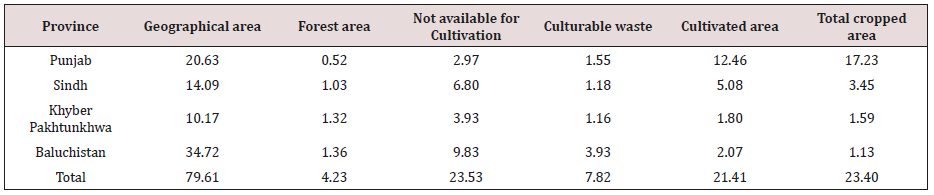
The province wise land use is presented in Table 1. The total area of Pakistan is 79.61 million hectares (mha) with 23.40 mha cropped area. The current cultivated area is concentrated in Punjab province with 12.46 mha, which is ~50 % of the total cropped area of Pakistan followed by Sindh Province at ~8 % of country’s cropped area. However, there is 7.82 mha culturable waste area that is largely concentrated in least developed provinces of Khyber Pakhtunkhwa (KP) and Baluchistan, which can be brought under cultivation to enhance food security. The province wise culturable waste areas are 12%, 23%, 64% and 190% of current cultivated lands in Punjab, Sindh, KP and Baluchistan respectively. Therefore, the agro based economies of KP and Baluchistan has greater potential for improvement by cultivating their culturable waste lands.
Table 1: Land use in Pakistan.
lupinepublishers-openaccess-journal-environmental-soil-sciences
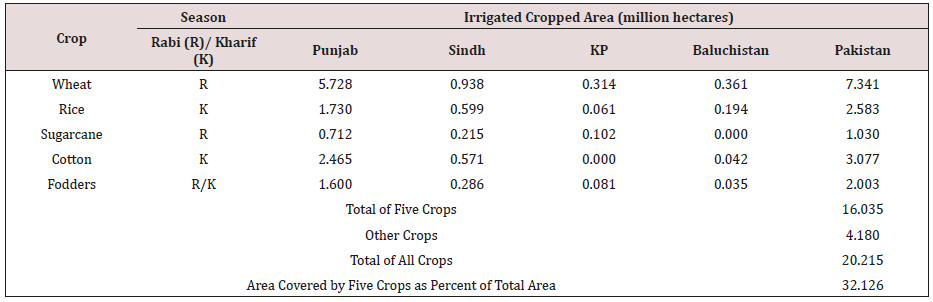
The irrigated cropped area in Pakistan is around 18.84 mha (Table 2) according to Agriculture Statistics of Pakistan 2006-07. This includes: wheat 7.34 mha (36.3 % of total); rice 2.58 mha (12.8 % of total); cotton 3.01 mha (15.2 % of total); sugarcane 1.03 mha (5.1 % of total); and fodders 2.00 mha (9.9 % of total). These five crops cover 16.03 mha of total irrigated area in Pakistan, which is 79.32% of the total irrigated area. Therefore, improving water productivity of these five major crops would have major impacts on productivity of irrigated agriculture in Pakistan. Other crops cover 4.17 mha; which constitute around 21.68 % of total irrigated area in Pakistan. The climate change induced floods and droughts significantly impact on crop production, especially during Kharif (summer) season, from both irrigated and rain-fed areas of Pakistan. The current land use methods tend to exacerbate the soil and water degradation and reduce land productivity potential. Similarly damage to standing crops due to lodging caused by heavy winds, water logging and salinity and frequent water stresses at crop critical growth stages causes production losses. Therefore, the traditional farming techniques need to be modified to control crop damage due to climate change induced threats, which is essential for sustainable agriculture in the country.
Table 2: Irrigated cropped area of major crops in Pakistan.
lupinepublishers-openaccess-journal-environmental-soil-sciences

Temporal Water Availability During Rabi and Kharif Seasons In Pakistan

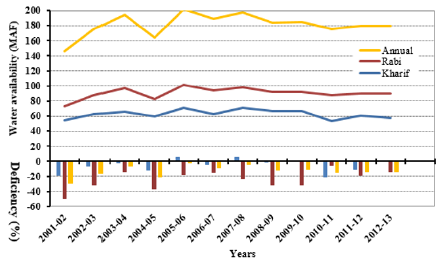
Temporal surface water availability and deficiency during rabi (winter) and kharif (summer) seasons in Pakistan is shown in Figure 1. Temporal changes indicated up to 23% increase and down to 16% decrease in total annual available surface water since 2001 until 2007. However, the variability in total annual available surface water diminished below 5% since 2009 onward. Interestingly a major flood occurred during 2010, but data show insignificant impact on the total water availability (Figure 1). Thus, climate change cannot be judged from the total water availability. However, the frequency, intensity and distribution of rainfall are important parameters to be considered. Similarly, the average deficiency remained around 6.4% during Kharif (summer season) and around 24% during Rabi (winter season) with an average annual water deficiency of around 13% during the last twelve years.
Figure 1: Temporal surface water availability and deficiency during rabi (winter) and kharif (summer) seasons in Pakistan.
lupinepublishers-openaccess-journal-environmental-soil-sciences

Increased Use of Groundwater in Pakistan

Canal water fluctuation and unreliability due to climate change has increased farming community dependence on groundwater during the last decade. The changing trend of water availability is presented in Table 3. The statistics of canal and tube well irrigated area in provinces from 1993-94 to 2010-2011 (Table 3) indicate a decrease of 19% and 26 % in canal irrigated areas and an increase of 26 % and 157% in tube well irrigated areas in Punjab and Sindh provinces respectively. The overall tendency from 1993-94 to 2010- 11 indicated a decrease of 17.5 % in the canal irrigated areas and an increase of 33.5 % in groundwater irrigated areas in Pakistan. The overexploitation of groundwater is coupled with saline water up-coning and disposing of deep brackish groundwater into the soil surface thus causing fertile lands barren in Pakistan. It is therefore essential to reduce groundwater usage by utilizing surface water more efficiently for fulfilling irrigation demands of larger areas. Thus, the traditional irrigation methods need to be modified to more efficient methods to reduce groundwater usage.
Table 3: Temporal change in irrigated area under surface and groundwater in Pakistan.
lupinepublishers-openaccess-journal-environmental-soil-sciences

Climate Resilient Interventions for Improving Food Security in HKH Region

The existing land use, crops, water availability and usage statistics clearly indicate that the traditional farming techniques are not capable to cope with the climate change induced risks. It is therefore essential to adopt suitable climate change risks mitigation interventions for improving food security in HKH region. Few of these interventions/technologies successfully adopted in irrigated leveled lands downstream of HKH are summarized below:

Furrow Bed (Raised Bed) Irrigation Systems

Furrow bed irrigation system is one of the commonly used form of surface irrigation throughout the world (Figure 2) and is generally considered a more water-efficient system compared with the traditional flat basin because of (i) the speed with which water is conveyed to the low end of a field [7]; and (ii) the relatively small proportion of the soil surface is in contact with the flowing water during irrigation than the basin [8]. Furrow bed irrigation system is important in the current climate change scenario of
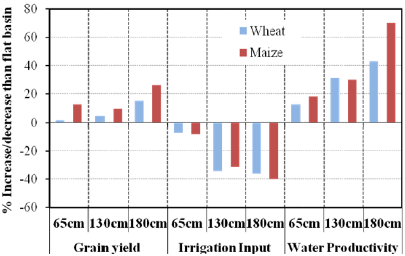
Figure 2: Advantages of furrow bed over flat basin [11].
lupinepublishers-openaccess-journal-environmental-soil-sciences
Pakistan agriculture in particular and Himalaya region in general due to the following reasons:
a) Furrow bed can save up to 50% irrigation water in comparison with traditional flat basin thus can reduce impact of limited water availability on crops in drought prone areas;
b) Furrows can quickly drain excess floodwater thus can reduce crop damage in flood prone areas;
c) Furrow beds reduce crops lodging by providing safe path and exit to speedy wind currents and greater reinforcement due to strong roots and soil grip;
d) Furrow beds laid perpendicular to slope can increase soil infiltration and ground water recharge by delaying runoff down slope and providing larger surface water storage capacity in furrows;
e) Conservation agricultural practices including minimum tillage, ground cover/mulching etc can be conveniently adopted on furrow beds which reduce soil erosion and soil and water degradation;
f) Furrow beds support mechanized farming thus can increase crop production and can be adapted to technological progress.
The Climate, Energy and Water Research Institute (CEWRI) of Pakistan Agricultural Research Council (PARC) has played a pioneer role in evaluation of furrow beds in Pakistan. Research conducted has shown that furrow beds is effective in improving yield of wheat by 20%, cotton 19%, Maize 58%, rice 26% compared with flat basin or ridge irrigation systems [9,10]. Similarly, crop yield per unit area increases by increasing the bed width. For instance, crop yield of maize showed up to 15% increase while wheat crop showed 26% increase on 180 cm bed size compared with flat basin [11], which was the largest increase noted when compared with other bed sizes given in Figure 2. Water saving of up to 50% in wheat, 30% in maize, 40% in cotton, 29% in rice were reported by N Ahmad et al. [9], Gill et al. [10], Hassan et al. [12]. Increase in water saving by increasing bed has been demonstrated in Figure 2 [9], which shows up to 40% and 36% increase in water saving by adopting 180cm bed size for maize and wheat crops respectively. Furrow bed increase crop yield and reduce irrigation application thus consequently crop water productivity is increased. For instance, an increase in water productivity of up to 70% in maize and up to 43% in wheat were reported by Hassan et al. [12] and Akbar et al. [13]. Impact of bed width on water productivity is illustrated in Figure 2, which shows up to 70% and 43% increase in water productivity for maize and wheat crops respectively compared with flat basin [13].
The CEWRI-PARC in collaboration with Australian Centre for International Agricultural Research (ACIAR) played a pioneer role in adopting furrow bed irrigation system in Maize wheat system of Pakistan. Conservation agricultural practices involving minimum soil disturbance were introduced in the form of permanent raised bed (PRB) farming system. Different bed width and furrow sizes were evaluated and demonstrated at farmer fields. Raised bed machinery imported from Australia was indigenously produced. The furrow bed farming system was disseminated by giving incentive to the farmers in the form of giving subsidies in purchasing raised bed machinery, training and demonstrations in the country. Although there are still issues in the machinery, especially for adopting PRB farming system, but the furrow bed system has been adopted widely for maize, cotton, sugar beat and vegetables crops throughout the country.

Sprinkler Irrigation Systems

In sprinkle irrigation method water is spayed into the air at 70-700 kpa (10-100 psi) pressure that fall on the ground or crop canopy like rainfall [14]. Using sprinkle irrigation system, the crop requirement can be accurately fulfilled through a combination of measures involving careful selection of sprinkle nozzle size, operating pressure and sprinkle spacing, thus adjusting sprinkle application rate to suit the soil infiltration rate. Sprinkle irrigation systems have increased importance for HKH region in the current climate change scenario due to the following reasons:
a) Use limited available water more efficiently as the application efficiency of a well-designed sprinkle system can vary from 60-80% thus can increase crop production and irrigated lands;
b) No land leveling required thus reduce operation cost and protect environment by avoiding cutting and filling of cultivated lands;
c) Irrigation of steep and rolling topography without producing runoff or erosion;
d) Greater potential to increase agricultural production by bringing extra undulating and sloppy HKH terrain under irrigation;
e) Light shower can avoid crop damage due to temperature extremes year around;
f) Timely irrigation of few centimeter using sprinkler irrigation system can double crop yield at critical crop growth stages, especially during wheat germination in HKH region;
g) The pre-sowing irrigation (Rouni) can be applied with sprinkler system for timely planting of crops.
All these factors increase sprinkle irrigation system suitability to the HKH region in the current climate change scenario. However, there are few drawbacks. For instance, these systems are affected by wind and, depending on the size of droplets and the spray trajectory, uniform distribution may be limited. Sprinkle systems have high initial costs and maintenance requirements. They also use high operating pressures, which has large energy requirement. The cost of portable and semi portable system is less but difficult to operate due to movement of laterals. The CEWRI-PARC in collaboration with local industries developed a complete range of rain gun sprinkler irrigation systems, including diesel, electric and PTO-driven pumping systems, couplers, other fittings and joints. To keep the systems portable, the pumping unit along with power unit (diesel engine, electric motor and solar panels) was mounted on a trolley. These systems have been used in the Khanpur Dam area where the rain gun sprinkler irrigation system is being used for establishment of orchards, efficient irrigation of fruits and vegetables, washing of Lychi and citrus, and for cooling and frost control in orchards. Initial investment requirements and unreliable electricity are restricting wider adoption of this technology.
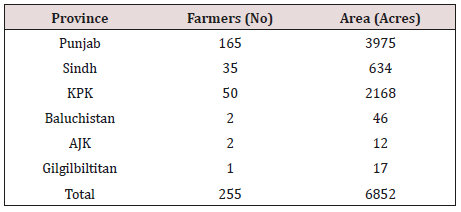
These rain gun sprinkler irrigation systems have been installed in various parts of Pakistan for demonstration and introduction of the technology. In rain fed areas, these systems are being used for supplemental and life-saving irrigations to fruits, vegetables and field crops. The research conducted by CEWRI-PARC resulted in local fabrication of Poly Ethylene (PE) based irrigation system components, sprinklers and high-pressure pumps. Based on research findings and success of pilot-scale installations, the Government of Pakistan launched a National Program entitled “Water Conservation and Productivity Enhancement through High Efficiency Irrigation Systems in Pakistan” during 2007-12. Drip and sprinkler irrigation systems were installed on an area of 6852 acres in all provinces (PARC 2010). The major area was in Punjab and followed by KP. There were 255 farmers benefitted from the project. There were 80 % sprinkler irrigation systems and 20 % were drip system during the period (Table 4).
Table 4: Drip and sprinkler irrigation systems in provinces, installed under the national project (from 2007-2012).
lupinepublishers-openaccess-journal-environmental-soil-sciences

Drip Irrigation Systems

Drip irrigation system applies water close to each plant and the application uniformity depends on the uniformity of discharge from the emitters [14]. It generally comprises of a pumping station, control head, main and sub main lines, lateral lines, emitters, valves and fittings. The drip irrigation system has special agronomical, agro technical and economic advantages that make it a suitable option of irrigation in the HKH and adjoining region. These advantages are as under:
a) Drip irrigation can conveniently and efficiently supply water directly to the individual crop rows or plants, thus can effectively utilize small continuous streams of water in the HKH region;
b) It reduces water requirement by saving up to 50% irrigation water to a young orchard as compared to sprinkle or surface irrigation methods thus can enhance community resilience to drought;
c) It requires less labor, as a well-regulated system can effectively utilize a continuous stream of water, a norm in HKH region, with less farmer supervision thus can increase production;
d) It discourages weeds growth and offers greater control over fertilizer placement and timing thus can save farmer resources;
e) Drip irrigation can be designed for any topography even if the area is rocky with steep slopes and plants are with irregular spacing, which increase its importance for HKH region.
Drip irrigation systems have shown yield gains of up to 100%, water savings of up to 40–80%, and associated fertilizer, pesticide, and labor savings over conventional irrigation systems [15]. The low rate of water application reduces deep percolation losses. The systems have lower energy requirements than sprinkler systems because of lower operating pressure requirement. The water application uniformity of locally developed drip irrigation system was above 85 % [16]. Evaluation of drip systems at CEWRIPARC showed lowest coefficient of variation of locally developed microtube emitters [17] with application uniformity above 85 per cent [16]. This shows that trickle irrigation systems have potential to use scarce water resource more efficiently if designed properly. The evaluations by Ahmad MM et al. [18] indicated that drip system with micro tube emitters can be operated at low pressure head (3.5 m) with an insignificant loss in uniformity as compared to operating at high pressure head (10 m), which can save energy cost, as given in Table 5. This low head drip system is being used for small scale vegetable production in Pakistan.
Table 5: Microtube emitter discharge and water application uniformity at various pressure heads and distances Ahmad et al. [9].
lupinepublishers-openaccess-journal-environmental-soil-sciences
These research outcomes are currently being disseminated through training and demonstration in provinces. The provincial governments are adopting drip/sprinkler systems evidenced through various programs, indicating government commitment for accelerating drip/sprinkler system adoption. By successful adoption of these technologies, more water can be saved or efficiently used along with an increase in yield. The saved water will automatically reduce over exploitation of groundwater and consequently mitigating the secondary salinity by improving overall water use efficiency of the irrigation system. This shows that the system has potential to use scarce water resource more efficiently if designed properly.

Conclusion and Recommendations

a) Lack of adoption of climate change resilient practices in the hill ecology of HKH region is negatively affecting their food security and also have negative implications for the irrigated agriculture downstream in adjoining countries;
b) The 51% area of Pakistan falls in HKH region, thus was considered as a representative case example for analyzing their agricultural production system, growing food security and climate change issues and promising climate resilient interventions mainly adopted in downstream leveled irrigated areas of HKH region;
c) Furrow bed, sprinkler and drip irrigation systems has been shown efficient irrigation methods with multiple advantages thus can be instrumental for improving community resilience to climate change by conserving the declining and uncertain available water resources in the hill ecology of HKH region;

d) However, adoption of these technologies is equally important for improving climate change resilience, food security and livelihood of the hill ecology of HKH region.

For more Lupine Publishers Open Access Journals Please visit our website:
For more Open Access Environment Journal articles Please Click Here:
To Know More About Open Access Publishers Please Click on Lupine Publishers


Follow on Twitter   :  https://twitter.com/lupine_online

Friday, 13 December 2019

Lupine Publishers | Utilitarian Value of Selected Mechanical Strength Tests for A Lightweight Floor Construction with A Heating Coil

Lupine Publishers- Trends in Civil Engineering and its Architecture


Abstract


This method of Lightweight floor construction does not require the use of heavy concrete screeds. It consists of a layer of hard thermal insulation on which the tile flooring is directly mounted, usingan adhesive mortar reinforced with a glass fiber mesh. This article summarizes the current results of the strength tests of this radiator model with XPS thermal insulation for bending, compression and point compression with a variety of constructional models. Application in all tests of various types and structures of insulating panels, with the use of glass fiber mesh and without it, allowed us to check and compare the most important strength parameters with different variants. At the same time, the principle of accepting materials that produce results guaranteeing the quality, durability and optimal price of the lightweight floor model with the use of a heating coil was followed.
Keywords: Compressive strength; Bending strength; Lightweight radiant heater; Cement adhesive

Introduction

In 2016 experimental studies on heat flux density and thermal inertia of light radiant heaters, described in [1] and [2], were completed. At the turn of 2016/2017, static shear strength, peel force, pull-off strength, shearing tests, absorbability and frost resistance tests were carried out on insulated EPS polystyrene insulation boards and extruded waffle type XPS with dissipating elements, using polyurethane adhesive [3]. This article describes compressive and bending strength in construction consisting of porcelain tiles, mounted to thermal insulation EPS or XPS through cement adhesive C2S1, both with and without the use of embedded glass fiber mesh. The latest tests on the strength of this radiator heater with XPS thermal insulation for bending, compression and point compression, with or without a glass fiber mesh, and with the use of PE/RT/Al/PE/RT PVC heating pipe with a diameter of 16x2mm, or without it, was made at the Białystok University of Technology.

Description of the measurement stand and research methodology

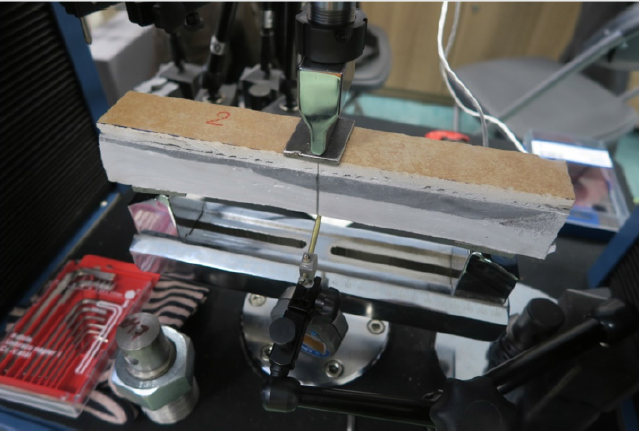
The tests were carried out in the laboratory at the Białystok University of Technology. The research included bending strength, compression and point compression of samples in different variants, using the XPS300 insulating board, a Synthos waffle. Bending strength was tested on the model of the size 45mm(width) x300mm(length) x 50mm(height) with tile, and dimensions 45mm(width)x300mm(length) x42mm(height) without tiles. For bending, we used steel support set with surface 40x45mm and axial spacing of 220mm, and steel pressing stamp of 35 x 47mm, all for 10 models. The first five models were tested with a glass fiber mesh 335 g/m2, embedded in the cement mortar as follow:
1. XPS300 with pipe / Sika Ceram 255 / tile,
2. XPS300 only / Sika Ceram 255 / tile,
3. XPS300 with a groove without pipe / Sika Ceram 255 / tile,
4. XPS300 with pipe / Sika Ceram 255 / no tile,
5. XPS300 only / Sika Ceram 255 / no tile,
The same systems as above were tested but without the use of a mesh.
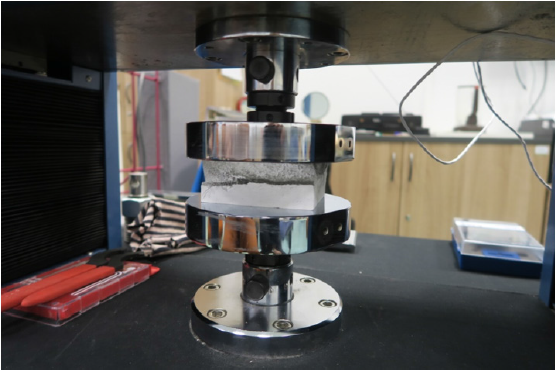
Compressive strength and point compression were tested on a model with dimension 80mm (width) x 100mm (length) x 50mm (height) with tile and 80mm (width) x 100mm (length) x 42mm (height) without tiles, using speed pressure of 4mm / minute. In the compression test, a pressing and supporting steel stamp with a circular surface larger than the surface of the samples was used, and in the point compression test 20x20mm steel stamp was used. The following sample models were tested:
1. XPS Synthos 300 / Sika Ceram 255 with a mesh of 335g/ m2/ tile
2. XPS Synthos 300 / Sika Ceram 255 without a mesh of 335g/m2 / tile
3. XPS Synthos 300 / Sika Ceram 255 with a mesh of 335g/ m2 /no tile
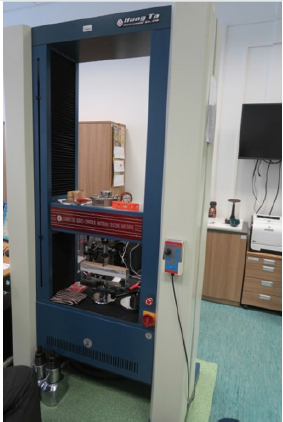
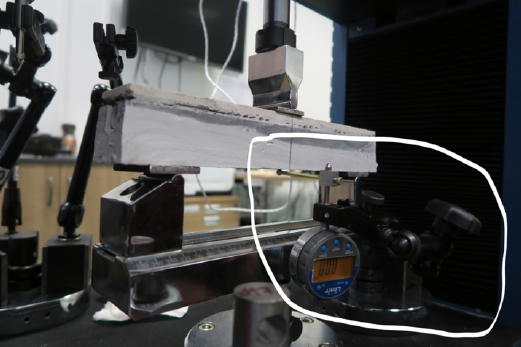
The test stand and tooling are shown in Figure 1-4.
Figure 1: Measuring stand of Hung Ta Instrument Co. Ltd to test the bending and compression strength.
Lupinepublishers-openaccess-journals-Civil-engineering-Architechture
Figure 2: Tooling to measure bending strength.
Lupinepublishers-openaccess-journals-Civil-engineering-Architechture
Figure 3: Digital indicator for measurement of bending Limit Company (marked in the border).
Lupinepublishers-openaccess-journals-Civil-engineering-Architechture
Figure 4: Tooling for measuring compressive strength.
Lupinepublishers-openaccess-journals-Civil-engineering-Architechture

Measurements

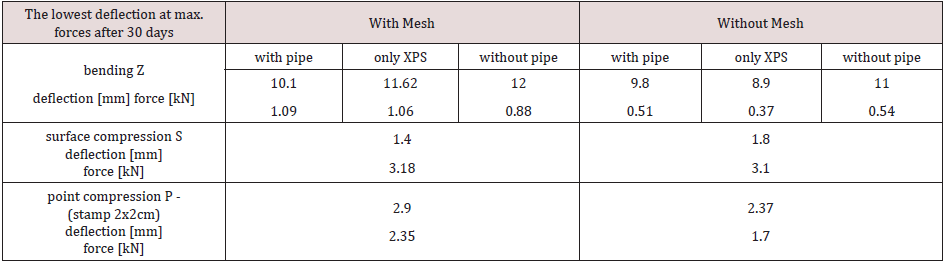
Maximum stresses causing destruction of samples and their smallest deflections when testing bending strength Z, compression S and point compression P of a radiant heating model, made of thermal insulation from waffles XPS, according to the construction described in item 2 of this article, is shown in Table 1. Value the Z, S and P strengths of the lightweight floor with the tiles are given under operating conditions (30 days from sample preparation).
Table 1: Results of bending, surface, and point compression tests of a lightweight floor made on XPS insulation.
Lupinepublishers-openaccess-journals-Civil-engineering-Architechture

Analysis of Results

This article closes the cycle of basic tests of mechanical strength over the so-called light-radiant heater in which no type of screed occurs. The aim of the experiments was to determine the possibility of installing this heater in accordance with Article 5.1 of the Construction Polish Law [4]. The model of this radiant heater consists of a thermal insulation layer with grooves in which heating pipes are placed. A coil is inserted into the grooves, and all floor surface is covered with a cement adhesive in a system without metal diffusion plates or polyurethane glue with these metal plates. Adhesives, and their reinforcement in the form of fiberglass mesh, were adopted, which according to the technical description of manufacturers can be used in such radiant heaters on difficult substrates.
Various lightweight heater designs were investigated, using a hard, easy to process thermal insulation with a minimum compressive stress of 200kPa (EPS) and 300kPa (XPS), with a bending strength of minimum 250kPa (EPS) and 300kPa (XPS), according to the Declaration of Properties Utility given by manufacturers and adequately guaranteed standards [5] and [6]. To reinforce the cement adhesive layer, a glass fiber mesh was used on which the most popular type of flooring - tile (stone) was laid. We can use it with underfloor heating or possibly a wall covering in wet rooms. This article summarizes new experiments that were carried out on samples of the entire heating model during bending, surface compression and point compression (puncture), in accordance with the construction described in point. 2., under operating conditions.
The maximum bending force resulting in the destruction of the model with the mesh was on average about 1.1kN, and without it about 0.48kN in different variants - with a mounted coil, without it or with an empty groove. At the same time, this gives a result at least two times better for the radiator construction with mesh reinforcement. The use of a mesh is not so important in compressive strength tests and puncture. The maximum compressive force was 3kN on average, regardless of whether the radiator was reinforced with mesh or not, while the puncture force in the structure with the mesh was on average 3kN, and without it 2.33kN.
Destruction of the samples during the bending strength test occurred at the lowest deflection (elongation) of 10.1mm (sample with mesh) and 8.9mm (sample without mesh) with the axial spacing of supports 220mm. According to the standard [7] for concrete structures calculation of deflections are not necessary if the deflection arrow of a beam, plate or bracket under load exceeds 1/250 of the span. In the previous Polish standard [8] for beams, slabs and flat roofs, the limit values of deflections could not exceed l/200 or 30mm with the construction spans 6-7,5m. In accordance with the above standards, the deflections of the main building structures referring to the tested samples in which the spacing of supports was 220mm can be maximum 220mm/250 = 0.9mm or 220mm/200 = 1.1mm. Deflections in the tests amounted to at least 10 times more, from 9mm to even 32mm. In the case of wooden structures described in the standard [9], the limit deflection arrow is the higest for beams based on 2 supports - l/150 or for the bracket - l/75, including the inverse deflection. It follows that the maximum deflections in relation to our samples can be 220mm/150 = 1.47mm or 220mm/75 = 2.93mm. It is still 3 times lower than the results achieved in the tested samples from 8.9mm upwards. This means that the construction of the light floor is very flexible and is able to bending more, without cracks than all acceptable standard deflections in both, concrete and wooden structures.
The maximum compressive force was not less than 2.6kN, and its average value in operating conditions after 30 days was 3.1kN. This gives us, per m2, a strength of not less than 325kN/m2. At very high compressive force, the samples of the lightweight radiant heater were not destroyed, they were subject only to progressive flattening (deflection). This means there is great resistance of such a radiant heater to any variable payloads found in construction works, including those subjected to dynamic loads. The tested values confirm the compression strength of XPS 300 insulation boards, declared by manufacturers, amounting ≥300kN/m2, in accordance with the standard [6]. This result is very high when we want to compare it to what is projected on the basis of the standard [10]. Utilitarian loads for the rooms, bedrooms of residential buildings and waiting rooms in hospitals, bedrooms in hotels, kitchens and toilets, are only 2kN/m2, or rooms with tables (in schools, cafes, restaurants, canteens, reading rooms, receptions, waiting rooms) 3kN/m2, and the maximum included in this standard with the area generally accessible to the crowd (in public buildings, concert halls, sports halls with stands, terraces, access points and railway platforms) amount to 7.5kN/m2. The maximum tested force under point compression with an area pressure of 4cm2 imitating the legs of a chair or table using a glass fiber mesh was not less than 2.9kN.

Conclusion

The bending strength of a radiant heater without screeds is made higher by using cement adhesives with a glass fiber mesh. As already pointed out in an earlier article [11], the cost of the fiber mesh does not have a significant impact on the price of the entire lightweight radiant heater.
The lightweight, not require screed floor is flexible enough to meet the standard requirements regarding the serviceability limit state at the deflections of concrete structures and wooden structures. It can be dedicated to all types of construction objects, both residential and sacral, sports, and other public utilities, and in industrial buildings with storage and production areas, depending on the loads determined to take into account the intended use and equipment installed. In the case when it can be expected that resonance effects will occur as a result of synchronous, rhythmic movement of people (eg dances, jumps), it is recommended that the calculation model be determined on the basis of a special dynamic analysis contained in [10].
Assuming placing on the floor a table with 4 legs, each with an area of 4cm2, the tested heater is able to transfer the maximum load of over 11kN. During work, when the floor is not yet laid, the maximum point load on the surface of 4cm2 should not exceed 1kN. Under normal conditions of use, there are no such heavy loads.
This article closes the cycle of basic strength tests of a light, thin radiant heater without screeds, and confirms the possibility of its use in all construction objects. I suggest adding to the current experiments new adhesion tests of type C2S2 cement adhesive, with 2 times greater deformability. This will allow a comparison with the results of the tested polyurethane adhesive strength, and give an answer to the question of whether it will be possible to use it outside of buildings, in snow and ice protection systems.

Acknowlegement

The author of the article would like to thank Mrs. Anna Zakowicz and Mr. Tadeusz Chyzy from the Bialystok University of Technology for providing laboratories.


https://lupinepublishers.com/civil-engineering-journal/pdf/TCEIA.MS.ID.000166.pdf

For more Lupine Publishers Open Access Journals Please visit our website:
For more Trends in Civil Engineering and its Architecture articles Please Click Here:
To Know More About Open Access Publishers Please Click on Lupine Publishers