Lupine Publishers | Current Investigations in Agriculture and Current Research
Abstract
With the increasing global population, urbanization, the current
unsustainable and expansive agricultural practices would be
expected to further elevate the risk of food and nutritional insecurity
of the global population, which is recognized as a global threat
for the 21st century. This paper reviews the demographic
changes, urbanization, sustainability of the conventional agricultural
systems, the environmental and resource implications and presents
possible sustainable alternatives. While this is still in its infancy,
we present a potential integrated, innovative model where the
universities, technologists, innovators, investors, municipal councils,
provincial and federal governments all can collectively engage, creating
iHORT ecosystem to develop an Innovative Horticulture
(iHORT) systems that could impact the global society in advancing
sustainable horticultural systems for the 21st century and
beyond
providing food and nutritional security irrespective of any location on
this planet, under any dire environmental conditions reducing
the carbon footprint. In addition to developing innovative technologies,
adopting a cluster business model and flexible, life-long
educational approaches would be beneficial for the success of the
industry.
Introduction
Global population continues to increase, and it is predicted
that it would reach 11 billion in 2100 [1]. Thus, there would be
an additional 2.5-3 billion people to feed. This means we need
an additional 140 million ha of arable lands to produce food [1].
Urbanization is also on the raise. It is estimated that nearly 2/3rd of
the global population live in urban cities, who are to be fed and food
generally travels from long distances sometimes as far as 8000-
9000 km in some northern latitude countries like, Canada. Globally,
nearly 26% of our current arable lands are already degraded or less
fertile. The conventional agriculture (CA) is expansive, contributing
to deforestation thus, contributing to species extinction, reducing
diversity [2]. CA also uses significant water resources. Nearly,
70% of the fresh water is used for agricultural production (both
animal and plant agriculture) while the Earth’s recharge capacity
reduced to 40% [1]. In addition, agriculture is known to contribute
significantly to the climate change due to use of fossil-fuel based
fertilizers, application of liquid manure, tillage practices and
methane emissions from animal agriculture [3]. It is estimated
that agriculture adds 12,000 megatons of carbon dioxide to the
atmosphere each year, which is nearly 24% of total GHG emissions
potentially contributing to climate change. Global drought events,
increase in global temperatures, sea level raise, increases in
heavy precipitation events, flooding are all on the raise, which are
attributed to climate change. These factors challenge field crop
production and raises significant concerns on food availability and
access. Use of pesticides to control insects, diseases and weeds
have increased globally contributing to environmental pollutions,
contaminating aquifers, rivers, seas and oceans. Some of the
agrochemicals used cause significant health risk to human beings
and are implicated in neurological disorders, various types of
cancers, renal failures, diabetics and skin and eye irritations and
so on.
Thus, the conventional agricultural practices are not sustainable,
and this alone cannot be a solution for feeding the world in the
future. We need to find innovative ways of producing more food
with less resources (space, water, nutrients), low carbon foot print
and free of agrochemicals. This review is an attempt to provide
an insight into various types of innovative indoor horticulture
systems (IIHS), the challenges and opportunities and an innovative
partnership model for enhancing the viability of the IIHS.
Sustainability of Conventional Agriculture
Sustainability is judged by managing resources in a responsible
way without causing irreversible damage to the environment or
harming nature and without depleting resources [3]. The extensive
agriculture to achieve green revolution with an unprecedented
yield increases from 1960s caused a significant pressure on the
planets natural resources including land, water and environment.
“Land and water resources are central to agriculture and rural
development and are intrinsically linked to global challenges of food
insecurity and poverty, climate change adaptation and mitigation,
as well as degradation and depletion of natural resources that affect
the livelihoods of millions of rural people across the world” (FAO,
2011: The State of The World’s Land and Water).
Over the last 50 years, the world’s cultivated area has increased
by 12%. The global irrigated area has doubled over the same
period, accounting for most of the net increase in cultivated land.
In total, global agriculture is estimated to use 11% of the world’s
land surface for crop production. Agriculture uses 70% of all
global freshwater withdrawals [4]. Models suggest that global
agricultural land will have to expand by another 140 million
hectares by 2050, a land area roughly the size of Brazil to feed the
global population increase by 2100 [1]. While the arable lands are
limited for expansion of agriculture, agricultural intensification
causes significant environmental damages that include habitat
fragmentation, disruption of ecosystems services and reduces
biodiversity. Furthermore, agriculture is a leading contributor
to global greenhouse gas (GHG) emissions, with agricultural
related activities contributing about one-third of the global net
CO2 emissions amounting to 12000 megatons per year primarily
through deforestation and burning [5].
Water availability will also be a critical factor in food production
soon. Farming using irrigation is an extremely productive method,
evident in that 40% world’s food production is from 20% irrigated
land (300 MA hectares). Under semiarid conditions, yield of nonirrigated
crops is substantially reduced (Pimentel, 2009). Model
predictions suggest water withdrawals must rise by 11% in the next
three decades to meet crop production demands. It is imperative
that water-use-efficiency In agricultural systems must increase.
Considering all the facts, finite use natural resources, agricultural
intensification is necessary to increase production to meet future
demands. However, under expansive farming systems, crop yields
are maintained through the heavy use of chemical fertilizers,
pesticides, and herbicides. Excessive use of these agro-chemicals
can lead to pollution of soils and ground-water, and agricultural
runoff threatens to damage environments, reducing biodiversity
and contributes to eutrophication of freshwater systems.
Intensification is also associated with increased GHG emissions
related to fuel consumption for equipment, food processing, and
chemical production, an example of the latter being that Haber
process for nitrate fixation consumes 5% of the world’s natural
gas production and 2% of the world’s annual energy supply [6].
It is time that we redefine and redesign our agricultural systems
to be resource efficient and sustainable. We need to think about
alternative innovative sustainable solutions to feed the world.
Climate Change
Climate change threats to agriculture cannot be ignored.
Several global climate change models predict increased incidence
of drought, high temperature, extreme low temperatures, frost,
flooding, increasing pest pressures leading to unexpected loss of
crop production. We have already started seeing this phenomenon
in several parts of the world. The impact can disproportionately
be significant in world’s poorest regions. Water scarce areas will
become much drier and hotter, there will be a decrease in rainfall
in semiarid to mid-latitudes and interior of large continents [6].
With climate change some northern latitude countries may benefit
by yield increases. Such an impact of climate change can have
significant food insecurity problems.
Sustainability of Urban Cities
Cities occupy nearly 2% of the world’s surface. Urban cities
are the home for nearly nearly 66% of the global population. It is
predicted that this trend will continue to increase [1]. Nearly, 6000
tonnes of food are imported daily to feed the urban population
in the megacities around the world [7]. Nearly 75% of the global
resources are consumed by the urban population and the urban
cities are the major contributors to GHG emissions and centers of
water and air pollution [6]. It is imperative to avoid catastrophic
effects, the cities must improve sustainability by reducing city’s
ecological footprints (water, energy, land and wastes) and become
centres of food production rather than food consumption while
enabling healthy environment and improve quality of life.
Types of Urban Horticulture Systems
The urban horticulture systems consist of production of crops
by non-profit organizations, community gardens, roof-top farming,
green walls, land sharing, greenhouses and backyard gardening.
While this is a dynamic concept, it still competes for resources such
as land, water, energy and labour. There is a potential synergistic
effect of urban horticulture systems and building-integrated
horticulture. This approach does not require additional space and
thus, it is called as indoor farming, zero farming or z-farming. This
has the potential with no additional space, utilize residential or
industrial waste water, utilize sunlight and sequester higher level
of carbon dioxide using the CO2 generated within the building
or in the cities. This can be a small space resources recycling
or saving system, which could reduce ecological footprint of a
city, contributing to sustainability [8]. More recently, vertical
farming (VF) has become increasingly popular, generating greater
interest and excitement, which can contribute to food security
of the cities and perhaps in location where food access is limited such
as northern territories where agriculture and food access is
constrained by extreme environments.
Vertical farming (VF) is fairly a new concept born out a school
project in the USA producing leafy greens for the school kitchen
by the students. VF can use any indoor space (thus called indoor
horticulture) such as abandoned buildings, tunnels, parking
garages or integrated into the building architecture. This can
also be integrated into existing greenhouses. The concept of VF is
utilization of vertical space effectively and thus, it provides space
for multi-layer production (also called multi-layer farming). This
system uses hydroponic, aeroponics, aquaponics or nutrient-film
technologies to supply water and nutrients. Nutrients are precisely
monitored for their pH, EC, BOD and macro- and micro- nutrients
using sensor continuously and adjusted as needed and recycled thus
contributing to nearly 95-98% of water and nutrient use efficiency
without polluting the underground water sources. The evaporated
water is also collected and reutilized further contributing to
water use efficiency. In VF, there is no need for Sunlight. The light
requirements are met by various spectrums of red, blue and far-red
LED lights to 18-24-hour photoperiod. The use of LED lights reduces
energy costs compared to HS (high pressure sodium) lamps used in
greenhouses. Heating or cooling may be needed depending on the
location, which can be achieved by recirculating hot/cold water in
the buildings or from the geothermal sources.
The VF systems contributes to 95-98% water and nutrient
use efficiency, with no runoff, with yields as high as 100 times
depending on the crop, and crops can be harvested throughout
year. In addition, there are no pesticides or fungicide applied thus,
ensuring food quality and safety. There is growing evidence that VF
can be the most sustainable way to produce crops. This approach
is used in sky farming or space farming or plant factories under
any adverse environmental conditions. The growth, maturity
and quality can be precisely monitored and manipulated to
produce nutritious and phytonutrients rich- food. The automated
control systems are used to regulate light intensity, spectral
quality, duration, humidity, temperature, carbon dioxide levels,
nutrient concentrations. Robotics are used to monitor quality
of the produce and for harvesting. Crop produced in VF have no
pesticide residues and no agrochemicals (pesticides or fungicides
or herbicides) and safe and ready- to- eat. While there need to be
a lot of research done to fine tune the iHORT systems in the areas
of crop and varietal suitability, the light spectral specificity for
each crop and variety, the nutrient requirement, manipulation of
growing environment, assessment of quality and phytonutrient
concentration, evaluation of energy costs and operational costs in
comparison to other production systems, sensor technologies to
monitor the quality, automation and robotics, the iHORT systems
present a significant hope for a sustainable future. While this may
not be a suitable system for all crops and the intension is not to
replace the conventional production of field crops, the iHORT
systems need to be considered for high value horticulture crops
to provide nutritious fruits, vegetables, and herbs throughout the
year in a sustainable way. It is our hope that the future city planers
and architects integrate iHORT systems into their design to provide
sustainable, healthy living solutions as they currently do with
providing a spa or a health and fitness club or a swimming pool or
a tennis court. iHORT system also have a very short supply chain.
Fresh products are directly sold or used, or it directly goes to local
market, reducing the carbon foot print significantly as against the
conventional production system where the produce is transported
to collection centres, then to distribution centres, then to whole
sale, then to the market and to the consumers.
Applications and Adaptation of iHORT systems in
Vertical Farming
Sky greens, Singapore
Sky Greens is the world’s first low carbon, hydraulic driven
vertical farm. It uses green urban solutions to achieve production of
safe fresh and delicious vegetables, using minimal land, water and
energy resources. They produce sky Nai Bai, Sky Cai Xin, Sky Bai
Cai, Sky Chinese cabbage, Sky lettuce, Sky Bayam, Sky Kai Lan, Sky
Kang Kong and Sky Spinach. They use a patented vertical farming
system consisting of rotating tiers of growing troughs mounted on a
“A” type frame. The frame is 9 m tall with 38 tiers of growing troughs
which can accommodate various media, soil or hydroponics. This
system provides high yield (10 times), high quality, high flexibility,
low energy use, low water use and low maintenance.
Plant lab, Netherlands
Plant lab is a privately-owned Dutch company that specializes
in controlled environment agriculture with a global reach. Plant
lab employs plant production units based on a revolutionary
technology and propriety algorithms to optimize production of
various crops including potted plants, flowers, specialty foods,
vegetables and fruits. They use proprietary mathematical models,
state-of the art LED systems, air control advances and a maximum
water control system. It also integrates R and D facility to further
advance the production system.
London Growing Underground, Grow up Urban Farm, UK
At Growing underground, fresh leafy vegetables and salad
greens are produced 33 meters below the busy streets of London
using hydroponic systems, LED technology and crops are grown
year-round in the perfect, pesticide free environment. The
production system is unaffected by the weather conditions. Their
hydroponic system uses 70% less water than traditional open field
systems and the nutrients are kept in a close loop.
TruLeaf, Truro, Nova Scotia, Canada
Founded in 2011, Truleaf’s systems offer the opportunity to
grow a sustainable year-round supply of leafy plants to replace and enhance current sources. The multi-level farm can be built
anywhere, offering key advantage of growing plants closer to
markets, maximizing freshness and reducing transportation costs
and spoilage. Their goal is to enhance the local food supply with
year-round reliance on imported produce. Truleaf specialises in
high-value crops. Their system includes a customized multi-tier
production system and specializes in LED spectrum selection, plant
production formulation, automation, and data collection. They
produce fresh, quality greens using clean and sustainable practices
and supplying to the local stores. Their commercial operation
expanded as Good Leaf.
Cluster Model for iHORT Business Development
The success of iHORT systems development heavy relies on the
acceptance of the business model in the horticulture cluster. As like
in any other successful Fortune 500 companies, iHORT requires a
successful business model. The success, the speed of adaptation and
growth of this business model is all about creating an “innovative
ecosystem”, which provides solutions for the relating to
i) Responsiveness and resilience;
ii) New innovation and business models;
iii) Cross-overs between and among sectors and scientific
domains;
iv) Inclusive society;
v) Sustainability and societal embodiment and
vi) Globally and locally balanced.
1. To achieve this, we need to switch our minds
a. From linear towards an integrated innovative ecosystem;
b. From projects towards integrated programmes;
c. From science-driven towards business-driven research
and innovation; and
d. From separate stakeholder agendas towards joint agendas
of the members in an “ecosystem”.
2. We need a system innovation or transition for the future
business models. In creating an innovative business models, the
ecosystem may comprise of
i) Entrepreneurs/industries;
ii) Government and policy makers;
iii) Research institutions;
iv) Educational institutions and
v) Investors [9].
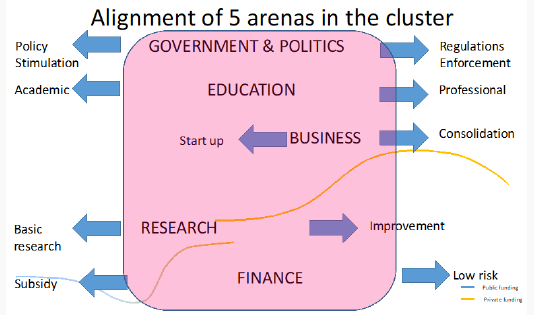
These different network partners are organised in arena’s,
with a specific set of drivers and culture. The business is profit
driven, the government is power driven, the researchers seeking
for recognition etc. The challenge in the innovative ecosystem
is to combine and align the different drivers and values. VF is
relatively new and very attractive for all stakeholder groups or
arenas. Mobilising and feeding the ecosystem to grow is one of the
challenges. New intermediary adaptive support structures emerge
to activate membership and cross-overs between these arenas
[9]. The innovative business model the Greenport West-Holland
in the Netherlands developed is business driven (Figure 1). The
stakeholders in the cluster signed a public private partnership:
Innovation Pact. The business partners defined an ambition to
develop a leading cluster for iHort industry in the world. Several
essential strategic development topics are identified and accepted
by the stakeholders in the ecosystem. Next step is to organise
the ecosystem to align all the activities and to get focus of the
investments of all the stake holder’s groups in the different arenas.
For example: research and educational institutes align the research
and educational programs according to the innovation topics of the
business. The intermediary organisation, Greenport West-Holland,
facilitates and challenges all actors in the network and stimulated
cross-overs between the different arenas.
Figure 1: Proposed innovative business model for the
success of the iHORT industries [9].
Training and Capacity building in iHORT
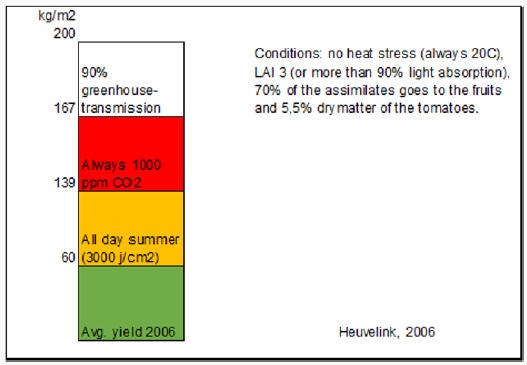
A decade ago, the average yield of a cluster tomato produced
in a greenhouse was 60 kg/m2. In theory, the calculated production
could be 200 kg/m2 [10] In 2008, in a trial set at the Improvement
Centre in Bleiswijk, 100 kg/m2 of tomatoes were produced. However,
in the current system of cultivation of tomatoes using artificial light,
the targets for crop managers are around 95 kg/m2. The next step
is indoor horticulture. Using this innovative cultivation system, it is
possible to create the environment to reach yields as high as 200
kg/m2. To reach higher yields or a more sustainable production
knowledge is needed. So, training people working in the industry,
building their knowledge and capacity using innovative techniques
and technologies are essential for the industry’s success and sustainability (Figure 2). For indoor growing, there are various
best practice cases in leafy crops, such as lettuce and herbs.
However, large scale food production in the main food sources, the
experience is limited. Even in the Certhon Innovation Centre (www.
certhon.com), a large- scale testing facility for indoor farming, they
are constant learning how to cultivate under indoor circumstances.
Traditional cultivation methods/ theories are not relevant in this
environment (Table 1). The results are impressive, but Certhon
realizes that this is just a beginning. There is still a lot to learn, so
the results will become even higher.
Figure 2: The changes in tomato yield in relation to various
technological advancements. (Source: [10]).
Dare to learn! The slogan of in Holland university of applied
sciences. When this slogan is related to the complex emerging
cultivation systems as indoor farming, what is it that should be
learned? The answer is: SKILLS. How to approach a complex
problem? How to deal with new techniques? Are we able to connect
what we know to different circumstances? To accomplish an
effective implementation of innovations it’s vital that the industry,
government, research facilities and knowledge institutions work
together. In the Netherlands, the development of a new curriculum
starts by exploring what the needs or demands from the industry
are. After consulting the industry, a curriculum mapping is
performed. In the curriculum, an important aspect is the structural
relationship with the industry. Students will work on assignments
or research not only just for curiosity but also for commissioners
from the industry. Therefore, the students work and learn always
on a relevant issue or topic. The commitment from the government
is shown in the infrastructure in the industry for knowledge
development and sharing. Together, the university, the industry
and the government will become a part of an “academic ecosystem”,
creating the opportunities to educate and train necessary skills,
advance knowledge and develop appropriate attitude in people
needed for the horticultural industry.
The development of “Flexible Learning” programs is a perfect
example how the cooperation between companies (industry),
government and the university that is flourishing. ‘New’ learning
pathways are connecting work- and learning environments
together. Furthermore, it becomes clear that in the 21st century
we need to adept to a “Life Long Learning”. For example, “Job
learning” is a learning method where the job environment is also
the learning environment. By creating learning challenges on the
work floor and using these challenges to build up evidence in a
portfolio on capacity in skills, knowledge and professional attitude.
A student determines their own learning path and speed, so the
path is personal and customized for each student. All students
can graduate with a bachelor’s degree, but the ways to get to this
diploma is non-traditional and it is very innovative.
Future Challenges and Conclusion
The challenges relating to population increase, declining
resources, climate change, environmental pollution and the
sustainability of the conventional agriculture in feeding the global
population by 2100 are real. With the integration of current
knowledge in plant science and horticulture, current sensor,
software, hardware, automation and robotic technologies, we could
create a sustainable iHORT production systems to meet the future
challenges. The model we described would build partnerships
among universities, technologists, innovators, entrepreneurs,
investors, policy makers, governments and consumers to create
an innovative, inclusive and transparent approach for research,
innovation, education and training, creating a climate for
investment and engagement of governments at various levels in
revolutionizing iHORT technologies for a sustainable future. While
there are several questions to be answered regarding cost: benefits,
return on investment, energy utilization, carbon footprints, the
foremost important solution that the iHORT systems can provide
a “safe, pesticides free” food year-round under any environment
itself is worth considering as an innovative solution for feeding the
world with nutritious, fresh, safe food in the 21st century.
Read More Lupine Publishers Agriculture Journal Article:






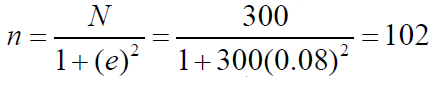 determined sample size for the study.