Showing posts with label Civil Open Access journal. Show all posts

Wednesday, 12 October 2022

Lupine Publishers| Physico-Mechanical Properties of Plaster Mortar Reinforced with Date Palm Fibers

 Lupine Publishers| Journal of Civil Engineering and its Architecture


Abstract

The aim of this study is the use of local materials (plaster, sand dunes and date palm fiber) for the region of southern Algeria. By expand areas of the use of these materials in the field of construction. Despite the large ament of gypsum, its use is limited to some secondary operations like coatings and decorative elements. The sand dunes and palm fiber, its use in the construction are very limited. In this study, the sand dunes and palm fiber was added to plaster, to find the mortar that has physical and mechanical properties that allow its use in construction. The results obtained showed that the addition of date palm fibers improves the physical properties (density, water absorption, etc.) and mechanical properties (compression strength, flexural strength, etc.).

Introduction

The Algeria, especially the South, is rich in natural materials, which can then be used directly in the construction field he must study their properties in order to extend their use. Among these materials, which can be exploited, and that we will consider, plaster, sand dune, and the fibers of the Palm. The use of vegetable fibers in the reinforcement of building materials to improve certain properties, it is the most used technology currently, because these results and to expand the use of eco-materials. Algeria has unlimited sources of vegetable fibers (of Palm, Alfa Abaca, hemp, Cotton,), but their use in the construction of the almost non-existent field. The incorporation of the fibers of date palm in the mortar of plaster, is carried out in order to improve the tensile strength and decrease its fragility. The major assumption that the fibers allow the judgment of the cracking mechanism, delaying the start of the crack and the controlling once it appears. In our study, we will examine the effect of the addition of fibers of palm trees date palm to the physical and mechanical properties of the Mortar plaster. Where we are looking at the impact of the rate and length of the fibers of date palm on the characteristics of mortar plaster, in the short and in the long term.

Materials used

The Materials used are those available at the local level:

Sand Dunes used: In our study we used the sand dunes of Guerrera (GHARDAIA). The physical properties of sand dunes used are represented in Table 1.

Mixing water: The used mixing water is the public drinking water of the network of the city of Ghardaia.

Lime: Air lime as a retardant of setting time of the plaster was used, because it decreases the solubility of the latter and allows to increase the time of employment. In addition it does not affect these mechanical properties. A chemical analysis of the lime used was performed using the method of diffractometer by X-rays in the lab. Physics at the University of Laghouat, the results of this technique are presented on the diffractogram me below [1] (Figure 1).

Figure 1: Diffractogramme of the powder lime by X-ray.

Lupinepublishers-openaccess-journals-Civil-engineering-Architechture

Fibers: The fibers used are vegetable fibers of DOKAR of date palm in the region of Ouargla. The Spectrochemical Analysis of the powder of the fibers after calcination at 400°C gave the following elements [2]. The fibers used with the following characteristics [3] (Tables 2 & 3)

Table 1: The physical properties of sand dunes

Lupinepublishers-openaccess-journals-Civil-engineering-Architechture

Table 2: Chemical analysis of the powder of fibers calcined at 400°C

Lupinepublishers-openaccess-journals-Civil-engineering-Architechture

Table 3: Physical and mechanical properties of the fibers used.

Lupinepublishers-openaccess-journals-Civil-engineering-Architechture

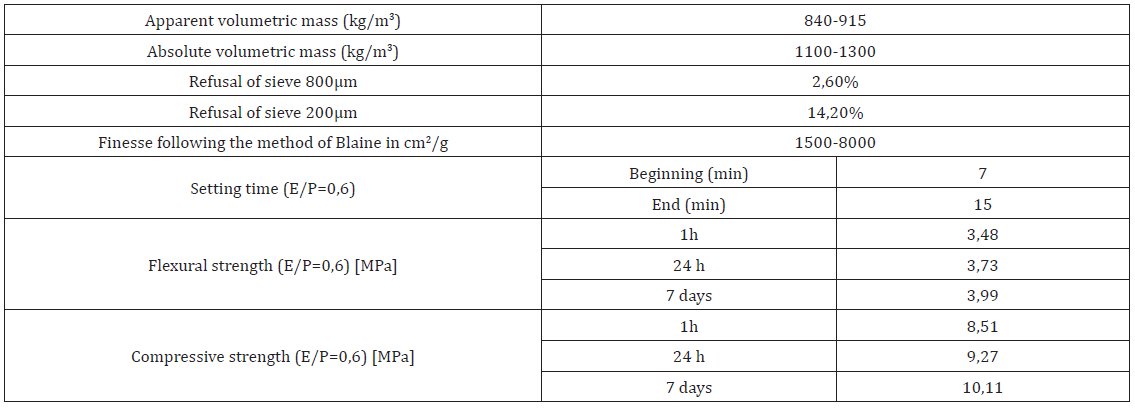
Plaster: The used plaster is a local product taken from the career of oasis in Ghardaia. It is available in the market. The chemical analysis is summarized in the Table 4. We can summarize certain essential properties in the Table 5, to identify the plaster (Table 5).

Table 4: Chemical analysis of plaster.

Lupinepublishers-openaccess-journals-Civil-engineering-Architechture

Table 5: Essential Properties of plaster.
Lupinepublishers-openaccess-journals-Civil-engineering-Architechture

Formulation of Plaster Mortar with Fiber: The determination of the composition of mortar plaster reinforced with fibers of date palm, we used the same composition with the classic mortar, so we take the following composition:

I. We take the report E/(P+S) = 0.6.

II. The report of S/P is set to the value 0.5.

III. They add 6 % limes air as retarding of setting time.

IV. After the preparation of fibers of date palm, we respect the recommandations of Kriker [2], for this, the fibers used are treated in the water, then dried in the free area.

V. The mixing is carried out in the following way.

VI. We are mixing first of all the Sand and fibers to sec.

VII. The plaster is added, while blending it well with the sand and fibers.

VIII. It adds the mixing water and lime and malaxant well the mixture.

Confections of Samples and Storage Conditions: After the mixing, it fulfils the mussels to reason of two layers and vibrate the mortar using a rod to ensure a good distribution and a proper orientation of the fibers, and finally grind and smooth the surface of the mortar. The test pieces are assembled, they are placed in the open air in the laboratory. After 24 hours, these are removed and placed in free air at a temperature of (25°C±1°C) up to the time of the test, this procedure is made for all the compositions and for all tests.

the samples used are (4x4x16)cm3 for the following tests.

i. Determining the density.

ii. Absorption of water.

iii. Tensile strength.

iv. Compression strength.

Composition of mortar of plaster reinforced by fibers of date palm: To get a good composition of mortar plaster reinforced with fibers of date palms, we follow the following steps:

First of all, we use the same composition of pate of mortar base of plaster, which we have obtained in the step above.

a. As regards the fibers we tried to determine.

b. First of all the mass fraction optimal fiber to introduce in the mortar of plaster using the fibers of the date palm to a constant length L=10mm and by increasing the dosage of fiber from 0% to 2% with a step of 0,5% by mass.

c. And then, the optimal length for the optimal fraction that we found previous for each length, 10mm, 20mm, 30mm, et 40mm.

Laying all tests, that we were conducting, keep well the workability of dough into court of sitting time. Because the addition of plant fibers to a mineral matrix leads to a decrease in workability.

All the samples are retained in the ambient air of the laboratory until the age of 14 days.

Results and Discussions

Variation of Physical And Mechanical Properties of The Mortar Plaster Reinforced by Fibers of Length of 10mm with Different Percentages

The results of the variation of physical and mechanical properties of the Mortar plaster reinforced by various dosage of fiber are:

A. The density : From Figure 2, we notice that density decreases slightly with increasing the dosage of fiber, which can be explained by the increase in the volume of void created by the incorporation of fibers where obtaining a less dense plaster mortar. This result is in agreement with the research of DJOUDI [1].

Figure 2: Variation of density of mortar of plaster in function of the percentage by mass of fibers.

Lupinepublishers-openaccess-journals-Civil-engineering-Architechture

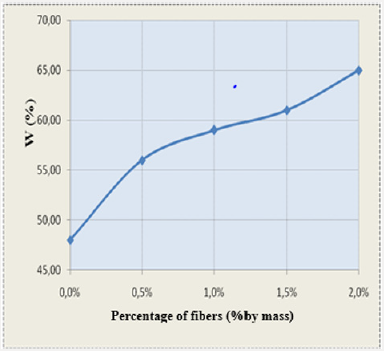
B. The absorption of water: Figure 3 illustrates the evolution of absorption of water for a mortar of plaster reinforced with fibers of a date palm, it is clearly visible that the absorption of water increases according to the increase in the percentage of the fiber plant, this is due to the volume of the high vacuum created by the addition of the fibers and by the nature of the fibers themselves. These results correspond to the results obtained by DJOUDI [1] in his research on concrete plaster reinforced with fiber of date palm, it has been found that incorporation of fibers increases the water absorption of concrete plaster

Figure 3: Variation of water absorption of mortar of plaster in function of the percentage by mass of fibers.
Lupinepublishers-openaccess-journals-Civil-engineering-Architechture

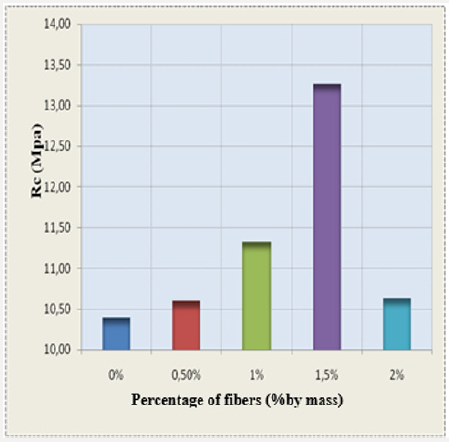
C. Compression strength: According to Figure 4, it can be seen that between 0% and 1% a slight increase in the compressive strength, then 1,5% an acute increase in the compressive strength and after this percentage a Fall in compressive strength. the increase in the compressive strength of mortar, plaster reinforced by fiber of the palm, from the non fibré mortar can be explained that the fibers in the percentage of fat play a role in normal concrete aggregate, and the fall that occurred after this increase, we can judge that the addition of fiber disruption the mortar with mineral skeleton void inside the dough and increasing its porosity, with minimal resistance. These findings are in agreement with most of the research conducted, as Kriker [2], in its research on the concrete reinforced by fibers of palm.

Figure 4: variation of compressive strength of mortar cast according to the mass percentage of fibers.
Lupinepublishers-openaccess-journals-Civil-engineering-Architechture

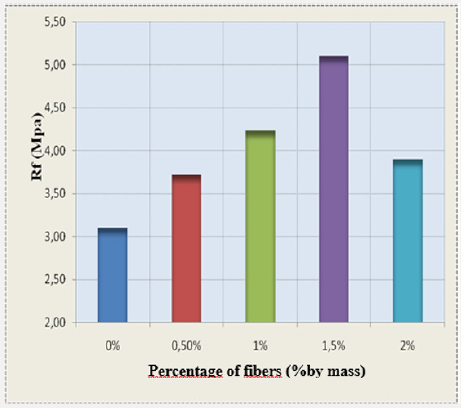
Figure 5: Variation of the flexural strength of plaster mortar as a function of the percentage by mass of fibers.
Lupinepublishers-openaccess-journals-Civil-engineering-Architechture

D. The flexural strength: Figure 5 shows the influence of the length of the fibers on the flexural strength of fiber mortar. First of all, we note clearly that the flexural strength considerable increases with all the lengths of the fibers. A net improvement for the fibers of lengths of 10mm and the resistance reaches the maximum for the lengths of 20mm. After, a decrease in the resistance for lengths 30mm and 40mm, which can be always translates by the loss of manoeuvrability that due to a exercised of fiber and a poor distribution of fibers in the pate increasing porosity and consequently a decrease in the flexural strength. By simulation, we find that the mortar of the plaster has the same properties of the cement mortar. That appears in the research on the cement mortar reinforced by strip of wood. It was found that, for a mortar to 2% had a flexural strength that 3/10 mortar witness that is to say three times more.

E. Recapitulation: The fibers of length 20mm give the best results of resistance to compression and flexion. As these fibers give acceptable results in the density and absorption of water. As for the handling, the mortars reinforced by the fibers of length of 20mm have a good workability and facilitates the implementation.

Read More About Lupine Publishers Journal of Civil Engineering and its Architecture Please Click on Below Link: https://lupinepublishers-civilengineering.blogspot.com/


Tuesday, 30 August 2022

Lupine Publishers| Plastic in Brick Application

 Lupine Publishers| Journal of Civil Engineering and its Architecture


Abstract

This paper outlines the utilization of municipal plastic waste (MPW) in construction industries. Both the MPW and the construction industries are increasing rapidly and world’s recycling rate of either Municipal Solid Waste (MSW) or MPW specifically is still low. Production of bricks is non-eco-friendly and a waste generating process because of the greenhouse gases released. Utilizing MPW as construction materials especially in production of bricks is one of a promising step towards a sustainable resources and waste management. Plastic waste can substitute either partially or completely one or more of the materials in brick production. Further research based on recent research and a better understanding in utilization of plastic waste in brick is needed to produce a high durability and quality of bricks as well as to achieve the optimum balance in all aspects especially in terms of cost and functionality.

Introduction

Urbanization caused a vast and rapid growth of construction industries which requires a lot of building materials that utilizes natural resources either in their production plant or as the materials itself. More recently the world concern about the demands for construction materials and the rate production of plastic that increases swiftly every year [1]. In turn, both industries contribute in increasing the MSW. Since the rate of production is projected to double the value in every 10 years, a more sustainable and safer way is needed to be taken into action [2]. Banning or minimizing plastic usage is not practicable to solve the problem as it is nearly impossible for different sectors to run efficiently without plastic. Mining of natural resources on the other hand is an energy waste process as only 900 million tons of raw materials is produced from 6000 million tons of waste generated [3,4]. They may be differ in constitution of raw materials but posses the same in contributing to various environmental threats. Hence, utilizing plastic waste in brick production can solve both the MPW and demands for construction materials. Previous studies showed the possibility of using plastic waste in bricks application but the bricks produced are still lacking of durability as a safe construction materials. The aim of this paper is to review the application of plastic waste in bricks.

Review of Research on Application of Plastic Waste in Bricks

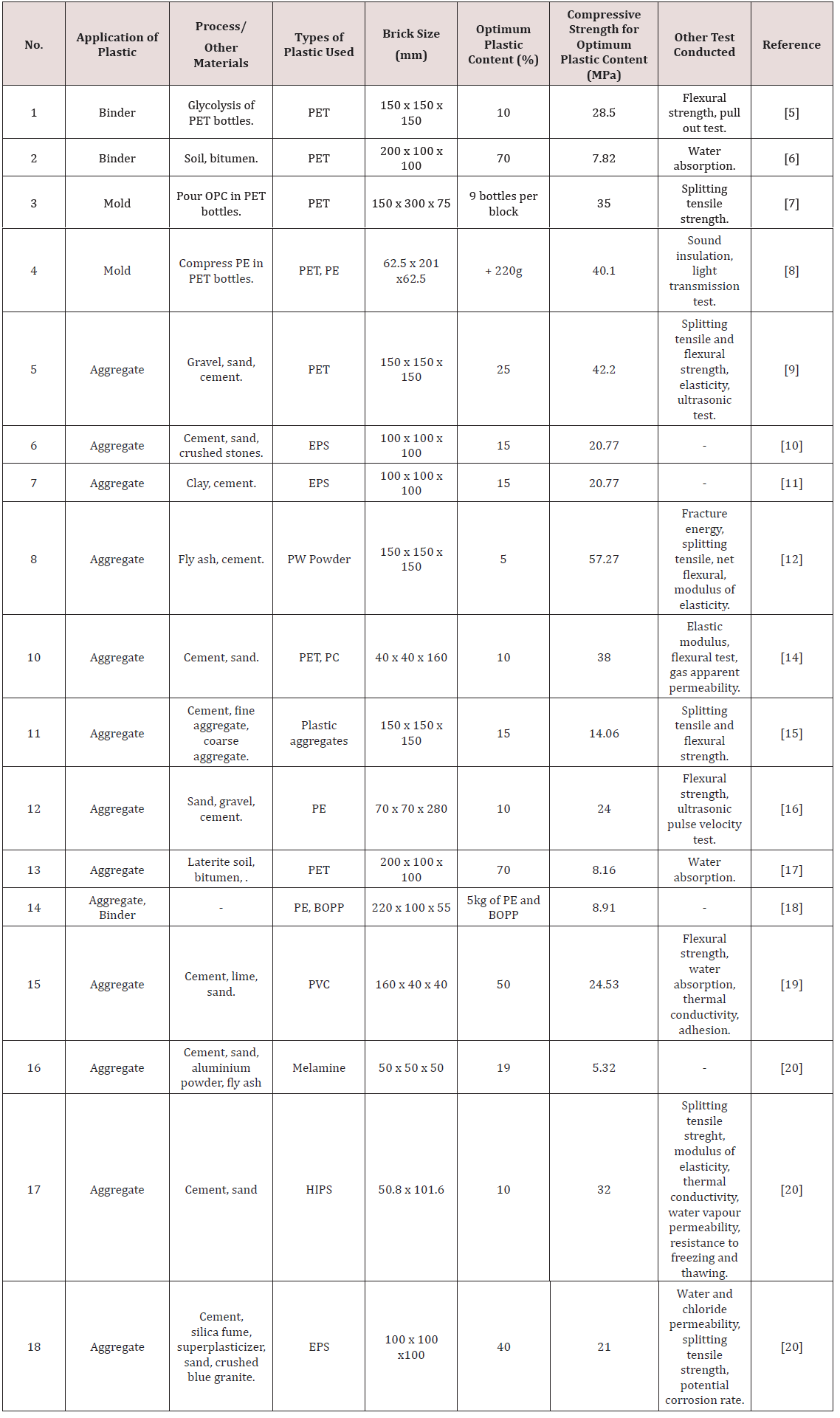
The table layout the use of plastic in manufacturing bricks. Plastic waste has been utilized in various extend producing various properties of bricks and the properties of bricks produced has been assessed following standards provided Table 1.

Table 1: Application of plastic in brick

Lupinepublishers-openaccess-journals-Civil-engineering-Architechture

Discussion

Previous studies showed the possibility of using plastic as binder with the aid of catalyst through depolymerization of PET to replace cement. Extensive studies of PET as aggregate is more common in compared to other plastic waste. From the table, it showed a significant decrease in compressive strength is observed for more than 50% replacement of binder with PET waste. In fact that PET is thermoplastic, poor bond is created between the matrix and the aggregates and over stress may result in debonding of bricks and structural failure [21]. Increasing the amount of PET increases the softening point of the bricks produced. However, if the amount of plastic waste which acts as binder is too low, the residual unfilled voids will increase and in turn, increasing the water absorption as well as decreasing its compressive strength. When plastic waste is used as a mold, it can be clearly seen that it can withstand a high compressive strength in compared to using it as binder. However, lacking of compaction of plastic waste in plastic waste bottle may result in entrapped air that will contribute to a low compressive strength to the structure. A slight amount of entrapped air is enough to disrupt the structure of the bricks. Incorporating plastic waste as an aggregate is more common in compared to other methods. A few other materials are added to increase the durability of the bricks produced. Using an optimum amount of plastic waste as an aggregate generally shows an acceptable compressive strength. Expanded PS has a flexural properties that is important for buildings built on a problematic soils as the incorporation of expanded PS reduces the cracks appearance on building structure. Normal bricks do not posses this properties. In addition, bricks that are incorporated with expanded PS as aggregate are lighter and it can retain its strength due to its less permeable properties that helps to inhibit hydration. When PVC is used as aggregates, a low compressive strength can be observed and cracks were rapidly observed around the PVC particles because of the modulus mismatch as PVC posses a lower elastic modulus in compared to the cement. The durability of plastic bricks depend on the amount of plastic incorporated in the mixture. An extensive reviews for the study of waste in construction has been highlighted [21,22]. With the right formulation, plastic waste can be a great substitution for raw materials extracted from natural origin.

Conclusion

A few conclusions can be drawn based on the review of studies on application of plastic in bricks;

a) A variety of plastic waste has been used in many ways in bricks production. The compressive strength of the bricks produced comply the standard outlined, which is more than the acceptable range outlined.

b) A suitable proportion between plastic waste and other materials used need to be optimized to meet the standard outlined for manufacturing of bricks. Further research and development is needed to improve the quality and durability of plastic bricks.

Read More About Lupine Publishers Journal of Civil Engineering and its Architecture Please Click on below Link: https://lupinepublishers-civilengineering.blogspot.com/

Tuesday, 22 February 2022

Lupine Publishers| The Role of Engineering Design in the Infection Control for Hospitals

 Lupine Publishers| Journal of Civil Engineering and its Architecture


Abstract

Hospital buildings are designed with intrinsic features for infection control, and are related to an intensive energy use. The infection control program is structured in a hierarchy of administrative, engineering and PPE controls. Building design plays a major role, because it must not only incorporate the systems that are responsible for infection's engineering controls, but also the features demanded by the administrative controls. Basic understanding of the infection control hierarchy and strategies and stringent communication with the HICC in the design phase is necessary, not only to provide a healthy and safe environment, but to achieve rational solutions that minimize the complexity, operational and maintenance costs. This review paper contributes with basic information about these topics, and presents references for detailed and advanced information.

Keywords: Infection control; Hospital; Healthcare; Engineering design; Ventilation

Abbrevations: ACH: Air Changes Per Hour; ASHRAE: American Society of Heating, Refrigerating and Air-Conditioning Engineers; CDC: Centers for Disease Control; DHHS: U.S. Department of Health and Human Services; HEPA: High Efficiency Particulate Air; HICC: Hospital's Infection Control Committee; HVAC: Heating, Ventilation and Air-Conditioning; MERV: Minimum Efficiency Reporting Value; PPE: Personal Protective Equipment; UVGI: Ultraviolet Germicidal Irradiation; WHO: World Health Organization

Introduction

Hospital buildings are designed with intrinsic features for infection control, which contribute to produce an intensive energy use and significant greenhouse gas emissions [1]. The scope of this review paper is to provide basic information on these intrinsic features, and relevant reference for advanced information.

The Infection control program

In order for an infection to occur, it is necessary the presence of the infectious agent and its source, the mode of transmission, and a susceptible host, in what is called the "infection chain" [2]. The bacterial agents are one of the most common pathogens related to hospital-acquired-infections (nosocomial infections) in the United States [3], but fungal and viral agents are also reported [3]. One of the main sources of these agents, in the hospital application, are the diseased patients. In this case, those pathogens use body fluid secretions, blood, feces and droplets expelled by the respiratory track, among others, as a portal of exit. The expelled droplets are produced in a broad range of sizes during the respiration, talking, coughing and sneezing processes [4]. The larger droplets (order ≥100 μm) settle down within a small distance from the source (1 to 2m), due to the gravitational action. The smaller ones (order < 100μm) may reach sizes that allow them to be suspended for a long time. References [5] and [6] provide detailed information about droplets dynamics in indoor environmental air.

The modes of transmission include direct contact during patient manipulation, indirect contact with contaminated surfaces (fomites) and airborne propagation (also a mode of indirect contact) [2]. Infection by the larger droplets is generally treated as direct contact [2]. Airborne propagation is related to droplet nuclei (size order ≤10μm) [7,8]. Reference [9] provides detailed information about airborne disease transmission.

The infection control program uses administrative, engineering and personal protective control measures [10], in the components of the "infection chain", in order to reduce the infection risk. Administrative controls are based on the stringent application of protocols. These require, among others, that universal precautions (hand hygiene, gloves when touching blood and secretions, etc.), must be used on all patient's manipulation, for instance. Surface disinfection and patient care products sterilization is another administrative control, among others. References [11] and [12] provide detailed information about the infection control program.

Engineering design and infection control

Building design must not only incorporate the systems that are responsible for infection's engineering controls, but also the features demanded by the administrative controls. The design team must keep in mind that engineering controls will not overcome the lacks in administrative controls, but these can promote protocols that can simplify the engineering design. Communication is a key factor for improving the engineering design.

Space design: Layout design must be planned in stringent relationship with the hospital’s infection control committee (HICC), geared to provide adequate patient, staff, materials and waste flows, in order to prevent cross contamination. Basic knowledge on droplet dynamics may be used to understand the infection control criteria that are used to size the gap between patient beds, geared to reduce the risk of cross infection by droplet direct contact. For the case of airborne transmission, the infection control program generally demands that patients with airborne communicable diseases (e.g. tuberculosis, measles, etc.) must be isolated in an airborne infection isolation room (AII) [11]. A Protective Environment room (PE) is generally demanded for the isolation of immunocompromised patients (e.g. bone marrow transplant, oncology, etc.) [11]. Basic knowledge on transmission modes may be used to understand the criteria that is used to request smooth and cleanable finishing for walls and floors, geared to meet the sanitization demands that reduce the risk of cross infection by indirect contact.

Ventilation for dilution control: Although dilution ventilation is a key factor in healthy indoor environments, the design team must be aware that the strategy of increasing ventilation rates, in mixing ventilation mode, has limited effectiveness on airborne infection control [13-16]. Moreover, using high ventilation rates, in air-conditioned spaces, increase energy consumption and may disturb humidity control in hot & humid climates, leading to undesirable mold growth and amplification [17]. Memarzadeh [9] provides an excellent literature review on the role of ventilation on airborne infection control. The reader shall address references [18] and [19] for design guidelines of HVAC systems for hospital applications. Examination of all these studies [13-16] and references [9,18,19] show that maximum rational ventilation rates for dilution control in mechanical ventilated spaces are in the order of 10 ACH. Administrative controls, like source isolation or elimination are more effective than the use of increased ventilation rates, for the prevention of airborne communicable diseases in the hospital setting. The isolation of a source patient in an AII room (single bed) is an example of an administrative control. Staff training for prompt triage of undiagnosed or unsuspected patients with symptoms suggestive of an airborne communicable disease in patient's waiting area is another example. Those patients may be asked to use a surgical mask and instructed to observe strict respiratory hygiene and cough etiquette procedures, while in general public area. Reference [20] provides additional information on administrative control measures for airborne communicable diseases. The WHO [21] provides a guide on natural ventilation for infection control in health-care settings, and this strategy may be an attractive solution for many design locations, notably the low- income developing countries. Reference [10] provides additional information on strategies for reducing healthcare building's energy use, while maintaining or improving effective airborne infection control.

Air filtering and disinfection: Guidelines demand the application of air filters in air-conditioned hospital settings [18,19]. These guidelines recommend that MERV-7 filters (efficiency > 90%, arrestance test) is the minimum filter requirement for coarse particulate control in any HVAC hospital application [18,22]. The requirement of additional filter banks, with higher efficiency for the fine mode particulate control, depends on the application, and is recommended for several ones, in the hospital setting [18,19]. ASHRAE recommends that MERV-15 filters shall be used in all area for inpatient care [18]. This recommendation needs to be analysed by the infection control point of view because of this filter’s high efficiency against the droplet nuclei size order and fine particles size order (size particle most likely to be deposited deep in the lung). Besides that, HEPA filters are often required for some applications, as AII and PE rooms, orthopedic and transplant surgery [18], among others. References [22] and [23] provide detailed information about air contaminants, particulate control and air filter ratings and testing. In the absence of local code requirements, references [18] and [19] provide guidelines on filter selection for air-conditioned hospital applications. However, the room particle concentration decay due to the filtering technique obeys the dilution equation. In this case, the precedent section discussion applies, about the limited efficiency of dilution on infection control. Moreover, the design team must be aware that the application of high-efficiency filters increases the energy use, due to enhanced fan power to overcome the higher pressure loss. In that case, refer to reference [24], for special design considerations that may reduce pressure drop, and provide a rational solution.

An attractive air disinfection technology for airborne infection control is the use of upper-room UVGI (ultraviolet germicidal irradiation) fixtures. This technique relies on the germicidal action of UV in the wavelength range of 200-270 nanometers [18]. The lamp fixture is designed to irradiate the upper-room (unoccupied) zone, while preventing direct irradiation of the occupied zone. An additional room air mixing system (natural or mechanical) is demanded to provide the transport of airborne particles from the occupied to the irradiation zone. References [25-28] provide studies and results on this technique, and references [29-31] provide detailed information on guidelines for installation.

Conclusion

Engineering design plays a major role in the infection control for hospitals. Besides providing the engineering controls, the hospital design must meet the requirements of administrative controls. Basic understanding of the infection control hierarchy and strategies and stringent communication with the HICC in the design phase is necessary, not only to provide a healthy and safe environment, but also to achieve rational solutions that minimize the complexity, operational and maintenance costs.

Read More About Lupine Publishers Journal of Civil Engineering and its Architecture Please Click on Below Link: https://lupinepublishers-civilengineering.blogspot.com


Monday, 24 January 2022

Lupine Publishers| Trends in Developing Critical Elastic Buckling Formula for Fixed Rectangular Plate Subjected To a Concentrated Load

 Lupine Publishers| Journal of Civil Engineering and its Architecture


Abstract

   Lateral buckling analysis of fixed rectangular plates under the lateral concentrated load is an interesting problem. However, there is not a determined equation to calculate the critical elastic buckling strength of such plate. This paper presents the equations of the previous studies by Cheng and Yuan and analyzes the critical buckling strength of the plate calculated by finite element method (FEM). Finally, discussion and suggestion on the trends in developing critical elastic buckling formula for such plate are made.

Short Communication

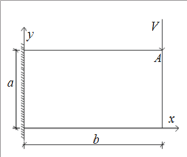
Rayleigh-Ritz method is commonly used energy method to calculate the elastic buckling strength of a plate Qu [1]. The total potential energy of a structure is π = U + W , where U is the buckling deformation potential energy and W is the external potential energy. The critical buckling strength of a structure can be calculated once . For an end-fixed rectangular plate subjected to a concentrated load, the mechanical diagram is shown in (Figure 1). The buckling deformation potential energy of the plate can be determined as:

Figure 1: Mechanical diagram of the plate.

Lupinepublishers-openaccess-journals-Civil-engineering-Architechture

Lupinepublishers-openaccess-journals-Civil-engineering-Architechture

Where D = Et3 /12(1 -μ2) is the buckling stiffness of the plate; E and t is the elastic modulus and the thickness of the plate, respectively; n is Poisson's ratio of the material used for the plate. ρ is the buckling deformation function, and ωxxxyyy are the partial derivatives of the buckling deformation function.

The external potential energy of the plate can be calculated by:

Lupinepublishers-openaccess-journals-Civil-engineering-Architechture

Where q is the lateral concentrated load and Δx (y) is the out- of-plane displacement of the plate caused by the buckling of the plate. It can be found that the critical buckling strength of the plate is determined by buckling deformation function. Therefore, it is important to assume a feasible buckling deformation function for the analyzing plate. Cheng [2,3] proposed the buckling deformation function as:

Lupinepublishers-openaccess-journals-Civil-engineering-Architechture

Yuan [4] modified the buckling deformation function of Cheng (1988), and given it as:

Lupinepublishers-openaccess-journals-Civil-engineering-Architechture

Where f1 and f2 are unknown variables to describe the various types of the buckling deformation function, thus the critical one could be found in these functions. Through case studies conducted by Yuan [4], the critical results calculated by Eq. (4) were lower than the results calculated by Eq. (3). Thus it was concluded by Yuan [4] that the Eq. (4) was more accurate for determining the critical buckling strength of the plate. However, Yuan [4] proposed another buckling deformation function as:

Lupinepublishers-openaccess-journals-Civil-engineering-Architechture

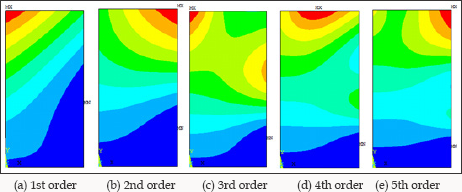
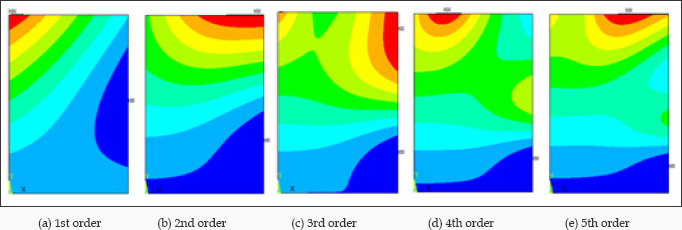
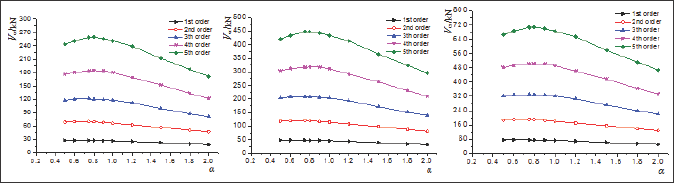
With developing of the computer-aided calculating method such as finite element method (FEM), the buckling modes of the analyzed plate can be depicted more visually. In this paper, the FEM model for the analyzed plate is generated by the FEM software ANSYS 12.0. A target plate is selected with a constant value of 2.7 m in height, and the elastic modulus of the plate is 206 GPa. The width of the plate is changing from 1.35 m to 3.6 m, and three cases with height-to-width ratio 2.0, 1.5 and 0.75 are analyzed. The thickness of the plate is 10 mm, 12 mm and 14 mm. Eigen value buckling analysis of these FEM models is conducted by Block Lanczos method. The first 5 orders of the buckling modes of these plates are generated, and the cases of α=2.0, α=1.5 and α=0.75 with 10 mm in thickness are depicted from (Figures 2-4). The critical strength of these plates for which calculated by FEM are shown in (Figure 5).

Figure 2: Buckling mode of the plate with ɑ=2.0.

Lupinepublishers-openaccess-journals-Civil-engineering-Architechture

Figure 3: Buckling mode of the plate with ɑ=1.5.

Lupinepublishers-openaccess-journals-Civil-engineering-Architechture

Figure 4: Buckling mode of the plate with ɑ=0.75 and t=10 mm.

Lupinepublishers-openaccess-journals-Civil-engineering-Architechture

Figure 5: Relationship between the critical strength and of and the � Jiang et al. [3].

Lupinepublishers-openaccess-journals-Civil-engineering-Architechture

Discussion and Suggestion

As shown in (Figures 2-4), it can be found that the consequence of the buckling modes is moved by changing the height-to-width ratio of the plate. High-order buckling mode may be occurred in the plate with lower height-to-width ratio. According to the studies conducted by Cheng and Yuan, only two variables were in their equations, and the cosine function and polynomial function were used to describe the buckling modes of the analyzed plates. However, two variables might not be used to present the high-order buckling mode of half-waves more than three. Such functions limit more degree of freedom (DOF) of the plate, and the critical buckling strength calculated from such functions is larger than the correct value.

Thus this paper suggests the buckling deformation function as follow:

Lupinepublishers-openaccess-journals-Civil-engineering-Architechture

Such function should be following the boundary conditions of the plate, and they are:

Lupinepublishers-openaccess-journals-Civil-engineering-Architechture

The Eq. (6) combines the double series function derived by Navy, and the single series function derived by Levy, and aims to find the most proximal buckling deformation function for the critical buckling mode of such plate.

Read More About Lupine Publishers Journal of Civil Engineering and its Architecture Please Click on Below Link: https://lupinepublishers-civilengineering.blogspot.com/


Sunday, 19 December 2021

Lupine Publishers| Stabilization of Expansive Soil Using Wheat Husk Ash and Granulated Blast Furnace Slag

 Lupine Publishers| Journal of Civil Engineering and its Architecture


Abstract

The Expansive soil swells when it comes in contact with water and shrinks on drying. These soils are characterized by inherent swelling and shrinkage characteristics due to presence of Montmorillonite clay mineral, which exhibits volume change behavior under changes of moisture content. Granulated blast furnace slag(GBS) is the waste material which is generated from the steel plant after with the increase in waste disposal problems and their solutions has increased to a where the waste disposal by several methods has become a technology of its own. To minimize the impact of wastes on the environment, final disposal which offers environmentally sustainable methodology for disposing wastes on land is inevitable, after thorough analysis of behavior of soils. Hence, an attempt has been made in the investigation to overcome the disposal problems of GBS that are mixed with wheat husk ash to achieve the desired requirements. In the same way the Expansive soils are treated with different percentage of GBS and wheat husk ash to improve the engineering properties of soil.

Introduction

Expansive soils, well-known as Black Cotton Soils in India, occupy about one-fifth of land area of the country. Black Cotton Soils are residual deposits formed from basalt or trap rocks. Expansive soil contain significant amount of montmorillonite material. These soils are very hard in dry state but lose their load carrying capacity when once they are comes in contact with water. They have high shrinkage and swelling characteristics. In general, these expansive soils are very much keen to changes in environment. The environment includes the stress system, the chemistry of pore water in the system, the seasonal variations in ground water table with consequent changes in natural moisture content and temperature variations. These swelling and shrinkage properties have made the soil unsuitable for civil engineering purposes either as foundation or embankment material.

The compaction is a mechanical process in which the densification is achieved through the expulsion of air voids at almost constant water content of the soil mass. However, densification through consolidation is primarily attributed to the gradual expulsion of pore water from the voids of the soil mass undergoing consolidation and to the increase in the effective stress on the soil mass. Stabilizing agents such as fly ash, quarry dust and rice husk ash are used for the stabilization of expansive soils. In the same way GBS is one of the materials used as stabilizing agent [1-5].

Soil properties that influence shrink-swell potential: The influence of shrink-swell potential depends on the following factors:

    a. Clay Mineralogy: Clay minerals which cause soil volume changes are montmorillonite, vermiculites and some mixed layer minerals. Illites and kaolinites are infrequently expansive, but can cause volume changes when particle sizes are extremely fine.

    b. Dry Density: Higher densities indicate closer particle spacing, which may greater repulsive forces between particles and larger swelling potential.

    c. Plasticity: In general, soils that exhibit plastic behavior wide ranges of moisture content and that have high liquid limits have greater potential for swelling and shrinking. Plasticity is an indicator of swell potential.

Soil water chemistry: swelling is depressed by increased cat ion concentration and increased cat ion valence.

Ground water: Shallow water tables provide a source of moisture and fluctuating water tables contribute to moisture.

Permeability: Soils with higher permeability, particularly due to fissures and cracks in the field soil mass, allow faster migration of water and promote faster rates of swell.

Temperature: increasing temperatures cause moisture to diffuse to cooler areas beneath pavements and buildings.

Laboratory tests used for identification of expansive soils

In Engineering practice, the common identification schemes are based on standard classification results, such as grain size analysis and Atterberg's limits. However, other tests such as microscopic examination, X-Ray diffraction and differential thermal analysis for identifying the type and amount of minerals used in identifying potentially swelling soils (Table 1.1).

Table 1.1: Laboratory tests used in identification of Expansive soils.

Lupinepublishers-openaccess-journals-Civil-engineering-Architechture

Physical properties of expansive soils

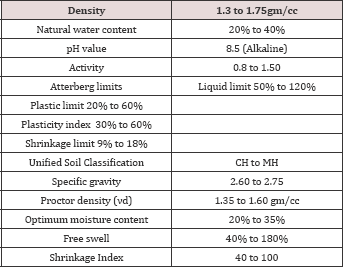
The typical characteristics of Expansive soil are shown in Table1.2

Table 1.2: Physical properties of expansive soils (Anand, KS 1989).

Lupinepublishers-openaccess-journals-Civil-engineering-Architechture

Methods of stabilization

The stabilization techniques may be grouped under the following two major heads

    A. Stabilization without additives

    B. Stabilization with additives

Stabilization without additive may be mechanical rearrangement of particles through compaction or addition or removal of soil particles [6,7]. Some of the stabilization process can be studied as follows:

Chemical stabilization

Besides the use of lime, other chemicals both organic and inorganic can be used to stabilize the expansive soils. But the cost of cement stabilization is considerably more than that of lime stabilization. GBS is added to the soil-lime mixture to increase pozzolanic reaction. Chemical like potassium, deactivation of sulphates with calcium chloride, water proofing with silicones or asphalts, cementation with silicates, carbonates all proved in reduction of plasticity index.

Wheat husk ash

India wheat husk ash for stabilization appears to be successful solution, wheat husk ash is readily available. Primarily being siliceous material act as pozzolona. Hence in this investigation the compressibility behaviour of black cotton soil treated with GBS and wheat husk ash has been studied. Wheat husk ash is obtained by burning locally available wheat husk in an open kiln for about twenty four hours. After complete burning, the burnt material was sieved through I.S.425 micron sieve and minus 425 -fraction was taken for the study.

Materials used

For the present study, Expansive soil, GBS and wheat husk ash have been used. Their physical properties have been determined.

Expansive soil

In India, 20% of surface deposits are covered with expansive soils. The Expansive soil swells when it comes in contact with water and shrinks on drying. These soils are characterized by inherent swelling and shrinkage characteristics due to presence of Montmorillonite clay mineral, which exhibits volume change behaviour under changes of moisture content. Due to characterized swelling and shrinkage behaviour of expansive soils leads to the severe damages to the Civil Engineering structures such as cracking in buildings or total distractions of the structure, foundations and pavements. For the present investigation the Expansive soil was obtained from Rudnoor village, Bhalki taluka, Bidar district, Karnataka state, India. It is collected from an open excavation at a depth of 0.5m below the natural ground surface. The soil was air dried and pulverized. This pulverized soil passed through 425 micron IS sieve has been used for this investigation.

Granulated blast furnace slag

Granulated blast furnace slag (GBS) was obtained from Kirloskar steel plant district Koppal, Karnataka, India. GBS is the waste material which is generated from the steel plant after with the increase in waste disposal problems and their solutions has increased to a where the waste disposal by several methods has become a technology of its own. To minimize the impact of wastes on the environment, final disposal which offers environmentally sustainable methodology for disposing wastes on land is inevitable, after thorough analysis of behaviour of soils [8-9].

Wheat husk ash

Wheat husk ash is obtained from Byalahalli village, Bhalki taluka, Bidar district in Karnataka state in India by burning locally available wheat husk in an open kiln for about twenty four hours. After complete burning, the burnt material was sieved through I.S.425 micron sieve and minus 425 -fraction was taken for the study.

Results and Discussion

The liquid limit, plastic limit, shrinkage limit and compaction tests were conducted based on the experimental programme. The effect of additives on index and compaction properties of expansive soil treated with various percentages of GBS and WHA have been studied. The results and discussions are presented in the following section (Table 1.3).

Read More About Lupine Publishers Journal of Civil Engineering and Architecture Please Click on Below Link: https://lupinepublishers-civilengineering.blogspot.com

Monday, 20 September 2021

Lupine Publishers| Electron Beam Additive Manufacturing with Wire

 Lupine Publishers| Journal of Civil Engineering and Architecture


Introduction

   Electron beam additive manufacturing with wire (EBAMW) is a novel technology which can directly fabricate 3-D near-net shape elements from metal wires. Of specific interest are the additive layer manufacturing processes with wires that are capable for producing fully dense metallic and hybrid parts in which the resulting parts may be used for loaded structure. This process is attractive because it eliminates contamination compare to powder process. Manufacturing near-net-shape elements layer-by-layer with wire as a deposit material offers a great potential for time and cost savings in comparison to conventional manufacturing technologies (such as casting, forging, etc.). The increasing market especially for aerospace industry demands for titanium, aluminum and other materials serial production parts has promoted wire- feed processes in recent years, as repeatability, material properties, material usage, possible part size, and building speed have also become issues.

Research carried out up to date was focused on the possibility of using EBAMW in space [1,2] and the ability to produce ready-made elements that meet the requirements of the space sector industry. Mitzner et al. [3] revealed that through the use of modulation of electron beam the refinement of the microstructure in the titanium alloy can be achieved. Gonzales et. al. [4] indicated that the use of flux cored wires containing aluminum, iron and boron allows manufacturing Ti-6Al-4V titanium alloys with a more stable and finer microstructure. The rapid prototyping process using a beam allows to produce a Ti-6Al-4V titanium airframe element at lower cost compared to older solution. The reduction of material consumption by 79% was achieved. The aim of the presented work was to carried out research on electron beam additive manufacturing with a stainless steel wire as a filler material. The scope of the work was to investigate the influence of selected EBAMW technological parameters such on stability of deposition process.

Methodology

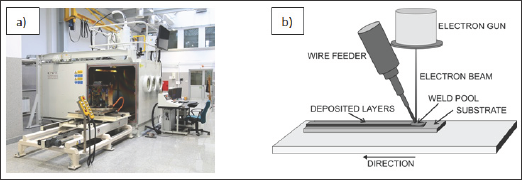
The EBAMW process was conducted based on EB machine CVE XW150 model: 30/756 (Figure 1). The device is equipped with a wire feeder and a working chamber with a volume of 4.9m3. The device is equipped with a system to monitor and record of the process parameters. The following parameters were applied during experimental tests: feeding angle 30°, working pressure 5•10-5mbar, beam current in the range of 1-30mA, accelerating voltage from 60 to 150kV, wire feed rate from 600 to 3600 mm/ min, travelling speed from 200 to 7000mm/min. To an additive manufacturing specimens welding wire 1.2mm in diameter (LNM307 Lincoln Electric: C 0.07%, Mn 7.1%, Si 0.8%, Cr 18.6%, Ni 8.0% wt.) was applied.

Figure 1: Electron beam additive manufacturing with wire set up a) EB machine b) scheme of the process.

Lupinepublishers-openaccess-journals-Civil-engineering-Architechture

Results and Discussion

The scope of the work was to investigate the influence of technological parameters such as: wire feed rate, beam current, travelling speed, acceleration voltage on stability of the deposition process and geometric dimensions of the padding welds, single layer as well as whole structure. The research revealed that, at low beam currents, the deposition process is unstable. The padding weld reinforcement is non-uniform. Irregularity of the width, height and straightness of the padding welds can be observed. At too high acceleration voltage and beam current, burn-through of plate and excess penetration weld can be revealed. When the wire feed rate is too high, the amount of energy supplied is insufficient to stabilize the fusion process of the wire. The wire is deeper feeding into the welding pool and limits the possibility of creating of a channel. The increased volume of filler material flooded the channel and caused that the welding pool becomes wider.

The gained knowledge as well as results of preliminary experimental tests including study of influence of technological parameters on with and high of single padding welds allowed to produce the fully dense metallic parts based on electron beam additive manufacturing process with wire. The results are presented in Figure 2. The EBAM 307 steel plate was fabricated in a vacuum chamber. The deposited path was scanned in one direction. It means that the return movements in opposite direction were dead. The spacing between two adjacent tracks (overlap) was 1.3mm. The scanning directions were alternated layer to layer and the time interval is 2 min. Eighteen layers were deposited and average height of each layer was approximately 1.0mm. The following technological parameters were applicable: accelerating voltage U=60kV, beam current 15mA, travelling speed 1000mm/ min, wire feed rate 1000 mm/min, feeding angle 30°. Number of padding welds in one layer was 42 [5].

Read More About Lupine Publishers Journal of Civil Engineering and Architecture Please Click on Below Link https://lupinepublishers-civilengineering.blogspot.com


Thursday, 4 March 2021

Lupine Publishers | Nanotechnology in Concrete: Small Things Shape a Great Future

 Lupine Publishers | Journal of Civil Engineering


Abstract

Concrete changes the world. Nanotechnology changes the concrete world. The nano-engineered concrete can be intelligent, strong, durable, easy to fabricate, recyclable and eco-friendly. Its potential benefits include improved infrastructures reliability and longevity, enhanced structural performance and durability, improved safety against natural hazards and vibrations, reduced lifecycle costs in operating and managing infrastructures, and reduced burdens on resources, energy and environment.

Concrete related to sustainable development of human society

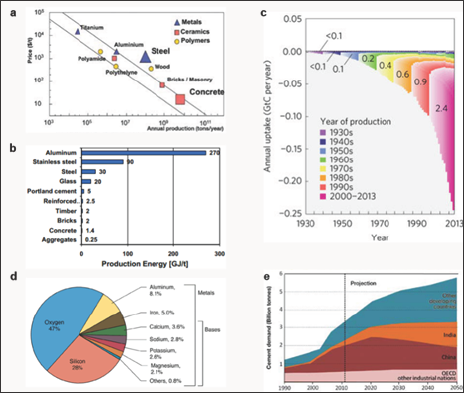
Figure 1: Concrete price and usage; b) Energy consumption for concrete production; c) The cumulative carbon sequestration from 1930 to 2013; d) Elemental composition of the earth; e) Cement demand prediction [1-5].

Lupinepublishers-openaccess-journals-Civil-engineering-Architechture

Concrete's excellent properties and low cost have made it tremendous quantity of concrete (4 billion cubic meters per year) the world's most widely used engineering material (Figure 1a). A has been consumed worldwide for infrastructure construction. China accounts for approximately 60% of the total concrete consumption with the per capita amount of 2 cubic meters. The manufacturing of cement, a key ingredient in concrete, has a significant impact on nature source, energy and environment. In fact, concrete has lower energy consumption and carbon emissions compared to other engineering materials (Figure 1b). According to recent research, as carbon sequestration, concrete can reabsorb a large fraction of CO2 released from cement production. From 1930 to 2013, carbonating concrete absorbed 43% of the cumulative CO2 emissions associated with the high-temperature calcination of carbonate minerals during cement production (Figure 1c). In addition, in terms of resource, it is almost impossible to find an alternative construction material to concrete. This is because O, Si, Al, Fe, Ca, Na, K and Mg comprise 98% of the crustal composition, which are the main components of concrete (Figure 1d). In the long term, on the basis of the urban development of the developing countries and the world's population growth rate, concrete will continue to be massively consumed as construction materials in the whole world. Taking the developing countries such as China and India for example, concrete usage converted by the total amount of cement will nearly double in the coming several decades (Figure 1e). Therefore, concrete is the largest material foundation bearing the civilization in today’s society and even in future society. The production and utilization of concrete are closely related to source, energy and environmental issues, thus having a strong effect on the sustainable development of human society [1-5].

Improving concrete performance to meet the ever-increasing demand for infrastructure construction

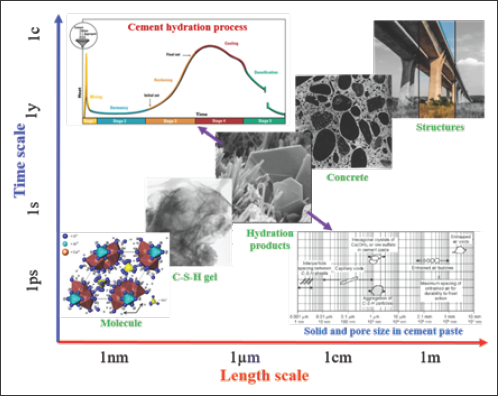
Figure 2: Multi-component, multi-phase and multi-scale nature [4].

Lupinepublishers-openaccess-journals-Civil-engineering-Architechture

Concrete has a multi-component, multi-phase and multi-scale nature and is considered as the most complicated composite while fabricated with the simplest production process (Figure 2). The feature of thermodynamic metastability has an effect on the concrete volume stability. Under deformation, shrinkage and loading, it is vulnerable to interrupt or destroy homophase continuity and heterophase bonding. In addition, concrete is known for its brittleness with low tensile strength, poor deformation performance and high cracking tendency. The presence of cracks tends to weaken the integrity and bearing capacity of structures and severely affect their safety, serviceability and durability, causing potential safety problems on construction. Especially with the trend toward large-scale and complicated infrastructures, extreme service environment, multi-factor coupling and ever-enlarging application field, these problems are becoming more serious and facing with a plenty of new challenges as well. In this case, high- performance and smart/multifunctional concrete becomes the only way to implement the sustainable development of concrete structures. High-performance and smart/multifunctional concrete has excellent mechanical properties, durability and processability needed for structural material. Meanwhile, it also presents selfsensing, self-healing and self-adjusting features. Making use of high- performance and smart/multifunctional concrete can effectively enhance the safety, comfort and durability of infrastructures and maintain a coordinated relationship between infrastructure and environment.

Nanotechnology adding new impetus for developing high-performance and smart/multifunctional concrete

As shown in Figure 2, concrete is a multi-scale complex system. Generally, the normal aggregate in concrete has a particle size ranging from millimeters to centimeters and the particle size of ordinary cement itself is usually 7-200|im. However, cement hydrated phases are primary nano structured materials mainly condensed by C-S-H gel tens of nanometers in size. Therefore, due to its natural attribute, concrete has the properties of nanomaterials. In addition, the scientific community and industry are always spontaneous to manipulate the nano-scale behavior inside concrete using nanotechnology to enhance or modify concrete performance in the process of concrete development, such as nano crystals, mineral admixtures and chemical admixture used for concrete preparation. It should be recognized that nanotechnology in concrete is not a new technique. It is just attributed to the rapid development of nanotechnology in recent two decades improving the understanding of the nano-scale behavior inside concrete and enriching the methods for concrete reinforcement and modification via nanotechnology. In this manner, research in the application of nanotechnology in concrete reaches a very active period.

Awareness of nanotechnology applications in concrete starts at 2001. The addition of nano-SiO2 to concrete was first used for concrete reinforcement. After that, nano-ZrO2, nano-TiO2 and nanocarbon material were applied one after another for the enhancement and modification of concrete. Much work indicated that the big gains in mechanical, durable and functional properties of concrete were achieved by nano nonmetallic oxide and metallic oxide modification. The addition of nano-SiO2 increased the 3d/28d compressive and flexural strengths by 48.1%/48.7% and 45.6%/16.0%, respectively. Meanwhile, the addition of nano-SiO2 can increase the freeze-thaw resistance, chloride penetration and permeability, abrasion resistance and fire resistance of concrete [6]. The fracture toughness of concrete can be enhanced by 400% when nano-ZrO2 is used as fillers [7]. The flexural and compressive strengths of concrete with nano-TiO2 at age of 28 d achieve increases of 87% /6.69 MPa and 12.26%/12.2 MPa with respect to concrete without nano-TiO2, respectively. Nano-TiO2 can also endow concrete with the photocatalytic effect to decompose both organic pollutants and oxides such as NO, NO2 and SO2 [8]. Moreover, extensive research endeavors demonstrated the potential of various nano carbon materials including carbon nanotubes (CNTs), carbon nanofibers (CNFs), and graphene for enhancing/modifying concrete materials [9].

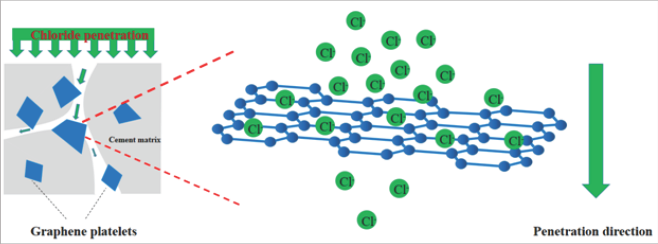
Figure 3: Graphene platelets acting like�filters�for chloride ions [11].

Lupinepublishers-openaccess-journals-Civil-engineering-Architechture

The observed best performance enhancement of concrete with CNTs or CNFs include a relative/absolute enhancements of 79%/74MPa and 64.4%/5.6MPa in compressive and flexural strength [10], a 34.28% increase in tensile strength, a 270% increase in fracture toughness, a 14% increase in fracture energy, an over 600% improvement in Vickers’s hardness at the early ages of hydration, a 2200% increase in deflection, a 130% increase in ductility, an over 430% improvement in resilience and a 227% increase in Young’s modulus. Graphene can improve the tensile, flexural and compressive strength of concrete by 78.6%, 60.7% and 38.9%, respectively. The presence of CNTs obviously enhances the transport property and durability of concrete materials. Graphene significantly improves the moisture transport performance, the acid resistance and the chloride ion penetration resistance (as listed in Table 1 and Figure 3) of the concrete.

Table 1: Chloride migration coefficient of concrete with grapheme.

Lupinepublishers-openaccess-journals-Civil-engineering-Architechture

DRCM: Chloride migration coefficient from non-steady-state migration test

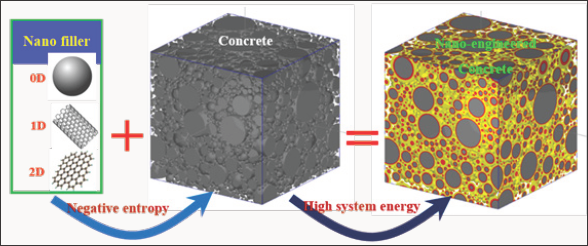
The electrical resistivity reduction extent of concrete materials than that of concrete without CNTs. The damping capacity of with CNTs/nano carbon black composite filler is 99.9%. The concrete with CNTs is 1.6 times than that of concrete without CNTs. thermal conductivity of CNTs concrete composites is 85% greater The addition of CNTs into concrete materials can lead to a 27%decrease in electromagnetic wave reflectivity at a frequency of 2.9 GHz. Additionally, the composites with CNTs, CNFs or graphene feature smart self-sensing (e.g. sensing stress, strain, crack, damage, temperature and smoke), self-heating and steel cathodic protection performances. Nano fillers not only can enhance/modify the also have strong impact on the rheology and workability of fresh concrete [11]. Nano fillers have higher surface energy compared with cement particle. Therefore, as shown in Figure 4, the addition of nano fillers raises the system energy of cementitious composites, thus importing negative entropy to the system of composites.

Figure 4: System of nano-engineered concrete [7].

Lupinepublishers-openaccess-journals-Civil-engineering-Architechture

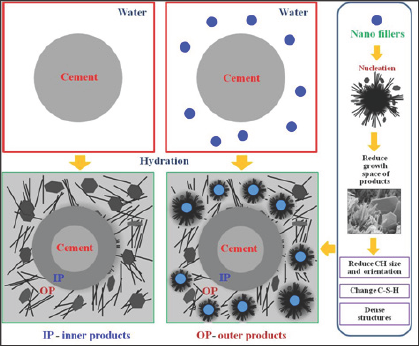
The mechanisms of nano-core effect on the enhancement/ modification are mainly due to two aspects: intrinsically excellent mechanical, electrical, thermal and electromagnetic properties and morphology features (high aspect ratio); and promoting cement hydration, optimizing C-S-H gel structure and forming ultrafine and compact crystals, improving interfacial transition zone and pore structure, controlling nano-scale cracks, autogenous curing, improving early strength and decreasing autogenous shrinkage through nucleating effect (Figure 5).

Figure 5: Schematic diagram of effect of nano fillers on the hydration products growth around cement particles [11].

Lupinepublishers-openaccess-journals-Civil-engineering-Architechture

Conclusion

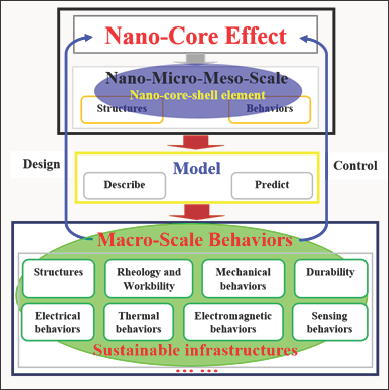
As a new industrial revolution, nanotechnology infiltrating in the field of civil engineering provides new impetus for developing high- performance and smart/multifunctional concrete. To restructure or modify material structural units in nanoscale via interpreting material genetic code and drawing the blueprint of nanoscale properties provides new theory and method to develop high- performance, durable, smart/multifunctional, and environmentally friendly concrete (Figure 6). The utilization of nanotechnology helps promote the understanding of concrete behavior, manipulate and design concrete performance, lower the concrete production and ecological cost, extend the service life of engineering infrastructures and reduce the relative demand of concrete. It is of profound significance to guide the sustainable development and application of concrete material and infrastructures.

Figure 6: Nano-engineered concrete based on nano-core effect.

Lupinepublishers-openaccess-journals-Civil-engineering-Architechture

Acknowledgment

The authors thank the funding supported from the National Science Foundation of China (51578110 and 51428801).

Read More About Lupine Publishers Civil Engineering Journals Please Click on:
https://lupinepublishers-civilengineering.blogspot.com/
Monday, 8 April 2019

Civil Engineering Research Journal-Lupine Publishers

Smart City by Smart Lighting: Utilizing Smart Lighting in Urban Texture Based on Effective Using of Power to Save in Macro Economy and Create Diversity in Cities by Amir Reza Goudarzi in Trends in Civil Engineering and its Architecture in Lupine Publishers

Lighting is the requirement of the present world realized by artificial lighting especially at nights. However, the price paid is not as much rational threatening the national economy. Today, permanent facing with economic problems requires utilizing any potential for economic growth. Smart lighting prevents energy and capital losses; it is applied whenever it needed; and smart streetlights provide lighting whenever any human or vehicle passes. Thus, not only the two factors of lighting and saving national capitals will always last at negligible error, but also, diversity and aesthetic elements granted to cities enjoying the social and economic convenience. It assumed that using smart lighting is one condition of providing these conveniences. However, the question raised here is the infrastructures and utilizing equipment, particularly in traditional cities, to be responded. In conclusion, utilizing such system can lead to cost return and saving in order to achieve national objectives and to unconsciously teach aesthetic, change, and saving culture.

https://lupinepublishers.com/civil-engineering-journal/fulltext/smart-city-by-smart-lighting-utilizing-smart-lighting-in-urban-texture-based-on-effective-using-of-power.ID.000149.php

For more Lupine Publishers Open Access Journals Please visit our website: http://www.lupinepublishers.com/

For more Civil Engineering Research Journal articles Please Click Here: https://lupinepublishers.com/civil-engineering-journal/


Friday, 5 October 2018

Experimental Investigation on FRP Composite Compression Members (TCEIA) - Lupinepublishers


In the last 25 years, fiber-reinforced polymer (FRP) composite materials have been considered to be used in various civil engineering applications such as the cooling tower system, waste water treatment plant, pedestrian bridges, reinforced concrete rebars, structure strengthening members, and some metallic sensitive specialized buildings. This review of study is only concentrated on the experimental investigation of GFRP composite compression members made from glass-fiber and polyester-based and vinylester-based polymers in a pultrusion process.

https://www.lupinepublishers.com/civil-engineering-journal/abstracts/.ID.000107.php

https://www.lupinepublishers.com/civil-engineering-journal/pdf/TCEIA.MS.ID.000107.pdf