Showing posts with label Journal of Textile Science and Engineering. Show all posts

Tuesday, 25 January 2022

Lupine Publishers| Creative Process in the Design and Creation of Textile Manufacture

 Lupine Publishers| Journal of Textile and Fashion Designing


Introduction

Creative process

Man has his creative manifestations through his individual aspirations, thoughts and idealization. The need is a motivating factor that drives the search for knowledge, problem solving and satisfaction, Santis [1]. For Lobach [2] "The conduct of the human being is also driven by multiple and varied needs. The emergence of needs is not always logical, especially when other activities or processes have occasional preference. "Necessity seeks satisfaction; aspiration is the spontaneous will to obtain something that comes from idea or visualization. The aspiration consists in the desire to obtain something that can be reached or not. Needs and aspirations accompany the evolution of technology, information tools and economic development. Lobach [2] states that design consists of a systematized design, plan or method that includes problem solving incorporating ideas, innovation, sketching, samples, models to make concrete the solution found.

Over the centuries, the needs in its evolution have been accompanied by the development of instruments, methods and systems. The constant evolution through research and events show that innovative creativity has played a key role. The development of the human creative process has also been marked by various frustrations, problems in creativity and with innovation; these problems are constantly reported by various scholars. Several researchers and researchers [2] have already been affected by creative inertia, difficulty in exposing ideas, fears, and lack of innovation or even problems that seemed unsolvable. Even so, the creative process has become an important tool for resource development. And the stimulation and organization of the creative process is being studied in theories, techniques and tools such as: Design Thinking, Design Methodology, and Inventive Problem Solving Theory. These are applied for the development of textile products.

Product Development

Ostrower [3] states that the ability to understand, assimilate, configure, and signify is the creative act. Creating is a way of establishing a new relationship between the human mind and the object in order to understand meaning or to redefine (giving a new meaning, a new practice, the ability to perceive an object through a different vision). Already the creative process derives from the structuring of cognition (knowledge of facts), intelligence (human characteristic composed of logical thinking, communication, knowledge, sensibility, problem solving, emotional control, etc.), creation ability (giving meaning to something or something) and innovation (creating something unknown). To meet the new type of consumer coming from social and communication changes, manufacturers seek to align existing needs with functionality and aesthetics by creating values that can be applied to technological fabrics.

Barbará [4] calls the process a set of ordered and integrated actions for a specific productive purpose that at the end of the cycle generate products, services or information. In the process of manufacturing with synthetic fibers began the decade of 30, the developed fibers become part of the manufacture of fabrics and clothing. To give a small notion of what we call fiber, I find it interesting to contextualize the historical beginning, recalling some important facts. In this sense, the textile manufacturing manufacture uses the fibers to compose the yarn, and the woven yarn becomes fabric and various stamping and dyeing techniques. The textile production manufacture is divided into three cores: the yarn manufacturing, the fabric manufacture and the confection. According to Sanches [5] the fiber consists of the smallest element of the composition of the fabric in any natural or manufactured substance that has suitable characteristics that allow its processing. Being, the smallest component of hairy nature, which can be extracted or separated from a tissue.

In wire manufacturing, the breeding process establishes the mixing of the materials for processing. The processing consists of a rational part that modifies the form of a structure or system for the construction of a mixture, an irrational part that is compounded by bringing together psychological, emotional, innovative, creative and personal aspects. This means that the transformation depends on the creative aspects to innovate in the fiber blend. The creation procedure promotes finding strategies that encourage the production of new means of mixing the components, which can motivate, add capacity and add value to the basic and secondary functions of the product or service to generate probabilities of more interactive information in the market, Santis [6]. The set of productive operations or manufacturing should have as main focus of improvement; increase in productivity and also in quality.

On an industrial scale (manufacturing sizing) in the contemporary, the good use of the methodology of the project presents some techniques that promote to encourage the application processes of the project methodology consist of the interaction of tools, resources and manpower converted into energy that perform the connection between procedures and tasks, Santis [1]. The manufacturing of textile the object of study of this research produces knitted fabric, working in the circular knitting industry, among its articles produced we can mention: knitwear for fitness, linings, beach and microfiber. Knitted textile manufactures that also serve as object for this research have a tradition in the Brazilian economy and, considered as one of the great s manufactured in Latin America, consisting of several business units in the country, its most common products made of fabric composed of combinations of polyamide, cotton and elastane (synthetic filament) in circular and straight looms.

Thus, actions constitute a form of processes that are interconnected in a physical or virtual structure, which establishes a set of ordered processes in operations to modify the resources in products. For Agostinho [7]. The fixation of the scripts and manufacturing processes fix the knowledge manufacturing, or how to do it, being considered the pillar of fixation of manufacturing knowledge. Following the scripts and manufacturing processes, it is determined the times required for each operation of the script, consequently of the parts and set of parts that make up the product [8-52].

Finally, the manufacturing and creative processes interrelate in a chain of interdependent functions, considering (external environment) and dependent variables (internal environment). This functional interrelationship facilitates the systematization of the production of goods and services. Each function has a sequential operation flow for the development of an operation from the inflow of resources to the exit of the goods or services. The set of actions in the creative process developed by a sequence of operations establishes the construction of a product, whether it is a consumer good or a service and this facilitates innovation in creative development.

Read More About Lupine Publishers Journal of Textile and Fashion Designing Please Click on Below Link: https://fashion-technology-lupine-publishers.blogspot.com/

Monday, 8 November 2021

Lupine Publishers| Some Significant Advances in Yarn Splicing Technology

 Lupine Publishers| Journal of Textile and Fashion Designing


Abstract

The article reviews some of the significant researches in the yarn splicing technology. The effect of important factors on the breaking force of wet spliced yarns has been studied by means of a central composite design, which is a statistical tool. The impact of vent pressure on the quality of yarn splicing when twisting and untwisting has been investigated. Modelling, analysis, and simulation of the air splice is done with the integration of two software's, so as to analyse the flow field and obtain the effect of speed and pressure of the inside the splicing chamber when changing the speed and the pressure while maintaining the diameter of the splicing, the vent hole diameter and the relative angle unaltered. The influence of cotton/polyester fibre blend ratios on spliced portion diameter at various splicing air pressures has been studied. Studies have been directed regarding the influence of various yarn splicing parameters on the strength, elongation and the appearance of spliced cotton/flax yarn. A number of independent variables have been considered. A half factorial experimental design has been used with two levels of each variable. The design and analysis of experiments have been achieved with a specific software.

Keywords: Blended yarn, Retained splice elongation; Retained splice strength; Pneumatic splicer system; Retained splice diameter; Software; Experimental design

Introduction

Yarn winding is the process of transferring yarn from bobbins to packages to facilitate in the subsequent processes of warping, weaving and knitting. In this process, both the yarn ends are joined together to provide the continuity of the yarn package and several yarn faults; neps, thin place, thick place are removed. Thus, more uniform yarn mass distribution and higher yarn evenness properties are obtained. The yarn ends are joined together by applying a blast of compressed air into a profiled device called a splicing chamber. The most important performance parameters of splicing are obtaining adequate strength and appearance at the splice point for all processing requirements. The diameter of spliced portion affects not only appearance of the splice joints but also physical characteristics such as packing density, strength, specific volume etc. Yarn diameter is an important property which affects the physical properties of the end products. Variations in yarn diameter cause undesirable effects such as imperfections in the knitted or woven fabric and difficulties in weaving preparation stages.

The achievement of an appropriate splice in winding is one of the most important factors for spinners to meet present requirements in terms of productivity and quality. Different splicing techniques, pneumatic, mechanical and electrostatic, were developed towards the end of the last century [1]. Over the last twenty years, many studies have tried to broaden the end use of pneumatic splicing, in the upward transformation process [2-4]. The mechanical properties of spliced yarns which affects the quality of the denim yarn are influenced by variations in parameters such as raw materials and process & machine variables. Increasing some of these variable results can increase or decrease the performance of mechanical properties. Splicing is a technique which was especially developed to meet requirements in weaving where demands are severe. This is the manner of joining two ends after preparation by air under pressure [5,6]. The high-speed compressed air is used as the driving force of the air splice, after the process of yarn cutting, untwisting and twisting, to complete the yarn splicing, which is a typical application of fiber-media fluid dynamics in the textile industry [7].

Central Composite Design to Determine Strength of Wet Spliced Post Sized Denim Yarns

The abrasion, tensile strength & elongation of the splices have been investigated [8,9]. It has been shown by linear regression and neural networks that the linear density ofyarn is the most influential parameter on these physical properties. The various zones which participate in traction by defining the total mechanism of splices have been considered [10-12]. It has been shown especially that splice remains a failing technique in weaving, and it is essential to optimise it in order to improve certain input parameters. The technique of image analysis of morphology of splices has been used to prove that splicing is not reliable compared to the parent yarn [13]. In general, it is important that mechanical properties of wet spliced yarn after sizing should have the highest values. For this reason, the levels of the variables that affect the performance of the splice should be selected so that maximum properties are achieved.

The influence of four parameters has been investigated with the help of a central composite design for the experiments. Statistical analysis used for the results obtained from these experiments establishes a relationship of retained strength and retained elongation at break with these variables [14]. The details of the experiments and the subsequent analysis have been reported. Detailed regression analysis shows that while the factors of yarn count, Yc, length of splice, SL and quadratic effect, 2 SL are highly significant, their interactions with the other factors are not significant regarding the strength of spliced yarn. Although a sizable lack of fit sum of squares is present, the response surface equation describes the experimental system reasonably well for our purpose, since regression accounts for 80% and 83.4% of the total variation of the data. The model can thus be used to predict the response within reasonable limits. Sizing encourages the resistance of wet pneumatic-spliced denim yarns, and this was justified for the two recipes used. With this type of experimental design, we optimised the basis of input parameters and their impacts on the breaking strength of splice after sizing.

Fluid Dynamics Software to Analyse Effect of Vent Pressure on Yarn Splicing

Through the air-splicing process, the quality of the yarn all will be influenced by the speed and pressure of the compressed air, the volume and of the air injection, the length of the air injection time and etc. The air pressure should be appropriate, and be kept stable. When the compressed air gets consumed to a certain value, the air pressure increases accordingly and the fibers in the overlap portion will be intertwined better. However, when the air pressure exceeding the maximum critical pressure, the pressure promotes the fiber splicing, also has a negative impact on the yarn splicing. The reason is that excessively high compressed air will result in air disorders vortex, which affecting the fiber splicing and leading to a decline in the quality of splicing. It can be seen that a suitable air pressure for improving the splice quality is essential [15]. Due to the fact that it is difficult to directly observe the internal cavity of the air splice, and the mechanism of the splicing process is derived based on the experimental data.

The, the speed and the pressure of the air flow field in the internal splice were analyzed, with the help of Pro/E, ANSYS and other software. By changing the inlet pressure on the splice cavity, the diversification of the air flow field was studied, and the mechanism of the air splice was researched deeply, which provided a theoretical basis for the parameter optimization and structure design of the splicing chamber. Through the flow field analysis of the splice chamber, the velocity and the pressure distribution of the same cross-section at different inlet pressures were compared comprehensively and observed that the speed, the pressure and other parameters of the chamber increase with the growth of the inlet pressure. Combined the simulation analysis with the demand of practical work, it can be drawn that under the conditions of the splice chamber diameter of 15mm, the vent diameter of 5mm, the relative angle of 60°, and the vent pressure of 0.6MPa, the effect of the splicing is best [16]. The analysis results have important significance to improve the effect of the yarn splicing and provide a theoretical basis for the design of the internal structure.

Influence of Fibre Blending Ratios on Retained Splice Diameter

In literature, some studies have been performed on the effect of splicing parameters such as splicing length, duration of splicing air blast, and splicing air pressure on strength and appearance of the spliced yarns [17-26]. Studies have been carried out on the effect of both fiber characteristics and splicing parameters on retained spliced diameter [27-29]. In these studies, yarn samples with different types of cotton fibers have been produced and applied splicing process. In literature, there is very limited study on effect of yarn blending ratio on spliced portion diameter at different slicing air pressures [30]. With the development in technology and improvement in human life standards, the consumer demands from a product increases day by day. In order to satisfy the requirements, the fiber blends are used with different ratios to make a full use of their specific characteristics. Each fiber has its own specific mechanical and chemical properties. The fiber characteristic properties such as length, bending, resilience, elasticity etc. determine the yarn properties. It is claimed that since the splicing process is based on the snarling of the fibers in yarn structure because of pressurized air, the splice joint diameter and spliced yarn strength will be affected by the fiber characteristics.

Attention has been directed towards study of the effect of fiber blend ratio on spliced portion diameter at different slicing air pressures. For this aim, three yarn samples 100% cotton, 8020% CO-PES and 50-50% CO-PES were produced with 40/1 Ne. Each yarn sample is spliced at three different pressures; 4 bar, 5 bar and 6 bar [31]. The images of the yarn samples were acquired. The diameters of spliced portion and retained yarns are measured on the images of the spiced yarns. The effect of cotton-polyester fiber blending ratio on splice portion appearance performance was investigated. It can be said that the optimum splice pressure for the most appropriate splice appearance changes with respect to the fiber content of the yarn. For 4 and 5 bar splice air pressures, as polyester ratio of the yarn content was increased, the diameter of the splice portion also increased with respect to the diameter of parent yarn. For 6 bar air pressure, the splice joint diameter decreased with the increase in polyester content of the yarn samples. According to statistical analysis results, it can be revealed that the splice pressure and yarn fiber content have statistically significant effects on spliced yarn diameter. On the other hand, it can also be concluded that each pressure level has statistically different effects on spliced yarn diameter. With respect to the fiber blend ratio, 50-50% CO-PES and 80-20% CO-PES blend types have statistically similar effect on the diameter of spliced yarn. But 100% CO yarn statistically differs from 50-50% CO-PES and 80-20% COPES blend types.

Effect of Splicing Factors on Some Properties of Cotton Flax Blended Yarn

In the yarn winding process, ring yarn bobbins are converted into yarn packages which are more practical in the subsequent processes of warping, weaving, and knitting. This process not only ensures the continuity of the yarn by splicing yarn ends on different bobbins one by one, but also results in clearing of several yarn faults. Manual knotting has been a traditional practice for joining yarn ends together, but it can seriously deteriorate the resultant yarn and fabric appearance [32]. Pneumatic splicing is a relatively complex phenomenon as compared to manual knotting and is the most widely used technique for acceptable knot free joint. Previous studies revealed that a splice consists of three distinct zones, viz., twisting, wrapping and tucking or intermingling [33,34]. In a pneumatic splicing chamber, yarn ends to be spliced are overlapped, surplus yarn ends (as per specified splice length) are removed and a turbulent (Reynolds number up to 105) compressed air blast is released to perform the simultaneous action. Due to the complexity and instability of the splicing process, the process outputs are often unpredictable.

A couple of studies have been reported on how splicing and yarn parameters affect the strength, abrasion, bending and appearance of the spliced cotton and polyester/cotton blended yarns [35]. A statistical model has been developed to observe the effect of fibre friction, yarn twist and splicing air pressure on spliced cotton yarn performance [36]. Comparison of splicing performance of viscose staple fibre yarns made from ring, rotor, friction and air jet spinning technologies has been reported along with the splicing performance of synthetic filament yarns [37]. Some researchers have illustrated the effect of splicing parameters (splice length, duration of splice air blast and splice air pressure) on the tensile and structural characteristics of spliced yarn of different spinning technologies [8]. They found that the difference in yarn structure, due to varied spinning technologies and yarn splicing parameters influence the performance of splice. Although the concept of pneumatic splicing is not new, there have so far been little published works available on the study of factors affecting the mechanical properties of spliced yarns, particularly no work has been reported on the cotton/flax blended yarns. Efforts have been directed towards the effect of different splicing parameters on strength, elongation and appearance of the spliced cotton/flax blended yarns (Figure 1).

Read More About Lupine Publishers Journal of Textile and Fashion Designing Please Click on Below Link: https://fashion-technology-lupine-publishers.blogspot.com

Monday, 17 May 2021

Lupine Publishers| An Infrared Technique for Rapid Analysis of Pineapple leaf fibre-Acrylic Blends

 Lupine Publishers| Latest Trends in Textile and Fashion Designing (LTTFD)


Abstract

An infrared technique used to analyze pineapple leaf fibre-acrylic blends of different blend compositions is reported. Blend estimations are effectuated from a calibration plot between the absorption of the 2235 cm-1 band (C≡N) and the composition percentages of acrylic fibres. The theoretical and actual blend composition by chemical method divulges matching with each other.

Introduction

Usage of unexplored lesser known natural fibres in the international arena are not only the burning issues but simultaneously to search out a suitable avenue for which separate spinning system is not widely available or established in developing countries like India. Pineapple leaf fibre is another unexplored natural fibre extracted from the green pineapple leaf; an agro waste reveals its immense potentiality for use as a fibre in the arena of sustainable fashion textiles particularly due to the disposal problem after harvesting for cleaner and green environment. PALF is well known for its silky lustre which possesses some advantageous physical and chemical properties like high tensile strength, dimensional stability, considerable resistance to heat and fire, and good dye ability while the demerits are coarseness, inextensibility. It is a low cost renewable resource and eco-friendly material. Due to non-availability of specialized spinning system for PALF in India, it will be much easier to promote PALF in any of the existing spinning systems provided an appropriate processing technology is developed.

Several workers have reported blending of pineapple leaf fibres alone or in blends with other fibres [1-4], but scanty work has been reported on the analysis of PALF blends since the early work by Dey et al [5]. Numerous methods are available for analyzing fibre blend composition, of which the chemical method is commonly employed when a sufficient sample is available. It is more desirable to opt for a micro technique that requires smaller samples of the order of a few milligrams. Such samples can be analyzed unambiguously in order to identify variations in blend composition from place to place for quality control and investigation of fabric defects that cause streaks or depth-of-shade variations in fabric.

Polyester and cotton or wool and acrylic fibres are complimentary to each other due to their versatility. Since PALF is often blended with acrylic fibres to improve performance and hand, information on specific changes that occur during blending should be of interest. The infrared spectrophotometer is a vital instrument for both qualitative and Quantative analysis of polymer blends. The occurrence of non-overlapping absorption bands in IR spectra makes such analysis easier and more reliable. Various examples of quantitative determinations of fibre blends have been reported including ramie/acrylic by Dey et al, cotton/Dacron by O’Conner [6], wool/ Terylene by Clark and Hickie [7], cotton/polyester by BhamaIyer et al. [8], and acrylic/wool by Soosamma et al [9]. In this paper, the authors report a simple technique based on an IR method for quantitative analysis of PALF/acrylic blends.

Materials and Methods

Specifications of Acrylic fibres-no shrinkable, 3 denier, 120 mm long, from Indian Petrochemicals Corporation limited (I.P.C.L) Baroda and pineapple leaf fibre from ICAR-Central Research Institute for Jute and Allied Fibres, Sorbhog, Assam procured for this research work. All chemicals were analytical grade. The average fineness and tenacity of the pineapple leaf fibre were 2.67 tex and 271.84mN/tex respectively. Acrylic fibres in this experiment having liner density of 0.33 tex and tenacity of 241.52 mN/tex. Decorticated PALF and acrylic fibres were blended at the first drawing stage in five different blend compositions 83:17, 67:33, 50:50, 33:67 and 17:83. Yarns of 84 tex were spun on a rove spinning machine using modified conventional jute processing machinery with blend proportions of PALF ranging from 17 to 83%. Samples need to be taken from all parts of the bulk sample in order to obtain representative test samples for blend analysis; this is known as zoning [10] and is an important step in preparing test samples.

Sample preparation and calibration plot

Acrylic and PALF fibres were finely cut with scissors and sieved through a 100 mesh screen. Acrylic/pineapple leaf fibre blends of predetermined compositions were prepared by carefully weighing finely cut fibres. The fibre mixture was mixed thoroughly with 400 mg spectral grade KBr powder by grinding for 5 minutes with a mortar and pestle. The sample-KBr mixture was placed in a die and pressed for 5 minutes under a pressure of 421.85 Kg/cm2. The sample was also subjected to evacuation in the die for 5 minutes prior to pressing. The pellets were taken from the die and mounted on a magnetic pellet holder. These pellets transmitted in the range of 20-80% while being scanned. A standard calibration plot was obtained by measuring the absorbance of the nitrile (C≡N) band.

a) Blend analysis: The same procedure was followed to analyze the blend composition of five different blended yarn samples. A known quantity of the sample was powdered thoroughly and mixed well and 4 mg of the sample was weighed accurately and mixed with 4oo mg of KBr. For each sample, two sets of pellets were prepared as described earlier (Figure 1).

Figure 1: Calibration Plot for determination of Acrylic content in Pineapple leaf fibre/acrylic blends by measurement of Absorbance of (C≡N) band.

b) Spectra Recording: Spectra of the Pellets were recorded by a Shimadzu double beam model IR PRESTIGE-21 spectrophotometer from 4000 to 400 cm-1 under a normal slit program and a scanning speed of nearly 19s/100cm-1. A KBr pellet without the sample was used in the reference beam. For each pellet, the nitrile band at 2243 cm-1 was scanned twice, the second scan corresponding to rotation of the pellet through 90°in its own plane with reference to the first position. If the transmittance differed by more than 1%, this was taken to indicate no uniformity of mixing the samples. Fresh pellets were prepared again discarding such samples and their spectrum was recorded. The peak intensity (absorbance) in each case was measured by the baseline technique [11].

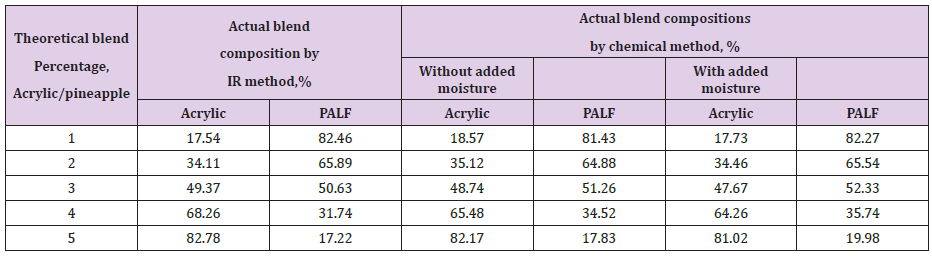
c) Chemical Analysis of Blends: The actual blend proportions were determined chemically as per the method IS: 3421-1966 for blend estimation [12]. All samples were extracted with a benzene-methanol (3:2) mixture to remove oil and any finishing materials that had been added during processing. Each blended sample was analyzed twice and the average value was reported in Table 1. Dey et al reported that the blend compositions of ramie-acrylic blends can be unambiguously assessed using infrared spectra with the help of calibration plot15. These compositions match those obtained by chemical methods (Table 1).

Results and Discussion

Acrylic fibres exhibit a strong nitrile band (C≡N) with a maximum at 4.48μ (2235 cm_1). This band is used for estimating the acrylic composition in blends. Regardless the origin of acrylic fibres, the position and intensity of the nitrile band are not much affected. The nitrile band is also independent of other functional groups, and so blend analysis by means of the infrared absorption spectra of the (C≡N) band is justified. Measurements of the intensity of the nitrile band for a series of acrylic/Palf blend samples yielded a calibration plot, shown in Figure 1. The individual points fall very much on a straight line, and scattering from the KBr disks is no problem. The calculated correlation coefficient is 0.9986 which is highly significant. BhamaIyer et al. observed that particle size plays a very important role in the peak intensity of the C=O stretching band of the carbonyl group in polyester, the absorption band recommended for analysis of cotton/polyester blends [13,14].

Table 1: Blend Extimation by Chemical Method.

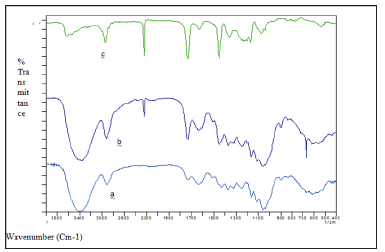
Figure 2: Infrared spectra of (a) PALF, (b) 50/50 PALF/ acrylic, and (c) acrylic fibre.

The absorbance of the C=O band versus composition does not yield a straight line. Soosamma et al. reported in their earlier work that the intensity of the (C≡N) band remains unchanged during ball milling period. This indicates that below a certain particle size, ball milling does not have any effect on the (C≡N) band. Hence, the absorption of the (C≡N) band versus composition gives a straight line. From such a calibration plot, the actual composition of any blend sample can be obtained rapidly with high accuracy. Blend compositions of the yarns based on the theoretical blend compositions of PALF/acrylic yarns spun on the jute spinning system measured by means of calibration plots and chemical methods are enumerated in Table 1. Figure 2 reveals the nature of the infrared spectra of PALF, 50%/50% PALF/acrylic blend and acrylic fibres. The results obtained with the infrared method using a calibration graph show the true compositions as given by the chemical method to a high degree of accuracy. After gaining some familiarity with the spectra of fibres, IR spectroscopy can provide a good technique for estimating blend composition-rapidly, reliably and with reasonable sensitivity.

Conclusion

The calibration plot will help to assess the blend compositions of acrylic/PALF blends unambiguously using their infrared spectra. The theoretical and actual blend composition by chemical method unveils matching with each other.

Read More About Latest Trends in Textile and Fashion Designing (LTTFD) Please Click on Below Link: https://fashion-technology-lupine-publishers.blogspot.com/


Friday, 24 May 2019

Lupine Publishers-Journal of Textile and Fashion Designing


Designers create products, services and systems to fulfill the society’s needs and desires. The adoption of Information Technology (IT) has changed the way designers develop new products. The collaborative work environment is a new paradigm of product design that integrates designers to quickly build, evaluate, optimize and select the best solution to complex problems [1]. In the last 20 years, internet has changed the way people communicate. The first era (1995), internet was an integrated hypermedia, in the second era (2000) internet had a programming media approach, that changed to people’s web service in the third era (2005), and the fourth era - which encompasses nowadays – represents a new level of organization and management of the entire value chain on the products’ life cycle. The Industrie 4.0 or Fourth Industrial Revolution is an integrative cyber-physical system based on modern control systems, embedded software systems and Internet addresses. This industrial revolution is based on improvement of brainwork, especially in engineering activities, and fast decision-making.


For more Lupine Publishers Open Access Journals Please visit our website: http://www.lupinepublishers.com/

For more Journal of Textile and Fashion Designing articles Please Click Here: https://lupinepublishers.com/fashion-technology-textile-engineering/

Wednesday, 26 September 2018

Fibonacci Circle in Fashion Design: (LTTFD) - Lupine Publishers


Fibonacci circle is a pattern which is created on the base of Fibonacci spiral square tilling and Fibonacci spiral. Fibonacci circle is designed similarly to Fibonacci spiral using the frame of Fibonacci spiral square tilling. The difference between both designs is: The spiral is drawn with quarter-circle arcs inscribed in the squares and Fibonacci circle is constructed with whole circles [1]. The design of Fibonacci circle on the frame of Fibonacci spiral square tilling is presented in Figure 1. The pattern without frame is shown in Figure 2. Similarly to Fibonacci circle the Golden circle can be created on the base of the Golden spiral.


Monday, 24 September 2018

Fibre Reinforced Composites: Multiplicity of Application: (LTTFD) - Lupine Publishers


Today, at the age of developing newer materials, it is needed to relook all textile fibers and materials by introspection of it in depth the strength and weakness of different fibers to be used alone or in combination with other materials as composites. The development of newer composite materials and to find their newer application potential, are still very attractive subjects of research investigation. Among different category of composites being made, fibre reinforced composites i.e. polymer matrix composites containing fibres as further sub-category under the broad heads-(a) fibre reinforced composites having high performance fibres as reinforcing material such as glass, Kevlar, carbon and boron, etc., in an appropriate polymer matrix system, (b) fibre reinforced composites incorporating low-cost natural fibres as reinforcing materials such as jute, hemp, sisal, coir and ramie etc. in an appropriate blend using more than one fibre as reinforcing materials i.e., incorporating one high polymer resin matrix, and (c) fibre reinforced composites having high performance fibre in combination to get advantages of both in the resultant two fibres hybrid composites e.g., jute-glass fibre hybrid composites.


Friday, 21 September 2018

Extraction of Pectic Acid from Citrus Fruit Peels and its Application as Textile Printing Thickener


Extraction of pectic acid by acid hydrolysis from citrus fruit peels and its conversion in to textile printing paste thickener in order to use it as an alternative substitute of sodium alginate thickener in reactive printing was studied in this research. Printing with the alternative thickener, sodium pectate, printed fabric characteristics; color yield, color brightness and wash fastness were improved. Pectic acid is extracted from the identified citrus fruit peels i.e. orange peel, lemon peel and bitter orange peels. Extraction time, type of solvent and extraction pH was standardized based on pectin yield obtained. The research found environment friendly extraction of pectic acid by sodium carbonate instead of acid hydrolysis with HCL or H2SO4.

Tuesday, 18 September 2018

Future Prospect for Sustainable Luxury Textiles from Pineapple Leaf Fibre - An Agro Waste: (LTTFD) - Lupine Publishers


The treasure of Major natural fibres belongs to cotton, jute, wool, silk, flax, sisal and Manila hemp which are extensively used across the globe. Besides, a large number of fibres grown in lesser quantities throughout the world have local economic importance and are consumed locally. Utilization of underexploited, unexplored natural fibres from crop waste are not only critical issues in the international scenario but are also the need of the hour in developing countries like India to search out a suitable avenue for which separate spinning system is not widely available or established. Pine apple leaf fibre successfully tested as a base material for conveyor belts in the early eighties, could well have been the magic yarn of the day. Pineapple leaf fibre extracted from the green pineapple leaf, an agro waste reveals its immense potentiality in the field of textiles particularly due to the disposal problem after harvesting for cleaner and green environment.

Wednesday, 22 August 2018

The Application Wearable Thermal Textile Technology in Thermal-Protection Applications: (LTTFD) - Lupine Publishers


Abstract

The needs for better thermal protection exist in various fields of our life, like the better thermal treatment, outside chill sports field and freezing working condition etc. However, the traditional passive thermal insulated clothing is insufficient, too blocky and heavy to constrain the movement of wearers and uncomforted to wear. Thus, an innovative light, flexible and active wearable thermal protection needs to be developed. This article reviews the relevant wearable thermal textile technology by utilizing the latest conductive textile materials in three developing levels: the fiber level, the yarn level and the fabric level, to provide more possibilities for new products development in various fields, which will facilitate the transfer from research achievement into mass production to realize its commercial benefits.