Lupine Publishers| Latest Trends in Textile and Fashion Designing (LTTFD)
Abstract
This paper empirically presents a batik production process
optimization using sustainable production (SP) methods. The stages of
batik production processes involve designing, methodology, dyeing,
washing, and finishing. The cost of production is determined by the
implementation efficiency and calculation of output to input ratio in
the production process. The case study method is employed for production
process optimization in two batik enterprises in the Kumasi metropolis.
The main objective of this research, is to determine the impact of
material sustainability, and the minimization of the production process
cost in order to promote maximum operational economic benefits.
The implications of this intervention shows that, in batik production
process, there could be a saving cost of resisting material by GH₡
31.00,
with a process time of 290mins and an activity cost reduction of GH₡
68.00 by just replacing paraffin wax with cassava starch. The identified
intervention has also been found as significant to address the
identified issues that bring a substantial change in the current
manufacturing
practices of the batik industry. It is recommended that much is to be
gained in sustaining the practice when cultural themes are employed in
the artifacts created.
Keywords: Batik Production; Environmental Resource; Sustainable Production Practices
Introduction
Batik is a process of dyeing fabric by making use of a resist
technique classified by the United Nations Educational, Scientific
and Cultural Organization (UNESCO) as part of the “intangible
cultural heritage of humanity”. It is a traditional creative selfexpressionistic
art form in fabric design which originated from
the Far East and known throughout the world [1]. In Ghana today,
the batik industry is recognized as a profitable enterprise in the
fashion industry and is also classified under the small to medium
scale creative industry. The potency of this small and medium
industry at the local level cannot be over emphasized as its
developmental efforts contribute to the quickening of the nation’s
economic empowerment. Its merchandise is well-known in the
creative industries as one of the leading developmental enterprises
clustered in Ghanaian communities.
The expectation of the industry is to provide important support
to the industrial sector’s contribution to local community revenue.
However, its production methodology appears to be detrimental
to the growth and development of the industry. The cause is not
farfetched, in that the prime resist component - paraffin wax - used
for its production is a foreign imported material, unsustainable
in its supply and harmful to human health due to the heat it
generates in the path of the melting and wax application. The cost
of production makes its market price much higher than those from
foreign lands. Comparatively, the cheapness of foreign batiks and
the high selling price of locally produced batik compete unfavorably
in the Ghanaian market. To avert this trend there is the urgent need
for the implementation of sustainable production practices that
offers an advantage for the progress and development of the batik
industry.
This is premised on the fact that using cassava starch and its
modification for batik making in Ghana due to its accessibility and
sustainability is far more beneficial than the traditional use of the
exportable paraffin wax which sometimes is unavailable and yet
expensive in the marketplace. This makes the end product very
expensive to the low income earner. Cassava offers a broad scope
of applications with its overall benefits and provides livelihood to
most farmers in the rural areas. Cassava cultivation is practiced in
all the Agro-ecological zones in Ghana which gives strength to its
sustainability in terms of cultivation [2]. In Ghana, it is estimated
that 70% of farmers grow cassava, contributing 16% of Ghana’s Agricultural Gross Domestic Product (AGDP) according to Safo-
Kantanka [3] and consumed by more than 80% of the population
[3,4]. The cassava flours used for this innovative batik print are
of two types, the white powdered flour starch used for laundry
finishing treatment and the brown powdered flour starch used for
food [5].
Thus far, the technique employed in Nigeria and elsewhere in
the production of Adire is the white cooked starch as Braide and
Adetoro [6] describe. The method of implementation is either by
free-hand painting with the cooked cassava starch, or by stenciling
the starch on the material. The stencils are made with corrugated
zinc or a perforated tin sheet which allows the starch print on the
fabric. Kadolph [7] advocates the use of cooked starch paste in
Nigeria via the screen print method to force the paste out of the
screen onto the fabric with the squeegee to produce Adire. Picton
and Mack [8] also affirm the use of cooked cassava starch mixed
with a small amount of copper sulphate to produce the Adire Eleko
resist dyed fabric using the same procedure mentioned above.
Important materials commonly used as binders for traditional
textiles are starch, derived from tree gums (acacia), food grains,
stems or bases such as maize, wheat, tapioca and cassava. The choice
of cassava starch as the vehicle for sustainable production practices
is as a result of the following characteristics when applied in textile
printing. Its high molecular weight compounds give a better viscous
paste in water below 90⁰C since hot starch pastes continue to lose
viscosity if maintained near boiling temperatures [9]. They impart
adhesiveness and softness to the printing paste when used on a
fabric surface without spreading. They are capable of maintaining
the design outlines even under extreme pressure. They hold on to
the dye particles in the desired area on the fabric until the transfer
and subsequent fixation of dye onto the fabric. Its viscosity is
sufficiently high to prevent rapid diffusion of the colour through the
fabric and to avoid poor print definition outlines. It delivers a stable
paste viscosity, which grants an even and measured flow through
the sieve. The viscosity stability is not only durable in terms of the
time during which the cloth is being printed, but even through the
dyeing operation [10]. The resultant cohesiveness ensures that the
forcefulness and the free flowing quality of the paste remains intact
after its formulation and execution.
Disadvantages of Paraffin Wax
Burning from paraffin wax emit carcinogens into the air. This
high temperature fast-burning wax creates a plethora of byproducts,
including benzene, acetone, xylene, formaldehyde and acetaldehyde
[11]. Paraffin wax as stated above has some limitations;
a. Their application process generates hazardous chemicals,
creating worker safety concerns,
b. They may generate hazardous wastes, and
c. These waxes are not environmentally friendly. The soot
created from these wax has been known to cause asthma and
allergy flare-ups [11]. Paraffin wax is more expensive than
regular cassava starch. Removing paraffin wax from the dyed cloth uses a difficult dewaxing process that requires hot boiling
water and even much disturbing when bee wax is used which
requires an addition of soap.
Cassava like starch on the other hand can be washed away
with just cold water. Hot paraffin wax in use is very hot and thus
devastating when it gets in contact with human skin. Cassava starch
however is applied virtually in a cold state. “Ice patterns”, usually
referred to as vein lines created when wax cools on fabric and the
dye liquor penetrates, is perhaps a significant advantage of using
paraffin wax over the use of starch. Its operational residue on the
floor coming in contact with heat or the sun’s ray becomes a danger
to workers due to its slippery nature.
Advantages of Cassava Starch
The natural thickening agent (cassava starch) used for the
print paste is available and easily accessible to traditional batik
and tie-dye printers all over the country. They impart adhesiveness
and softness to the printing paste so it can be applied to a fabric
surface without spreading. They are capable of maintaining the
design outlines even under excessive pressure. They adhere to the
dye particles in the desired place on the fabric until the transfer of
the dye into the fabric and its fixation are complete. Its viscosity
is sufficiently high to prevent rapid diffusion of the colour through
the fabric, in order to avoid poor print definition outlines [12]. It
has a stable paste viscosity, which allows an even and measured
flow through the screen. The viscosity stability is not only durable
in terms of the time during which the fabric is being printed, but
even through the dyeing process, [10]. The resultant cohesiveness
ensures that the strength and the free flowing quality of the paste
remains intact even after its preparation and its execution [13].
Preparation of starch is much slower and at a cooler temperature
than does paraffin wax. It is a process that emits less soot, if any, than
paraffin wax and therefore environmental toxicity with implications
on human health is eliminated. Because the starch is locally made,
every purchase of it boosts the starch market and helps support
farmers. Creating intricate design patterns with starch is easier to
control than paraffin wax due to its cooler temperature and slower
fluidity when in use than paraffin wax which tends to work better
when hot with low viscosity making it difficult to control or require
a higher expertise to control. Perhaps the greatest advantage in the
use of starch as a resist medium is the whole change in technique
that employs only a screen and squeegee.
Wax application as resist medium however, requires the use
of wax application tools to print the design. The starch application
technique, with its unique properties, has the ability to mimic any
design and produce diverse textural effects on any substrate with
high artistic value. The study, therefore, unveils the results of a pilot
project that explored an abounding environmentally degradable
organic material (cassava starch) as a vehicle and a resist medium
in the process of batik production thus effectively reducing the
production process time. This was made possible by the varied
abilities of cassava to be transformed into different starch types,
modified in its preparation to attain varied consistency and characteristics at different temperatures during preparation and
application. The inference drawn is that the new methodology
adapted is able to replace the melted wax effectively and yet
maintain the batik characteristics with an enhanced well-defined
images and clarity of colour prints at the end of the printing
operation. This unique production methodology not only extends
opportunities for adult creative work, but also makes room for kids
from age 4 upwards with little help.
Methodology
In this study, a sustainable production method is used to
optimize the production process of batik in two prominent
batik enterprises in Ashanti Region of Ghana used for the pilot
project. The main objective of this optimization is to minimize
the costs incurred in the production process of batik in order to
obtain maximum benefit. The innovative production method was
designed to optimize the production goals of Asfatex enterprise
and Craft Consult by using cassava starch and paraffin wax and
other common limits of existing resources in their operations.
The two basic materials in contention used are the paraffin wax
and the starch and its modifications as resist mediums. A mixed
methodology comprising case study, experimental and exploratory
methods under the qualitative research approach was used. The
experimental mainly employed the practice based research that
depended on studio activities. The studio experiment contributed
to the analysis established in the new sustainable production
approach to create the unique type of dye prints [12]. Results
of experiments conducted carefully recorded, analyzed and
interpreted.
The qualitative research gave a holistic picture of what goes
on in the dyeing industry [14]. The purposive sampling technique
was used in selecting both the materials and the enterprises for the
study, with interviews being a major tool for collecting data that
was consequently authenticated by means of triangulation. The
respondents were chosen based on their technical knowledge and
batik-centered businesses and comprised home-based batik craft
artisans, small scale batik enterprises, and consumers. There were
8 hand-drawn batik enterprises, 10 stamped batik enterprises,
2 printed batik enterprises, 7 batik garment manufacturers,
6 knowledgeable academicians, and 13 households-managed
business units of batik trade.
These enterprises were used to ascertain their acceptance
or rejection of starch as a substitute for paraffin wax in the
manufacturing of batik. Since competition is no longer between
enterprises, but among sustainable manufacturing practicing firms,
effective, sustainable manufacturing practices assume a potentially
valuable way of securing competitive advantage and improving
industrial performance. This research conceptualizes and developed
three dimensions of sustainable manufacturing practices which
are the effective utilization of environmental material product
and the culturally sustainable production practices and that of the
manufacturing product. The anticipated benefits of sustainability
though considered as latent variables was to:
A. Minimise health implications
B. Maximize financial benefits
C. And promote cultural communication that will lead to
trade opportunities. The parameters used for the pilot experiments
in its computations considered the use of water resources, the use
of the resist medium, the consumption of the energy resources and
its cultural sustainability.
Materials
Aside the main resist materials mentioned in the review, the
following common materials were used in the project; 100 %
mercerized cotton, tracing paper, powdered cassava starch, vat dye,
distilled water for recipe preparation, aluminium/stainless pots,
plastic palette bowls, cups and spoons, big plastic bowls as dyebaths.
Others included small plastic palette bowls for measuring
dyes, wax, mild detergent, heat source (coal pots), metal bucket,
rubber gloves, thumb-tacks, P.V.A (Carpenters glue), Potassium
dichromate, sodium hydrosulfite (Na2S2O4), sodium hydroxide
(NaOH)), wooden ladle and aprons. Tools and equipment employed
included, staple machine and pins, a pair of scissors, cutting tool,
coating trough, squeegee, mesh, cello-tape, pens and pencils. A ruler,
tjanting, masking tape, pressing iron, working table, and working
shed, camera, computer, Wooden frames, and water reservoir for
washing were additionally used. Corresponding differences in
material and tool usage that were considered in the project were
as follows; paraffin wax to replace cassava starch and vice versa,
wooden designed stamps to replace silk designed screens
Results and Discussion
A Proposed Production Model
Based on the comprehensive study of the batik making process,
a new production model was proposed with the aim of minimizing
cost by utilizing an available environmentally friendly material
like the local starch, to conserve energy. The new sustainable
manufacturing model aims at integrating culturally sustainable
approach to product design, with new application tools and
methodologies in every single step of production. In fact, the case
study of enterprises mentioned showed that the implementation
of this new paradigm could lead to new market opportunities
for the batik industry. Findings suggest that different types of
environmentally sustainable manufacturing practices associated
with different competitive outcomes may emerge. These specific
findings could be helpful to textile designers and practitioners as
they respond to environmental and competitive demands.
Though sustainable manufacturing is widely regarded as
a business strategy, few researchers have concentrated on the
validation of its positive link with business performance [15]. The
proposed hypotheses have been tested to empirically validate
the proposed model by means of conducting a summation survey
among the 2 small enterprises (SMEs) located in Kumasi. The
research hypotheses considered in the study indicated that the
utilization of environmental resources, to promote economic benefits,
and cultural sustainability is feasible in batik production.
However, no previous study had tried to propose the possibility of
utilizing environmental resources, to promote economic benefits,
and the environmental sustainability of batik production in Ghana.
Table 1 shows the current key raw materials, material cost,
process time and cost of activity in batik production process used to
produce batik cloth. Table 2 shows the raw material, material cost,
process time and cost of activity in batik production process used in
the intervention model to produce batik. Cost of materials is stated
in Ghana cedis, which indicates the amount of cost needed for the
procurement of raw materials to produce 6 batik cloths for each
model. The processing time is expressed in hours/minutes, which
shows the amount of time required for the production process of 6
metres of batik cloth. The cost of an activity is indicated per work
done at each stage of production for the 6 yards fabric and not
necessarily the cost of production per month of each worker.
Traditional Manufacturing Practices
The entire production process adopted the current traditional
practices that batik practitioners are familiar with using the coal
pot and charcoal as a source of energy. The process engaged
non-consumables and consumables but concentrated on the
consumables and function driven activities since the two models
all used the same non-consumables for the projects. The duration
of the production process was between an hour and 2 days. The
production process was executed by 2 employees from each
enterprise. The production costs were calculated without taking
their salaries into account. Tables 1 & 2 recorded the production
process time for batik and the cost of raw materials needed as
GHl 290.00 and GHl 259.00 with as much as 520 and 230 mins of
production time respectively. The cost of activity for Table 1 was
GHl160.00 as against GH₡ 68.00 for (Table 2). The savings accrued
for material cost was therefore realized.
Table 1: Key Material Cost, Process Time and Cost of activity in Batik Production Process for traditional Batik manufacturing
processes.
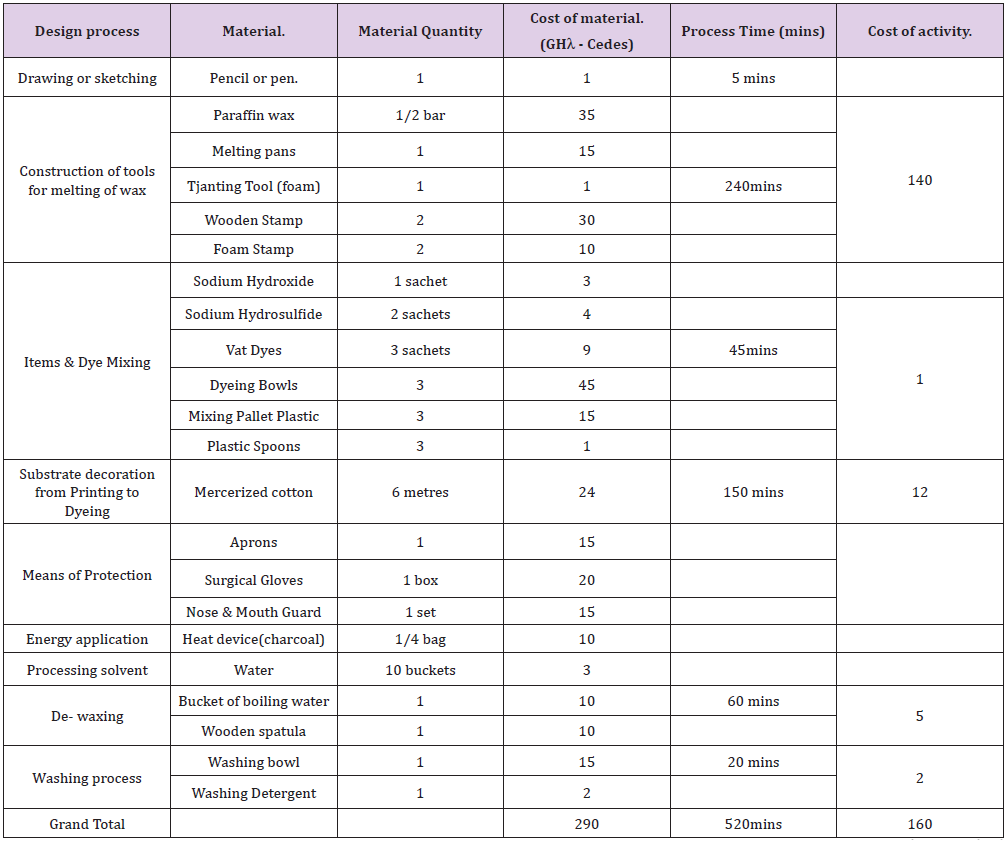
Table 2: Key Material Cost, Process Time and Cost of activity in Batik Production Process for the Proposed Intervention.
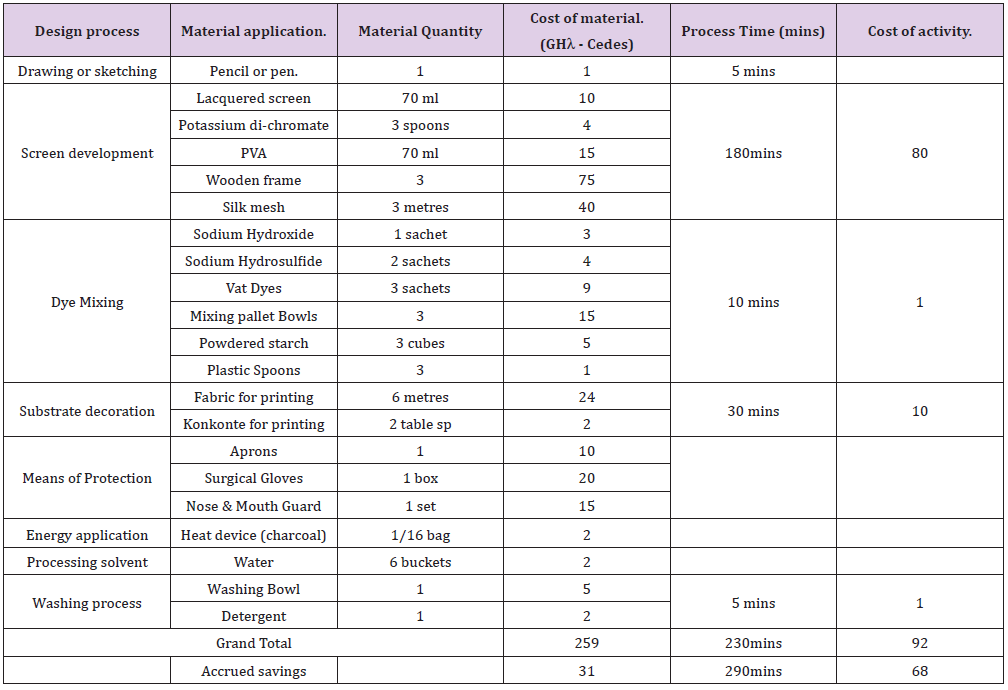
A critical factor worth mentioning was the fact that the chemical
content within the various pastes formulated for Table 2, required
a lacquered screen to secure its effectiveness of accommodating
the various formulated print pastes. This was extremely important
to avoid the chemical corrosion of the photographic film of the
screen during the printing process [12]. To commence, four types
of screens were developed,
a) Three of them was to transfer the varied dye paste to
produce the printed fabrics and
b) The last, was to allow the resist konkonte paste to cover
the already printed portions of the fabric, leaving the unprinted
portions uncovered to allow the intake of the dye during dyeing
by immersion.
Unlike the traditional batik printing process, all the three colors
were printed one after the other, before the final konkonte covering
and dyeing by immersion. Traditional dyeing however, followed a
series of waxing, dyeing, re-waxing and re-dyeing of colour dyes
within a two day period to achieve almost the same results. Thus, the
differential materials used are the cassava starch and the silk screen
instead of wax and wooden block. The outcome of the process is
an improved quality, alongside improved efficiency in production,
time management and waste minimization, an envisaged increase
in market share, creation of new markets, lower costs, innovation and
improved flexibility, which are all key performance criteria for
industries engaged in sustainable practices. The implication of this
intervention shows that use of the locally available raw material
saves cost by GH₡ 31.00, with a process time of 290mins and an
activity cost reduction of GH₡ 68.00. Additionally, operational cost
was reduced, resulting in improved profitability, worker safety and
the advantage of using an environmentally-friendly product and
minimizing environmental pollution.
The efficient use of cassava starch obviously ensures that
manufacturing activity are sustained due to their availability.
Having dealt with the main material that impedes safety in batik
manufacturing, the youth are likely to be encouraged to engage with
the industry to promote sustainable rural and urban development.
The implication of this intervention potentially offers the
possibility of marketing its products to both local and international
markets as it finds expression in traditional clothes and garments
to government and private organizations. Its patronage will even
increase if their aesthetic characteristics reflect the Ghanaian
identity or are the expression of the people’s culture through
cherished traditional apparels. This effort made to revitalize batik
making is an important driver for sustainable rural development
because any economy built on an available natural resource
base has the likelihood of improving the vocational sector of the
economy [16]. The youth equipped with such skill in schools will also
strengthen the concept of made in Ghana goods to facilitate
the patronage, promotion and the sustainability of locally made
textiles. Holistic Economic Development based on technological
innovation processes and natural resource exploitation is believed
to be the key to the future of the batik industry
Conclusion
This paper examined the sustainability of batik production and
its material development strategies in Ghana. It suggests that the
batik enterprises are important in economic and social terms, in
the short-run by providing incomes, jobs, especially for artisans,
and foreign currency receipts and in the long run by providing
the country the opportunity for sustained economic development
through appropriate technology to enhance the dynamic effects of
batik clothing. The potential of its raw materials and methodology
to contribute to long-run growth and sustainable development
depend not only on the qualities (desirable or otherwise) of the
product, but also on the quality and effectiveness of production
processes and availability of raw materials at a low cost within the
country’s forest and market space. The effects on employment of the
batik enterprises are quite significant for economic development
compared to the overall share of the country’s total employment
in the cloth manufacturing sector within the various communities
in Ghana.
An important factor for the sustainability of an enterprise is
the genuine involvement of the local people (farmers) as active
participants whose beneficial concerns and experience are
essential to the enterprise’s success [17]. The level of community
support determines whether the enterprise becomes successfully
established, and how it quickly responds and adapts to meet
changing needs. By exploiting Ghana’s low labour cost advantages
to fill emerging niches and meet buyer demands, its dynamic effects
for sustainability becomes even greater, if more linkages can be
built up between the production centres and the community. In
effect, the characteristics of the batik product (relatively low capital
intensity; low investment costs; and use of low skilled labour), also
mean that the industry is relatively footloose and able to adjust
to changing market conditions quickly and further increasing its
sustainability [18].
Though batik making is seen as a productive venture with
export potential, it lacks fast production approaches to meet higher
consumer demands and therefore needs to be revived and sustained
as an industry. Making room for new developmental ideas will
inject new techniques of production and make production easier
and sustainable. The selection of right material is critical, as it does
not only affect the product’s cost, enhance methodology, quality,
and growth of batik enterprises, but also impact the environment.
Adopting such innovative practices will guarantee the benefits
derived in the environment, to promote safety, minimize energy
utilization and health of producers [19].
Recommendations
It is highly recommended that batik be introduced into a broader
public space to provide a viable platform for engagement between academia and industry through studio base learning (workshops)
of batik design processes not only in educational institutions, but
also in batik making communities. The focus of sustainability and
development in this direction needs to be strengthened using
different local material components and design methodologies that
relate to traditional African textile culture. Finally, for sustainability
of the batik craft to be successful, it is also recommended that skills
training of batik producers be intensified and encouraged to create
new forms using varied methodologies.
Read More About Lupine Publishers Latest Trends in Textile and Fashion Designing (LTTFD) Please Click on Below Link: https://fashion-technology-lupine-publishers.blogspot.com/