Showing posts with label Peer Reviewed Dentistry Journals. Show all posts

Tuesday, 10 August 2021

Lupine Publishers| Atypical Implant Failure

 Lupine Publishers| Modern Approaches in Dentistry and Oral Health Care


Abstract

With an average survival rate of 95%, the endosseous dental implant is one of the most successful and predictable innovations in modern dentistry. The factors contributing to the success, and failure, of dental implants are now well-established [1-6] and include the oral and systemic health of the patient, patient age, implant type, implant surface, implant length, bone type, surgical site (mandible or maxilla), type of surgery (one- or two-stage) and immediate (fresh socket) or delayed implant placement. Other important aspects regarding the success of an implant include the skill, experience and, apparently gender, of the surgeon [7]. Early implant failures, a prevalence of about 5.6%, most often is observed in edentulous upper jaws, notably with implants having a turned surface. There is some controversy as to whether pre- and post-operative antibiotic coverage is needed, but overall antibiotic therapy can be helpful but apparently is only essential when infection is present.

Clinical

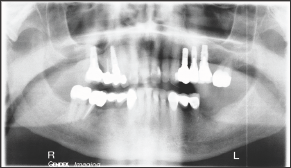
A healthy, well-nourished 76 year old man without systemic or oral diseases presented with missing teeth in tooth positions #18 and #19. The patient previously had successful implant surgery together with a sinus lift in the maxilla some years prior to the present surgery. The patient had no history of metal allergies and satisfied the selection criteria for successful implant surgery Pre-operative radiographs, Figure 1, showed that the bone at the surgical site was compact and well-vascularized. The satisfactory bone conditions at the implant sites were confirmed by CT scan. After fabrication of a placement template for the implants, sockets for the implants was prepared using the Nobel Biocare tapered osteotomy drill kit, utilizing the 2 mm twist drill, the 3.5 mm drill, the 4.3 mm drill and the 4.3 mm dense bone drill.

Figure 1: Pre-operative Panorex of the patient oral cavity.
Lupinepublishers-openaccess-dentistry-oral-healthcare

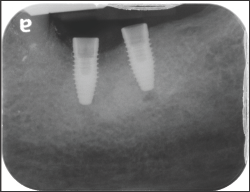
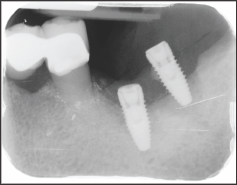
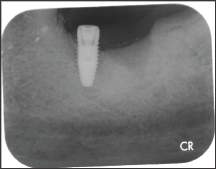
The placed implants were Nobel Biocare tapered conical implants, 4.3 mm diameter x 10 mm length. The implants were placed by the same surgeon in positions 18 and 19, Figure 2. No antibiotic coverage was deemed necessary because there was no evidence of infection at the surgical site. Four months after implant placement, the implant at tooth #18 started to extrude, Figure 3, followed by complete loss of the implant within 5 days. Follow-up radiographs and clinical examination showed no indications of infection at the implant site, Figure 4. There was no indication of epithelial down growth surrounding the implant at any time, and no soft tissue residue was noted on the revered implant.

Figure 2: Post-operative radiographs of placed implants.
Lupinepublishers-openaccess-dentistry-oral-healthcare

Figure 3: Post-operative surgical site at 4 months.
Lupinepublishers-openaccess-dentistry-oral-healthcare

Figure 4: Post-operative radiograph 5 days after loss of implant.
Lupinepublishers-openaccess-dentistry-oral-healthcare

Discussion

This implant failure appears to have no simple explanation. Implant failure within 6 months of placement is uncommon, occurring in about 5% of all cases. However, many of the recognized factors contributing to early failure did not apply in the present case. Both implants were placed by the same very experienced male surgeon. Further, there were no signs of pre-operative or postoperative infection and the surgical site was in the mandible rather than the maxilla, the latter being the more common site for early implant failure [7]. Interestingly although recent research suggests that the administration of prophylactic antibiotics may significantly reduce the prevalence of dental implant failure under ordinary conditions but certainly when infection is present or might be anticipated. Neither situation was present in this particular case.

It is possible that the design of the implant might have contributed to failure although when an identical implant was placed in the bone adjacent to #18, there appears to be satisfactory osseous integration. Overall, there appears to be no logical explanation for this individual implant failure since none of the potential contributory factors to early failure apply in this particular case. It is proposed that a different design of implant will be placed in 4-6 months’ time after complete healing of the implant site. Prior to surgical site preparation and implant placement, the authors intend to closely monitor both patient and the mandible to ensure success of the next surgery

Conclusion

Although the endosseous dental implant is one of the most successful and predictable innovations in modern dentistry and all factors contributing to the success of dental implants were satisfied in this particular case, failure still occurred. Operator skill and expertise were not in question in this case because the surgeon has placed over 2000 implants without incident over a period of years. The reason for failure is not clear and, certainly, implant #19 was deemed to be successful. The final conclusion to be drawn is that implant failures can occur for inexplicable reasons and from no readily ascribable causes.

Read More About Modern Approaches in Dentistry and Oral Health Care Please Click on Below Link: https://lupine-dentistry-oral-health-care.blogspot.com/


Sunday, 20 June 2021

Lupine Publishers| Combined Digital and Traditional Bite Registration

 Lupine Publishers| Modern Approaches in Dentistry and Oral Health Care


Introduction

A high percentage of dental restorative procedures failure is attributed to the failure of maintaining the patient's occlusal patterns, and this fact becomes more and more valid as the restoration is more and more extensive. Our need to evaluate the distribution and the quality of occlusal forces is of a growing importance along with our growing knowledge of the masticatory system's sensational perception in the Central Nervous System, keeping in mind that the CNS potential adaptation is of a limited capacity and this is related to some individual factors of the patient (age is a major factor).

Among the symptoms of inaccurate bite registration:

    i. Functional difficulty, may reach the extend of refusal and rejection of the assumed restoration

    ii. Distortion of speech, swallowing and breathing

    iii. Headaches, Ear pain, vision distortion, throat and neck pain

    iv. TMJ dysfunction

This concept applies to all kind of restorations including fillings, crowns and bridges, but it is very important in two special cases;

    A. Comprehensive Dental Treatment under General Anesthesia

    B. Full mouth rehabilitation

The digital bite registration can give.com a good idea about the patient's bite patterns before commencing any procedure, so we have an idea regarding the forces distribution and what are the needed modifications if any is undoubtedly needed and the quantity and quality of the required modifications.

The added conventional method is to create a stable position of the tray, so we can use it and reuse it as required without taking the risk of a new bite patterns when checks up are repeated. We can use any bite registration semi fluid material (silicon) keeping in mind the fast setting (20 seconds) plasticity and relative stability. This method will enable.com to avoid taking impressions to create models and usage of bite registration papers (blue papers). It is an accurate way to control and study new contact points in a scientific, up to date, readable and reliable procedure.

i. Choose the appropriate size of the bite tray (Figure 1).

Figure 1:

ii. Apply material on both sides (Figure 2).

Figure 2:

iii. Reasonable material thickness (4 to 5 mm) (Figure 3).

Figure 3:

    iv. Elimination of material in respect to the presumed treatment areas while trying to preserve tow points of contact on each side or at least one point on each side (Figure 4).

Figure 4:

    v. This technique is still under technical development and needs more clinical trials to achieve its most complete specifications (Figure 5).

Figure 5:

Some modifications might be implemented on the used materials (trays) simplifying the data reading and better understanding the brain interpretation to these stimulating signals.

Read More About Lupine Publishers Modern Approaches in Dentistry and Oral Health Care Please Click on Below Link: https://lupine-dentistry-oral-health-care.blogspot.com/


Thursday, 16 May 2019

Do you really know what Periodontal Disease is? by Jose Ricardo Kina in Modern Approaches in Dentistry and Oral Health Care in Lupine Publishers (MADOHC)- Lupine Publishers

Do you really know what Periodontal Disease is? by Jose Ricardo Kina in MADOHC in Lupine Publishers

The etiology includes the sum of evidences related to the causes of a disease. Majority of all forms of periodontal diseases, are considered as microorganisms-induced dependent. However, it is improbable that bacteria alone cause periodontal disease. The etiological concept of the inflammatory periodontal disease is an exceedingly complex interaction of bacteria and predisposing risk factors. The predisposing risk factor may be an inherent characteristic associated with an increased rate of a subsequently occurring disease, but does not necessarily cause the disease. In periodontal disease, the predisposing risk factors may be defined as local environmental factors, behavioral factors in nature and systemic factors, which may be responsible in providing an ideal environment for bacterial colonization and/or fragility in a determinate tooth or teeth and adjacent periodontal tissues and/ or interference in the inflammatory process. Local environmental factor may interfere in the fragile equilibrium of the gingival sulcus defense by favoring microbial colonization and growth or/and altering the local susceptibility of the periodontal tissues to be damaged by the bacterial onslaught.


For more Lupine Publishers Open Access Journals Please visit our website: http://www.lupinepublishers.com/

Thursday, 9 May 2019

The Dental Service of the French Army in 1940 - Lupine Publishers


On December 1 1892, the Brouardel law was voted which gave legal status to dental surgeons. At that point, those who had followed appropriate studies delivered by the Faculty of Medicine were the only ones who could practise dental surgery [1]. Therefore, it was a profession in its infancy which enlisted during the war in 1939? On February 26 1916, a dental service was created in the infantry within the French army for the duration of the war. That of the Navy only started on March 1st 1916. After the Great War, only the Navy decided to dissolve its dental service for it did not have a satisfying organization to greet its patients. In 1934, a backup dental service was implemented once again. While they were made lieutenants in 1818, dentists could become captains after the law voted on December 19 1934 [2]. A few months later, dentists in the land army were attributed the same rank.  


Friday, 3 May 2019

The Dental Service of the French Army in 1940 - Lupine Publishers


On December 1 1892, the Brouardel law was voted which gave legal status to dental surgeons. At that point, those who had followed appropriate studies delivered by the Faculty of Medicine were the only ones who could practise dental surgery [1]. Therefore, it was a profession in its infancy which enlisted during the war in 1939? On February 26 1916, a dental service was created in the infantry within the French army for the duration of the war. That of the Navy only started on March 1st 1916. After the Great War, only the Navy decided to dissolve its dental service for it did not have a satisfying organization to greet its patients. In 1934, a backup dental service was implemented once again. While they were made lieutenants in 1818, dentists could become captains after the law voted on December 19 1934 [2]. A few months later, dentists in the land army were attributed the same rank.


Tuesday, 30 October 2018

Hepatitis B Surface Antigen (Obsag) in Pregnant Women Attending Antenatal Clinic at The General Hospital, Amaku, Awka, Anambra State, Nigeria (IPDOAJ) - Lupinepublishers


This study was carried out to determine the prevalence of HBsAg among pregnant women attending antenatal clinic at General Hospital in Agba, Ekwulobia, Anambra State. Two hundred pregnant women who consented voluntarily after thorough explanation of the purpose of the study were recruited for this study. The samples were tested for the presence of antibodies using rapid Dia Spot HBsAg rapid test strip developed by Dia Spot Diagnostics, USA and ClinotechHBsAg (Clinotech diagnostics, Richmond, Canada). Analysis of the result showed that 23(11.5%) of the pregnant women had HBsAg. Statistical analysis, however, showed no significant difference between the prevalence and the age of patients, parity, trimester and type of family. The frequency of HBY carriers did not vary significantly with the Use of condoms and contraceptives. However, there was a significant frequency variation in the distribution of HBsAg between those that have previous history of transfusion, operation, circumcision and those who never had history of operation, transfusion or circumcision Therefore, the need to institute public health measures to reduce disease burden and transmission, including routine screening of all pregnant mothers for HBV infection and early passive-active immunization of babies born to HBsAg-positive mothers are advocated.

http://lupinepublishers.com/pediatric-dentistry-journal/abstracts/IPDOAJ.MS.ID.000129.php

http://lupinepublishers.com/pediatric-dentistry-journal/pdf/IPDOAJ.MS.ID.000129.pdf

Friday, 26 October 2018

Strategies for Reducing Dental Stress in Children (IPDOAJ) - Lupinepublishers


The dental office for children has always been scary and eerie. The reason for this fear is the lack of mental fitness of children towards the dental health environment. Unknown instruments, scary sounds of dental devices, and sometimes seeing others’ fears during dental procedures would affect the child’s mind; and creates fear within them. No research has pointed to the definitive causes of anxiety and stress, but some studies have shown that the bad experience of dental treatments associated with pain is one of the most common in this case

http://www.lupinepublishers.com/pediatric-dentistry-journal/abstracts/IPDOAJ.MS.ID.000126.php

http://www.lupinepublishers.com/pediatric-dentistry-journal/pdf/IPDOAJ.MS.ID.000126.pdf

Thursday, 4 October 2018

Posterior Indirect Adhesive Restorations: for Vital Posterior Teeth: Clinical Report (IPDOAJ) - Lupinepublishers


This article describes a case of compromised posterior vital teeth treated by indirect bonded ceramic restorations. A 24 year old female patient presented to the department of Prosthodontics. He was complaining about sensitivity in the posterior region. A comprehensive examination revealed failing amalgam restoration in the first molar with compromised cusps in the first molar. The treatment plan included indirect bonded ceramic restorations consisting of inlay and on lay on the concerned teeth.

https://www.lupinepublishers.com/pediatric-dentistry-journal/abstracts/IPDOAJ.MS.ID.000123.php

https://www.lupinepublishers.com/pediatric-dentistry-journal/pdf/IPDOAJ.MS.ID.000123.pdf

Wednesday, 3 October 2018

ND: Yag Laser Excision of Lower Lip Mucocelesin Pediatric Dentistry: 12-Year Follow-Up Case Report (IPDOAJ) - Lupinepublishers


Mucoceles is the most common benign minor salivary gland lesion commonly affecting children and adolescents, being more prevalent on lower labial mucosa with periodic rupture history and local trauma. A complete excision is recommended for mucoceles, including associated salivary gland tissue and marginal glands. Conventional surgical intervention as well as laser excision is indicated. This case report describes lower lip mucoceles excision with an Nd: YAG laser in a 6-year-old girl, with no recurrence after 12 years. When properly used, Nd: YAG laser can play a beneficial role to both clinicians and patients in achieving high quality results, as it provides good hemostasis, reduced postoperative swelling, bacterial reduction at the surgical site, lesser need for suturing, faster healing, and less postoperative pain. The success of this procedure was reflected due to a lack of recurrent lesion with a comprehensive follow up period of 12 years.

https://www.lupinepublishers.com/pediatric-dentistry-journal/abstracts/IPDOAJ.MS.ID.000121.php

https://www.lupinepublishers.com/pediatric-dentistry-journal/pdf/IPDOAJ.MS.ID.000121.pdf

Monday, 1 October 2018

Importance of Tooth Brushing in Pediatrics-A Short Review (IPDOAJ) - Lupinepublishers


A poor oral hygiene or any oral disease affects the oral health and then ultimately the general health of a person which in return influences the overall appearance of a person. Thus it is very important to take a good care of oral health. Oral hygiene is the practice of keeping the mouth clean and healthy by brushing and flossing to prevent gum diseases and tooth decay. It is done in order to prevent the plaque and food deposit on tooth thus to prevent caries and cavities.

https://www.lupinepublishers.com/ipdoaj/abstracts/IPDOAJ.MS.ID.000118.php

https://www.lupinepublishers.com/ipdoaj/pdf/IPDOAJ.MS.ID.000118.pdf


Friday, 28 September 2018

Effect of Twin Block Appliance on a Growing Patient – A Case Report (IPDOAJ) - Lupinepublishers


Twin block appliance is very effective in a growing patient. The successful use of this appliance in the treatment of skeletal Class II malocclusion is based upon factors such as; age of patient, compliance of the patient and other case selection criteria. This case report includes a 14-year-old boy who was treated with twin block appliance. If treated timely, growth modification and orthopedic effects with this appliance can be achieved in a growing individual. This appliance is very successful in a patient with retruded mandible and well aligned arches in whom VTO is positive. This brings the mandible forward and improves the profile immediately.

https://www.lupinepublishers.com/ipdoaj/abstracts/IPDOAJ.MS.ID.000117.php

https://www.lupinepublishers.com/ipdoaj/pdf/IPDOAJ.MS.ID.000117.pdf


Thursday, 27 September 2018

Oral Hemangioma Management in Children: A Concise Review (IPDOAJ) - Lupinepublishers


Head and neck region bears the burden of approximately 60% of all the vascular anomalies diagnosed, affecting about 1 in 22 children. These lesions, irrespective of the size, when present on the face are a major cause of esthetic concern and patient usually seek treatment for the same. Various treatment modalities are available and sclerotherapy with intra/peri-lesional injections of 03% Sodium tetra decylsulphate remains the mainstay of treatment in most cases. This article provides a concise review regarding various management options available for smaller vascular lesions especially emphasizing the role of sodium tetradcy sulphate.

https://www.lupinepublishers.com/ipdoaj/abstracts/IPDOAJ.MS.ID.000114.php

https://www.lupinepublishers.com/ipdoaj/pdf/IPDOAJ.MS.ID.000114.pdf

Tuesday, 25 September 2018

Dental Complications of Sucking Thumbs (IPDOAJ) - Lupinepublishers

Dental Complications of Sucking Thumbs by Karimi in IPDOAJ - Lupinepublishers

Putting a finger in the mouth and sucking it is the normal habit of all children that will not leave for many years. Sucking a thumb is a natural reaction in children that may be beneficial or harmful. Sucking a thumb or other fingers and sucking a pacifier or other objects gives a sense of safety or joy to the infants; and helps them to better understand the world around themselves. Behavioral and mood changes, reactions to family differences and lack of affection are the most important factors in sucking fingers in children. Significant complications such as speech impairment, irregularities in teeth, malocclusion, intra-oral ulcers, and wounds and scars on the thumbs can occur after long sucking of the fingers. With sucking, young children feel more relaxed and fall asleep. Most children leave this harmless habit before the age of two without any worries or interventions but the sucking habit in some children is so severe or repeated that it becomes a dental and social problem.

https://www.lupinepublishers.com/ipdoaj/abstracts/IPDOAJ.MS.ID.000111.php

https://www.lupinepublishers.com/ipdoaj/pdf/IPDOAJ.MS.ID.000111.pdf

https://www.lupinepublishers.com/ipdoaj/fulltext/IPDOAJ.MS.ID.000111.php

Monday, 24 September 2018

Thursday, 20 September 2018

Surgical Treatment of Natal Teeth from Standpoint of Haemorrhage Control, Infection Prevention and Application on Anaesthetics (IPDOAJ) - Lupinepublishers


Most babies, new-borns, get their first tooth between 5 and 8 months of age. The first teeth that poke through the gums are the central incisors, which are located on the bottom front. While most infants get their first teeth months after birth, some babies are born with one or more teeth. These are called natal teeth. Natal teeth are relatively rare [1]. Most studies however give an incidence between 1 in 2000 to 1 in 3500 live births. The incidence probably varies between different racial groups, with some American Indian tribes reported to commonly present with natal teeth. Statistical significance between regions is yet to be shown. [2] Natal teeth are said to be three times more common than neonatal teeth [3].

https://www.lupinepublishers.com/ipdoaj/abstracts/IPDOAJ.MS.ID.000104.php

https://www.lupinepublishers.com/ipdoaj/pdf/IPDOAJ.MS.ID.000104.pdf


Wednesday, 12 September 2018

Caries Survey in 3-5 Year Old Children in Dubai Schools (IPDOAJ) - Lupine publishers


Dental caries is considered the most prevalent chronic disease in the world, which affect individual from all ages. Host acceptability, cryogenic bacteria, fermentable carbohydrates and time are the four elements that are essential for the caries to start. dmft index is a measurement used to determine the degree of caries in any given population, in which it could help in setting aims and strategies to reduce and prevent this disease.