Abstract
Extraction of pectic acid by acid hydrolysis from citrus fruit peels
and its conversion in to textile printing paste thickener in order to
use it as an alternative substitute of sodium alginate thickener in
reactive printing was studied in this research. Printing with the
alternative thickener, sodium pectate, printed fabric characteristics;
color yield, color brightness and wash fastness were improved. Pectic
acid is extracted from the identified citrus fruit peels i.e. orange
peel, lemon peel and bitter orange peels. Extraction time, type of
solvent and extraction pH was standardized based on pectin yield
obtained. The research found environment friendly extraction of pectic
acid by sodium carbonate instead of acid hydrolysis with HCL or H
2SO
4.
Introduction
The citrus fruit is formed by the following fundamental parts: the
flavedo (external colored part of the peel), the albedo (white internal
part of the peel), the pericarp that contains the above mentioned parts,
and the pulp subdivided in to segments and viscose containing the juice
and the seeds, called endocarp. The peel, rag & seeds from the
juice extractors are combined with rejected fruits & becomes the
source of byproducts of citrus. The peel part which includes the inner
white part of the fruit contains pectin, amino acids and other
materials. The production of pectin is considered the most reasonable
way of utilization of the juice industry by-product both from economical
and ecological point of views. Pectin is present in the middle lamella,
primary cell and secondary walls and is deposited in the early stages
of growth during cell expansion. From byproducts of citrus fruit dried
citrus pulp, Molasses, Citrus peel oil, Citrus seed oil; alcohol,
pectin, & feed yeast have been produced to a lesser extent [1].
Pectin is found in most plants, but is most concentrated in citrus
fruits (oranges, lemons, grapefruits) and apples. Pectin obtained from
citrus peels is referred to as citrus pectin [2].
Pectin is used in a number of foods as gelling agent in jam and
jellies, thickener, texturizer, emulsifier and stabilizer in dairy
products, fruits preparations or in icings and frostings. It is also
used in pharmaceutical, dental and cosmetic industries for its
jellifying properties. It is generally produced by acid extraction of
citrus peel followed by filtration and precipitation by alcohol as
2-propanol [3]. There are three different extraction techniques of
pectin from citrus peels; acid hydrolysis, enzymatic and water
extraction methods. Compared with acid hydrolysis, enzymes extraction of
pectin is preferred despite of its cost because only a little effluent
in the filtrate and because of consumer demands for green products.
However, the mechanism of enzymatic extraction is still not fully
understood [4]. Water soluble pectins inside the plant cell wall of
plants can be easily extracted with boiling water. Although it is
conventional and the easiest means of extracting pectin, this method is
not applicable for commercial extraction of pectin because longer time
and elevated temperature is required to isolate adequate pectin from the
peels. Boiling the peels at elevated temperature for long time cause
degradation of the pectin during extraction and is relatively costly
because of the high energy requirement [5].
In this study, acid hydrolysis of pectin using HCL and H
2SO
4,
new Pectin extraction method using sodium carbonate and Conversion of
pectin into sodium pectate for textile reactive printing paste thickener
application was investigated. The advantages of sodium pectate as
thickener than using sodium alginate is also shown with comparative
study of the thickeners in terms of color yield, wash fastness and color
brightness.
Materials and Methods
Methods Materials, Equipments and Chemicals
The materials used for this study were 100% cotton full bleached
woven fabric, Dried Citrus Fruit peels, 8 scale gray staining and color
change scale. Beaker was used to boil the mixture of citrus fruit peel,
water and acid, stirring spoon, and thermo meter to control the
extraction temperature, weighing balance for weighing the amount of
chemicals and materials used for the extraction of Pectin, PH meter to
control extraction PH, launder-meter for wash fastness testing, mini
dryer to dry and cure printed fabric sample and spectrophotometer to
measure k/s value of the printed area [6-10].
H
2SO
4, HCL and Na
2CO
3
were used to extract pectin from citrus peels so were used. The solvents
used to precipitate pectin were ethanol, methanol and acetone. For the
conversion of pectin into sodium pectate, isopropyl alcohol, NaOH and
common salt are used. Isopropyl alcohol is used to wash the pectate and
common salt is used to solidify the derived sodium pectate. The
chemicals used to print cotton fabric were Sodium alginate as a
thickener, sodium carbonate as dye fixing agent, Dispersing agent to
form true solution of dye paste, Urea to prevent hygroscopic dye paste
and Reactive dye.
Method
Preparation of citrus fruit peel: Citrus fruit peels were
collected from juice industries. Ripened peels are sorted by identifying
with their color; orange color peels are ripened, the peels are washed,
dried and grinded into pieces.
Pectin extraction and conversion in to sodium pectate: 250
ml water was measured into a 500ml beaker and heated to 50oC. 25 gm
milled citrus peel was added to the water. Measured amounts of acid
added to the peel-water mixture trace by trace until the desired PH
obtained. The mixture was agitated at a constant temperature until the
desired extraction time elapsed. Using polyester fabric filter the solid
residue of citrus fruit was removed. The filtered solution is collected
and approximately the same the volume of solvent added for overnight
precipitation. Extraction of pectin Using Na
2CO
3
was carried out at 50oC with the same procedure followed in acid
hydrolysis but 500ml water and 50gm citrus peel was used in a bigger
beaker. The precipitate pectin is removed and pectin is reacted with
caustic soda and solidified by common salt [10-15]. The solidified
sodium pectate is dried in oven dryer at 50oc overnight and ground in
small plastic containers.
Printing and testing: Two Fabric samples were printed using
sodium pectate and sodium alginate as thickener. The Reactive printed
samples are tested for their color strength, wash fastness and hand
feels. Relative to the characterized properties the thickeners; alginate
thickener and sodium pectate thickeners were compared.
Result and Discussion
The experimental Design used was OFAT (One factor at a time). Three
extractions at PH of 2.6 using 0.5M Hcl, 150 ml of ethanol, methanol and
acetone, for 2 hours and 650c incubation temperature. The Experiment
was conducted to choose a solvent for the precipitation of pectin which
yields more pectin (Table 1). Keeping the other parameters constant,
only extraction time is varied to 1hr, 1hr and 30 minutes and 2 hrs and
using acetone to precipitate pectin (Table 2). Extractions were carried
out for 1 hr and half using acetone to precipitate pectin at varying
temperature (65oC, 80oC and 90oC) (Table 3).
Table 1: Keeping the other parameters constant, only
extraction time is varied to 1hr, 1hr and 30 minutes and 2 hrs and
using acetone to precipitate pectin.
 Table 2:
 Extractions were carried out for 1 hr and
half using acetone to precipitate pectin at varying temperature (65oC,
80oC and 90oC).
 Table 3:
 Solvent type selection, Extraction time,
Extraction temperature are already optimized. Optimization of PH is done
by using the selected solvent type, extraction time and extraction
temperature. Optimized temperature is identified by varying extraction
PH to 1.6, 2.6 and 3.6.

Solvent type selection, Extraction time, Extraction temperature are
already optimized. Optimization of PH is done by using the selected
solvent type, extraction time and extraction temperature. Optimized
temperature is identified by varying extraction PH to
1.6, 2.6 and 3.6 (Table 4). This study has investigated an alternative
way of extracting pectin from citrus fruit peels with minimized
environment pollution. The method is environment friendly and also
results in more pectin yield than acid hydrolysis of pectin. For
hydrolysis purpose sodium carbonate (Na
2CO
3) was
used. For 50gm dried milled peel 10gm of sodium carbonate was used. The
result from the experiment is as follows (Table 5).
Table 4:
Table 5:

Effect of pH
The effect of pH on extracted pectin yield was determined by adding
trace of HCL to alter the pH to the desired values of 1.6,
2.6, and 3.6. Because of slight changes in solution pH throughout the
extraction, it was difficult to repeatedly reach an exact pH so
approximately 2% error was allowed when measuring pH. The three
experiments showed that pectin yield was 23.2% at pH 2.6. The hydrolysis
of pectin is facilitated in soften peels. Lower pH, i.e., more strong
acid, dissolves the citrus peels [15,16]. The dissolved peels form a
thick paste of citrus peel. Pectin is entrapped in the thick paste
instead of dispersing through the filter solution. Less pectin amount in
the filter solution minimized the amount of precipitated and extracted
pectin. Increased pH above 2.6 result in less softness of peels which
result in less pectin wash off from the peels, as a consequence less
pectin yield.
Effect of Extraction Time
The noticeable trend occurred with increasing extraction time from 1
hour to 1:5 hour shows increase in pectin yield. Increasing the
extraction time further may result in pectin loss. Accordingly when
extraction time is increased from 1.5 to 2 hours the yield of pectin.
Flowing of pectin into extraction solution increase as extraction time
increases up to 1hr and half. Heating the mixture of peels and
water-acid mixture more than 1hr and half will dissolve peels instead of
softening and minimize the pectin yield.
Effect of Temperature
With increasing extraction temperature up to 65oC pectin yield will
increase. Increasing the extraction temperature further result in pectin
loss. When extraction Temperature is increased above 65oC the yield of
pectin will be minimized. Wash-off of pectin into extraction solution
increase as extraction time increases up to 650C after which the yield
starts declining. Heating the mixture of peels and water-acid mixture
above 65oC will dissolve peels instead of softening and minimize the
pectin yield.
Extraction of Pectin using Na2CO3
Extraction with Na
2CO
3 has some advantages than acid hydrolysis of pectin from citrus fruit peel. Extraction carried out using Na
2CO
3 hydrolyzing agent has yielded more pectin. It is also environment friendly compared to acid hydrolysis. Na
2CO
3
extracted pectin has improved solubility compared to acid hydrolyzed
pectin due to the presence of sodium ion which may give solubility for
the extract.
Conversion of the Extracted Pectin into Sodium Pectate
The isolated precipitate of pectin which is very slightly gummy and
somewhat rubbery was grounded to fine powder and the added to a mixture
of 50% isopropyl alcohol and NaOH in solution and then stirred every 5
minutes at room temperature until it creates viscose solution. Finally
sodium pectate is formed after which it was filtered to remove excess
liquid and washed with water followed by isopropyl alcohol wash to
remove excess alkali [17-20]. The pectate may be hydrated during water
wash and it must be given consideration to not cause so. Then the dried
pectate was solidified with common salt and made ready to serve as
printing thickener.
Printing Fabric Samples and Testing Printed Fabrics Performance
Evaluation of printing performance was carried out in terms of color
strength, wash fastness, rubbing fastness and fabric feel. Two printed
fabric samples, one sample (S1) printed by commercial sodium alginate
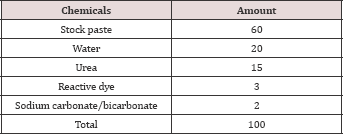
and the other one (S2) with the derived sodium pectate. The recipes for
the samples were (as shown in Tables 6 &7):
Table 6: Stock Paste Recipe.
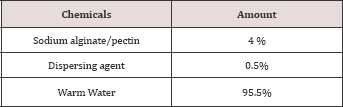 Table 7:
 Printing Paste Recipe.
 Procedure for the printing:
 The printing was carried out using screen printing technique. The procedures followed were as follows.
a) Prepare printing paste: The paste should be as uniform as
possible. For uniform mix prepare the printing the recipe for stock
paste (as shown in Table 1) was mixed for 5 min at maximum speed. Then
mix the components for printing paste recipe as shown in the Table 2.
The actual quantity of water was to vbe determined practically.
Viscosity should be in such a way that the paste should flow easily
while printing but maintaining the sharpness of the images to be
printed. Two printing pastes were prepared for alginate thickener and
pectin separately.
Figure 1: Printed fabric Samples a) Printed with sodium alginate (S1) b) printed with the derived Sodium Pectate (S2).
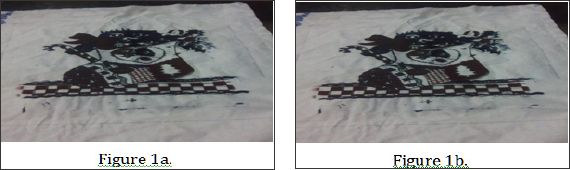 b) Printing: After preparing the paste and sample, the next process
was application of paste onto the sample. Put the sample under the
screen with proper positioning of the design, put the paste at one side
the screen spread uniformly along the width of the design, move the
squeegee from one side to the other pushing the paste towards the other
side and down wards at the same time. Here the inclination angle of
squeegee and pressure applied was very important, these should be
uniform, angle the squeegee should be held at 450C approximately.
Accordingly two samples were done for alginate and another two samples
were done for pectin printing performance evaluation (Figure 1).
b) Printing: After preparing the paste and sample, the next process
was application of paste onto the sample. Put the sample under the
screen with proper positioning of the design, put the paste at one side
the screen spread uniformly along the width of the design, move the
squeegee from one side to the other pushing the paste towards the other
side and down wards at the same time. Here the inclination angle of
squeegee and pressure applied was very important, these should be
uniform, angle the squeegee should be held at 450C approximately.
Accordingly two samples were done for alginate and another two samples
were done for pectin printing performance evaluation (Figure 1).
c) Drying: Then the samples were dried at 60oC for 3 min and cure at 150oC for 5 min.
d) Printing performances: Of the printed samples were measured in
terms of Color strength, wash fastness, handle feel
and rubbing fastness. Color yield of each of the samples was measured
using Data color 650 TM spectrophotometer and wash fastness was assessed
using laundry meter. For assessing the performance of the two
thickeners in terms of wash fatness gray scale and gray staining was
done. Accordingly printing performance of the thickeners along with the
obtained result is concluded in the following (Table 8).
Table 8: Performance in terms of Color Strength (k/s).

As it is observed from the experimental data, sample fabric printed
with alginate thickener (S1) has reflectance and K/S value slightly
higher than sample fabric printed with the Extracted sodium pectate
(S2). Decrease in reflectance and K/S value represents higher shade
darkness. Sade darkness increase with increase in dye absorption. This
truth has shown sodium pectate thickener yield more color strong print
than sodium alginate thickener even though the difference is neglecting
(Table 9).
Table 9: Performance in terms of Color Strength (k/s).
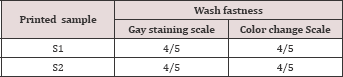 Performance in Terms of Wash Fastness:
 Wash fastness was
tested using the standard test method. 5g/l detergent, MLR 1:30, heat
setting at 100oC for 30 minutes was used. Then gray staining and color
change scales are tested using 5 scale gray scale and gray staining
card. Both alginate and pectate printed fabric samples have shown very
good wash fastness.
Conclusion
Pectin extraction from citrus peels can be carried out by either of
water extraction, acid hydrolysis, alkali hydrolysis, enzyme extraction
and using sodium carbonate as hydrolyzing agent [21,22]. In this
particular study extraction of pectin with Na
2CO
3
is given preference since it yielded more pectin and since it has
advantages like environment friendliness, more solubility in water due
to presence of the sodium ion which is functional to make compounds
soluble.
The conversion of pectin into sodium pectate by reacting pectin with
caustic soda in isopropyl alcohol must be controlled and given
concentration for the production of high quality pectate thickener.
Since the derived sodium pectate is washed with water and then with
isopropyl alcohol for the production more pure pectate, care must be
given during water washing to not hydrate the derived pectate.
Solidification of the pectate is done by using common salt.
Sodium pectate thickener printed fabric sample has absorbed more dye
than sodium alginate thickener printed fabric sample. The lower
reflectance and k/s value has recorded for fabric sample printed with
the derived sodium pectate. Even though the difference is neglect able;
this truth justified that sodium pectate is more inert thickener than
alginate thickener. That is the suspect behind more color strong of
sodium pectate. Both alginate and pectate printed samples have very good
wash fastness. Since the printing is reactive printing then the
attachment of the dyes to the fibers are by covalent bond.
Generally speaking; citrus fruit peels can be used for the production
of reactive printing thickeners by acid hydrolysis, using sodium
carbonate to hydrolyze pectin in citrus fruits, or other extraction
techniques. First pectin is extracted then pectin is reacted with
caustic soda forming crude sodium pectate. The crude sodium pectate is
then washed in water and in isopropyl alcohol successively to increase
the purity of the pectate. The derived
sodium pectate is used as textile printing thickener for reactive
printing in the same manner alginate is used.