This study evaluated the quality of honey imported from eighteen
different countries into Saudi Arabia. Twenty pesticides,
5-hydroxymethlfurfural and the antibiotic chloramphenicol were analysed.
Approximately 20% of honey was rejected out of 712
consignments. Ten countries breached the regulations for one or more of
the following: exceeding the MRLs, using banned pesticides
or presence of chloramphenicol. Three neonicotinoids; acetamiprid,
imidacloprid and thiamethoxam was found in combination
with other pesticides. The HMF content of honey from eight exporting
countries exceeded 80mg/kg. Despite the years of monitoring
for pesticides, breaches of MRLs continue to be reported. Recommendation
for more stringent approaches to the management of
pesticide along the supply chain are suggested as the implications to
bee pollinators, environment and human life are wide, varied
and unsafe.
Keywords: Pesticides; Monitoring; Honey; Saudi Arabia
Introduction
Honey is defined by Codex Alimentarius [1] as the natural sweet
substance produced by honey bees from the nectar of plants or from
secretions of living parts of plants or excretions of plant sucking
insects on the living parts of plants, which the bees collect, transform
by combining with specific substances of their own, deposit,
dehydrate, store and leave in the honey comb to ripen and mature.
The demand for natural sweeteners is on the increase globally [2-3]
and many consumers prefer honey since it has a multitude of uses
and benefits [4-5]. In Saudi Arabia, and in many other countries,
the major motivators for consuming honey include health and wellbeing,
medicinal and nutritional value [6]. However, bee products
can also be a source of toxic substances [7-8]-antibiotics (such as
chloramphenicol) [9], pesticides (neonicotinoids) [10] and heavy
metals (e.g lead, cadmium and arsenic) [7] due to environmental
pollution and misuse of beekeeping practices. Pesticide residues
have been implicated in genetic mutations and cellular degradation
while the presence of antibiotics may increase resistance in human
or animal pathogens. In addition, Abeshu and Gelata [6] reported
there have been cases of infant botulisms that have been attributed
to contaminated honey. Honey that has not been analysed and
sterilized should not be used in infants and should not be applied
to wounds or used for medicinal purposes. The Maximum
Residue Limit (MRL) set for neonicotinoids by the European
Union Commission are 50ng/g for acetamiprid, imidacloprid and
thiacloprid and 10ng/g for clothianidin and thiamethoxam [11]. Due
to their high acute toxicity and concern, the European Food Safety
Authority re-assessed the risks and placed a moratorium in 2013
on three [12-14] of the most harmful neonicotinoids (imidacloprid,
clothianidin and thiamethoxam). The poisoning of bee pollinators
is a result of serious adverse effect of insecticide use, which leads to
a drastic decrease in the insect numbers, reduction of honey yields,
destruction of plant life, presence of insecticide residues in food,
and ultimately, to significant losses in the income of beekeepers.
Thus, the main purposes for monitoring bee products are to assist
in public health protection, global commercial competition and to
realise better quality products. In addition, this provides a greater
understanding of some of the issues in the supply chain with regard to
pesticide loads as bee pollinators have been recognised as
bioindicators of environmental pollution [15].
Saudi Arabia imported US$73 million worth of honey and the
worldwide importation of honey totalled US$2.01 billion in 2019
[16]. In international trade, the quality of honey will vary depending
on a number of factors. These may include the authenticity (nature,
organic, region etc) type of honey (blossom honey, honeydew honey,
comb honey, filtered honey, bakers honey etc), moisture content,
electrical conductivity, diastase activity, 5-hydroxymethylfurfural
(HMF) content, antibiotics, colour and sugar content (glucose and
fructose together and sucrose). According to Codex Alimentarius
Standard [17] these quality standards are not compulsory for
governments and can be voluntarily agreed upon, while according
to the EU draft they have to be fulfilled by all commercial retail
honeys. Many organisations use the Codex Standard for Honey
but importing countries may use this standard with their own
stipulation that vary in specifications. This work examined the
quality of imported honey arriving at the Port of Jizan in Saudi
Arabia. The objective of this study was to analyse the imported
honey from different regions around the world in order to highlight
the variances in the quality of honey by country. In addition, the
results of this study will provide guidance to importers as well as
competent authorities about breaches and practices in the countries
of origin. Recommendations for Good Agricultural Practice (GAP)
that incorporate HACCP and rigorous auditing are made.
Materials and Methods
Sample Collection
Our approach utilises the sampling method by Grainger (2000)
[18]. Product arriving at the Port of Jizan during 2018 was placed
on hold until the final results were obtained. Each consignment
was randomly sampled at 2.5% of the volume of shipment. Drums
were thoroughly mixed using a paint mixer for five minutes. After
allowing two minutes for settling of contents, three samples were
removed, one from the top, one from the centre and one from the
bottom. Each sample was analysed in triplicate. Any product in
bottles within cartons was also sampled at the above rate.
Analytical Procedures
Determination of Pesticides
Pesticide analysis was conducted using the procedure by
Camino-Sanchez et al (19) as reported in Khatri et al. (20). The
pesticides acetamiprid, imidacloprid, carbendazim, methomyl,
metalaxyl, pyridaben, indoxacarb, azoxystrobin, difenoconazole,
tebuconazole, boscolid, linuron, ethion, metalaxl-m, chlorpyrifos,
thiamethoxam, mycobutanil, hexythiazox, chinomethionat and
biphenyl were determined by means of liquid chromatography
coupled with tandem mass spectrometry (LC-MS/MS) using
standards obtained from Dr. Ehrenstofer GmbH (Germany).
Extraction Procedure
Accurate sample weights of 10±0.1g were measures and then
samples were transferred into a 50ml PTFE tube (extraction
kits). To this 10ml acetonitrile was added and shaken vigorously
for 1 min. Buffer salt was added. The mixture was then shaken
vigorously for 1 min and centrifuged at 10 000 RPM for 10 min.
The upper clear solution was transferred into dispersive solid
phase extraction tubes (15ml Polyethylene tube) containing 150mg
primary secondary amine (PSA) and 900mg anhydrous magnesium
sulphate. The tube was capped and the extract was mixed with
sorbent and vigorously mixed for 1 min followed by centrifugation
at 4000 RPM for 5 min. Two millilitres of the clear extract was
transferred into stoppered vials.
Analytical Procedure
The preferred technique for determination of multiresidue
methods reported for fruits and vegetables are based mostly on
the use of liquid chromatography coupled with tandem mass
spectrometry (LC-MS/MS). LC‐MS/MS was performed with an
Agilent 1200 series HPLC instrument coupled to an API 3200 Qtrap
MS/MS from Applied Biosystems with electrospray ionization
interface (ESI) (AB SCIEX, Dublin, CA, USA) and operated under unit
mass resolution. The pesticide analysis procedure was conducted
as reported in [15] by Sanchez et al (2010). The samples were
extracted following the quick, easy, cheap, effective, rugged and safe
method known as QuEChERS.
A 20μl sample extract was injected for chromatography into a
C18 column ZORBAX Eclipse XDB‐C18 4.6x150mm, 5μm particle size
(Agilent, Santa Clara, CA, USA), in which Mobile Phase A contained
5mM ammonium format and Mobile Phase B was methanol. An ESI
source was used in the positive mode, with nitrogen as the nebulizer
curtain gas. Other gas settings were optimized according to
recommendations made by the manufacturer; source temperature
was 300 °C, gradient elution programme was 0.3ml/min flow, ion
spray potential: 5500 V, de‐cluster potential and collision energy
were optimized using a syringe pump by introducing individual
pesticide solutions into the MS instrument to allow optimization of
the MS/MS conditions.
Identification and Quantification
The selected reaction monitoring (SRM) mode was used in
which one transition ion product was used for quantification and the
other for confirmation. The identification of a pesticide residue was
considered to be confirmed when the retention time of the pesticide
matched with that of the pesticide in the pure standard in and the
appearance of two product ion transitions that matched the relative
intensity criterion under SRM conditions. Once the presence of a
pesticide residue was confirmed in an extract, the concentration of
the residue was obtained from the appropriate calibration function which
corresponds to the matrix‐matched calibration standards.
Calibration standard curves were produced by plotting the peak
areas for each pesticide versus its concentration with the matrixmatched
standard solution and used for the quantification of each
pesticide in the sample extract. All sample analyses were conducted
in triplicate. The standard curves were linear in the range 0.005-
0.200μg/g with correlation coefficients greater than 0.998. The
concentration of the pesticide in the sample extract, Cs (μg/g), was
calculated using the following formula:
Cs = Ci x Vtot/Ve x Vf/W
Where:
Cs = sample concentration (μg/g)
Ci = injection concentration (μg/ml)
Vtot = total volume of extraction (ml)
Ve = volume for evaporation (ml)
Vf = final volume (ml)
W = sample weight (g)
Antibiotic Determination
Chloramphenicol testing was achieved using the method
provided by Ortelli et al. [10]. LC-MS/MS was utilised to test samples
against a chloramphenicol standard from Thermo Fisher Scientific
(UK). The AB SCIEX Triple Quad 3500 system enables relatively
rapid laboratory performing antibiotic testing and was operated
with Turbo V source and Electrospray Ionization (ESI) probe set
to 500°C. QuEChERS extracts were diluted 10 times with water to
minimize possible matrix effects. Honey samples were diluted with
5 times water and injected directly. LC separation was achieved
using a Phenomenex Kinetex Biphenyl 2.6u (50 x 2.1mm) column
and a fast gradient of water and acetonitrile with 0.1% formic acid
at a flow rate of 0.5 mL/min. An injection volume of 10μl was used.
Determination of 5-Hydroxymethylfurfural
HMF content was measured using method by Winkler [23] as
reported in Zapalla et al. [24]. Ten grams of honey were dissolved in
20ml water and transferred to a 50ml volumetric flask. Exactly 2ml
of the diluted honey solution and 5.0ml of p-toluidine solution were
placed in two separate test tubes; to the first tube 1ml of distilled
water was added (this acted as a reference solution); to the second
tube, 1ml of 0.5% barbituric acid solution was added (this was the
sample solution). The absorbance of the sample was measured
against the blank at 550nm was determined using a Varian UVVIS
Cary 400 spectrophotometer. For the calibration, a standard
solution of 0.300μg of HMF was spectrophotometrically assayed.
The quantitative value of HMF was calculated using the proposed
formula for the method [25].
Statistical Analyses
Data analysis was performed using SPSS software, version
19.0 (IBM Corporation, Armonk, NY). Descriptive statistics for
frequencies and ranges were used to summarise the variables of
interest.
Results and discussion
Table 1: Pesticides Detected in Imported Honey.
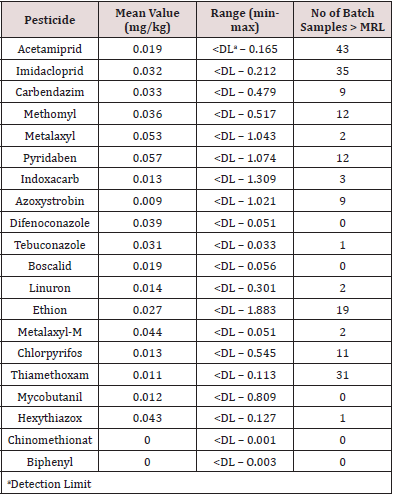
A total of 712 batches of product from 18 countries (Benin,
New Zealand, Poland, Bulgaria, Pakistan, USA, Morocco, Hungary,
Portugal, Kazakhstan, Kyrgyzstan, Tajikistan, Slovenia, Turkey,
Italy, France, UK and Germany) were analysed. Products were
rejected based on any one of the following - exceeding the pesticide
MRLs or presence of banned pesticides, detection of the antibiotic
chloramphenicol or HMF greater than 80mg/kg. Figure 1 shows
that 19.9% of product was rejected (n=142) with 80.1% being
accepted (n = 570). The countries breaching the limits are shown in
Figure 2. These countries were: Benin 8 batches, Pakistan 6 batches,
Kazakhstan 12 batches, Kyrgyzstan 52 batches, Tajikistan 6 batches
(all being rejected), Slovenia 12 batches, Turkey 9 batches, Italy
27 batches and France 8 batches. The number of accepted batches
were 13, 161, 3, 8, 10, 2, 8, 2, 1, 32, 69, 78, 25, 126, 24, 8, and 3
for Benin, New Zealand, Poland, Bulgaria, Pakistan, USA, Morocco,
Hungary, Portugal, Kazakhstan, Kyrgyzstan, Slovenia, Turkey, Italy,
France, UK and Germany respectively. The number of samples
from various batches containing different pesticides is shown in Table 1. There were 192 breaches of MRLs in the 712 batches.
One or more of these pesticide residues was present in some of
the imported batches. Thus, neonicotinoids coexisted with other
pesticides which could increase harmful effects to pollinators and
humans. Ethion, acetamiprid, carbendazim and imazalil are banned
in Saudi Arabia and their presence is a concern for importers as
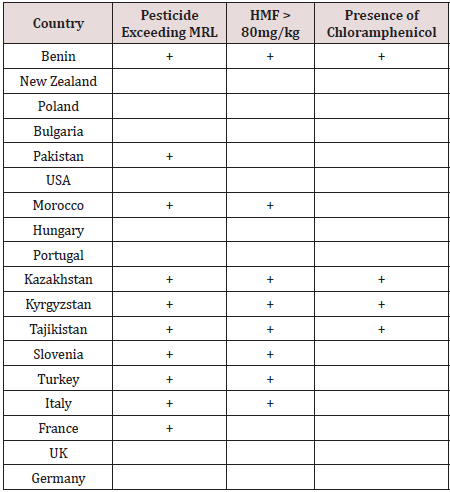
well as exporting bodies. Table 2 the reasons applied for rejection
are provided by country of origin. Benin, Kazakhstan, Kyrgyzstan
and Tajikistan had consignments rejected due to the presence
of chloramphenicol, exceeding the MRLs authorised for human
consumption and levels of HMF greater than 80mg/kg. Batches
from Morocco, Slovenia, Turkey and Italy contravened the MRLs
as well as the HMF requirements while honey from Pakistan and
France breached the MRLs only.
Figure 1: Percentage of Imported Honey Rejected/Accepted.

Figure 2: Compliance Rate for Imported Honey.
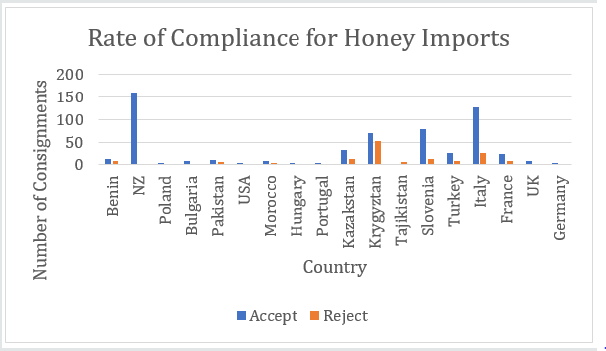
Table 2: Reasons for Rejecting Imported Honey from Various
Countries.
In the study by Mitchell et al. [11], they found neonicotinoids in
75% of the samples, although, concentrations in all cases were below
the admissible levels. Many pesticides were present in tandem with
others. Despite this fact, evidence from two fairly recent studies
[26-27] on the impact of neonicotinoids on human health could
warrant re-evaluation of the MRLs towards more stringent levels
and control measures, especially, when up-regulation of nicotinic
a4b2 Achars receptors in mammalian brains during long-lasting
exposure and higher affinity metabolites have been found using
imidacloprid. Sub-lethal effects of neonic pesticides on bees have
been documented as suppression of the immune system, cognitive
ailments, impaired reproductive function, queen survival and poor
honing capacity [11]. The level of HMF in honey is an indicator
of freshness and quality. It is formed from reducing sugars on
heating in the Maillard reaction under acidic conditions. Typically,
HMF is absent in honey (or is present in only very small amounts
in fresh honeys), while its concentration tends to rise during
processing and/or because of storage. HMF has been shown [22,
28] to have negative effects on human health, such as cytotoxicity
toward mucous membranes, the skin and the upper respiratory
tract, mutagenicity, chromosomal aberrations and carcinogenicity
toward humans and animals. The maximum levels of HMF used in
international trade is 40mg/kg. However, a level of 80mg/kg is used
for tropical honeys and bakers honey.
Chloramphenicol is normally used to control bee brood disease
[8]. Both Codex and EU Standards prohibit the use of antibiotics
in honey. It is permitted in some countries such as India and Iran
[29], Turkey [30] and has also been detected in samples from
China that were imported into Canada [31]. Concerns relating to
antibiotics include allergic reactions in hypersensitive individuals
and disorder of the haemopoietic system, or problems indirectly
through induction of resistant strains of bacteria. It is quite clear
that the quality of honey provides invaluable information about
certain aspects in the supply chain. Measuring pesticide MRLs
and antibiotic residues (in this case chloramphenicol) have
revealed issues about misuse of neonicotinoids and prohibited
pesticides and excessive use beyond internationally recognised
standards, several pesticides used in combination as well as some
of the countries flaunting the regulations and utilising banned
substances. Measuring the HMF level reveals information on further
processing which includes heating and also of its age. Bee and other
pollinators, the environment and human health are at risk and
therefore agricultural authorities are urged to provide appropriate
and rigorous training for the use of pesticides, provide a clear
understanding between importing and exporting bodies as well as
importing country legislation. Furthermore, auditing of facilities
with rigid specifications should include HACCP requirements on
farm in line with GAP.
Conclusion
Imported honey into Saudi Arabia from eighteen countries was
analysed for pesticides, chloramphenicol and HMF. Approximately
20% of imported honey was rejected. Moreover, imported honey
from 10 countries breached the MRLs and in some cases, with
pesticides that have been banned as well as the presence of
chloramphenicol from four countries. HMF was in excess of 80mg/
kg from 8 countries. Routine monitoring programmes for pesticides
in honey can assist in the prevention, control and reduction of
pollution of the environment and minimise risks to health. However,
more rigid approaches to the management of pesticide along the
supply chain are necessary. These include training for all individuals
concerned with specified objectives, audit schemes on bee farms,
assisting bee farmers to reduce the risks of contamination,
understanding of legal requirements and specifications in domestic
and international trade as well as cooperation between competent
authorities and exporting countries. The reduction of pesticide use,
in particular neonicotinoids is essential as bee and other pollinators
are at high risk. With dwindling bee populations across the globe,
the long-term production of honey that is sustainable and safe for
human consumption will require agriculture authorities, policy
makers and epidemiologists to intervene rapidly as the supply of
honey may be threatened.
Read More About Lupine Publishers Journal of Food and Nutrition Please Click on Below Link:
https://lupine-publishers-food-and-nutrition.blogspot.com/