Showing posts with label Chemical Sciences Journal. Show all posts

Thursday, 20 May 2021

Lupine Publishers | Heavy Metals Removal from Wastewater by Adsorption on Modified Physically Activated Sewage Sludge

 Lupine Publishers | Journal of Organic and Inorganic Chemical Sciences


Abstract

Low cost adsorbent (activated carbon) with a high metal adsorption capacity was prepared from the disposal sewage sludge by physical activation method (Pyrolysis temperatures at 500 °C, 650 °C, 700 °C, 800 °C and 900 °C). The resulting material was evaluated as adsorbents for the removal of Cd, Pb, Cu, and Mn from aqueous solution. The results revealed that sewage sludge activated by pyrolysis at 800 °C [ASS800] was the most effective adsorbent for the removal of Cd, Pb, Cu and Mn from polluted water. Batch studies were performed to evaluate the influences of various experimental parameters such as pH, initial metal ion concentration, adsorbent dosage, and contact time and solution temperature. Adsorption of Cd, Pb, Cu and Mn by ASS800 increased with increasing pH and adsorbent dosage, while decreasing with the increase of initial metal concentration. From batch adsorption data the optimum conditions for the adsorption of Cd , Pb, Cu and Mn by ASS800 were 1gL-1 adsorbent dosage, 1 hour contact time, 10mgL-1 initial metal concentration, 25 °C solution temperature; and pH 6 . Adsorption data were well fitted to the Langmuir, and Freundlich isotherms. Thus, simple pyrolysis provide conversion of sewage sludge into inexpensive low-rank adsorbent potentially useful for the removal of heavy metals from polluted water .

Keywords: Adsorption; Heavy metals; Activated carbon; Sewage sludge; Treatment

Introduction

Sewage sludge as waste material produced from the treatment of municipal waste water. Due to their unstable nature of biomass, sewage sludge disposal may cause environmental problems, so it is important to save environment from pollution with this sewage sludge. For converting the sewage sludge to more useful material [1].

Sewage sludge contains high organic contents from 60 to 80%; therefore it is important to use the sewage sludge for the production of low-cost activated carbons [2]. Sewage sludge has received great attention in the preparation of effective adsorbents with environmental applications. Adsorbents from sewage sludge have been prepared by different methods includes chemical activation [3-6], and physical activation [7-9].

Various types of adsorbents were developed from sewage sludge. De Filippis et al. [10] studied the removal of Cu, Zn and Cd from wastewater using adsorbents produced from pyrolysis of sewage sludge at 550 °C. Rashed et al. prepared adsorbent by chemical activation of sewage sludge. [7] studied the removal of copper from synthetic wastewater by adsorption on sewage sludge adsorbent [11] prepared activated carbon from sewage sludge by the pyrolysis at 500 °C for 3h. Rashed [12] used washed sewage sludge and sludge activated carbon as adsorbents for removal of Acid Blue 93 from industrial wastewater. Hammaini et al. studied the effect of pH and biomass concentration on the biosorption of Cu, Cd, Zn , Ni , and Pb using activated sludge.

In this study, physically activated adsorbent was prepared from sewage sludge by pyrolysis it at various temperatures (500 °C, 650 °C, 700 °C, 800 °C,or 900 °C) and time. The developed suitable adsorbent was applied for adsorption and removal of Cd, Pb, Cu, and Mn ions from aqueous solutions. The removal efficiency of the developed adsorbent was investigated as a function of pH, contact time, initial metal concentration, temperature and adsorbent dose.

Material and Methods

Material, chemicals and reagents

All chemicals and reagents used were analytically grade. All the batch experiments were carried out in a Pyrex conical beaker (100ml) at room temperature under mechanical stirring (150rpm), the solution pH was adjusted with (1N) NaOH or HCl.

Sample collection

Sewage Sludge: Sewage sludge sample (5Kg) was collected from sewage sludge disposal of Kima wastewater treatment plantat Aswan city, Egypt. The sewage sludge mixed liquor was washed with distilled water, air dried in a clean place, and then oven dried at 105 °C for 24h. The resulting adsorbent was grinding and sieving within 63|im . The chemical composition of sewage sludge sample was cited in Table 1.

Table 1: Chemical composition of raw sewage sludge.

Lupinepublishers-openaccess-journals-chemistry

Wastewater Sample: Wastewater sample was used to evaluate the potential efficiency of the developed adsorbents for the removal of heavy metals from wastewater. Water sampler, with handle 500ml, was used for collecting wastewater from the laboratory (heavy metals analysis) of Aswan branch of the Environmental Affairs Agency. Samples were filtered by filter paper (Whatman-42), collected in 1liter polyethylene bottles and preserved in the refrigerator at the 5 °C until the experiment.

Adsorbents preparation

Pyrolyzed materials were obtained from the dried sewage sludge (100 g) by thermal treatment for 30 min in a muffle furnace at different temperatures (500 °C, 650 °C, 700 °C, 800 °C and 900 °C ) for 1h. The resulting materials, after cooling, were washed with 1M HCl solution, followed by filtration, and then washed with deionized water until the pH of leached solution was between 6-7, after then it were dried at 105 °C for 24h, crushed and sieved to 63|im. The resulted adsorbents were labeled ASS500, ASS650, ASS700, ASS800, and ASS900, respectively. A washing procedure by 1M HCl solution and deionized waterwas to remove acid-soluble inorganic matter and residual activating reagent.

Adsorption experiments

Comparative study of the developed sewage sludge adsorbents: Dosage 150mg of the prepared adsorbents (ASS500, ASS650, ASS700, ASS800, ASS900) was stirred with 50ml single metal standard solutions (Cd, Pb, Cu and Mn) for 8h. The solution pH was adjusted to pH 6. Experiments were under gone with different initial metal concentration (10, 30, 50 and 75mgL-1), with solution temperature 25 °C. After an equilibrium contact time 8 h the samples were filtered through What man filter paper No.42. The metal ion concentration in the filtrate was measured by atomic absorption spectrophotometer and the removal percent of the metal ion by each ASS was calculated.

Batch adsorption

After selecting the best adsorbent ASS800, the following batch adsorption were carried to determine the optimum condition for adsorption process. For the effect of initial metal concentration,150 mg of ASS800 adsorbent was Shacked with 50mL standard solution of single heavy metal ions (Cd, Pb, Cuand Mn) for 8h, temperature 25 °C , pH 7 for Cd, pH 6 for Pb , pH 5.2 for Cu, and pH 9 for Mn, and various initial metal concentrations 10, 30, 50 and 75 mgL-1. 1M HNO3 or 1M NaOH was used to adjust pH value. After 8h the samples were taken and filtered through Whatman filter paper No. 42. The metal ion concentration in the filtrate was measured by atomic absorption spectrophotometer and the percent removal for metal ion by each ASS was calculated. The effect of pH (2, 3, 4 ,6 ,7, 8 and 10 ), ASS adsorbent dosage (2.5, 10, 30, 50, 100, 200 mg),contact time (0.5, 1, 2, 4, 6 h )and solution temperature (25, 35, 45 and 55 °C) were carried out.

Analytical techniques

Metal ion concentrations (Cd, Pb, Cu, and Mn)were measured by atomic absorption spectrophotometer, using hollow cathode lamps of Cd, Pb, Cu, and Mn. Absorption reading was taken at 228.8 nm for cadmium, 324.8nm for copper, 283.3nm for lead, 279.5nm for manganese. Air-C2H2 gas was used as fuel gas with flow rate ranged 1.8 -2 L/min. Metal adsorbed concentration was evaluated by the difference between initial and remaining concentration in the sample.

Morphological features

The micro-morphology and chemical composition of the raw Kima sewage sludge and the developed adsorbent (ASS800) were examined with a scanning electron microscopy (JEOL JSM-5500 LV) coupled with energy-dispersive x-ray spectrometry.

Application in the real wastewater sample

Wastewater sample, from the heavy metals analysis laboratory, was treated by ASS800 adsorbent at the optimum conditions ofCd, Pb, Cu and Mn adsorption.

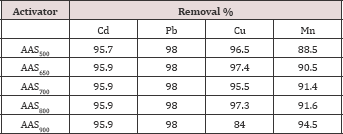
Table 2: Metal removal efficiency by the developed activated sewage sludge.
Lupinepublishers-openaccess-journals-chemistry

Results and discussion

Metal removal efficiency bythe developed adsorbents

Pyrolysis temperatures affected the surface area of the sewage sludge adsorbent. The adsorption data for the removal of Cd,Pb, Cu and Mn by the developed adsorbents (AAS900, AAS800, AAS700,AAS650, and AAS500), at the experimental optimum conditions are represented in Table 2. The data showed that all the ASS adsorbents, the adsorbent AAS800 have higher metals removal capability than with the other adsorbents, and so, this adsorbent AAS800 will be used for all experiments. The chemical composition of the prepared adsorpant (ASS800)is presented in Table 3.

Table 3: XRF data of chemical composition of adsorbent ASS(800).

Lupinepublishers-openaccess-journals-chemistry

Rozada et al. (2009) prepared sewage sludge adsorbents by physical activation with pyrolysis at 650 °C to remove Pb from aqueous solution, their results showed that physically activated sludge at 650 °C has an adsorption capacity of 30.1 mgg'1 which was lower than our result (46.7 mgg'1) by physically ASS at 650 °C. Hammaini et al. [13] used dried activated sewage sludge to remove Pb and Cd from aqueous solution, and found that the maximum Pb and Cd adsorption capacity were 143mgg'1 and 51.8mgg-1, respectively. These results were higher than that in our results by physically activated sewage sludges which ranged from 40.4 to47.8mgg-1 for Pb, and from 9.4 to 32.8mgg-1 for Cd. Bouzid et al. [14] prepared activated sewage sludge with physical activation at 600 °C to remove Cu, the estimated maximum adsorption capacity of Cu was 5.71mgg'1 which is lower than that in our result by physically ASS at 650 °C (20.2mgg'1). Seredych and Bandouz [15] prepared adsorbents from sewage sludge by the pyrolysis at 650 and 950 °C to remove Cu, the results showed that low pyrolysis temperature 650 °C results in adsorbent with Cu adsorption capacity (63.4mgg'1) , and this result was higher than that in our results using pyrolysis temperature 950 °C (34.0mgg'1).

Batch adsorption

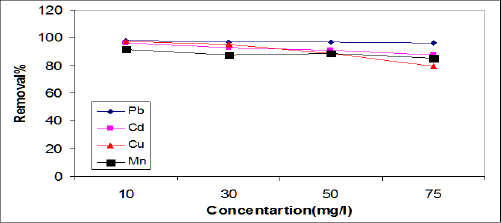
Effect of initial metal ion concentration: The adsorption data for the removal of Cd, Pb, Cu,and Mn by ASS800 adsorbent at the optimize experiment conditions is represented in Figure 1. The adsorption data show that with the increase of the initial concentration of Cd, Pb, Cu, and Mn from 10 to 75mgL-1, the percent removal of Cd, Pb, Cu, and Mn by ASS(800) decreased from 95.9 to 87.3%, 98 to 95.9%, 97.3 to 79%, and 91.6 to 84.8%, respectively. This means that the highest adsorption affinity occurred at lower metal concentration and this agreed with the results obtained by Faust and Aky [16]. This result may be explained by a limited availability of active sites on the ASS surface [17]. Xuejiang et al. [18] showed that the adsorption capacities of Cd and Cu on the surface of the dried activated sludge increased with the increase of initial metal ion concentration from 20 to 100 mg/L. The experimental data of [18-20] indicated that the adsorption capacity of Pb, Cd, and Cu on activated sewage sludge increases with the increase in initial metal concentration. Our results were agreed with all previous results.

Figure 1: Effect of initial metal ion concentration on removal efficiencies of ASS.
Lupinepublishers-openaccessjournals-chemical-science

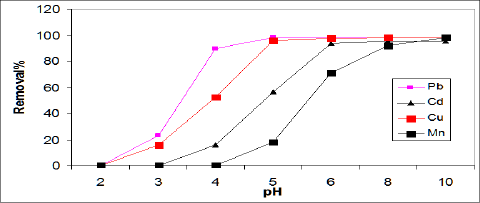
Effect of solution pH: The effect of pH on the adsorption efficiency of Cd, Pb, Cu, and Mn on ASS (800) adsorbent was studied in the pH range of 2-9 using 100mg/L of initial metal concentration, and represented in Figure 2. The removal of Cd, Pb and Cu increased with an increase of pH level up to pH 6, whileMn reached maximum adsorption at pH 8 as the result of Mn precipitation. The removal of Cd, Pb, Cu and Mn ions by sewage sludge adsorbent (ASS800) was explained by electrostatic attraction, surface complex formation and precipitation mechanism [21].

Figure 2: Effect of initial metal ion concentration on removal efficiencies of ASS.
Lupinepublishers-openaccessjournals-chemical-science

Majumdar et al. [22] reported the maximum sorption of Pb by biomass noted at pH 5-6. Otero et al. [8] showed that the maximum adsorption of Pb and Cu by activated sewage sludge was at pH 4. Rashed [17] showed that Pb adsorption on peach and apricot stones increased as pH increases from 3 to 6.5, and the maximum adsorption of Pb observed at pH 7. Bouzid et al. [14] showed that Cu adsorption using sewage sludge ash increased as pH increased and the maximum adsorption (99%) was at pH 7.2. Rozada et al. [8] showed that at pH values lower than 6.0 the removal of Cu by dry activated sludge was performed by biosorption mechanism, while above pH 6 metal precipitations occurs.

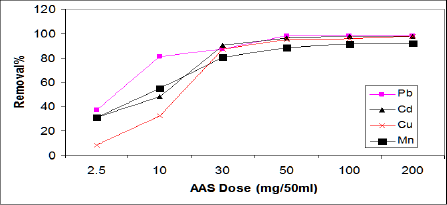
Effect of ASS800 dosage on metal ion adsorption: The effect of adsorbent amount on the adsorption of Cd, Pb, Cu, and Mn were studied for a variety of ASS800 adsorbent amount (g), and represented in Figure 3. The results show that the removal percent of Cd, Pb, Cu andMn increased with increaseASS800 adsorbent dose; this due to the availability of more surface functional groups and surface area at a higher adsorbent dose [23]. The optimum dosage of ASS800 for the removal of Cd, Pb, Cu, and Mn at experimental conditions is 50mg/50ml, with the removal percent of 95.5%, 98%, 97.6%, 91.5%, respectively. Zhai et al. [23] reported that increasing activated sewage sludge dosage increased Cd adsorption. Hammaini et al. [13] observed the variation of the sorption capacity for Pb, Cd and Cu versus activated sludge (biomass) dosage. Chenget al. [24] found that the residual concentration of Cu in synthetic wastewater decreased with the increase of sewage sludge ash, when the dosage reached 30-40g/L. Cu removal reached 99% at pH 4 and initial concentration 50mgl-1. Lian et al. [25] reported that the increasing of activated sewage sludge dosage from 1 to 6g has little effect on Curemoval, at the optimum dosage of 3g/100ml. Zehenze Li et al. [26] observed reduction in the adsorption amount of Mn from 99.5 to 10mg/g with increasing of the dosage of adsorbent (thermal decomposed leaf) from 0.6 to 5g/L, this result disagree with our result.

Figure 3: Effect of ASS dosage on the adsorption of Cd, Pb, Cu, and Mn.
Lupinepublishers-openaccessjournals-chemical-science

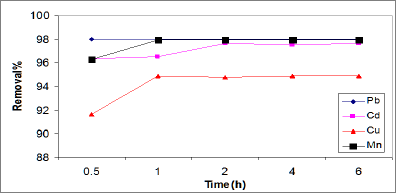
Effect of contact time on metal adsorption: The removal of Cd, Pb, Cu and Mn ions by ASS800 adsorbent as a function of contact time is presented in Figure 4. It was observed that the amounts of Cd, Pb, Cu and Mn ions adsorbed increased with an increase in contact time and gradually reached constant values within 1h. That result means that the adsorption equilibrium maintained at one hour. The fast adsorption at the initial stage may be due to the higher driving force making fast transfer of metal ions to the surface of adsorbent particles and the availability of the uncovered surface area and active sites on the adsorbent (Wu et al. [27]; Aroua et al. [28]). Lian et al. [25] observed little effect of contact time on Cu and Cd adsorption by activated sewage sludge. Cu adsorption reached up to 90% after 0.5h, while Cd adsorption (96% Cd) uptake is after contact time 7h. Rashed [17] reported that Pb adsorption on peach and apricot stones increased with time to reach its maximum that the equilibrium times for Mn and Cd by a clay mineral are 48 adsorption at 3 and 4h, respectively. Fonseca et al. [29] reported and 72h, respectively.

Figure 4: Effect of contact time on the adsorption of Cd, Pb, Cu, and Mn.
Lupinepublishers-openaccessjournals-chemical-science

Effect of solution temperature on metal ion adsorption: The solution temperature has main effects on the adsorption process; in which it can affect the diffusion rate of the sorbate within the pores as a result of decreasing solution viscosity and also affect the number of the sorption sites generated because of breaking of some internal bonds near the edge of active surface sites of sorbent [30]. The adsorption data for the removal of Cd, Pb, Cu and Mn by ASS800 at a different solution temperature (25, 35, 45 and 55 °C) under the experimental conditions is represented in Figure 5.

Figure 5: Effect of solution temperature on the adsorption of Cd, Pb, Cu, and Mn.

Lupinepublishers-openaccessjournals-chemical-science

The rate of metal removal increases with an increase in solution temperature from 25 to 35. The increase of metal adsorption with temperature could due to the strength of the binding and attraction between metal ions and active site on the surface of ASS800, where the decrease in metal adsorption with the rise of temperature may be due to the weakening of adaptive forces between the active sites of the adsorbents and adsorbate [31]. Lian et al. [25] observed that the biosorption of Cu by activated sewage sludge is maintained at about 94% when temperature changes from 10 to 40 °C. Ozdemir et al. [32] showed that no significant change in Mn, Cd, and Cu adsorption by dried powdered cell (microbial cells) when the temperature increase from 30 to 80 °C. Xuejiang et al. [18] reported that the sorption capacities of Cu and Pb by activated sewage sludge decreased with the increase of solution temperature which indicates an exothermic reaction.

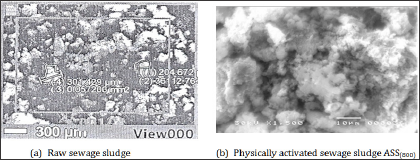
Figure 6: SEM of raw and activated sewage sludge of Kima plant.
Lupinepublishers-openaccessjournals-chemical-science

Morphological features: The micro-morphology and chemical composition of raw sewage sludge and ASS800 adsorbent were examined with ascanning electron microscopy coupled with energy-dispersive x-ray spectrometry. The results are represented in Figure 6 and Table 3. The scanning electron microscope (SEM) images as shown in Figure 6 revealed porous and irregular morphology of ASS800. Raw and activated sewage sludge seems as brown color particles. The data in Table 3 indicated that the main chemical composition of ASS800 is silica, iron and calcium in addition to a small percent of iron and aluminium.

Adsorption Isotherm

Langmuir, Freundlich and Scatchard isotherms were applied to describe the sorption equilibrium of metal ions on the adsorbent. The Freundlich expression is an empirical equation based on a heterogeneous surface, which relates that the concentration of a solute on the surface of an adsorbent, to the concentration of the solute in the liquid, Freundlich equation is given as follows:

Lupinepublishers-openaccessjournals-chemical-science

Equation (1) can also be expressed in the linearized logarithmic form

Lupinepublishers-openaccessjournals-chemical-science

Where qe is the amount adsorbed (mg/g), Ce is the equilibrium concentration of the adsorbate (mg/l), and kf and n are the Freundlich constants related to adsorption capacity and adsorption intensity respectively, When Log qe is plotted versus Log Ce, the slop is equal to (1/n) and the intercept is equal to Log kf. The high value of R2 (Correlation coefficient of line) indicates that the adsorption follows Freundlich isotherm model perfectly [33]. When the value of (1/n) is between 0 to 1 indicate the heterogeneity of the sorbent, furthermore, the smaller 1/n and larger Kf values for sorbent indicate that sorbent has higher adsorption capacity, intensity and affinity for metal ion than the other types of sorbents .

Langmuir equation expressed as follows

Lupinepublishers-openaccessjournals-chemical-science

Where Ce (mg/l) is equilibrium concentration, qe (mg/g) the amount adsorbed at equilibrium, b (L/mg) is the Langmuir constant which related to the affinity of the binding site, and Qo (mg/g) is the maximum adsorption capacity parameter. When Ce/ qe is plotted versus Ce, the slope is equal to (1/Qo) and the intercept is equal to 1/Qo b.

The Scatchard plot analysis is a widely used technique in evaluating the main interaction types taking a role in a particular sorption process and dependence of binding types to experimental conditions, the Scatchard isotherm represents intermediate situations close to the Langmuir model. The shape of Scatchard plot is related to the type of the interactions of analyte with adsorbent. The presence of a deviation from linearity on a plot based on Scatchard analysis usually points out the presence of more than one type of the binding sites. Whilst the linearity of the Scatchard plot indicates that the binding sites are identical and independent. So, if the Scatchard plot is liner with a negative slop, it is related to interaction between the analyte and the binding sites follows the Langmuir model. When the Scatchard plot exhibits a deviation from linearity the interaction follows the analysis of data in terms of the Freundlich model [34].

The Scatchard isotherm equation for a linear plot [35,36] is represented by the following equation:

Lupinepublishers-openaccessjournals-chemical-science

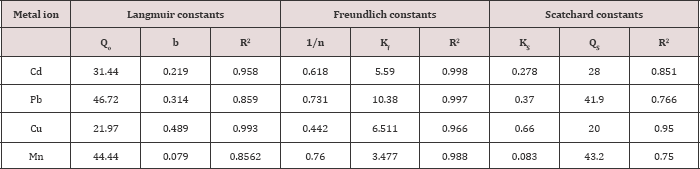
Where QS and Ks are Scatchard constants, related to the maximum monolayer adsorption capacity and equilibrium adsorption constant respectively. The results obtained on the adsorption of Cd, Pb, Cu, and Mn by ASS800 at different initial metal ion concentrations( 10, 30, 50 and 75mgL-1) was analyzed by models given by Freundlich, Langmuir and Scatchard , and represented in Table 4.

From Freundlich constants, the values of 1/n for adsorption on ASS800 were 0.618 for Cd, 0.731 for Pb, 0.442 for Cu and 0.760 for Mn. The maximum adsorption from Langmuir parameters for Cd, Pb, Cu, and Mn on ASS (800) are 31.4, 46.7, 21.9, and 44.4mg/g. These values indicated that the order of metal ions according to their affinity to adsorption on ASS800 is Pb>Mn>Cd>Cu. From Scatchard parameters the values of R2 for adsorption on ASS800 were 0.851 for Cd, 0.766 for Pb, 0.950 for Cu and 0.750 for Mn (Table 4) [37,38].

Table 4: Langmuir, Freundlich and Scatchard isotherm constants for adsorption of Cd, Pb, Cu, and Mn by ASS(800).
Lupinepublishers-openaccess-journals-chemistry

Application of real wastewater sample

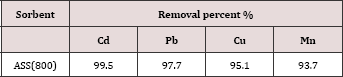
The possibility of the utilization of ASS800 as an effective adsorbent for the removal of Cd, Pb, Cu, and Mn was studiedby the application on real wastewater sample (Lab wastewater) containing these metals. The concentrations of metal ions in the Lab wastewater sample before and after the treatment with ASS800 are represented in Tables 5 & 6. The results revealed the possibility of the utilizationASS800 as an effective adsorbent for the removal of Cd, Pb, Cu, and Mn from polluted water.

Table 5: Physical and chemical analysis of lab. wastewater before treatment with activated sewage sludge.

Lupinepublishers-openaccess-journals-chemistry

Table 6: The removal percent of metal ions (Cd, Pb, Cu, and Mn) after treatment of lab. Waste water with ASS(800).
Lupinepublishers-openaccess-journals-chemistry

Conclusion

The present study showed the possibility of utilizing the activated sewage sludgeASS800, which derived from sewage sludge waste, as an active adsorbent for the removal of Cd, Pb, Cu, and Mn from polluted water. The results of this study indicated that the developed adsorbent, from activated sewage sludge, showed good ability to remove Cd, Pb, Cu, and Mn at low and high concentrations. The initial metal concentration, pH value, contact time and ASS(800) dosage exhibited significant effect on the adsorption process of Cd, Pb, Cu and Mn by ASS800. The adsorption data of Cd, Pb, Cu, and Mn on ASS800 were fitted well the Freundlich model and Langmuir equations.

Read More About Lupine Publishers Journal of Organic and Inorganic Chemical Sciences Click on Below Link:
https://lupinepublishers-chemicalsciences.blogspot.com/

Saturday, 13 February 2021

Lupine Publishers | Synthesis and Characterization of Poly (1,4-Benzenedimethylene Phthalate) and the Study of its ability to sorb Pb(II), Cd(II), and Zn(II) ions

 Lupine Publishers | Journal of Organic and Inorganic Chemical Sciences

Abstract

Poly (1,4-benzenedimethylene phthalate) was synthesized by condensation of phthaloyl chloride with 1,4-benzenedimethanol in the presence of pyridine in dry THF at 30 °C . The resulting polymer white powder was characterized by viscosity measurement, FT-IR, 1H and 13C NMR, elemental analysis, thermal (TGA-DSC) methods and scanning electron microscopy. The uptake properties of Pb(II), Zn(II) and Cd(II) metals by the polymer from aqueous solutions were studied by the batch and column techniques as a function of pH, temperature, concentration and contact time. The uptake increased with increasing pH reaching a maximum at pH = 6.00 for all ions. The polymer showed high uptake capacities toward Pb(II) and Zn(II) ions, but medium uptake capacity toward Cd (II). The linearized forms of Langmuir, Freundlich and Dubinin-Radushkevich adsorption isotherms indicate studied ions Pb(II), Zn(II), and Cd(II). The adsorption capacity follow the order: Pb(II) > Zn(II) > Cd(II).

The thermodynamic functions, ΔGǂ, ΔHǂ and ΔS° were determined for Pb(II), Zn(II) and Cd(II); the values of AG° indicated that the adsorption process of these metal ions on the polymer is favorable. In this work, the values of ΔGǂ, ΔGǂ and ΔSǂ were determined by using Eyring-Polanyi equation and Arrhenius equation. The results indicated that ΔGǂ=72.8, 78.6, 87.8kJ/mol for Pb, Zn, Cd ions, respectively. The column experiments for metal ion uptake were conducted at pH= 6.0, 25.0 °C, and initial concentration of 150.0mg/L. The loaded concentrations were 76.42, 49,05 and 28.47 ppm for Pb, Zn, Cd ions, respectively. The efficiency for recovery of metal ions after adsorption by treatment of the loaded polymer with 0.1M HNO3, 0.1M EDTA, gave good percent recovery for 0.1M HNO3

Keywords: Benzendimethanol; Phthalate polymers; Condensation polymerization; Polymers uptake; Metal ion uptake; Adsorption

Introduction

Heavy metals are known for their toxicity to living organisms. Their concentrations in the environment increase with the increase of industrial activities. Most important, these metals are not biodegradable and tend to accumulate in living organisms, and causes serious health problems [1]. Allot of methods were reported for removal of metal ions from aqueous solutions; these include filtration, adsorption, chemical precipitation and ion exchange [2]. Different approach for removal of metal ions from water streams which have been increased in recent years [3], is the adsorption of metals by polymers. This approach is characterized by high effectiveness, high adsorption capacity, and high selectivity, fast kinetics of metal-ion uptake, high mechanical strength, chemical resistance and recyclability of the polymer [4,5].

According to their methods of preparation, synthetic polymers can be divided into three major types:

    A. Chain Reaction (Addition) Polymers: These polymers are formed by addition to the double bond of monomers containing carbon-carbon double bonds, called vinyl monomers, without the loss of small molecules. The repeating units of addition polymers have the same composition as the monomer [6].

    B. Condensation Polymers: these polymers are formed by condensation reaction of monomers containing organic functional groups. These reactions usually involve elimination of small molecules (e.g., water, methanol, and ethanol) [6].

    C. Other Polymers May Be Prepared by Modification of Polymers by: I- Attachment of an appropriate specific ligand groups to the polymer chains. This method has been preferred since functional groups containing ligands can easily be attached to polymers than inorganic supports. [7,8]f The attachment of dithiocarbamates to polystyrene cross linked with 2% divinylbenzene is an example of this type [9]. II- Polymerization of monomers to which ligand groups are attached. Polymers with ester linkages in their main chain are used in many applications such as biomedical matrices, liquid crystals, fibers, and heat resistant materials [10]. Polyesters are characterized by higher adsorption capacities, efficiencies as well as high selectivity to some metal ions. [11] Synthetic polyesters may be prepared by polycondensation of diacids with diols, diaciddichlorides with diols and ester interchange reaction of diesters with diols.

There are two types of polyesters: Aliphatic polyesters and aromatic polyesters. The synthesis of aliphatic polyesters has been well established for several years. However, these polyesters possess low thermal stability due to their low melting points and glass transition temperatures owing to their low molecular weight. These properties resulted in limited usage and few applications of aliphatic polyesters, yet they showed potential as biodegradable polymers. On the other hand, aromatic polyesters display an excellent pattern of physical properties. They are strongly resistant to hydrolysis, bacterial and fungal attack, they also remain unaltered in the environment [11,12], Combining aromatic and aliphatic units in the same polyester chain has been envisaged as an attractive approach to obtain novel products encompassing biodegradability and high performance properties [11].

There are a lot of polymers were prepared and their sorption behavior was studied in our laboratory,such aspoly (1,4-cyclohexanedimethylene oxalate), Poly (bisphenol A oxalate), poly-cis,trans (1,3-cyclohexylene oxalate), poly (bisphenol- Aphthalate), poly (bisphenol-Acis-1,2 cyclohexanedicarboxylate), poly (1,4-yclohexanedimethanolphthalate) and poly (1,4-cyclohexanedimethanol succinate).

Experiment

Materials

The chemicals were obtained from commercial sources as either analytical reagent grade or chemically pure grade and were used as received. The chemicals were purchased from the corresponding companies: Phthaloyl dichloride, 1,4-benzenedimethanol, cadmium(II) nitrate tetrahydrate and zinc(II) nitratehexahydrate from BDH; N,N-4-dimethylaminopyridine (4- DMAP), dimethylsulfoxide (DMSO) from Acros, pyridine (GPR), nitric acid (65%), hydrochloric acid (36.5 %), and disodium ethylenediaminetetraacetate(EDTA)(Scharlau), sodiumperchlorate (SIGMA), tetrahydofuran (THF) (GCC) and lead(II) nitrate (PRS Paureac) and 4-dimethylaminopyridine (4-DMAP)from Acros.

Preparation of The Polymer

Poly(1,4-benzenedimethylenephthalate) was synthesized by polycondensation using single phase organic solvent polymerization. 1,4-benzenedimethanol ( 4.97g, 0.036 mol), pyridine (8.54g, 0.108mol) and a catalytic amount of 4-DMAP were dissolved in THF (60 mL). To this solution, a solution of phthaloyl chloride (7.307 g, 0.036mol) in THF (30mL) was added drop wise with stirring. The reaction mixture was stirred for 1 h at (30-35) oC and then for 3 days at room temperature. The polymer precipitated as a white solid from the THF solution. The solvent was evaporated and the solid was dissolved in chloroform (150mL) and washed with water (2x500mL), (6% v/v) HCl solution (1 x 150mL), and finally with distilled water (3x500mL). The chloroform solution was dried over anhydrous sodium sulfate, and was then concentrated to about 100 mL of solution. The polymer was precipitated by drop wise addition of chloroform solution to 500.0mL of methanol. The precipitated polymer was then filtered and dried at 55.0 oC under vacuum to give a white powder 66.0g, (68 % yield).

Preparation of Stock Solutions

Stock solutions (1000.0 mg/L) of the three metal ions were prepared by dissolving specific amounts of the salts of Pb(II), Zn(II), and Cd(II), in 0.1 M NaClO4 which was adjusted to the desired pH. The stock solutions were used to prepare solution with different concentrations (20.0, 40.0, 50.0, 60.0, 80.0, 100 and 150.0mg/L). The dilution is achieved by using 0.10 M NaClO4 and adjusted by 0.10 M HClO4 to achieve the desired pH= 4.00, 5.00 and 6.00.

Study of Metal Uptake Characteristics of The Polymers By Batch Technique

The metal uptake characteristics for each metal ion were studied using batch equilibrium technique. An aqueous solution of known metal ion concentration (25.0mL) was added to polymer powder (0.10 g), the mixed solutions were mechanically shaken, after a certain period of time at 25.0 oC, 35.0 oC, 45.0 oC, the mixture was filtered and the amount of the metal ion remaining in the filtrate solution was determined by atomic absorption spectrometry after constructing up an analytical calibration curve for each element (Pb(II), Zn(II), and Cd(II)).

The Rate of Metal Ion Uptake

Experiments for determining the equilibrium time for the metal ion uptake process involving 100.0mg ± 0.1 mg of the polymer was swelled with 25.0mL of metal ion solution containing 150mg/L metal ion at different pH, and the solution was mechanically shaken. The contact time was varied from 5 minutes to 48 hours at 25.0 oC, 35 oC, 45 oC. The mixture was filtered and the amount of the metal ion remaining was determined with atomic absorption spectrometry. The amount of metal ion uptake by the polymer (qe), may be obtained from the following relation:

Lupinepublishers-openaccessjournals-chemical-science

qe: Metal ion uptake by the polymer (in mg M(II)/ g polymer).
Ci: Initial metal ion concentration (mg/L).

Ceq : The residual concentration of the metal ion in solution at equilibrium (in mg/L).

V: volume of solution (L).

m: mass of polymer (g).

And the percentage of metal ion loading by the polymer expressed as % uptake was [13]:

Effect of pH on The Metal-Ion Uptake

Similar experiments were also carried out, under different pH values of 4.00, 5.00 and 6.00 for fixed contact time of 24 hours to determine the effect of pH on the metal ion uptake by the polymer.

Adsorption Isotherms Studies

The adsorption of Pb(II), Zn(II), and Cd(II) was carried out by taking a known mass of 100.0g ± 0.1mg of the polymer swelled with 25.0mL of solutions of concentration variation ranging from (20.0- 150.0)mg/L for each metal, under different pH values of 4.00, 5.00 and 6.00 and different temperatures (25.0, 35.0 and 45.0) oC.

Metal Ion-Uptake By The Polymer Using Column Experiment

Glass column of 30.0 cm length and 1.5cm inner diameter was used in this experiment. The column was packed with 1.00g ± 0.1mg dried polymer. A sample volume of 150.0mL containing Pb(II) of 1000mg/L was passed through the column at a flow rate of 1.0mL/4min. The eluate was collected in a 100.0mL volumetric flask, and concentration of the metal ion was then determined by AAS. The same experimental conditions were used for the determination of Zn(II), and Cd(II) ions uptake, where the sample which passed through the column was 150mg/L of these metal ions.

Desorption studies

The desorption of the Pb(II), Zn(II), and Cd(II), ions was carried under column condition, where the polymer was loaded with each metal ion as described before, using 50.0mL of two eluting agents, 0.10M HNO3 and 0.10M EDTA were used for polymer recovery from adsorbed metal ion, keeping the flow rate of elution at (1mL/4min). The concentration of metal ion in the eluate was collected in five 10.0mL portions, and was then determined by AAS.

Lupinepublishers-openaccessjournals-chemical-science

Water regain (α):

Water regain is defined as the amount of water absorbed by 1000.0mg ± 0.1 mg of polymer [14]. A sample of dry polymer was suspended in water, and was left for 2 and 24 hours. The polymer was filtered and weighed, dried at 60.0 oC and then re-weighed. Water regain (α) was calculated from the mass difference (eq).

Lupinepublishers-openaccessjournals-chemical-science

Results And Discussion

Polymer synthesis

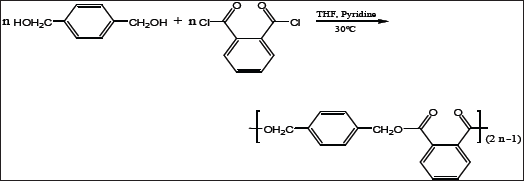
The synthesis of poly (1,4-benzenedimethylene phthalate), from equimolar amounts of 1,4-benzenedimethanol and phthaloyl chloride was performed by solution polycondensation in THF at 30.0 °C in the presence of excess pyridine as acid scavenger and 4-DMAP as the catalyst. The reaction proceeded by pyridine- catalyzed nucleophilic displacement of the chloride of the phthaloyl chloride with the alcoholic group of 1,4-benzenedimethanol. The relatively high yield of the polymer may have been due to the high reactivity of phthaloyl chloride group. The resulted polymer, which was obtained as a powder was found to be insoluble in many common organic solvents such as tetrahydrofuran (THF), diethyl ether, acetone and methanol but soluble in chloroform.

Solution viscosity

The inherent viscosity of poly(1,4-benzenedimethylene phthalate) solution was calculated from viscosity measurements of dilute polymer solutions (0.5g/dL) in chloroform at 25 °C. The polymer had an inherent viscosity of 0.22dL/g. This value indicates that the polymer had an intermediate inherent viscosity which implies that it had moderate molecular masses. This value is higher than the those obtained at 0-5° for poly(bisphenol-Aphthalate), poly(bisphenol-Asuccinate), and poly(cyclohexanedimethylene phthalate) which had the values of 0.11dL/g , 0.13dL/g, and 0.11dL/g, respectively [15].

Infrared spectroscopy

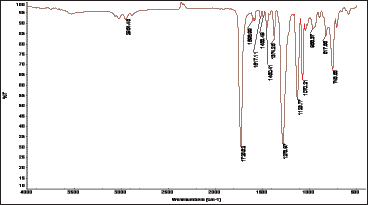
The polymer was analyzed by FT-IR spectroscopy. The FT-IR spectrum exhibits characteristic absorption bands for the major bonds involved in the polymer. The FTIR spectrum (Figure 1) showed two strong absorption bands for the stretching vibration of the carbonyl group (C=O) of the phthalate ester group at 1726cm-1 and for C-O-C in the range from 1124 to 1279cm-1. Another strong IR band was observed at 2951cm-1 assigned to the C-H stretching in the 1,4-benzendimethanol moiety. These wave numbers, which are typical for the ester group are conformed to the reported literature [15], and thus confirm the formation of the postulated polymer Scheme 1 and Figure 1.

Scheme 1: Preparation of poly (1,4-benzenedimethylene phthalate) polymer.

Lupinepublishers-openaccessjournals-chemical-science

Figure 1: IR spectrum of poly(1,4-benzendimethayl phthalate) polymer.

Lupinepublishers-openaccessjournals-chemical-science

The Nuclear magnetic resonance (nmr) spectra for polyesters

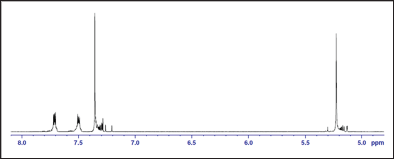
Figure 2: 1H-NMR spectrum of the polymer.

Lupinepublishers-openaccessjournals-chemical-science

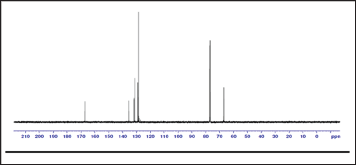
1H-NMR spectrum: The polymer was analyzed by NMR spectroscopy in order to elucidate its chemical structure and support its formation. In the 1H-NMR spectrum of poly(1,4- benzendimethylene phthalate), the signal of the aromatic protons of the phenylene ring of benzendimethylene unit was observed as singlet at δ = 7.36ppm, whereas that of the aliphatic methylene protons attached to the oxygen of the ester group was observed as singlet at δ = 5.22ppm. The aromatic methylene protons of the phthalate unit in ortho and meta positions to the ester were observed at δ = 7.71ppm and 7.50ppm, respectively. The 1H-NMR spectrum is shown in Figure 2. In the 13C-NMR spectrum of poly(1,4- benzendimethylene phthalate), the signal of the aromatic carbon atoms of the phenylene ring of benzendimethylene unit appeared at δ = 129ppm. The signal of the quaternary aromatic carbon atoms appeared at δ = 136ppm. The signal of the aliphatic methylene carbon atoms attached to the oxygen of the ester group appeared at δ = 67ppm. The signal of the quaternary aromatic carbon atoms of the phthalate unit to which the ester group is attached appeared at δ = 132ppm. The signals of the aromatic carbon atoms in ortho and meta positions to the ester group appeared at δ = 129ppm and 133ppm, respectively. The signal of the carbonyl carbon atom of the ester group appeared at δ = 167 ppm. The 13C-NMR spectrum of the polymer is shown in Figure (2), and the1H-NMR and 13C-NMR spectral data for the polymer assigned to the various proton and carbon atoms are presented in Table 1 (Figures 3 & 4).

Figure 3: 13C-NMR spectrum of the polymer.

Lupinepublishers-openaccessjournals-chemical-science

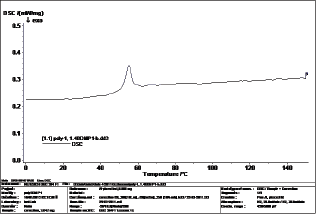
Figure 4: DSC thermo gram of polymer.

Lupinepublishers-openaccessjournals-chemical-science

Table 1: Thermal stability of polymer.

Lupinepublishers-openaccess-journals-chemistry

Thermal Properties

The thermal properties of polyesters synthesized were also investigated by differential scanning calorimetry (DSC), and thermogravimetric analysis (TGA) under dry N2 atmosphere.

Thermal Transition

The thermal properties of polymer were investigated with DSC and TGA. The Tg value of the polymer was 52°C. This value is considered lower than expected for such an aromatic polymer such as poly(ether carbonate) containing aromatic -aromatic ether showed Tg values from room temperature up to 47°C [16] and polyquinoxalines and other aromatic polymers were studied Tg from 215.5 to 394.5°C [17]. This Tg value may have been due to the imparted flexibility effects of the aliphatic methylene groups of the 1,4 -benzenedimethanol. The presence of the aliphatic moieties in the polymer backbone imparted flexibility to polymer segments to move under the effect of temperature. This ease of motion is reflected in the slightly low Tg value of the polymer [16]. The DSC thermogram of the polymer is shown in Figure 4.

Thermal stability

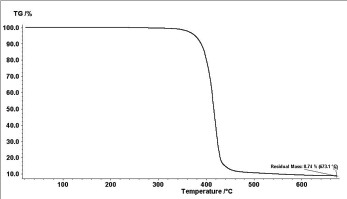
The thermal stability of the polymer was investigated by TGA under dry nitrogen. Table 1 summarizes the initial thermal decomposition (onset) temperature Tid, T5%d , T10%d , and T50%d decomposition temperatures, which correspond to the temperatures at which 1, 5, 10, and 50% loss of mass of polymer occurred, respectively. The table 2 also shows the residual mass percent remaining after heating the polymer to 673.1 °C which was found to be 8.74%. The thermogram of the polymer Figure 5 displayed a typical one-stage characteristic with a relatively fast mass loss occurring at temperatures between 400 and 450 °C. The fast mass losses may have been due to decomposition of the polymer backbone. These values are higher than the corresponding values obtained in the case of poly (1,4-cyclohexandimethlene- phthalate), which occurred between 350-450°C and the residual mass equal 0.44% [15].

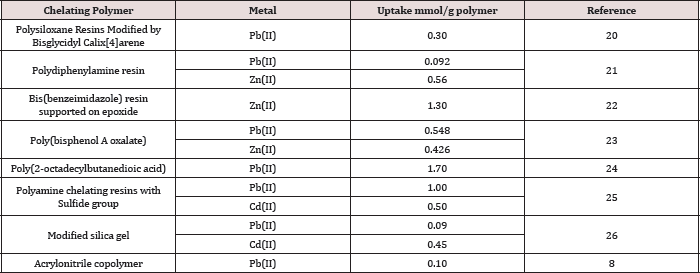
Table 2: Several reported metal uptake values by chelating polymers in the literature.

Lupinepublishers-openaccess-journals-chemistry

Figure 5: TGA thermogram of poly(1,4-benzenedimethayl phthalate) polymer.

Lupinepublishers-openaccessjournals-chemical-science

Morphological Characterization

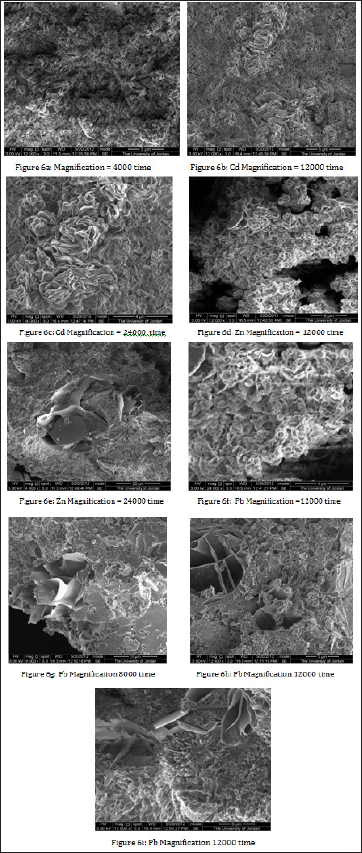
The surface ofthe polymer was also characterized by SEM before and after metal sorption. The SEM micrographs for the polymer synthesized are shown in Figure 6. The pores are distributed on the rough surface of the polymer, the small pores which are similar to the forms of flowers are located on the surface of the rods with an average size <5|im. The existence ofthese pores provides convenient diffusion channels for metal ions into the interior of the polymer when it is used for adsorption of metal ions from aqueous solution. The interior structure of the polymer showed randomly distributed large gaps and air pockets created during polymerization. The spongy structure of the inner rods maximize the contact surface between the polymer and the solution which led to increased metal ion uptake, this is shown in Figure 6a for the polymer before metal sorption. However, after adsorption of metal ion by the polymer, a slight loss occurred to the composition of surface features and of the channel and a small part of its surface became smooth. This is represented for the polymer surface loaded with Cd(II) ions and is shown in Figure 6b & c. It has been found by SEM investigation that loading the polymer with zinc ions changed its surface topography, increased the proportion of smooth surface and resulted in narrow channels and pores Figure 6d & 6e. The highest uptake of metal ions by polymer was for Pb(II), the polymer loaded with lead ions was studied by SEM to observe the changes in surface topography that took place, the entire surface became smooth and the pores disappeared due to full metal ion coverage. SEM for our polymer was similar to that of poly(cychlohexandimethelen succinate) (Al- Dweri, 2010). The images are presented in Figure 6f-6i.

Figure 6: SEM images of poly(1,4-benzenedimethelen phthalate).

Lupinepublishers-openaccessjournals-chemical-science

Water Regain or Water Content ( α )

Water regain experiment was performed to determine the water regain ratio (α) for the polymer. Water regain is usually correlated with the hydrophilic character of the polymer, the higher the water regains, and the more hydrophilic the polymer is. The water regain value for the polymer was found to be 0.019 g/g after 2h of stirring and 0.029g/g after 24h stirring, this indicates that the polymer has a low hydrophilic character. These values are higher than the corresponding values obtained by poly(1,3-cyclohexylene oxalate) polymer which was found to have values of 0.011g/g and 0.014g/g, respectively. Based on these values the polymer is considered to be low hydrophilic in nature [18] and these values are smaller than the corresponding values obtained for poly (1,4-cyclohexanedimethylene oxalate) polymer which was found to have values of 0.064g/g and 0.087g/g [19]. Principally, the water molecules are polar and would interact with the polar groups of the polymer (the ester group), this interaction explains the water regain properties of the polymer.

The rate of metal ion uptake by the Polymer

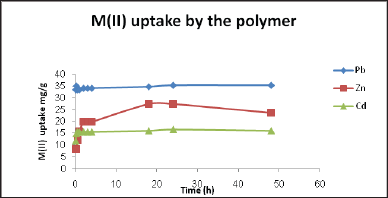
The adsorption kinetics of metal ions on the surface of the polymer was investigated as shown in Figure 7 for example. The adsorption of metal ions increase with time until complete saturation.

Figure 7: Metal uptake as a function of contact time, at pH = 6, T = 45 °C, and initial concentration of 150ppm.

Lupinepublishers-openaccessjournals-chemical-science

Adsorption Isotherms of the Polymer

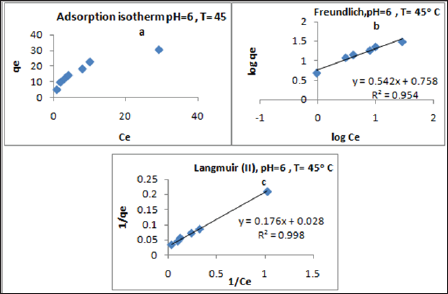
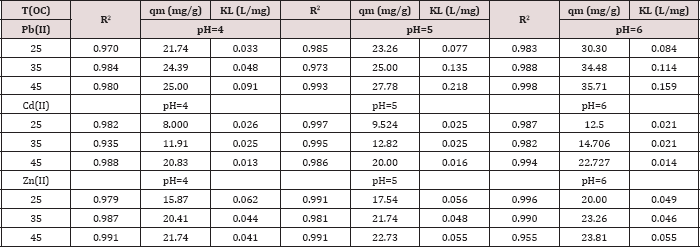
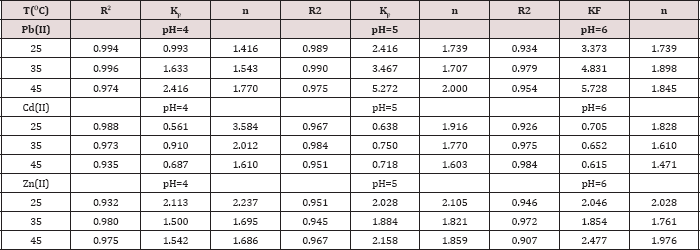
Using linearized Langmuir and linearized Freundlich isotherm as analyzed to determine adsorption isotherms for metal ion Pb(II), Zn(II) and Cd(II) at different pH values (4.00, 5.00 and 6.00) and different temperatures (25.0 oC, 35.0 oC and 45.0 oC) in the range of concentrations from 20.0 to 150.0mg/L. The adsorption isotherms results are presented in Table 3 and shown in Figure 8 & (Table 2) (20-23).

Figure 8: Plots of a) adsorption isotherm b) Linearized Freundlich c) Linearized Langmuir of Pb(II) at pH = 6 and 45 °C.

Lupinepublishers-openaccessjournals-chemical-science

Table 3: R2, qm, and KL values obtained from Langmuir plots

Lupinepublishers-openaccess-journals-chemistry

In the Langmuir model, the values of correlation regression coefficient (R2) are greater than 0.90 and had excellent linearity. This indicates that homogenous sites of interaction are better to describe the process and the maximum sorption capacities (qm) deduced from these results indicated that the polymers has the highest capacity towards Pb(II) ions, but it shows a lower capacity towards Cd(II). It is observed that the adsorption capacity (qm) increases as the temperature and pH values increase for all investigated metal ions. Comparing the values of qm of the synthesized polymer to literature values Table 2. Typical qm values obtained in this work at pH= 6.00 and 45.0 oC for the adsorption of various metal ions on our polymer were as follows:

Metal ion: Pb(II) > Zn(II) > Cd(II)

qm (mg/g) = 35.7 > 23.8 > 22.7

Metal ion: Zn(II) > Cd(II) > Pb(II)

qm (mmol/g) = 0.36 > 0.20 > 0.17 (Tables 3 & 4).

Table 4: R2, KF and n values obtained from Freundlich plots

Lupinepublishers-openaccess-journals-chemistry

The trend in qm values in poly(1,4-cyclohexanedimethylen phthalate) at pH= 6.00 and 25.0 oC is Pb(II) > Cd(II), in (mg/g) were 53.5>17.7 respectively [15]. The trend in qm values for poly(1,4- cyclohexanedimethylene oxalate) at pH= 4.00 and 25.0 oC is Pb(II) > Cd(II) > Zn(II), in (mg/g) were 31.2 > 29.8 > 15.9, respectively [19]. The trend for Pb(II) and Cd(II) ions in poly(hydroquinone oxalate), and in poly(neopentyl oxalate) polymer, were as follows: Pb(II)>Cd(II) [24-27] and thus the results similar in order the metal ion with our results in the literature [23] that is qm values 207.7 >30.7 >19.1 for Pb(II) >Zn(II) >Cd(II) in poly(bisphenol A oxalate). The results indicate that our polymer has reasonable qm values. In the Freundlich model, both KF and nare Freundlich constants, being indicative of the adsorption capacity and the adsorption intensity respectively. High value of n between (1.4-3.6) indicates that adsorption is good over the entire range of concentration studied, while small values of n means that the adsorption is good at high concentrations but much less at lower concentrations and the values of n were greater than one indicating that the adsorption was favorable. A greater value of KF indicates a higher capacity for the adsorption than smaller values [28].

Dubinin-Radushkevich

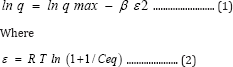
The linear form for Dubinin-Radushkevich (D-R) isotherm has the following expression:

Lupinepublishers-openaccessjournals-chemical-science

R is the ideal gas constant (8.3145 J.mol-1.K-1) and T is the

absolute temperature (Kelvin). The values of p and q max are evaluated from the slope and intercept of the linear plot of lnq versus s2, where q max is related to the adsorption capacity and p is the constant related with the adsorption energy. The free energy of adsorption (E) is defined as the free energy change required for transferring one mole of ions from solution to the solid surface, this energy is calculated as follows:

Lupinepublishers-openaccessjournals-chemical-science

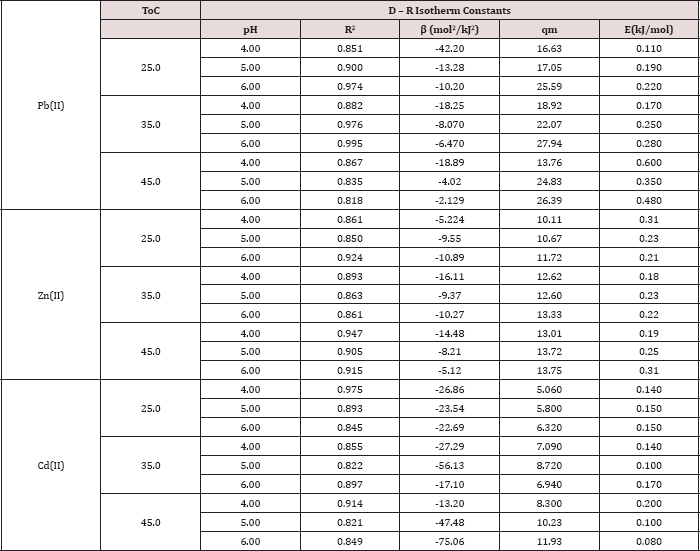
Table 5: Dubinnin-Radushkevich (D-R) isotherm parameters for Pb(II), Zn(II) and Cd(II).

Lupinepublishers-openaccess-journals-chemistry

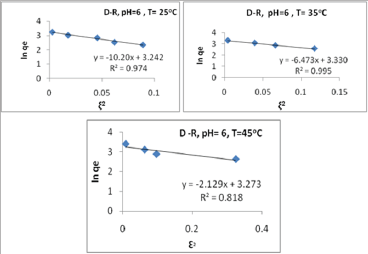
As illustrated in Tables 3-5, the values of E for Pb (II) are (0.1100.600 kJ/mol), for Cd(II) are (0.080 -0.200 kJ/mol) and for Zn(II) are (0.180-0.310kJ/mol). All values are less than 8.00kJ/mol, this indicates that physical forces affect adsorption. The result of the concentration variation isotherms of polymer (Table 5) and the plots of Dubinin-Radushkevich at pH= 4, 5 and 6 at 25 °C, 35 °C, 45 °C are shown in Figure 9.

The Effect of Temperature on The Uptake

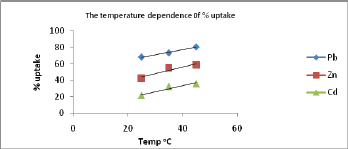
The effect of varying temperature on the % uptake of metal ions was also investigated. The results are obtained by plotting % uptake at different pH against temperature and are presented in Figure 10. The results obtained showed that the adsorption process of Pb(II) , Zn(II) and Cd(II) onto the surface of the polymer is an endothermic process since the % uptake increases as the temperature increases nearly at all tested pH values.

Figure 9: Plots of Dubinnin-Radushkevich (D-R) isotherm for the adsorption of Pb(II) on the polymer at pH= 6.00 and a) T= 25 °C, b) T= 35oC, c) T=45 °C

Lupinepublishers-openaccessjournals-chemical-science

Arrhenius Parameter

Table 6: The Arrhenius parameters for Pb(II), Zn(II) and Cd(II) at pH=6 and temperatures 25.0oC, 35.0oC, 45.0oC.

Lupinepublishers-openaccess-journals-chemistry

Table 7: The Arrhenius parameters: Activation energy ( E) and pre-exponential factor (A) for Pb(II), Zn(II) and Cd(II) at pH=6 and temperatures 25oC, 35oC, 45oC.

Lupinepublishers-openaccess-journals-chemistry

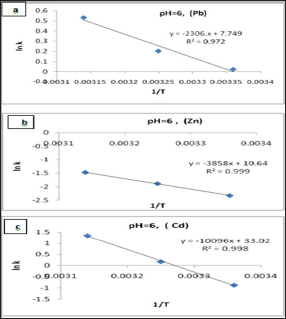
Arrhenius equation can be used to determine the activation energy and pre-exponential factor for a reaction were calculated from Figures 11 and shown in Table 6. The results A and Ea values that obtained in Figure 11 and Table 6 are calculated from Arrhenius equation:

Ln k = - Ea / R T + Ln A .....(4) (Table 7)

Where k is the rate constant, Ea activation energy, R gas constant and A pre-exponential factor. The values of A and Ea can be calculated from intercept and slope of a straight line of a plot of Ln k against 1/ T. The pre-exponential factor A is the constant of proportionality between the concentration of the reactants and the rate at which they collide. The activation energy Ea is the minimum kinetic energy required for a collision to result in reaction, through the more favorable molecular orientations. The factor exp (-Ea / RT) represents the fraction of molecular collisions that have an energy value equal to or greater than the activation energy Ea. At higher temperatures a larger portion of reactant molecules will have the required Ea to react. Thus, the reaction rates depend on Ea, the reactant orientations (relative positions) during collisions and the temperature. Both A and Ea are approximately constant over a moderate range of temperature (50K) [29]. The order of Ea values for Pb, Zn and Cd is (19.2, 32.1, 83.9kJ/mol) respectively. This low value of Ea indicates a reaction rate slightly sensitive with temperature [30]. So, we cannot explain the mechanism of the process from activation energy only but needed to use Eyring equation [31].

The Eyring equation (activated complex theory)

Determination of activation energy, entropy and enthalpy of activation by this equation

Lupinepublishers-openaccessjournals-chemical-science

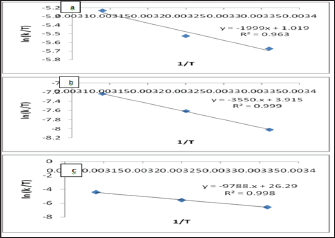
Thus, the above general form ofthe Eyring equation or activated Complex Theory equation, also known as Eyring-Polanyi equation in chemical kinetics, relates the reaction rate to temperature and is trivially equivalent to the empirical Arrhenius equation. The results were calculated from Figures 11 & 12 and shown in Table 8.

Figure 10: The temperature dependence of % uptake of Pb(II) , Zn(II) and Cd(II) ions at pH=6.

Lupinepublishers-openaccessjournals-chemical-science

Figure 11: The Arrhenius Plots of (a) Pb(II), (b) Zn(II) and (c) Cd(II) at pH= 6.00.

Lupinepublishers-openaccessjournals-chemical-science

Figure 12: The Activated Complex theory Plots of (a) Pb(II), (b) Zn(II) and (c) Cd (II) at pH= 6.00 .

Lupinepublishers-openaccessjournals-chemical-science

Table 8: Calculated thermodynamic parameters of activation (AH, ASt, AGt) at pH= 6 and 25oC.

Lupinepublishers-openaccess-journals-chemistry

The Eyring-Polanyi equation has been applied to rate processes and the calculation of values of enthalpies and entropies of activation without pointing out the significance of the obtained values and the difference between the activation energy values found by using the Arrhenius equation.

Lupinepublishers-openaccessjournals-chemical-science

A plot of (Ln k/T) versus 1/T gives a straight line with a slope of -ΔHǂ/R from which the enthalpy of activation can be derived and with intercept of ln (kB/h) +ΔSǂ/R from which the entropy of activation is derived. From the values of the free energy of activation the real energy requirements are known, thus, suggesting the use of the Eyring-Polanyi equation mainly as a tool for gaining a deeper understanding of the actual processes at work and not only as a tool for predicting reaction rates based on measured rate constants. This relation is usually used for the suggestion of a mechanism for a certain reaction in the following way: the certain reaction is performed at various temperatures where the reaction rate constant is measured. The pre-exponential factor A of Arrhenius equation has been related to ΔSǂ of Eyring equation.

Low values of lnA correspond to negative values of ΔSǂ, the activated complex in the transition state has a more organized, more ordered and more rigid structure than the reactants. This happens when bonds are formed or substances are absorbed, and high values of lnA correspond to positive (or less negative) values of ΔSǂ, a positive value for the entropy of activation indicates that the transition state is disordered (less organized), compared to the state of the reactants. This happens when bonds are broken or substances are desorbed. The calculated value of the entropy of activation is used for the suggestion of a mechanism i.e. in replacement reactions: Associative (ΔSǂ< 0), Dissociative (ΔSǂ> 0), Interchange (ΔSǂ = 0). [32] In our results in Table 8, the values of ΔSǂ for Pb(II), Zn(II) and Cd(II) are -188.7, -164.7, -21.3 J/mol.K, respectively all the values of ΔSǂ< 0 indicated that the process has Associative mechanism. The relation between Ea of the Arrhenius and ΔHǂ of the Eyring equation (activated complex theory) is:

Lupinepublishers-openaccessjournals-chemical-science

There was no comparison between Ea values and the ΔGǂ values that lead to the conclusion that Ea does not represent the full energetics of a process. Thus ΔGǂis the critical factor and not Ea. Thus, near room temperature (the thermodynamic temperature, 25 oC), Ea is roughly 2.5 kJ mol-1 larger than ΔHǂ. [32] Through Table (4.68) can be calculated divide between ΔHǂ and Ea for Pb(II), Zn(II) and Cd(II) that equal (2.6, 2.6, 2.5 kJ mol-1) respectively, there results indicated of the temperature independence on reaction rate and the temperature influences is room temperature 25 oC [32]. For, so, we needed calculate the free energies of activation ΔGǂ. It has been found that ΔGǂ gives a more realistic/true value of the "activation the processes need in order to take place and not Ea or ΔSǂ alone. The free energy of activation ΔGǂ includes not only the ΔHǂ component (= Ea-RT) but also the ΔSǂ component that may be important. The term -TΔSǂ that hΔSǂo be added to ΔHǂ in order to give ΔGǂ which may be critical,

ΔGǂ = ΔHǂ- T ΔSǂ......(8)

Determines the spontaneity of the reaction ΔGǂ

ΔGǂ greater than zero reaction is spontaneous

ΔGǂ0 = system at equilibrium, no net change occurs

ΔGǂ less than zero reaction is not spontaneous [33]. The results of ΔGǂ in Table 8 were explaining that all the values of ΔGǂ > 0. So, this process is spontaneous (physical process).

Distribution Coefficient (Kd)

The distribution coefficient is defined ΔSǂhe final concentration of metal ion in the sorbed form on polymer divided by its final concentration in solution. It is regarded a standard parameter in the assessment of the physicochemical behavior of metal ions between solid and liquid phases. It is calculated by the following equation.

Kd = qe / Ce = KL qm-KL qe........(9)

Table 9: Distribution coefficient for Pb(II) for different pH values and temperatures.

Lupinepublishers-openaccess-journals-chemistry

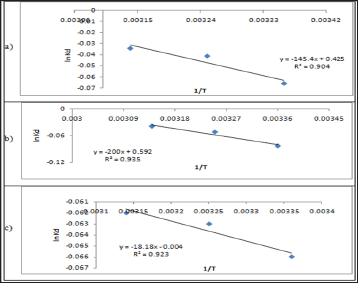
Where Kd is the distribution coefficient (L/g). Thus, a plot of (qe / Ce) against (qe) should be a straight line with slope= - K and an intercept= qm K if Langmuir equation is applicable The distribution coefficients (Kd) is calculated for the polymer at different pH values (4.0, 5.0, and 6.0) and temperatures (25°C, 35°C, and 45°C) are given in Table 9.

Thermodynamics of Adsorption on the Polymer

In order to understand the possible adsorption mechanism involved in the removal process, thermodynamic functions for the system, including changes in Gibbs free energy (ΔG°), change in enthalpy of adsorption (ΔHǂ) and changes in entropy of adsorption (ΔS°), were calculated using the following equation Using the following equation:

Lupinepublishers-openaccessjournals-chemical-science

Where Kd is the equilibrium constant, R is the gas constant and T is the temperature in Kelvin.

The plot of lnKd against 1/T for each metal ion gives a linear relationship, where the values of enthalpy (ΔHo) were entropy (ΔSo) are obtained from the slope and intercept of lnKd vs. 1/T plots. AGo was calculated at each temperature using the following equation:

Lupinepublishers-openaccessjournals-chemical-science

Table 9 present the data of distribution coefficients at different temperatures and pH values, while Figures 13 show the plots of lnKd versus 1/T (Table 10).

Figure 13: Plots of ln KdVs 1/T for Pb(II),(a) pH =4.00 (b) pH=5.00 and (c) pH=6.00.

Lupinepublishers-openaccessjournals-chemical-science

Table 10: Thermodynamic Functions for Pb(II) at T= 298.15 (K).

Lupinepublishers-openaccess-journals-chemistry

The results of the studies on the influence of temperature on metal ions adsorption are presented in Table 10 above. The positive values of enthalpy indicate that the adsorption removal increased with increase of the solution temperature. This shows that the adsorption process is an endothermic one. AG°, ΔHǂ, and ΔS° are the thermodynamic functions related to the experiment conditions. Spontaneity and favorability of the adsorption process is established by decrease in Gibbs free energy values, AG°. The value of AG° between (0.16 - 1.04) indicates the degree of favorability of the adsorption process, so the values of AG presented in Table 10 indicate that the adsorption of Pb(II), Zn(II) and Cd(II) is a favorable process [28]. All the values of AG° are very small and positive which suggests that the adsorption of metal ions onto polymer require some small amount of energy to convert reactants into products [34].

This is agreeing with values of Table 10 which represent to the degree of favorability of adsorption, the decrease of AG° values of Pb(II) >Zn(II) >Cd(II). As shown in Table 10 all AH values are positive this suggests the endothermic nature of metal adsorptions. One possible explanation of this is the well-known fact that heavy metal ions used are well solvated in water. In order for these ions to be adsorbed, they are denuded to some extent of the hydration sheath. This dehydration process of ions requires energy for removal of water from ions is essentially an endothermic process [35]. We assume that the energy of dehydration exceeds the exothermicity of the ions attaching to the surface [36]. The implicit assumption here is that after adsorption the environment of the metal ions is less aqueous than it was in the solution state.

The endothermic interactions between polymer surface and metal ions were accompanied by small positive values of entropy, which wΔS⫲he driving force for adsorption. The positive values of AS signify an increased state of randomness at the solid- solution interface following adsorption. Also the positive entropy of adsorption reflects the affinity of adsorbent for metal ions used. The adsorbed water molecules, which are displaced by the adsorbate species, gain more translational energy than is lost by the adsorbate ions, thus allowing the prevalence of randomness in the system [28]. The entropy changes were most likely to be due to structural changes and adjustments in the adsorbate as well the adsorbent. The structural changes arise from the release of ions like H+ from the polymer surface into the solution and also from partial solvation of the metal ions in water. The adsorptions of Pb(II), Cd(II) and Zn(II) on polymer were associated with entropy decrease in conformity with the general situation of ions existing in a more chaotic random distribution in aqueous solution compared to their adsorbed and immobilized states [37].

Column Experiments

Metal ion uptake by the polymer

The metal ion uptake by the polymer using column experiment for Pb(II), Zn(II) and Cd(II) was determined at pH 6.0 and 25.0 oC, initial concentration of 150.0 mg/L and a flow rate 1 mL/4min. The uptake for metal ions is represented in Table 11.

Table 11: Metal iron uptake using column experiments.

Lupinepublishers-openaccess-journals-chemistry

It can be seen that the uptake capacities of the polymer with the metal ions fall in the order;

Lupinepublishers-openaccessjournals-chemical-science

This result is similar to the order of the metal ions in the batch experiment. However, the values of percent uptake for the metal ions in column experiment are lower than those obtained in batch experiments, because in order to achieve the complete saturation a much greater time is needed. On the other hand, there is no mechanical shaking associated with the column experiments, which result a decrease in percent of metal uptake.

Desorption Studies

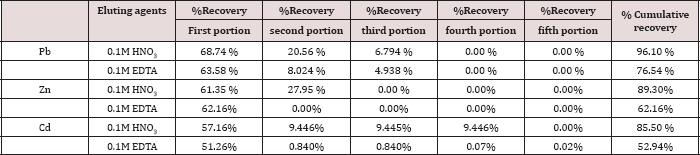
Two eluting agents, 0.10 M HNO3 and 0.10 M EDTA were used for removal of metal ions, keeping the flow rate of elution 1 mL/4 min. The fluent was collected in five portions, 10.0mL for each portion; the results are expressed as percent recovery and represented in Table 12. The eluting agents react in two different ways: HNO3 act as proton-exchange agent and the second a complex-forming agent as EDTA. Depending on the values of the % accumulative recovery, in Table 12, the following trend was observed for the eluting agents of metal ions from the polymer:

0.1M HNO3 > 0.1M EDTA

Table 12: Desorption of Pb(II), Zn(II) and Cd(II) ions from the polymer.

Lupinepublishers-openaccess-journals-chemistry

The experiments confirmed that maximum metal desorption can be achieved with mineral acids in concentrations of 0.1M solutions. This could be attributed to cation exchange between the proton and metal sorbed. However, this method is more complex than protonation [8,38].

Conclusion

In this study, we prepared a polymer containing phthalate function group and capable of adsorbing the metal ion by solution polycondensation and characterization of poly(1,4- benzenedimethelene Phthalate). The structure and properties of polymer was confirmed by FT-IR, 1H NMR, 13C NMR, elemental analysis, SEM and thermal analysis. The sorption properties of the synthesized polymer toward Pb(II), Zn(II), and Cd(II) in aqueous solutions were examined under various experimental conditions using both batch and column experiments. The effective desorption for the metal ions was studied, and the coefficient of recovery of sorption ability was also investigated. The polymer has high sorption rate for Pb(II) observed during the first 24h with high percentage of uptakes toward Pb(II), Zn(II) and low percentage of uptakes toward Cd(II) ions. The influence of different pH on metals uptake showed that the metal-ion uptake by the polymer increased with increasing pH and reached a maximum at pH=6 for Pb(II), Zn(II), and Cd(II). The best conditions for adsorption of metal ions and maximum adsorption capacity (qm) on polymer surface are pH=6, T= 45°C and initial metal concentration of 150 ppm.

The obtained adsorption data showed fitting for Langmuir, Freundlich and Dubinin-Radushkevich adsorption isotherm models. The application of the Eyring equation to literature data i.e. the calculation of AH+, AS+ and AG+, has pointed out that in geochemical transformations it is necessary to calculate the entropy of activation along with the enthalpy of activation in order to fully characterize a process energetically. A column packed with the polymer has good metal uptake properties toward all metal ions, and followed the order: Pb(II) > Zn(II)> Cd(II) at pH 4.0 and 25 oC and flow rate 1 mL/4min. The efficiency of recovery of metal ions after adsorption can be carried out by treatment of the loaded polymer with 0.1M HNO3 and 0.1M EDTA with good percent recovery.

Acknowledgements

The authors would like to thank the Deanship of Academic Research and Quality Control (DAR) of The University of Jordan for supporting this work and all supervisors who worked in the improvement of this work.

Read More Lupine Publishers Chemistry Journal Articles:
https://lupinepublishers-chemicalsciences.blogspot.com/