Showing posts with label Journal of Archaeological Sciences. Show all posts

Thursday, 7 September 2023

Lupine Publishers | Decorating or Money: An Alternative on the Example of the Multi-Layered Paleolithic Site of Kostenki (Russia)

 Lupine Publishers | Journal of Anthropology & Archaeology


Opinion

The use shells of molluscsas money is well known in world history. This precedent ended only in the last century. But, the beginning of such use is lost in the depths of the Paleolithic. Reliably established facts of the most remote from modern times, the use of shells as money is known in China (3500 years ago). The possibility of using mollusk shells as money is considered in the abstract on the example of the multi-layered Paleolithic site of Kostenki in the Voronezh region. This Paleolithic site is one of the most studied in Russia. Note at once that there is no direct evidence of the use of shells as money, but the very way of life of Paleolithic man in Kostenki and some features of the structure of mollusk shells, their species identification indicate a high probability of such use.
The location of the site. The increase in population and competition for food resources pushed Paleolithic man to move to the deserted North, to the periglacial zone of glaciation on the Russian plain. However, it was impossible for a Paleolithic man to live on it due to unfavorable conditions (low air temperatures, low precipitation). However, man has found an oasis in this periglacial desert. They turned out to be deep ravines and gullies that go out into the valley of the then not very deep Don river on the Kostenki-Borshchevo section. There were springshere during the Interstadial period. There was a river nearby, a thicket of vegetation with edible berries, and on the plateau there were herds of undaunted mammoths, horses, and other animals. This did not always continue. People were forced to migrate to the South during the Stadial cold, the permafrost, the disappearance of springs.People again mastered with improved climate conditions to the ravines and gullies of the Don after hundreds of years or even millennia. Traces of Paleolithic human activity are reflected in the multi-layered sites of the Kostenki-Borshchevo section .
Economic activity of Paleolithic man. People of the Paleolithic society had to adapt to survive in the harsh conditions of the ice age, to specialize in the extraction of natural resources. Only a few people possess the skills of hunting for wild animals, especially the mammoths. It was necessary to have a certain skill to catch, for example, a horse or an arctic fox. Not all, but only “narrow specialists” could butcher the carcasses of the extracted animals. Special skills, special raw materials were needed to make hunting tools. Concretions of black opaque flint from the Cretaceous rocks were the best rock for the production of tools and hunting. Such flint had to be extracted from the layers of chalk exposed on the slopes of the steep walls of the ravines. Oxidized (exposed to long-term exposure to air) flint was used for black flint deficiencies. Quartzites, silicified limestones from Devonian rocks, sand concretions, and glacial boulders were used less frequently as tools. Skills and abilities were necessary to maintain a fire (bonfire) for cooking, take care of children, collect plant food (raspberries, cloudberries, possibly mushrooms), build structures for housing using mammoth bones, fish, and make art objects. Consequently, farming was not spontaneous at the end of the Middle and beginning of the Late Paleolithic, judging by the multi-layered sites in Kostenki. It looked, on the contrary, organized, complex. Leaders and chieftains were in Paleolithic societies. They stood out for their skills and, perhaps, strength. But they could not ensure the functioning of primitive society.There was a need for the existence of an “economic” lever, through which the management of society became relatively unproblematic. Such a lever is most likely to be works of art, including crafts such as arctic fox teeth, and small attractive natural objects in the form of preferred (including marine) mollusk shells.
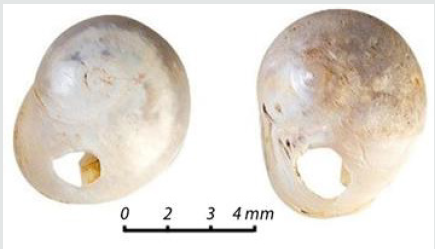
Shells of mollusks as a possible monetary unit.Shells of continental (land and freshwater) and marine mollusks were found in the deposits of the multi-layered Paleolithic site of Kostenki.L and mollusksexistedinvisiblywithPaleolithicman. These were mainly soil periglacial species from the so-called loess complex. Species associated with herbaceous plants of submerged biotopes were observed less frequently, only during the warming phases. Shells of freshwater species that can exist in small pools have been singly recorded in the fauna of Kostenki 14 [1]. Paleolithic man deliberately brought the shells of the following river mollusks to the site: Theodoxus cf. fluviatilis (Linnaeus), Lithoglyphus naticoides (Pfeiffer), Valvata naticina Menke, and unidentifiable members of the Unioidae family. Shells of the mentioned river species are found only in cultural layers. They could not inhabit the waters of the Don river in the vicinity of the Kostenki section.These are interglacial and Holocene species that existed on the Russian plain in river waters outside the permafrost zone.Shells of Theodoxus cf. fluviatilis (Linnaeus) should be considered separately. First, the shells of this species have artificial holes, designed according to archaeologists for wearing pendants. Meanwhile, there are no signs of long-term use as suspensions on part of shells with artificial holes.It is possible that these shells, which are small in size, were simply strung on thin branches of plants or on a thread for transportation, including over long distances. It was hard to lose them in this position. Secondly, the species identification of shells raises questions. The fact is that the shells of the European species Theodoxus fluviatilis (Linnaeus) are very similar to the shells of the Pontic-Balkan mollusk Theodoxus danubialis (C. Pfeiffer). The difference between them is mainly in the color of the shells and the features of the pattern. The surface of the shells of the species Th. danubialis (C. Pfeiffer) has a bluish-purple hue and a banded pattern, while the shells of the related species Th. fluviatilis (Linnaeus) the color is mostly reddish-purple with a mottled pattern. The surface color of the shells from the site Kostenki 14 (Markova Gora) was changed under the influence of oxidative processes during their stay in the soil-loess layer. However, the poorly preserved pattern on some shells still suggests that some of the shells belong to the species Th. danubialis (C. Pfeiffer) (Figure 1).

Figure 1: Shells of Theodoxus danubialis (C. Pfeiffer) with artificial holes from the archaeological site of Kostenki 14.

Lupinepublishers-anthropological-and-archaeological-sciences

This means that the shells were brought by Paleolithic man to Kostenki from a very narrow area, from the lower Danube river basin, where the species was in a refugium during the global cold snap (glaciation) in Europe.Having made such a journey from the mouth of the Danube to the Middle Don, shells became a valuable commodity that could be used as decoration and as a monetary equivalent.
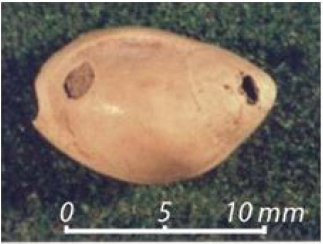
The shells of another species of river mollusks, not previously recorded in the Kostenki, were used by Paleolithic man as jewelry or even money.These are shells with artificial holes belonging to the species Valvata naticina Menke (Figure 2). Paleolithic man drew attention to these shells in connection with the porcelain-glossy luster, strength.The shells of this species, like those of Theodoxus danubialis (C. Pfeiffer), had to be brought from far away, from the lower flow of large low-lying rivers that flow into the Black and Caspian seas. This happened approximately 32 thousand years ago. The proposed route of the Aurignacian man with the shells Valvata naticina Menke, Theodoxus danubialis (C. Pfeiffer) was as follows: lower Danube - Kostenki 1 (Polyakov site), Kostenki 14 (Markova Gora).

Figure 2: Shells of Valvata naticina Menke with artificial holes from the archaeological site of Kostenki 1 [2].

Lupinepublishers-anthropological-and-archaeological-sciences

Sea shells with drilled holes in the cultural layer of the Kostenki site are represented by a single specimen of the young cowry Cyprea moneta Linnaeus, 1758 from the family Cypraeidae (Figure 3). (This shell is considered a member of the Collumbellidae family in the archaeological literature on the Kostenki site). The species Cyprea moneta Linnaeus currently inhabits the coasts of the Indian and South Pacific oceans.The Red sea is the closest habitat for cowries both at present and in the Paleolithic.Shells of this trade and monetary name cowry are found during excavations of Paleolithic sites in Europe, Africa, and the Middle East.Other marine organisms found at different times in the cultural layers of Kostenki 14, we point to the shells of the Mediterranean mollusk Nassarius nitidus (Jeffreys, 1867).

Figure 3: Shells of Cyprea moneta Linnaeus with artificial holes from the archaeological site of Kostenki 14 [3].

Lupinepublishers-anthropological-and-archaeological-sciences

ZA Abramova and AA Sinitsyn [4] believe that the shells from the Kostenki site were used only as beads and pendants.In our opinion, shells of mollusks, especially sea shells, had a value comparable to commodity money.It was necessary to make a long journey to the South, to the mouth of the rivers that flow into the Black or Caspian sea in order to deliver the strictly defined shells to Kostenki.The shells could be exchanged for something valuable from neighboring tribes. The most successful people of the Upper Paleolithic society, who could provide, for example, the maximum supply of meat in the form of a mammoth or reindeer carcass, were awarded with shells, beads, pendants made of Arctic Fox teeth, ammonites from Cretaceous deposits and other decorations.The Upper Paleolithic society in Kostenki probably consisted of successful, and therefore rich and less successful members. The symbols of wealth were the possession of the most original pendants made of mollusk shells and Arctic Fox teeth. Therefore, they served the role of money.

Read More About Lupine Publishers Journal of Anthropology & Archeology Please click on Below Link:
https://journalofanthropologicalsciences.blogspot.com/

Saturday, 15 July 2023

Lupine Publishers | Assessment of Garrick Sokari Braide Movement in Ndokiland

 Lupine Publishers | Journal of Anthropology and Archaeology


Review

Christian religion has its cradle in Palestine and Jesus Christ is the founder. It is commonly believed that the first Pentecost witnessed a great increase in the church’s numerical strength and received impetus to witness universally to its Lord. No sooner than the church left Palestine than it spread rapidly to Greece, Rome, Europe and Africa under the “direction of the Holy Spirit, finger of God or divine providence.In Nigeria Christianity was introduced by freed slaves in the early 19th century. After the abolition of the Trans Atlantic Trade some freed slaves who were originally Nigerians (the Egbas) left Freetown and arrived Badagry on April, 1839. The leader of the group, Thomas petitioned the government to allow them own their colony under the British jurisdiction, where they could engage in trade and also plant Christianity. Following this request James Ferguson invited Church Missionary Society (CMS) in London to begin Missionary activities in Badagry. Consequently, Thomas Birch Freeman of the Methodist Church and his colleagues Revd. Henry Townsend of the Anglican Church arrived Badagry, and on September 24, 1842 the first ever Christian worship was held in Freeman’s traveling tent. The Revd. Samuel Adjai Crowther who was ordained in 1842 later joined the mission team in 1846.

Following the successful establishment of Yoruba mission by the freed slaves another group became nostalgic and as a result took positive steps to return home. This group was the Igbo freed slaves settled in Sierra Leone. In their quest to establish a mission in their homeland they petitioned the local CMS committee to plant Christian religion in Niger “as it has done to the Yoruba” Adiele [1]. Consequently in 1853 the CMS commissioned Revd.Edward Jones to engage in expedition and explore the possibility of establishing missionary work in the Niger. Later in 1857 Rev Samuel Adjai Crowther led a CMS team including Revd. John C. Taylor Catechist Simon Jonas and Augustus Radillo, who were Igbo ex-slaves, to open the ‘Niger Mission’ on July 27, 1857. It is worthy of note that the 1853 expedition of Jones was a precursor to the 1857 Crowther success story in founding the Niger mission, although Crowther worked in a supervisory capacity. In another development, King William Dappa Pepple came in contact with Christian religion while in London.Invited missionaries to Bonny his domain. He felt that the Whiteman had civilization through Christianity and education, therefore on his return to Bonny he wrote to Bishop Tait to come over to Bonny and introduce Christianity and school in order to civilize his people. The Bishop on receipt of the King’s letter directed it to Revd. Henry Venn, the CMS General Secretary in London. In effect, Bishop Samuel Adjai Crowther was assigned to ensure that Niger Delta mission was opened. The Bishop’smaiden visit was in 1864 and the mission work began on April 29, 1865. This mission became the nucleus of the Niger Delta Pastorate (NDP) with major centers in Bonny (October 1864), Brass (1868) and Kalabari (1874). On April 24, 1892 the Niger Delta Pastorate ruptured from the Church Missionary Society (CMS) for obvious reasons. Incidentally, Archdeacon Dandeson Crowther, the last son of Bishop Samuel Adjai Crowther became the sole Administrator of the Delta church, with Bishop James Johnson, the assistant Bishop of the Diocese of Equatorial Africa as supervisor. In his definition of the NDP Archdeacon Dandeson Crowther stated in May 1892 thus:
The Pastorate is a self-supporting, self-governing pastorate, instituted in full communion with the Church of England. We recognize the CMS as our originator(qtd. in Iwuagwu 2).
It was within this independent status of the Delta Church that a lay man of humble birth arose from St. Andrews’s Church Bakana to cause a great revival in the whole church within the jurisdiction of both Niger delta and Niger churches. He was no other than Garrick Sokari Braide. According to Tasie “Braide was a man of humble background and his parents were not well to do…” (Isichei 4)

Garrick Sokari Braide In Perspective

A number of traditions surround Garrick Braide’s birth, childhood and upbringing. The first is the Obonoma tradition. It is believed that Garrick Sokari Braide was born in 1882 and his father, Idaketima Marian Braide, a native of Bakana was married to Abarigania who gave birth to Garrick Sokari Braide at her home Obonoma following Kalabari custom that required expectant mothers to return to her maiden home until the period of delivery was over. This custom may have been followed in order to ensure the security of Kalabari daughters and guarantee the safe arrival of the new born baby. Abarigania belonged to a traditional religious family who were custodians and worshippers of Ogu divinity cult. Garrick Braide uncle was at one time the chief priest of Ogucult in Obonoma. According to Bakana tradition,Idaketima was of Igbo origin, probably a slave in the Marian Braide’s family. A story is told in Bakana that a priestess had prophesied to Abarigania that the foetus in her womb will be an exceptional child filled with the Holy Spirit whose ministry shall begin after his father’s death. The prophecy went on to affirm that the unborn child will constitute a serious threat to the cults; events that unfolded in future proved the prophetess right. The young boy grew up in a pagan home and was initiated into the ogu cult of Obonoma by his mother [2].
Garrick Sokari Braide did not receive formal education, probably for the reason that he was of a humble background. However, he enjoyed the privilege of traditional education prevalent in his own time. Garrick Braide served in Chief Marian Braide’s canoe where he learned commercial skill until he attained the retirement age of thirty. During this period of training he was exposed to travel far and near and this gave him an advantage when he later became an itinerant evangelist. Those areas where he visited for commercial purpose were to become his mission stations [3].
Church historians are not sure at what point Garrick Sokari Braide became a Christian. Open air services began in Bakana in 1886 where Christian converts met for worship and catechetical purposes. Garrick Sokari Braide out of curiosity may have availed himself the opportunity of this worship place. In 1890 Garrick Sokari Braide enrolled as an “inquirer” in St. Andrew’s Sunday School, Bakana where he received instruction under Rev. M. A. Kemmer, of Kemmer town, Brass. In the school he learnt the basics of Christianity which include the Ten Commandments, the Lord’s Prayer and memorization of Bible portions. Igbo language was also taught in the school. It took Garrick Sokari Braide two decades to grasp lessons in the school, for at that time it was the Anglican church policy that an Inquirer must show evidence of brilliant performance in the school before he/she could qualify to receive the sacrament of baptism. However, on January 23, 1910 Garrick Braide was baptized in St. Andrew’s Church, Bakana after two years he was confirmed in 1912 [4].
Before the emergence of Garrick Sokari Braide as a spirit filled prophet the issue of appointment of indigenous agents in the Niger Delta Pastorate has been agitating the minds of the faithful in the area. The Delta worshippers made a representation to Bishop James Johnson, the supervisor of the NDP in 1905. They submitted that the Niger Delta pastorate has been self-supporting since its inception in 1890 but not self-governing, since its depended more on the Creoles and Yoruba agents for its staff. Furthermore, the delegations pointed out that since the inauguration of the Niger Delta Mission only one agent was appointed from among the indigenes. Tasie states:
Some pastorates which felt very strongly against the existing situation reiterated that unless action was taken to remedy the uncompromising situation, the Delta Church might split up (173).
In his response to this agitation Bishop James Johnson called a meeting of the Delta Church Conference in February 1905 where it was resolved that a theological institute be established in Bonny for the training of Delta indigenous agents to govern the Church in the Niger Delta Pastorate. Regrettably due to paucity of fund the project could not open till October 1912.
After he had received confirmation in 1912 Garrick Sokari Braide narrated his spiritual experience during his first communion in these words:
As I knelt down with others looking at the Holy Table with the elements laid down on the occasion, but more so as the minister pronounced the words as I was about to receive the elements: ‘the body of our Lord Jesus Christ which was given for thee preserve thy body and soul unto everlasting life. Take and eat this is in remembrance that Christ died for thee and feed on Him in thy heart with thanksgiving’. A thrill came over me; a bright light flashed over my eyes and as the elements entered into my mouth, as it were still small voice said to me; ‘Garrick Braide for you Jesus died, for you He gave his body and shed his most precious blood on the cross to wash away your sins. Have you been washed in his precious blood?’ In deep and silent tone I replied: ‘Lord wash me and I shall be wither than snow’. After the communion I knelt down in my pew and pour out my soul in prayer to God. I could not sleep the whole night; several times I got up from my bed and pray….. At about the still hours of the morning, I heard a still small voice saying Garrick! Garrick! Are you prepared to be my servant? Are you ready to witness to mankind the saving truths of the Gospel? (174 -175) [5].

Subsequently, Garrick Sokari Braide gradually developed his spiritual life by engaging in spiritual exercise. It is said he often spent time in the church alone lying prostrate on bare floor confessing his sins and asking Jesus Christ for forgiveness. At times Garrick Braide observe all night in the church fasting and praying with his bible and prayer book. He also began to practice healing through prayers and recorded good success. Garrick Braide at some point noticed that he was developing spiritually and decided to give himself for the work of evangelist.Above experiences marked the call to ministry, training and inauguration of Garrick Braide’s evangelistic outreach which was to span the whole of Southern part of Nigeria and swept many converts into Christianity [6]

Aside from Garrick Braide’s personal spiritual experience on the first day of making his first communion in the Anglican Church and the direct call he received from God, his home pastor Revd. M. A. Kemmer reported from Bakana that Garrick Braide was gifted in healing the sick through prayers, prophetic (foretelling) utterances and performing miracles. He went on to appoint him his Pastor’s warden. Garrick Braide visited Bonny at the instance of Chief Alexander Hart and there his ministry was recommended to the congregation of St. Stephen’s Cathedral Bonny by their pastor, Revd. S.S. Macarthy and was thereafter nicknamed Elijah II and his home town Bakana was known as “Israel”. Again, he was invited to Abonema shortly after his visit to Bonny. Garrick Sokari Braide arrived Abonema, some two and half kilometers to his mother’s home Obonema, where he was born. The people were in high spirit to welcome him and he was enthusiastic to visit them. On January 5, 1916 Garrick Sokari Braide arrived Abonema amidst a rousing reception. On January 7, 1916 he launched an evangelistic crusade that resulted to many converts trooping to the Anglican church the next Sunday [7].
One may ask, what was the push and pull factors that characterized Garrick Braide’s Evangelistic campaign? Before we can answer above question we need to appreciate the fact that the Anglican Christianity has touched the Delta soil in 1865, that is to say, five decades (fifty years) before the emergence of the Garrick Braide movement in 1915. The Anglican Church method of evangelism and church planting policy, we may recall, was “consolidation before expansion”. Therefore the church’s method of recruitment of membership was a rigorous ‘Catechetical approach’ of teaching “Inquirers” the Ten Commandments, the Creed, the Lord ’s Prayer, Catechism etc. For instance it took Garrick Braide over two decades (1890– 1912) to graduate from the status of Inquirer to a full communicant. Conversely Garrick Sokari Braide came with the method of “expansion before consolidation” following the Biblical parable of the dragnet. Therefore, “Converts were baptized in their hundreds without the usual preparation and examination”. Added to this, was his iconoclastic method. He believed that it is only when people break loose from the grip of traditional religious practice such as charms, idols, shrines etc and abstain from alcoholic drink, and confess their sins would they become genuine Christians. Therefore, Garrick Sokari Braide evangelistic movement won many converts into Christianity in the Niger Delta. It spread into commercial cities, villages, hamlets, fishing ports and every nook and cranny in Sothern Nigeria. The push factor to Garrick Braide movement was the agitation for self-actualization and selfdetermination of the Niger Delta Christians and their resistance to perceived marginalization by Sierra Leone and Yoruba agents in the Delta church government [8].
To this end, the Delta people saw Garrick Braide Movement as coming to fulfill two major purposes for them. They felt that with the emergency of Garrick Sokari Braide, Christianity being a civilizing agent would be made more accessible to the Delta people. Second the monopoly of church government by Sierra Leoneans and Yoruba has been broken. Therefore, it was credited to Garrick Braide in January 7, 1916 during his address in a conference this statement: “that the time has come for Africans to actualize themselves and assume responsibility among their people”. To back up this, the Chiefs and his kinsmen presented him to Bishop of the Diocese of Equatorial Africa,James Johnson to be recognized as an evangelist within the Anglican Church (Isichei 108). And to buttress this expectation he appointed evangelists to whom he delegated healing powers to different parts of Niger Delta. Following this were bands of self-acclaimed evangelists known as Ndi amuma “the sons of the prophets”.
However, Bishop Johnson’s refusal to grant the request of the Delta Chiefs left Garrick Braide and his people disappointed.In reaction, revolt against the NDP erupted. Many Churches of the NDP became empty on Sunday because many have sympathy for the new order. In response, the NDP authority disbanded Garrick Braide Movement and suspended pastors who gave it support.The Church further accused Garrick Sokar iBraide Movement of abuse of healing practices and Prophetic ministry. For instance his followers deified him by calling him god; and even his bathe water was used for healing. Added to this, the colonial government represented by P. A. Talbot the District commissioner of Degema persecuted Garrick Sokari Braide. He tried the prophet three times in1916 by accusing him of sedition, economic sabotage etc. Dayrell who was Talbot’s successor joined force to accuse Garrick Sokari Braide of (1) obtaining by threats and false pretenses (2) behaviour likely to cause breach of the peace (3) Willfully damaging jujus (Iwuagwu 52-53). It was the intensity of the persecution from the church and the colonial government that hastened Garrick Sokari Braide’s death on 15th November 1918. He foresaw his death and told his followers “my time is due and I will soon leave you” (Tasie 179) [9].

Doctrine of The Garrick Sokari Braide Movement

Garrick Sokari Braide Movement introduced an entirely new order into an existing (old) order in the Niger Delta Pastorate. The NDP vis-à-vis the Anglican Church was not designed for Africans, rather for English Anglicanism. The liturgy was fashioned to suit English conservatism and contains prayer for the monarch and prayers that have vestiges of the Reformation acrimony. The use of prosaic hymnals and organ was meant for Western churchmanship. Moreover the missionaries’ method of recruiting converts was rather clumsy and discouraging. In this vein, Garrick Braide was to up turn the near fruitless mainline churches’ method and practices to favour a new dynamic, creative and innovative method and procedure.
First, he contextualized the gospel for his people by encouraging singing local or native airs in place of hymn book. This was to accommodate worshippers, majority of who were illiterates. Therefore the perfunctory form of worship gave way to participatory worship for all. Clapping of hands and ecstatic dancing which is African self-expression were encouraged. Little wonder Bishop N. B. Iyalla quipped concerning Garrick Sokari Braide that “he taught the African how to worship God in his own way” (Tasie 177).
Second, Braide encouraged worshippers to lose faith in traditional religious practices. Therefore he burnt shrines, charms, idols (juju) etc. In the Delta the drinking of gin and rum was a habit which the natives were addicted to and this led to moral decadence among the populace, even the Delta Christians and their leaders. The new prophet demanded abstinence from alcoholic drink and encouraged confession of sins and engagement in prayer (20 times a day) and fasting among adherents of Christianity.
Third, Garrick Sokari Braide laid emphasis on the fourth commandment “Remember the Sabbath Day and keep it holy…” (Exodus 20:8-11 KJV). It would be recalled that Deltans, both Christians and pagans of Garrick Braide’s home were in the habit of profaning the Sabbath (Sunday) in preference to their commercial activities and fishing business.Therefore, the prophet demanded strict observance of Sunday, only church worship and religious activities were allowed (Isichei 106-107).
Fourth, Garrick Sokari Braide movement was favorably disposed towards the institution of polygamy although himself had one wife. He may have glossed over polygamy for the useful purpose it serves among Africans including economic social and political.
Fifth, Garrick Sokari Braide healing ministry and miracles were practical tools that more than any factor attracted converts to the church since at the time there was little or no medical facilities in Nigeria. From above survey, we deduce that Garrick Braide came to fill a yawning gap in the NDP ministry among the Niger Delta people and by extension African Christianity.
In response to Garrick Braide’s teaching there was mass conversion into Christianity in the NDP and Southern Nigeria was rapidly Christianized between 1915/1918. It must be observed that Garrick Sokari Braide methods and teachings were not inimical to or at aberrance with Orthodox Christian doctrines. It was in this vein that S. A. Coker in a public lecture on Tuesday 10 April 1917 declared “I challenge the pastorate church to state publicly what portion of Garrick’s theology is wrong supporting their statement from the Bible”. He further asked “what evil then has Braide done? (Tasie 194-195). Of a truism Garrick Braide committed no evil and did not teach wrong doctrine. The NDP authority out of envy, jealousy, insentivity, impatience and abuse of power accused the movement of abuse of prophecy and threw away the bath-waterwith- the-baby. What a regrettable action?

Garrick Braide And The Founding Of A New Church

One of the negative sides of religion is pluralism and N.S.S Iwe avers that it could be harmful to society because its effect is “negative and repressive, disintegrative and counter-productive, violent and dangerous for humanity” (Iwe qtd in Asu 40). Garrick Sokar iBraide was therefore cautious enough not to compound the problem of the society to which he was called to serve. He was not ambitious or driven by filthy lucre because he was a man of quiet disposition and a man of God full of piety. To this effect, when his followers suggested to him to establish a church he replied, “my mission is that of a prophet; God has endowed me specially with this prophetic power and nothing can sway me from that… Let us not be hasty. Let us wait” (Tasie 201). Garrick Braide could have been justified if he had readily opened a new church for himself considering the persecution he received from the church and colonial government. To further buttress their leaders’ position in founding a new church in the face of daunting circumstances his followers collaborated thus:

It must be mentioned that before the persecution came to a head, the prophet had no secular motive in his relationship with the parent church, neither had he any intention of seceding with his teaming flock from it. Rather, he continued his membership of that denomination, submissively and faithfully serving it (Iwuagwu 53).
The persecution not withstanding Garrick Braide was clear of his divine mandate that is to ‘fill the gap between the NDP and the eventual indigenization of Christianity’ in Delta in particular and by extension Africa. Indeed this was the beginning of African quest to fill the spiritual and political gap created by early missionaries in their failure to contextualize the gospel on African soil (Nwoko 100). However, Garrick Braide followers was not to be as focused and patient as their leader. Therefore, one of the followers, Kurubo Pepple saw a vision that teaming population of “church rebels” who were persecuted and frustrated were God’s own army consequently on January 30, 1916 the first schismatic group evolved from the Niger Delta pastorate (NDP) and knew itself as “Christ Army Church” (Iwuagwu 53) [10].

The Coming and Spread of Garrick Braide Movement In Ndoki land

In the West African sub-region there arose two important religious phenomena that brought revival in the churches within the region before and after the First World War in 1914. The first took place along the gulf of Guinea. Prophet Wade Haris emerged in the 1910 and brought about an unprecedented revival in the mainline churches and many folks believed and thronged around the charismatic figure. Again, between 1915 and 1918 another charismatic figure arose in the Niger Delta of Eastern Nigeria and caused revival in the Niger Delta Pastorate Church (NDP) and its influence precipitated in the Christianization of the entire Eastern Nigeria within a short period of three years (Kalu 95). Garrick Sokari Braide Movement began in St. Andrew’s Anglican Church Bakana with performance of miracle and act of healing, iconoclastic ministry and abstinence. Many people within Bakana were attracted to the person of the founder of the evangelistic ministry, Garrick Sokari Braide, a humble man of God full of piety and the power of God [11].
In 1916 the “waves from the Rivers” blew in Ndoki land. Ndoki was accessible to the Garrick Sokari Braide just as it was to the Ubani traders who settled at the water fronts in different houses and established the Anglican Christianity in the area alongside their commercial business. The first entry point was Obunku Ugbo from where they visited other villages. According to S.C Chuta, in Akwete the priest of the arch-divinity Nwaiyieke woke up in the morning and fell into religious ecstasy, ran around the community summoning the people, then climbed the Nwaiyieke divinity tree and screamed:

Unu tuorom Ugbo – o-prepare a boat for me
Agam ilaala-o-o-I must go away
Unu tuorom Ugbo-o-o-prepare a boat for me
Agam ilaala-o-o-I must go away
Agham’huru kpunchu-o-the battle I perceive wears a hat
Ha ti nwei ochicha-o-they are all dressed in white;
Ha si ntukpu abia-o-o-they are coming from the water side

Following this clarion call and appeal devotees of the dreaded Nwaiyieke gathered, prepared a boat and gathered sacrificial materials into it and let the juju priest off; he set out and disappeared from sight. After two weeks the Garrick Braide movement arrived Akwete and burnt the Nwaiyieke shrine, an incident that hardly leaves any typical Akwete Christian which the community knows as era of “Igbu ekwensu” (Akparanta J OC). Garrick Braide evangelistic team revived the “Choochi Delinta” in Akwete. From thence “this new religious force, like a wave, swept through Akwete, obunku (which became the headquarters), Ohambele, Azumini, Ohaobu to Mkpukpule desecrating religious shrines” (144).
According to oral source the Garrick Braide movement on arrival at Akwete paid a courtesy call on Chief Nwagbara Akpara who summoned his people together at Nwaiyieke shrine, the people surrendered the shrine to be burnt. The evangelists prayed and set the shrine ablaze as the people pour faggot in the blazing fire and sang “Ekwensu bialaa na Jisos abiala” (Satan pack and go; Jesus has come). To Akwete people the religion introduced to them in the 1880s by Ubani traders was simply “choochi Delinta”. It was now the Garrick Braide Movement that brought “Jesus” to them in 1916.
Again, during the reign of chief Okereuku, the heir apparent to the Akawor chieftaincy stool Prophet Elijah II arrived Egberu from Bakana in 1916. He assembled everyone in Egberu at the shrines of “Wetiobu” and “Nneanyi”. He offered prayer and poured kerosene on the shrine and set fire onthem. The exercise Igbu Ekwensu extended to all public and private shrines in the village. Consequently, “Christ Army Church” was founded in Egberu. The first converts were chief Hudson Nwagbara, Francis Ogbuagu, Thompson Nnah Nwankwo Tata and Eli Okijah. The first teacher posted to the church by Prophet Elijah II was Mr. Aberdee alias Frank Nwaikpahia, a native of Ahoada. “The church was noted for healing the sick with holy water, mud and holy oil”. It also emphasized fervent prayer and power to heal the sick. The church planted a junior primary school in Egberu which acted as spring board for civilizing the people (Akawor Harold). The influence of the movement later waned in Egberu as a result of low morals among its leadership and followers [12].

It is said that Prophet Garrick Sokari Braide(may be his delegation) visited Obeakpu in 1915 from Obunku Okwankwu. Many shrines in Obeakpu were torched but Ogu shrine became stubborn. However, after the “college” (a prayer arm of the church) engaged in one week fervent prayer of faith and fasting,Ogudeity was routed into “ehereehi” (great river) in Obeakpu. The movement healed the sick through use of camwood obtained from “mini Ogbu” (a special spring source of water). The church planted basic school in Obeakpu with teacher Dauton as the first teacher while the church was manned by teacher Ukata, an Ngwa man. Furthermore, Obete community received the wave of Garrick Braide movement from Obeakpu. One Mgbokwo Sokari George of Obeakpu, a prophetess opened a prayer band for Sunday Onyeamuma the heir apparent of Obete. And out of religious zeal Sunday took the fire of evangelism to Asa Ugbobekee in Asa [13].
Besides, through the instrumentality of Philip Halliday a Bonny oil trader resident in Ohaobu the Garrick Braide movement visited the village. Prior to the advent of this movement in 1915 Ohaobu had shrines called Nkukwa, Nworu, Ajamaja, Ihuala, Neneobu, Tututurutu etc. At a junction located at the center of the village known as “Mbuba” (Assembly ground) evil spirit raked havoc from 6pm that no one dare cross the spot.But with the coming of Garrick Sokari Braide Movement the evil forest was dis-virgined and Christ Army Church was later built on the spot. After an evangelistic crusade led by the Movement Christ Army Church was founded at Polo Odum house from where it moved to the extreme part of the community, Okpikoro. In November 1919 Moses Hart (later Bishop) led an evangelistic campaign that saw the destruction of evil deities at “Mbuba”. The natives surrendered their private charms, amulets and shrines for destruction. The first batch of converts in Ohaobu to embrace Christianity through the auspices of Garrick Sokari Braide movement include: Jacob Nwankwo Onyeuku Obasi, Jeremiah Nnah Udoo, Egege Igbo, Mbunta, Mary Egeolu, Nwaikpeghi Jim Owo, Philip Halliday and Stephen Okere Anyato. From among the early converts the following persons were baptized by Moses Hart in 1921. They include: Jacob Nwankwo Onyeuku Obasi, Jeremiah Nnah Udoo, Egege Igbo, Mbunta, Mary Egeolu, Nwaikpeghi Jim Owo, Mbunta of Akpala. The first set of converts to receive confirmation in 1925 were Jacob Nwankwo OnyeukuObasi, Jeremiah Nnah Udoo, Egege Igbo, Mbunta, Mary Egeolu, Nwaikpeghi Jim Owo, Stephen Okere, Philip Halliday and Rhoda Halliday. The pioneer Sunday school teacher was Jeremiah Nnah Udoo. It is noteworthy that Christian religion was properly contextualized to the early converts in Ohaobu through the use of songs composed and tuned in the people’s thought pattern, local idioms and minstrel.

Olu oma Elijah-Elijah’s good work
O wu ihe m nuru gbara biawa-that is my reason for hasty arrival
Elijah gbuele opi-Elijah has blown the trumpet
Ndi elu uwa kwerecha-the whole world has come to faith
Oruole mgbe oruru-at some point
Akana akpo anyi ndi amuma-we are now known as prophets

The theology of the church was solid and sound following Biblical teaching as contained inProverbs 23:26 –“My son, give me thine heart, and let thine eyes observe my ways”; Composed thus:

Na mgbe, mgbe na mgbe o wula-from time to time
Olu m hu nanya nasi-a lovely voice beckons
Si nwam furu uzo nyem obi gi-saying my child give me your heart
Enyele obi gi na ekwensu ozo-do not give your heart to Satan again
Na mgbe, mgbe na mgbe owula-from time, to time

Converts faith was so consolidated to the extent that no back slider was ever recorded. One teacher Anyanwu took up catechetical responsibility very seriously. Every night he assembled children in his private residence and taught them the Catechism, the Lord’s Prayer and the Ten Commandments. This exercise readily paid off as many illiterate children whose parents could not afford formal education availed themselves the opportunity to learn rudiments of the Christian faith. Garrick Braide Movement produced indigenous prophets including Long John Nnanna Okoro, Jeremiah Nwosu, Rhoda Halliday, and Agnes Nwafor Nwulu. These indigenous prophets displayed exceptional and powerful gift of faith healing and foretelling prophecy in their ministries. In 1948 the Ark Faith Healing School was planted in Ohaobu – Ndoki by Bishop Inyambi Hart.
Garrick Braide Movement was introduced in Obeaku by one J. Gordon a fisherman, resident at a commercial spot named Mkpirikpo water side. He established Christ Army Church in Obeaku and assigned the station oversight to a prophetess called (Mammy) a native of Oboama in Opobo. The church grew in leaps and bounds with pioneer members which include Moses Nwagbara Nnah Aka, Jonah Nnah Aka, Michael Philip etc. Moses Nnah Aka became the Sunday school teacher and Michael Philip was the lay reader. Incidentally, Emmanuel Nnanna (Philip’s son) boosted the image of the church from 1974 and later became a Revd. Canon.
A story is told of one of the devotees in the person of Mr. David Obomanu in 1943 who absconded Friday prayer to attend to his farm work. While at work he perceived severe migraine that forced him back to join the prayer. As soon as he arrived the church his headache disappeared and he became completely relieved. Consequently, he became a voluntary sexton in the church all his life. The church produced indigenous prophetess who were gifted in faith healing through prayers and foretelling the future through vision and trance. They were Felicia Dickson, Elizabeth Nnah and Salome Nnanna.

Conclusion

Our survey in this research revealed a number of issues to be considered by the contemporary church as touching the Garrick Sokari Braide Movement. The honest truth remains that Garrick Sokari Braide was a precious gift to the Niger Delta Pastorate [NDP]. The movement was a divine given to complement the mission mandate of the Anglican Church in the Niger Delta by way of evangelistic outreach and Christianization of Southern Nigeria. However, the movement’s weakness lies in the fact that it failed to fashion monitoring mechanisms for the control of its teaming converts and evangelical bands. Therefore, the converts abused the privilege and free hands given to them out of religious zeal and brought Garrick Braide into strained relationship with the NDP Church. And the Colonial government who had the responsibility of maintaining peace in its domain could not fold its hands and watch the church that preaches peace engulfed by crises.

On the other hand, the NDP threw caution to the wind and over reacted at the slightest provocation by the new converts and had no sympathy for Garrick Sokari Braide who remained a humble member of the church till his death. Bishop James Johnson could have in principle recognized Garrick Sokari Braide as an evangelist and create the “office of prophet and evangelist for him” as a doctrine of convenience and a tool for evangelism, at least within the NDP only. This could have assuaged the agitating Niger Delta Christians andgave the church a pass mark. The Garrick Braide Movement is commended for its excellent work in the Delta Church and beyond. Although, it could not provide social amenities such as hospitals, road, remand homes, higher institutions etc. therefore,In order to repair the age long strained relationship which aroseas a result of the Anglican church mistake this paper recommends as follows:

A. Christ Army Church founded through Garrick Braide Ministry, after a century needs to close rank and return to its founder’s original vision and mission in the NDP; rediscover his principles and methods of evangelism for the good of the society and the universal church.
B. Anglican Church need to learn from its past mistake and be sensitive to new innovations for God does not do things in stereotype manner instead he is dynamic in his activities. The Church should therefore have a discerning spirit and know the direction to which the Holy Spirit is pointing her.
C. Christ Armyand Anglican Churches should learn contextualization method of doing theology from Garrick Sokari Braide. This has been the brain behind the success story of the Roman Catholic Church in Nigeria. According to Alain Mayama “the basic elements of African traditional religion can be used as raw material for the construction of African theology”. Fortunately Garrick Braide developed this method earlier, but the AnglicanChurch rejected it at her detriment. The time is rife for the church to re-discover this method.
D. Anglican Church should render an unreserved apology to the memory and family of a good and faithful servant of God in the person of Garrick Sokari Braide who was persecuted unjustly, and also confess its sins of omissions to God. In addition, the Anglican Church is urged to initiate a reconciliatory service with the Christ Army Church for the unfair treatment meted to her progenitors, cooperate and work with the denomination. The ecumenical organization, which is the umbrella body that unites the whole churches in Nigeria- Christian Council of Churches (CCN) and the Christian Association of Nigeria (CAN) should admit and allow Christ army to head the bodies for ten (10) years, in order cushion the effect of the injustice they have suffered over the years. This done; the spirit of Garrick Soraki Braide after a century, will rest in peace.

Read More About Lupine Publishers Journal of Anthropology and Archaeology Please Click on Below Link:
https://journalofanthropologicalsciences.blogspot.com/

Thursday, 8 June 2023

Lupine Publishers | A Review on Rights-Based Strategies in the Prevention of Domestic Violence

 Lupine Publishers | Journal of Archaeology & Anthropology


Abstract

This paper is an attempt to broaden the discussion about the prevention of domestic violence against women informed by a rights-based strategy. Specifically, the study discusses the critical elements of a human rights framework to reduce domestic violence, present research findings on the prevalence and correlates of domestic violence in intimate relationships and explore strategies for the prevention of domestic violence on the basis of research and analysis. The study suggests that domestic violence needs to be resituated in the broader social transformation of society and that domestic violence should be conceptualized as violation of a woman’s most basic right. The strength of a rights-based strategy is that it meshes formal treaty doctrines with grassroots activism and critiques of power. The study suggests that “right to housing” and “right to property and inheritance” are critical and most fundamental for any strategy in the prevention of domestic violence. Importance of immovable assets and social support is significant in making a difference to the incidence of violence, Changing norms of acceptability of violence in the family is critical to reduce inter-generational transmission of violence, Male attitudes and society’s attitudes also need to be changed in this regard. Since prevention of domestic violence requires fundamental changes in attitudes and behavior, it confronts societal and individual resistance to change, Support structures could be both within the family and from NGOs, SHGs etc., who can both help in changing attitudes and in helping women acquire immovable assets. This calls for creative community involvement, shared responsibilities, and collective action with the goals to challenge the patriarchal assumptions of power and control and entitlement to women.

Keywords: Domestic Violence; Women; Human Rights; Development; Gender Equality; SDG5

Introduction

Within the burgeoning discourse on human rights, domestic violence against women is increasingly viewed as a serious violation of human rights subject to legal intervention. The societal responses to domestic violence have focused, to date, primarily on crisis intervention after the harm has occurred. While crisis intervention is a necessary response to domestic violence, it alone cannot address the complex dynamics of domestic violence. What is needed is a comprehensive strategy that addresses the prevention of domestic violence. However, few such strategies have been developed, and even fewer have been evaluated. This study is an attempt to provide a framework for the prevention of domestic violence informed by a rights-based strategy.
The study is divided into five sections. The first section provides a brief overview of the evolution of the international human rights system. The second section clarifies the concept and value-added of a rights-based approach to development. The third section examines the scope of the international human rights law to prevent violence against women. The fourth section examines the links between domestic violence and women’s social and economic rights. The concluding section provides a rights-based strategy in the prevention of domestic violence.

Evolving International Human Rights System

Human rights have made a great deal of progress as moral and legal force since the Universal Declaration of Human Rights was adopted by the United Nations (UN) on December 10, 1948. The Declaration, which was written by Eleanor Roosevelt, chair of the UN Commission on Human Rights, and 17 other international delegates, is the primary international articulation of the fundamental and inalienable rights of all human beings. The Declaration is not only the point of departure for all human rights treaties that followed; it has truly become the singly most meaningful human rights document around the globe. The Declaration consists of 30 different articles that enumerate a wide range of fundamental and inalienable rights to which all human beings are entitled. The Declaration states that “all human beings are born free and equal in dignity and rights”, and it declares that everyone is entitled, without distinction of any kind, to the various rights articulated in the Declaration. The Declaration was not intended to be a legally binding document. The first step toward implementation of the Declaration was the creation of specific treaties to deal with some of the main principles outlined in the Declaration. The International Covenant on Civil and Political Rights (ICCPR) and the International Covenant on Economic, Social and Cultural Rights (ICESCR), for example, were adopted by the UN General Assembly in 1966, and they were drafted and adopted as legally binding international treaties meant to ensure protection of the rights proclaimed in the Universal Declaration. These two treaties are broad in scope. Others are more specific, such as convention on the elimination of discrimination on the basis of race or gender, and on the right of the child. The standard method of enforcing human rights treaties is a reporting system. Governments are obliged to report periodically on their human rights practices and then must defend their records in front of an international body that can put diplomatic pressure on them to comply.
A major international treaty on women’s rights was adopted in 1979 by the UN General Assembly: Convention on the Elimination of All Forms of Discrimination against Women (CEDAW). CEDAW, in fact, is the first comprehensive human rights treaty to address women’s rights. CEDAW comprises of 30 articles, and provides a universal definition of discrimination against women. The treaty covers a wide range of issues, including maternity leave, pregnancyrelated health care, property rights, and affirmative action for women in education and employment. The treaty also provides a legal framework for nations to eliminate gender discrimination. Till today, 170 countries have ratified CEDAW.
In the 1990s, women’s rights have been further defined and expanded through negotiations at six major world conferences. The recognition of the fact that human rights are crucial for women’s well-being, women’s organizations continued to focus on the global stage some of women’s most basic rights, including freedom of movement, freedom to work outside of the home, right to bodily integrity and freedom from violence. It was the violence against women issue, especially domestic violence, which finally drew wide international attention to the idea that women’s rights are human rights. In fact, women’s human rights became the most dramatic agenda item at the 1993 World Conference on Human Rights held in Vienna, Austria. The 1995 UN World Conference on Women held in Beijing, China, reaffirmed the conclusions of the Vienna Conference and put women’s human rights even more firmly on the world agenda.
In June 2000, the UN General Assembly reviewed the implementation of the Beijing Platform (Beijing +5) and reaffirmed government’s commitment to work for the realization of women’s rights. The new document (Women 2000/Beijing +5 Outcome Document) reaffirms the 150-page Platform for Action at the landmark 1995 UN Women’s Conference and moves forward with tougher measures to combat domestic violence and trafficking of women. The Outcome Document calls for prosecution of all forms of domestic violence, now including marital rape. The traditional practices of forced marriage and honor killings are addressed for the first time in an international document.
Although these documents and programs of action do not have the status of international law, they carry political and moral weight as policy guidelines for the UN, governments, and other international organizations. Women’s organizations can use these documents to hold governments and the UN accountable.
All these conferences provided opportunity and space for public assessment and discussion of the critical areas of concern. They reaffirm the commitments of women’s movements that have placed women’s empowerment and rights on the international agenda. There is now a clear recognition that women will never gain dignity until their human rights are respected and protected. Strengthening families and societies by empowering women to take greater control over their own destinies cannot be fully achieved unless all governments around the globe accept their responsibility to protect and promote internationally recognized human rights. Empowering women is also critical to promoting democracy. The challenge, however, is to develop strategies to grant basic rights to women and enable them to choose how to exercise those rights. This is especially important because the gap between principles and practices defines the central dilemma of human rights Steiner et al. [1].
In order to improve institutional effectiveness, the international human rights system has been rapidly evolving. In recent years new roles have evolved for the UN, especially through the creation of the office of the High Commissioner of Human Rights. Within the Human Rights Commission, new thematic mechanisms (such as special rappoteurs and working groups) have emerged. New avenues have opened for individual communications, as reflected in the recently adopted Optional Protocol to the Convention on the Elimination of All Forms of Discrimination against Women (CEDAW). New forms of redress are being developed – including international prosecution against individuals and against corporations.
There is clearly room for additional reform of the UN mechanisms to ensure effective institutions and stronger means of enforcement. However, the international human rights norms have had, in fact, a demonstrable and positive effect on the behaviour of states toward their citizens (Risse et al. Ropp and Sikkink, 1999). Thus, significant strides have been made; both on a global scale through the United Nations and its agencies and on a regional level through the proliferation of human rights interest groups and nongovernmental organizations around the globe.
There has been a paradigm shift in the vision of human rights discourse. Now, the scope of the human rights vision has been broadened to include non-state actors (e.g., individuals, corporations, financial institutions and third-party states), in addition to the traditional state-centric paradigm. In an era of globalization where the world economy is increasingly being integrated, moving beyond a state-centered view of human rights to include non-state actors has a potential to hold non-state actors accountable for violations of social and economic rights. However effective implementation still rests with states, who as signatories to international conventions are duty bound to protect, fulfill and promote rights. Though for some states human rights are still contentious, there has been a dramatic progression in the acceptability of rights with the number of states ratifying core conventions rising from 10 percent to more than half in the last decade. This increasing acceptability of all rights including political, civil, cultural, social and economic has made inroads into current thinking on development policy and practice.

Rights-based Approach to Development

There has been a paradigm shift in the development discourse, from a welfare-based approach to development to a rights-based approach to development. Unlike the centrality of ‘economic efficiency’ in the welfare-based approach, the rights-based approach reflects a global consensus on the centrality of human dignity and equality in social and economic life and the nonnegotiable accountability of states for fulfilling their obligations.
The Human Development Report 2000 shows that human rights and human development are inextricably linked and mutually reenforcing. They take root and grow in diverse societies. They expand capabilities by protecting rights [2]. This understanding has contributed to the development of people centered sustainable development.
This revolution in the discourse of development is strongly influenced by the writings of Amartya Sen, the winner of the 1998 Nobel Prize in economics. First, Sen illustrates that human values are not always analogous to preference-satisfaction, and provides a critique of utility/ welfarism [3]. Second, Sen has had a long-held conviction that violation of rights and freedom is inimical to socio-economic development. Finally, Sen has combined these two strands effectively in his recent book, Development as Freedom [4]. Sen argues that freedom properly understood is the appropriate normative framework by which to understand global issues of development. At the heart of Sen’s extensive writing in moral philosophy and development economics is the idea that the ability to survive is a substantive freedom. He focuses on a person’s “capabilities” or substantive freedom of people ‘to lead the lives they have reason to value and to enhance the real choices they have’. These freedoms include the ability to acquire sufficient food, freedom from disease and ill treatment, access to education, freedom from social exclusion, freedom to participate in the life of the community, and freedom from unemployment. According to Sen, the success of development must be assessed by the achievement of such freedoms. In fact, development is the result of the exercise of these freedoms [4].

Sen further argues that substantive freedoms are supported by instrumental freedoms, such as economic opportunities to use resources, political choices about laws, social questions about arrangements of health care, the security of a social safety net, etc. The effectiveness of freedom interrelates with one another, and freedom of one type may greatly help in advancing freedom of other types. More importantly, Sen argues that individual freedom is a social commitment: that substantive freedom is extremely contingent on personal, social and environmental circumstances; and that the exercise of such freedom is inseparably linked to social, economic and political institutions.

According to Sen, expansion of freedoms is both the definition of development and the means to achieve it. The ultimate aim of development is enlarging the capabilities of all human beings. What are really important for people are the freedoms associated with human rights, he argues. In May 2001, the United Nations Committee on Economic, Social and Cultural Rights reaffirmed this view in a forceful statement arguing for a better integration of human rights in development strategies. The Millennium Development Goals calls for the adoption of policies, programmes and strategies informed by a rights-based approach. The Millenium Declaration requires answers to pertinent questions relating to how targets are achieved, and who are affected by improvements. The UN organizations such as United Nations Development Programme (UNDP), United Nations Children Fund (UNICEF), and United Nations Development Fund for Women (UNIFEM) are increasingly becoming committed to follow a rights-based approach. The international bilateral and multilateral non-government organizations such as OXFAM, CARE, and DFID have come out with plans and strategies with a rightsbased approach in their development work. The international financial organizations like International Monetary Fund (IMF) and the World Bank have some commitments to adopt a rights-based approach. For instance, poverty, according to the World Bank’s World Development Report 2000/2001, is “more than inadequate income or human development – it is also vulnerability and lack of voice, power, and representation”. Also, World Bank’s “Voice of the Poor”, which is based on extensive consultations with thousands of poor people around the world, concludes that dependency, lack of power and voice are the core elements of poor people’s definition of poverty [5] The Poverty Reduction Strategies Papers (PRSPs) include human rights issues for some countries like Nicaragua, Rwanda, Bolivia, Cambodia, Camaroon, Tanzania, Uganda and Vietnam. According to some critiques, the approaches of the IMF and the World Bank are not strictly in line with a rights-based approach [6,7].

All these developments indicate that a new dialogue is taking place between development and human rights experts. Today, it is widely recognized that the path of human dignity runs not through imposed technocratic solutions or imported foreign models or assumed tradeoff between development and rights. Health, education, housing, fair justice and free political participation are not matters of charity but rather matters of right. This is what is meant by “Rights-based Approach”. This refers to a participatory, empowering, transparent, accountable and non-discriminatory development paradigm that is based on universal, inalienable human rights and freedoms.
The rights-based approach to development is based on the central premise that development policies and programmes should be based on norms and values enshrined in the international human rights law. As compared to other development approaches, the idea of legitimacy in international law, with the principles of equity and justice, provides an added value to a rights-based approach.
The essence of rights is that they are empowering. Rights are transformatory: people are able to take their own decisions as actors or rights-holders by transforming rights to entitlements. And it is the obligations of the state and non-state duty-bearers to respect, protect and fulfill all human rights. The duty to respect requires the duty-bearer not to breach directly or indirectly the enjoyment of any human right. The duty to protect requires the duty bearer to take measures that prevent third parties from abusing the right. The duty to fulfill requires the duty-bearer to adopt appropriate legislative, administrative and other measures for the full realization of human rights.
The rights-based approach to development is based on the international principles of non-discrimination and equality, and participation. The principle of non-discrimination requires that laws and institutions, at local, national and international levels, that foster discrimination against specific individuals and groups (e.g., vulnerable, marginal, and disadvantaged or socially excluded) be eliminated. It calls for a broader strategy that addresses socio-cultural and political-legal institutions. The principle of participation requires active and informed participation by the people, including the socially excluded, in the formulation, implementation and monitoring of development policies and programmes. Participation is recognized not just as a means to other ends but also as fundamental human rights that should be realized for its own sake. The rights based approach places equal emphasis on accountability on part of the duty holders (state and inter-governmental organizations).
The rights-based approach also recognizes the interdependence or complementarity of rights. For instance, right to participation may depend on right to association, right to assembly, freedom of expression, right to information, right to education and right to employment. Since all rights are equally important, the rights-based approach recognizes the crucial interdependence of economic, social and cultural rights, on the one hand, and civil and political rights, on the other.
Keeping in mind the resource and other constraints in many developing countries, the rights-based approach allows for progressive realization and prioritization of rights over a period of time. In other words, governments can set benchmarks and priorities in participatory consultation with citizens. At the same time, it emphasizes that all countries have to provide a ‘minimum core obligation’ of all human rights to protect socially excluded people against retrogression and non-fulfillment of this minimum core obligation.
In the new millennium, human rights issues are taking on a new focus. First, economic and social rights are becoming of paramount concern as the link between an adequate standard of living and the enjoyment of other basic rights becomes more apparent. Second, there is an increasing realization that many groups in society require a higher level of protection than society as a whole. These groups are children, women, and indigenous groups, among others. The rights-based approach can be conceived as a pre-condition for women’s empowerment.
To re-iterate the essence of rights is that they are empowering. Rights are legally-binding entitlements, not charity. Rights are legitimate claims. The rights perspective is transformatory as it transforms needs into rights and responsibilities. The state and non-state actors have legal obligation to respect, protect and fulfill those rights. So, rights empower women. Empowerment promotes the exercise of meaningful choice by enhancing capabilities. It recognizes that women are active agents in solving their problems. It is also important to realize the interdependent nature of rights. For example, enacting and implementing equal opportunity laws will help empower women to gain equitable access to resources, liberating individual initiative and creating economic opportunities. Legislating against gender discrimination will enhance the capabilities of women by giving them better access to credit and productive resources, property and inheritance rights and improved political participation and representation. In other words, supporting and enacting a rights-based approach to the needs of women can not only end discrimination against them but also empower them. Women’s empowerment, in turn, is linked to the well-being of children, family and society.
A recent study has found that countries that promote women’s rights and increase women’s access to resources and education have lower poverty rates, lower child and infant mortality, improved nutrition, lower fertility rates, lower AIDS prevalence, less corruption, higher economic productivity and faster economic growth than countries who do not .
Most of the principles of a rights-based approach to development mentioned above are vital for protecting women from violence. For instance, the critical elements of a rightsbased strategy in the prevention of domestic violence are the following: non-discrimination and equality; dignity of the person; the understanding that all rights are interconnected and interdependent in their realization; the participation of women in the determination of issues affecting them.

Domestic Violence as a Human Rights Issue

Violence against women, including domestic violence, is a human rights abuse. It exists in every country and culture in epidemic proportion, and is disproportionately committed against women. The irony is that international human rights instruments and many domestic laws prohibit and condemn such violence.
Women experience violence in both conflict and non-conflict areas. In civil conflict areas like Kosovo, Rwanda, Sierra Leone and East Timor, sexual violence has been used as a means of domination and control over ethnic populations by military and paramilitary forces. Women in refugee camps also suffer from rape and sexual violence. Further in conflict and post-conflict societies domestic violence is widely prevalent.
In non-conflict areas there is an epidemic of violence against women. Population-based surveys from a range of countries indicate that 10 to over 50 per cent women report physical assault in intimate relationship. Of these women 33 to 50 per cent also report sexual abuse or coercion [8]. Moreover, discrimination in the enforcement of law, denial of equal opportunity in education and employment, exclusion of women from political representation, and the use of physical and psychological violence to intimidate and subordinate women in public spheres all constitute violations of the right to gender equality.
The effect of such violence is devastating. It not only harms the woman, it destroys the family, limits a community’s workforce, and perpetuates an atmosphere of fear, insecurity, and impunity. It also is connected to other devastating human rights abuses such the suppression of the right of speech, association and more importantly liberty. Violence against women has also significant impact on health of the woman and community. For example, violence against women is now recognized as a lead factor in the spread of the Human Immunodeficiency Virus (HIV), which invariably results in the Acquired Immune Deficiency Syndrome (AIDS). Progress against HIV requires that women are able to protect themselves against all forms of violence, including domestic violence, rape, and sexual abuse. The disease has also placed many women at greater risk of further violence.
The roots of violence against women are located in the unequal balance of power between men and women. The low value some cultures assign to women and girls and the norms that discriminate against women contribute to violence and prevent women from defending themselves. Unequal access by women and girls to education, economic resources, and decision making authority are the central outcomes of gender inequality and this limited access undermine the ability of women to negotiate both public and private acts of violence. Overall the denial of equal rights to women through cultural and social norms and practices in fact perpetuates and reinforces violence against women.
The recognition of violence against women, and specifically domestic violence, as a human rights violation is first articulated in Vienna Declaration and Programme of Action adopted at the 1993 United Nations World Conference on Human Rights. Although CEDAW does not explicitly address violence against women, it recognizes that discrimination is a root cause of violence against women and that the denial of equal rights to women reinforces and perpetuates violence against women. The UN Convention to Eliminate Violence Against Women is the first protocol to specifically focus on the full continuum of violence experienced by women.
Fundamentally the human rights approach focuses on those whose rights are being violated, allowing developing solutions that keep victims experiences and needs at the forefront. International standard continue to evolve in recognition of the pervasive nature of violence against women under circumstances ranging, for example, from domestic violence, to coercive sex work, to rape as a weapon of war. There are three critical approaches within the rights framework that have contributed enormously to facilitate the placing of domestic violence on the international and national agendas – namely due diligence, equal protection and domestic violence as torture. These three distinct legal approaches are discussed below.

Legal Approaches to Domestic Violence

Under international human rights law, the concept of state responsibility has been enormously expanded. The state now has a dual role to play. First, the state should not indulge in human rights violations. Second, more importantly, if violations occur in the private spheres, the state has a clear obligation to prevent those violations and protect the victims. Currently, there are three approaches of state responsibility for dealing with the issue of violence against women by private actors.

Due Diligence

The legal concept of “due diligence” describes the minimum effort a state must undertake in order to fulfill its responsibility to protect individuals from abuses of their rights. The committee charged with overseeing implementation of CEDAW in 1992 adopted General Recommendation 19 which emphasizes that “States may also be responsible for private acts if they fail to act with due diligence to prevent violations of rights or to investigate and punish acts of violence, and for providing compensation”. In 1993, the United Nations Declarations on the Elimination of Violence against Women (DEVAW) also calls on States to “pursue by all appropriate means and without delay a policy of eliminating violence against women” and further to “exercise due diligence to prevent, investigate and, in accordance with national legislation, punish acts of violence against women, and whether those acts are perpetrated by the State or by private actors”.
Equal protection of the law: This approach is based on the principle of the equal protection of law. If discrimination in law enforcement is demonstrated in case of violence against women, then the State may be held liable for violating international human rights standard of equality . For instance, Article 26 of the ICCPR provides that “all persons are entitled without any discrimination to the equal protection of the law”. This has then led the basis for states addressing victims of domestic violence, a group usually outside law enforcement. Here lies the significance of the Optional Protocol to the CEDAW which was adopted in 1999. The proposed inquiry procedure under that protocol can be approached, following complaints from individuals or groups. Individual women can bring claims against a government, which fails to take measures to punish or prevent domestic violence. There is provision for international prosecution against individuals who perpetrate domestic violence.
Domestic violence as torture: Convention against Torture defines torture as “an act by which severe pain or suffering, whether physical or mental, is intentionally inflicted on a person” for a purpose such as obtaining information or a confession, punishment, intimidation, or coercion, “or for any reason based on discrimination of any kind”. Domestic violence is a violation of a woman’s rights to bodily integrity, to liberty, and often right to life itself. Therefore, this approach argues that domestic violence is a form of torture, and should be dealt in line with other human rights instruments. Article 7 of the ICCPR states that “no one should be subjected to torture or to cruel, inhuman or degrading treatment or punishment”. When states fail to provide protections through legislation and other measures, they hold responsibility for the abuse. The failure of a government to prohibit acts of violence against women when they are of the nature and severity envisaged by the accepted definitions of torture constitutes a failure of state protection. Proponents of this approach believe that application of a human rights framework by recognizing domestic violence as torture and by insisting states to fulfill their responsibility to protect women, can be a powerful tool in eliminating violence against women. These three approaches to address domestic violence suggest that women’s rights groups have been successful in deconstructing the false dichotomy between public-private divide which has so long restricted efforts to put domestic violence in the national agenda. Marcus makes a strong legal case for the reconceptualization of domestic violence as a human rights issue, given the similarity and close parallel between abuse and terrorism. She contends that people or group wishing to terrorize others use three basic tactics: (a) surprise and seemingly random (but actually well-planned) acts of violence, (b) psychological and physical warfare to silence protest and minimize opposition, and (c) the creation of an atmosphere of intimidation in which there is no way to escape. In the similar manner as terror can be directed at a community, it can also take the form of violence perpetrated in a women’s home by her partner. In similar ways to terror, violence is designed to maintain domination and control, to increase advantages, and to defend privileges. She argues that the term terrorism as an alternative to domestic violence carries a connotation of privacy and thus minimizes or diminishes its importance and seriousness. Thus, significant language now exists to advance the status of women, and it is critical to capitalize on these advances. In recent years, women’s human rights groups are pressurizing governments to implement CEDAW, and take positive measures to end legal, social and economic gender inequality.

Links between Domestic Violence and Social and Economic Rights

Domestic violence is rooted in gender power balance, gender identity, and gender-specific roles and responsibilities.
First, since women and men often have different roles and responsibilities, they have different needs and priorities. For instance, women tend to carry the primary responsibility for maintaining household, like collecting water, fuel wood, preparation of food, care for children and elderly. These activities not only increase women’s daily burden of work (time poverty), they also restrict women’s participation in community activities and decision-making processes, employment, physical mobility etc. Further the perceived non-fulfillment of these responsibilities is often a precipitating trigger for domestic violence.
Second, women tend to have limited access to and control over productive resources such as land, house, credit, agricultural extension, water etc. Women’s limited access to land means less access to agricultural extension services, credit and water. Women are particularly threatened by loss of land, house and other property, and ownership rights because of the prevalence of statutory law and other forms of discrimination. This inhibits women’s rights within marriage, leading to threat of divorce and violence against them. Women also face additional obstacles to develop coping strategies.
Third, the pervasive nature of gender-specific violence not only affects the individual victims directly, it also indirectly limits women’s mobility and participation in social, economic and political activities. Women in many societies are afforded little recourse against domestic violence.
Finally, women are far less likely to participate in formal decisionmaking processes. Unequal control over economic resources not only inhibits women’s autonomy in household decision-making; it also inhibits participation in public institutions and to break the shackles of poverty and deprivation. Gender inequality is the most pervasive manifestation of inequality of all kinds in any society because it typically affects half of the population.
Moreover, women more than men in most countries face structural barriers that impede women from having rights, capabilities and capacity to choose. Women also face institutional barriers and discrimination in law. Women’s participation in decision-making are low at all levels. As a result they lack power and voice. Therefore an enabling environment is necessary to remove the structural and institutional obstacles. Therefore, promotion and protection of these critical rights can not only prevent violence against women, they will also empower women. In the long run, the realization of these economic rights along with reduced violence will help advance for overall empowerment.

Conclusions

For centuries, states have viewed domestic violence against women as a private matter not relevant to state policy. During the past decade, however, the issue of domestic violence against women has become one of the preeminent issues in the women’s international human rights movement. A large variety of countries now have accepted some responsibility to help prevent violence in the home and to prosecute offenders. To prevent and reduce domestic violence, government, non-governmental and intergovernmental organizations are already working at many levels [9, 10]. The strategies that are being adopted include: home visitation, collaborative efforts of domestic violence service providers, prevention efforts that address violence both in homes and in communities, school-based programs, and public education campaigns.
India, like many other countries, has enacted legislation that codifies domestic violence as a crime along with the creation of national media campaigns designed to raise consciousness about the issue, and establishment of women-only police stations intended to encourage reporting of domestic violence crimes. To respond to the needs of the victims, protection and support systems must be available. Religious and social institutions that could assist victims need to be trained in appropriate responses. Since the existing legal framework is inadequate to fully address women’s needs, political advocacy should be mobilized to change particular elements within the laws that continue to be unresponsive to issues of gender-based violence [11].
In addition to legal and institutional interventions domestic violence needs to be resituated in social justice and broader social transformation of society. What is needed is a rights-based strategy in the prevention of domestic violence. The strength of a rights-based strategy is that it meshes formal treaty doctrines with grassroots activism and critiques of power. While the right to make the claim is global, the specific and useful strategies to build a nonviolent and gender egalitarian society must be developed locally [12-15].
If one conceptualizes domestic violence as a violation of a woman’s most basic right, the focus becomes an ecological perspective [16-20]. It is only at this level of analysis and interventions that the problem of domestic violence has the potential to be eradicated. Domestic violence prevention strategies must include a critical understanding of the underlying causes of domestic violence as well as a vision of what constitutes a healthy, non-violent family [21-27].
Research and analysis in this paper clearly suggests that “right to housing” and “right to property and inheritance” are critical and most fundamental for any strategy in the prevention of domestic violence. Empowerment of women is the key to prevent genderbased violence. Access to, and control over economic resources, especially immovable assets, is the precondition to women’s empowerment. Social support network, especially natal family and neighbors, is also a crucial factor in reducing domestic violence. Four points need to be emphasized here:

a) Importance of immovable assets and social support is significant in making a difference to the incidence of domestic violence.
b) Changing norms of acceptability of violence in the family is critical to reduce inter-generational transmission of violence.
c) Male attitudes and society’s attitudes also need to be changed in this regard. Since prevention of domestic violence requires fundamental changes in attitudes and behavior, it confronts societal and individual resistance to change.
d) Support structures could be both within the family and from NGOs, women’s self-help groups etc., who can both help in changing attitudes and in helping women acquire immovable assets. This calls for creative community involvement, shared responsibilities, and collective action with the goals to challenge patriarchal assumptions of power and control and entitlement to women.
Prevention of domestic violence at the national level depends on the level of public and governmental commitment to making prevention a long-term priority, and to establish a consistent, coordinated, and integrated approach for each community. Given the pervasiveness and harms of domestic violence, a national policy of zero tolerance for domestic violence is necessary.

Read More About Lupine Publishers Journal of Archeology and Anthropology Please Click on Below Link:
https://journalofanthropologicalsciences.blogspot.com/

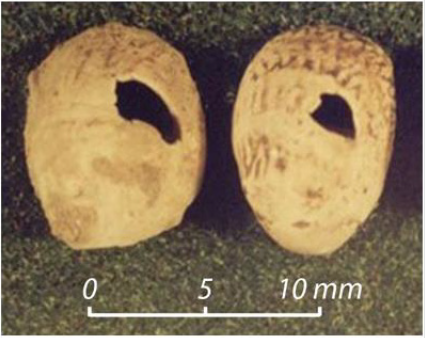
Friday, 16 December 2022

Lupine Publishers | Relative Chronology of the Historical and Cultural Sites of Yazd-Ardekan Plain Based on the Archaeological Data

 Lupine Publishers | Journal of Anthropological and Archaeological Sciences


Abstract

Yazd-Ardekan plain is one of the most important plains in Yazd Province in terms of natural and human resources. Due to its location between different mountains, this plain provides a natural corridor to cross one of the most important transportation routes that connect the cities such as Qom, Tehran, and Kashan to the southern and southeastern regions of Iran. In the past years, scattered archeological activities have been carried out in this plain, the most important of which is the excavation of Gharbalbiz sitein Mehriz during several seasons. But, in recent years, several seasons of research have been done in this area, the maximum focus of which has been on Meybod Town and Rostaq region. During these activities, many sites related to the different cultural periods were identified, which include the time interval from the Epipaleolithic periodto the Qajar period. Also, the archaeological test trenches of the historical context of Yazd City have provided us with very good information about the Islamic Era, especially in the field of pottery, which shows that Yazd had been considered as one pole ofthis industry in some periods.

Keywords: Relative Chronology; Yazd-Ardekan Plain; Natural Corridor; Islamic Period; Pottery Comparison

Introduction

Yazd Province is one of the provinces in which the volume of archaeological activities has been very lowthat is why our knowledge of its archaeological data is very little [1]. But, in recent years, good activities have taken place in this province, leading to an increase in our awareness of its archaeological resources. Among these activities, three chapters of archeological test trenches in the historical context [2-4], archaeological survey of Rostaq region [5,6], the first phase of the archeological study of Abarkooh Town [7]. canbe referred, providing us with generally useful information.
The main focus of these activities is in the Yazd-Ardekan Plain, which is one of the most important population centers in the province due to its special natural location, containing about70% of the province’s population. These activities led to the discovery and identification of the sites that in terms of chronology can be dated from the Epipaleolithic period to the Qajar period. Although many parts of this plain have not been explored yet, this little available information can lead to thecorrect understanding of its chronological status (Figure 3 and 4).

Yazd-Ardekan Plain

Yazd-Ardekan Plain´s watershed with an area of about 1,595,070 hectares is located in the northern part of Yazd Province and covers about 12.1% of the total area of the province. This plain is spread in the northern latitude of 48 32-32 31 and eastern longitude of 59 54-57 52, in the central part of the Iranian Plateau, which is one of the most important plains in terms of natural and human resources and 6 major cities of the province, includingYazd, Mehriz, Taft, Meybod, Ardekan, and Ashkezar are located in this plain [8].
The plain is surrounded by Shirkuh Mountain Range in the south, Ahangaran and Morgh-e-Zard mountain in the west, Haft Admin and Hanza mountains in the east and Chakchak Mountain the north and leads to the Siahkuh with a general southeastsouthwest slope. The highest heights of this plain are Shirkuh peak with the height of 4075 meters and its lowest point is Siahkuh Desert with the height of 970 meters above the sea level (Figure 1 and 2).

Figure 1: The location of the city of Yazd in Iran and the south west of Asia.

Lupinepublishers-anthropological-and-archaeological-sciences

Figure 2: Location of Yazd-Ardekan Plain among the mountains of the province.

Lupinepublishers-anthropological-and-archaeological-sciences

Figure 3: Location of identified areas in the Meybod area.

Lupinepublishers-anthropological-and-archaeological-sciences

Figure 4:Location of identified areas in Rostaqarea.

Lupinepublishers-anthropological-and-archaeological-sciences

The climate of this plain is extremely dry and desert. In the past, several qanat provided water for the residents of the plain;but, today, due to their drying, deep and semi-deep wells have replaced them [9]. The most important vegetation that can be seen on the surface of this plain is hawthorn and tamarisk trees, which are specific to the desert areas. Today, in order to prevent the advancement of quicksands, the government has planted these plant species on a very large scale and they have been able to adapt well to the environmental conditions.

Relative chronology of Yazd-Ardekan Plain

Prehistoric Period

One of the sites of Yazd-Ardekan Plain where prehistoric artifacts have been identified is Meybod. The works related to this period are dated from the Paleolithic period to the Iron Age. The main cultural materials that have been obtained from this period include pottery and stone artifacts. Stone artifacts include various types, including chips, blades, perforators, and cores that could be formed for tool-making after chipping (Figure 5). The mentioned tools had been mostly made of siliceous and calcareous chert stones in different liver, milk, gray, brown, and black colors, mostly using the rubbles of the region [10].

Figure 5: An example of cultural evidence obtained from the Meybod region.

Lupinepublishers-anthropological-and-archaeological-sciences

Pottery is also divided into two categories. Plain pottery, which mostly had an orange fabric and was tempered with coarse sand and straw. In addition, shredded copper slags was used as the temper. Their inner and outer parts were covered with an ocher slip.

Painted pottery is both well fired handmade and wheelmade. Their outer surface is decorated with geometric patterns, including horizontal parallel lines, solid triangles, hollow and short parallel and diagonal lines, wide bands, and etc. The surface coating and fabric are orange in color and their tempers are straw and coarse sand particles (ibid). In the excavations carried out in the Gharbalbiz sites, some artifacts were found that were located under the sedimentary layers of the sites, dating to the second half of the fourth millennium BC [11] Evidence of the Iron Age in this plain is very limited and some of its findings have been mentioned with suspicion only in the excavations carried out in Narin Castle of Meybod [12]. Although according to the results of the surveys and excavations conducted in recent years, it is possible to suggest a relative chronology for the prehistory of the Yazd-Ardekan Plain, providing a more accurate chronology is needed to complete the surveys and study the obtained the data.

Achaemenid Period

According to the studies, some sites of Yazd-Ardekan Plain can be attributed to this period. The scattered pottery on the surface of these sites has a paste of pea, red, and gray colors, with higher percentage belonging tothe red paste. Also, in most cases, the inside and outside of the container is covered with the pea or red slip and sand temper is used in the clay. Pottery has a good variety, including shallow bowls with small vertically rotated edges [5]. Comparable samples were obtained from the sites of Kahoor Langarchini [13], Pasargad [14] and Gharbaliz site [11].

Figure 6: AchaemenidPotteries of the Ashkezar area.

Lupinepublishers-anthropological-and-archaeological-sciences

Also, some samples are comparable to the pottery species obtained from the Persepolis Plain [15]. Additionally, some identified pottery species from Gharbalbiz Site have been dated to this period [12]. Other forms are bowls with curved edges to the outside and an open angle below the edge in the S shape, which were common in the sites of Pasargad [14], Persepolis [16], Gharbalbiz [12], datingback to the Achaemenid period (Figure 6 and 7).

Figure 7: Pottery of the Tudeh area.

Lupinepublishers-anthropological-and-archaeological-sciences

Figure 8: Some white and blue pottery obtained from the historical context of Yazd City.

Lupinepublishers-anthropological-and-archaeological-sciences

Parthian and Sassanid periods

The GharbalbizSite can be considered as one of the most important sites from which works related to the Parthian period have been obtained. As a result of the excavations carried out in this site, a trapezoidal structure with adobe materials has been identified, in some parts of which stone has been used for more strength. The main part of the building is located in the south and consists of two porches, two corridors on both sides and a small room in the south, surrounded by a thick fence, whose outer surface has been made of stone. Excavation in the southern part revealed a thick corridor and wall along the eastern part. In the northern half of the building, a central courtyard with three porches and a platform made of mud- brick are marked. According to the archaeological evidence, Gharbalbiz building is one of the few known ancient remains related to the Parthian period in the central Iran [17]. Also, the Parthian pottery of this site is comparable to the pottery of Sam Castle in the east of the country [12].

Some types of pottery obtained from the sites of Rostaq region are also comparable with the Parthian samples [18]. Most of these pottery have a red fabric and sand temper used inside. Pottery is wheel-madeand the effects of the pottery wheel are well visible on the body. These specimens arecomparable with the ones obtained fromthe northeastern Iran, Sam Castle and the Qomes Site [19].
Evidence has been obtained from the Rostaq region that may be dated to the Sassanid Period. The pottery is wheel-made and in most cases has a red fabric covered with a pea or red slipand its used temper is also sand. Among the obtained pottery species are bowls with raised edges and turned outwards, similar samples of which have been obtained from Yazdgerd Castle [20]. Other types of pottery are the ones decorated with carvings that are comparable to the samples obtained from the Sassanid period [21].

The Early Islamicperiod

Archaeologically, very little information is available from the early Islamic period in the Yazd-Ardekan Plain, except for some sites of the Rostaq region that can probably be dated to this period because some types of pottery are comparable to the samples obtained from Ras al-Kheimeh [22]. Archaeological excavations in the Meybod Town have not found any site that can be considered related to the early Islamic period. Due to the lack of the archeological activity, no correct information is available on the conditions of the sites in other parts of the plain.

Seljuk Period

One of the most important types of pottery that can be dated to this period is the splashed pottery, whose examples have been obtained in the soundages of the historical context of Yazd. This type of pottery, which mostly includes bowls and cups, has pea and red fabric,using sand temper inside.
Sgrafitto pottery was also one of the other data dated to this period. Like the previous type, the fabric of this type of pottery, is in red or pea colors using sand temperinside. The motifs that also decorate the dish are geometric and mostly include vertical or horizontal diagonal, wavy and parallel lines in their inner body. Comparable samples have been also obtained in the excavations of Alamut Castle [23] and Ghubayrā [24].
One of the identified sites in Yazd-Ardekan Plain, which can be dated to this period, is Malekabad. Although pottery dating to the Islamic Middle Ages has been scattered throughout the site, there are many specimens of the splashed glaze that can be dated to this period as well. The fabric of these pottery is mostly pea-colored and sand temper has been used inside them; also, in terms of form, they mostly include bowls and cups [18].

The Ilkhanid Period

In the Ilkhanid period, the region enjoyed good prosperity. In this period, after Al-Muzaffar government came to power, a new chapter began in the development of the region, so that the peak prosperity and cultural greatness of Yazd is related to the same time [25].
One of the most important sites from which works related to this period were obtained is the historical context of Yazd. In the test trenches made in this site, a large amount of data was composed of the pottery decorated with the under glaze-paintings, which was a common species in that period [26, 27] in the archeological literature, it is referred to SilhouettePottery (decorated pottery in black under a clear turquoise glaze). These potteries mostly have a pea-colored fabric made of sand temper. The cover of the mentioned pottery was mostly pea-colored mud, which after decoration was covered with the turquoise, green, or transparent glazes.
The motifs of the mentioned pottery are also geometric and plant [28] and in very few cases, the inscription has been also used to decorate the pottery [29]. Comparable examples with it were obtained from the sites such as Ghubayrā [24], the tomb of Sheikh Safi al-Din Ardabili [30], Alamut Castle [23], Golkhandan Bumehen Fortress [31] and Toos [32]. An example of tiles decorated in black under a clear turquoise glazehas been installed in the porch of the Yazd Jami Mosque, which has a date of 765 AH [33].
In the studies carried out in the Rostaq region, several sites related to the Ilkhanid period have been identified, among which we can mention Tudeh, Chahardeh and Khiyareh sites. In the Meybod studies, Ilkhanid sites have been identified, among which the areas of Jahanabad 2, Jahanabad 5, and Tal-e Mesgaran 6 can be referred [10].
Zarrinfam species was also obtained in the soundages of the historical context of Yazd City, most of which are related to the tiles and are decorated with plant, animal, and inscription motifs. Some of the discovered specimens have been made in the molded method [28) which can be compared with the specimens in the shrine of Imam Reza in terms of technique [34] and the Thakht-e- Soleyman [35].

White and bluesamples that can be confidently attributed to this period were not obtained except for a few cases, in which the container was comparable to the common dishes in the period in terms of form [28, 29] and an example of it has been obtained in Soltanieh excavations [32].

Timurid and Safavid period

According to the trenches made in the historical context of Yazd City and the identified sites in the Rostaq region, a lot of pottery evidence was identified that can be considered related to the Timurid period. These pottery evidences are mostly blue and white species that are decorated with plant, geometric, and animal motifs [36]. According to the results of XRD and XRF experiments performed on the mentioned pottery, Yazd can be considered as one of the most important centers for the production of such utensils.
Some found specimens are comparable with the ones in the Royal Ontario Museum [37], Uzbek History and Art Museum [38] and Metropolitan Museum [39].
From the Safavid Period, traces and evidences were identified in some sites, among which we can mention the Tudeh and Chahardah sites [18]. From the soundages of the historical context of Yazd, a lot of pottery evidence related to this period was identified [29]. White and blue pottery is one of the most commontypes of pottery in this period and some samples that are comparable to the obtained evidence are preserved in the Victoria Albert Museum [40], Ardabil Museum [41], and the Metropolitan Museum [42].
The decorative motifs of the mentioned pottery also include plant, geometric, animal, human, and in some cases, Chinese-style motifs, such as clouds, trees and animals, used in this regard. Shapes of this species include bowls, plates, vases, saucers, and cups.
Kerman pottery is another type that has been obtained in the studies and test trenches of the historical context of Yazd City. Their decorative motifs, which were common types in the Safavid period [43], include plant motifs painted with blue, white and black colors on a white background and finally a little green glaze covered them. The main production center of such dishes was Kerman City [44] and the obtained samples from Yazd are also comparable with them.
Celadon is another common species of this period that has been obtained in the excavations and surveys of Yazd region and can be compared with the samples obtained from Kerman [45].

Qajar Period

One of the significantidentified periods in the Yazd-Ardekan Plain is Qajar period. This period has been identified in the Meybod surface surveys such as Kachalag 4, Kachalag 5 and in the Rostaq such as Mazraeh Khan and Asrabad.
One of the characteristic pottery types of this period is white and blue pottery, which is much lower in quality than the samples dated to the Safavid and Timurid periods. The fabric of these pottery is made of kaolin (Porcelain) soil, and in terms of form includes bowls, plates, and saucers. The motifs that decorate these potteries are geometric and plant motifs, which in some samples have the potter’s signature and the date of its construction on the inner floor of the vessel.
Other evidence that has been obtained in some sites dated to this period are English-made porcelain decorated with plant and European motifs [6] and in terms of form, they mostly include a plate and a bowl.
Pottery decorated with under glaze-painting was also widely used in this period. This type of pottery mostly has a red or pea fabricin which sand temper has been used. The motifs are drawn in black on a background covered with the pea or red flowers, and the motifs are mostly geometric or plant. Glaze stains have been also used to decorate the dishes. These types of pottery have been identified in some sites of Rostaq region such as Mazraeh Khan [6] and are widely identified in thetest trenches of the historical context of Yazd [29].

Conclusion

Yazd-Ardekan Plain is one of the most important residential areas in Yazd Province, which has created a natural corridor that has caused the passage of one of the most important roads in the country. This has caused this plain to be noticed by the humans for a long time. The greatest concentration of the prehistoric works of this plain is in Meybod region. The oldest archaeological evidence is related to the Late Paleolithic period, which continues with ups and downs until the Iron Age. In the historical times, Rostaq region has been highly noticed and some siteshave been formed in this region. Although the sites related to this period have been identified from Meybod and Mehriz regions, the focus of the settlement is in Rostaq region.
There is not much information about the settlement status in the plain from the beginning of Islam; but, from the Seljuk Period to the Qajar Period, very good evidence has been obtained from the test trenches of the historical context of Yazd in addition to identifying different sites in the Meybod and Rostaq regions. It shows that Yazd region was one of the important centers of the pottery production in some periods such as the Ilkhanid Period (Al-Muzaffar government), whose products competed with other regions. Laboratory results also show that this area was one of the main centers for the production of white and blue pottery, which was equal to the Chinese samples in terms of quality.
Although according to the archaeological activities, we have a good picture of the chronological status of the Yazd-Ardekan Plain, the expansion of these activities can lead us to the better understanding of the archaeological status of this plain. Our knowledge of some of its areas such as Ardekan is still at a very low level and the scattered activities that have taken place in the Fahraj area do not provide us with accurate information. Also, the stratigraphy of some sites of this plain can complete our knowledge of its chronological status.

Read More About Lupine Publishers Journal of Anthropology & Archaeology Please Click on Below Link:
https://journalofanthropologicalsciences.blogspot.com/