Showing posts with label Journal of Forensic Sciences. Show all posts

Friday, 1 September 2023

Lupine Publishers | The Nok Smoking Gun

 Lupine Publishers | Journal of Forensic & Genetic Sciences


Introduction

The Nok culture arose in Nigeria in the first millennium BC and vanished in the first millennium AD. It is remembered for terracotta figures that bear an uncanny resemblance to the brass and bronze Ife Yoruba art that arose centuries later. “The Yoruba were the creators of remarkable bronze and terracotta sculptures that flourished from the 12th to the 14th century and that were possibly associated with the more ancient Nok culture (end of the first millennium BC)” [1]. “West African Nok culture. Terracotta heads characterized black Africa’s first known sculpture. Civilization from c.a. 500 BC. Nok culture. Well organized economy and administrative system in northern and central Nigeria; first people in sub Saharan Africa to make iron tools and weapons. Influenced neighbors in region” [2]. “The Yoruba are a people of great antiquity and have a record of impressive achievements in many fields of human activity. The Yoruba trace royal genealogies as far back as the 12th century but higher forms of political and social organizations have existed among the Yoruba for much longer: it is thought that they may have developed as early as the first millennium BC, and archaeological discoveries in the Nok valley and on the island of Jebba on the Niger substantiate this’ [3].

“The discovery of the widespread Nok culture and the recognition it was ancestral to the later highly developed art of Ife…” [4]. “The supreme examples of this are found among the works from Katsina Ala especially. The mouth is usually shown with thick lips, sometimes open, but only rarely showing teeth. There are two both found at Nok. The first was possibly a headdress mask, strangely like the bronze headdress masks of the Oduduwa cult.” [5]. “The Yoruba communities clustered around Ife, the religious centre and centre of dispersion. These were probably extant by the 13th century, a period which may tentatively be associated with the emergence of the marvellous brass art of Ife, itself probably a development of the earlier Nok culture” [6]. “It is natural to consider the possibility of a genetic connexion between the art of Nok and that of Ife and indeed, a terracotta fragment of a face found at the north Yoruba town of Ire, seems to approximate more closely to the Nok than to the Ife style” [7].

“We do not know what political and ritual systems the Nok adopted. But perhaps we shall extrapolate our information of Ife to Nok” [8]. “Many of the distinctive features of Nok art can also be traced in later developments of Nigerian art produced in such places as Ife” [9]. “As far as the origins of the Yoruba are concerned, all that archaeology can point to is some stylistic similarities between pottery in Ife and in Northern Nigeria, dating to a period between 900 BC and AD 200. This indicates that they probably migrated southward from the savanna into the tropical forest area after that time” [10]. In today’s ultra-politically correct world will I be vilified and crucified if I dared theorize that Proto Yoruba people once lived in northern Nigeria and were the brains behind Nok? Will I be called an ethnocentrist if I dare use my intelligence, common sense and God given powers of deduction to infer and suggest that hostile non-Yoruba tribes migrated into northern Nigeria and displaced The Yoruba via warfare, massacre and marginalization and that when these Yoruba vanished their Nok culture vanished with them?

Read More About Lupine Publishers Journal of Forensic & Genetic Sciences Please Click on Below Link:
https://forensic-journal-lupine-publishers.blogspot.com/

Thursday, 13 July 2023

Lupine Publishers | Some Meaningful Points on Suicidal Death Crime Scene Investigation

 Lupine Publishers | Journal of Forensic & Genetic Sciences


Abstract

Death investigation is a complicated process, which involves several different members of the police, medicolegal experts and forensic experts. Finding every important detail, however small it might be, is very important in crime scene forensic investigation. The experienced observer is quick to recognize the suicide which has been tampered with in the attempt to create the impression of a homicide or vice versa, usually for purposes of collecting insurance, or the homicidal case which has been altered to make it resemble a suicidal, accidental or natural death. This study highlights some meaningful points on suicidal death crime scene investigation.

Keywords:Suicide; Crime Scene Investigation

Introduction

Different responsibilities and miscommunications among the police officers, medicolegal examiners, forensic experts, prosecutors and others involved in the process at crime scene investigation results in serious errors which affect the outcome of the cases. If a case is reported as a “Suicide,” the police officers who respond as well as the investigators automatically tend to treat it as a suicide. Experts must keep an open mind and not be influenced either by the initial reports or the presentation in the crime scene. A forensic expert must respond to every unattended death scene, whether it was reported as a homicide, suicide, accident or natural to assure that any potential crime scene and/or evidence surrounding the event was not disturbed. Anything and everything should be considered as evidence whether these are physical or testimonial, it must be preserved, noted, and brought to the attention of the investigators. In many suicide cases where it was apparent that the investigators did not take each point to its conclusion due to insufficient photographs and certain tests were not conducted. Death investigations of the elderly are often assumed to be naturals and there is a tendency on the part of uniforms and experts to rushthrough the crime scene process. Many investigators, due to the initial call treated the cases like a routine suicide or a natural death, but they greatly embarrassed when the medicolegal examiner’s finding showed the death to be a homicide [1-7].

Some Meaningful Points Hanging Related Crime Scenes

In the crime scene of hanging first location is important i.e. crime scene is indoor or outdoor. If outdoor crime scene is then type of anchor plays an important role i.e. tree, pole etc. Some of the important points are as follows

a) If anchor is tree, then detailed account of the tree must be taken in the account like specific characteristics thorns, latex over the trunk or leaves etc. because sometimes these creates special marks on the body. The cloth of deceased possesses any marks of thorn/any latex is present which resembles the tree. The hand and shoes of deceased possess any latex of trunk of tree or thorn, which indicates that the deceased has attempted to climb over the tree. The hanging complete or partial are important. The approximate time of incident may be decided based on rigor mortis present or absent, purification of body started or not, any pool of decomposed body fluid is present at floor or not also equally important.

b) Capacity of anchor (is it capable to provide enough strength to ligature).

c) Type of ligature material and their specific description. Whether the ligature has been used single or double. The presence of some fibers over the hand of deceased which resembles the ligature material. Type of knot, applied to tie the ligature material with anchor (tree or anything else) is it possible to tie such type of knot without climbing over the tree? Depth and intensity of ligature mark. Location and shape of ligature mark and whether the marks are continued around the neck or not. Presence of ecchymoses and abrasion around the ligature marks.

d) The mark of friction of pulling of ligature through the anchor (tree) if present (Indicates the body has been pulled by someone). If not possible then any support has been used to climb or any ladder if available at spot.

e) Relative position of neck with respect to knot tied around the neck. Type of knot used around the neck and their position. Neck is elongated or not?

f) Position of eyes (opened or closed or opened slit like). Whether any difference exist in the opening of eyes i.e., the eye toward the ligature knot is more opened or not. The petechial hemorrhage if present inside the eyes.

g) Dribbling of saliva is present or not? If absent, then evidences of salivation present over the clothes. the face is placid or pale? The tongue is drawn in, or caught between the teeth or protruded? Presence of bloody froth if coming out from the nose or mouth.

h) The palms of hands are clinched or opened.

i) Escape of urine or fecal matter and the direction of flow i.e. downward or lateral flow.

j) Presence of post mortem staining in the arms and legs of the body.

k) Existence of marks of struggle, presence of marks of nails, external injuries.

l) Height of the deceased and anchor. Distance between the toes and floor. Position of shoes and socks. Distance between the knot tied with anchor and over the neck

m) Any documental/tattoo/evidence through which identity could be established.

The Suicide as a Homicide Investigation

According to literature, “All death inquiries should be conducted as homicide investigations until the facts prove differently. The resolution of the mode of death as suicide is based on a series of factors which eliminate homicide, accident and natural causes of death. It is recommended that an investigator to be assigned to every unattended death case. Sometimes authorities mistakenly allowed patrol officers to conduct basic death investigations with the assumption that such deaths are generally not criminal incidents and don’t require investigation. On the contrary, these cases may very well be homicides, which have been staged to appear to be suicide, accidents or natural causes. In a case a lady living in city apartment was discovered hanging by her neck from the shower in her bathroom. The case was reported as a suicide by the person discovering her body and the initial police officers had reported the case as a suicide. When crime scene experts examined the body of the victim, they found an ante-mortem injury to her face and noticed a Red chief ® shoe print on the bucket and the toilet seat. The deceased was barefooted and could not have caused that impression. The crime scene experts lifted the footwear impression as a piece of evidence as the officers conducted their canvass of the apartment and questioned the victim’s relatives and friends. Basically, they determined that the victim did not fit any “suicide profile” and the death was in fact suspicious. Experts during investigation of case found that a 29-year old person who had been working in the adjoining apartment had got into a verbal dispute with the victim over the noise that he was making and angry words had been exchanged earlier that same day. The plumber had left the apartment shortly thereafter and failed to notify his owner. When the experts located him at a friend’s residence, he admitted that he had killed the woman by strangling her and then cleverly “staged” the scene by hanging her from the shower making it appear that she had committed suicide. For him to lift her into that position he had to stand on the bucket and toilet seat there by leaving several footwear impressions, which matched his Red chief ® shoe print.

Some Meaningful Points on Suicide Investigation

One of the most significant factors to consider in any death investigation is victimology. Victimology as it pertains to both suicide and homicide investigations is significant in ascertaining motives, suspects and risk factors. In suicide cases, this becomes paramount in determining motive and intent. Does the victim fit a “Suicide Profile?” Was there any evidence of marked depression or suicide ideations? Did the victim have both short- and long-term plans? Victimology is the collection and assessment of all significant information as it relates to the victim and his or her lifestyle. personality, employment, education, friends, habits, hobbies, marital status, relationships, dating history, sexuality, reputation, criminal record, history of alcohol or drugs, physical condition and neighborhood of residence are all pieces of the mosaic that comprise victimology.

The Basic Investigative Considerations for Establishment of the Death as Suicidal in Nature

The crime scene expert must be aware of following basic considerations to establish if a death is suicidal in nature.

a) The presence of the weapon or means of death at the scene.

b) Injuries or wounds that are obviously self-inflicted or could have been inflicted by the deceased.

c) The existence of a motive or intent on the part of the victim to take his or her own life.

The Weapon and Wounds

The weapon or means of death should be present in cases of suicide however, the absence of a weapon does not necessarily indicate that death was due to a homicide. The weapon could have been stolen or otherwise disposed of prior to the arrival of the authorities. Furthermore, family members have been known to conceal weapons and/or suicide notes in order to collect on an insurance policy. Injuries and wounds in suicides may be very similar to those observed in homicides. However, certain observations that the wounds found on the body are consistent with homicide or suicide should be made. For example, a person found dead from multiple stab wounds of the back would certainly not be considered a victim of suicide. It’s not the number of wounds that are self-inflicted, but the lethality of these wounds and what organs have been impacted. Some information is important like the deceased cause the injuries and death? The person physically able to accomplish the act? Are the wounds within the reach of the deceased?

Motive or Intent and Factors for Ultimate Results

The manner of death may be important in determining suicidal intent. People who hang themselves or jump to their deaths certainly have indicated an intention to take their lives. Similarly, deaths that involve a combination of methods, such as poisoning, shooting, slashing of wrists, inhaling gas, etc. show an extreme desire to die. Some information to be collected like medical, social, family history and previous suicidal attempts. If the victim left a note and the case is a suicide, obtain an exemplar (An example of the victim’s handwriting from some document that was known to have been written by the deceased.) this is necessary specially to get rid future dispute. The presence of a Suicide note certainly suggests suicide. However, there are several investigative considerations to determine whether the note is genuine, was it written voluntarily by the deceased and the note indicate suicidal intent? Suicide notes often have mixed emotional content including “positive” and “negative” feelings. The Suicide Note is a direct communication indicating intent to commit suicide. The notes are often coherent and legible unless written under the influence of alcohol or drugs and may be instructional and/or admonishing. These notes should be collected in a manner to preserve any latent fingerprints and exemplars should be obtained for comparison. The note often provides a basis of inquiry into the background of the deceased. In suicide cases the application of a “Psychological Autopsy” might be useful in drawing important conclusions.

Conclusion

It should be noted that the final determination of suicide is made by the medicolegal examiner after all the facts are evaluated. However, the investigation at the scene and an inquiry into the back¬ground of the deceased may indicate the presence of lifethreatening behavior or activities that suggest suicidal intent. Of course, the medicolegal examiner is supposed to avail him or her of the input of the investigators, who were present at the scene and conducted the death investigation.

Read More About our Lupine Publishers Journal of Forensic & Genetic Sciences Please Click on Below Link:
https://forensic-journal-lupine-publishers.blogspot.com/

Friday, 2 June 2023

Lupine Publishers | Homographic, Heterophonic and Heteronymic Evidence that Yoruba is a Language Isolate

 Lupine Publishers | Journal of Forensic & Genetic Sciences


Introduction

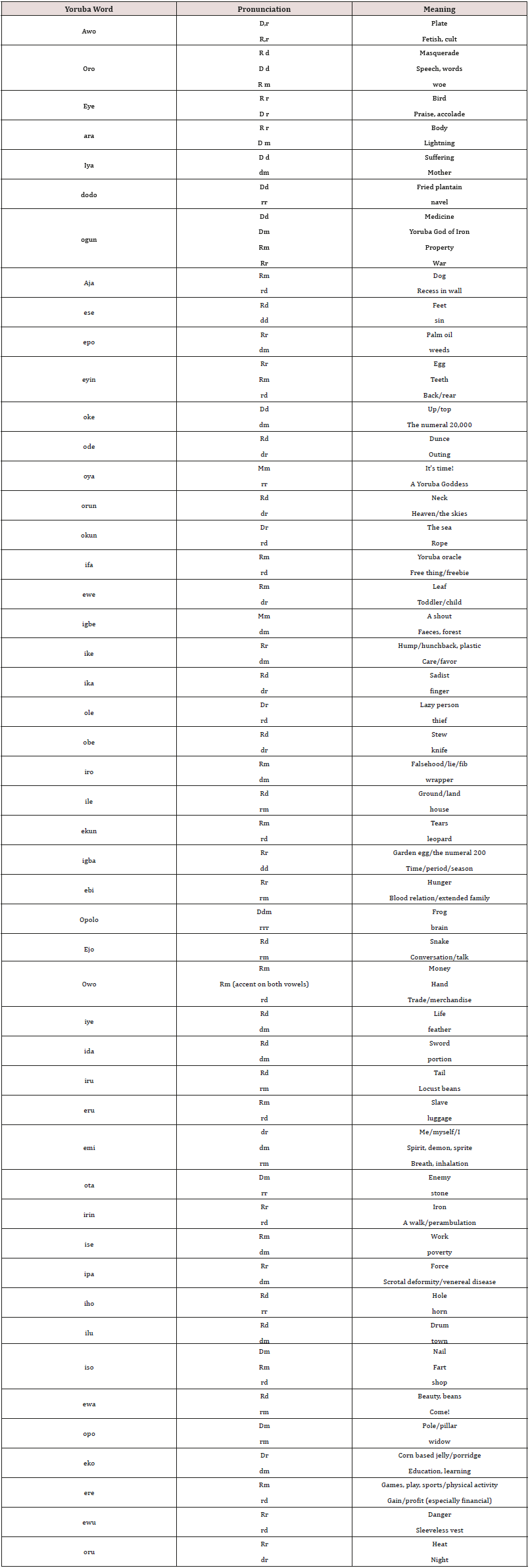
In linguistics, words that have the same spelling but have different meanings when pronounced differently are called homographs, heterephones or heteronyms [1,2]. Apart from English, Dutch and a few other Indo-European languages, few other languages on earth-apart from Yoruba have so many heteronyms. And given that many of the English heteronyms are merely verb and noun heteronyms (e.g. the noun ‘house’ means an actual structure for domicile while as a verb to ‘house’ means to provide said domicile and/or place person(s) therein) the number of spoton English heteronyms falls significantly. Also, many English and Indo-European language heteronyms come in pairs e.g. ‘confine’ as a noun means a boundary or limit while ‘confine’ as verb means to restrict. On the other hand, many Yoruba heteronyms came in trios, quartets, quintets and in rare cases septets such as the word ‘OKO’ which, depending on the pronunciation means spear, penis, farm, vehicle, husband, stone and hoe! [3] This is seven meanings for just one word merely by varying the pitch! It’s time for linguists worldwide to stop burying their heads in the sand and to do the honorable thing-officially reclassify Yoruba as a language isolate.

More examples of Yoruba homographs and heteronyms include the following: kindly note that the alphabet ‘d’ stands for the sound ‘do’, ‘r’ stands for the sound ‘re’ and ‘m’ for ‘mi’ (Table 1). This list of Yoruba heterophones is by no means exhaustive. But these are enough for any fair-minded and reasonable observer to strongly suspect, if not conclude that Yoruba is a language isolate [3].

Table 1:

Lupinepublishers-openaccess-Forensic-Genetics


Thursday, 16 February 2023

Lupine Publishers | The Philosophical Odyssey of Temporality

 Lupine Publishers | Journal of Forensic & Genetic Sciences

Abstract

During their research of the explanation of the world, most authors were, and still are, concerned about temporality. However, the literature of the subject is dominated by a proliferation of opinions and a dramatic absence of demonstrations, the tenacity of historians, poets and philosophers deserves praise. In his Annales, the Latin poet Tacitus (c.55-c.120) notices that there is little distance between art and error (Book IV, Ch. LVIII, 3).

Keywords:Precursor; Event; State of a System

Introduction

Since antiquity, the main trends of thought have developed from the idea of eternity: in many cultures, man in his anguish refuses death by attributing himself an eternal destiny. The idea of eternity can be considered a prodrom of temporality; a major precursor of time observed as soon as the writing was invented about 5000 years ago. This study reviews the main concepts of temporality, according to their appearance in history, and through over fifty major authors.

Eternity and Rebirth

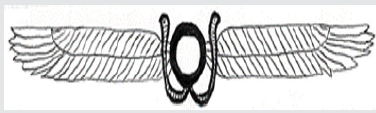
Figure 1: A sacred precursor of time and space. .
Lupinepublishers-openaccess-Forensic-Genetics

Eternity is a theological precursor of time that has first appeared in Mesopotomia and in Egypt. An Egyptian hieroglyph (Figure 1) symbolizes the cycle of the Sun God Re, in which the disc represents Re, creator of living beings. The spread wings of the Goddess Nephthys symbolize the Sun’s path, with the alternation of day and night, and with rebirth after death: a life post mortem in an imaginary hereafter, a life that is sustainable, perpetual; hence the idea of eternity, the idea of eternal duration. This sacred symbol of motion spread across a large part of western Asia, but no trace has been observed in Greek and Roman architecture and numismatics.

In most theogonies, Gods created humans with the purpose of being served and venerated; but, as they were afraid of being overwhelmed by these creatures of their own making, an idea which may seem strange to us, they made them mortals. They could then exert their occult Uranian influence by using aging and subsequent death. God must be written with a capital letter, as the Latin poet Petronius (?-c.65 CE) (CXIV) did in Satiricon, and as Tacitus did in Annales (Book III, Ch. VI, 2); indeed, their Gods were not inferior to ours. (CE for Common Era; BCE for Before Common Era). The Gilgamesh Epic (Sumer, c.2700 BCE) reveals that the Gods created humans, but that death was part of the deal. The legendary king was protected by the sun God Shamash, requesting that neither he nor his double Enkidu should be required to age: they wanted eternal life.

Pharaoh Narmer, c.3000 BCE, Menes in Greek « the one who is eternal » [1], p. 37), was the first pharaoh of unified Egypt. The name of pharaoh Menkaou-Re (c.2500 BCE), Mikherinos in Greek means « the solar God Re is eternal » [1], p. 46). The Pharaoh Khety, c.2070 BCE, gave his opinion: « Man survives after death, his deeds in a heap at his side. We are here for eternity; he who does not take Eternity is a theological precursor of time that has first appeared in Mesopotomia and in Egypt. An Egyptian hieroglyph (Figure 1) symbolizes the cycle of the Sun God Re, in which the disc represents Re, creator of living beings. The spread wings of the Goddess Nephthys symbolize the Sun’s path, with the alternation of day and night, and with rebirth after death: a life post mortem in an imaginary hereafter, a life that is sustainable, perpetual; hence the idea of eternity, the idea of eternal duration. This sacred symbol of motion spread across a large part of western Asia, but no trace has been observed in Greek and Roman architecture and numismatics. In most theogonies, Gods created humans with the purpose of being served and venerated; but, as they were afraid of being overwhelmed by these creatures of their own making, an idea which may seem strange to us, they made them mortals. They could then exert their occult Uranian influence by using aging and subsequent death. God must be written with a capital letter, as the Latin poet Petronius (?-c.65 CE) (CXIV) did in Satiricon, and as Tacitus did in Annales (Book III, Ch. VI, 2); indeed, their Gods were not inferior to ours. (CE for Common Era; BCE for Before Common Era). The Gilgamesh Epic (Sumer, c.2700 BCE) reveals that the Gods created humans, but that death was part of the deal. The legendary king was protected by the sun God Shamash, requesting that neither he nor his double Enkidu should be required to age: they wanted eternal life.

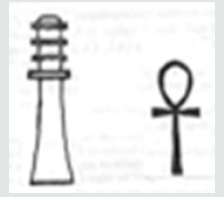
Pharaoh Narmer, c.3000 BCE, Menes in Greek « the one who is eternal » [1], p. 37), was the first pharaoh of unified Egypt. The name of pharaoh Menkaou-Re (c.2500 BCE), Mikherinos in Greek means « the solar God Re is eternal » [1], p. 46). The Pharaoh Khety, c.2070 BCE, gave his opinion: « Man survives after death, his deeds in a heap at his side. We are here for eternity; he who does not take care of that is a total fool! » [2], p. 62). The Djed (Figure 2) is a pillarshaped amulet which was intended to allow the pharaoh to live on « for ever in the next world » [3], Ch. III). The Djed appears on the side of the throne of Sesostris I (1970-1928 BCE) which was found in Karnak (Museum of Egyptian Antiquities in Cairo). It reminds the backbone of Osiris [4], p. 27), the God of rebirth after death. In his hypogeum, Amenophis II receives the cross of life Ankh (Figure 2) from the Goddess Hathor, thus conferring the gift of immortality [4], p. 121). In Odes, the Latin poet Horace (65-8 BCE) writes « we shall take the barque for the eternal exile » (Book II, III). For the polytheists (early 1st century), αιων (aion) is the eternal duration, associated with change. The fourth century Greek philosopher Euhemerus made a rational study of the post mortem divination of monarchs and prophets, called euhemerism, which is today lost in part. Medieval Judeo-Christians used the expression eternal time [5], p. 522).

Figure 2: Djed and Ankh.
Lupinepublishers-openaccess-Forensic-Genetics

The Day

Figure 3: Hittite hieroglyph for « day ».

Lupinepublishers-openaccess-Forensic-Genetics

The Hittite pictographic writing appears during the 15th century BCE, as does their first hieroglyphs: they use the day in their everyday life as a kind of unit (Figure 3) [6]. In Odyssey, the Greek poet Homer (9th century BCE) writes: « when Zeus brought the seventh day » (Song XII). « Then Helios was falling (in the Okeanos), and it was the end of this war of one day » (post-Homeric song). In Cratyle, the Greek philosopher Plato (428-348) notices that for Socrates (470-399), (the Sun) « is continuously rotating around the Earth ». The Latin poet Virgil (70-19 BCE), refers to volvenda dies: the rolling out of the days; what let suppose he considered that time is an active phenomenon. In de rerum natura, the Latin poet Lucretius (99-c.55 BCE) mentions the revolutions of the Sun (Song V, 931). In Manuel des Poids et Mesures, published in 1840, A. Tarbe gives an exemplary definition: « the returns (of the Sun) to the meridian mark the days » (Titre IV, §8). This is the rigorous semantic of an Avocat General at the Court of Cassation who was not, however, an astronomer.

The Month

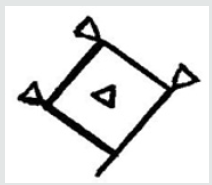
Figure 4: The invention of temporality.
Lupinepublishers-openaccess-Forensic-Genetics

From 2800 BCE, Sumerians have developed a cuneiform writing [7]. An unexpected clay tablet has been uncovered: it is engraved with a cuneiform sign (Figure 4) which means « lunar month » (6, Ch. II). It is the oldest proven reference to temporality (2800-2500) in the history of thought. The foregoing analysis demonstrates that the lunar month was not discovered somewhere in Nature or in the Universe, unlike a virus or an exo-planet. The Sumerian savants observed the Moon alternations, they named it arhue, which corresponds to the lunar month, and they used it as a unit in their everyday life. The lunar month is the invention of the first parameter of time, knowing that the word time does not exist yet. In Odes, the Latin poet Horace (65-8 BCE) wrote: Luna volvit menses (the Moon rolls out the months). In Aeneid, Virgil, who assumes that time is active, ventures the following expression: volvendis mensibus (the course of the months).

The Year

The year was used in Mesopotamia from the late 3rd millennium (7, Ch. IV): it comprised 360 days. During the Assyrian period (12th- 7th century BCE), the limmu was an important person whose name was used to indicate the year (5, p. 239). In Odyssey, Homer writes: « when time comes with the course of years » (Song I). « when the fourth year came, and when the seasons began again » (Song II). « after days and months have passed and the year being performed, seasons come again » (Song IV). « at the end of the year, when the hours have accomplished their round trip, when the months have gone by and when long days have elapsed » (Song X). In Histories, the Greek historian Herodotus (484-425) reports his travel in Egypt during which Egyptians claimed that they were the first to identify the annual cycle of seasons, this being divided into twelve months (Book II, 4). In Georgics, Virgil uses Volventibus annis (the years roll out). In Epistles, Horace complains: « During their course, the years strip us all our advantages » (Book II, II). In Life of Numa, the Greek philosopher Plutarch (c.46-c.126) writes about the year: « It only has three months among certain barbarians. Among Egyptians, the year had one month at first, and later it had four months » (18, 6 & 7). The Consul Ausonius, in The other prayer to the calends of January (379 CE), was the first in Rome to associate the regular advent of seasons with Annus (5, p. 553). The calends was the first day of the lunar month.

Past, Present and Future

Homer refers to what has passed using the word παρωξημενοζ (5, p. 547). In Odyssey, he writes: « So that we sang them in the future days » (Song VIII). The Greek poets Aeschylus (c.525-456) and Pindar (518-438) talk about future time: μελλων (5, p. 547). For the Greek Stoic Zeno (335-264), ομελλων means the future. The present is initiated with οενεστωζ, but its reality is denied (5, p. 551). They were right, because present time is a concept. In on Common Conceptions against the Stoics, Plutarch criticizes them with an unjustified reproach: « it is contrary to the notion that we have a future time and a past, but no present » (5, p. 549). In Isis, he mentions Rhea, the mother of Gods, spouse of Cronus (or Kronos), and the source of duration [8].

In Pyrrhonian Hypotyposes, the philosopher Sextus Empiricus (c.160-c.210) mentions the three divisions of time. He wonders if time exists or not. Is it finite or infinite? Divisible or indivisible? Perishable if it was created, or imperishable if it was not created? (5, p. 548). In the Peloponnese War, the Greek founder of historical science, Thucydides (c.465-c.395), reports the conflict which opposes Athena and Sparta from 431 to 404, pulled into conflict by their various alliances. He does not study present time, but present events. He follows the sequence of events in order to understand, and to accomplish his work as a historian (Book V, 26). In his conference La Conscience et la Vie (in L’Energie Spirituelle) at Birmingham University in 1911, the French philosopher Henri Bergson (1859-1941) described the present, as a duration thickness located between our immediate past and our imminent future. The physicist J. M. Levy-Leblond claims about present, that there is a width and a thickness between future and past [9]. In fact, if present designates present event, its duration is measured with a timer; if it designates present time, the duration of time is an obvious sophism.

The Seasons

Thucydides talks about the season (August) during which people’s health grows weaker (Book VII, 47). He avoids the confusion between the seasonal climatic impact and time. His translator Denis Roussel notes that physicians of the Cos School, that of Hippocrates (c.460-c.377) were taking the influence of climate and seasons into account. In the early fourth century AD, during Roman times, winged women were used to represent the four seasons, as in the Mosaic of the Seasons which was discovered near Antioch [10], Ch. V), and is now in the Musee du Louvre. In Histoire du temps (Fayard 1982), the French intellectual Jacques Attali reports an investigation carried out by Reinberg and Halberg about people suffering from brain death in France between 1962 and 1967, from which it results a greater fragility during winter seasons. Attali takes this as an action of time on individuals (Ch. 4), whereas in fact there is no action of time, merely a seasonal climatic impact. DAYS’ WALK

Herodotus frequently specifies the distance travelled (or to be travelled) in « days’ walk », in « days’ sail », or in « months’ sail » (Book I, 203; Book II, 19 and 31: « The distance is not short, it’s three days’ walk » (Book III, 6). In Anabase, the historian and strategist Xenophon (c.428-c.353) uses « days’ walk » (Book I), like Plutarch does in Life of Timoleon (25, 5). Considering how slow walking armies could be, for Persian, Greek, and Phoenician strategists, and especially for the foot soldiers and sailors who carried out these maneuvers, these expressions had the advantage of indicating both the « distance » and the « duration » of the travel. « distance walked in one day », « distance sailed in one day » and « distance sailed in one month » can be considered the first speed units. The British physicist Issac Newton (1643-1727) formalizes the distance travelled according to speed, with the equation: (distance travelled) = (velocity) x (duration of the travel) (9, p. 67).

The Clepsydra

The Latin writer Cicero (106-43) uses ad clepsydram, which means: under the control of the clepsydra, which is a water clock. Plutarch says that he’s measuring the water of clepsydra (Life of Alcibiades, 19, 5): he measures how much water has flowed, not the duration of an event.

Duration

The Queen Hatshepsut (1504-1483 BCE) says « So that my name is durable and perpetual ». Hatshepsut’s high priest: « I went towards my place of infinite duration ». Amenophis I « Amon is satisfied » (1558-1530 BCE) adds « Amon whose monuments are long-lasting » [11], Ch. II). Ptahhotep begs his pharaoh Isesi (c.2400 BCE) to discharge him of his functions: he complains of « the longlasting of life » (12, Ch. III). Was the concept of duration known at this epoch? Instead, Ptahotep probably said « the many years of life ». The physicist Michel Paty points out that the philosopher Alfred North Whitehead (1861-1947) thought that a duration had a temporal thickness [9].

Time

In Tell el-Amarna, on the tomb of Ai, who was the second husband of Nefertiti « the beautiful one has come » (second half of XIVth BCE), there appears a poignant anthem to the Sun composed by the Pharaoh Akhenaten, instigator of the first monotheism: « You are time itself, you last with it. In you, we all live eternally thanks to your splendour » [12], Ch. II). Eternity was subsequently referred to as the father of time by the Greek philosopher Proclus (412-485) (5, p. 540). In the Heracleidae by the Greek poet Euripides (480- 406 BCE), eternity was given the nickname son of time. According to Plato, the Demiurge has created a mutable copy (time) of the immutable model (eternity) (5, p. 537); in other words, Plato considers time to be a reality, without defining it. In Timaeus, he notes: « the Sun, the Moon and the five other planets were born to define the numbers of time » (5, p. 559). This is correct, given that the numbers of time correspond to our time units. However, he adds: « days, nights, seasons, are time divisions »; which shows that he did not see the need to distinguish phenomena (days, nights and seasons) and concepts (time divisions).

Philosophy treats time and physical space as primordial categories of understanding, although Philosophy does not explain what time and space are. For the Greek philosopher Aristotle (384-322), time and place are two out of his ten categories of understanding. In his cosmological treatise On the Heavens, the tutor of Alexander the Great, uses αιων (aion) for duration; the tripartition of time is not clearly established (5, p. 537). In De rerum natura Lucretius notices « the immensity of time » (Song V, 427) and « the infiniteness of time » (Song II, 574 et Song V, 378); he uses spatium tempus for space of time. Fugit irreparabile tempus (Time flies irremediably): this aphorism due to Virgil in Georgics represents all the metaphors of the presumed dynamics of time. In Geography, the historian and geographer Strabon (c.64-c.22 EC) reminds that the Egyptian priests of Thebes, who also dealt with philosophy and astronomy, decided to connect the course of time to the Sun and no longer to the Moon. The Roman historian Titus Livius (c.59-17 CE) used spatium tempus for space of time. In The art of loving, the Latin poet Ovid (43- 18 CE) asserts that « with time you will conquer Penelope » (Book I). He rejoices: « Others praise the past; for myself, I am pleased to be born in this century » (Book III). « Time flows like water » (Book III). Tempus edax rerum (Time destroys things), the aphorism of Ovid in Metamorphoses, suggests that time is the cause of change, including aging.

Plutarch was careful enough to say he had « leisure » instead of « free time » (Life of Cesar, 11, 5). Petronius describes « a clock near which a bucinator warns us of the flight of the days, and time gone by » (XXV). Days and hours cannot be measured; it is changes observed by Petronius that are measured. In Annals, Tacitus uses the expression « succession of times » instead of « succession of events » (Book XII, Ch. XL, 5). He uses distanti tempore for space of time. The Mosaic of Antioch (150 x 350 cm) was brought to light in 1939 in the lower valley of the Orontes river. Dated from Roman times (3rd Century) it carries the inscription ΧΡΟΝΟΙ (plural of time). The mosaic represents three allegories at a banquet: ΠΑΡΩΞΗΜΕ// ΝΟΕ (past), ΕΝΕΣΤΩΣ (present), ΜΕΔΔΩΝ (future). Outside the symposiac scene, the fourth allegory, ΑΙΩΝ (Aion), God of eternity, exhibits the ring of the zodiac, which symbolizes the uninterrupted and eternal duration of cosmic cycles (5, p. 517). Proclus proposes a truly constructive definition: « Time is the measure of the common return of all motions to the same point » (5, p. 557). This definition is interesting, even though Proclus does not differentiate between a phenomenon and the corresponding concept. Strictly speaking, it’s the observation of the return of motions that defines the concept of time.

The Roman bishop Aurelius Augustinus (354-430) complained in his Confessions (398) that time was familiar to him, but otherwise totally elusive if ever he attempted to explain it. In La Magie Orientale, Idries Shan observes that the Qutub was the supreme and invisible head of Sufism who managed to reach the degree of Wasl (Union with the infinite); he used to communicate with chiefs of the Order through telepathy, by abolishing time and space (p. 83). In As you like it, the British playwright William Shakespeare (1564- 1616) has Rosalind say: « the lazy foot of Time as well as a clock. Time travels in divers’ paces with divers’ persons » (Act III, Scene II). He uses heterochrony to express the illusive heterogeneity of durations; asserting that time passes quickly or that it flows slowly assigns a speed to time, but with respect to time, which is a sophism. In Julius Caesar, Mark Antony speaks to Caesar who has just been murdered: « Thou art ruins of the noblest man That ever lived in the tide of times » (Act III, Scene I, 256). For Newton, time determines phenomena (9, p. 33). « I saw the customs of my time », the Swiss philosopher Jean-Jacques Rousseau (1712-1778) writes in the preface to La Nouvelle Héloïse published in 1761: Rousseau used the word time instead of the word epoch. The German philosopher Emmanuel Kant (1724-1804) considers time and space as two out of his twelve philosophical categories: Kant asserts that time and space are pure intuitions, cognizable by intellect.

Time as a Phenomenon

Lucretius asserts that « time does not exist » (Song I, 459), but he later refers to « the strong forces of time » (Song III, 451), and « the eternal stretching of time » (Song V, 216). Lucretius mentions « the strong laws of time » (Song V, 58), « the ravages of time » (Song V, 317), and « the forces of immense time » (Song V, 379). He adds that « time is changing the nature of the world » (Song V, 834). In Ancient History of the Jews, the Jewish historian Flavius Josephus (37-c.100) noticed that the beauty of the palace built in Ecbatana, the capital of Media, now Hamadan, in the sixth century BCE by Darius King of Persia, was not tarnished by time (Book X, 11). Flavius recalls that « The Temple of Jerusalem was taken (by Pompey) on a day of fasting during the 179th olympiad » (Book VIII, 2), which would have been about 60 BCE. The Roman historian Curtius Rufus (1st century) admired the good condition of the Hanging Gardens of Babylon (Bab-Ilu means the door of God Ilu), which were created by Nebuchadnezzar II (604-562), and which had thus escaped the gradual destruction by time.

Plutarch observed that the monuments of Pericles (including the Parthenon) were preserved from « the ravages of time » (Life of Pericles, 13, 5). He cited Pericles when he was faced with the threat of war: « Time is the best advisor » (17: 18, 2), thereby discouraging haste. The French poet Victor Hugo (1802-1885) quotes the inscription on the façade of Notre Dame cathedral in Paris, which refers to damage done to the monument during the Revolution: Tempus edax, Homo edacior (Time destroys, humans more so). In L’Evolution Creatrice (1907), the French philosopher Henri Bergson (1859-1941) asserts that time is a flux and a kind of force, however flux and force are mutually exclusive. In La Fin des Certitudes (Odile Jacob, 1996), the Belgium Ilya Prigogine, Nobel Prize in chemistry in 1977, is convinced that time must necessarily play an active role in physical laws (Ch. I): The French philosopher Gilles Deleuze (1925-1995) thinks that time keeps dividing itself into before and after with the motion of the instant.

Events

In Bibliotheca historica, the Greek historian Diodorus of Sicily (c.90-30) stresses the fact that history has valuable lessons to teach us: the history that Diodorus is talking about concerns past events and present events, rather than past time and present time. In Ars Poetica, Horace mockes the laudator temporis acti (the old man who praises past time); of course, Horace means past life or past events, instead of past time as such. In Odes he writes: Luna volvit menses (The Moon rolls out the months). Fugaces labuntur anni! (The years pass quickly!) (Book II, XIII).

The Physical State of a System

The Greek philosopher and mathematician Pythagoras (c.570-c.480) considers that « everything changes, nothing disappears ». In de Natura, the Greek philosopher Parmenides (c.504-450) explains that the Universe is stationary. On the other hand, the Greek philosopher Heraclitus (c.541-c.480) has an intuition of impermanence: Παντα ρει και ουδεν μενει (everything flows, nothing remains) [5]. In de rerum natura, Lucretius writes that « nothing stays the same as it is now » (Song V, 830). In on the E at Delphi, Plutarch pointed out the impossibility of « observing a deadly substance twice in the same physical state » (5, p. 555).

Time and duration will be defined from the concept of state of a system [13].

The Existence of Time

In Sein und Zeit (1927), the German philosopher Martin Heidegger (1889-1976) postulates the existence of time and the phenomenology of time. He thinks of time as a being, and confused time, events, and historiality; he wondered why the flux of time could not be reversed. Despite his baroque phraseology, he could not explain the nature of time. The Austrian physicist Ernst Mach (1838-1916) thought that space and time did not exist, and that they were used to relate together certain phenomenona (9, p. 130). In other words, Mach considered that time and space were only parameters. In 1953, the French poet Louis Aragon (1897- 1982) proclaims without hesitation that Stalin, who had just died, was « the greatest philosopher of all time » (L’Express, Feb. 22nd, 2012). Naturally, we should understand here: in the whole history of philosophy, as the poet did not know the meaning of the word time. The Dictionnaire General du Surrealisme (P.U.F 1982) reports that the grave of the surrealist poet André Breton (1896-1966) in Batignolles cemetery in Paris carries the epitaph: « I seek the gold of time ». In Princeton in 1954, the Swiss physicist Albert Einstein (1879-1955) did a statement wherein he was in favour of a theory with no space and no time; « although we do not know how to do », Einstein added (9, p. 44).

Conclusion

Tacitus reminds us that « The habits were modified, according to needs; also, today’s innovation would soon happen in the manners » (Book XII, Ch. VI, 3). The long and rich Odyssey of time, from eternity to Einstein’s interrogation, offers an unexpected illustration of Titus’s aphorism.

Read More About Lupine Publishers Journal of Forensic & Genetic Sciences Please Click on Below Link:
https://forensic-journal-lupine-publishers.blogspot.com/

Saturday, 10 December 2022

Lupine Publishers | A Tale of Two Isolates-Ainu Paradigm

 Lupine Publishers | Journal of Forensic & Genetic Sciences


Opinion

“I hope, however, it will be a long time before any other supersedes the MUSICAL Yoruban tongue” [1] REV. R. H. STONE. ‘Yoruba is a tonal language. The same combination of vowels and consonants has different meanings depending on the pitch of the vowels. For example, the same word -ARO can mean ‘cymbal’, ‘indigo dye’, ‘lamentation’ and ‘granary’ depending on intonation’. -Junior World mark Encyclopaedia of World Cultures. In linguistics there is a phenomenon called a “language isolate”. This is when a group of people speak a language which is totally unrelated to the language or languages spoken by the peoples surrounding them. Usually people in each area speak related languages- often because they are of the same or similar genetic stock. [2] Yoruba is a language isolate [3]. It is totally unrelated to all other languages within Nigeria and in North, Central, Western, Eastern and Southern Africa.

Like Yoruba, the Ainu language spoken by The Ainu People of Northern Japan is a language isolate, and The Ainu are isolate speakers. They say two heads are better than one, and so many sources will be consulted in this extra linguistic proof that Yoruba indeed is a language isolate. In other words, this is a situational, socio-cultural, historical and scientific comparison of two language isolate speaker’s vis a vis their neighbours. Let us explore the paradigm of the Ainu and Yoruba isolate speakers viz- “In the northern part of the Japanese archipelago are to be found the Ainu, or Aino. They number around 16,000 and 90% of their settlements are in Hokkaido. Practically all the remainder are in Sakhalin, which now belongs to the USSR. THEIR LANGUAGE IS ENTIRELY DISTINCTIVE [4]. “Although there have been attempts to show that the Ainu language and the Japanese language are related, modern scholars have rejected that the relationship goes beyond contact, such as the mutual borrowing of words between Japanese and Ainu. No attempt to show a relationship with Ainu to any other language has gained wide acceptance, and Ainu is currently considered to be a language isolate. Words used as prepositions in English (such as to, from, by, in and at) are postpositional in Ainu; they come after the word that they modify. A single sentence in Ainu can be made up of many added or agglutinated sounds or affixes that represent nouns or ideas.

The Ainu language has had no system of writing and has historically been transliterated by the Japanese kana or Russian Cyrillic. Today, it is typically written in either katakana or Latin alphabet. The unwieldy nature of the Japanese kana with its inability to accurately represent coda consonants has contributed to the degradation of the original Ainu. For example, some words, such as Kor (meaning “to hold”), are now pronounced with a paragoge, as in Koro. Many of the Ainu dialects, even from one end of Hokkaido to the other, were not mutually intelligible; however, the classic Ainu language of the Yukar, or Ainu epic stories, was understood by all. Without a writing system, the Ainu were masters of narration, with the Yukar and other forms of narration such as the Uepeker (Uwepeker) tales, being committed to memory and related at gatherings, often lasting many hours or even days” [5].

Differences Between the Ainus and the Other Japanese

Location

Ainu confined to northern Japanese island of Hokkaido (called Yezo in the past).

Physical Appearance

Ainu are physically bigger and taller than other Japanese. Ainu eyes often lack an epicanthus (slant) or have less prominent ones. Some Ainu also have beetled eyebrows. It is not unusual to see blue or green eyes among them. In comparison, mainstream, mainland (Yayoi) Japanese have brown eyes. In addition, blonde and red hair is not unheard of among the Ainu compared to the jet-black hair of the regular Japanese. Ainu also have longer nosed and hirsutism compared to their much more numerous neighbours. “The Ainu are somewhat taller than the Japanese, stoutly built, well proportioned, with dark-brown eyes, high cheek-bones” [6]. ‘Because they are very hirsute, they are popularly called “the hairy Ainu”. THEY ARE CLASSIFIED AS WHITES and have been racially linked to some of the inhabitants of Siberia. In ancient times The Ainu were divided into several tribes, collectively known as The Emishi. They were fierce and warlike and were driven north by the Japanese only after a long struggle, but later tended to trade and intermarry with Japanese frontiersmen’. [7] “On the north-east coast of Yezo and in Shikotan (Kurile Islands) I saw some Ainu who, contrary to the rule, had red hair” [8].

‘Ai′nos, a primitive thick-set, hairy race, now confined to Yezo and the islands N. of Japan, aboriginal to that quarter of the globe, and fast dying out.’ [9] “The physical characteristics of the Aino-short stature, flattened humerus and tibia, heavy beards, and general hirsuteness (much exaggerated by travellers), lighter skin, dolichocephaly and brachycephaly, somewhat regular features, and non-savage looks-have given rise to theories of relationship with almost every known race. Drinton (1890) allies them with the Giliaks of the Amur; Deniker (1900) considers them sui generis; Keane (1896) and Baelz (1901) believe them to have been originally of the Caucasian (white) race. The last, who has studied the Aino at first hand, is of the opinion that they are the extreme eastern branch of a race related to the Caucasian stock, once occupying much of North-eastern Asia, but split into two sections by the inroads of the Mongol-Turkish peoples at a very remote date, a view which has a good deal to commend it. But the Aino are not a uniformly pure type, as the differences between those of Yezo and of Saghalien show. The linguistic, geographical, and mythological researches of B. H. Chamberlain (1887) and Bachelor (1882- 1894) prove both the uniqueness of the Aino tongue and the great influence upon Japanese life exerted by that people in times past. Driven northward from their ancient habitat in south-western and central Japan, they have left their names on the natural features of the archipelago”. [10]

‘People have classified the Ainu as Mongolians, notwithstanding that they possess no characteristics whatsoever of the Mongolian races.

The colour of their skin is light reddish-brown, and not yellow and sallow, like that of Mongolians; they are very hairy, and the Mongolians are smooth-skinned; the features of the one race are diametrically opposed to those of the other; the mouth is strong and firm in the Ainu and weak in the Mongolian; and the Ainu eyes, the strongest characteristic of Mongolian races, do not slant upwards, nor are they long and almond-shaped, as with the Chinese or the Japanese, but with their long axes are in one horizontal plane, as in most Europeans. Indeed, the Ainu have a much greater resemblance to the Northmen of Europe in their prehistoric stage than to any modern races, and least of all to the Mongolians. But let us examine the eye more carefully. The iris is light brown, sometimes tending towards dark grey. One seldom sees black or very dark brown eyes save in half-breeds; and they are deeply set, as with Europeans’ [11].

Cultural

Ainu almost always cook their meat and fish. No sushi etc. among them compared to regular Japanese. The Ainu practise animism rather than Shinto. ‘They never eat raw fish or flesh, but always either boil or roast it’ [12].

Differences Between the Yorubas and the Other Nigerians and West Africans

‘Perhaps in no one area are we so favourably impressed with the Yoruba people as in the language, the vehicle of their ideas. IT HAS NO CLASSIFICATION WITH ANY OF THE AFRICAN TONGUES. The language is most difficult because of the innumerable contractions made by the natives in rapid speaking. Many words have several meanings which are determined only by the accent given them. For instance, OJO signifies ‘coward’, ‘rain’ or a man’s name, either of which can only be known by the accent, so that if it be in the least changed, nonsense is the result and a stupid glare is the answer of the native. So difficult can the language be rendered by theses contractions and accents that the natives may be heard puzzling each other by their exercises while the singing of one town cannot be readily understood by the people of another. It is rather a smooth than a rough, and more a MUSICAL than an inharmonious language’ [13].

Location

Yorubas found in south-western tip of Nigeria.

Fertility

Yoruba women more fertile than other Nigerian women. In fact, Yoruba women most, fertile women on earth! [14]

Haemoglobin

Yorubas suffer from abnormal haemoglobin C while other Nigerians/Africans suffer from abnormal haemoglobin S (Sickle Cell) [15,16].

Precolonial Urbanism

‘The Yoruba are unusual among Africans in their tendency to form urban communities’ [17]. ‘Noted for their long tradition of urban residence, the Yoruba’ [18]. ‘By (the year) 1400, The Yoruba were already organized in a complex system of city states’ [19]. ‘Perhaps the most remarkable thing about the Yoruba is their habit of living in towns. At all periods, even in the greatest days of Timbuktu, Djenne or Gao the largest towns in West Africa have been The Yoruba ones, unknown to the outside world’ [20].

Genetic Variations

Peculiar variations observed in Yoruba genes include variations in genes controlling hair formation and patterning, metabolizing mannose, regulating dietary fatty acids, brain development and function/ neurotransmission and dystrophin binding [21].

Conclusion

It is highly improbable that people so genetically, physiologically and socio culturally different would speak a language of the same family as their neighbours. It rarely, if ever happens. Take for instance the Khoisan/Sandawe people of South Africa who speak the Sandawe click language isolate. Though black skinned, they have the “oriental” eyes [epicanthic fold/epicanthus]. The radical differences between The Ainu and the other Japanese and The Yoruba and the other Nigerians is proof positive and further confirmation that Yoruba is a language isolate.

Greenberg’s Great Gaffe

Today, The Yoruba language, which is a language isolate [3] is often erroneously classed as being in the “Niger Congo” family. The man responsible for this flawed classification was an individual called JH Greenberg (died 2001). One of the worst things a researcher can do is to have a very strong bias towards a particular outcome BEFORE carrying out experimentation. This was the bane and Achilles heel of the work carried out by the partly self-styled linguist called Greenberg. Greenberg was hell bent on reducing ALL African languages to set ‘families’ and was not perceptive enough to realize that not every tongue on the continent would fit into his artificial straight jacket. After and even at the height of Greenberg’s career, most of his contemporaries were doubtful of his conclusions and it is no doubt due to Greenberg’s international connections that his flawed classification system came to prevail. Greenberg’s work on African languages has been criticised by Lyle Campbell and Donald Ringe, who do not believe that his classification is justified by his data; they request a re-examination of his macrophyla by “reliable methods” (Ringe 1993:104). Harold Fleming and Lionel Bender, who are sympathetic to Greenberg’s classification, acknowledge that at least some of his macrofamilies (particularly Nilo-Saharan and Khoisan) are not accepted completely by most linguists and may need to be divided (Campbell 1997). Their objection is methodological: if mass comparison is not a valid method, it cannot be expected to have brought order successfully out of the confusion of African languages [22,23].

Read More About Lupine Publishers Journal of Forensic & Genetic Sciences Please Click on Below Link:
https://forensic-journal-lupine-publishers.blogspot.com/


Saturday, 17 September 2022

Lupine Publishers | Mental Capacity and Decision Making in Bipolar Disorder

 Lupine Publishers | Journal of Forensic & Genetic Sciences


Introduction

Bipolar disorder is a chronic, recurrent and potentially debilitating illness characterised by fluctuations in mood state and energy, which is associated with significant impairments in cognitive, social and everyday functioning. Difficulties appear especially in the manic or depressive phase, but this disorder allows more than half of these patients to have a normal life and make their own decisions when no severe symptoms appear, which is in these patients for most of their life.

Principles

a. All people have mental capacity until proven otherwise, even if they suffer from a mental illness.

b. An important principle in the evaluation of mental capacity is the freedom every person must make bad decisions. The fact that a person might make an irrational decision is not proof enough of incapacity. These facts may raise doubts but must not be decisive in the process.

c. In order to prove inability for decision making, it is necessary to demonstrate disability, through a diagnosis of mental illness that incapacitates the abilities related to the decision-making process at that moment and for a specific task that is being evaluated.

d. When difficulties in the decision-making process appear, the least restrictive suitable and available measure should be taken. In this sense, curatorship may be more beneficial than guardianship. The best interest of the patients should be uppermost in the mind of a curator. Only in some areas and when the patient is unwell, the curator person will make decisions on economic or health aspects.

Practical Issues

a. To determine that a person does not have the capacity to make his own decisions, a mental disorder of enough severity to be unable to understand, appreciate and reason about relevant information for decision making must appear.

b. All intermediate courses are preferred rather than extreme courses. Incapacitation must be avoided as long as it is not strictly necessary and seek less drastic measures or support systems.

c. As medical and mental health professionals, it is always important to check with family members and sometimes talk to neighbors with the patient’s consent, explaining your concerns and trying to win their collaboration for the patient’s medical follow-up.

d. There are several ways to support patients that suffer Bipolar disorder, so that they can make the best possible decisions. They should be adapted to the mood phase in which they are at the moment. For instance, depressed patients should be encouraged to carry out their daily life activities while hypomanic patients should be encouraged to rest and be in the most quiet and calm environment available.

Read More About Lupine Publishers Journal of Forensic & Genetic Sciences Please Click on Below Link:
https://forensic-journal-lupine-publishers.blogspot.com/


Friday, 5 August 2022

Lupine Publishers | The Fingerprints of President Ronald Wilson Reagan and the Phenomenon of Coincidence of the Numerical Elements

 Lupine Publishers | Journal of Forensic & Genetic Sciences


Editorial

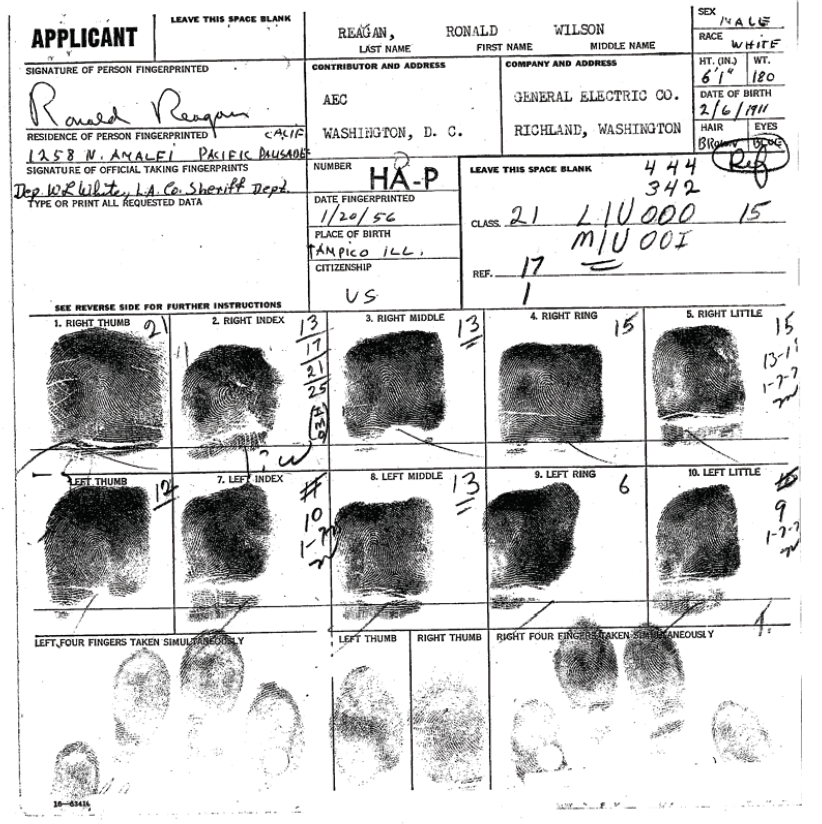
It is interesting to note that the majority of ulnar loops on the digits of former president, Ronald Reagan (deceased) displayed the same ridge count or a numerical reverse of the ridge count. The president’s right index, right middle and left middle revealed a ridge count of 13. It is also noted that the middle fingers, which are opposite to each other maintained a ridge count equivalence. The right ring and little, as two neighboring digits share the same ridge count of 15. Both thumbs, the primary digit of the hand, had a numerical ridge count in horizontal reverse; 21 on the right and 12 on the left. In another mirrored phenomenon, the left ring and little finger share a coincidence like the right ring and little finger; with the left ring, a ridge count of 6 followed by the left little with a ridge count of 9; as each digit exhibited a reverse in the vertical display of the ridge count. The left index, a digit noted for departure in frequency stands apart from this aspect of interest (Figure 1).

Friday, 8 July 2022

Lupine Publishers | Ethanol Neogenesis in Stored Blood

 Lupine Publishers | Journal of Forensic & Genetic Sciences


Abstract

During the investigation of accidental cases, blood samples obtained from accidental victim are submitted to forensic science laboratory for toxicological analysis. All through, ethanol analysis is performed on almost all cases of blood samples. The main problem is determining alcohol concentration in these cases is changes in Blood Alcohol Concentration (BAC) that can occur due to neo formation of ethanol. Blood samples stored under in sufficient conditions or for longer times and body fluids have undergone petrifaction often contains certain amount of volatile compounds. In the light of possibility that, neo formation of ethanol in improperly stored blood might give rise to an incorrect estimation of BAC. With this in mind, to study the effect of preservative and temperature on the formation and concentration of ethanol in blood samples, we estimated the ethanol neo genesis in stored and normal blood in different time period (0, 7, 14, 21, 28, 35 and 42 days). Head Space-Gas Chromatography instrument used to measure the level of ethanol in blood sample. We found that neo formation of ethanol was observed in normal blood sample. There was no any neo formation observed in blood sample with preservative and blood stored at 4 °C. Our study is supporting the studies which suggest that storage condition will affect the neo formation of ethanol in blood samples.

Keywords: Blood Alcohol Concentration; Neo formation; Head Space-Gas Chromatography; Ethanol.

Introduction

Determination of alcohol concentration is of great importance in medico legal autopsy blood samples, regardless of whether civil, criminal, or insurance law is involved. Blood alcohol cases in living individuals is often performed in forensic practice (e.g. after traffic accidents). Medico legal problems are not confined to determining alcohol as either a sole or joint cause of death, such as in accidents, but also include the problem of distinguishing true alcoholic poisoning. It is known that alcohol can be produced in blood after sampling. The amount of generated ethanol depends on the species of microorganisms present, the available substrates, the temperature and time of storage and the presence of preservatives added to the specimens. Neogenesis means regeneration of biological tissue or the formation of new products. Transformation and degradation of the well-known body structures (e.g. enzymatic digestion of cell components and membranes), together with accumulation of bacterial metabolites are likely to generate a huge range of new chemical compounds. Blood samples stored under insufficient conditions or for longer times and body fluids have undergone petrifaction often contains certain amounts of volatile compounds. A number of ubiquitous microorganisms are capable of forming or degrading alcohol, and neo genesis of ethanol is only a byproduct of bacterial decomposition processes [1-3].

The reactions that take place are mainly influenced by temperature, pH value, concentrations of available carbohydrates, and the presence of other utilizable nutrients.

Pathway of Metabolism:

Fructose -1, 6 - bisphosphateglyceraldehyde - 3 - phosphate ⇒ 3 - phosphoglycerate ⇒ 2 - phosphorglycerate ^ phosphoenolpyruvate ⇒ pyruvateacetaldehyde Acetaldehyde + glyceraldehyde - 3 - phosphate + H2O ⇒ 3 - phosphoglycerate + ethanol.

Putrefaction or decomposition is the final stage produced mainly by the action of bacterial enzymes mostly anaerobic organisms. These destructive bacterial agents cause marked haemolysis, liquefaction of clots and fresh thrombi and emboli, disintegration of tissues and gas formation in blood. Bacteria produces a large variety of enzymes and these breakdown the various tissues of the body. There is a progressive alteration of proteins, carbohydrates and fats. Putrefaction begins mainly by reductive processes due to the action of endogenous and exogenous bacteria and their enzymes and decay, based on oxidative reactions. Body tissues remain bacteriological sterile from exogenous infection for at least 20 hours after death. Whereas advanced putrefaction of a blood sample can be recognized macroscopically and by its odour, the transitional phase into putrefaction presents difficulties. As the blood decomposes its coloring matter transducer into the tissues which become uniformly red. The colour becomes darker and finally turns black. The most abundant volatiles detected during the forensic ethanol analysis are ethanol, acetaldehyde, 1-propanol, 2-propanol and acetone. These volatiles could either be initiated in the human body after the consumption of alcoholic beverages; or have been produced later during metabolic processes or by microbes [4-7].

Alcohol concentration often changes in putrefying blood. These changes might be caused by either a change in the level of ethanol or to the formation of higher alcohols, aldehydes, and ketones. Even though "fresh" samples of blood can contain a variety of higher alcohols. Therefore, the presence of such alcohols must be a result of neo genesis within the corpse or the stored blood sample. Anticoagulants and preservatives for blood: Anticoagulant is a substance that prevents blood from clotting by suppressing the synthesis or function of various clotting factors. The first anticoagulant preservative was introduced by Rous and Turner in 1916. It consisted of a citrate-glucose solution in which blood from rabbits was stored for two weeks, which prevented anaemia when transfused in another rabbit who had suffered from blood loss. Some of the commonly used anticoagulants are:

a) EDTA: Ethylenediaminetetra acetic acid as disodium or potassium salts is used. This is a chelating agent which binds the calcium which is needed for coagulation. It is effective at a final concentration of 1 to 2 mg / ml of blood. More than 2 mg / ml causes shrinkage of the cells. This is the best anticoagulant for peripheral blood smear and studies. Drawbacks: It inhibits the activities of enzymes like alkaline phosphatase, creatine kinase, and leucine aminopeptidase. EDTA is not suitable for calcium and iron estimation.

b) Heparin: It is mucoitin polysulfuric acid available as sodium potassium, lithium and ammonium salts. Heparin accelerate the action of antithrombin III which neutralizes thrombin thus prevents the formation of fibrin from fibrinogen. Heparin is added 0.2 mg/ml of blood. Drawback: It inhibits the acid phosphates activity. It interferes with binding of calcium to EDTA.

c) Oxalate: This form insoluble complex with calcium ions. Potassium oxalate at concentration of 1 to 2 mg/ml of blood is used. Combination of ammonium/potassium oxalate does not lead to shrinkage of the RBCs. Drawbacks: If the concentration is 3 mg/ ml, then there are chances for hemolysis. Oxalates inhibit several enzymes like acid phosphates', alkaline phosphates, amylase, LDH, and may cause the precipitation of calcium as oxalate salt.

d) Sodium Fluoride: This is a weak anticoagulant but used antiglycolytic agent to preserve the glucose. This inhibits the system involved in glycolysis and preserves the glucose. This is effective at a concentration of 2 mg/ml of blood along with other anticoagulant like oxalate.

Drawback: This is also inhibitor of many enzymes and also effect urease for the estimation of urea

a. Effect of temperature and preservative on blood

When blood is stored at 2-6 °C, glycosis is reduced but does not stop. Preservative solutions provide buffering capability to minimize pH changes and optimize the storage period. The lower temperature keeps the rate of glycolysis at lower limit and minimizes the proliferation of bacteria that might have entered the blood unit during venipuncture or from atmosphere. The rate of diffusion of electrolytes (Na+ and K+) across the cell membrane is also less at lower temperature.

b. Additive Solutions

One major benefit of the additive system is increase in the level of ATP, and red cells viability is enhanced, extending the shelf-life of the red cells to 42 days.

c. Health Care

Heavy drinking is a cause of ill-health and premature death. A person's blood alcohol concentration and state of inebriation at the time of death is not always easy to establish owing to various postmortem artifacts. The possibility of alcohol being produced in the body after death, e.g. via microbial contamination and fermentation is a recurring issue in routine casework. If ethanol remains unabsorbed in the stomach at the time of death, this raises the possibility of continued local diffusion into surrounding tissues and central blood after death. Blood samples, stored under insufficient conditions or for longer times and body fluids of corpses which had undergone putrefaction often contains certain amount of volatile compounds. This putrefactive alcohol is partly identifiably with congeners of alcoholic beverages. Such it is of Forensic relevance to discover post sampling ethanol neoformation and to discriminate putrefactive alcohols from fusel alcohols. Hence it cause on effect on person's health as it is stored blood but studies have revealed that few factors can change the results, such as amount of alcohol etc., so it is critical to decide the actual amount and this may also challenged by the legal system whether the person was under the influence of alcohol or not.

Aims and Objectives

    a) To determine the volatile compounds in blood samples.

    b) To study the effect of preservative and temperature on the formation and concentration of volatile compounds in blood samples.

    c) To study the effect of storage time (duration of storage) on blood samples under controlled conditions.

Materials and Method

Blood sample of healthy individual was collected from blood bank Sh. Narayan Hospital Rewari, Haryana).

Three flasks were taken having human blood (60ml) in each flask. Chemical used:

    a) Sodium fluoride (as preservative), this inhibit the system involved in glycolysis and preserve the glucose

    b) N-propanol (for internal standard) standards are used by which can be relate the concentration of the standard to concentration of the peak of the ethanol. Samples were analyzed using instruments Head space-Gas Chromatography

    Blood samples were divided into three conical flasks.

    a) With 500mg sodium fluoride (preservative) at room temperature

    b) Without preservative at room temperature

    c) Without preservative at cold temperature.

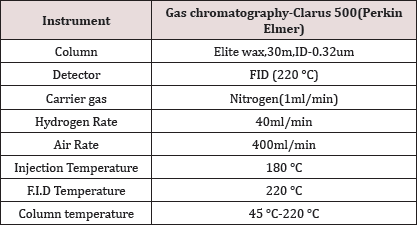
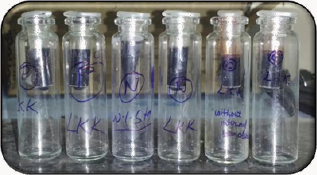
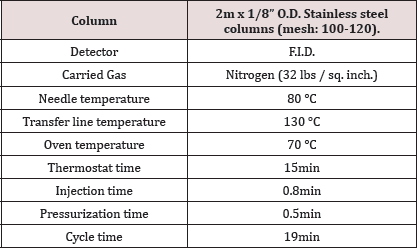
All three flasks were kept at their respective sites up to completion of the study from 16 February 2016 to 31 March 2016. Two vials of 1 ml each were prepared from each conical flask. Three vials with internal standard (90ul/1ml of blood sample) and three without internal standard. Blood was prepared for HS-GC. Three vials were subjected for qualitative study and another three for the quantitative analysis. After instrumentation graph was prepared and studied (Figure 1) (Table 1).

Table 1: Showing parameters of Gas Chromatography.


Figure 1: Showing preparation of samples..

Lupinepublishers-openaccess-Forensic-Genetics


Headspace GC is used for the analysis of volatile and semi- volatile organics in solid, liquid and gas samples. The headspace method is especially suitable for the very fast separation of volatile components (alcohols, acetone, aldehydes) in complex biological matrices especially blood in mass-liquor and prohibition law related cases. This method has the advantage of avoiding the risk of contamination of non-volatile components, which may be eliminated due to on-line analysis by gas chromatography. The principle underlying the headspace analysis is that in a sealed vial at constant temperature, equilibrium is established between the volatile components of a liquid sample and the gas phase above it (the head space). After allowing the time for equilibrium a portion of the headspace may be withdrawn one by one from vials using a gas-tight syringe and injected to GC for on-line analysis (Table 2).

Table 2: Showing parameters of Head space.


Results and Discussion

Boold samples stored under insufficient conditions or for longer times have undergone putrefaction often contains certain amounts of volatile compounds. The increase of ethanol and higher alcohols in putrefying blood is often recognized, for which first and foremost bacteria's are reasonable. Therefore, ethanol is only a byproduct of bacterial decomposition processes. The reactions that take place are mainly

influenced by temperature, pH value, concentrations of available carbohydrates, and the presence of other utilizable nutrients.

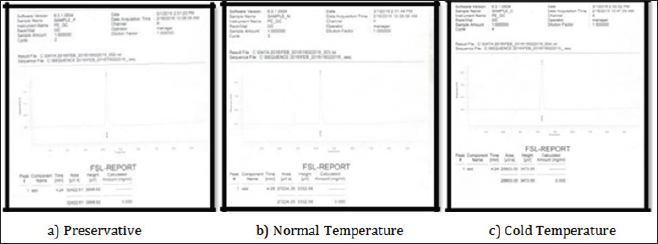
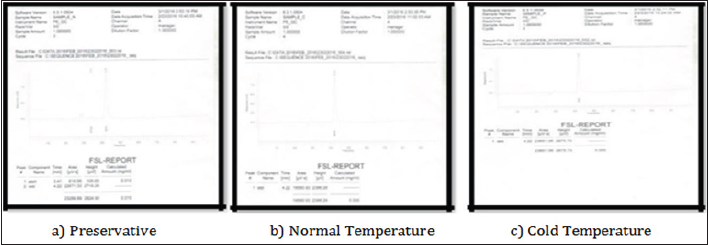
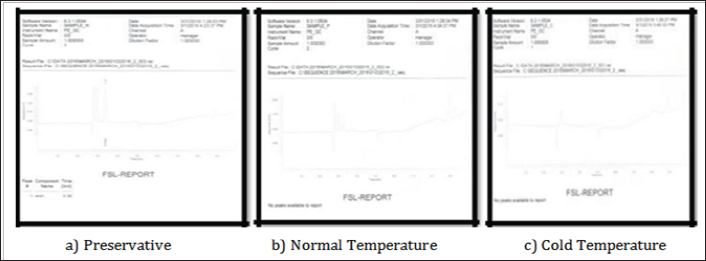
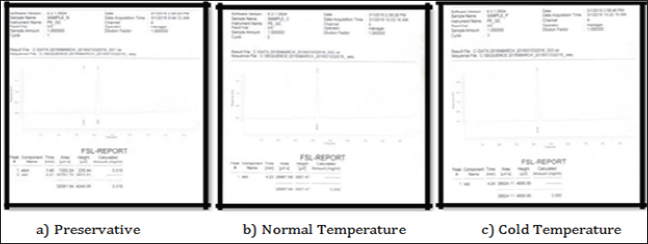
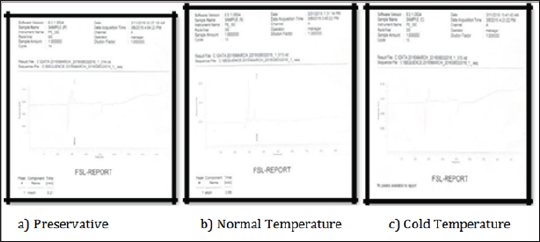
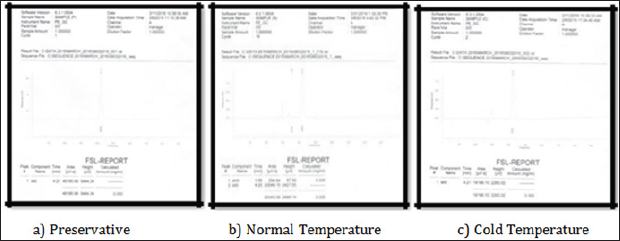
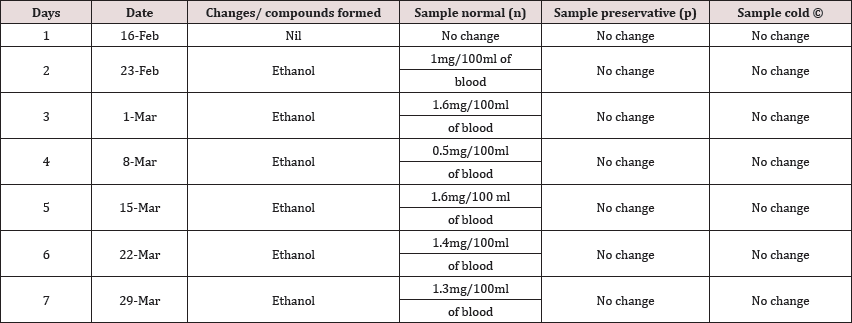
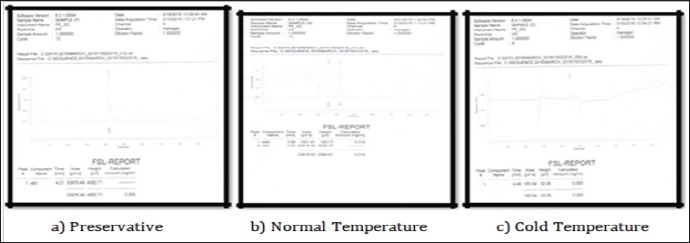
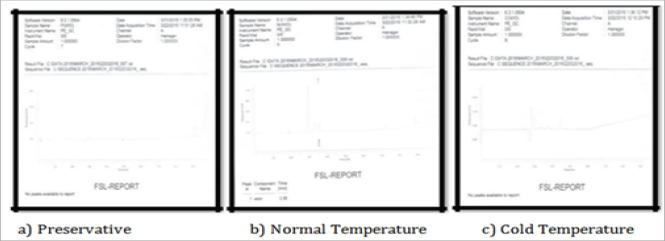
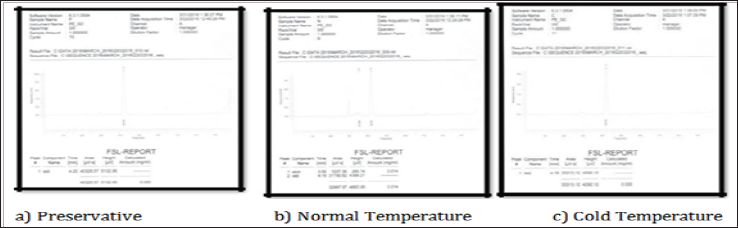
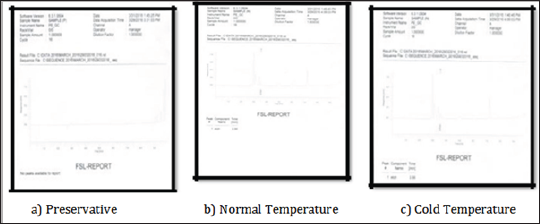
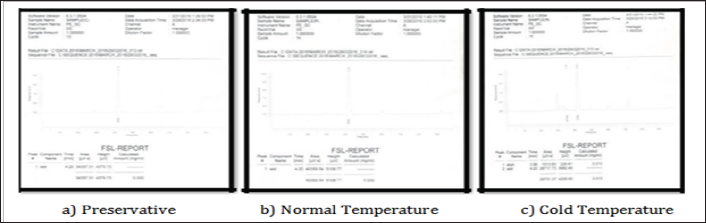
The main problems in the assessment of ethanol concentrations in blood from corpses include the potential of water loss, autolysis, putrefaction and postmortem glycogenolysis. A more precise differentiation of putrefactive alcohols has only been made possible by the introduction and development of gas chromatography. Comparing blood samples will recognize that the qualitative and quantitative; concentration of alcohols can be quite different. The possibility that neo genesis of ethanol after death might give rise to an incorrect estimation of BAC. In this study we examined the alcohol concentration qualitatively and quantitatively using head space-gas chromatography at the interval of successive seventh day from 16 Feb 2016 to 31 March 2016. The chromatogram of three different samples at different time periods is shown in following figures. Putrefaction of a blood sample was recognized by its odour and color. The predominating compound of alcohol formation in anaerobic putrefaction is ethanol. Additional formation of methanol, acetone and other alcohols occur only in trace amounts. But this study was only focused on the formation of Ethanol. The degradation of all alcohols however is assumed to commence within a few days. Peak values were measured after one week. It was found that the concentration of ethyl alcohol varies. After few weeks ethanol level decreases with increase in time of putrefactive blood and became almost constant. However no alcohol was detected at 4 °C. However, comparison of these graphs demonstrates that alcohol concentration often changes in putrefying blood. (Table 3) (Figure 2-12).

Figure 2: Showing quantitative chromatogram for the concentration of alcohol at day 1 in different samples.Day 1(16 Feb 2016)

Lupinepublishers-openaccess-Forensic-Genetics


Figure 3: Showing quantitative chromatogram for the concentration of alcohol at day 2 in different samples.Day 2(23 Feb 2016)

Lupinepublishers-openaccess-Forensic-Genetics


Figure 4: Showing qualitative chromatogram for the concentration of alcohol at day 3 in different samples.Day 3(1 March 2016)

Lupinepublishers-openaccess-Forensic-Genetics


Figure 5: Showing quantitative chromatogram for the concentration of alcohol at day 3 in different samples.

Lupinepublishers-openaccess-Forensic-Genetics


Figure 6: Showing qualitative chromatogram for the concentration of alcohol at day 4 in different samples.Day 4(8 March 2016)

Lupinepublishers-openaccess-Forensic-Genetics


Figure 7: Showing quantitative chromatogram for the concentration of alcohol at day 4 in different samples.Day 5(15 March 2016)

Lupinepublishers-openaccess-Forensic-Genetics

Table 3: Showing concentration of alcohol in different samples during different time periods.

Figure 8: Showing quantitative chromatogram for the concentration of alcohol at day 4 in different samples.Day 5(15 March 2016)

Lupinepublishers-openaccess-Forensic-Genetics


Figure 9: Showing qualitative chromatogram for the concentration of alcohol at day 6 in different samples.Day 6(22 March 2016)

Lupinepublishers-openaccess-Forensic-Genetics


Figure 10: Showing quantitative chromatogram for the concentration of alcohol at day 6 in different sampl

Lupinepublishers-openaccess-Forensic-Genetics


Figure 11: Showing qualitative chromatogram for the concentration of alcohol at day 7 in different samples.DAY 7 (29 MARCH 2016)

Lupinepublishers-openaccess-Forensic-Genetics


Figure 12: Showing quantitative chromatogram for the concentration of alcohol at day 7 in different samples.

Lupinepublishers-openaccess-Forensic-Genetics

Conclusion

The interpretation of postmortem alcohol levels is still problematic in forensic setting and in the field of legal medicine. Neo-formation of ethanol is due to microbial action either post-mortem in the body or from improper storage or preservation of the biological samples is a common problem in forensic toxicology. The same uncertainty applies to alcohol levels in blood samples that are improperly stored or are contaminated. In this project report neo formation of ethanol has been checked by using different temperature conditions and preservative. The alcohol concentration qualitatively and quantitatively using head space- gas chromatography at the interval of successive seventh day from 16 Feb 2016 to 31 March 2016. The chromatograms of three different samples at different time periods are shown in figures given above. At normal room temperature i.e. 20-28 °C without any preservative the decomposition of the blood starts and leads to formation of Ethyl alcohol. The concentration of ethyl alcohol varies as the days increases. It was found that the concentration of ethyl alcohol have varied pattern followed by a slight concentration decrease after 4th day. Thereafter, ethanol concentration remains more or less constant. However no alcohol was detected at 4 °C (Cold Temperature) and in the preserved blood. There is no real possibility for detail knowledge of post mortal changes of blood alcohol concentration in near future, so that it is necessary to comment alcohol aemia with special aspects on empirical practice.

Acknowledgement

I express my sincere and profound gratitude and deep regards to Prof Dr. RK Sharma, Chairperson, Department of Zoology Kurukshetra University Kurukshtra for allowing me to carry out the present study. I am highly obliged to Dr. RK Sarin, Director Forensic Science Laboratory, New Delhi-Rohini) for giving me the opportunity to undergo training course at their estimated institute. However, it would not have been possible without the kind support and help of many individuals and organizations. I would like to extend my sincere thanks to all of them. I am highly indebted to Mr. Loveleen Kumar Katyal for their guidance, ideas and constant supervision as well as for providing necessary information regarding the project and also for their support in completing the project. I would like to express my gratitude towards Dr. Jogender Tanwar (maternal uncle) and all member of Forensic Science Laboratory, New Delhi (Rohini) for their kind co-operation and encouragement which help me in completion of this project. My thanks and appreciations also go to my colleague my friend Ritu Malik in developing the project and people who have willingly helped me out with their abilities.

Read More About Lupine Publishers Journal of Forensic & Genetics Please Click on Below Link:
https://forensic-journal-lupine-publishers.blogspot.com/