Lupine Publishers| Journal of Pharmacology & Clinical Research

Abstract
The TCM role of Liver understood with the meridian route and functions shows that the insulting sequence plays a key to understanding the relationship between Liver and Lung in the effective treatment of cough. Liver qi stagnation is the most important and common pattern in clinic that deserves attention, which can be interpreted with scientific evidence. However, there remains a long way to go for the integration of TCM with the conventional medicine.
Keywords: Cough; Liver Qi Stagnation; Liver Meridian; Yin Yang
Introduction
Pathological mucus or foreign irritants are cleared out of the airways in the lung disorders with the protective action coughing when the lung is contracted with the infections. Cough categorized as the acute, the subacute, and the chronic with the duration from less than three weeks to over eight weeks can affect the patients’ life as long as it continues for more than two weeks [1,2]. How to make acupuncture treatments effectively requires an accurate diagnosis following Zang-Fu organs, meridian theories, Yin-Yang, and acupoint indications. Although the stimulations with the acupuncture treatments on the immune system for the infection issue like cough have been verified effective to improve the symptoms resulted from the cough in the recent scientific studies [3,4], the unique technique pattern should deserve attention for the expected successful treatments. Compared to the Western medicine, symptoms in traditional Chinese medicine (TCM) are believed to be broader with the pattern identification. The pathological classifications of diseases in the Western medicine are not generally followed by TCM physicians and acupuncturists, but they strictly depend on the patterns developed with the Yin- Yang balance, Qi-Blood, and the meridian theory [5].
Glance at the Functions of the Liver Meridian
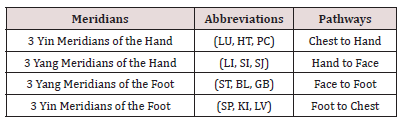
A human body is supported by the three essential and vital treasures Jing (essence), Qi, and Shen. Jing (essence) is viewed as Ying, referring to material that seems to bear high similarity to genes. The damages to Jing may cause serious issues with physiological and psychological developments. Qi is classified as Yang for functions of the body and viewed as the energy to benefit the body to fight against external evil Qi (pathogens), and transports Blood to nourish the all the systems of the body [6,7]. In addition to Jing, Qi, and Shen, spirit, the combination of body and mind, indicates whether or not Yin and Yang are at balance and serves as the foundation for diagnosis and treatment. The concept that the human body in TCM is not only seen as the interaction between humans and Heaven but as a miniature of the universe highlights the importance of Yin-Yang balance. A disease is believed and understood to be the Yin and Yang imbalance in Figure 1. The Yin- Yang balance in TCM has severed as the guideline for explaining the etiology of the diseases and the treatments for over two thousand years in the history of Chinese medicine and the key to the accurate diagnosis and successful treatment outcomes. On the basis of QiBlood, Essence, and fluids, Liver, Heart, Spleen, Lung, and Kidney are five Ying Zang organs that co-work through the meridian systems with the six Fu Yang organs Gall Bladder, Large Intestine, Stomach, Small Intestine, Sanjiao, and Bladder to connect all the body systems. The systems of the body can be affected with the activities of ascent and dispersion of Liver [8]. The Five Elements theory indicates that one of the functions of Liver is to store Blood for regulating the blood volume to nourish the constituents of the body and the Liver qi can affect the Spleen qi to ascend and the Stomach qi descend correctly and the regulation of emotions. On the other hand, whether or not Qi can flow freely within the body in order to ensure the distribution of fluids and blood is also governed by Liver [9]. Qi circulates in the traditional twelve meridians in the body to connect the tissues and organs together, collaborating with Blood to regulate the normal functions of the body and reflect pathology for diagnosis. Meridians are divided into three Hand Yin meridians, three Foot Yin meridians, three Hand Yang meridians, and three-Foot Yang meridians as shown in Table 1 [10]. The Liver meridian classified as Foot Jueyin originates at the lateral side of the big toe, goes upwards along the inner side of the leg meeting with SP12 and SP13, and then encircles the pubic region to connect with the Conception Vessel at CV2, CV3, and CV4. It ascends to Stomach and penetrates Liver to connect with Gallbladder and Lung at PC1, and finally connect with the Governing Vessel at the vertex of the head [11].
Figure 1: Characteristics of Yin and Yang.
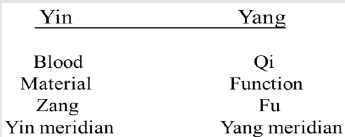
Table 1: Twelve meridians and pathways.
Pathological View of Liver with Cough
It is stated that “Five Zang organs and six Fu organs make people cough, in addition to Lung.” in the 38th Chapter On cough of the volume Su Wen (Essential Questions) of the Huang-Di-Nei- Jing (Essential Questions of Yellow Emperor’s Inner Classic). This warning suggests that a TCM practitioner and an acupuncturist must consider the relationship of the other organs in treating cough based on the Five Elements theory to gain the whole picture of the etiology. Liver in the Five Elements theory refers to Wood while Lung is Metal to govern Qi in TCM. The meridian route of Liver indicates that the Liver meridian passes Lung and the insulting sequence that Liver can invade Lung explains that Liver can affect the functions of Lung with its failure in free flow of Qi to descend Lung qi, which can result in such symptoms as cough, dyspnea, and asthma. Blood regulation and dispersing stagnated Qi rely on the smooth flow of Liver qi [12,13]. Unfortunately, Liver qi stagnation, presented with the symptoms of swelling in the breast, frequent sighs, the tightness in the chest, tension in the epigastric region, the sensation of a lump in the throat called Plum Pit Qi, or sometimes stabbing pain in the hypochondriac region, is the extremely common TCM pattern in clinic and one of the pathological changes of Liver. The circulation of Qi is impeded with this change when Liver is depressed with the negative emotions like anger, worry, depression, and resentment [14,15]. Scientific studies of depression, which is understood to be the presentation of negative Shen in TCM, have shown that the neurotransmitter signaling in transforming macronutrients into molecules is dysregulated with the stagnated Liver qi. Stagnated Liver qi leads the molecules to be delivered insufficiently to the brain with the disrupted mitochondrial ATP production in neurons [16]. In addition, the failure in controlling the ratio of lymphocytes and granulocytes that can be seen as Yin and Yang by the autonomic nervous system is viewed as Liver qi stagnation [17]. On the other hand, the sympathetic nervous system controls the Natural Killer cell while the parasympathetic nervous system is assumed to be closely connected to the release of cytotoxic substances [18,19].
Discussion
The quotation “Qi is the commander of Blood and Blood acts as the mother of Qi” highlights the collaboration of Blood and Qi. Blood is seen as Yin and Qi can be classified into Yang, which can result in diseases when the imbalance of Yin-Yang occurs. Blood, produced with food qi (gu qi) by Spleen, circulates in the veins governed by Heart to nourish the organs and the systems. Blood, in addition to food qi, is also generated by the mother of Liver based on the Generating sequence Kidney, which stores prenatal Jing and produces marrow that generates to manufacture Blood. Qi circulates in the traditional twelve meridians to support the life, interacting with Blood for the Zang-Fu organs to function normally in harmony [20,21]. The studies on the relation between Qi in the twelve meridians and the oxygen metabolism highlight that one may be short of breath and experience wheezing or coughing when the normal level of blood oxygen is below, presenting the high similarity of physiological functions and pathological reactions between Qi and oxygen [22]. In other words, this suggested that oxygen, to some extent, is equivalent to Qi [23]. The Generating Sequence of the Five Elements theory shows Kidney is the mother of Liver, which suggests that Kidney’s problems can affect its child Liver. The maximum oxygen is delivered with the normal value of 45% of hematocrit [24]. Kidney produces Erythropoietin to promote the number of red blood cells to increase the capacity of the blood to carry more oxygen. In addition, the circulation of oxygen in the Kidney is closely associated with the production of Erythropoietin determined by tissue oxygen pressure [25]. In other words, stagnated Liver qi can be dispersed as long as Kidney can function normally with the delivery of the healthy Qi to Liver. In a word, the inflammation resulted from the infection can be reduced with much more oxygen delivered upwards with the blood to Lung.
Conclusion
Inductive logic thinking is the basis of the developments of TCM and acupuncture theories. TCM practitioners and acupuncturists must stick to the pattern identification developed based on Yin-Yang and the Five Elements theories that act as the two key principles in practice to the accurate diagnosis and the expected outcomes. With the collaboration of Liver and Kidney, it is suggested in this study that Qi may be viewed as oxygen in the blood and Kidney is the key to producing Qi, which makes Liver an anti-inflammatory role eventually to reduce the inflammation of the Lung. The integration of the western medicine and TCM has gained much more attention, which suggests that the trend may be the optimal choice for the public health system. However, how to link each other together needs more research and shows that there is a long way to go.
To Know More About Lupine Publishers Journal of Pharmacology and Clinical Research Please Click on Below Link: https://lupine-publishers-pharmacology.blogspot.com/

