The profile of Addis Ababa city has been changing due to the
promotion of privatization, slum area clearance, construction of
condominium houses, and conversion of agricultural fields in the suburbs
to urban lands. Hundreds of low-income households have
been displaced and, as an aftermath, were adversely affected by this
development-induced displacement. The objective of this study
was to describe and explore the perceived social and psychological
effects of the “development-induced displacement” on a sample
of Twenty-three purposefully selected participants in Addis Ababa. Data
were collected from those low-income households who
were originally residing in Kebele houses around Tikur Anbessa Hospital
and later resettled into one of the suburbs of Addis Ababa
called “Jemo Three Condominium site” through open-ended interviews and
questionnaire. As expected, findings have indicated
that displacing people from the inner city to new resettlement sites in
the outskirts was associated with social breakdowns (such
as frustration to form close relationship with neighbors and absence of
warm and trusting relationship) as well as psychological
problems (like lack of confidence and motivation to earn a living and
poor self-esteem). The finding also indicated that the
displacement has additionally created loss of jobs, incurred high
transport costs, and challenged access to education and healthcare.
The damage caused by resettlement on poor resettles far outweighs its
benefits and, therefore, the government needs to revisit its
housing strategy.
Keywords: Displacement; Resettlement; Social wellbeing; Psychological Wellbeing
Introduction
Internally Displaced People are among the least studied
categories of people in the world and, hence, internationally
agreed upon definitions for it is yet to come. Developmentinduced
displaced persons are among the internally displaced
group. Scholars, therefore, used the operational definition for
‘Development-Induced-Displaced people as ‘persons or groups
of persons who are forced to leave their lands or homes or their
possessions as a result of development processes that put their
livelihoods in danger Pankhurst & Piguet [1], UN and Habitat [2].
The number of Internally Displaced People seems to be increasing
globally as about ten million people enter the cycle of forced
displacement and relocation on an annual basis mostly due to
development projects. Out of these, urban development projects
reportedly cause the displacement of some six million people every
year from their lands and homes Cernea [3], Pankhurst & Piguet [1].
It is widely and increasingly accepted that urbanization is inevitable
phenomenon. In developed countries like Europe and North
America urbanization has been a consequence of industrialization
and has been associated with economic development. In the
developing countries of Latin America, Africa and Asia, urbanization
has occurred as a result of high natural urban population increase
and massive rural-to-urban migration Brian [4], Minwuyelet
[5]. According to Cernea [6], ongoing industrialization and
urbanization processes are likely to increase, rather than reduced.
As the demands of the urbanizing population increases, notably
in Africa and Asia, it is inevitable that the need for infrastructure
development will grow enormously and displacement from inner
cities is likely to occur on massive scale McDowell [7], Pankhurst
& Piguet [1], World Bank [8]. Development-Induced-Displacement
has serious human rights and socio-economic impacts. It breaks
up entire communities and families, making it difficult for them
to cope with the uncertainty of resettlement. Risks are usually
higher for vulnerable groups, such as children, women, poor, the
elderly, ethnic minorities, and indigenous people Minyahil [9]. Furthermore, Cernea [10] has identified and discussed in detail
eight principal risks that lead to the impoverishment of displaced
community. These are: landlessness, joblessness, homelessness,
marginalization, food insecurity, increased morbidity, loss of access
to common property, and community disarticulation. Both global
and national experiences show that resettlement usually fails to
achieve its objectives UN-Habitat [11].
It is usually unproductive, ineffective, catastrophic, grievous,
and environmentally detrimental. As discussed by “…resettlement
often leads to impoverishment…and sometimes involves abuse
of human rights”. According to Pankhurst and Piguet [1], many
development programs are often in conflict with the interests of
local people worldwide. A number of communities have witnessed
serious resource depletion and economic impoverishment as
a result of their displacement in the name of ‘development’.
Feleke [12], Feyera [13], Eyasu [14], Eyob [15] examined the
consequences of urban development projects on the lives of
people who are evicted from their rural lands and houses. These
studies uncovered that, as a result of inadequate consultation and
compensation the displaced families are exposed to social and
economic impoverishment. The works of Gebre [16], Mengistu
[17], Wolde-Selassie [18] vividly depict the absolute failure, harsh
and ruinous life experience of resettlers in Ethiopia over previous
decades. Gebre [19] has discussed the issue in his report of urban
development and displacement in Addis Ababa. He outlined the
impact of resettlement projects on low-income households. His
research revealed that because of their relocation away from the
inner city, most of the displacees experienced different hardships,
such as decline/loss of income, poor access of educational and
health services, transport problems and breakdown of social
networks. Why does resettlement so often go wrong, and end up
leaving the resettled people (and often others as well) economically,
socially and psychologically worse-off than before? According to
Pankhurst and Piguet [1], there seem to be two broad approaches
to answering this question: the inadequate inputs approach and
the inherent complexity approach. Among these approaches
the inadequate inputs approach is evident in the process of
Development- Induced Displacement so far conducted in Ethiopia.
According to this approach, resettlement goes wrong, principally
because of a lack of proper inputs such as legal frameworks and
policies, political will, funding, pre-resettlement surveys, planning
the displacement ahead, consultation with those to be displaced,
careful implementation, and monitoring.
In Ethiopia, urban development appears to be the order of
the day and will remain an on- going process for decades to come.
There are indications that more new projects and the expansion
of existing ones will displace more people. In a televised press
conference in the context of the Ethiopian Millennium celebration,
the late Prime Minister Meles Zenawi indicated that 70 percent of
the houses in Addis Ababa would be demolished and rebuilt. An
inadequate master plan, poor housing facilities, environmental
problems, and shanty corners, among others, characterize urban
centers of developing countries Dierig, [20], Kamete, Tostensen,
Tvedten[21], Meheret [22], Potts [23], Rabinovitch [24]. The renewal
and development programs of urban areas often target slums
and shanty areas normally inhabited by low-income households.
Compared to suburbs, income generating opportunities and social
services are often concentrated in such areas. Therefore, relocation
of low-income households from inner cities to the outskirts would,
undoubtedly, affect their livelihoods and informal networks of
mutual assistance, their critical coping strategies Lourenço Lindel
[25]. It has been widely agreed that people dislocated from inner
cities are likely to lose important locational advantages linked to
their survival Davidson et al. [26], Gebre [19]. Addis Ababa is in a
position that it is not able to accommodate inhabitants due to the
substantial flooding of new comers from rural areas and small
towns of the country in search of better life. Nevertheless, they
usually find themselves in difficult socio-economic circumstances.
The number of homeless and those who live in very poor houses is
increasing in an alarming rate Gebre [19]. According to a report of
80 per cent of the population in Addis Ababa lives in sub-standard
slum housing that needs either complete replacement or significant
upgrading. There is a massive demand for serviced, healthy, and
affordable housing in the capital. This demand stems both from
the current housing deficit and the poor quality of the existing
government housing stock (kebele houses) that are beyond repair.
The government of Ethiopia estimates that the housing deficit in
urban areas is between 900,000 and 1,000,000 units, of which
300,000 units are found in the capital city, Addis Ababa MWUD [27],
UN-Habitat [2]. The government also estimates that only 30 per
cent of the housing stock is in a fair condition, while the remaining
70 per cent is in need of total replacement.
In response to this challenge, the Ethiopian government
outlined an ambitious vision of constructing condominium houses
for low and middle-income households and inner-city up grading
program since 2005 UN-Habitat [2]. The initial goal of the program,
Integrated Housing Development Program (IHDP), was to promote
homeownership for low and middle-income households by
constructing 400,000 condominium units, reduce unemployment,
promote the development of 10,000 micros and small enterprises,
enhance the capacity of the construction sector, and regenerate
inner-city slum areas. For the purpose of achieving these goals the
Addis Ababa city government displaced and displacing many lowincome
households from inner city to peripheries of the city. The city
is expanding horizontally, and the population is moving to unplanned
settlements on the peripheries at the expense of agricultural lands.
Since most private investments are highly concentrated around
the main urban center, the problem of displacement is becoming a
primary concern Hehl & Stollman [28]. Addis Ababa, the capital of
Ethiopia, is undergoing a major transformation as evidenced by the
construction of condominiums, road, networks, schools, healthcare
institutions, hotels, real estates, banks, shopping centers, and many
other businesses. There is a sense of jubilation on the part
of authorities and the general public with the direction of the
urban development policy and the remarkable gains scored thus
far. What remains unnoticed, however, is that thousands of people
have been displaced and adversely affected by the process of urban
development Teshome [29]. The process of relocating people from
inner city to new resettlement sites in the outskirts have disrupted
the relocatees’ business ties with customers, broken their informal
networks, caused loss of locational advantages, loss of jobs and
incurred high transport costs Gebre [19]. Although the Addis Ababa
city administration considers that its land lease allocation system
boosts the market value and proper exploitation of urban land,
most of its projects are not in accordance with the international
and national policies and the norms set by agencies like the UN, the
World Bank and the Environmental Protection Authority. The rural
people affected by the urban projects are also not actively involved
in the assessment, feasibility studies, planning and implementation
process. The urban development projects rather have tended to give
more attention to local and foreign investors than the urban poor
and the peasants who live in the vicinity of the city Melaku [30],
Pankhurst & Piguet [1]. Many other studies focused on the physical
and economic impacts of relocation scheme giving emphasis to
the housing conditions and the availability of infrastructures.
These studies gave little, if any, attention to psychological and
social breakdowns that result from displacement. But the present
study focused mainly on social breakdowns and psychological
disturbances associated with low-income households who were
displaced from inner city (around Tikur Anbessa) and located to
Jemo Three condominium site which is found in the outskirts (13
kilometers away from the center of the city). This area (Jemo Three)
was part of Oromiya region previously. This study focused on lowincome
households who were living in Kebele houses paying few
birr for house rent (8.6 birr on average per month). People who live
in Kebele houses are believed or expected to be relatively poor, and
hence, adaptation to new environments would be difficult for them
when compared to people who are financially strong.
The available statistics reveal that social services and
infrastructural facilities are concentrated in the inner city as
compared to suburbs Eyob [15], Gebre [19], Nebiyu [31]. Therefore,
relocation of people from the center of a city to the outskirts
would lead to social and psychological impoverishment as well as
to the decline of access to infrastructural services and facilities.
The aim of this study is to explore the aforementioned problems
of displacement and to indicate sound strategies to minimize the
adverse effects of Development-Induced-Displacement. If the
expansion of urban areas and clearing shanty corners continue
the same way in Addis Ababa, as expected to be the case, one can
imagine that large number of people to be displaced will soon face
social and psychological problems. Therefore, research that assesses
the social and psychological consequences of urban development
projects is expected to play an important role in filling the existing
knowledge gap. Therefore, this research is conducted to examine
the multifarious effects of development-induced displacement
focusing mainly on infrastructural problems, livelihood impacts,
social problems, and undesirable psychological effects.
Methods
Research Setting: this research is conducted in one of the
condominium sites found in Nifas Silk-Lafto sub-city of Addis
Ababa named as Jemo Three condominium site. Addis Ababa is
the economic and political city of Ethiopia, and the melting pot of
different nations and nationalities. Almost all the Ethiopian ethnic
groups are represented in Addis Ababa due to its position as capital
of the country and its location in the geographic center of the
country (PEFA, 2008). The city has a population of more than 3.5
million, ten times larger than the second largest city in the country,
Dire Dawa. In the past couple of decades Addis Ababa has risen from
a city of self-built single-store homes, to a city of skyscrapers. This
happened as a result of the inauguration of the Integrated Housing
Development Program (IHDP) in 2004. The IHDP is targeted at
constructing condominium houses for low income groups through
cleaning shanty corners. While the IHDP has the laudable aim of
targeting the low-income sector of the population, unfortunately
experiences have shown that many poor people are not benefiting
from the IHDP due to inability to afford the initial down-payment
and monthly service payments. The poorest are primarily excluded
from securing a unit because they do not have the financial capacity
to pay the required down-payment. Furthermore, the inability
to pay the monthly mortgage and service payments forces many
households to move out of their unit and rent it out rather than
risk losing it through bank foreclosure. The IHDP aims at producing
low-cost houses but not low-quality houses. Nevertheless, there
have been reports of burst sewerage pipes that leaked through
all floors and wide-spread cracking of wall plaster. The expected
lifespan of the units is 100 years, although local professionals and
residents doubt the validity of these predictions. Construction
quality is affected by micro and small enterprises seeking to make
additional profit by using cheaper substandard fixtures, such as
doors and door handles, as well as the low levels of construction
skills and capacity, which is somewhat understandable considering
the vast numbers of recently employed inexperienced contractors
and builders necessary for projects of this scale. As mentioned
earlier the setting of this research is Jemo Three condominium site.
The research site is found at the western part of Nifas Silk-Lafto
sub-city. Jemo Three is 13 kilometers away from the center of Addis
Ababa (Piassa-Georgis). This area was previously governed by
Oromiya regional state. Some of the peasants living in the area were
displaced and relocated to another area while the rest were given
money as a compensation for their land. It is witnessed by people
who were living in this area that the land was fertile. Peasants
were producing crops like barley and wheat. The peasants were
displaced without their willing. It is to this area that people who
were living in inner city (around Tikur Anbessa Hospiital) were
relocated. Even though peasants were producing sufficient amount
of crops from this site, it is not suitable for people who were living
in inner city and relocated here. The majority of displaced people
were earning a living by getting employed in government and
nongovernment
organizations in inner city. Jemo Three is characterized
by relatively poor social services such as transportation, health care
and schooling.
Population and Participants: low-income households who
were displaced from Tikur Anbessa area and resettled to Jemo Three
are the population of this study. These households were living in
kebele houses owned by the government before the displacement
where they pay very amount of money for house rent. The quality
of kebele housing stock is low: typically constructed of mud, wood,
and/or discarded materials. Kebele houses are old, having been
constructed many decades ago and little to no maintenance has
been carried out. Some houses remain with no access to water
and electricity, and many do not maintain minimum standards
of sanitation. Nevertheless, the social and cultural bonds in their
previous village were stronger. They had stronger relationship
with people around them. Furthermore, they were economically
advantageous before displacement because they were living in
inner city where economic activities were better. They lived in this
area for more than twenty years on average. Now they are living in
condominiums where they were paying 875 birr for house rent on
average per month. Data were collected from 23 households who
were selected based on snow ball sampling technique. Snowball
sampling technique was used since the researcher knows two
households who were dislocated from Tikur Anbessa area and
relocated to Jemo Three. The process of data collection was started
from these two information-rich resettlers. Then, they were asked
to locate those households who were displaced from the same area
and relocated to Jemo Three.
Tools of Data Collection and Analysis:
Questionnaire: Since this research was mainly qualitative
in nature, open-ended questionnaire was developed by the
researchers by relying on the existing literature. The purpose of the
questionnaire was to assess the psychological and social impacts
of displacement on low income households. It was also intended
to compare the difference in infrastructure before and after
displacement. The questionnaire had two parts. The first part dealt
with demographic variables such as age of the respondents and
amount of money paid for house rent before and after displacement
while the second part, which was comprised of 7 items, assessed
the quality of the respondent’s social (e.g., “Do you think that your
relationship with your neighbors is warm and trusting?”) and
psychological life (e.g., “Are you satisfied/dissatisfied with your
current setting?”) including the quality of infrastructure. Initially,
the questionnaire was written in English and then translated into
Amharic and it was the Amharic version that was administered
finally.
Interview: the interview guide consisting open-ended
questions was primarily written by the researchers was translated
into Amharic language by the help of two language teachers in Addis
Ababa University. This guide was composed of 9 items assessing the
social life (e.g., “Does displacement affect your life? If yes, in what
ways?”), psychological life (e.g., “Do you think that displacement
affected your self-concept and motivation? If yes, explain how?”),
and infrastructural quality (e.g., “Where do you get better access
to social services like road, electricity, telephone, transportation,
shopping centers, clinic, etc.?”) of respondents who were displaced
from inner city, due to development-induced displacement, and
relocated to the peripheral of the city, specifically to Jemo Three.
Data Analysis: data were collected through interviews and
open-ended questionnaires. The data were organized in to different
themes and analyzed thematically. Using different methods,
informants’ sayings were highlighted whenever they have relevance
with the topic of the study. Codes were created and brought together
for categorizing purposes. Finally, the main themes (based on the
category) were identified and the categories were brought together
and rearranged under those themes.
Ethical Considerations: During the process of data collection,
all necessary precautions were made to ensure that the rights of
the sources of data were respected. The data collection instruments
were accompanied by informed consent form. The research
participants were debriefed concerning the purpose of the research.
Besides, the research participants were informed that participation
in the research is on voluntary basis and they have all the rights to
pull out if they find the data collection or the nature of information
is not consistent with their expectations.
Findings
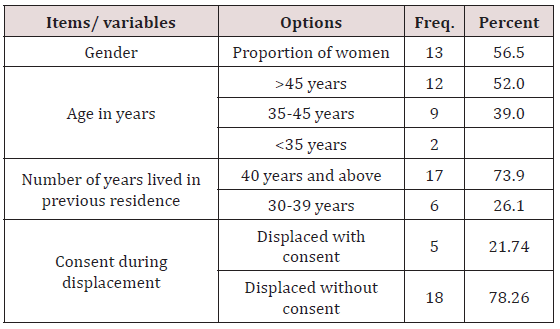
Characteristics of the Respondents: there were more than
sixty households that were displaced from their previous residence
and resettled into Jemo Three Condominium site. As indicated
in Table 1, data were collected from 23 participants from lowincome
households of which 56.5% were females, 91 % were aged
more than 34 years, and almost all of them have lived for more
than 30 years in their previous residence. More importantly, the
greater majority (78%) have expressed that they were displaced
without consent. Interview results also confirm this observation.
For example, a 64 years old woman expressed this discontent as
follows:
Table 1: Characteristics of the respondents.
Unless forced, nobody wants to get detached from his/
her home where he/she has lived for many years. Nobody wants to
leave a home we have been grown up, learnt, and passed through
huge life experiences… (A woman interviewee No. 6, age 64).
A 51-years-old woman interviewee also expressed, “…if
you ask me how I left my old and lovely home, I will definitely tell
you that I was forced by groups of youngsters who were given the
task of destroying shanty corners (our old homes). They used to
threaten us frequently to move to this new site as soon as possible.”
A response obtained from another male interviewee aged
61 years also illustrates the same idea. “We were not happy by
getting separated from our previous homes, though the aim of the
government was development”.
Infrastructural Concerns: Data obtained from the research
participants of the study clearly showed that there were noticeable
differences in availability of regular and adequate services of
electricity and water before resettlement (at participant’s previous
residences) and after resettlement (at participant’s current
residences, Jemo Three). For example, an interviewee said, “there
is slight difference in my previous and current residences, but
concerning water supply the two areas are incomparable. At Jemo
Three, we get water two or three days a week. We get water at
mid night, if you are able to wake up at about 12:00PM or 1:00AM
o’clock” (male, age 51). Another relatively younger interviewee
(Female, aged 36 years) responded as follows:
…there are huge differences between electricity and water
services in my previous and current houses. I wash my cloths
once or twice in one month here (new residence) due to shortage
of water, but I usually wash once every week at Tikur anbessa
(previous village). I learnt how much water is important in once life
in practice (though I know it theoretically) at Jemo Three. I started
to use water very economically. If I fail not to use economically I
must collect water in bucket from very far area and carry the bucket
up on to the third floor. The supply of electricity is relatively better
than that of water supply at Jemo Three, although, it is worse when
compared to the supply of electricity at Tikur anbessa. Here, electric
power disappears once or twice a day.
Table 2: perceived infrastructural services of participants before
and after displacement.
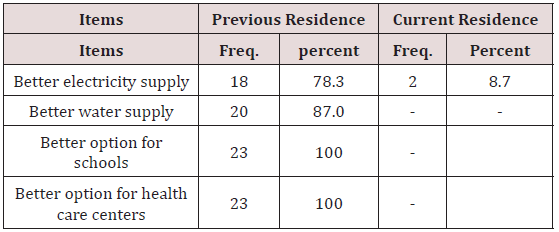
Similarly, responses obtained from the questionnaire revealed
that there were better electricity and water supply in their previous
than current residences. Among the 23 respondents who filled
in the questionnaire, three of them responded that the supply of
electricity and water in their previous and current residences was
similar. The responses of the rest 20 participants are given in Table
2. As indicated in Table 2, nearly all respondents were saying that
their previous residence was better in electricity supply (78.3%),
water supply (87 %), options for their children’s schools (100%),
and health care centers (100%).
Interviewees were also complaining about the distance
of the site from the center of the city, which incurs them extra
transportation cost:
My previous living site was found at the center of Addis Ababa.
I was surrounded by Merkato, Legehar, Piassa, Mexico, Abinet,
Autobus tera (bus station), etc. Look at those beautiful areas. You
can get everything you need in your life (clothes, food items, goods)
simply by moving towards these locations with very few amounts
of money, or you can even go on foot. Now, I have to, at least, pay
more than 20 birr to go to Merkato. I should have to go to the center
of the city, Mexico for instance, to buy things I need because goods
and food items are relatively more expensive here when compared
to their cost at the inner city. Furthermore, things you need are not
sufficiently found here (male, age 61).
Another interviewee explained the distance of Jemo Three from
the center of the city and problems associated with transportation
as follows: My neighbors who were displaced like me were resettled
to better sites. I am not lucky by having thrown to this site. It is
too far from inner city and the environment is ugly. I think you too
agree with my idea. Isn’t it? I will never like this site because it will
never get improved or will take very long period of time. I have to
leave my home very early in the morning, like about 11:30 - 12:00
o’clock due to the reason that he road from the center of the city to
my house usually gets overcrowded. Likewise, I need to stop my job
early in the afternoon, for instance at about 10:30 so that I could get
back to my house before the road once again get congested. What
bothers me is not only about the congestion of the road but also
about the extra amount of money I am asked on a taxi. We are asked
to pay more than the limit set by the transport authority” (male,
age 50 years).
Finally, the data collected concerning the provision of schools
and health care centers at respondent’s previous and current
residences revealed that there was significant difference in the
number and quality of schools and health care centers. The data
showed that respondents were surrounded by various health care
centers and hospitals in their previous residences. They were
receiving medical services at different government health care
centers (Tikur Anbessa hospital, Zewditu hospital, Teklehaimanot
health center), but today, in their new village, there is only one
government health center. This was substantiated by the following
quote. “Recently, I started to frequently pray to God not to get me
sick. You know why? Last time (she attempted to recall the exact
time, but she couldn’t) I went to wereda 02 health care center (a
health center around Jemo 1) with one of my neighbor. We went there because she was sick. The long queue of patients I observed
on that day made me pray to God to stay me healthy. There are many
clinics for those who are rich. These clinics are not affordable by
poor people like me and my neighbor.” Data about the availability
of schools for children of displaced parents showed that parents
were experiencing shortage of schools for their children. “In my
previous village I can send my children to different schools because
we had various options. The schools were also relatively closer to
our homes. Here we have very limited options and simultaneously
the few available schools are located at distant areas” (Interviewee
No. 11, male, age 56). The other interviewee (male, age 49) also
reported that there was shortage of schools and parents were
suffering a lot. “…of course, the schools found in our area are meant
for rich people because they charge you a lot of money. We cannot
send our children to these schools. Affordable schools are found
a bit far from Jemo Three.” The researcher of this study observed
that the schools found around the study area were not intended for
those poor displaced people. These schools were charging not less
than 600 birr per month for a child. The researcher also noticed
that some parents were sending their children to schools that are
found in their previous village. These parents had to wake up and
force their children wake up very early in the morning so that they
could send their children to schools before the roads get crowded.
Responses obtained from questionnaire similarly showed that there
was a difference in the number of health care centers and schools
for children of displaced parents. Resettlers were asked to compare
where they found relatively better health care centers and schools
for their children. Those participants who had no children to send
to school were asked simply to compare the number of schools in
their old and current living areas.
According to the observation of the researcher, the presence of
two churches (St Gebriel and St Mary) at Jemo Three condominium
site was the only thing that made Christian respondents feel
good and a little bit happier. There was no worshipping area for
Muslims at Jemo Three, but there is a mosque around Jemo Two Site
which is not too far. Concerning worshipping areas, respondents
were comfortable, though, there were differences in the number
of churches and mosques between the previous and current
residences of resettlers. “We (Christians) have two churches both of
which are very close to our homes. St Gebriel Church is at the back of
my home.” The other participant explained about worshipping area
in her site as “Even though, I don’t want to compare the number of
churches and mosques, there is no single mosque at which we pray
at least one prayer a day, leave-alone five prayers. There were not
less than 5 mosques around Tikur Anbessa” (Christian and Muslim
women interviewees of age 41 and 48 respectively).
Livelihood Impacts: Responses obtained from the interview
indicated that poor people who were displaced have many concerns:
“I am one of those whose life is messed up as a result of
Development-Induced-Displacement. I am unable to deal with
the required monthly mortgage repayment. Due to this reason, I’m forced to beg and pay the monthly cost of my house not to
lose it through foreclosure by commercial bank of Ethiopia”
(agd 55 years).
“The lives of many poor and those who were unable
to cope up with the ever-changing condition of life are being
affected as a result of displacement from their village and
being resettled to the outskirts of the city. I and many others
are unable to meet our needs. My life has been affected because
my home cannot accommodate my previous income generation
activity. Previously I bake bread and injera for sale. The lack
of my previous income source put me under extra financial
pressure. No schools around for our children and there are
insufficient employment opportunities for youngsters when
compared to our previous site” (aged 56 years).
Many of the respondents were earning a living from selling
different goods, for instance, charcoal, vegetables and fruits such as
tomato, potato, onion, etc. in their previous village. They were buying
these fruits and vegetables from Piassa-atkilt tera with very cheap
price. Atkilt tera was very close to their previous residence. It was
not more than 2.5 kilometers for which they were being charged less
than two birr for a taxi. But unfortunately, they are located far from
the inner city, as a result of Development-Induced-Displacement
where different goods for consumption and infrastructural services
were not easily and closely available. Atkilt tera is very far from
Jemo Three (more than fifteen kilometers). It costs them above ten
birr (huge money, if their poverty is considered) to arrive at Atkilt
tera with taxi. In addition to its distance there was no sufficient
transportation system and it was an area where taxi drivers
frequently violet the rules/tariff set by transport authority. They
usually got charged above the tariff. Due to this and other similar
factors, the overwhelming majority of respondents indicated that
their income is significantly declining. As a result, respondents were
encountering economic and psychological problems as mentioned
by one of the informants:
My previous house was closer to church, and market
places. I just go to Markato and Atkilt tera, buy onion and
tomato with Birr 20.00, display it in front of my house and then
sell it and make a profit. But, our present location is detached
everything; what can you work and earn in this wilderness
environment. Rich men may establish a business but poor
people like me are getting hard time. You should wake up early
in the morning to take a bus to Markato; taxi is even hard to
think about (43 years old interviewee No 23).
Furthermore, respondents indicated that the cost of
their new houses was another factor that exacerbated their
poverty. They were asked to pay between Birr 20,000.00 up
to 40,000.00, depending on the number of bedrooms, to take
their new houses. As already mentioned above, almost all of the
participants of this study were poor and had no reliable daily/
monthly income. Some of them had paid the initial payment
(20% of the total cost of the house) by begging from religious
institutions while some others paid by asking from their
relatives. The six interviewees in Table 3 explained this issue
as: “I and my neighbor, Weizero Zeynaba, were forced to move
from one church/mosque to another to collect the money that
was required for the initial payment (18,000 and 27,000 birr
respectively). Finally, both of us managed to collect sufficient
amount of money for the 20% down payment.”
Table 3: Housing payment of participants before and after
displacement.
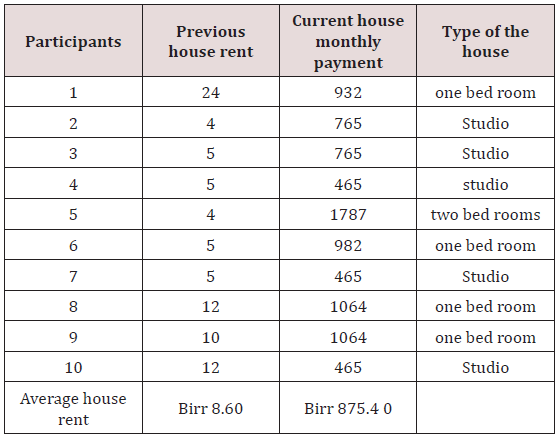
Though the initial 20% was paid, the participants were worried
and challenged with the amount of money to be paid monthly
for twenty years to reimburse the remaining 80% of the cost of
their houses along with the interest. As it can be referred to in
Table 3, they were paying very small amount of money for house
rent before displacement (about Birr 8.60). After displacement
they owned a house but were asked to pay nearly 100 times per
month (i.e. an average of Birr 875.4 0. This dramatic increase in
expenses has occurred in the face of a decline in income and rising
standards of living in Addis Ababa. Because of these challenges,
many condominium owners were forced either to sell their house
or rent it and then live in a house with lower rent so that they can
make a living with the difference earned. The other lesson taken
from this research was the inability of some respondents to adjust
to the life styles that are expected from someone who leaves on
apartment houses. The life style of people who were living in old
kebele houses made of wood and iron sheets were different from
those who live on large apartments. Some of these problems were
observed while they were slaughtering, traditional injera baking,
washing clothes, and boiling coffee. The life in apartments was
found in convenient to carry out these activities in a traditional way.
In the same way, the UN-Habitat (2011) reported that the building
designs of condominium houses in Addis Ababa do no respond to
occupants’ customary activities such as preparation of traditional
injera, bread, and slaughtering of animals. These activities require
sufficient space for large ovens and open areas. Due to lack of
sufficient space in the condominium units, the above-mentioned
activities were being undertaken in circulation areas, which caused
inconveniences for neighbors.
Social Wellbeing: The data collected concerning the number of
intimate neighbors, level of social security, and warm and trusting
relationship that displaced people experienced revealed that they
have found it difficult and frustrating to form close relationship
with others in their new residence when compared to their
residence before displacement. The data also showed that intimacy
with their previous neighbors was stronger than the current one. A
response from 38-year-old man which was taken from the interview
strengthens this idea. “There were so many people around me
when I was there (old residence) and I had reliable friends too.
All those my friends and others whom I know were resettled to
different condominium sites, though, it is not clear for me that the
benefit of dispersing people who have been living together apart.
I found it so difficult to form and maintain relationship with my
new neighbors. I think everybody is not happy to carry on his/her
life without having any relationship with neighbors.” Furthermore,
the way a man of age 49 responded clearly shows that those who
were resettled to Jemo Three area were unable to connect to people
around them. “I had smart link with those people around me in my
previous home. Our relationship was interesting. You Know that we
used to borrow and give goods and food items (even injera)? I can
leave my children with my neighbors so that they can take care of
them when I had to move out of Addis Ababa or when I was sick.
Doing this is totally impossible here. I don’t know what would likely
to happen in the future. I hope things will get better.”
In the same vein, resettlers had many people to talk to and
to listen at before resettlement than after resettlement. They had
many people alongside them to share their day-to-day concerns
before displacement. They have found very difficult to open
up when they want to talk to their new neighbors. The current
political instability in the country have made people stay away
from one another and exacerbated the loneliness of people living
in condominium houses. “I am a social animal. As a social animal I
have to get someone to whom I express my day to day concerns. I
need to have someone whom I trust. As you are observing I am very
old person (approximately above 70). All human beings need to
have good neighbors. For old and poor people like me the need will
be higher. Many of us have not yet established good relationship
with people around us” (4th interviewee, male). The following
quote which was taken from an interview conducted with a woman
interviewee of age 46 revealed that people who were displaced
from inner Addis Ababa and relocated to outer part of the city
were in an isolated life condition. Truly speaking, I and those who
are displaced from inner city are experiencing harsh and difficult
conditions in so many ways. For instance, I know only three persons
on this building (there are 30 homes on the building of which
11 were empty) and our relationship is not more than greeting
each other. I think it was ten days before that I heard someone
shouting and looking for help on our building. I wanted to get out
and help the person but I preferred to stay at my home. I did not know
whether that person received any help or not. This did not
happen in my previous residence. We know each other very well
and help one another. The condition of our life and the quality of
our relationship before and after displacement are incomparable.
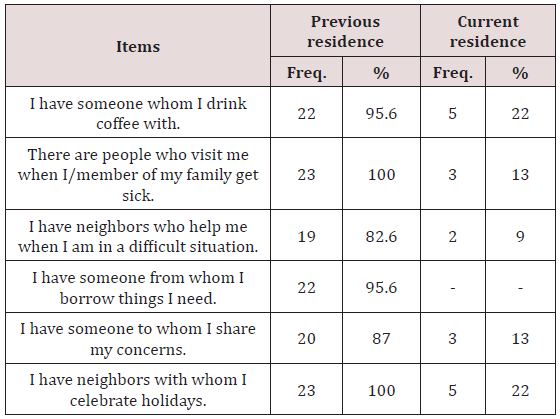
Responses obtained from questionnaire in Table 4 also indicated
that respondent’s relationship with neighbors before displacement
was sincere and trusting. The following table vividly depicts the
differences in the quality of the participant’s relationship at their
previous and current residence.
Table 4: Perceived social support of the participants before and
after displacement.
In relation to resettles participation in social roles such as idir,
ikub, and mahber; data showed that displaced people had better
and interesting participation in social activities in their previous
village than in the current residence. The majority of respondents
reported that they did not fit well with people around them. They
had no social partners at their current residence and hence have
poor participation in social activities taking place in their village.
I know nobody here. There is no interaction among people in this
village because everybody spends his/her time in his/her own
closed doors. There is no one I know to the south, north, east and
west of my home. I doubt if I could get someone who would bury
my body (male interviewee of age 48). In an interview conducted
with a 55-year-old male participant, social roles that link people
together such as idir,
ikub, and mahber, are absent in their new village.
“Although, it is our responsibility to form relationship with our new
neighbors and participate in various social roles, currently, we are
not in a position of doing this. This could be due to the fact that we
afraid one another so that nobody is willing to take the initiation.
I came to Jemo Three nine months before. There was one person
on that building (demonstrating the building) who was trying to
talk to us so that we could begin knowing and visiting each other.
Nevertheless, there is no idir and other social activities in this area.”
Furthermore, a relatively young participant explained the absence
of participation in various social activities. “In our previous village
we have so many reliable neighbors from different groups of
people. We have good relationship with Muslims, youths, elderly, employed, unemployed, and with other categories of people. If
someone needs help due to illness, poverty (of course all of us are
poor), and death of relatives we really spend our time, money, and
energy to help our neighbor who is in need. Wow! That was very
sensational. I think I will never and ever come across that type of
life here after. As you see here (in her new village), most of the doors
are closed and locked. Nobody is willing to visit his/her neighbors.
Our culture and religion encourage us to visit our neighbors and
strengthen our social relationship. I, sometimes, feel as I am not
living with Ethiopians as Ethiopians are good at social life. I think
this (poor social relationship) is the result of modernization” (a
woman interviewee No. 21, age 38). Responses obtained from
questionnaire in Table 5 revealed similar results. Participants who
were displaced as a result of development and resettled far from
the center of the city were not participating in social activities and
the presence of reliable individuals was poor as indicated in the
Table 5.
Table 5: social engagements of participants before and after
displacement.

Psychological Wellbeing: According to a response obtained
from an interviewee (Male, aged 61 years), “We were nothappy by
getting removed from our previous homes, though the aim of the
government was development. Here, there are no worshipping areas
(mosques), schools for our children, and so on. These were some of
the reasons that made us resist the displacement.” Data collected
revealed that respondents were not satisfied with the process of the
displacement and resettlement since it was conducted without their
consent. They were also dissatisfied with the new environment,
transportation costs, absence/shortage of worshiping areas, and
the likes. Furthermore, the new area requires new living condition.
The environment was not suitable for some typical life activities
of the respondents, for instance, slaughtering purpose, washing
clothes, and the likes. These factors led respondents to problems
of adaptation to the new environment. In fact, data revealed that
resettlers’ were more satisfied with their new homes than with
their previous old homes because the buildings were attractive and
eye catching than their previous old homes. The following quotes
were taken from the interviews conducted with three interviewees.
“Our earlier houses were very small in size and built of wood and
cardboard. Members of more than 5 houses were using a single
toilet in common so that we sometimes stand in a queue. My new
house has three rooms and I am using my own toilet alone. Don’t
try to compare those shanty houses with these beautiful buildings.” The
second interviewee responded: “Even though I love my house
I don’t like this area. The weather is too cold here.” Lastly, the third
interviewee replies as follows. “Of course, there is a huge difference
between my previous home and my new home. Home alone
cannot generate satisfaction. Satisfaction is obtained through the
combination of various things” (male and female interviewees No.
4, 14, & 23 respectively).
Responses obtained from questionnaires and interviews
indicated that many respondents’ effort to live a kind of life they
need was not successful after resettlement. Almost eighty percent
of the participants reported that they are losing confidence and
motivation in their struggle to live a better life. The following quote
clearly shows that some of the participants were losing interest
and motivation in their day-to-day life activities. “I was very strong
person. I wake up very early in the morning. But now, I do not want to
even get out of my bed. My interest to go to employment is declining
from time to time” (a man of 47 years). This kind of psychological
impact emanated from the feeling that they were displaced without
their consent and due to the fact that they were relocated to the
outskirt of a city. Data collected about loneliness and rejection
indicated that most of the respondents reported that they did not fit
well with the people and the community around them in their new
village. Resettlers did not feel attached to the people around them
after resettlement. “When I walk out of my home, after few strides,
there were many people who usually greet me and whom I greet,
but here (in her new house) I found no one to say ‘good morning/
good afternoon’ even after travelling remarkable distance” (woman
interviewee of age 39). A response obtained from an interview
held with another woman who was 44 fortifies that participants
were isolated from the community. “When I wake up from a sleep
I usually hear noise of children, neighbors, and noise from cars
(before resettlement). Here (after resettlement), you hear nothing.
Life in condominium houses is so difficult for me because nobody
is conscious of you. Nobody knows whether you are happy or
not; whether you are fine or not; whether you need help or not.”
Likewise, responses obtained from questionnaire revealed that
many of the respondents were experiencing the feeling of isolation
and that of rejection. Some of them felt that they were rejected from
the larger community. The aim of the questionnaire was to compare
the quality of psychological variables before and after displacement
as given in the table below. Equally speaking, many respondents
reported that their circle of friends and acquaintances were too
limited after displacement and hence they were experiencing a
feeling of loneliness. They have no confidants to share their social,
psychological and life issues. One of the male informants aged fiftysix
speaks out as: “We are thrown away as a dust as if we were not
created from mankind. I know not more than six individuals here.”
The other interviewee also strengthened the idea as follows: “It has
been ten days since I got a visit by someone in this new site. Nobody
knocked at my door these days. If I want to talk to someone I have
to go to other condominium sites where my previous neighbors
were relocated (people living in the same area were relocated to
different and far away sites after displacement) or I have to go to
my old village so that I would share my concerns and inner feelings”
(11th interviewee, male, age 56).
Data obtained from questionnaire about loneliness and lack
of confidants to share problems in life reveals similar results with
that obtained from interviews. Although, almost all respondents
reported that they were not suffering from loneliness before
displacement, 74 % of the respondents indicated that they were
experiencing a feeling of loneliness after displacement, while the
rest 26 % explained that they were in a feeling of companionship.
Concerning the availability of confidants to discuss problems with,
the data showed that 87 % of the displaced people indicated that
they had no one close to them to whom they share their concerns at
their new residences, though; the majority of them had confidants
at their previous residents. The other 13 % reported that they
had confidants both at their previous and current residents.
Respondents were also asked about the feeling of frustration and
hopelessness. Responses obtained from the interviews revealed
that people who were displaced from inner city and relocated to
remote areas were experiencing frustration, negative attitude
about themselves, as well as hopelessness. Here after I would have
no hope. Early in the morning I go to church and when I come
back to my home I spend the rest of the day sleeping. It is better
to die than to live in such a miserable condition (64 years old, male
interviewee, No.22). A woman interviewee of age 49 presented her
feeling as follows. “Previously (before displacement) we spend our
spare time with our neighbors because there were many people
around us. As you see here (demonstrating at the building on
which she is living) there are only six houses who are not reserved.
The other 24 houses are occupied by at least one household, i.e.
there are at least 24 individuals currently living on this building.
I have a relatively better relation with individuals living on these
two rooms (indicating at the two rooms beside her home on the
same floor). Therefore, I am not comfortable with this kind of life
style. To be honest with you, I am in a position to leave this area.
I will rent my home and scape out of this frustrating and hopeless
life. It is very recently that I learnt that our culture (collectivist
culture) is very important for our health and day-to-day activities.”
Correspondingly, another participant who was living on the same
building but different floor described his wellbeing as “I was a very
happy person when I was around kebele 44 (one of the kebeles
found in her previous village). The reason was that I was living a
relatively joyful life before I was forcefully displaced from my home
in which I lived for nearly 30 years. Although my previous home is
not comparable with this beautiful home (the previous home had
only one room and very old), it was my home in which I gave birth
for all my children. The lesson I learnt from my recent life is that, it
is not the beauty and quality of home that makes people satisfied
and happy; rather it is the quality of your relationship and your
mental state. I can’t adjust myself to this village forever” (53-yearold,
woman interviewee, No. 9). In the same vein, responses
obtained from the questionnaire revealed that the percentage of the participants’ feelings of hopelessness and frustration after
displacement was significantly higher when compared to their
feelings of frustration and hopelessness after displacement as
indicated in the table below.
Discussion
Forced displacement arises from the need to build infrastructure
for new industries, irrigation schemes, transportation highways,
power generation dams, or for urban developments such as
hospitals, schools, and airports. Such programs are indisputably
needed. They improve many people’s lives, provide employment, and
supply better services. But the involuntary displacements caused
by such programs also create major impositions on some segments
of the population. According to Cernea [10], displacement leads to
social disarticulation. If a community is displaced it tears apart the
existing social structures. “It breaks up families and communities;
it also dismantles patterns of social organization. From the findings
of this research, one can clearly observe that displacing people from
their habitual areas breaks up the social relationship and kin ties.
Many resettlers reported that their social networks have broken
down. Almost all respondents of this research reported that there
was significant difference in their social wellbeing before and after
displacement. They had satisfying connections with people around
them in their previous village. There number of people they usually
visit and visited by before displacement was relatively better. The
finding further indicated that the social relationship of displaced
people is weak not only in terms of the number of people they have
contact with but also in terms of closeness to people around them
in their new village. The participants made a point that they had no
close and trusting relationships with neighbors in the new village
(after displacement). Similarly, it was obtained from the finding
that participants did not have someone to talk to and to listen at.
The other interesting result of this research, in relation to social
life, was the issue of Idir and Mahber. Idir and Mahber are among the
many socially constructed roles in many parts of Ethiopia that are
meant for the purpose of helping the needy and strengthening social
bond. Their main purpose is to link members of the community
together so that they would help each other when something good
(for instance, marriage) or bad (for instance, death) happens. As the
finding indicated resettler’s participation in Idir and Mahber, and in
other similar social roles, in their previous setting was incomparable
with their participation after they got displaced from inner city. The
finding boldly indicated that due to lack/shortage of social roles
and weak interest to participate, resettlers were experiencing poor
social wellbeing. In the same vein, Pankhurst and Piguet [1] made a
point that many ‘development’ programs are often in conflict with
the interests of local people worldwide. A number of communities
have witnessed serious resource depletion, economic, as well as
psychological impoverishment as a result of their displacement
in the name of ‘development.’ Lourenço- Lindel [25] also added
that relocation of low-income households from inner cities to the
outskirts would, undoubtedly, affect their livelihoods and informal
networks of mutual assistance. Furthermore, developmentinduced-
displacement affects coping strategies of people who are
displaced from the homes in which they have been living for several
years and relocated to new home and new environment. This
is consistent with the findings of this research. According to this
research, people who were displaced from their previous homes
and environment (Tikur Anbessa area) and relocated to Jemo
Three (new site) were experiencing psychological problems. Many
relocatees are experiencing psychological problems such as lack of
positive attitude about themselves, problems related to adaptation
to the new environment, a feeling of despair, and inability to lead
responsible life. The researcher of this study believed that one of
the factors for the poor psychological wellbeing of resettlers, in
addition to displacement, was the social breakdown indicated
above. The other factors that weakened psychological wellbeing
of resettlers was the cost of the houses. It was already discussed
in the ‘Introduction’ section that resettlers were unable to afford
the initial down-payment and monthly service payments since
they were economically poor. Furthermore, questions associated
with the quality of the buildings affected psychological wellbeing
of participants [32,33].
Conclusion
Displacement as the result of urban expansion and ‘slum
clearance’ has been increasing rapidly worldwide and is becoming
a significant phenomenon particularly in the large cities of the
developing world. As the demands of the urbanizing population
increases, notably in Africa and Asia, it is inevitable that the need for
infrastructure development will grow enormously and displacement
is likely to occur on massive scale World Bank [8],McDowell [7],
Pankhurst & Piguet [1]. As the research findings of this study
revealed, most people’s livelihoods were affected by displacement
programs. Resettlement requires careful and systematic planning
particularly in the selection of sites and verification of different
infrastructure and social services notably in terms of health and
education. Resettlers were brought to the site (Jemo Three) before
clinics, schools, and transportation services were not sufficiently
arranged. Addis Ababa city administration has to learn from such
mistakes for displacements and resettlements to be carried out in
the future. Many respondents explained the displacement process
as forced displacement. Consent from resettlers should be secured
because much of the literatures suggest that forced relocation is
more likely to be damaging to poor people’s livelihood prospects
than it is to improve them Cernea [10], Pankhurst & Piguet [1]. The
damage caused by resettlement far outweighs its benefits and the
vast resources wasted on the various programs would have been
more profitably employed elsewhere.
Recommendations
- Adequate planning and preparation for displacement is
vital from the part of the government.
- Displacees should be consulted and participated in the
plan and also in the process of displacement.s
- Some infrastructures, if not adequate, such as electricity,
transportation, clinics, and schools have to be built in the new
environment before relocating people.
- It is better to give displacees chance of choosing among
the available sites for resettlement than displacing them by
force.