Showing posts with label Mechanical Engineering Articles. Show all posts

Friday, 19 July 2019

Lupine Publishers | Advances in Robotics & Mechanical Engineering


Journal of Robotics & Mechanical Engineering | Lupine Publishers

Smart Robotics for Smart Healthcare

Abstract

The technological advances in ICT, IoT and robotics have enabled development of specific, optimal service-based solutions for many societal issues and problems. Notably in the recent times smart, service-enabled robotics are being applied to impart smart healthcare solutions in healthcare domains like complex surgeries, elderly care, assistive technologies, patient care at home to name a few. This paper is devoted to highlighting how smart robotics is being and can be applied for delivering smart healthcare in varied healthcare perspectives and domain.
Keywords: Intelligent Robotics, Smart robotics, Healthcare, Assistive Technologies

Introduction

Robotics in healthcare holds the potential to aid a number of practices and tasks[1]. Robots can be used to aid people with cognitive, sensory and motor impairments [2]. They can also act as caregivers to ill, injured or elderly people [3]. They are also being utilized in performing complex surgeries in a trained manner [4]. Since long they have also been used to go inside the human body and scan for varied ailments etc. Robots are physically embodied machines that allow precise and real-time movement of instruments and perform functions in an accurate manner eradicating chances of human error [2]. Advancements in technology especially the proliferation of IoT based solutions has transformed a normal human life into smart living through creation of smart environments, smart homes and smart cities [5,6]. Advancements in medical sciences have further created avenues for smart healthcare solutions [7]. This manuscript gives a brief overview of how robotics is been used to enable smart healthcare to improve human life.

Advances in Healthcare Robotics

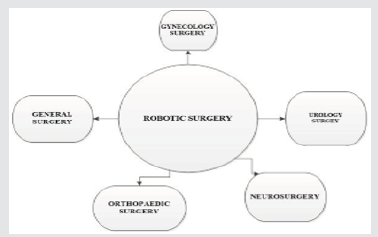
Robotics in the present times has proliferated by leaps and bounds delivering successful, precise services and solutions in a number of domains [2]. Robotics with IoT has even transformed healthcare and opened numerous avenues. Some of its key focus areas include: surgical and interventional robotics, rehabilitative robotics, clinical workforce support, elderly and people with disability care, assistive living etc [1], [7–10]. Human Surgery has typically witnessed phenomenal changes with the introduction of robotic surgery [2]. Robots are being successfully applied for a number of surgical operations as depicted in Figure 1 below:
Figure 1: Types of Robotic Surgery. .
Lupinepublishers-openaccess-robotics-mechanical-engineering-journal
Figure 1 above highlights the different avenues where robots have guided and performed minimally invasive surgeries [2]. Intuitive Surgical da Vinci robot has reportedly performed successful surgeries on almost 3 million patients worldwide [4]. They are being successfully used in neurosurgery to examine brain lesions without causing any major damage to the adjacent tissue. In orthopaedic surgeries robots shape the femur to fit prosthetic hip joint replacement with accuracy. With increased life expectancy due to better standards of living a growing demand has unfolded for assistive technologies, healthcare facilities and professionals to provide simple, affordable healthcare services to elderly people or people with disability in an unobtrusive manner. An IoT enabled solution to this demand has emerged in the form of smart homes equipped with wearable medical sensors, actuators and modern IT solutions [5]. ORCATECH Life Laboratory is one such in-house health monitoring solution [2]. Another requirement of trained health professional to provide look after and care to such patients has also been substituted by care bots to provide companionship or look after to patients [11].

Challenges in Healthcare Robotics Adoption

The advances in healthcare robotics are promising. However it is essential to still note some challenges in the domain and discuss how to overcome them. First and most importantly safety and reliability are critical to healthcare. There need to be efforts to ensure safe and gentle human-robot interactions. This especially needs to be taken care of when patients involved may be people with cognitive disabilities of kids. The next major challenge can be attributed to usability and acceptability of robots by clinicians as well as end users. This demands appropriate technical awareness and training. Only effective awareness, knowledge and training of all stakeholders involved in effective usage of healthcare robots can ensure successful usage of these robots. Another major limiting factor can be cost which includes their purchase, maintenance as well as training costs. Robot manufacturers should aim at devising techniques to manufacture and distribute well-trained and tested robots at the optimal possible costs.

Conclusion

Healthcare robotics has witnessed promising advances in the recent years. Their usage has also carved many successful stories validating their usage and application. However, how much they will be integrated into the lives of primary beneficiaries still remains unknown as this would be decided by a number of regulating environmental factors which may vary on a case to case basis as the beneficiaries involved are humans.

https://lupinepublishers.com/robotics-mechanical-engineering-journal/fulltext/smart-robotics-for-smart-healthcare.ID.000121.php

For more Lupine Publishers Open Access Journals Please visit our website: https://lupinepublishers.us/


Monday, 1 July 2019

Insight Virtual Humanoid Robotics Modeling: the Ultimate Level 0f Artificial Intelligence (ARME) - Lupinepublishers

Insight Virtual Humanoid Robotics Modeling: the Ultimate Level 0f Artificial Intelligence by Sadique Shaikh in ARME in Lupine Publishers
I have no doubt to state Virtual Humanoid Robots (VHRs) are the ultimate level of Artificial Intelligence which change the scenario of world and human technologies, it would be applicable in all domains of technology with common factor Ultra Artificial Intelligence (UAI) with disappear and appear ability by any means which boost to our civilization from Type-0 to type-1 civilization at least and would be first step to compete with Aliens technology, if exist (hypothesis only). I would like to define term Virtual Humanoid Robotics (VHR) as “it’s Humanoid Robotics with UAI and has ability to transform from Physical to Virtual by any Internal (Humanoid Self-Control) or External (Human-Control) mode activation mechanism”. VHR is future technology which will use energy from Sun (or Space), Internet of Things (IoT) with RFID USN, Bigdata and Self-learning and healing mechanism. Now I would like to generate future utopia front of your eyes with initial modeling to coined term VHR in this short communication.


Monday, 17 June 2019

Introducing Deep Mind Learning Modeling (ARME) - Lupine Publishers

Introducing DeepMind Learning Modeling by Sadique Shaikh in ARME in Lupine Publishers
Since 2010 Google & Uber researchers and engineers are engaged in DeepMind project with registered company in UK and USA. DeepMind. Google used to “Deep reinforcement learning” to implement DeepMind technology. We can see the results of DeepMind learning with live examples of Google Assistance, Google Echo- Smart Speaker and Google home assistance, Google AI-God and AI Church, Amazon Alexa, Amazon echo, Apple Siri. Google is one the strong player in DeepMind learning technology but two major players also Amazon and Apple after Google. This technology brings next wave in future about to 2029 but also spoiling human ethics when AI became more then of human intelligence. This short communication discussed fundamental aspect related to DeepMind
designing and engineering with the help of model. 


https://lupinepublishers.com/robotics-mechanical-engineering-journal/fulltext/introducing-deepmind-learning-modeling.ID.000101.php


For more Lupine Publishers Open Access Journals Please visit our website: https://www.lupinepublishers.com/
 

Monday, 11 March 2019

Robotics Journal Ranking -#ARME -#Lupinepublishers


I was started my research only with one thinking “How we feel and understand sadness or happiness of others, why our eyes sometime filled with tears, when we see others crying or sad, why we cheer up when we see others happy, why we bless others, why we care for others, why we become sad when we watch sad seen in movies, why we motivate when we watch something exciting and meaningful in movies, why, why and why?” these are the big questions front of us. My common answer which support to all these questions is “when situation is common between two or more than two people they completely understand each other, because their brains neurons handling same situation. Some time may be feelings for other because of past common situation of us is the present situation of someone or may be some time we think if that situation on me what I would do. Hence common situation either good or bad doesn’t matter but common situation people show strong feelings about each other with respecting emotions and feelings of each other’s and this is because “common situation setup brain-to-brain link between people through which they understand feelings and emotions of each other [1].
For more Lupine Publishers Open Access Journals Please visit our website
For more automation engineering books articles Please Click 

Friday, 8 March 2019

Mechanical Engineering Journals Impact Factor-#ARME-#Lupinepublishers


There  is  presented  the  author’s  mini  Review  of  the  realized  theoretical   investigation   of   the   Multi   (n=6)-component   Mass  Transfer (MMT) kinetics of the process inside the modern combined sorption “Nano-Composite” (NC) materials. The visual NC examples considered  in  the  author’s  manuscripts  may  be  represented  by  the   selective   bi-functional   NC   as   the   “Metal 0-Ion   Exchangers (IEx)”  planar  NC  L-membrane  matrix  where  the  inner  active  zero charged  “NP 0-nano-sites”  (i.e.  Nano  Particles,  Me 0-agglomerates) are imbedded into the final combined NC-IEx sorption matrix resulting after the preliminary synthesis of the final NC L-matrix considered. The computer simulation for the modelling of the MMT NC  kinetics  is  based  here  on  the  foundations  of  the  irreversible  thermodynamics   such   as   multi(n)-component   mass   balance n (6)-Eqns.  in  partial  differentials  characterized  fundamentally  by  the new k (2) (6)-“thermodynamic  variance”  (k-parameter).  

For more Lupine Publishers Open Access Journals Please visit our website
For more automation engineering books articles Please Click