Showing posts with label Computer Science Journals. Show all posts

Tuesday, 14 December 2021

Lupine Publishers| Mitigating Disaster using Secure Threshold-Cloud Architecture

 Lupine Publishers| Journal of Computer Sciences & Applications


Abstract

There are many risks in moving data into public cloud environments, along with an increasing threat around large-scale data leakage during cloud outages. This work aims to apply secret sharing methods as used in cryptography to create shares of cryptographic key, disperse and recover the key when needed in a multi-cloud environment. It also aims to prove that the combination of secret sharing scheme and multi-clouds can be used to provide a new direction in disaster management by using it to mitigate cloud outages rather than current designs of recovery after the outages. Experiments were performed using ten different cloud services providers at share policies of 2 from 5, 3 from 5, 4 from 5, 4 from 10, 6 from 10 and 8 from 10 for which at different times of cloud outages key recovery were still possible and even faster compared to normal situations. All the same, key recovery was impossible when the number of cloud outages exceeded secret sharing defined threshold. To ameliorate this scenario, we opined a resilient system using the concept of self-organization as proposed by Nojoumian et al in 2012 in improving resource availability but with some modifications to the original concept. The proposed architecture is as presented in our Poster: Improving Resilience in Multi-Cloud Architecture.

Keywords: Secret Shares; Disaster Mitigation; Thresholds Scheme; Cloud Service Providers

Introduction

With the introduction of cloud services for disaster management on a scalable rate, there appears to be the needed succour by small business owners to get a cheaper and more secure disaster recovery mechanism to provide business continuity and remain competitive with other large businesses. But that is not to be so, as cloud outages became a nightmare. Recent statistics by Ponemon Institute [1] on Cost of Data Centre Outages, shows an increasing rate of 38% from $505,502 in 2010 to $740,357 as at January 2016. Using activity-based costing they were able to capture direct and indirect cost to: Damage to mission-critical data; Impact of downtime on organizational productivity; Damages to equipment and other assets and so on. The statistics were derived from 63 data centres based in the United States of America. These events may have encouraged the adoption of multi-cloud services so as to divert customers traffic in the event of cloud outage. Some finegrained proposed solutions on these are focused on Redundancy and Backup such as: Local Backup by [2]; Geographical Redundancy and Backup [3]; The use of Inter-Private Cloud Storage [4]; Resource Management for data recovery in storage clouds [5], and so on. But in all these, cloud service providers see disaster recovery as a way of getting the system back online and making data available after a service disruption, and not on contending disaster by providing robustness that is capable of mitigating shocks and losses resulting from these disasters.

This work aims to apply secret sharing methods as used in cryptography [6,7] to create shares of cryptographic key, disperse and recover the key when needed in a multi-cloud environment. It also aims to prove that the combination of secret sharing scheme and multi-clouds can be used to provide a new direction in disaster management by using it to mitigate cloud outages rather than current deigns of recovery after the outages. Experiments were performed using ten different cloud services providers for storage services, which at different times of cloud outages, key recovery were still possible and even faster compared to normal situations. All the same, key recovery was impossible when the number of cloud outages exceeded secret sharing defined threshold. To ameliorate this scenario, we look forward to employ the concept of self-organisation as proposed by Nojoumian et al. [8] in improving resource availability but with some modifications as proposed. The rest of the work is organised into section II, Literature Review takes a closer look at current practices, use of secret sharing and cloudbased disaster recovery with much interest in the method used in design. III. Presents our approach, in section IV, present Results and Evaluations and Conclude in section V with future works and lessons learnt.

Literature Review

There are research solutions based on different variants of secret sharing schemes and multi-cloud architecture that give credence to its resilience in the face of failures, data security in keyless manner, such as: Ukwandu et al. [9] - RESCUE: Resilient Secret Sharing Cloud-based Architecture; Alsolami & Boult, [10], - CloudStash: Using Secret-Sharing Scheme to Secure Data, Not Keys, in Multi-Clouds. Others are: Fabian et al. [11] on Collaborative and secure sharing of healthcare data in multi-clouds and [12] on Secret Sharing for Health Data in Multi-Provider Clouds. While RESCUE provided an architecture for a resilient cloud-based storage with keyless data security capabilities using secret sharing scheme for data splitting, storage and recovery, Cloud Stash also relied on the above strengths to prove security of data using secret sharing schemes in a multi-cloud environment and Fabian et al proved resilience and robust sharing in the use of secret sharing scheme in a multi-cloud environment for data sharing. Because our approach is combining secret sharing and multi-clouds in developing a clouddisaster management the need therefore arise to review current method used in cloud-based disaster in a multi-cloud system and their shortcomings.

a) Remus: Cully et al. [13] described a system that provides software resilience in the face of hardware failure (VMs) in such a manner that an active system at such a time can continue execution on an alternative physical host while preserving the host configurations by using speculative execution. The strength lies on the preservation of system’s software independently during hardware failure.

b) Second Site: As proposed by Rajagopalan et al. [14] is built to extend the Remus high-availability system based on virtualization infrastructure by allowing very large VMs to be replicated across many data centres over the networks using internet. One main aim of this solution is to increase the availability of VMs across networks. Like every other DR systems discussed above, Second Site is not focused on contending downtime and security of data during cloud outages.

c) DR-Cloud: Yu et al. [15] relied on data backup and restore technology to build a system proposed to provide high data reliability, low backup cost and short recovery time using multiple optimisation scheduling as strategies. The system is built of multicloud architecture using Cumulus [16] as cloud storage interface. Thus providing the need for further studies on the elimination of system downtime during disaster, provide consistent data availability as there is no provision for such in this work.

Our Approach

Our approach is in combining secret sharing scheme with multi-clouds to achieve resilience with the aim of applying same in redefining cloud-based disaster management from recovery from cloud outages to mitigating cloud outages.

The Architecture

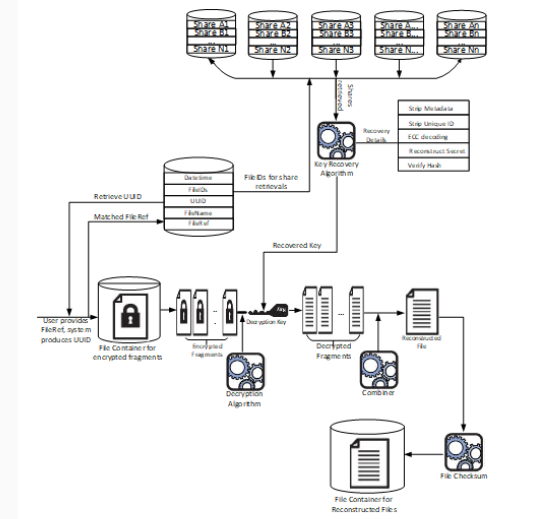
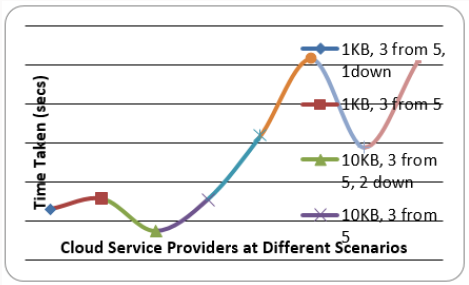
The architecture of as shown in Figure 1 shows key share creation, dispersal and storage, while that of Figures 2 & 3 is of shares retrieval and key recovery

Figure 1: Key Share Creation, Dispersal and Storage.

Lupinepublishers-openaccess-computer-sciences-journal

Figure 2: Share Retrievals and Key Recovery.
Lupinepublishers-openaccess-computer-sciences-journal

Figure 3: Cloud Service Providers at Different Scenarios.
Lupinepublishers-openaccess-computer-sciences-journal

Share creation and Secret recovery: The diagram above explains our design of key share creation, dispersal and storage using different cloud service providers (Figure 1). Share Creation: The dealer determines the number of hosts shares combination from which data recovery is possible known as threshold (t) and the degree of the polynomial, drived from subtracting 1 from the threshold. In this case, the threshold is 3 and the degree of polynomial is 2. He initiates a secret sharing scheme by generating the polynomial, the coefficients a and b are random values and c is the secret, the constant term of the polynomial as well as the intercept of the graph. He generates 5 shares for all the hosts H1… H5 and sends the shares to them for in an equal ratio and weights we, and thereafter leaves the scene [1].

Secret Recovery: Just as in Shamir [6] authorised participants following earlier stated rules are able to recover the secret using Lagrangian interpolation once the condition as stated earlier is met. The participants contribute their shares to recover the secret.

Results and Evaluations

Test: Cloud Outages against Normal situations. This test assumes that cloud outage prevents secret recovery.

Discussions

The results above show that cloud outage has no negative effect on key recovery, rather reduces the overhead in comparison with normal situations. It shows the relationship between cloud outage and normal operational conditions. From available results at twenty percent (20%) failure rate using 3 from 5 share policy, the system becomes faster by sixteen percent (16.41%), but at forty percent (40%) failure rate using same share policy, the download speed is faster by a little above fifty one percent (51.80%). Looking at a higher share policy of 6 from 10, at thirty percent (30%) failure rate, the system download speed is higher by a little above thirtyseven percent (37.90%), while at forty percent (40%) failure rate, the system performed better by about forty-three percent (42.99%). The implications therefore are that in as much as failure rate is not equivalent or above the threshold, system performance improves as there was no result obtained when the cloud outage exceeds or equal to threshold. These therefore do not support the assumption as above that cloud outage has negative effect in key recovery. There is no significant evidence to show that the size of the share has effect on the key recovery during cloud outages because at forty percent (40%) failure rate using share of 10KB in 3 from 5 shows performance rate of above fifty-one percent while in 6 from 10 share policy approximately forty-three (42.99%) percent performance rate.

Conclusions, Lessons Learnt and Future Work

Current cloud-based disaster recovery systems have focused on faster recovery after an outage and the underlying issue has been the method applied, which centered in data backup and replicating the backed-up data to several hosts. This method has proved some major delays in providing a strong failover protection as there has to be a switch from one end to another during disaster in order to bring systems back online, the need thus arises for research to focus on method capable of mitigating this interruption by providing strong failover protection as well as stability during adverse failures to keep systems running. This method we have provided here using this paper. Because, secret sharing schemes are keyless method of encryption, data at rest and in transit are safe as it exists in meaningless format.

The recovery of key is done using system memory and share verification is usually carried out using an inbuilt share checksum mechanism using SHA-512, which validates shares before recovery. Else, share recovery returns error and halts. We have learnt that cloud outage rather than prevent key recovery, using our method proved that it hastens key recovery from results available. Also, understand that when cloud outage exceeds threshold of the share policy, key recovery becomes impossible and to ameliorate this situation, we propose as future work to use the concept of Self- Organization as proposed by Nojoumian et al. [8] to manage cloud resources though with some modifications so as to maintain share availability from cloud service providers.

Read More About Lupine Publishers Journal of Computer Science and Applications Please Click on Below Link: https://computer-sciences-lupine-publishers.blogspot.com/

Monday, 10 May 2021

Lupine Publishers| Self-Payment Fraud Detection on Automated Teller Machine

 Lupine Publishers| Current Trends in Computer Sciences & Applications (CTCSA)


Abstract

Over the past decade the amount of transactions and reported frauds on Automated Teller Machines (ATM) has significantly increased. Various types of frauds have been reported around misusing ATM cards and many methods have been deployed to detect and prevent them. In some countries, banks sell ATMs to investors under predefined circumstances and pay them in commission in order to increase the availability of the service but some ATM owners have been found to create fake transactions to obtain extra commissions. This paper attempts to detect such frauds using a two-stage method. In the first stage fraudulent customers are detected by certain rules and in the second stage their accomplices are identified using transaction loop and cycle detection algorithm. Transactions of an Iranian bank have been used to evaluate the proposed method and all detected fraudsters by system were confirmed by bank fraud detection office.

Keywords: Fraud Detection; Cycle Detection; ATM Fraud Detection; Data warehouse

Introduction

Using credit and ATM cards for different purposes, such as buying services and products, has become one of prevalent methods in digital economy [1]. These cards help people buy anything without carrying cash and facing its risks. ATM cards also help buyers pay their product and service fees with minimum details of invoice. Effectively many customers use these cards instead of cash. Using ATMs for paying bills, transferring money, buying cell phone charges, viewing transactions list, and many other services causes customers to prefer doing their affairs without the need to be at bank, and banks benefit from these services through customer retention and higher cash flow. They can also use their human resources for other tasks and gain more productivity or alternatively reduce their staff to decrease their expenses. To increase customer satisfaction and liquidity, banks try to promote their services in cities. For this purpose they provide ATMs to investors under special conditions: if an investor can prepare required security and communication infrastructure banks allow them to buy ATM. The business model between bank and investors let banks to pay some percent of daily ATM transactions as commission to ATM owners.

Although ATM cards provide many advantages and services for customers and banks they are very susceptible to fraud. The significant number of ATM transactions compared to other payment methods has made them a worthy target for fraud [2]. This leads card issuers and beneficiaries to try to detect and confront ATM frauds. There are many methods proposed to detect frauds, which are presented in Figure 1. Due to Anderson classification on frauds there are eight classes of fraud [3]. In this classification ATM fraud is a subcategory in “Technologies ATM &Internet” category which can be further categorized into [4]

Figure 1: Types of Fraud.

Lupinepublishers-openaccess-computer-sciences-journal

Physical Attacks

Attacker tries to move or damage ATM device physically.

Gaining ATM User’s Banking Information

There are many methods for gaining ATM users information. Attacker tries to attach illegal objects to ATM in order to capture card data and password, card password is stolen using different methods such as looking over the shoulders of ATM users and etc.

Financial Transactions Made by Inappropriate Methods or Users

Inappropriate methods or users consist of many items like using stolen cards by fraudsters and using forged notes in ATM environments, etc.

Self-Payment Attack

Unlike other mentioned types of fraud, which are related to a third party, frauds can also be conducted by ATM owners to obtain more commission. This is known as self-payment attack. Due to bank business model the more transaction amount ATM has, more commission is paid to its owner. This is the main reason for creating fake transactions by some ATM owners. In this paper a novel method is proposed to detect self-payment frauds on ATMs. In this method the fraudsters are identified using rules obtained by experts. Then transactional networks of these customers are built and by extracting loops in these networks, other users who collaborated in the fraud are extracted. Using this method in an Iranian bank many fraudsters were identified. The rest of the paper is organized as follows. In the next section, definitions and related studies are reviewed briefly. Then in section 3, the proposed method is described with details. Result of this proposed method on the practical data of Iranian bank transactions is presented and discussed in section 4. Finally, the conclusion and some other hints for future works are described in section 5.

Related Works and Definitions

In this section related studies about ATM fraud detection along cycle detection algorithm, which is used in this paper, are explained.

ATM Fraud Detection

Extensive research has been carried out to prevent these crimes, which can be divided into three categories [4]. Detection of physical damage on ATM, prevention of ATM banking user’s information and prevent financial transaction made by inappropriate users and methods. For detecting physical attacks motion sensors are used to detect the suspicion activities around ATMs [5]. Also, in [6] mentioned three ways to overcome physical attack of ATMs: the certification level of the ATM safe, using alarm and sensors to detect physical attacks and at last using ink stain technology that will mark and effectively make any removed money unusable. There are methods to detect illegal objects, such as cameras and card reproducers, attached to ATM [7]. Also, in [8] proposed a system to detect criminal objects attached to ATM like cameras that could read the users’ password. To prevent password theft in [9] diversifies password entering methods to avoid another people looking from behind of user. In [8] a system developed which warn user when loiterers are behind the customer. To detect and prevent financial transactions made by inappropriate methods or users there are methods such as card holder identification via biometrics [6,10,11], forged note detection in ATM environment [6,9] and recording facial images of ATM users [5,12,13].

Eft Switch

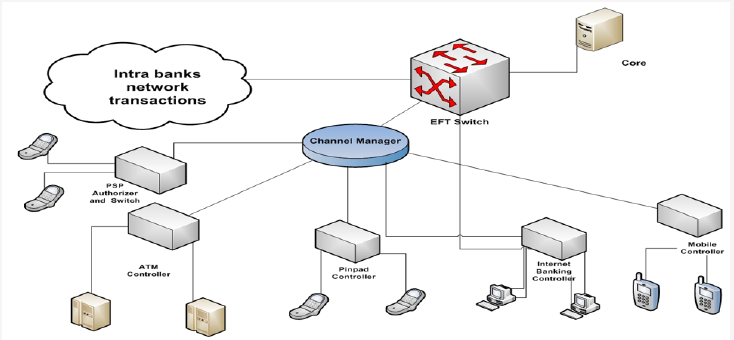
Figure 2: EFT switch architecture.

Lupinepublishers-openaccess-computer-sciences-journal

Electronic banking architecture in many banks is as following Figure 2. The standard is used for financial transaction is ISO8583. This standard has three versions and they are related to 1987,1993 and 2003. Messages in this standard have 128 fields containing transaction information such as Amount, Date, Time, Device code, Function code, Process code etc. So, all devices on bank network have to be compatible with ISO8583 and they have to send and receive message with this format. For more information see [14]. As it is shown in Figure 3 each transaction is done by a device which is sent to its controller. After verifying message’s security and content, the transaction is sent to Channel manager. In addition to control payment channels this switch controls content and security of sent messages. After verifying messages by channel manager, they are sent to central EFT switch of bank. At central EFT switch if card is issued by other banks message is sent to Intra bank electronic message network, otherwise it is sent to Core banking system. The response is then provided to the customer.

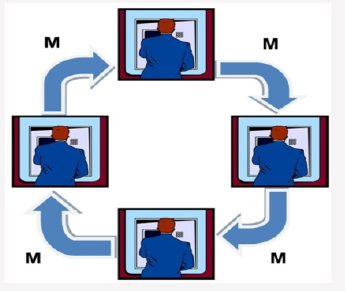
Figure 3: Transfer loop.

Lupinepublishers-openaccess-computer-sciences-journal

Self-Payment Fraud

As mentioned before, some banks sell their ATMs to investors under predefined conditions. They pay some percent of transactions done by ATMs to the owner as commission. Unfortunately, some ATM owners make fake transactions for increasing their obtained profits, which is called self-payment fraud. For instance, suppose that there are four people with ATM card. First person transfer amount M to second person and second person transfers this amount to third person. Similarly, fourth person gets amount M from third person and finally transfer it to the first one. This way, four transactions with amount of M are done on the ATM for which the ATM owner obtains commission. Figure 2 depicts the elaborated process. This fake cycle could repeat many times and with shorter paths. Consequently, these transactions cost a lot in commission for the bank and also hinder them from their main goal and business model. Therefore, in this paper we focused on detect this type of frauds.

Proposed Method

In this part the proposed method for self-payment fraud detection is introduced. ATM’s transaction information is first sent to ATM controller and then they are sent to central bank switch. Information is periodically extracted from switch database of bank and ETL process is done on them. After this phase data warehouse is created. Due to high volume of bank transactions, using data warehouse increases fraud detection speed dramatically.

Phase I

In this part all EFT central switch data items need for future processes are extracted.

All transactions with ATM Device code are selected

From previous step transactions, all transactions with local transfer Function code are selected (As it was mentioned before fake transactions are created by local transfer)

All successful transactions are selected (transactions with response code=00)

In this step we have transactions in ISO8583 format, so ATM No, Card No, Amount, Date and Time data items are selected.

Selected items in previous step are transferred to a table with following format.

If money is transferred to card, “Deposit” field will be transferred amount and “Withdrawal” field will be 0 and if money is transferred from card, “Deposit” field will be 0 and “Withdrawal” field will be transferred amount.

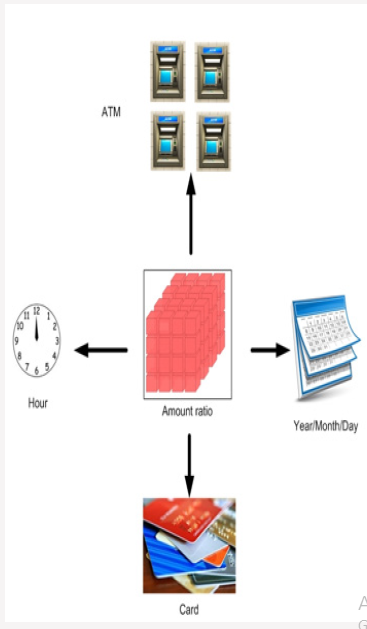
In this part data warehouse and cubes are created on Table 1. ATM No, Card No, Date and Time are considered as dimensions. Deposit and Withdrawal amount are considered as measures. Sum function is selected for data warehouse function. Also, a KPI is defined as Amount ratio (ϴ). The formula is defined as follow:

Table 1:

Lupinepublishers-openaccess-computer-sciences-journal

ϴ(Card No)=Deposit/Withdrawal

In this formula Deposit is the amount transferred to card and Withdrawal is the amount transferred from card. Amount ratio ϴ (Card No) shows Deposit / Withdrawal for a card. Table 2 shows information about Dimensions and Measures. Data warehouse general schema is shown in Figure 3. As demonstrated, Time dimension includes Year, Month, Day and Hour. This dimension is used for fraud detection in various time ranges and with different granularities. In this paper following rules are used for fraud detection. 1-Cards with ϴ=1, ϴ between 0.9 and 1.1 or ϴ between 0.8 and 1.2 have higher probability of creating fake transactions. The smaller granularity on a dimension and KPI, the higher the probability of fake transactions. For example, if a customer on an ATM in a day has equal deposits and withdrawals with a high probability he has committed self-payment fraud (Table 3).

Table 2:

Lupinepublishers-openaccess-computer-sciences-journal

Table 3:

Lupinepublishers-openaccess-computer-sciences-journal

2-Because it is possible the fraud takes place on two or more ATMs, ATM dimension is omitted and then investigation about Amount ratio is repeated again. Each of transactions meeting KPI thresholds is considered as a probable fake transaction. In this type of fraud, customers of multiple ATMs collaborate to create fake transactions on their ATMs. Above rules are extracted from experts’ knowledge. The customers who fall into the above category are considered to have most likely committed the fraud. These rules can detect suspicious customers. Customers extracted by this method with high probability really have committed fraud actions.

Phase II

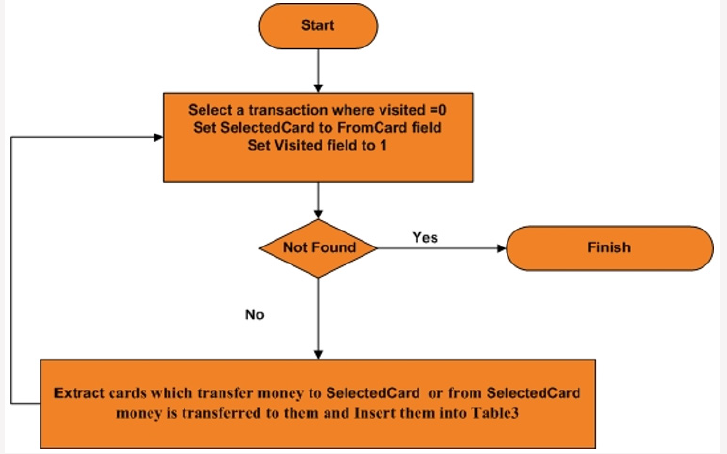
After extracting data items from central switch database, a restricted network is built with customer transactions. In previous section some customers who create fake transactions with high probability are discovered. But the point about this kind of fraud is that customers for doing this fraud need other customers. So, for finding other customers that are collaborating to create fake transactions more analysis is needed. As mentioned before, for increasing ATM amount operation, some customers transfer some amount of money to each other several times. With more analysis a loop is created between these customers. Result table format is as follow. Following algorithm is used for related card extraction.

First all cards that have relation with suspicious cards are extracted. These cards are those that transfer/receive money to/ from suspicious cards. So, all transactions which are related to these cards are extracted (Figure 4).

ϴ for extracted cards is calculated (as mentioned in Phase 1).

Transactions which have ϴ out of threshold range are omitted from transactions set.

Set Visited field for all transactions to 0.

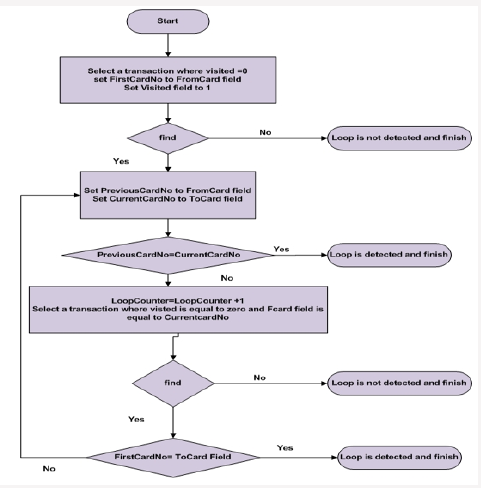
Following Algorithm is used for Loop Detection

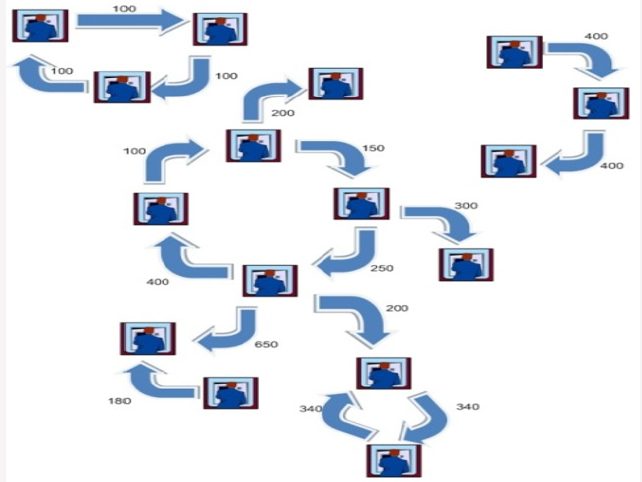
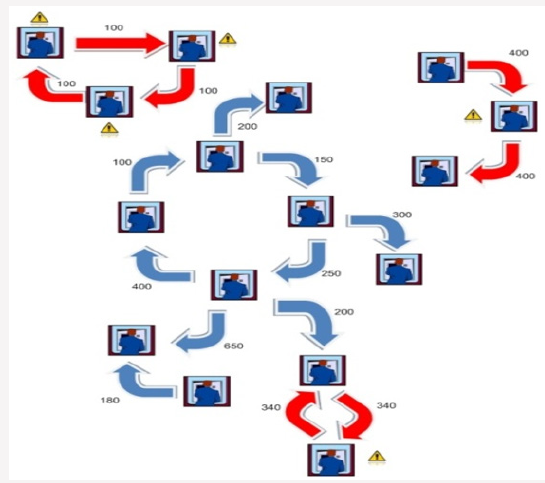
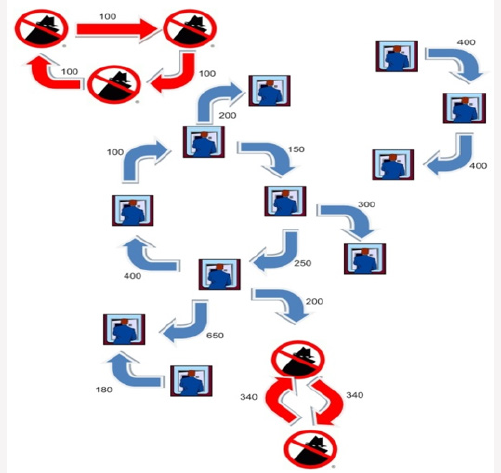
For more clarification an example is provided in Figures 5-9. Assume that there is a network of transactions. Figure 6 shows this network. Amount of transaction is on each edge. First phase of proposed method are executed on each node (card) and all nodes which have equal input and output are extracted(ϴ=1). These nodes are suspicious nodes. Figure 7 shows this phase. In this Figure 4 card holders are detected as suspicious. But as you see in Figure 7 not all of them are fraudsters. After detecting suspicious nodes, Phase 2 algorithm is executed on suspicious nodes. Detected loops are shown in Figure 8. As demonstrated some suspicous nodes from previous phase have been detected as normal behaviour. Two suspicious loops are detected in Figure 9. In addition to creating loop, all card holders which are in loop must have predefined range of amount ratio. In Figure 9 Amount ratio is equal to one. The detected customers can be introduced to bank fraud detection office for further investigations.

Figure 4: Data warehouse design.

Lupinepublishers-openaccess-computer-sciences-journal

Figure 5: Extract related cards flow chart. .

Lupinepublishers-openaccess-computer-sciences-journal

Figure 6: Extract related cards flow chart. .

Lupinepublishers-openaccess-computer-sciences-journal

Figure 7: Transactions network.

Lupinepublishers-openaccess-computer-sciences-journal

Figure 8: Detecting suspicious nodes.

Lupinepublishers-openaccess-computer-sciences-journal

Figure 9: Loop detection.

Lupinepublishers-openaccess-computer-sciences-journal

Results

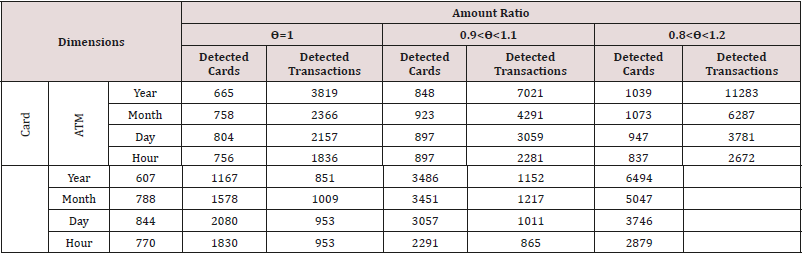
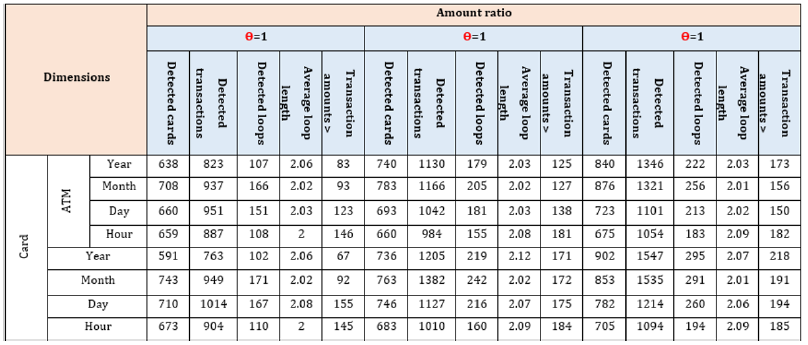
To evaluate the proposed method, it is applied on transactions of an Iranian bank. For this purpose92702 local transfer transactions were investigated. Table 4 shows results of first phase of proposed method due to various dimensions (Card No, ATM, and Time). As it is illustrated in Table 4 using different periods for time dimension could affect the number of suspicious transactions. In Table 4 different ranges for ϴ is used. Due to these ranges and changing dimensions different card numbers and transactions are extracted. When ϴ range and Time dimension are bigger, more transactions and cards are extracted. But if ϴ range and Time dimensions are smaller fraud probability is higher. Because proposed method used database and data warehouse techniques, it has high performance for large amount of data like be Table 5 shows Phase II of proposed method results. As it can be seen in this table suspicious cards and related card are detected as it was described before. Then amount ratio filter applied on them. Finally loop detection phase is applied on cards. Table 5 shows detected cards, detected transactions, detected loops, average loop lengths and transactions which are bigger than 1000000 Rials. Detected cards certainly committed self-payment fraud. These cards, related ATMs, Date and Time were delivered to bank fraud detection office. They investigated transactions and loops and put some filters on these transactions. For example, if amount of a transaction in loop were smaller than 10000 Rials, these transactions were probably for system function test and were not fraud. Also, they decided if loop count for a specific card is bigger than one then this card committed self-payment fraud. With these two rules final results are as Table 6. Based on the amount of fake transactions some ATM owners had to pay penalty to the bank and for others the ATMs were seized.

Table 4:

Lupinepublishers-openaccess-computer-sciences-journal

Table 5:

Lupinepublishers-openaccess-computer-sciences-journal

Table 6:

Lupinepublishers-openaccess-computer-sciences-journal

Conclusion

In this paper we discussed self-payment fraud. Due to the nature of this fraud, all transactions should be investigated and fraud loops should be extracted. Two approaches were discussed in this paper. To the best of our knowledge there was no method for ATM owners’ fraud detection. Also, in this paper a method for loop detection is introduced that can be used for loop detection in many other systems. Proposed method extracts suspicious transactions in the first phase. Then related transactions are extracted in the second phase and all transactions are investigated again. Finally, it presents a list of fraudsters’ loops. Self-payment frauds are guaranteed in these loops. There is a problem with proposed method when all members of fraudsters loop have other transactions in addition to their fake transactions and amount sum of fake transactions by total transaction is lower than ϴ thresholds. For future work, proposed method can be used for link analysis in anti-money laundering. Also, it can be used for fraud detection on other payment channels like point of sale (POS) and fraud committed by their owners. Generally, proposed method loop detection can be used for all big data environments which need loop detection with some changes in details.

Read More Lupine Publishers Current Trends in Computer Sciences & Applications (CTCSA) Click on Below Link: https://computer-sciences-lupine-publishers.blogspot.com/


Wednesday, 14 April 2021

Lupine Publishers| Internet of Things and Privacy

 Lupine Publishers| Current Trends in Computer Sciences & Applications


Opinion

The Internet of Things is a concept that has been heard quite a lot in recent years, a concept that slowly emerged, but over time it has experienced a booming growth that was then adopted not only by giant IT companies, offering according to the directions of each company that adopts the corresponding services and applications to the end user. Undoubtedly this technology has come to stay for a long time, it has come to improve our living conditions and to simplify habits and functions that required time and many times difficulties. The Internet of Things is almost everywhere around us from the super market to the cars we drive, our everyday life is going easy and we are happy to live with, but there are two important points that we should consider:

a) Uncontrolled product design based on the Internet of Things.

b) Access to data managed by Internet of Things are inaccessible by the users.

According to the above, important questions arise, such as:

a) How and where these devices store and manage the data now?

b) How and where these devices store and manage data in the future?

c) What personal data are collected and for whom?

d) How protected they are from hacking attacks?

e) How capable is an Internet of Thing to take full control of an information system?

Surely for all of us who are involved in the security of information systems, we have a lot of work to do. The biggest challenges we have to face are:

a) No one knows an Internet of Thing how it collects, how it uses, and where stores personal data. One could construct an Internet of Thing that behaved properly according to the purpose it was created, but it could also act as intelligence espionage product to transmit personal sensitive data and information related to the online traffic and services of an organization, and the worst scenario is that this device can work for years without being noticed.

b) Depending on the complexity of the smart device, the amount of data it sends is increasing, for example a complex smart device can send up to 5 times the volume of unidentified data.

c) The Internet of Things, as I mentioned above, was designed to make our lives easier because technology evolves and these devices evolve, so many unknowingly use them in a computer room or in critical security infrastructures for which the devices have not been made for this purpose, and of course with unknown security implications for the company’s network since these devices do not have an management interface for the user, so it is impossible to access them.

d) Depending on the type of the device, third-party information is internally embeded, for example GPS maps, geostrategic data, human habits information, transaction information, which will then have to work all together for the Internet of Thing.

e) We do not know exactly what kind of data and metadata are collected, it is enough to ponder that an IoT card containing basic medical data of a patient sends about 200MB of unknown data per year.

f) The Internet of Things are not safe enough in external attacks, a denial of service attack on an Internet of thing could be the entry for violating an information system and collect sensitive information from it.

g) The construction of these devices varies, there are not enough standards to build and protect personal data, no one can guarantee that an Internet of Thing will protect its owner against an external threat, which for example could get the control of a car with unpleasant consequences for the driver.

Considering the above, we should consider whether we really need an Internet of Thing and if this is necessary, how much we can parameterize and access to it [1,2].

Read More About Lupine Publishers Current Trends in Computer Sciences & Applications Please Click on Below Link https://computer-sciences-lupine-publishers.blogspot.com/