Showing posts with label computer science journals with impact factor. Show all posts

Wednesday, 19 January 2022

Lupine Publishers| Numerical Solution of Boundary Layer Flow of Viscous Fluid Via Successive Linearization Method

Lupine Publishers| Journal of Computer Sciences & Applications


Abstract

The aim of this work is to obtain the numerical solutions for the boundary layer flow of heat transfer of incompressible viscous fluid. The governing partial differential equations are converted into ordinary differential equation by using a similarity transformation. The nonlinear equation governing the flow problem is modeled and then solved numerically by means of a successive linearization method (SLM). The numerical results are derived in tables for comparisons. The important result of this comparison is to show the high precision of the SLM in solving system of nonlinear differential equations. Graphical outcomes of various parameters such as Prandtl number (Pr) and Eckert number (Ec) on the flow, field are discussed and analyzed. Besides this the present results have been tested and compared with the available published results in a limiting manner and an excellent agreement is found.

Keywords: Viscous fluid; Successive linearization; Boundary layer

Introduction

In the recent years, a great deal of interest has been gained to fluids applications. Some fluids not easy to expressed by particular constitutive relationship between shear rates and stress and which is totally different than the viscous fluids [1,2]. These fluids including many home items namely, toiletries, paints, cosmetics certain oils, shampoo, jams, soups etc. have different features and are denoted by non-Newtonian fluids. In general, the categorization of non-Newtonian fluid models is given under three class which are named the integral, differential, and rate types [3-6]. In the present study, the main interest is to discuss the heat transfer flow of hydrodynamic viscous fluid over a flat plate in a uniform stream of fluid with dissipation effect. The most phenomena in the field of engineering and science that occur is nonlinear. With this nonlinearity the equations become more difficult to handle and solve. Some of these nonlinear equations can be solved by using approximate analytical methods such as Homotopy analysis method (HAM) proposed by liao S [7,8], Homotopy Perturbation method (HPM) it was found by Ji-Huan [9] and Adomain decomposition method (ADM) Q Esmaili et al. [10], Makinde OD et al. [11] and Makinde OD [12].

However, some of these equations are solved via traditional numerical techniques such as finite difference method,shooting method and Keller box method, Runge-Kutta. Recently some studies have presented a new method called Successive Linearization Method (SLM). This method has been applied successfully in many nonlinear problems in sciences and engineering, such as the MHD flows of non- Newtonian fluids and heat transfer over a stretching sheet [13], viscoelastic squeezing flow between two parallel plates [14], two dimensional laminar flow between two moving porous walls [15] and convective heat transfer for boundary layer with pressure gradient [16,17]. Therefore, the effectiveness, validity, accuracy and flexibility of the SLM are verified among of all these successful applications. Presently a new investigation on the heat transfer flow of hydrodynamic viscous fluid over a flat plate in a uniform stream of fluid with dissipation effect is discussed. The numerical solution to the resulting nonlinear problem is computed by using the SLM approach. The embedded flow parameters are discussed and illustrated graphically.

Mathematical formulation of the problem

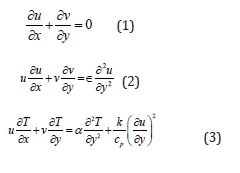
The governing equations are
Lupinepublishers-openaccess-computer-sciences-journal

where (u,v ) are the components of velocity in (x , y) directions, the kinematic viscosity T is temperature of fluid, the thermal diffusivity

k the fluid thermal conductivity, ρc the fluid capacity heat and cp the specific heat. The relevant boundary conditions are defined as
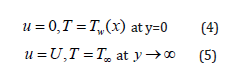
Lupinepublishers-openaccess-computer-sciences-journal

Where , Tw T∞ are constants. Introducing the following dimensionless variables
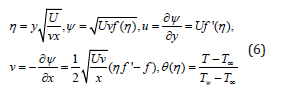
Lupinepublishers-openaccess-computer-sciences-journal

Utilizing equation (6), equation (1) is satisfied automatically and equations (2) and (3) characterize to the following problems statement
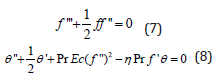
Lupinepublishers-openaccess-computer-sciences-journal

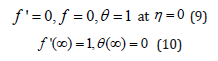
The related boundary conditions

Lupinepublishers-openaccess-computer-sciences-journal

Solution of the problem

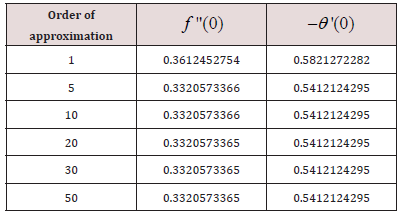
Here successive linearization method (SLM) [14-16] is implemented to obtain the numerical solutions for nonlinear system (8) and (10) corresponding to the boundary condition Eq. (11) – (13) (Table 1). The convergence for numerical values of f "(0) and −θ '(0) for different order of approximation when Ec = 0.01, Pr =1 and n =1.00 (Table 1).

Table 1: The convergence for numerical values of f "(0) and −θ '(0) for different order of approximation when Ec=0.01, Pr 1 and 1.00 Ec n=1.00.
Lupinepublishers-openaccess-computer-sciences-journal

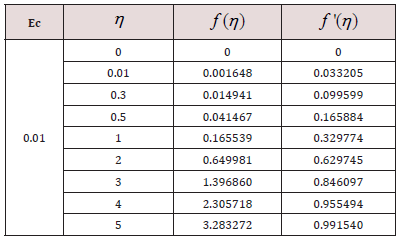
The numerical values of f (η ) and f '(η )when, n =1, Pr =1 for Ec= 0.01. (Table 2).

Table 2: The numerical values of f (η ) and f '(η ) when, n =1, Pr =1 for Ec = 0.01.
Lupinepublishers-openaccess-computer-sciences-journal

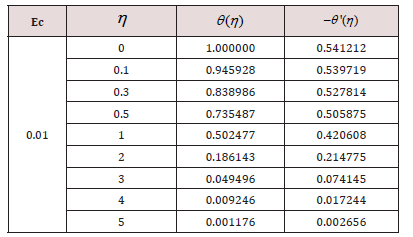
The numerical values of θ (η ) and −θ '(η )when, n =1, Pr =1 for Ec =0.01 (Table 3).

Table 3: The numerical values of θ (η ) and −θ '(η ) when, n =1, Pr =1 for Ec =0.01.
Lupinepublishers-openaccess-computer-sciences-journal

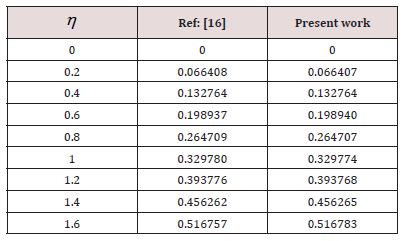
Comparison of numerical values of f (η ) with Ref: [16] when, n= Ec = 0, Pr =1 (Table 4).

Table 4: Comparison of numerical values of f (η ) with Ref: [16] when, n= Ec = 0, Pr =1.
Lupinepublishers-openaccess-computer-sciences-journal

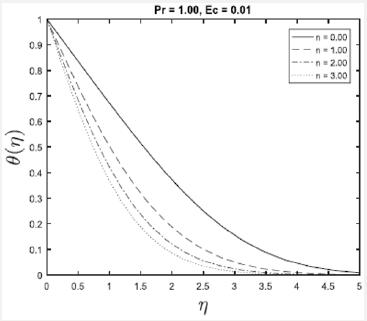
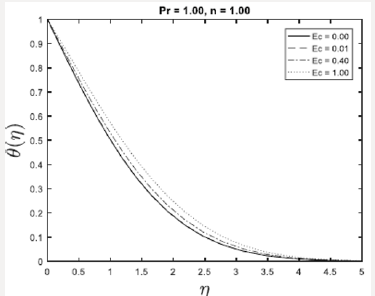
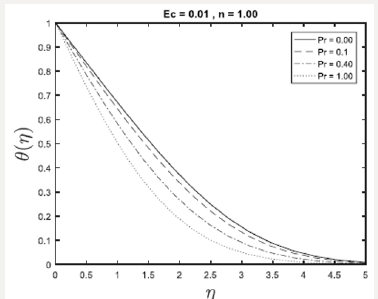
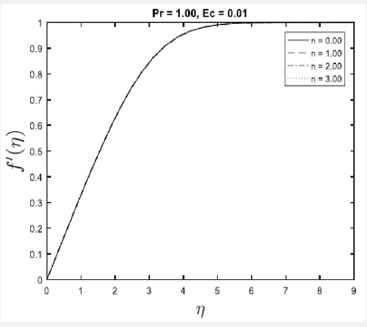
This section concerns with the graphical illustrations obtained by using successive linearization method for velocity, temperature profiles. These profiles show the variations of embedded flow parameters in the solution expressions for heat transfer analysis for an incompressible viscous fluid. The physical interpretation of the problem has been discussed in Figures 1 – 4. These figures are plotted in order to illustrate such variations. Here the graphs have been determined for the heat transfer flow of steady Newtonian fluid. Figures 1 & 2 shows the effects of the parameter on the velocity profile for f '(η ) and θ (η ) when Ec, Pr are fixed. It is worth noticing that by increasing the parameter η reveals that buoyancy because of augments of gravity which boosts on the velocity. Figure 3 is sketched for the variation of Prandtl number Pr on θ (η ) . It is noted that for lager Pr ,the thermal field is lower and then this reduce the temperature. In fact law Prandtl number Pr assist fluid with higher thermal conductivity and this create thicker thermal boundary layer than that for lager Pr. Finally, Figure 4 shows the effect of Ec on velocity and temperature profiles over the plate, and we note that by increasing in Ec parameter is seen that the effect is very big for the temperature.

Figure 1: Effects of n and f '(η ) .
Lupinepublishers-openaccess-computer-sciences-journal

Figure 2: Effects of n and θ (η ) .

Lupinepublishers-openaccess-computer-sciences-journal

Figure 3: Effects of Ec for θ (η ) .

Lupinepublishers-openaccess-computer-sciences-journal

Figure 4: Effects of Pr for θ (η ) .

Lupinepublishers-openaccess-computer-sciences-journal

Conclusion

In this research, the problem of heat transfer of an incompressible viscous fluid over flat pate is solved numerically. The numerical solutions are well established by SLM. The influence of various parameters is shown through different graphs. The present results have been tested and compared with the available published results in [16], in a limiting situation shown in tables v and an excellent agreement is found [17].

Read More About Lupine Publishers Journal of Computer Sciences & Applications Please Click on Below Link https://computer-sciences-lupine-publishers.blogspot.com/

Tuesday, 14 December 2021

Lupine Publishers| Mitigating Disaster using Secure Threshold-Cloud Architecture

 Lupine Publishers| Journal of Computer Sciences & Applications


Abstract

There are many risks in moving data into public cloud environments, along with an increasing threat around large-scale data leakage during cloud outages. This work aims to apply secret sharing methods as used in cryptography to create shares of cryptographic key, disperse and recover the key when needed in a multi-cloud environment. It also aims to prove that the combination of secret sharing scheme and multi-clouds can be used to provide a new direction in disaster management by using it to mitigate cloud outages rather than current designs of recovery after the outages. Experiments were performed using ten different cloud services providers at share policies of 2 from 5, 3 from 5, 4 from 5, 4 from 10, 6 from 10 and 8 from 10 for which at different times of cloud outages key recovery were still possible and even faster compared to normal situations. All the same, key recovery was impossible when the number of cloud outages exceeded secret sharing defined threshold. To ameliorate this scenario, we opined a resilient system using the concept of self-organization as proposed by Nojoumian et al in 2012 in improving resource availability but with some modifications to the original concept. The proposed architecture is as presented in our Poster: Improving Resilience in Multi-Cloud Architecture.

Keywords: Secret Shares; Disaster Mitigation; Thresholds Scheme; Cloud Service Providers

Introduction

With the introduction of cloud services for disaster management on a scalable rate, there appears to be the needed succour by small business owners to get a cheaper and more secure disaster recovery mechanism to provide business continuity and remain competitive with other large businesses. But that is not to be so, as cloud outages became a nightmare. Recent statistics by Ponemon Institute [1] on Cost of Data Centre Outages, shows an increasing rate of 38% from $505,502 in 2010 to $740,357 as at January 2016. Using activity-based costing they were able to capture direct and indirect cost to: Damage to mission-critical data; Impact of downtime on organizational productivity; Damages to equipment and other assets and so on. The statistics were derived from 63 data centres based in the United States of America. These events may have encouraged the adoption of multi-cloud services so as to divert customers traffic in the event of cloud outage. Some finegrained proposed solutions on these are focused on Redundancy and Backup such as: Local Backup by [2]; Geographical Redundancy and Backup [3]; The use of Inter-Private Cloud Storage [4]; Resource Management for data recovery in storage clouds [5], and so on. But in all these, cloud service providers see disaster recovery as a way of getting the system back online and making data available after a service disruption, and not on contending disaster by providing robustness that is capable of mitigating shocks and losses resulting from these disasters.

This work aims to apply secret sharing methods as used in cryptography [6,7] to create shares of cryptographic key, disperse and recover the key when needed in a multi-cloud environment. It also aims to prove that the combination of secret sharing scheme and multi-clouds can be used to provide a new direction in disaster management by using it to mitigate cloud outages rather than current deigns of recovery after the outages. Experiments were performed using ten different cloud services providers for storage services, which at different times of cloud outages, key recovery were still possible and even faster compared to normal situations. All the same, key recovery was impossible when the number of cloud outages exceeded secret sharing defined threshold. To ameliorate this scenario, we look forward to employ the concept of self-organisation as proposed by Nojoumian et al. [8] in improving resource availability but with some modifications as proposed. The rest of the work is organised into section II, Literature Review takes a closer look at current practices, use of secret sharing and cloudbased disaster recovery with much interest in the method used in design. III. Presents our approach, in section IV, present Results and Evaluations and Conclude in section V with future works and lessons learnt.

Literature Review

There are research solutions based on different variants of secret sharing schemes and multi-cloud architecture that give credence to its resilience in the face of failures, data security in keyless manner, such as: Ukwandu et al. [9] - RESCUE: Resilient Secret Sharing Cloud-based Architecture; Alsolami & Boult, [10], - CloudStash: Using Secret-Sharing Scheme to Secure Data, Not Keys, in Multi-Clouds. Others are: Fabian et al. [11] on Collaborative and secure sharing of healthcare data in multi-clouds and [12] on Secret Sharing for Health Data in Multi-Provider Clouds. While RESCUE provided an architecture for a resilient cloud-based storage with keyless data security capabilities using secret sharing scheme for data splitting, storage and recovery, Cloud Stash also relied on the above strengths to prove security of data using secret sharing schemes in a multi-cloud environment and Fabian et al proved resilience and robust sharing in the use of secret sharing scheme in a multi-cloud environment for data sharing. Because our approach is combining secret sharing and multi-clouds in developing a clouddisaster management the need therefore arise to review current method used in cloud-based disaster in a multi-cloud system and their shortcomings.

a) Remus: Cully et al. [13] described a system that provides software resilience in the face of hardware failure (VMs) in such a manner that an active system at such a time can continue execution on an alternative physical host while preserving the host configurations by using speculative execution. The strength lies on the preservation of system’s software independently during hardware failure.

b) Second Site: As proposed by Rajagopalan et al. [14] is built to extend the Remus high-availability system based on virtualization infrastructure by allowing very large VMs to be replicated across many data centres over the networks using internet. One main aim of this solution is to increase the availability of VMs across networks. Like every other DR systems discussed above, Second Site is not focused on contending downtime and security of data during cloud outages.

c) DR-Cloud: Yu et al. [15] relied on data backup and restore technology to build a system proposed to provide high data reliability, low backup cost and short recovery time using multiple optimisation scheduling as strategies. The system is built of multicloud architecture using Cumulus [16] as cloud storage interface. Thus providing the need for further studies on the elimination of system downtime during disaster, provide consistent data availability as there is no provision for such in this work.

Our Approach

Our approach is in combining secret sharing scheme with multi-clouds to achieve resilience with the aim of applying same in redefining cloud-based disaster management from recovery from cloud outages to mitigating cloud outages.

The Architecture

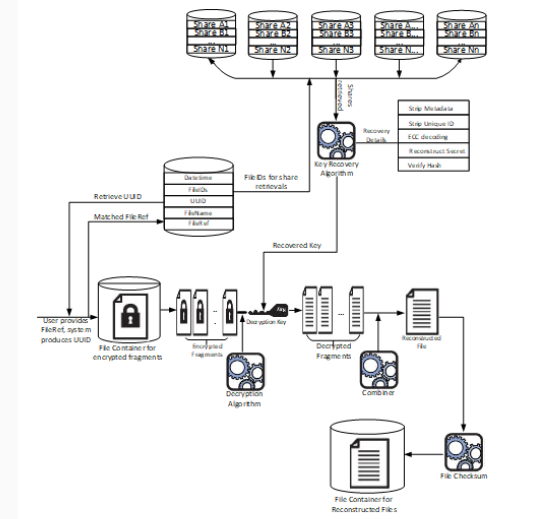
The architecture of as shown in Figure 1 shows key share creation, dispersal and storage, while that of Figures 2 & 3 is of shares retrieval and key recovery

Figure 1: Key Share Creation, Dispersal and Storage.

Lupinepublishers-openaccess-computer-sciences-journal

Figure 2: Share Retrievals and Key Recovery.

Lupinepublishers-openaccess-computer-sciences-journal

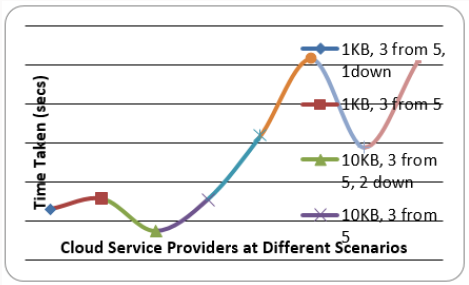
Figure 3: Cloud Service Providers at Different Scenarios.

Lupinepublishers-openaccess-computer-sciences-journal

Share creation and Secret recovery: The diagram above explains our design of key share creation, dispersal and storage using different cloud service providers (Figure 1). Share Creation: The dealer determines the number of hosts shares combination from which data recovery is possible known as threshold (t) and the degree of the polynomial, drived from subtracting 1 from the threshold. In this case, the threshold is 3 and the degree of polynomial is 2. He initiates a secret sharing scheme by generating the polynomial, the coefficients a and b are random values and c is the secret, the constant term of the polynomial as well as the intercept of the graph. He generates 5 shares for all the hosts H1… H5 and sends the shares to them for in an equal ratio and weights we, and thereafter leaves the scene [1].

Secret Recovery: Just as in Shamir [6] authorised participants following earlier stated rules are able to recover the secret using Lagrangian interpolation once the condition as stated earlier is met. The participants contribute their shares to recover the secret.

Results and Evaluations

Test: Cloud Outages against Normal situations. This test assumes that cloud outage prevents secret recovery.

Discussions

The results above show that cloud outage has no negative effect on key recovery, rather reduces the overhead in comparison with normal situations. It shows the relationship between cloud outage and normal operational conditions. From available results at twenty percent (20%) failure rate using 3 from 5 share policy, the system becomes faster by sixteen percent (16.41%), but at forty percent (40%) failure rate using same share policy, the download speed is faster by a little above fifty one percent (51.80%). Looking at a higher share policy of 6 from 10, at thirty percent (30%) failure rate, the system download speed is higher by a little above thirtyseven percent (37.90%), while at forty percent (40%) failure rate, the system performed better by about forty-three percent (42.99%). The implications therefore are that in as much as failure rate is not equivalent or above the threshold, system performance improves as there was no result obtained when the cloud outage exceeds or equal to threshold. These therefore do not support the assumption as above that cloud outage has negative effect in key recovery. There is no significant evidence to show that the size of the share has effect on the key recovery during cloud outages because at forty percent (40%) failure rate using share of 10KB in 3 from 5 shows performance rate of above fifty-one percent while in 6 from 10 share policy approximately forty-three (42.99%) percent performance rate.

Conclusions, Lessons Learnt and Future Work

Current cloud-based disaster recovery systems have focused on faster recovery after an outage and the underlying issue has been the method applied, which centered in data backup and replicating the backed-up data to several hosts. This method has proved some major delays in providing a strong failover protection as there has to be a switch from one end to another during disaster in order to bring systems back online, the need thus arises for research to focus on method capable of mitigating this interruption by providing strong failover protection as well as stability during adverse failures to keep systems running. This method we have provided here using this paper. Because, secret sharing schemes are keyless method of encryption, data at rest and in transit are safe as it exists in meaningless format.

The recovery of key is done using system memory and share verification is usually carried out using an inbuilt share checksum mechanism using SHA-512, which validates shares before recovery. Else, share recovery returns error and halts. We have learnt that cloud outage rather than prevent key recovery, using our method proved that it hastens key recovery from results available. Also, understand that when cloud outage exceeds threshold of the share policy, key recovery becomes impossible and to ameliorate this situation, we propose as future work to use the concept of Self- Organization as proposed by Nojoumian et al. [8] to manage cloud resources though with some modifications so as to maintain share availability from cloud service providers.

Read More About Lupine Publishers Journal of Computer Science and Applications Please Click on Below Link: https://computer-sciences-lupine-publishers.blogspot.com/

Monday, 26 July 2021

Lupine Publishers| Mini View on Current Trends in Computer Sciences & Applications

 Lupine Publishers| Current Trends in Computer Sciences & Applications (CTCSA)


Abstract

Computer science has contributed a lot for making the life of human being smooth. The recent developments in the field of computer science are proven to be more smarter and more applicable structures result from marrying the learning capability of the applications with the transparency and accuracy. Foundations of computer science applications highlights the advantages of integration making it a valuable resource for the students and researchers in engineering, computer science and applied mathematics. The authors’ tried to lime light various applications that are an asset to industrial practitioners, corporates, academicians and professionals for control systems, data analysis and optimization tasks. With the continuous improvisation in the computer science applications the need of the young generation is fulfilled, and they can achieve their targets with the help of updated and enhanced support system. Authors are highlighting on current trends in computer sciences & applications and further illustrate how these various technologies integrate with social and economic factors to provide a thorough solution to the real-world problems of the human being in every domain of life.

The authors demonstrated how a combination of both techniques and human interventions enhances control, decision-making and data analysis systems.

Keywords: Computer; Trends; VLSI Technology; Multiprocessor; Parallelism; Configurable Computing; DSP; Internet

Introduction

Although the very state forward answer for the latest trends in Computer science could be Machine learning, cloud computing and Artificial Intelligence. But basically, Industry build the software not only with what is new but by what customer problem can be solve easily and with good future scope and current market trends which covers customer requirements, this force towards innovation and create next generation products that can be quickly adopted for solving new use cases by Connecting to new data sources easily.

Top technologies which are in current trends in computer science & Application are as below:

A. Deep learning or Machine learning (ML).

B. Digital currencies: Example Bitcoin

C. Blockchain.

D. IoT

E. Robotics

F. Big Data Analytics.

G. Cloud Computing

H. Cyber Security

I. Virtual Reality

J. Predictive Analytics

The emerging areas that are seeking attention of many researchers in the field of computer science are designed and developed according to the latest market trends. Now a day trends in information technologies are directly or indirectly associated with the customer centric approach. One of the latest technology like computational biology where in the gathering and processing of biological data with the use of computer programs. This technology covers under Bio Informatics, which works with the combination of computers and living beings. It converts the biological data into readable format. This is helping the medical science a lot. Another most promising technology of today is Data Science or Big Data. This field has a very large and promising scope of research and development considering the huge volume of data being produced by organizations and individually in different sectors worldwide. It deals with the storage processing and analysing the massive data stored across the world in various organization and data centres.

The existence of newest trend of Virtual Reality cannot be ignored. The biggest stakeholders of VR applications are medical science, physical sciences, environment, businesses, space industry and entertainment industry. VR produces the set of the data which is used to develop new models training methods, communications and interaction. The major disadvantages in the use of VR application are time, cost and technological limitations. But because of its support system it is expected to become more affordable in future, today’s generation is grown up having technology at their disposal. They are familiar with smart phones, tablets therefore VR Developments will also increase in number of professionals more acquainted with the technology. Cloud Computing has already become the area of attention by most of the researcher and scientists. Cloud provider is basically data or internet provider. This plays an important role in various fields of business, computing security etc. This application works on the shared pools of configurable computer system recourses and higher-level services that ease the managerial effort with leads to economics of scale and development. It helps in running business more efficiently.

Cloud computing eliminates the capital expenses of buying hardware and software along with other related expenses. Business has become very flexible as cloud computing services are available on demand that leads to delivering right amount of IT resources resulting in scale elasticity. Lots of ‘Racking and Stacking’ task is being eliminated as cloud computing removes the needs for many of these tasks resulting in more time devotion towards more important business goals. Cloud computing services run on a worldwide network regularly upgraded data centres. This reduces network latency for application and improvises efficient computing hardware. It also helps in providing security to the data, apps from potential threats. However, several types of cloud computing is operational to help offer right solution for your needs like public, private and hybrid.

Deep Learning or Machine Learning is sub set of artificial intelligence and in today’s trends it’s one of most widely used computer science application, the ability of ML is to self-trend from data or able to learn from its own experiences, which can improve from application behaviour or experience without being explicitly programmed. Machine learning focuses on the development of computer programs that can access data and use it learn for themselves.

I. Example:

A good example can be a Navigation system or MAP application which initially developed with limited data but later on when this application gets used its design in a way so it trained itself to predict the best possible path.

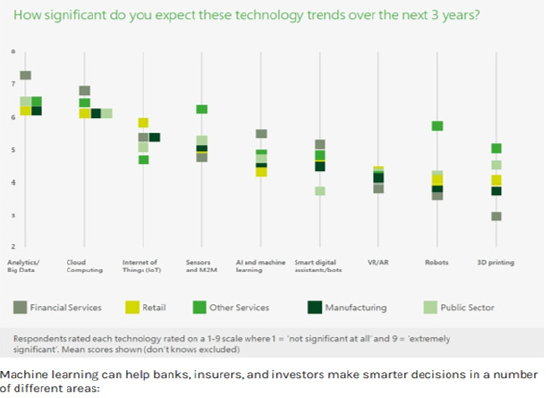
Google search, uber, Pay Pal, Facebook are the good example of ML and these actually improving the usability of their services by applying deep learning algorithms. Below is the comparative example where one sector is using Machin learning and takin its benefits and other one is moving very slowly in digital and it’s far behind (Figure 1). Machine learning can help banks, insurers, and investors make smarter decisions in a number of different areas:

Figure 1:

Lupinepublishers-openaccess-computer-sciences-journal

a) Customer and Client Satisfaction: Machine learning helps financial services on below key points.

i. By analysing user activity.

ii. Smart machines can spot a potential account closure before it occurs.

b) Reacting to Market Trends: Another aspect can be cover by using a good ML algorithm which is generating the alerts or by preserving the trained to track trading volatility or manage wealth and assets on behalf of an investor.

c) Calculating Risk: Good ML algorithms can analyse datasets and based on the dataset (credit scores, spending patterns, financial data etc.) to accurately assess risk in both insurance underwriting and loan assessments, tailoring them to a specific customer profile.

Conclusion

Trends in Computer Sciences & Applications changed drastically the life of one and all. Be it a student learning or business corporate or any other professional, computer science and its applications are extending their updated support system to give more effective performance infrastructure in every sphere. Recent developments gives acceleration to the development of a Digital currency or digital money introduction in the form of digital, Blockchain a digital ledger in which transactions made in cryptocurrency. The contribution is endless and so the developments in this field are boundless.

Read More About Lupine Publishers Current Trends in Computer Sciences & Applications (CTCSA)  Please Click on Below Link:  https://computer-sciences-lupine-publishers.blogspot.com/


Friday, 17 May 2019

Lupine Publishers-computer science journals


The Internet of Things is a concept that has been heard quite a lot in recent years, a concept that slowly emerged, but over time it has experienced a booming growth that was then adopted not only by giant IT companies, offering according to the directions of each company that adopts the corresponding services and applications to the end user. Undoubtedly this technology has come to stay for a long time, it has come to improve our living conditions and to simplify habits and functions that required time and many times difficulties. The Internet of Things is almost everywhere around us from the super market to the cars we drive, our everyday life is going easy and we are happy to live with, but there are two important points that we should consider:
a) Uncontrolled product design based on the Internet of Things.
b) Access to data managed by Internet of Things are inaccessible by the users.
According to the above, important questions arise, such as:
a) How and where these devices store and manage the data now?
b) How and where these devices store and manage data in the future?
c) What personal data are collected and for whom? To know more click on below link.

https://lupinepublishers.com/computer-science-journal/fulltext/internet-of-things-and-privacy.ID.000101.php

For more Lupine Publishers Open Access Journals Please visit our website: http://www.lupinepublishers.com/

For more computer science journals articles Please Click Here: https://lupinepublishers.com/computer-science-journal/