Showing posts with label Journal of Behavioral Sciences. Show all posts

Thursday, 6 July 2023

Lupine Publishers | A Review on Gender Differences in Schizophrenia in Indian Settings

 Lupine Publishers | Journal of Psychology and Behavioral Sciences


Abstract

The present article is a scientific review aimed to explore the various gender differences, which are seen in individuals with schizophrenia. Cultural difference is seen as one of the factors playing a major role in the gender differences of people with schizophrenia. The present article presents a comprehensive review of the research done in the past in the area of schizophrenia, thereby presenting a significant summary of the previous research findings. This article focusses on the researches on gender differences in Schizophrenia in Indian context as well as worldwide. It suggests that there are various factors, which have not been further explored, and there is a scope for research in the Indian context, thereby helping to fill in the gaps in the literature related to the factors involved in contributing to the gender differences in Schizophrenia.

Keywords: Schizophrenia; Gender Differences; Indian context; Worldwide

Introduction

Schizophrenia is one of the widely studied disorders across the globe. It is the most widely researched topic by scholars worldwide. It is a chronic and disabling mental illness affecting millions of people worldwide [1-5]. The annual prevalence of Schizophrenia worldwide is 0.2-0.4/1000 [6]. The prevalence of Schizophrenia in India is 3/1000 [7]. The annual incidence rates obtained were 4.4 and 3.8 per 10,000 for rural and urban areas, respectively. There are many gender differences observed in the individuals with Schizophrenia. Men tend to show more Negative symptoms as compared to women who display more of Affective symptoms [8]. Gender differences in terms of prognosis is noted, where women have better outcomes in terms of clinical course and occupational and social functioning [9-11]. Disability being one area where gender differences are evidently seen, men face disability in occupational functioning [12] whereas women in the marital functioning [13]. The cumulative lifetime risk is the same in both the genders [14].

Prevalance and Incidence

Sex differences in the incidence and prevalence of Schizophrenia may be dependent on the stringency of diagnostic criteria applied. When the diagnostic criteria are broader, there sex differences are less significant [15].

Age of Onset

Majority of studies done in this area suggests that men have an earlier age at their 1st hospitalisation as compared to woman [16,17]. They further noted that these differences in the age of 1st hospitalisation have ranged from 2-6 years. Another research suggests that there has been a general shift in the age of onset between both genders, with women being at a higher rate to have a later onset of symptoms regardless of when hospitalisation first occurred [18]. Castle and [3,8] did a prospective study where they go the average onset of males, which was 31.2, was almost 10 years younger than the average onset age for females, which was 41.1. In addition, when family ratings of then1st appearance of Schizophrenic symptoms was used, it was clearly seen that men show an earlier onset of schizophrenic symptoms than women [7,10]. This difference in the age could also be affected by the familial values versus non-familial status. Albus and [5] conducted a study to see the differences in the age of onset related to familial and nonfamilial status and found that there is no difference in onset age in familial cases of schizophrenia (38 Male-male pairs and 29 femalefemale pairs). It was also evidently seen that the age of onset of earlier for males in non-familial cases. It is widely seen that females have a much later onset of Schizophrenia. Researchers suggest that the females also have a better course of illness than males. They suggest that these two phenomena are related to one another, I.e., worse subtype of illness occurs earlier and hence results in later onset in women results in a less aggressive illness thereby resulting into a better outcome. These views are encouraged by epidemiological literature to s great extent [6].

Premorbid Functioning

Andia [3] did a research on the sex differences in the premorbid functioning in individual with schizophrenia. It was found that females had a higher level of functioning which majorly included greater educational attainment. It was also evidently found that females had a greater likelihood of getting married prior to their onset of illness. There is a positive correlation between premorbid functioning and prognosis. Better the premorbid functioning, better is the prognosis for illness. Shtasel, Gur & Heinberg [14] found gender differences in premorbid functioning being worse in men than women. McGlashan and Bardenstein [5,9]

did a research related to gender differences and found that females had better premorbid functioning and marital adjustment. Symptomatologic characteristics: Gender differences are vividly seen in symptoms and its exhibition. Females are more likely to present with comorbid depression or even anxiety disorders as opposed to males who are more likely to receive a diagnosis for substance abuse or alcohol abuse and difficulties in impulse control during the first psychiatric admission. When the symptoms are expressed, it is seen that men tend to experience more affective flattening and negative symptoms at the time of their 1st episode as compared to females [4]. These results were also supported by the study done by Rachel Willhite in California. In addition, males were found to have more difficulties related to emotions and were found to be impaired on emotional and social withdrawal, blunted affect, poor rapport. Females on the other hand were seen to have severe somatic symptoms.

Course and Outcome

Alice & Chue [2] did a study to explore the gender perspective in course of schizophrenia and found that the course was more favourable in women with less smoking and substance abuse. It was also seen that women presented higher rates oh remission, less days of hospitalisation and better response to typical anti psychotics than men. However, research has contrast view related to gender differences in hospitalisation. Haro and his colleagues [1] found that women presented higher risk of hospitalisation than men. Another study done by Usual and colleagues in 2001 reported that number of previous hospitalisation were similar to both men and women. These 3 contradictory results pave way for further investigation in this regard.

Types of Research Done in India

Prevalence & Incidence

The prevalence of schizophrenia in India is observed to be lower as compared to that in the western countries [16]. In addition to this, it was also seen that the prevalence rate in “least developed” countries was significantly lower as compared to emerging and developed countries. One of the factors which might affect this difference would be “under reporting” (Avasthi [5]). Considering the important aspect of the incidence and prevalence rate across gender, various kinds of results have been noted by differences researchers. Rode [3] did a study on 196 individuals having schizophrenia, of which 55.61% were males and 44.39% were females. It is interesting to note these sex differences and understand the factors related to it. This area of research remains least explored in Indian context and is in need of further research.

Age of Onset

Similar to the research from western countries, it was seen that the gender differences do exist in the age of onset of schizophrenia in Indian population too Murthy [8] found that the males had an earlier onset of the illness as compared to that of females. The males were seen to develop it 5 years earlier than the females [12]. But another study done by Gangadhar and colleagues found contradictory results. It was seen that there was no difference in the onset age between the genders. Although, it was further seen that the proportion of females was higher in group if under 20 years of age. Janakiramiah [11] said that this could be due the over representation of younger ages. Murthy and colleagues in 1998 did a study and found no sex differences in the age of onset. These studies contradict in results thereby paving a way for further research. It is important to find that if the difference in the onset age is really a true onset age or age at case finding. Many factors could affect it and they play a major role. It can be highly possible that the early hospitalisation in men is due to quicker response to symptoms by society rather than early manifestation. It is also possible that the females are cared at home prior to diagnosis which postpones hospitalisation.

Premorbid Functioning

Stusser [9] reported various types of premorbid abnormalities in individuals with schizophrenia. These abnormalities are exaggerated in intellectual and social areas. Foerster [13] added to these results that such abnormalities I’m the premorbid functioning are seen more in men as compared to women who develop schizophrenia. Other studies also supported the findings where in it was seen that males have higher premorbid abnormalities than females Childers [11]. Retrospective studies reported children seeking mental health services and those at high risk suggest similar results. These premorbid deficits also result in an early onset of illness especially in Male gender. According to the neurodevelopmental model of schizophrenia, the premorbid functioning has abnormal development in early years. Crow [10] confirmed this view adding gender differences related to it. Men have an irritable, disagreeable premorbid functioning. They also tend to be defiant of authority, whereas women tend to be secure and shy and participate less in groups [1,6].

Clinical Representation

Gender also influences the way the symptoms are expressed. Seeman [1] did a research and found that females are seen to have more affective symptoms and fewer negative symptoms. They also tend to get a diagnosis of schizoaffective disorder. Roberta & Handel [4] found that females with schizophrenia tend to be more hostile as compared to males. They also are physically active and dominating, with more sexual delusions. They tend to be more emotional than men. McGlashan & Bardenstein [6] did a study and results were consistent with earlier findings that women experience affective symptoms and less negative symptoms. They also said that females exhibit more or anxiety and paranoid symptoms. The meaning of symptoms seems differ across genders and manifest in different ways. Symptoms of withdrawal and dependency reflect as depression syndrome in women whereas negative symptoms in men.

Course and Outcome

Thara [1] did a longitudinal study of 25 years in madras and found that there were no differences in genders in the course and outcome of schizophrenia. These results contradict the results from western countries. Although, there have been studies which support that women have favourable outcomes than men. Dutta & Kapur [7] did a research related to course and outcome of schizophrenia and the gender differences in it. They looked at the prognostic factors and found a negative correlation between chances of improvement and duration of illness. Shorted the duration of illness (less than one year), higher are the chances of improvement. Other factors playing important role in improvement are no family history of mental illness, acute onset and younger age. It was also seen that gender and previous history of mental illness had no prognostic significance.

Cultural Influences

“Culture” plays a very important role in the entire journey of schizophrenia especially in the Indian context. Various studies focus on the culture and its influence on overall functioning of individuals with schizophrenia. Loganathan and Murthy did a research on gender differences and doing marriage, job and children as most important factors being affected. Women had a ear if rejection and were not comfortable disclosing about their illness to their husbands. They used concealing as a strategy. Females also preferred to stay unmarried. It was seen that separation was a common event occurring when told about their illness. Women who expecting were forced to abort their child, and of given birth, were separated from child. On the other hand, men with schizophrenia, faced a lot of frustration in securing jobs. They were highly stigmatised. It was therefore seen that women were separated or divorced while more men remained single.

Lacunae in Researches Today

The “culture” as a factor which broadly influences the expression of symptoms across genders needs to be investigated further. This investigation may help to identify the unexplored link between the illness and related factors. In the Indian context, religious influences need to be investigated further. To determine various causal mechanisms across the genders, longitudinal studies need to be done.

Studies Required in Indian Setting

The prevalence and incidence of schizophrenia is seen more in men in India. But the reasons for this higher proportion in one gender remains unexplored. Ignorance and underreporting could be some factors that can be studied in Indian context. Factors involved in favourable outcomes for women in Indian context can be studied further Another area which needs to be explored are the religious influences on the overall course of schizophrenia. Studies related to practising spirituality and outcomes of schizophrenia can be done.

Conclusion

The evidences noted throughout the paper point towards general susceptibility across genders for schizophrenia. Despite of contrary results in various studies, most of the work consistently show that males are more prone towards early onset, have negative symptoms and less favourable outcome towards Schizophrenia in both, Indian as well as western context. However, research done in India has been without much structure and organisation. Wellcoordinated studies are needed to arrive at clear, structured and organised reports of the gender differences in India. In addition, the results can also be used effectively in planning for gender-sensitive mental health services in India.

Read More About Lupine Publishers Journal of Psychology Please Click on Below Link:
https://lupine-publishers-psychology-journal.blogspot.com/

Friday, 26 May 2023

Lupine Publishers | Incidence and Clinical Outline of Hyponatremia in Psychiatric Inpatients: a Native Preliminary Evaluation

 Lupine Publishers | Journal of Psychology and Behavioral Sciences


Abstract

Introduction: Hyponatremia is one of the most frequent ion and water disorders and severe hyponatremia is associated with well-known clinical symptoms and manifestations. In the present assessment the incidence and clinical profile of hyponatremia have been probed among a great sample of non-western psychiatric inpatients and compared with the available data in literature regarding prevalence and other associated clinical characteristics.

Methods: All inpatients with idiopathic hyponatremia during the last sixty-four months had been included in the present study. Clinical diagnosis, as well, was in essence based on ‘Diagnostic and Statistical Manual of Mental Disorders, 5th edition (DSM-5)’. Statistical significance had been defined as a p value ≤0.05.

Results: While the annual incidence of hyponatremia in current evaluation was around 0.01%, the annual incidence of mortality due to hyponatremia was around 0.001%. It was significantly more prevalent among male psychiatric inpatients (p<0.04) and patients with duration of illness in excess of one year (p<0.04). Furthermore it was meaningfully more evident among schizophrenic patients (p<0.007), in comparison with remaining primary psychiatric disorders. There was no significant relationship between hyponatremia and symptomatic profile, or serum level of sodium and occurrence of seizure.

Conclusion: Hyponatremia was significantly more prevalent among male patients and cases with duration of illness in excess of one year. Furthermore it was meaningfully more evident among schizophrenic patients.

Keywords: Hyponatremia; Psychiatric disorders; Psychotropic drugs; Schizophrenia

Introduction

Hyponatremia (serum sodium concentration < 136mEq/L) is one of the most frequent ion and water disorders. It is generally due to disproportionate renal water retention. Severe hyponatremia (<125mEq/L) is associated with well-known clinical symptoms and manifestations. However, even mild reductions in sodium blood levels have been shown to be associated with increased mortality and with the risk of falls and fractures. The diagnosis of hyponatremia, although requiring simple clinical and laboratory tests, may be complex and difficult [1]. Hyponatremia is a prevalent and potentially dangerous medical comorbidity in psychiatric patients, too [2]. Hyponatraemia can occur in the context of water intoxication, where water consumption exceeds the maximal renal clearance capacity along with a low serum and urine osmolality. Cross‐sectional studies of chronically ill, hospitalized psychiatric patients have found the prevalence of water intoxication to be approximately 5% [3]. It may occur, as well, due to drug‐induced syndrome of inappropriate antidiuretic hormone (SIADH), where the kidney retains an excessive quantity of solute‐free water. In this situation, serum osmolality is low and urine osmolality is relatively high. The prevalence of SIADH has been estimated to be as high as 11% in acutely ill psychiatric patients [4]. Risk factors for antidepressant induced SIADH (increasing age, female gender, medical co‐morbidity and polypharmacy) seem to be less relevant in the population of patients treated with antipsychotic drugs [5].

Overall prevalence of antipsychotic‐induced hyponatremias has been estimated at 0.004% [6] and 26.1% [5]of patients. Mild to moderate hyponatremia presents as confusion, nausea, headache and lethargy. As the plasma sodium falls, these symptoms become increasingly severe and seizures and coma can develop. So while monitoring of plasma sodium is desirable for all those receiving antipsychotics, signs of confusion or lethargy should provoke thorough diagnostic analysis, including plasma sodium determination and urine osmolality [3]. Prevalence of polydipsia in a population of chronic psychiatric patients can be as high as 6 to 17% [7]. Schizophrenia represents 80% of cases reported [8]. Early onsets of psychiatric disorder and long duration of that or poor response to psychopharmacotherapy have been identified as significant risk factors for appearance of hyponatremia [9]. Patients with hyponatremia may be asymptomatic or present with nausea, anorexia, muscle cramps, weakness, fatigue, confusion and disorientation. Severe hyponatremia may result in serious neurologic sequelae such as coma and seizures, and death. Advanced age, too, appears to be a risk factor for this adverse effect, as does the concomitant use of diuretics [10]. Like other psychotropic medications, it is suspected that atypical antipsychotics can induce hyponatremia by either stimulating antidiuretic hormone release from the brain or enhancing antidiuretic hormone activity in the kidneys [10]. Currently, there are no reliable estimates of incidence or risk of hyponatremia from atypical antipsychotic drugs in older adults [11]. On the other hand, while acute hyponatremia is characterized by onset of symptoms in less than 48h, chronic hyponatremia develops over 48h and most patients have chronic hyponatremia. The serum sodium concentration is usually above 120meq/L. Brain adapts itself to hyponatremia by generation of idiogenic osmoles. This is a protective mechanism that reduces the degree of cerebral edema; it begins on the first day and is complete within several days. Hence in chronic hyponatremia patients may appear asymptomatic [12]. Mild chronic hyponatremia is not benign as previously thought and can directly contribute to increased morbidity and possibly, mortality [13,14]. In the present assessment the incidence and clinical profile of hyponatremia have been probed among a great sample of non-western psychiatric inpatients and compared with the available data in literature regarding prevalence and other associated clinical characteristics.

Methods

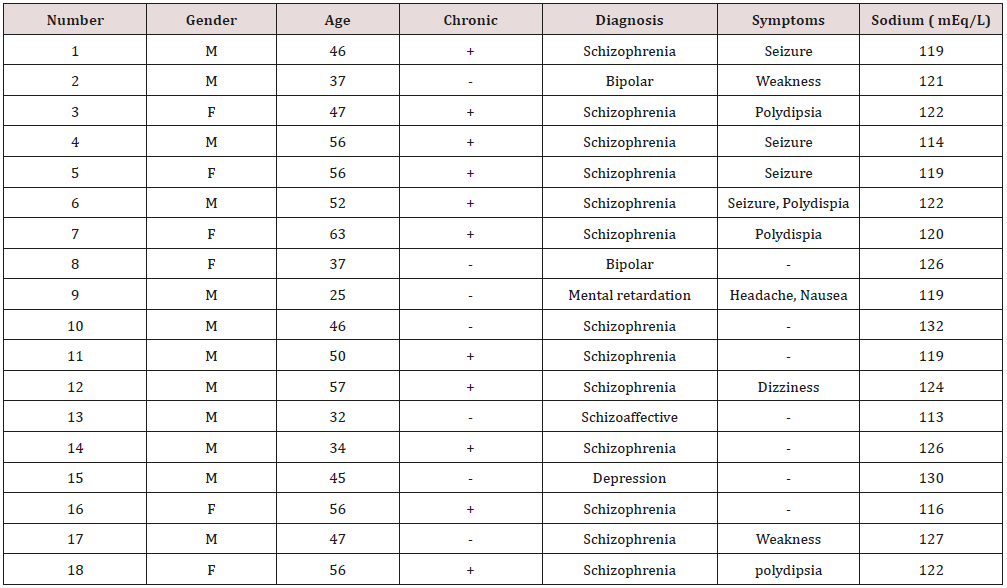
Razi psychiatric hospital in south of capital city of Tehran, as one of the largest and oldest public psychiatric hospitals in the Middle East, which has been established formally in 1917 and with a capacity around 1375 active beds, had been selected as the field of study in the present retrospective assessment. For evaluation, all inpatients with idiopathic hyponatremia during the last sixty-four months had been included in the present study. Hyponatremia had been detected during systematic baseline laboratory checkups or later as a result of clinician’s request and examination due to various symptoms or signs. Clinical diagnosis, as well, was in essence based on ‘Diagnostic and Statistical Manual of Mental Disorders, 5th edition (DSM-5)’ [15]. Among eighteen detected cases, twelve patients were male and six patients were female. Also, the necessary general permission had been obtained from the patients or their relatives during admission. The mean age of samples, as well, was around 43.92±9.51 years old and 52.50±8.34 years old for male and female patients, respectively. Most of the patients met with diagnosis of schizophrenia (n=13), and the remaining met with diagnosis of mental retardation (n=1), schizoaffective (n=1), bipolar disorder (n=2) and major depressive disorder (n=1) (Table 1).

Table 1: Demographic and clinical characteristics or hyponatremic patients.

Lupinepublishers-openaccess-journals-psychology-behavioral-science

Abbreviations: M= male; F= female; Chronic= duration of illness more than one year.

Statistical Analysis

Analysis of dependent variables had been accomplished by ‘t-test’ and appraisal of independent variables had been explored by means of ‘comparison of proportions’. Statistical significance, as well, had been defined as a p value ≤0.05. MedCalc Statistical Software version 15.2 was used as statistical software tool for analysis.

Results

As said by results, among 20118 psychiatric patients hospitalized in razi psychiatric hospital, during the last sixty-four months (April of 2014-August 2019), eighteen patients had been diagnosed as hyponatremic, whether symptomatic or asymptomatic, during their inpatient treatment, based on laboratory checkups. So, the annual incidence of hyponatremia in the current inpatients’ evaluation was around 0.01%. In spite of referral to intensive care unit and given medical treatment, one elderly chronic female patient died by reason of hyponatremia. Accordingly, in the present survey the annual incidence of mortality because of hyponatremia was around 0.001%. Also, with regard to gender difference and in keeping with results, while there was no significant difference regarding age between male and female patients (t = 1.962, p< 0.08, CI 95%: -18.29, 1.13), hyponatremia was significantly more prevalent among male psychiatric inpatients (z= 2.00, p<0.04, CI 95%:0.006, 0.660). Besides, concerning chronicity of psychiatric disorders, comparison of proportions showed that hyponatremia was significantly more prevalent among psychiatric patients with duration of illness in excess of one year (p<0.04) (twelve patients in the chronic wards versus six patients in the acute districts of the hospital). Moreover, with respect to prevalence of primary psychiatric disorders among patients, who have experienced hyponatremia during the last 64 months, schizophrenia was significantly more prevalent in comparison with remaining disorders (z=2.66, p<0.007, CI 95%: -0.11, 0.77). While, eleven patients had different clinical symptoms due to hyponatremia, seven cases were asymptomatic and diagnosis had been confirmed based on merely coincidental checkup. Quantitatively, analysis revealed no significant difference between those groups (z=1.33, p<0.18, CI 95%: -0.54, 0.10). Also, though mean total plasma level of sodium was around 121.72±4.97mEq/L, there was no significant difference between serum level of sodium in seizure cases (mean total= 119.75±1.29mEq/L) and non-seizure patients (mean total=122.64±5.06mEq/L) (t = 1.929, p< 0.28, CI 95%: -6.07, 0.29).

Discussion

Many psychiatric patients have polydipsia and polyuria without identifiable underlying medical causes. Hyponatremia develops in some polydipsic patients and can progress to water intoxication with such symptoms as confusion, lethargy, psychosis, and seizures or death [16]. This syndrome is sometimes called “compulsive water drinking,” “psychogenic polydipsia,” and “self-induced water intoxication.” Although the underlying pathophysiology of the syndrome is unclear, several factors have been implicated in producing polydipsia and symptomatic hyponatremia. These include a possible hypothalamic defect, the syndrome of inappropriate secretion of ADH (SIADH), and neuroleptic medication. Evaluation of psychiatric patients with polydipsia includes a search for other medical causes of polydipsia, polyuria, hyponatremia, and SIADH. Treatment modalities currently available include fluid restriction and medications [16]. Polydipsia, chronic or intermittent, with or without hyponatremia, frequently occurs among chronic patients with schizophrenia. The pathogenesis of polydipsia remains poorly understood.

It has been suggested that maybe in some of these patients, polydipsia and hyponatremia are consequences of patients’ adjustment to a prolonged intake of an insufficient diet, dominantly poor in potassium. Deficits of potassium, without significant hypokalemia, may cause impairment of the urine-concentrating ability with polyuria-polydipsia. A fall of intracellular tonicity, dominantly due to a decreased amount of K (+) and attendant anions in cells, should be accompanied with a fall of extracellular osmolality. Because of the diminished content of ions that may diffuse out of cells and because osmotic equilibrium between the extracellular fluid and intracellular fluid compartments cannot be established in a short period of time, these patients have a diminished ability to adapt to an excessive intake of fluids. These mechanisms might be related to the development of polydipsia and water intoxication in patients with different mental and somatic disorders [17]. On the other hand, while mild chronic hyponatremia, as defined by a persistent (>72 hours) plasma sodium concentration between 125 and 135mEq/L without apparent symptoms, is common in ambulatory patients and generally perceived as being inconsequential [18], hyponatremia at time of inpatient admission is associated with increased severity of illness and mortality in patients hospitalized for treatment of medical conditions and should trigger enhanced clinical monitoring to identify and treat somatic disorders [19]. Drug-Induced hyponatremia is a frequent and potentially seri¬ous adverse reaction with many psychopharmacological agents, mediated in most cases by SIADH. This condition most often leads to subtle psychomotor symptoms due to its slow progression, permitting a compensatory adjustment of intra-cellular volume in the central nervous system. Subtle psycho¬motor symptoms and motor imbalance readily resolve after discontinuation of the responsible pharmacological agent [19]. In contrast, rapid onset of hyponatremia may present with life-threatening encephalopathy, which requires emergent in¬fusion of intravenous hypertonic saline to reverse acute cerebral edema [20]. Back to our discussion and along with analysis, while our estimate respecting prevalence of hyponatremia was lower than the approximations of [4,5,9,12], it was higher in comparison with the calculations of Letmaier [6]. These variances can be due to diverse variables and confounding factors, like the principal of analysis, sample selection and settings of study. On the other hand, in spite of its acknowledgement as a known risk factor, a deficiency of epidemiological studies regarding hyponatremia is palpable, which is not limited to prevalence and incidence, too.

Regarding the risk of mortality as a result of hyponatremia, our outcome, though limited to only one elderly and chronic female schizophrenic patient, was, more or less, in harmony with the conclusions of Naticchia [1], Rodon Berrios [18] and Siegel [2], who had indicated that, even mild reductions in sodium blood levels have been shown to be associated with increased mortality and hyponatremia should be regarded as a prevalent and potentially dangerous medical comorbidity in psychiatric patients. Moreover, consistent with the outcome of the present evaluation, male gender could be regarded as a risk factor for occurrence of hyponatremia, at least among psychiatric patients. Concerning chronicity of psychiatric disorders, conclusion of the current appraisal was in accord with the suppositions of Oshawa [9] and Gandhi [11], who had found a long duration of psychiatric disorder and a prolonged admission as statistically significant factors in occurrence of hyponatremia, though the later had specified that due to atypical antipsychotic medications among older patients.

Moreover, with regard to higher prevalence of hyponatremia among schizophrenic patients, our conclusion was again in harmony with the findings of Ohsawa [9], Lapierre [7] and Siegel [2], who had found the aforesaid medical complication more among that disorders. Furthermore, regarding clinical profile of hyponatremia, our outcome, which had revealed that there was no significant difference, quantitatively, between symptomatic and asymptomatic hyponatremic cases, was in agreement with the report of Liu [4], who stated that patients with hyponatremia may be asymptomatic or present with nausea, anorexia, muscle cramps, weakness, fatigue, confusion and disorientation. Besides, our result as regards the insignificant relationship between sodium levels and severity of clinical symptoms, like seizure, was somewhat in accord with the findings of Manu [19], who had found medical deteriorations incidences in both hyponatremic and non-hyponatremic patients, although more among the first group. Anyhow, as the most common electrolyte abnormality in medical prac¬tice, recent evidence from meta-analyses indicates that hypo¬natremia is associated with increased morbidity and excess mortality, and psychiatric patients are at substan¬tial risk for this adverse event, which may occur with many pharmacologic agents. Since SIADH is the most common underly¬ing mechanism, accounting for over 80% of cases in psychi¬atric patients, in contrast to less than 30% in general medi¬cal practice, clinicians prescribing pharmacological agents conferring risk for dilutional hyponatremia should main¬tain a high index of suspicion for the full spectrum of conse¬quent clinical severity [20]. Restricted period of study, due to inadequate registration and documents in the last decades, and thus insufficient number of cases with idiopathic hyponatremia, and no concurrent checking of osmolality of serum and urine for proper classification of hyponatremia into water intoxication and drug‐induced syndrome of inappropriate antidiuretic hormone, do not permit generalization of outcomes to more than a preliminary survey. No doubt, further methodical studies in future will improve our clinical idea concerning diagnosis and management of this important medical problem among psychiatric patients.

Conclusion

Hyponatremia was significantly more prevalent among male patients and cases with duration of illness in excess of one year. Furthermore it was meaningfully more evident among schizophrenic patients.

Read More About Lupine Publishers Journal of Psychology Please Click on Below Link:
https://lupine-publishers-psychology-journal.blogspot.com/

Friday, 5 October 2018

Why Should We Learn to Swim?: (SJPBS)-Lupinepublishers


Why Should We Learn to Swim? by Gabriel Miranda Nava in SJPBS in Lupinepublishers

There is an anecdote in which an intellectual was being transported in a small boat by a person of scarce academic resources, when when trying to mock this poor man he asks “young… do you know? Of mathematics? And the poor boatman answers NO, and the unfriendly scholar tells him “because he thinks you’ve lost 30% of your life, later he asks him if he knew about philosophy and when he answered with a second refusal, the scholar in question tells him that he had he lost another 30% of his life, and he maintained it until suddenly the boatman, smiling, asked him, “Sir, do you? Can you swim? The intellectual in question responds, “naturally not” and the boatman ends up telling him “well, pretend that you lost 100% of your life because the ship sinks”.


Wednesday, 3 October 2018

Perceived Effects of Development-Induced Displacement on Low-Income Households in Addis Ababa: (SJPBS)-Lupinepublishers


The profile of Addis Ababa city has been changing due to the promotion of privatization, slum area clearance, construction of condominium houses, and conversion of agricultural fields in the suburbs to urban lands. Hundreds of low-income households have been displaced and, as an aftermath, were adversely affected by this development-induced displacement. The objective of this study was to describe and explore the perceived social and psychological effects of the “development-induced displacement” on a sample of Twenty-three purposefully selected participants in Addis Ababa. Data were collected from those low-income households who were originally residing in Kebele houses around Tikur Anbessa Hospital and later resettled into one of the suburbs of Addis Ababa called “Jemo Three Condominium site” through open-ended interviews and questionnaire. As expected, findings have indicated that displacing people from the inner city to new resettlement sites in the outskirts was associated with social breakdowns (such as frustration to form close relationship with neighbors and absence of warm and trusting relationship) as well as psychological problems (like lack of confidence and motivation to earn a living and poor self-esteem). The finding also indicated that the displacement has additionally created loss of jobs, incurred high transport costs, and challenged access to education and healthcare. The damage caused by resettlement on poor resettles far outweighs its benefits and, therefore, the government needs to revisit its housing strategy.

The Current Problem of Oral Health Due to Improper Tooth Brushing in the State of Mexico: (SJPBS)-Lupinepublishers


In ancient times the importance to oral hygiene was already taken, diseases were often considered a punishment of the gods for offenses inflicted on them. Subsequently, dental caries was attributed to vitiated bodily fluids or worms. The medicine of Greek and Roman times are the problems of teething (Hippocrates, 460- 377 BC, Galen, 130-200 AD) persistent milk teeth (Celso, 25 BC JC 50 Be JC) and the presence of erupted teeth in newborns (Pliny the Elder, 23-79 AD JC).In 1743 Rober Bunon, “Father of Pediatric Dentistry.” Other authors who also intervened in the birth of this specialty were LT Duchein (1759) and ND Dechément (1804) in France and Z. Fraenkel (1817) in Denmark. In Mexico, caries is a public health problem that affects about 95% of children under 8 years of age and even 99% of adults.

Depression: From Sorrow to Melancholia: (SJPBS)- Lupinepublishers


Sometimes we have felt so sad and so disappointed for a few hours or days, a situation that leads us to sleep badly, have constant awakenings, decreased appetite, easy crying, tiredness, attention deficit, cranky, even wanting to you “swallow the earth” which is a minor thought to “want to die”; These situations are normal in the mood swings we experience throughout the day or in a few weeks, and that is recovering over time, thanks to the adjustment in your brain experienced by neurotransmitters, which we have already mentioned are substances chemical in the brain that allow to carry out the different phases of thought. This series of symptoms or sensations come to us from a series of external stimuli or characteristic experiences that all, absolutely all of us must cross at some time in our life, as are the love breaks, both the conjugal separation and the diverse breaks of the courtship, the loss of a loved one, an economic bankruptcy, a robbery, a labor dismissal, in short.

Friday, 28 September 2018

The Problems of the Dream in Mexico: (SJPBS)- Lupinepublishers


As we discussed in our previous talk, we will talk in general about sleep disorders in our country. Fifty years ago, the first national studies began to learn about the dream and its suffering, all this thanks to clinical, neurophysiological and neuropsychological studies to understand the stages of sleep, which helped in turn to understand some statistics in general as is the fact that one third of Mexicans are snorers, which is probably increasing due to the concomitant problem of weight, and it is also known that these snoring patients have moderate to severe apneas, just under 10%, or the fact that that when sleeping badly increases the prevalence of depression and anxiety in the population and at the same time its treatment becomes increasingly difficult.