Showing posts with label Journal of Fashion Design. Show all posts

Wednesday, 14 June 2023

Lupine Publishers | Sustainability, gives Impetus to Innovation and Research

 Lupine Publishers | Latest Trends in Textile and Fashion Designing


Abstract

An increasing population of the Globe in general and that of India and China in particular brings before us a number of challenges of providing the people enough food, shelter, clothing, sanitation & health facilities, infrastructure, etc. To meet these challenges, unbridled manufacturing activities disregarding environment and society has been taking place almost all over the world which has resulted in alarming level of increase in Green House gases and depletion of valuable nonrenewable resources and water bodies. Under this backdrop business practices based on sustainability are becoming inevitable and textile sector is no exception to it. India’s aspiring young population, like consumers from developed countries, further demands quality apparels with multifunctional performance properties and thus Technical Textiles consumption is growing rapidly. The present paper explains how innovation and sustainability driven research can meet the challenges of coming decades. In this paper a few examples of the research work and their findings are summarized and their potential in meeting such challenges is presented.

Introduction

Indian Textile Industry being Mother industry, its growth is weaved with the future of over 55 million people connected directly or indirectly to this sector. Many a times Business as usual manufacturing activities are carried out with unbridled freedom, and total disregard to optimization and use of raw materials/ processes and energy sources. This is leading to air & water pollution; Green House Gases Emission and rapid depletion of fossil fuels and water resources. It has been reported that Globally we have ploughed in extra 30% of earth’s resources depriving our future generations. Hence, it is natural that Sustainability issues take center stage. It is inevitable that we adapt to Sustainable value model.

Environment has to be protected and people have to be respected and looking after the profitability of any business enterprise. Planet, People and Profit are these three pillars on which business success is to be measured. While following sustainability agenda, the steps to be taken include more and more use of renewable raw materials and energy; process intensification to conserve energy, water, and use of utilities, etc. increase the use of products which are biodegradable, etc. Thus, SUSTAINABILITY is never to be considered as financial burden; in fact, it is a key driver for Innovation based research as well as Technological Developments which can give an enterprise competitive advantage.

When we look at the respect to environment and people over the profitability, it is not a philosophical or wishful thinking. Top management needs to have commitment to sustainability; intern it, it is a matter of commitment to ethically doing the business. Indeed, when ethics becomes core component of business, only then no one would compromise environment and the society for the paltry sum of profits. Sustainability requires multipronged approach. It necessitates exploration of newer ways of processing, newer raw materials, technologies which require minimum energy/water inputs and has lowest level of emissions and effluents. Hence, naturally the regular processes and technologies need to be relooked in to the sustainability lens and explored giving impetus to research and developments. Fortunately, awareness about use of products made by eco-friendly processing technologies is increasing and such products based on green technology are being preferred even paying slight premium. Positive development in India is the introduction of new company law, making it compulsory for the companies to spend 2% profit of theirs for Corporate Social Responsibility projects, which again creates mental frame among the corporates about social commitment and corporate philanthropy.

India is a Young Nation as 65 % of its population is below the age of 35 years. This aspiring young Population with increasing standard of living and surplus disposable income, are quite aware about Consumer rights and environment, and are Brand conscious and quality conscious. They need improved quality of life and Standard Medical care. And to meet these demands of enlightened and economically affording section of customer base, we have to switch from traditional Textile manufacturing to the diversification towards manufacture of Technical Textiles. Coming decade is thus going to be decisive in terms of adapting to various products based

on Technical Textiles of different segments.

Many of the reported technologies such as Digital Printing; Transfer Printing; Ultrasonic /Laser Energy, Supercritical Carbon dioxide dyeing of Polyester; Plasma application etc. can be further extrapolated and up-scaled to see their application potential on large scale level. Also, a number of efforts in Process intensification giving rise to optimum use of utilities, with improved performance of the product and quality , various Fibre Modification processes and Nano -Technological applications need to be thoroughly investigated to extract the un-tapped value in these technologies which can propel us toward the fulfillment of our sustainability agenda.

Personally, I have been privileged to guide the research in the field of fibre science, technical textiles and textile processing for close 40 years with over 200 students for Master and Ph D degrees. Due to the paucity of the space and time, it will be prudent to describe here the outlines of a few pieces of our research work which are deeply rooted in sustainability, process intensification and technical textile applications. The examples taken here are not exhaustive and they are just representative samples.

Ecofriendly and Economical Finishing agents for Cotton and Cellulosic fibres

Cotton and cellulosic fibres enjoy important position in clothing. In fact, today Cotton garments have become revenue earners and are the materials for those who can afford to have them. However, fibre lacks wrinkle resistance and it is important that these required properties are imparted to cotton. Traditional way is to modify this fibre by resin finishing, which makes use of formaldehyde-based resin. This itself gives rise to the issue of release of formaldehyde during wearing. Hence low formaldehyde and formaldehyde free finishing agents are in demand. Polycaroxylic acid such as 1,1,2,2, butanae tetra carboxylic acid(BTCA) is presented as an alternative to this; however, it is cost prohibitive and hence used only in a limited extent. We have worked on similar lines making use of polycarboxylic acids such as polymaleic acid, citric acid and their combination and we have found interesting results with respect to crease recovery properties. The use of Polyethylene emulsion further helps in reducing the stiffness caused and thus fabric does not suffer on that account too. In addition, when this formulation is mixed with Chitosan, (We had prepared the naturally occurring biopolymer Chitosan from shrimp shells obtained from the fish market), it gets further enhanced with regard to imparting antibacterial properties. Padding through the solution was done with Wet pick up of 95% and then drying on pin frames at 80°C for 2 min. This was followed by curing at 160°C for 2 min .The results indicate very good degree of CRA and wrinkle resistance properties as well as acceptable softness level, and antibacterial properties [1].

Dyeing of finished Garments as per the Market needs

The limited aim was to address the need of the Garment dyers to quickly deliver the goods as per the purchase order, which is fluid. Since the demand for typical fashion colors keep changing fast, it is important to avoid the unnecessary large inventory of the garments in specific color combinations. The wise things to do is to have the garments finished in un-dyed form which can be dyed in a short time as per the orders placed and made available promptly. Technologically this is a bit difficult thing to do as after finishing the color uptake of the garments is reduced to as low as 10% of the unfinished garments.

We undertook this work with an aim to convert the finished un-dyed garment into dyeable form as and when needed as per color requirements. To that effect we used N- containing Additives in finishing formulation for garment dyeing. Nitrogen containing additives such as Triethanol amine can act in acidic conditions of dyeing enabling protonation of the fabric due to cationisation effect and the exhaustion of the reactive dye takes place very easily which can then be fixed well. The results were quite promising, and additives used in finishing were found to give the dyeability as good as or near about equivalent to that when finish was absent [2].

Simultaneous ACID Dyeing and Finishing of Cotton

It is well known that Acid dyes are cheaper than that of direct dyes; however, they do not have any substantivity for cotton and hence one is compelled to restrict the use of acid dyes only to proteinic fibres. In this piece of work, we attempted to establish linkage between acid dyes and cotton using a bridging chemical such as multifunctional resin or polycarboxylic acids. The resin as well as polycarboxylic acid while reacting with hydroxyl groups in cellulosic chains on one end, can be made to react with amino groups of acid dyes at the other end ,in one single operation of pad, dry and cure technique. A lot of trials to optimize conditions were taken and it was concluded that acid dyes which contain free primary or secondary amino groups can participate in this reaction with cross-linking agents, which intern can also react with the cellulosic fibre and impart wrinkle resistance properties as well as dyeability. The padding bath contained cross-linking agent, catalyst, acid dye and after padding the fabric with 100%expression, it was dried and cured at 150oC for 3 mins. Detail studies showed that the dye forms a covalent bond with the cross-linking agent which inturn is covalently bonded with the fabric. Hence the fastness properties exhibited by these dyeing were exceptionally good. The Advantages of this process include capacity to make dyeing operation continuous; acid dye application on Cotton and cellulosic fibres; high performance properties; simultaneous resin finishing happening and thus saving on energy, chemicals and water. Shortening of the process will give rise to extra production and thus this process is Eco-friendlier and more sustainable one [3,4].

Development of Hygienic, Fragrant and Mosquito repellent Cotton

Fragrance and essential oil have specific effects on individual’s feelings and emotions such as relaxation, exhilaration, sensuality, happiness and wellbeing through odour via stimulation of brain. Essential oils also have antibacterial, insect repellent, and mosquito repellent properties. However, many of these oils are volatile and hence lose their property very rapidly. However, the storage life of a volatile compound can be increased markedly by micro-encapsulation technique. Microencapsulation of fragrance compounds maintain fresh aroma on textiles, so that material retains its freshness for longer duration. Capsules rupture by friction during wearing giving necessary fragrance and under normal conditions remain intact. Fragrance oil has been encapsulated in gum Arabic and gelatin. The microcapsules containing these oils (Cederwood , Lavender, Lemon grass oils) with aroma are applied on cotton fabric from resin as well as binder bath.

The evaluation of the final finished fabric involved estimation of intensity of aroma, washing durability of the aroma, Antibacterial activity of these oils in microcapsules and efficiency of Mosquito repellency of microcapsule treated fabric. All these anticipated properties were found to be imparted on to the cotton fabric using this one shot natural herbal recipe. In other words, finished fabric in addition to being wrinkle resistant, also showed, pleasant aroma, antibacterial property, as well as mosquito repellency. The feasible end uses of such products include ribbons, handkerchiefs, curtains and furnishing fabrics [5].

Conclusion

These are just a few examples of actual research having carried out by my group of students, it shows that there lies a great potential to exploit commercially the findings of these pieces of research work and convert them into acceptable novel technologies/products which can satisfy the parameters of sustainability and requirement of technical textiles demanded by the modern consumers. Indeed, they can provide the products of high-quality performance, the products which can be delivered in shorter dwell time, the products having optimized use of utilities and thus low Carbon foot prints. The novel products and technologies developed can offer a very good potential of industrial exploitation.

Read more about Lupine Publishers Journal of Textile and Fashion Designing Click on the below link

https://fashion-technology-lupine-publishers.blogspot.com/


Wednesday, 22 September 2021

Lupine Publishers| The Application Wearable Thermal Textile Technology in Thermal-Protection Applications

 Lupine Publishers| Journal of Textile and Fashion Designing


Abstract

The needs for better thermal protection exist in various fields of our life, like the better thermal treatment, outside chill sports field and freezing working condition etc. However, the traditional passive thermal insulated clothing is insufficient, too blocky and heavy to constrain the movement of wearers and uncomforted to wear. Thus, an innovative light, flexible and active wearable thermal protection needs to be developed. This article reviews the relevant wearable thermal textile technology by utilizing the latest conductive textile materials in three developing levels: the fiber level, the yarn level and the fabric level, to provide more possibilities for new products development in various fields, which will facilitate the transfer from research achievement into mass production to realize its commercial benefits.

Keywords: Wearable technology; Thermal protection; Conductive textile; Silver-coated yarn

Introduction

With the capability of the human to survive in various extreme environments is growing stronger and stronger, the desire to act and move freely in chill condition is growing as well. Although the surviving ability in the extremely cold condition has been confirmed, the free motion and activity in the chill environment and the thermal comfort is still a problem. In some circumstance, people need to work or do exercises in this severely cold condition so that they may sacrifice their thermal protection for a period to exchange for free motions and activities, because this thermal protection is too heavy, thick and blocky and it is also a kind of striction. In these circumstances, human is easy to be cold injured, such as frostnip, frostbite, trench foot, and even whole-body hypothermia etc. These cold injuries can occur on any body part, but tends to occur more on exposed areas such as the face and on the extremities, which have a high surface area to mass ratio and are also more often exposed to conductive heat loss. Some cold injuries are permanent and incurable.

Meanwhile, although human can survive through the low temperature condition, thermal comfort is still a problem that the traditional passive thermal-insulate clothing protection, which is thick and in blocky multi-layer structure, to prevent the heat dissipation to the environment as less as possible. In this circumstance, the heat energy source is only the human body itself. While in these extreme condition, the tradition passive thermal protection is insufficient. Further, this bulky and massive multilayer structure constrains the free movement of human beings, especially when human doing exercises and conducting works in chill winter outside trials.

Typically, the applicators involve relatively thick bulky compresses which do not conform closely to the contour of the body. Failure of the compress to conform closely and to retain close contact once positioned, results in irregular heating of the ski area. This problem often results in irregular or non-uniform healing of the skin, swelling, and the like. Further, due to its passive working-machinimas, this protection is far insufficient to maintain the thermal comfort of wearers in extreme condition, especially for the children and the elderly groups. Thus, an innovative flexural wearable active thermal technology is under research [1-3].

On the other hand, wearable smart textile is a new technology emerged two decades ago. After 20-year continuous developing, this technology already expends its applications into different fields, such as fashion, home textile, medicine, sports, military etc. It integrates flexible conductive materials to form complete electric circuit or functional e-components and connected to external circuit to achieve designed responsive functions towards outside stimulus or to enlarge the human themselves capability to against outside the environment. Currently, textiles are transcending their traditional functions and embrace various new possibilities to fulfill new roles in innovative functional exploration. Fibers are dramatically transforming the world and environment around.com and as they do so, they are also inspiring radical new visions for the future.

In this way, thanks to the fast-growing wearable smart textile technology, conductive textiles with various electric resistant properties, can be applied for developing the proposed light, flexible active thermal-protective clothing products, through different fabricating methodologies to integrate these conductive textile materials together with different areas with different electric resistances so that following the Joule’s law, the target positions in a conductive fabric will enable to heat up actively when certain electric energy provided. This active thermal textile can be widely applied in the fields of professional and protective thermal wear, fashion, sport and well-being, home interiors, automotive, construction, medical and health care etc. Especially the fields, sports and medicine, are the two main drivers for further growth, because the attitude shift of our main consumption power that everybody is towards to pursuing for a healthy life manner, and the social aging problem is becoming more and more severe, the market potential is unpredictable [4-7].

The Thermal-protection in Various Scenarios

Scenario I-Thermal Treatment

Thermal treatment, or the manipulation of body or tissue temperature for the treatment of disease, can be traced back to the earliest practice of medicine. Cultures from around the world can point to ancient uses of hot therapy for specific medical applications, even including cancer. Today there are a growing number of clinical applications of thermal therapy that benefit patients with pain-relief, a variety of diseases and heat-activated drug delivery. In order to deliver a better therapy effects in a constant period, the thermal functional textile is required to closely fit with the body curve and contact the target skin position with large area and distribute the heat energy evenly in case any overheating occurs. Further, this technology can be extended to other fields, to offer this treatment all the time. It can integrate with fashion and textile, transportation and home textile, such as smart thermal mattress, sheets, pillowcases etc. to offer an active thermal comfort or thermal treatment to achieve better fatiguerelief and pain-relief effects. Especially, in the scene of home textile, through this next-to-skin technology, electric energy consumption can be significantly saved, compared to the traditional air-condition controlling manner [8-12].

Scenario II-Chilling Sports Field

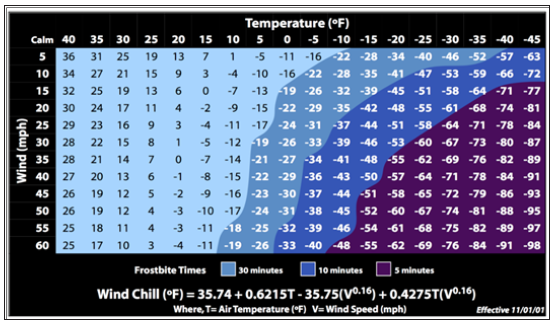
Driven by the public pursuit for a healthy modern lifestyle and a perfect body figure, an upsurge of physical training and fitness is sweeping the entire world that everyone, not only professional athletes anymore, is taking exercise all the year around, even in the chill winter outside fields. This trend also boosts the consumption of thermal-protective sportswear recently. When the environmental temperature drops below 5ÂșC, it is already dangerous to conduct outdoor exercises that cold injuries may occur, especially when taking wind this factor into consideration. The relationship among the health risk, the tense of wind, the environmental temperature and the time of human subject exposure in the outdoor, is well studied and listed in the Figure 1. It shows that in the condition where the temperature under 40°F (5 °C) and the wind intense than 5mph/h, and the exposure time exceeds 30 min, there is a high risk to get cold injuries [13,14].

Figure 1: Wind Chill Temperature Index in Fahrenheit [14].* Wind Chill Temperature is only defined for temperatures at or below 50°F and wind speeds above 3 mph. Assumes no impact from the sun, i.e., clear night sky. Frostbite times are for exposed facial skin.

Thus, sufficient thermal protection against the chill condition is critical both for elite athletes and common sports consumers. For elite athletes, injuries may lead to missing the whole season, which also means losing sponsor deals and possible prize money. For common sports consumers, injuries may cause, for example, sick leaves from work, monetary losses both for the society and the individual. Injuries can also cause mental problems, especially for elite athletes, whose career depends on their bodies and its functioning. Injuries also may harm the physical progress, especially on young athletes, who develop quickly and might fall behind because of the cold injuries [15].

However, facing this high injury risk, the only current solution is to wear multi layers of clothing, which is heavy and blocky in the end. The cumbersome and multilayer-structure cloth of such clothing restricts physical motions and normal consumers will feel more exhausted, which makes it impractical. It is critical that designers understand the movement needs of individuals who will wear these thermal protections. Movement involves time, energy and space. Among these three elements, they need to rank after their importance by gathering realistic information from the practices. Additionally, it is suggested to take off the out layer after excises and starting to sweat out. However, how to deal with the taken-off clothing will be a problem. Carry them around and do strenuous exercises simultaneously? Of course, it is a distraction from the exercises. Therefore, the proposed wearable thermal textile can act as the second layer of sports skin to against the chill weather intelligently [14].

Thursday, 12 September 2019

Lupine Publishers | A Combined Material Substitution and Process Change Approach to Sustainable Batik Production

Lupine Publishers | Journal of Textile and Fashion Designing 

Abstract

This paper empirically presents a batik production process optimization using sustainable production (SP) methods. The stages of batik production processes involve designing, methodology, dyeing, washing, and finishing. The cost of production is determined by the implementation efficiency and calculation of output to input ratio in the production process. The case study method is employed for production process optimization in two batik enterprises in the Kumasi metropolis. The main objective of this research, is to determine the impact of material sustainability, and the minimization of the production process cost in order to promote maximum operational economic benefits. The implications of this intervention shows that, in batik production process, there could be a saving cost of resisting material by GH₡ 31.00, with a process time of 290mins and an activity cost reduction of GH₡ 68.00 by just replacing paraffin wax with cassava starch. The identified intervention has also been found as significant to address the identified issues that bring a substantial change in the current manufacturing practices of the batik industry. It is recommended that much is to be gained in sustaining the practice when cultural themes are employed in the artifacts created.
Keywords: Batik Production; Environmental Resource; Sustainable Production Practices

Introduction

Batik is a process of dyeing fabric by making use of a resist technique classified by the United Nations Educational, Scientific and Cultural Organization (UNESCO) as part of the “intangible cultural heritage of humanity”. It is a traditional creative selfexpressionistic art form in fabric design which originated from the Far East and known throughout the world [1]. In Ghana today, the batik industry is recognized as a profitable enterprise in the fashion industry and is also classified under the small to medium scale creative industry. The potency of this small and medium industry at the local level cannot be over emphasized as its developmental efforts contribute to the quickening of the nation’s economic empowerment. Its merchandise is well-known in the creative industries as one of the leading developmental enterprises clustered in Ghanaian communities.
The expectation of the industry is to provide important support to the industrial sector’s contribution to local community revenue. However, its production methodology appears to be detrimental to the growth and development of the industry. The cause is not farfetched, in that the prime resist component - paraffin wax - used for its production is a foreign imported material, unsustainable in its supply and harmful to human health due to the heat it generates in the path of the melting and wax application. The cost of production makes its market price much higher than those from foreign lands. Comparatively, the cheapness of foreign batiks and the high selling price of locally produced batik compete unfavorably in the Ghanaian market. To avert this trend there is the urgent need for the implementation of sustainable production practices that offers an advantage for the progress and development of the batik industry.
This is premised on the fact that using cassava starch and its modification for batik making in Ghana due to its accessibility and sustainability is far more beneficial than the traditional use of the exportable paraffin wax which sometimes is unavailable and yet expensive in the marketplace. This makes the end product very expensive to the low income earner. Cassava offers a broad scope of applications with its overall benefits and provides livelihood to most farmers in the rural areas. Cassava cultivation is practiced in all the Agro-ecological zones in Ghana which gives strength to its sustainability in terms of cultivation [2]. In Ghana, it is estimated that 70% of farmers grow cassava, contributing 16% of Ghana’s Agricultural Gross Domestic Product (AGDP) according to Safo- Kantanka [3] and consumed by more than 80% of the population [3,4]. The cassava flours used for this innovative batik print are of two types, the white powdered flour starch used for laundry finishing treatment and the brown powdered flour starch used for food [5].
Thus far, the technique employed in Nigeria and elsewhere in the production of Adire is the white cooked starch as Braide and Adetoro [6] describe. The method of implementation is either by free-hand painting with the cooked cassava starch, or by stenciling the starch on the material. The stencils are made with corrugated zinc or a perforated tin sheet which allows the starch print on the fabric. Kadolph [7] advocates the use of cooked starch paste in Nigeria via the screen print method to force the paste out of the screen onto the fabric with the squeegee to produce Adire. Picton and Mack [8] also affirm the use of cooked cassava starch mixed with a small amount of copper sulphate to produce the Adire Eleko resist dyed fabric using the same procedure mentioned above.
Important materials commonly used as binders for traditional textiles are starch, derived from tree gums (acacia), food grains, stems or bases such as maize, wheat, tapioca and cassava. The choice of cassava starch as the vehicle for sustainable production practices is as a result of the following characteristics when applied in textile printing. Its high molecular weight compounds give a better viscous paste in water below 90⁰C since hot starch pastes continue to lose viscosity if maintained near boiling temperatures [9]. They impart adhesiveness and softness to the printing paste when used on a fabric surface without spreading. They are capable of maintaining the design outlines even under extreme pressure. They hold on to the dye particles in the desired area on the fabric until the transfer and subsequent fixation of dye onto the fabric. Its viscosity is sufficiently high to prevent rapid diffusion of the colour through the fabric and to avoid poor print definition outlines. It delivers a stable paste viscosity, which grants an even and measured flow through the sieve. The viscosity stability is not only durable in terms of the time during which the cloth is being printed, but even through the dyeing operation [10]. The resultant cohesiveness ensures that the forcefulness and the free flowing quality of the paste remains intact after its formulation and execution.

Disadvantages of Paraffin Wax

Burning from paraffin wax emit carcinogens into the air. This high temperature fast-burning wax creates a plethora of byproducts, including benzene, acetone, xylene, formaldehyde and acetaldehyde [11]. Paraffin wax as stated above has some limitations;
a. Their application process generates hazardous chemicals, creating worker safety concerns,
b. They may generate hazardous wastes, and
c. These waxes are not environmentally friendly. The soot created from these wax has been known to cause asthma and allergy flare-ups [11]. Paraffin wax is more expensive than regular cassava starch. Removing paraffin wax from the dyed cloth uses a difficult dewaxing process that requires hot boiling water and even much disturbing when bee wax is used which requires an addition of soap.
Cassava like starch on the other hand can be washed away with just cold water. Hot paraffin wax in use is very hot and thus devastating when it gets in contact with human skin. Cassava starch however is applied virtually in a cold state. “Ice patterns”, usually referred to as vein lines created when wax cools on fabric and the dye liquor penetrates, is perhaps a significant advantage of using paraffin wax over the use of starch. Its operational residue on the floor coming in contact with heat or the sun’s ray becomes a danger to workers due to its slippery nature.

Advantages of Cassava Starch

The natural thickening agent (cassava starch) used for the print paste is available and easily accessible to traditional batik and tie-dye printers all over the country. They impart adhesiveness and softness to the printing paste so it can be applied to a fabric surface without spreading. They are capable of maintaining the design outlines even under excessive pressure. They adhere to the dye particles in the desired place on the fabric until the transfer of the dye into the fabric and its fixation are complete. Its viscosity is sufficiently high to prevent rapid diffusion of the colour through the fabric, in order to avoid poor print definition outlines [12]. It has a stable paste viscosity, which allows an even and measured flow through the screen. The viscosity stability is not only durable in terms of the time during which the fabric is being printed, but even through the dyeing process, [10]. The resultant cohesiveness ensures that the strength and the free flowing quality of the paste remains intact even after its preparation and its execution [13].
Preparation of starch is much slower and at a cooler temperature than does paraffin wax. It is a process that emits less soot, if any, than paraffin wax and therefore environmental toxicity with implications on human health is eliminated. Because the starch is locally made, every purchase of it boosts the starch market and helps support farmers. Creating intricate design patterns with starch is easier to control than paraffin wax due to its cooler temperature and slower fluidity when in use than paraffin wax which tends to work better when hot with low viscosity making it difficult to control or require a higher expertise to control. Perhaps the greatest advantage in the use of starch as a resist medium is the whole change in technique that employs only a screen and squeegee.
Wax application as resist medium however, requires the use of wax application tools to print the design. The starch application technique, with its unique properties, has the ability to mimic any design and produce diverse textural effects on any substrate with high artistic value. The study, therefore, unveils the results of a pilot project that explored an abounding environmentally degradable organic material (cassava starch) as a vehicle and a resist medium in the process of batik production thus effectively reducing the production process time. This was made possible by the varied abilities of cassava to be transformed into different starch types, modified in its preparation to attain varied consistency and characteristics at different temperatures during preparation and application. The inference drawn is that the new methodology adapted is able to replace the melted wax effectively and yet maintain the batik characteristics with an enhanced well-defined images and clarity of colour prints at the end of the printing operation. This unique production methodology not only extends opportunities for adult creative work, but also makes room for kids from age 4 upwards with little help.

Methodology

In this study, a sustainable production method is used to optimize the production process of batik in two prominent batik enterprises in Ashanti Region of Ghana used for the pilot project. The main objective of this optimization is to minimize the costs incurred in the production process of batik in order to obtain maximum benefit. The innovative production method was designed to optimize the production goals of Asfatex enterprise and Craft Consult by using cassava starch and paraffin wax and other common limits of existing resources in their operations. The two basic materials in contention used are the paraffin wax and the starch and its modifications as resist mediums. A mixed methodology comprising case study, experimental and exploratory methods under the qualitative research approach was used. The experimental mainly employed the practice based research that depended on studio activities. The studio experiment contributed to the analysis established in the new sustainable production approach to create the unique type of dye prints [12]. Results of experiments conducted carefully recorded, analyzed and interpreted.
The qualitative research gave a holistic picture of what goes on in the dyeing industry [14]. The purposive sampling technique was used in selecting both the materials and the enterprises for the study, with interviews being a major tool for collecting data that was consequently authenticated by means of triangulation. The respondents were chosen based on their technical knowledge and batik-centered businesses and comprised home-based batik craft artisans, small scale batik enterprises, and consumers. There were 8 hand-drawn batik enterprises, 10 stamped batik enterprises, 2 printed batik enterprises, 7 batik garment manufacturers, 6 knowledgeable academicians, and 13 households-managed business units of batik trade.
These enterprises were used to ascertain their acceptance or rejection of starch as a substitute for paraffin wax in the manufacturing of batik. Since competition is no longer between enterprises, but among sustainable manufacturing practicing firms, effective, sustainable manufacturing practices assume a potentially valuable way of securing competitive advantage and improving industrial performance. This research conceptualizes and developed three dimensions of sustainable manufacturing practices which are the effective utilization of environmental material product and the culturally sustainable production practices and that of the manufacturing product. The anticipated benefits of sustainability though considered as latent variables was to:
A. Minimise health implications
B. Maximize financial benefits
C. And promote cultural communication that will lead to trade opportunities. The parameters used for the pilot experiments in its computations considered the use of water resources, the use of the resist medium, the consumption of the energy resources and its cultural sustainability.

Materials

Aside the main resist materials mentioned in the review, the following common materials were used in the project; 100 % mercerized cotton, tracing paper, powdered cassava starch, vat dye, distilled water for recipe preparation, aluminium/stainless pots, plastic palette bowls, cups and spoons, big plastic bowls as dyebaths. Others included small plastic palette bowls for measuring dyes, wax, mild detergent, heat source (coal pots), metal bucket, rubber gloves, thumb-tacks, P.V.A (Carpenters glue), Potassium dichromate, sodium hydrosulfite (Na2S2O4), sodium hydroxide (NaOH)), wooden ladle and aprons. Tools and equipment employed included, staple machine and pins, a pair of scissors, cutting tool, coating trough, squeegee, mesh, cello-tape, pens and pencils. A ruler, tjanting, masking tape, pressing iron, working table, and working shed, camera, computer, Wooden frames, and water reservoir for washing were additionally used. Corresponding differences in material and tool usage that were considered in the project were as follows; paraffin wax to replace cassava starch and vice versa, wooden designed stamps to replace silk designed screens

Results and Discussion

A Proposed Production Model

Based on the comprehensive study of the batik making process, a new production model was proposed with the aim of minimizing cost by utilizing an available environmentally friendly material like the local starch, to conserve energy. The new sustainable manufacturing model aims at integrating culturally sustainable approach to product design, with new application tools and methodologies in every single step of production. In fact, the case study of enterprises mentioned showed that the implementation of this new paradigm could lead to new market opportunities for the batik industry. Findings suggest that different types of environmentally sustainable manufacturing practices associated with different competitive outcomes may emerge. These specific findings could be helpful to textile designers and practitioners as they respond to environmental and competitive demands.
Though sustainable manufacturing is widely regarded as a business strategy, few researchers have concentrated on the validation of its positive link with business performance [15]. The proposed hypotheses have been tested to empirically validate the proposed model by means of conducting a summation survey among the 2 small enterprises (SMEs) located in Kumasi. The research hypotheses considered in the study indicated that the utilization of environmental resources, to promote economic benefits, and cultural sustainability is feasible in batik production. However, no previous study had tried to propose the possibility of utilizing environmental resources, to promote economic benefits, and the environmental sustainability of batik production in Ghana.
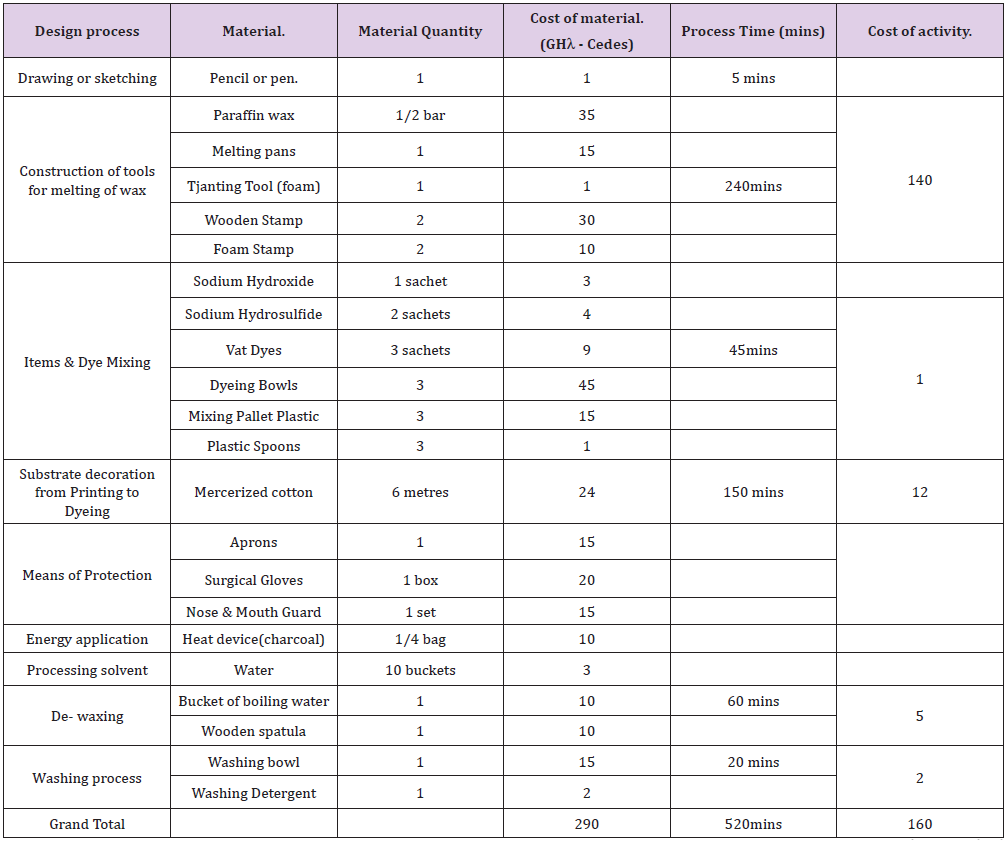
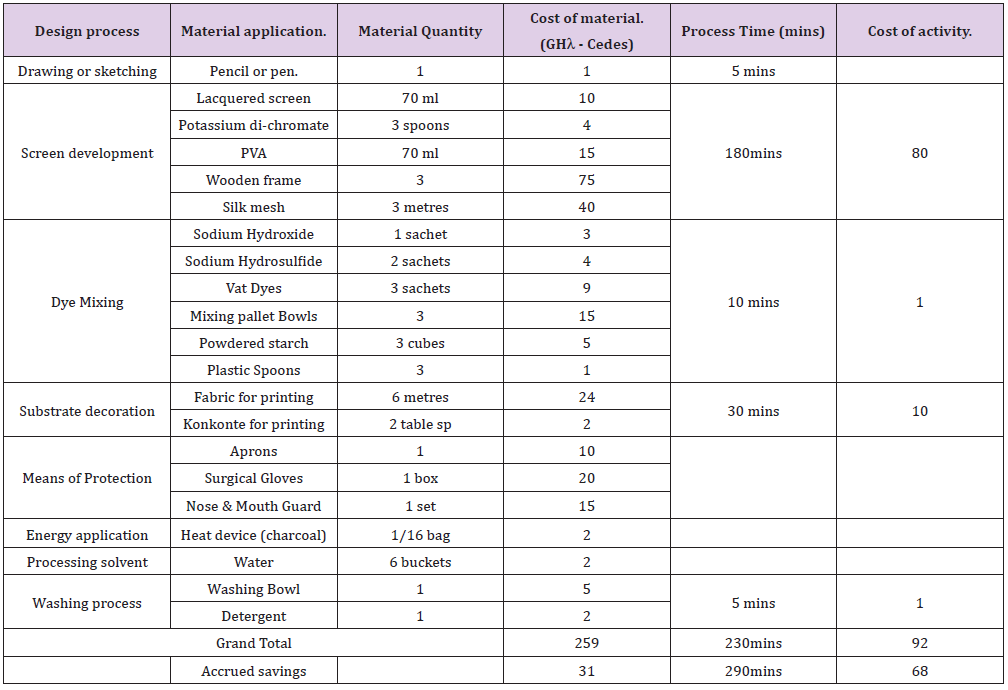
Table 1 shows the current key raw materials, material cost, process time and cost of activity in batik production process used to produce batik cloth. Table 2 shows the raw material, material cost, process time and cost of activity in batik production process used in the intervention model to produce batik. Cost of materials is stated in Ghana cedis, which indicates the amount of cost needed for the procurement of raw materials to produce 6 batik cloths for each model. The processing time is expressed in hours/minutes, which shows the amount of time required for the production process of 6 metres of batik cloth. The cost of an activity is indicated per work done at each stage of production for the 6 yards fabric and not necessarily the cost of production per month of each worker.

Traditional Manufacturing Practices

The entire production process adopted the current traditional practices that batik practitioners are familiar with using the coal pot and charcoal as a source of energy. The process engaged non-consumables and consumables but concentrated on the consumables and function driven activities since the two models all used the same non-consumables for the projects. The duration of the production process was between an hour and 2 days. The production process was executed by 2 employees from each enterprise. The production costs were calculated without taking their salaries into account. Tables 1 & 2 recorded the production process time for batik and the cost of raw materials needed as GHl 290.00 and GHl 259.00 with as much as 520 and 230 mins of production time respectively. The cost of activity for Table 1 was GHl160.00 as against GH₡ 68.00 for (Table 2). The savings accrued for material cost was therefore realized.
Table 1: Key Material Cost, Process Time and Cost of activity in Batik Production Process for traditional Batik manufacturing processes.
Lupinepublishers-openaccess-journals-Textile-Fashiondesigning
Table 2: Key Material Cost, Process Time and Cost of activity in Batik Production Process for the Proposed Intervention.
Lupinepublishers-openaccess-journals-Textile-Fashiondesigning
A critical factor worth mentioning was the fact that the chemical content within the various pastes formulated for Table 2, required a lacquered screen to secure its effectiveness of accommodating the various formulated print pastes. This was extremely important to avoid the chemical corrosion of the photographic film of the screen during the printing process [12]. To commence, four types of screens were developed,
a) Three of them was to transfer the varied dye paste to produce the printed fabrics and
b) The last, was to allow the resist konkonte paste to cover the already printed portions of the fabric, leaving the unprinted portions uncovered to allow the intake of the dye during dyeing by immersion.
Unlike the traditional batik printing process, all the three colors were printed one after the other, before the final konkonte covering and dyeing by immersion. Traditional dyeing however, followed a series of waxing, dyeing, re-waxing and re-dyeing of colour dyes within a two day period to achieve almost the same results. Thus, the differential materials used are the cassava starch and the silk screen instead of wax and wooden block. The outcome of the process is an improved quality, alongside improved efficiency in production, time management and waste minimization, an envisaged increase in market share, creation of new markets, lower costs, innovation and improved flexibility, which are all key performance criteria for industries engaged in sustainable practices. The implication of this intervention shows that use of the locally available raw material saves cost by GH₡ 31.00, with a process time of 290mins and an activity cost reduction of GH₡ 68.00. Additionally, operational cost was reduced, resulting in improved profitability, worker safety and the advantage of using an environmentally-friendly product and minimizing environmental pollution.
The efficient use of cassava starch obviously ensures that manufacturing activity are sustained due to their availability. Having dealt with the main material that impedes safety in batik manufacturing, the youth are likely to be encouraged to engage with the industry to promote sustainable rural and urban development. The implication of this intervention potentially offers the possibility of marketing its products to both local and international markets as it finds expression in traditional clothes and garments to government and private organizations. Its patronage will even increase if their aesthetic characteristics reflect the Ghanaian identity or are the expression of the people’s culture through cherished traditional apparels. This effort made to revitalize batik making is an important driver for sustainable rural development because any economy built on an available natural resource base has the likelihood of improving the vocational sector of the economy [16]. The youth equipped with such skill in schools will also strengthen the concept of made in Ghana goods to facilitate the patronage, promotion and the sustainability of locally made textiles. Holistic Economic Development based on technological innovation processes and natural resource exploitation is believed to be the key to the future of the batik industry

Conclusion

This paper examined the sustainability of batik production and its material development strategies in Ghana. It suggests that the batik enterprises are important in economic and social terms, in the short-run by providing incomes, jobs, especially for artisans, and foreign currency receipts and in the long run by providing the country the opportunity for sustained economic development through appropriate technology to enhance the dynamic effects of batik clothing. The potential of its raw materials and methodology to contribute to long-run growth and sustainable development depend not only on the qualities (desirable or otherwise) of the product, but also on the quality and effectiveness of production processes and availability of raw materials at a low cost within the country’s forest and market space. The effects on employment of the batik enterprises are quite significant for economic development compared to the overall share of the country’s total employment in the cloth manufacturing sector within the various communities in Ghana.
An important factor for the sustainability of an enterprise is the genuine involvement of the local people (farmers) as active participants whose beneficial concerns and experience are essential to the enterprise’s success [17]. The level of community support determines whether the enterprise becomes successfully established, and how it quickly responds and adapts to meet changing needs. By exploiting Ghana’s low labour cost advantages to fill emerging niches and meet buyer demands, its dynamic effects for sustainability becomes even greater, if more linkages can be built up between the production centres and the community. In effect, the characteristics of the batik product (relatively low capital intensity; low investment costs; and use of low skilled labour), also mean that the industry is relatively footloose and able to adjust to changing market conditions quickly and further increasing its sustainability [18].
Though batik making is seen as a productive venture with export potential, it lacks fast production approaches to meet higher consumer demands and therefore needs to be revived and sustained as an industry. Making room for new developmental ideas will inject new techniques of production and make production easier and sustainable. The selection of right material is critical, as it does not only affect the product’s cost, enhance methodology, quality, and growth of batik enterprises, but also impact the environment. Adopting such innovative practices will guarantee the benefits derived in the environment, to promote safety, minimize energy utilization and health of producers [19].

Recommendations

It is highly recommended that batik be introduced into a broader public space to provide a viable platform for engagement between academia and industry through studio base learning (workshops) of batik design processes not only in educational institutions, but also in batik making communities. The focus of sustainability and development in this direction needs to be strengthened using different local material components and design methodologies that relate to traditional African textile culture. Finally, for sustainability of the batik craft to be successful, it is also recommended that skills training of batik producers be intensified and encouraged to create new forms using varied methodologies.

Acknowledgement

We would like to acknowledge Miss Juliet and Miss Christina Mensah for their contribution to the background work and critical comment on the paper. The authors would like to thank the following for their support of this project: Asfatex enterprise in KNUST campus and craft consult at Bomso.

For more Lupine Publishers Open Access Journals Please visit our website:
http://lupinepublishers.us/
For more Open Access Journal on Fashion and Textile Engineering articles Please Click Here:
https://lupinepublishers.com/fashion-technology-textile-engineering/

To Know More About Open Access Publishers Please Click on Lupine Publishers

Friday, 21 September 2018

Dyes and Dyeing: (LTTFD) - Lupine Publishers


Dyeing in ancient times was conducted from natural animal and vegetable resources till artificial dyes were discovered in the middle of the 19th century in coal tar. Mordating using inorganic compounds to fix the dyes on textile material was responsible for the creation of alumina for the growing aluminum industry at the end of that century. Now inorganic material like asbestos can be dyed with synthetic dyes to render it less toxic and some minerals are dyed to enhance their beauty.