Coordination polymers including metal-organic frameworks, clathrates
and cyanometallates have recently gained significance as an important
class of solid state materials. In this critical review, the diversity,
classification, synthesis, structure, properties, applications,
geometrical and chemical factors that influence their formation have
been carefully presented. The synthesis of these new classes of
compounds from molecular building blocks and demonstration oftheir high
surface area, adsorptive and trapping potentials of molecules,
selectivity in separation and uptake of molecules, tunable and
modifiable molecular structure, and photoluminescence, magnetic and
antimicrobial responses holds the potential for innumerable applications
based on these tailored properties.
Keywords: Coordination polymers; Properties; Applications; Metal organic frameworks
Abbrevations: MOFs: Metals-Organic
Frameworks; CPs: Coordination Polymers; SBUs: Secondary Building Units;
PCPs: Porous Coordination Polymers; HSAB: Hard Soft Acid Base; KTP:
Potassium Titanyl Phosphate; CT: Computed Tomography
Introduction
The development of polymer materials with coordination complexes as
repeating units has increased in recent years .In the past decade, there
have been rapid growth in coordination polymers and this defines one of
the most exciting fields in solid state chemistry. The surprising
variety of structures, compositions and properties of these polymers as
well as their easy modification and synthesis has attracted many
researchers [1]. As a consequence of the various synthetic procedures
followed with modifications of the structures of these polymers, solid
state chemistry has moved in several different directions depending on
the particular property being investigated. Coordination polymers have
very many unique properties that its applications can never be over
emphasized. Their relevance in many fields like organic and inorganic
chemistry, biochemistry, material science, electrochemistry and
pharmacology with very many potential applications has led to extensive
study of these polymers. Coordination polymer is a coordination compound
or an inorganic or organ metallic polymer structure having metal cation
centers connected by organic ligands with repeating coordination
entities extending in one, two or three dimensions [2].
Coordination polymers have the subclass coordination networks which
are coordination compounds extending through repeating coordination
entities in one dimension but with crosslinks between two or more
individual chains, loops, or spiro- links or a coordination compound
extending through repeating coordination entities in two or three
dimensions or metals-organic frameworks (MOFs) a coordination network
that have organic ligands containing potential voids. Various authors
have defined the concept based on their perceptive but all are the same
or nearly related. Rowsell & Yaghi [3] noted that coordination
polymers (CPs) are solid species produced by metal clusters ligated to
polydentate organic complexones. By this definition, enormous variety of
species containing organic molecules and metals defined by
characteristic properties such as porosity, non-porosity, crystallinity
and amorphosity with emphasis on metal organic frameworks (MOFS) as
special group of coordination polymers. The terms coordination polymers
and metal organic frameworks have been currently used interchangeably.
Cheetham et al. [4] noted that coordination polymers, or metal organic
frameworks (MOFs) defines extended network arrays of metal clusters
joined to polyfunctionally defined organic specie.
Therefore, coordination polymers (CPs) within the last decade emerged
as hybrid materials made up of organic bridging ligands coordinative
bonded to metal ions or metal ion clusters which when crystalline and
three-dimensional are often regarded as metal-organic frameworks (MOFs).
Metal organic frameworks (MOFS) according to O' Keeffe [5] used to be
interchangeably used as coordination polymers but it specifically apply
to materials with frameworks built by linking polyatomic clusters
(secondary building units or SBUs) formed holistically by strong
covalent bonds unlike coordination polymers which have some interplay of
weaker bonds and lower stability. Long & Yaghi [6] observed that
inorganic joints are linked with organic units regarded as struts
through strong interaction to yield non-porous or porous metal organic
framework wrapped in architecturally extended network. Thus, the term
“coordination polymers” refers to molecular crystal assembly or systems
in which metal atoms multitypically coordinates to organic components.
The metal organic framework currently discussed as reticular chemistry
include components linked by strong bonds as indicated in metal
carboxylates and is differentiated from coordination polymers.
Classification of coordination polymers
Coordination polymers can be classified in different ways according
to their structure and composition into porous coordination polymers and
non-porous coordination polymers. Porous coordination polymers (PCPs)
are micro porous materials or coordination polymers that have large
surface area grouped into flexible porous coordination polymers and
rigid porous coordination polymers. Flexible porous coordination
polymers are coordination polymers whose structures are transformable
depending on external stimuli. They are highly flexible, porous with
high surface area and possibility of rotation of their bridging ligands.
Rigid porous coordination polymers are rigid and their structures are
not transformable unlike the flexible porous coordination polymers [7].
Coordination polymers can also be classified according to
dimensionality in which the structure can be determined to be one
dimensional structure coordination polymer, two dimensional structure
coordination polymers and three dimensional structure coordination
polymers [8]. This classification depends on the number of directions in
space the array extends. One dimensional structure coordination
polymers extends in a straight line that is along the x axis as
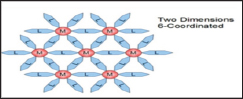
illustrated in Figure 1. Two dimensional structure coordination polymers
extends in a plane that is in two directions, x and y axis illustrated
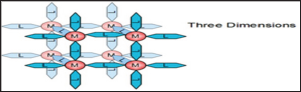
in Figure 2. Three dimensional structure coordination polymers extends
in all three directions, that is x, y, z axis as illustrated in Figure
3.
Figure 1: One dimensional structure coordination polymers.
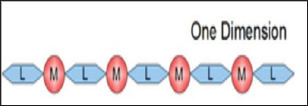
Figure 2:
Two dimensional structure coordination poly-mers.
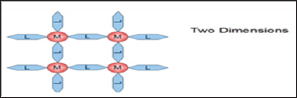
Figure 3: Three dimensional structure coordination poly-mers.
Factors that determine the crystal structure and dimensionality of coordination polymers
Figure 4: Dimensionality of coordination polymers.
The crystal structure and dimensionality of the coordination polymer
is determined by intermolecular forces and bonding, coordination
geometry, metal centres, ligands, crystallization environment, counter
ion and guest molecules. Intermolecular forces are one of the factors
that affect the structure and dimensionalities of coordination polymers
and include van der waal forces, n- n interactions, hydrogen
bonding and stabilization of n bonds of polarization bonds in addition
to the coordination bond formed between the metal and the ligand. The
coordination geometry and the functionality of the linker of the metal
center determine the crystal structure and dimensionality of the
coordination polymers. Dimensionality as shown in Figure 4 is driven by
the metal center that can possess the ability to bond to as many as
sixteen functional sites on linkers. This number of possible bonds is
the coordination number, commonly between 2 and 10 and the bonding sites
are distinctly separated by angles [9].
Metal centers known as nodes or hubs bond to a particular number of
linkers at well-defined angles. These number of linkers bound to a node
is called coordination number and are held along with the angles which
determine the dimensionality of the structure. Coordination number and
coordination geometry of a metal center is determined definitely by the
number of uniform distribution which increases with increase in cation
size [9]. Prediction and explanation of coordination geometry is
difficult in part due to the complex effect of environment on electron
density distribution. Although, models like hybridization model and
molecular orbital theory use Schrodinger equation to predict and explain
it. Metal centers in coordination polymers could be that of
a) Transition metals: These are commonly used as nodes either
in the atom or ion and particularly filled d-orbitals can hybridize
differently. This depends on the environment of the transition metals,
particularly copper and gold ions that have fully filled d-orbitals in
their outer shell as neutral atoms exhibit multiple coordination
geometries because of their electronic structure.
b) Lanthanides: These are large atoms that have coordination
number varying from 7 to 10. Lanthanides coordination environment are
difficult to predict making them hard to use as nodes. They create
avenue of mixing luminescent components.
c) Alkali metals and alkaline earth metals: These metals exist
as stable cations and readily form cations with stable valence shells.
This gives them different coordination behavior than transition metals
and lanthanides. They are very much affected by the counter ion from the
salt used in synthesis and that is hard to avoid. Consequently, the
dimensionalities of the structures increase as the radius of the metal
increase down the group that is, from calcium to strontium to barium as
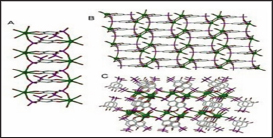
shown in Figure 5a-5c. These metal cations from the group 2 of the
periodic table increase in metal cation size and polarizability leading
to increase in dimensionality [10,11].
Figure 5a-5c: Diagrams showing (a) [CaCl)(H2O)].H2O (b) [Sr(L)(H2O)4] (c) [Ba(L)(H2O)4].H2O.
A ligand in most coordination polymers will formally donate a lone
pair of electrons to a metal cation and form a coordination complex by
the means of acid/base relationship. Coordination polymer is formed by a
ligand when it has the capability to form multiple coordination bonds
and acts as a bridge between multiple metal centers. Ligands are of two
types namely monodentate ligand and polydentate ligand which forms
single coordination bond, referred to as terminal due to their inability
to offer a place for the network to continue and form multiple
coordination bonds that could lead to coordination polymers as they
connect multiple metal centers together that an infinite array is formed
respectively. These ligands can also form chelates, that is, multiple
bonds of the same metal. Most at times, coordination polymers will
contain a combination of polydentate and monodentate bridging, chelating
and terminal ligands but is dependent on chemical composition and
structural orientation [12]. Nearly atoms of any type that have a lone
pair of electrons can be incorporated into a ligand.
Common ligands in coordination polymers include; polypyridines,
phenanthrolines, hydroxyquinolines and polycarboxylates. Common binding
sites are oxygen and nitrogen atom through other atoms like sulphur and
phosphorous. As a consequence, the hard soft acid base theory (HSAB)
trends are likely followed by ligands and metal cations. This implies
that larger, more polarizable soft metals will coordinate more readily
with larger more polarizable soft ligands and small, non-polarizable
hard metals coordinate to small, non-polarizable hard ligands. Another
factor that affects the structure of coordination polymers is the
structural orientation. Ligands can either be flexible or rigid. A rigid
ligand has no freedom to rotate around bonds or orient again within a
structure. Flexible ligands produce more variety in the structure
because they can bend, rotate around bonds and orient themselves again.
There are examples of coordination polymers with two configuration of
the same ligand within one structure [13] and two separate structures
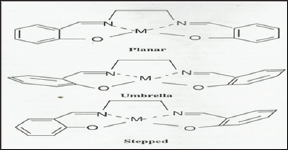
with different ligand orientation. Example of a flexible ligand is shown
in Figures 6a and b.
Figure 6a: Example of a flexible ligand.
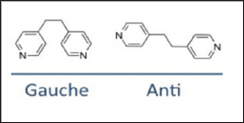
Figure 6b: Planar, umbrella and stepped molecular confor-mations of Salen complexes.
Apart from metal and ligand choice, the structure of the coordination
polymers can be affected by many other factors like counter ion. For
instance, most of the metal centers are positively charged ions that
exist as salts. A counter ion in the salt can affect the overall
structure. Using silver salts as an example, AgNO3, AgBF4, AgClO4,
AgPF6, AgASF6 and AgSbF are all crystallized with the same ligand. Their
structures differ in term of the coordination environment of the metal
and the dimensionality of the entire coordination polymer [14].
Crystallization environment also affects the structure of coordination
polymer. Varying the crystallization environment can change the
structure of coordination polymer. According to Ni et al. [15], changes
in pH change the resulting structure of coordination polymer, also
exposure to light or change in temperature do affect the structure [16].
However, these influences can be determined on a case by case basis.
Guest molecules are molecules used to occupy pores or channels in
coordination polymers. These molecules determine the stability of
coordination polymer structure. Coordination polymer structures always
have empty space in the form of pores or channels.
Thermodynamically, this empty space is not favorable. Therefore, in
order to maintain a stable structure and prevent the collapse of
coordination polymer structure, the channels or pores are often filled
with guest molecules. These molecules do not form bond with the
surrounding lattice but interact sometimes by the means of
intermolecular forces like hydrogen bonding or n stacking. Frequently,
the solvent used in crystallizing coordination polymer will be the guest
molecule but, it can also be anything like other salts present,
atmospheric gases such as Nitrogen, Oxygen, CO2, etc. Lastly, guest
molecule present can sometimes influence the structure of coordination
polymers by supporting a pore or channels where otherwise none would
exist. The structure of coordination polymer may be affected by the
addition and removal of guest molecules. This is illustrated below in
Figure 7a with (top) change of a linear 1D chain to a zigzag pattern,
(middle) staggered 2D sheets to stacked, and (bottom) 3D cubes become
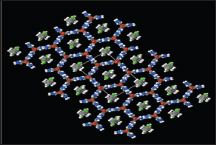
more widely spaced. Where a lattice traps or contains guest molecules
extending into polymeric species, a clathrate compound is formed. This
polymeric compound envelops the guest molecule with bars or in lattice
as illustrated in Figure7b.
Figure 7a: Conformational changes in coordination poly-mers due to guest-host interaction.
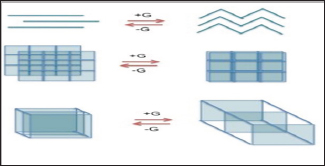
Figure 7b: Clathrate compound.
Synthesis of coordination polymers
Self-assembly which involves crystallization of metal salts with
ligands, a replica of the method of growing crystals has been the
commonest, reliable and age long method for synthesizing coordination
polymers. These methods involve growing crystals of adequate size and
quality as the characterization method involves the use of x-ray
crystallography. Commonly used methods include slow diffusion (solvent
layering), slow evapouration and slow cooling. Apart from this general
method, some other methods applied in the preparation of some
coordination polymers in order to get advantageous properties are
discussed. The various methods, advantages and disadvantages are briefly
listed. In slow evaporation method, metal salts and organic linkers are
mixed together in the liquid phase with or without the aid of
additional auxiliary molecules however, time-consuming is one of the
major disadvantages in comparison to other conventional synthesis
methods [17]. This could be overcome by using low-boiling solvents.
Hydro/solvothermal method involves liquid-phase synthesis and the
reaction is carried out at higher temperatures (temperature higher than
lOOOC) and pressure for several hours or days with the aid of closed
vessels.
The method is advantageous because it offers high solubility of the
precursors and the formation of good quality metal organic framework
crystals suitable for structural characterization. On the other hand,
microwave assisted synthesis which makes use of energy in the form
microwaves for a period of about an hour is advantageous because the
technique is adjustable to power outputs, pressure and a wide range of
temperatures. Other methods such as mechanochemical method are
considered better because the use of organic solvents can be avoided,
room temperature is sufficient, side products formed are harmless and
MOF can be obtained in short reaction time [17]. In sonochemical
synthesis, the idea is to shorten the crystallization time by the
application of ultrasound energy thereby creating energy efficient,
environmental friendly method used to generate homogeneous nucleation
centers which has no direct interaction between ultrasound and
molecules. The emergence of electrochemical synthesis brings into focus a
fast and continuous production of large amounts of metal organic
framework crystals with the use of metal ions in synthesis instead of
metal salts.
Synthetic methods of transition metal coordination polymers
Transition-metal coordination polymers are generally prepared using
three general methods. These methods include the following; use of
ligands capable of simultaneously coordinating to two metal atoms to
generate the desired polymer, use of performed polymers to which metal
atoms are attached to yield polymers of useful properties and the use of
transition-metal coordination complexes containing at least one of the
ligands with functional group useful in polymer formation [18,19]. The
use of ligands capable of simultaneously coordinating to two metal atoms
to generate the desired polymer could be represented using equation 1.
nM + n(-Y-) → (-M-Y-)n 1
Figure 8a: Coordinating polymer formed from monoden-tate halide or pseudohalide ligands.
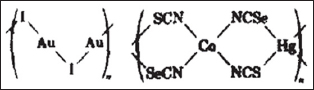
Figure 8b: Coordinating polymer formed from bis-chelat-ing ligands.
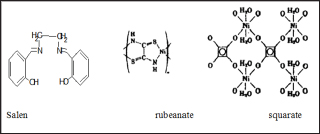
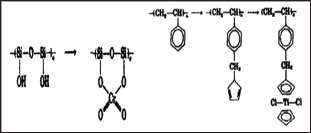
Figure 9: Silica and polystyrene support polymer.
M the metal atom and Y the ligand. For a monodentate halide or
pseudohalide ligands, coordinating polymer illustrated in Figure 8a is
formed. In a case where the ligand is multidentate, structures such as
that in Figure 8b could be formed from bis-chelating agents like Salen,
rubeanate or squarate. Grubbs et al. [20] noted that silica and
polystyrene support polymer with phosphines, amines or cyclopentadienyl
ligands act as functional group on polystyrene supports as illustrated
in Figure 9. Recently, the use of transition- metal coordination
complexes in which at least one of the ligands has functional group that
can be used in polymer formation is on the increase. Much interest has
been on this method in recent years and substituted metallocenes have
been the most interesting in this research. Pittman et al. [21] observed
that vinylferrocene forms both homo- and copolymers on polymerization
in almost the same pattern as ethylene polymerizes by addition as
illustrated in Figure 10a.
Figure 10a: Vinylferrocene coordination polymer.
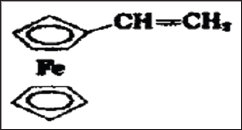
Figure 10b: Polyesters formation between metallocene and alkanols.
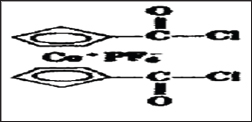
Figure 10c: Rigid rod like polymer from condensation of Pt [P(n-C4H9)3]2Cl condenses with but-1,3-diene.
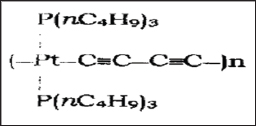
Figure 10d: Linear chains of octahedral coordination.
In a similar faction, acid chlorides of various metallocenes undergo
condensation with alkanols to form polyesters as shown in Figure 10b.
Condensation complexes such as, Pt [P (n-C4H9)3]2Cl condenses with
but-1,3-diene to form rigid rod like polymer illustrated in Figure 10c.
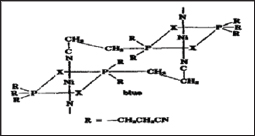
Foxman & Janfmann [22] showed that
square planar NiX2[P(CH2CH2CN)3]2 (X=Cl, Br) complexes polymerize either
in solution or solid state to form linear chains of octahedral
coordination as the nitrogen atom of one cyanoethyl chain bonds to the
nickel atom of another adjacent complex as
shown in Figure 10d.
Figure 10e: Example of supramolecular polymer.
Synthetic method of porous coordination polymers
Generally, porous coordination polymers (PCPs) are prepared in the
liquid phase by using solvent as a medium to induce the self-assembly of
a regular framework. This type of reaction can be carried out by mixing
the metal ion solution with the chelating ligand solution at room
temperature or under hydrothermal or solvothermal conditions [23]. Metal
ion and ligand, solvent and counter ions must be involved to get porous
coordination polymers of desired property. The limitation of flexible
ligand products complexes of been structurally amorphous therefore
allows the use of rigid or semi-rigid ligands for such purposes. The
rigidity of aromatic ligands which may be neutral, cationic and anionic
other than the aliphatic ones gives them an edge in the synthesis.
Initially, the prepared porous coordination polymers do not have void
space because the guests filled all the cavities and these guests may be
solvent molecules, excess ligands or counter ions. To make the void
spaces usable, the guest molecules are substituted with sufficiently
volatile or exchangeable solvent molecules.
Notwithstanding the relevance of vacant spaces, some porous
coordination polymers cannot exist without the guest molecule. In some
porous coordination polymers the solvents collapses after and are
removed. In such a case, the solvent are likely to be unimportant in the
use ofthe polymer as it will be eliminated after the preparation of the
polymer. Solvent play notable role in the preparation and
characteristics of porous coordination polymers such as the size and
shape of pore and can be controlled by using different solvents [24].
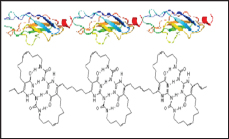
The evolution of another branch of coordination polymers, the
supramolecular polymers as shown in Figure 10e. The monomeric units are
held together through highly directional and reversible non-covalent
bonding relationship which subsequently defines their properties.
Similarly, building frame work template and formation of open molecular
structure is feasible eliminating catenation. Sareeya et al. [24]
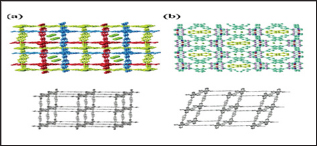
demonstrated notable examples such as (a) [(Co3(ndc)3(bipyen)1.5].H2O]n and (b) [(Co3(ndc) (bipyen)1.5].H2O.C6H6]n where ndc is naphthalinedicarboxylate as shown in Figures 11a & 11b.
Figure 11(a,b): Structures of (a) [(Co3(ndc)3(bipyen)1.5]. H2O]n and (b) [(Co3(ndc)(bipyen)1.5].H2O.C6H6]n where ndc is naphthalinedicarboxylate (Sareeya et al, (2008)).
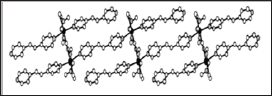
Specifically, Cd(NO3)2(1,2-bis(4-pyridyl)ethyne)1.5]n was made by the
reaction of Cd(NO3)2.4H2O with trans-1,2-bis(4- pyridyl)ethyne in a
methylene chloride/methanol solvent system. Large pale yellow infinite
one dimensional structure of inter penetrating molecular ladder
coordination polymer crystals formed at the interface of
methanol/methylene chloride was collected by filtration to give a yield
of 50% as shown in Figure
12. Similarly, [[Cd(NO3)2(1,2-bis(4-pyridyl)ethene)1.5]n was synthesized
from the reaction of Cd(NO3)2.4H2O with the trans- 1,2-bis
(4-pyridyl)ethene ligands in ethanol/water system. At the interface of
the ethanol/water large colorless crystals were formed, collected by
filtration and washed severally with n-hexane. The coordination polymer
formed of 75% yield has a novel infinite non-interpenetrating zigzag
chain structure that is made up of trans-1, 2-bis
(4-pyridyl)ethene-Cd-trans-1,2-bis(4-pyridyl)ethene-Cd-
trans-1,2-bis(4-pyridyl)ethene building units as shown in Figure
13.
Figure 12: Coordination environment around the cadmium atom in [Cd(NO3)2(1,2-bis(4-pyridyl)ethyne)1.5]n (Sa- reeya et al, (2008).
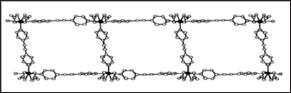
Figure 13: Coordination environment around the cadmium atoms in [Cd(NO3)2)2(1,2-bis(4-pyridyl)ethene)1.5]n ( Sareeya et al, (2008).
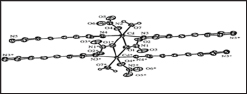
[Cd(NO3)2(1,2-bis(4-pyridyl)ethane)1.5]n was also
synthesized by the reaction of Cd(NO3)2.4H2O with the 1,2-bis
(4-pyridyl) ethane chelating ligand in a methylene chloride/methanol
system. Colourless crystals were obtained overnight, collected by
filtration with a yield of 72%. This coordination polymer forms square
units that are connected through the two Cd (II) centers to give
infinite linear chains [25] as shown in Figure 14.
Figure 14: Coordination environment around the cadmi-um atoms in [Cd(NO3)2)2(1,2-bis(4-pyridyl)ethane)1.5]n ( Sareeya et al, (2008)).
Nanoporous coordination polymers
Coordination polymers have been synthesized and used for a wide range
of applications including gas storage, nonlinear optics, drug delivery,
catalysis and chemical sensing but recent works has been extended to
templates synthesis of silica nanoshells nanoporous carbon and metallic
nanoparticles [1] bearing in mind that most nanoparticles contain either
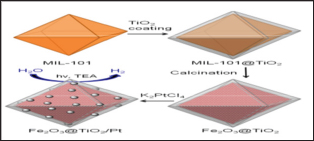
only organic or only inorganic components. A typical template is
represented in Figure 15. Many methods abounds for the synthesis of
nanoparticles of coordination polymers or nanoparticles of metal organic
frameworks but all of the processes takes advantage of reduced
solubility of the particles in comparison of the individual components.
Common methods rountinely used include solvothermal synthesis, simple
mixing of precursor solutions, precipitation by rapid addition of a poor
solvent, high-temperature surfactant-assisted synthesis and reverse
microemulsion synthesis [1,2,26]. Specifically, a nanoparticle metal
organic framework with the formula Zr6O6(OH)4(BDC) (BDC = 1,4-benzenedicarboxylate) was made by the solvothermal method.
Figure 15: Coordination polymer templated synthesis of
Fe2O3@TiO2 by coating MIL-101 with TiO2 followed by calcination, and its
use for photocatalytic hydrogen production after depositing Pt
particles (Kitagawa et al., 2004)
Another group of coordination polymers regarded as cyanometallates is
composed of relevant building blocks for series of one, two and three
dimensional coordination polymeric networked structures with transition
metal templates. Some authors [27-29] noted that this group of
strikingly important compound possesses clathrate hosts' structure with
properties not
limited to spin-crossover phenomena and molecular magnetism. In a
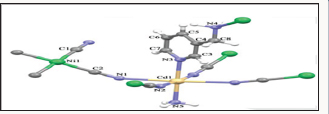
typical synthesis, Dursun et al. [30] prepared (K2(Ni(CN)4].H2O) cyanometallate by mixing the stoichiometric amounts of N iCl2. 6H2O with potassium cyanide in water. The coordination polymer [Cd(NH3)(μ-ampy)Ni(μ-CN)4]n (ampy= 3-aminomethylpyridine) was synthesized by mixing together with the water K2(Ni(CN)4]. H2O
and cadmium compound of 3-aminomethylpyridine. The coordination polymer
of 3D conformation crystallizes in the orthorhombic crystal system with
the asymmetric unit containing one Cd(II)ion, one Ni(II)ion, one amine,
four cyano and bis(monodentate) bridging ampy ligands having Ni(II)ion
coordinated in square-pyramidal geometry as illustrated in Figure 16.
Figure 16: Coordination polymer templated synthesis of
Fe2O3@TiO2 by coating MIL-101 with TiO2 followed by calcination, and its
use for photocatalytic hydrogen pro-duction after depositing Pt
particles (Kitagawa et al., 2004).
Properties of Coordination Polymers
Notable unique properties attributed to coordination polymers makes
these groups of compounds very useful in various applications. This has
increased research in coordination polymers where transition metals are
linked with suitable ligands in the past years. Notable excellent
properties not limited to semiconducting and catalytic properties,
protective coating properties, waste water treatment for metal recovery,
as antifouling paints and anti-microbial properties. Coordination
polymers with efficient ionophores have been of much interest and
constant consideration owing to their efficient therapeutic and
fluorescence properties [31,32]. Some coordination polymers containing
ionosphores of 8-Hydroxyquinoline are important in areas of metal
recovery from waste water as they exhibit complexing ability, as water
disinfectants, protective coatings, ion-exchange resin, gels and
ointment for medical applications, antifouling paints, antimicrobial
agents, surgical materials.
Electrical conductivity
Coordination polymers exhibit electrical conductivity as one of their
important properties. Some coordination polymers have short inorganic
and conjugate organic bridges in their structure which provide pathways
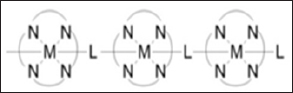
for electrical conduction. A one dimensional coordination polymer that
exhibit conductivities in a range of 1x10- 6 to 2x10⁻¹ S/cm is shown in
Figure 17. The conductivity has been supported to be as the result of
the interaction between the metal d-orbital and the π level of the
bridging ligand [2]. Coordination polymers could also exhibit
semi-conductive property and a typical
example is the three dimensional structures that comprise sheets of
silver containing polymers when the metal centers are aligned. The
conduction decreases as the silver atoms move from parallel to
perpendicular direction.
Figure 17: One dimensional coordination polymer where M =
Fe, Ru, OS; L = Octaethylporphyrinato or pthalocya-ninato and N belongs
to pyrazine or bipyridine
Magnetism
Magnetism is one ofthe major properties exhibit by coordination
polymers. They show three types of magnetism a consequence of
cooperative phenomena of the magnetic spins within a solid and which
include antiferromagnetism, ferromagnetism and Ferrimagnetisms. The
property results from the coupling between the spins of the paramagnetic
centers. Research [2,33] has shown that efficient magnetic property is
obtained when metal ion is bridged by small ligands thereby allowing
short metal- metal contacts as exemplified in cyano, or oxo, azido
bridges.
Luminescence
Luminescent coordination polymers typically contain organic
chromophoric ligands that absorb light and then transmit the excitation
energy to the metal ion. Coordination polymers are the most versatile,
efficient and effective luminescent species potentially because of their
emission properties being couples with guest exchange relationship
[2,34]. Of recent, luminescent supramolecular architecture has been of
much interest and great deal of work has been on the high gear on their
potential applications in optoelectronic devices or as fluorescent
sensor and probes since they are stable, both thermo and solvent
resistant in comparison to organic species. Katz et al. [35] has noted
that some ligands fluoresce in the absence of metal linker not because
of ligand to metal charge transfer but the intense photoluminescence
emission of the coordination polymers is of magnitudes higher than that
of the free ligand. This further explained the fact that increase in
rigidity and asymmetry of the ligand upon coordination to the metal
center increases the fluorescence of the specie.
Sensor capability
Of notable interest in the property of coordination polymers is the
change in colour upon the change of solvent molecule mixed into the
guest structure. The variation or replacement of the solvent in the
coordination sphere leads to change in the geometry of the polymer
necessary in sensor application. A typical example when two cobalt
coordination polymers of the type [ReS(CN)]4- - cluster contains water
ligands coordinated to the cobalt atoms. Replacement of water with
tetrahydrofuran changes the original orange solutions to either purple
or green while on addition of diethylether, the colour changes to blue
[2,36]. Coordination polymers in this case act as solvent sensor capable
of physically changing color in the presence of certain incoming
solvents displacing the water ligands on the cobalt atoms resulting in a
change of their geometry from octahedral to tetrahedral.
Non-linear optical behavior
Non-linear optical behavior one of the striking properties of
coordination polymers describes the ability of a material or materials
to convert frequency and intensity modulation. Research [34,37] has
shown that one of the best known non-linear optical materials is a one
dimensional coordination polymer, potassium titanyl phosphate (KTP). KTP
characteristically has high non-linear optical co-efficient, low
threshold power, high optical damage threshold and low phase matching
sensitivity [37] and could be a good replacement for silicon solar cells
which is limited in mobile applications and processing cost.
Flexibility
This very unique property peculiar to third generation porous
coordination polymers because they showcase flexible framework and
dynamic functionalities is highly sought in industrial polymer
materials. Sareeya et al. [7] noted that this form of flexibility common
to porous coordination polymers and not observed in other porous
material like zeolite and activated carbon makes the coordination
polymers respond to external stimuli by reversible structural
transformation. Thus, the guest molecules serve as the stimuli capable
of transformation of flexible porous coordination polymers with the
rotation of the bridging ligands possible due to uncommon high
flexibility of the coordination polymer. The presence of high void space
provides more applicable and efficient function for this group of
compounds as they are more dynamic than other non-porous solids as
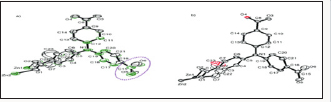
enough space allows ligand rotation. Typically, a 3-dimensional porous
coordination polymer [(Zn3(nbt)2(EtOH)].4EtOH]n (Figure 18) shows
reversible structural transformation through the coordination geometry
of Zn2+ changing from a trigonal bipyramide [(Zn3(ntb)2(EtOH)2] n to a
tetrahedral [Zn3(ntb)2]n after the removal of EtOH molecules coordinated
to the framework without the collapsing the structure. Similarly,
rotation of the O-C-O plane of the carboxylate part geometrically
changes the structure. (ntb = NN,N',N”- nitrilotrisbenzoate).
Figure 18: Structures of (a): [(Zn3(ntb)2(EtOH)2]n to a tetrahedral (b): [Zn3(ntb)2]n where (ntb = NN,N',N"-nitrilotris-
benzoate) (Sareeya et al 2008).
Thermal stability
Thermal stability of coordination polymers is one of the most
striking properties of this group of compounds. They are notably of low
thermal conductivity, low density and exhibit phonon phenomena (energy
carriers are linked with the vibration modes of crystal lattices) making
them dielectric materials [2,7]. The thermal conductivity of porous
coordination polymers rely on the mode of phonon scattering which could
be phonon-grain boundary, scattering defect-phonon scattering or phonon
scattering. Recently research by Huang et al. [38] opined that thermal
conductivity of single crystal metal organic framework below 35K of
temperature increases with temperature increase and defect phonon
scattering mechanism dominates. Within the range of 35 to l00K of
temperature, phonon-phonon scattering mechanism becomes prominent
leading to rapid thermal conductivity decrease with temperature increase
whereas above 100K of temperature, thermal conductivity is mostly
independent of temperature indicating minimum phonon mean free path.
Porosity
Sareeya et al. [7] noted that porous coordination polymers are highly
porous and they have high surface area with permanent pore size and
pores shape. This is an advantage of porous coordination polymers for
gas storage application. This property has given them edge over their
non- porous counterpart in industrial applications.
Solvent resistance and ferroelectric property
Coordination polymers are resistant to solvents compared with purely
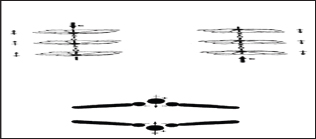
organic species [2]. Coordination polymers especially the Shiskabob
class of transition-metal coordination polymers [39] of typical example
the non-planar metalloporphyrins with non-symmetrical bridging ligands
carry a net and aligned dipole moment along the stacking axes as shown
in Figure 19. This dipole moment originate from the change separation
between the bowl shaped porphyrinato core and the metal atom. The metal
atom tends to be pulled out of the porphyrin plane by a stronger axial
ligand.
Figure 19: The schematic representation of ferroelectric
coordination polymer and dipole moment switching in response to an
externa! field.
Applications of Coordination Polymers
Coordination polymer an organometallic or inorganic polymer or a
coordination compound with coordination complexes asrepeating units are
important in inorganic and organic chemistry, material science,
pharmacology and electrochemistry because of the stunning variety of
their structure, compositions and easy tailoring widening their
applications in most areas of modern society [7,40,41]. Specifically,
they are used as commercial dyes, in separation of hydrocarbons, as
molecular sieves, light emitting diodes and other miscellaneous
applications.
Pigment
Coordination polymers are used mainly in the commercial form as dyes. A cyanide complex known as Prussian blue (Fe4[Fe(CN)6].
XH2O) is also commercially used as dye. The compound is easy to make,
cheap, non-toxic and intensely colored and widely used as a pigment in
oil and water color and dyeing as pigments in the production of black
and bluish inks and a common pigment in paint [7].
Separation of hydrocarbons
Among the early commercialized coordination polymers are the Hofmann
compounds which crystallize with small aromatic guests such as some
xylenes, benzene and of the formula Ni(CN) Ni(NH) [2]. The selectivity
of this material has been applied in the separation of hydrocarbons.
Electrical conductors and semiconductors
This is one of the most important applications of coordination
polymers. Many coordination polymers are used in materials science as
electrical conductors and semiconductors. Metal conductivity is
generally higher than semiconductors with temperature dependence
defining the difference as increase in temperature increases electrical
conductivity in metals unlike the semiconductors in which increase in
temperature decreases their conductivity. The interest in
superconducting materials is solely in synthetic metals and of interest
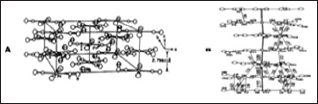
are dimensional coordination polymers that conduct electricity. The best
known are the cyano platinum salts (Pt(CN)4]n- and
halocarbonyliridium salts (Ir(CO)2Cl2]n-. which are cation deficient
salts shorter than 2.9A and structurally shown as a and b respectively
in Figure 20(a) Rb2[Pt(CN)4][FHF]0.4 and (b) K0.58[Ir(CO)2Cl2. Other
ambient pressure superconductors based on electron transfer , metal
-metal distance, periodical variation of the charge density along
radical donor and polymeric anions in such compounds has electron
transfer donor molecules alternating layers in their crystal structure
and polymeric anions [37].
Figure 20: Structures of cation deficient salts of (a) Rb2[Pt(CN)4][FHF]0.4 and (b) K0.58[Ir(CO)2Cl2.
Luminiscent materials
Luminescent polymers are used as fluorescent sensors and probes
because of the presence of organic chromophoric ligands which absorbs
light and then pass the excitation energy to the metal ion. Potentially,
coordination polymers are the most versatile luminescent species
because of their emission properties together with guest exchange and
are efficient materials for light emitting diodes [2,35,37].
Medicine
The application of coordination polymers in medicine is currently on
the rise with special emphasis on nanoparticle drug delivery.
Photolytically sensitive caged compounds have been examined as
containers for releasing a drug or reagent [42,43]. A metal organic
framework with the formula Zr6O6(OH)4(BDC) (BDC =
1,4-benzenedicarboxylate) was made by the solvothermal method. This
nanoparticle metal organic framework is important in x-ray computed
tomography (CT) a type of biomedical imaging that is capable of
providing three-dimensional images with excellent spatial resolution. CT
is mainly and recently used to image a wide range of structures within
and throughout the whole body not limited to organs, blood vessels, and
bones. The technique is a relevant tool for diagnosing and monitoring
abnormal health conditions and ailments throughout the body with
conditions such as tumors, calcifications, embolisms, aneurysms, and
inflammation efficiently and effectively treated [2,44,8]. Similarly,
one of the cyanide complexes, Fe4[Fe(CN)6]3.XH2O has the ability to
incorporate mono-cations and this makes it an important separating agent
for certain heavy metal poison including but not limited to patients
who have ingested radioactive caesium or thallium.
Laboratory histopathology stain for iron
One of the recognized, common, honoured, effective and efficient
coordination polymers used in histopathology stain to detect iron
presence in biopsy specimens by pathologists in bone marrow samples is
Fe4[Fe(CN)6]3.XH2O [4]. The deposits of iron in the tissue form purple
Prussian blue dye in place and are seen as blue or purple deposits.
Gas storage and trapping
Flexible porous coordination polymers have attracted attention as gas
storage vessel recently because of their high porosity and surface
area. Fuel gases like hydrogen (H2) and methane (CH4) due to their
economic, environmental balanced benefits have been realized as vehicle
fuels and have attracted much interest as replacements of petroleum and
diesel power source. However, Kesanli et al. [45] have noted that
inefficient storage, in other words, low mileage owning to their low
volumetric density is a major disadvantage of fuel gas for automobile
use. Storage of these gases in adsorbate phase has been observed to
increase the volumetric density and this has been efficiently done at
room temperature and pressure of 0-30 atm using porous coordination
polymer [46]. In the same way, Zn4O-based MOF compounds are well known
for their application to fuel gas storage because of their high porosity
and large surface area. Though, some of the MOFs are too large for
effective adsorption of hydrogen due to presence of large void space,
however the unused space increases the volumetric density and hence
smaller pores are favorable but controllable by the use of nonvolatile
guests.
The intercalation of nonvolatile guests in the porous coordination
polymers decreases the void space and pore size making the active
surface guests an adsorbent as well. Decrease in pore size is better
probably because the interaction between the aromatic ring of the donor
ligand and the fuel gas leads to increase in storage ability [7].
Recently, coordination polymers with pillared layers structures are
applied in adsorption to tune the pore size to that ofthe adsorbed gas
and are effective for stabilizing the explosive gases like acetylene.
Since they are structurally transformable, pore shape and size can be
adjusted towards the most stable state with guest to improve host -guest
interaction. The molecular interaction between the acetylene molecules
placed in porous coordination polymer and acetylene molecule and the
wall of the flexible porous coordination polymers is reduced and the
system is stabilized a consequence of the large surface area of the
flexible porous coordination polymers. Typically, [Cu3(BTB)2(H2O)3.
(DMF)9(H2O)2]n where (BTB = 4,4I,4 I I -benzene-1,3,5-tribenzate) the so
called MOF-14 shows high H2 uptake because of the large void space and
the interpenetrating fashion [7].
Selective adsorption and separation
The world is becoming more complex with an ever increasing search for
a more efficient, effective, energy-saving and environmentally friendly
procedure for separation and adsorption of gases and this calls for the
design of tailored structures with tunable surface properties. The
flexible porous coordination polymers and metal organic frameworks are
promising candidates as adsorbents for gas separations owing to their
thermal stability, large surface areas, adjustable pore sizes and
tunable properties [47,48]. Flexible porous coordination polymer shows
unequalled high selective guest sorption even though interpenetration
results in porosity reduction. The combination of the flexibility of
flexible porous coordination polymer and functional surface activity
enables effective selectivity. The flexible porous polymer
{Ni(bpe)2(N(CN)2] (N(CN)2}n where (bpe =1,2-bis (4-pyridyl)ethane and
N(CN2)= dicyanamide) is a 2-fold interpenetrating frame work which shows
selective gas adsorption and anion exchange property. The tunable,
modifiable active site and dynamic ability of the flexible porous
coordination polymers makes it effective in the adsorption of all sizes
of gases [7].
Nanoreactors for polymerization
Current research is on the rise in the use of porous coordination
polymers as nanoreactors for polymerization. The behavior, regularity,
reactivity and nature of monomers could be affected by the interaction
between the host framework and monomers as well as the restricted
available nanospace. The result amounts to polymerization that is
precisely controlled and as well the polymer arrangement. Researches
[7,49,50] has indicated that when one dimensional nanochannels of
crystalline porous compounds are filled with polymerizable groups of
guest molecules, the monomers can be polymerized as well. Sareeya et al.
[7] has noted that the porous coordination polymer
(Zn2(1,4-dbc)2(dabco]n where (bdc=benzenedicarboxylate,
dabco=1,4-diazabicyclo[2.2.2]
octane) is an important nanoreactor for polymerization because, the
introduction of p-divinylbenzene(DVBs) into (Zn2(1,4- dbc)2(dabco)n
channel causes the lattice to expand small compared with the original
host though without effect on the framework.
Anaytical chemistry
In analytical chemistry, coordination polymer is used in the
determination of phenols. Specifically, one of the cyanide complexes
(Fe4(Fe(CN)6)3.XH2O is formed in its assay for total phenols and very
effective in the spectrophotometric study of phenols or polyphenols
[51,52].
Conclusion
Coordination polymers, metal-organic frameworks, clathrates and
cyanometallates represent an emerging class of hybrid inorganic-organic
materials that have attracted the attention of solid-state chemists
owing to their combined unprecedented degree of porosity with other
notable functional properties that are predominantly active in the
ligand or metal moiety. Their ease of synthesis, modifiable and tunable
characteristics are second to none in science and engineering. These
class of polymers have opened a new area of research because of their
versatility, applicability, thermo stability and resistant to solvents.
Highest known surface areas has been generated and shown by coordination
polymers and metal organic frameworks with lowest crystal densities and
thermal stabilities offering them as important materials for high
hydrogen storage, selective heterogeneous catalysis, magnetic ordering
channels for regulating polymerizations, selective carbon dioxide
capture and guest-dependent luminescence, nanoparticles in medicine and
drug delivery, non- linear optical devices among others. Thus, this new
class of materials due to their diversity, multiplicity, and exceptional
properties are important and required to solve some of our most
pressing societal problems including but not limited to creation and
deployment of clean, sustainable environment.
To Know More About Lupine Publishers Journal of Chemistry Please Click on Below Link:
https://lupinepublishers-chemicalsciences.blogspot.com/