In the presented investigation, some novel tri-heterocyclic
benzamides, 8a-g, were synthesized in several steps. First, the
electrophilic benzamide,
{4-[3-(chloromethyl)benzoyl]-1-piperazinyl}(2-furyl) methanone (3), was
synthesized by the reaction of 2- Furoyl-1-piperazine (1) and
3-chloromethylbenzoyl chloride (2). In second series of steps, different
carboxylic acids, 4a-g, were refluxed with ethanol and conc. sulfuric
acid to form esters, 5a-g. These esters were further refluxed with N2H4.H2O
in methanol solution to acquire acid respective hydrazides, 6a-g. These
hydrazides were cyclized by refluxing with KOH, ethanol and CS2
into corresponding 1,3,4-oxadiazoles, 7a-g. In the final step, the
electrophile, 3, was coupled with synthesized 1,3,4-oxadiazoles, 7a-g,
in acetonitrile and potassium carbonate to acquire the targeted
tri-heterocyclic molecules, 8a-g. The structural characterization of
these novel compounds 8a-g was done by IR, 1H-NMR, 13C-NMR
and EI-MS spectral data. These synthesized molecules were subjected to
antibacterial and enzyme inhibitory and cytotoxicity evaluation. Among
the series, 8b exhibit good enzyme inhibition whereas 8c exhibited good
antibacterial and antifungal potential against B. subtilis, E. coli and A. flavus
strains, respectively. Most of the molecules possessed moderate
cytotoxicity and hence these can be utilized as possible therapeutic
agents.
Keywords: Tri-Heterocyclic; 1H-NMR; 13C-NMR; EI-MS; Hemolytic Activity; Enzyme Inhibition; Antibacterial; Antifungal activity
Introduction
Ox diazole is a heterocyclic five membered ring bearing two nitrogen
atoms and one oxygen atom. It has four different isomers among these
four different isomers, 1,3,4-oxadiazole has been synthesized in the
presented work and subjected to formation of some new derivatives [1]. A
lot of derivatives of 1,3,4-oxadiazole has been synthesized by
substituting at second and fifth positions of the ring. They undergo a
variety of organic reactions such as electrophonic substitution,
nucleophilic substitution, thermal and photochemical reactions and hence
act as a medicinal backbone on which a number of valuable molecules
have been constructed
[2] . A broad spectrum of biological activities reported for different
substituted 1,3,4-oxadiazole derivatives include anticonvulsive [3].
Muscle relaxant [4]. Herbicidal, antimicrobial [5]. Insecticidal [6].
Antibacterial, anti-inflammatory [7,8]. Analgesic, hypoglycemic [9,10].
Anti-Parkinson, anti-mitotic, anticancer [11]. Anti-tubercular [12].
Tranquilizing, anti-proliferative, antifungal [13]. Anti-HIV,
anti-depressive etc [14]. Piperazine nucleus is one of the most
important heterocycles exhibiting remarkable pharmacological activities.
Piperazine is a heterocyclic compound, containing nitrogen atoms at
opposite positions in six membered ring [15]. The piperazine scaffold
has been classified as a privileged structure and is frequently found in
biologically active compounds across a number of different therapeutic
areas [16]. This motif is found in drug candidates displaying
anti-depressant, analgesic, anti- allergenic, antibacterial,
anti-cancer, anti-psychotic, anti-migraine, gastrointestinal agent and
cardio tonic agent [17-23]. Thus, it appears that the piperazine core
acts as a privileged structural element for the construction of
bioactive molecules [24]. In order to find new drug candidates, the
piperazine ring is encompassed in the new synthesized compounds along
with 1,3,4-oxadizole. The coupling of multiple functionalities was
considered to boost up the bioactivity potential of resulting molecules.
The presented work covers synthesis of new compounds having different
bioactive moieties like piperazine, 1,3,4-oxadiazole and carbamate. The
antibacterial, enzyme inhibition and hemolytic potential have also been
demonstrated for all the synthesized molecules. The present work was
aimed to synthesize new molecules in order to evaluate their bioactivity
potential against certain bacterial strains and enzymes.
Experimental
Chemistry
Purity was checked on thin layer chromatography (TLC) on pre-coated
silica gel G-25-UV254 plates using different percentage of ethyl acetate
and n-hexane giving single spot. Griffin and George melting point
apparatus was used to record the melting points of the synthesized
compounds by open capillary tube and were uncorrected. Jasco-320-A
spectrophotometer was used for the IR spectra (wave number in cm-1).
1H-NMR spectra were recorded in CDCl3 on a Bruker spectrometers
operating at 600 MHz. 13C-NMR spectra were recorded in CDCl3
on a Bruker spectrometers operating at 150MHz. Chemical shifts were
recorded in ppm. Mass spectra (EI-MS) were taken on a JMS-HX-110
spectrometer, with complete data system.
General Synthesis of {4-[3-(chloromethyl)benzoyl]-1- Piperazinyl}(2-furyl)Methanone (3)
1-(2-Furoyl)piperazine (12.8mmol; 1) was taken in an iodine flask (250mL) containing 15.0mL of distilled water and 10 % Na2CO3
solution to adjust pH at 9-10. Then equimolar 3-chloromethylbenzoyl
chloride (2) was added drop wise to the reaction medium in 2-5min. After
complete addition, the iodine flask was vigorously shaken (manually)
and then set to stir at room temperature for 4 hours till the formation
of solid precipitates. The progress of reaction was monitored by thin
layer chromatography (TLC) till single spot. The obtained precipitates
were filtered, washed with distilled water and dried to yield the titled
electrophile, 3.
Procedure for the synthesis of ethyl carboxylates (5a-g)
Carboxylic acids (50mmol; 4a-g) were refluxed for 3-4 hrs with 40mL
EtOH in a 250mL round bottom flask in the presence of conc. H2SO4
(0.5mL/g acid). After maximal completion by TLC, excess water was added
and pH was adjusted to 8-10 by aq. Na2CO3 soln (10%). The title compounds, 5a-g, were extracted by chloroform.
Procedure for the synthesis of carbohydrazides (6a-g)
Compounds 5a-g (40mmol) and N2H4.H2O (40mmol) were refluxed for 4-6 hrs in 25mL MeOH in a 100mL RB flask. After final
TLC, excess water was added to acquire precipitates, 6a-g, which was separated by filtration.
General procedure for the synthesis of 5-substituted- 1,3,4-oxadiazol-2-thiols (7a-g)
Compounds 6a-g (30mmol) were refluxed for 0.5 hr with solid KOH
(30mmol) in 45mL EtOH in a 100mL RB flask. Then CS2 (60mmol) was added
and further refluxed for 3-6 hrs. After final TLC, excess water was
added followed by conc. HCl to adjust pH of 2. The mixture was left for 3
hrs for precipitation. Precipitates, 7a-g, were collected through
filtration and washed with water
General synthesis of tri-heterocyclic molecules (8a-g)
The respective 5-substituted-1,3,4-oxadiazol-2-thiol (24mmol; 7a-g,
one in each reaction) was dissolved in acetonitrile (20-30mL) in 100mL
round bottom flask. Then solid K2CO3 (12mmol) was added. The
mixture was refluxed for half an hour and then the equimolar (24mmol)
the electrophile, 3, was added. The mixture was further refluxed for 4-5
hours. Thin layer chromatography was carried out to check the reaction
completion. Distilled water was added to the reaction mixture to acquire
the precipitates. Precipitates were filtered, washed and dried to get
the titled compounds, 8a-g.
4-[3-({[5-(2-Chlorophenyl)-1,3,4-oxadiazol-2-yl] sulfanyl}methyl)benzoyl]-1-piperazinyl}(2-furyl) methanone (8a).
Light brown liquid; yield: 84%; Molecular formula: C25H21ClN4O4S; molecular mass: 508 g/mol; IR (KBr, υmax cm-1):
3411 (N-H), 3073 (Ar C-H), 2880 (R C-H), 1654 (C=O), 1582 (Ar C=C),
1203 (C-O-C), 1106 (C-N-C), 658 (C-S); 1H-NMR (600 MHz, CDCl3,
δ in ppm): 5 7.96 (d, J = 1.6 Hz, 1H, H-2"), 7.57 (dist. d, J = 1.5 Hz,
1H, H-5), 7.52 (d, J = 8.7 Hz, 1H, H-6”), 7.49-7.46* (m, 4H, H-3””,
H-4””, H-5”" & H-6"”), 7.42 (t, J = 7.5 Hz, 1H, H-5"), 7.37 (dt, J =
1.5, 6.1 Hz, 1H, H-4"), 7.07 (d, J = 2.5 Hz, 1H, H-3), 6.50 (dd, J =
1.6, 3.3 Hz, 1H, H-4), 4.51 (s, 2H, H-8"), 3.84 (br s, 4H, H-3' &
H-5'), 3.50 (br s, 4H, H-2' & H-6'); 13C-NMR (150 MHz, CDCl3,
δ in ppm): 170.04 (C-7''), 166.00 (C-5'''), 163.40 (C-2'''), 159.21
(C-6), 147.60 (C-2), 143.95 (C-5), 136.52 (C-3"), 135.57 (C-1”), 131.77
(C-1"”), 130.77 (C-2''''), 129.21 (C-4''''), 129.08 (C-3'''') 128.12
(C-5''''), 126.92 (C- 6’”’), 126.68* (C-4” & C-5”), 126.64 (C-2”),
123.46 (C-6"), 117.10 (C-3), 111.47 (C-4), 45.50* ( C-2’, C-3’, C-5'
& C-6'), 36.21 (C-8"); EI-MS (m/z): 510 [M + 2]+, 508 [M]+, 440 [C21H16ClN4O3S•+, 411 [C20H15ClN4O2S]+, 329 [C16H9ClN2O2S]+, 262 [C12H7ClN2OS•+, 246 [C13H14N2O2•+,179 [C8H4ClN2O]•+, 179 [C9H11N2O2], 151[C8H9NO2]+, 95 [C5H3O2]+.
{4-[3-({[5-(3-Aminophenyl)-1,3,4-oxadiazol-2-yl] sulfanyl}methyl)benzoyl]-1-piperazinyl}(2-furyl) methanone (8b).
Light brown liquid; yield: 81%; Molecular formula: C25H23N5O4S; molecular mass: 489 g/mol; IR (KBr, υmax cm-1): 3413 (N-H), 3071 (Ar C-H), 2886 (R C-H), 1658 (C=O), 1580 (Ar C=C), 1203 (C-O-C),
1106 (C-N-C), 653 (C-S); 1H-NMR (600 MHz, CDCl3, δ in ppm): δ
7.91 (d, J = 7.9 Hz, 1H, H-4”’’), 7.57 (s, 1H, H-2’”’), 7.56 (d, J =
1.5 Hz, 1H, H-2”), 7.54 (d, J = 8.0 Hz, 1H, H-6), 7.47 (d, J = 7.4 Hz,
1H, H-6”), 7.43 (br s, 1H, H-5), 7.42 (t, J = 7.5 Hz, 1H, H-5”"),
7.39-7.37* (m, 2H, H-4" & H-5” ), 7.06 (d, J = 2.5 Hz, 1H, H-3),
6.48 (br s, 1H, H-4), 4.52 (s, 2H, H-8"), 3.85 (br s, 4H, H-3' &
H-5' ), 3.50 (br s, 4H, H-2' & H-6'); 13C-NMR (150 MHz, CDCl3,
δ in ppm): 170.08 (C-7"), 166.06 (C-5’”), 163.48 (C-2’”), 159.25 (C-6),
147.69 (C-2), 143.91 (C-5), 136.57 (C-3”), 135.50 (C-1"), 132.08
(C-3’”’), 131.70 (C-1""), 130.73 (C-2''''), 129.21 (C-4'''), 128.12
(C-5''''), 126.92 (C-6''''), 126.64 (C-2"), 126.62* (C-4” & C-5"),
123.45 (C-6"), 117.10 (C-3), 111.45(C-4), 45.51*( C-2', C-3', C-5' &
C-6'), 36.21(C-8"); 489 [M]+, 421 [C21H19N5O3S]+ 392 [C20H18N5O2S]+, 310 [C16H12N3O2S]+, 246 [C13H14N2O3]+, 243 [C12H9N3OS]•+,179 [C9H11N2O2]•+, 161 [C8H7N3O]+, 151 [C8H9NO2]+, 95 [C5H302]+.
{4-[3-({[5-(3-Nitrophenyl)-1,3,4-oxadiazol-2-yl] sulfanyl}methyl)benzoyl]-1-piperazinyl}(2-furyl) methanone(8c).
Light brown liquid; yield: 86%; Molecular formula: C25H23N504S; molecular mass: 519 g/mol; IR (KBr, υmax cm-1):
3412 (N-H), 3070 (Ar C-H), 2887 (R C-H), 1653 (C=O), 1580 (Ar C=C),
1205 (C-O-C), 1107 (C-N-C), 652 (C-S 1H-NMR (600 MHz, CDCl3, δ in ppm): 5
8.35 (d, J = 2.0 Hz, 1H, H-2’”’), 8.17 (d, J = 6.9 Hz, 1H, H-6’’”),
7.83 (br s, 1H, H-2''), 7.59-7.53* (m, 1H, H-4'''' & H-5''''), 7.52
(br s, 2H, H-5), 7.48-7.43* (m, 2H, H-4’’ & H-5”), 7.07 (d, J = 3.2
Hz, 1H, H-3), 6.51 (dd, J = 1.7, 3.4 Hz, 1H, H-4), 4.55 (s, 2H, H-8”),
3.84 (br s, 4H, H-3’ & H-5' ), 3.51 (br s, 4H, H-2' & H-6'); 13C-NMR (150 MHz, CDCl3,
δ in ppm): 169.96 (C-7’’), 165.18 (C-5’’’), 164.23 (C-2’’’), 159.22
(C-6), 149.53 (C-3''''), 147.61 (C-2), 143.97 (C-5), 136.20 (C-3''),
135.67 (C-1’’), 130.79 (C-6’’”), 129.25 (C-5”’’), 128.88 (C-4’’), 128.78
(C- 5’’), 128.44 (C-1’’”), 128.17 (C-2’’), 127.54 (C-6’’), 126.09
(C-4’”’), 125.49 (C-2’”’), 117.21 (C-3), 111.53 (C-4), 48.00* ( C-2',
C-3', C-5’ & C-6'), 36.21 (C-8”); EI-MS (m/z): 519 [M]+, 451 [[C21H19N5O3S]•+
422 [C20H18N5O2S]+, 340 [C16H12N3O2S]•+,, 273 [C12H9N3OS]•+, 246 [C13H14N2O3]•+ 191 [C8H5N3O3]+, 179 [C9H11N202]+, 151 [C8H7N3O]+, 95 [C5H302]+.
{4-[3-({[5-(4-Methylphenyl)-1,3,4-oxadiazol-2-yl] sulfanyl}methyl)benzoyl]-1-piperazinyl}(2-furyl) methanone (8d).
Black brown liquid; yield: 88%; Molecular formula: C26H24N404S; molecular mass: 488 g/mol; IR (KBr, υmax cm-1):
3411 (N-H), 3074 (Ar C-H), 2880 (R C-H), 1658 (C=O), 1583 (Ar C=C),
1209 (C-O-C), 1109 (C-N-C), 660 (C-S); 1H-NMR (600 MHz, CDCl3, δ in
ppm): 5 7.86-7.83 (m, 1H, H-2’’), 7.55 (d, J = 8.6 Hz, 1H, H-6’’),
7.53-7.52 (m, 2H, H-2’”’ & H-6’’”), 7.49 (br s, 1H, H-5), 7.42 (t, J
= 7.5 Hz, 1H, H-5’’), 7.37-7.36 (m, 1H, H-4’’), 7.33 (d, J = 6.0 Hz,
2H, H-3”’’ & H-5”’’), 7.07 (d, J = 3.4 Hz, 1H, H-3), 6.50 (dd, J =
1.8, 3.4 Hz, 1H, H-4), 4.50 (s, 2H, H-8’’), 3.84 (b s, 4H, H-3' &
H-5'), 3.39 (br s, 4H, H-2' & H-6'), 2.39 (s, 3H, H-7””); 13C-NMR (150 MHz, CDCl3,
δ in ppm): 170.06 (C-7’’), 166.16 (C-5’’’), 163.08 (C-2’’’), 159.22
(C-6), 147.57 (C-2), 143.97 (C-5), 142.39 (C-3’’), 136.58 (C-1’’),
136.34 (C-4’’’’), 130.77 (C- 4’’), 130.38 (C-5’’), 129.20 (C-2’’’’ &
C-6’’’’), 128.10 (C-3’’’’ & -5’’’’), 127.84 (C-2’’), 126.88
(C-6’’), 120.71 (C-1’”’), 117.09 (C-3), 111.52 (C-4), 46.50* ( C-2',
C-3', C-5' & C-6'), 36.21 (C-8’’), 22.58 (C-7’”’); EI-MS (m/z): 488
[M]+, 420 [C22H20N403S]•+ 391 [C21H19N503]•+, 309 [C17H13N2O2S]+, 246 [C13H14N203]+ 242 [C13H14N203]•+ 179 [C9H11N202]+, 160 [C9H11N202]+, 151 [C8H7N3O]+, 95 [C5H302]+.
{4-[3-({[5-(4-Hydroxyphenyl)-1,3,4-oxadiazol-2-yl] sulfanyl}methyl)benzoyl]-1-piperazinyl}(2-furyl) methanone (8e).
Light brown liquid; yield: 85%; Molecular formula: C25H23N504S; molecular mass: 490 g/mol; IR (KBr, υmax cm-1):
3075 (Ar C-H), 2889 (R C-H), 1654 (C=O), 1585 (Ar C=C), 1201 (C-O-C),
1109 (C-N-C), 655 (C-S); 1H-NMR (600 MHz, CDCl3, δ in ppm): 5 7.71 (d, J
= 8.3 Hz, 2H, H-2’’’’ & H-6’’’’), 7.53 (br s, 1H, H-2’’), 7.52 (br
s, 1H, H-5), 7.46 (d, J = 6.1 Hz, 1H, H-6’’), 7.40 (t, J = 7.6 Hz, 1H,
H-5”), 7.33 (d, J = 7.4 Hz, 1H, H-4’’), 7.04 (d, J = 3.4 Hz, 1H, H-3),
6.86 (d, J = 8.4 Hz, 2H, H-3’”’ & H-5”’’), 6.47 (dd, J = 1.3, 3.0
Hz, 1H, H-4), 4.43 (s, 2H, H-8’’), 3.82 (br s, 4H, H-3’ & H-5’),
3.46 (br s, 4H, H-2’ & H-6’); 13C-NMR (150 MHz, CDCl3, δ in ppm): 170.25 (C-7’’), 166.30 (C-5’’’), 162.21 (C-2’’’), 159.33 3(C-6),
147.25 (C-2), 144.21 (C-5), 136.82 (C-3’’), 135.23 (C-1’’), 130.86
(C-4’’), 129.23 (C-5”), 128.54 (C-3”’’ & C-5’”’), 128.08 (C-6’’),
126.75 (C-1”’’), 161.05 (C-4”’’), 117.34 (C-3), 116.48 (C-2’’” &
C-6’’’’), 114.25 (C-2”), 111.59 (C-4), 45.49* ( C-2', C-3', C-5’
& C-6'), 36.20 (C-8’’); EI-MS (m/z): 490 [M]+, 422 [C6H2N2]+ 393 [C6H2N2]+, , 246 [C13H14N2O3]•+ 244 [C6H2N2]•+ 179 [C6H2N2]+, 161 [C6H2N2]+, 151 [C6H2N2]+, 118 [C6H2N2]+ 95 [C5H3O2]+
{4-[3-({[5-(2,4-Dichlorophenyl)-1,3,4-oxadiazol-2- yl]sulfanyl}methyl)benzoyl]-1-piperazinyl}(2-furyl) methanone (8f).
Light brown liquid; yield: 85%; Molecular formula: C25H23N5O4S; molecular mass: 542 g/mol; IR (KBr, υmax cm-1):
3414 (N-H), 3070 (Ar C-H), 2882 (R C-H), 1659 (C=O), 1579 (Ar C=C),
1198 (C-O-C), 1113 (C-N-C), 659 (C-S); 1H-NMR (600 MHz, CDCl3,
δ in ppm): 5 7.86 (d, J = 1.6 Hz, 1H, H-2’’), 7.59-7.51* (m, 2H,
H-5’’’’ & H-6’’’’ ), 7.55 (dist. d, J = 1.6 Hz, 1H, H-5), 7.51 (d, J
= 8.7 Hz, 1H, H-6’’), 7.45 (t, J = 7.5 Hz, 1H, H-5’’), 7.49 (s, 1H,
H-3’’’’), 7.32 (dt, J = 1.5, 6.1 Hz, 1H, H-4’’), 7.09 (d, J = 2.5 Hz,
1H, H-3), 6.50 (dd, J = 1.5, 3.2 Hz, 1H, H-4), 4.50 (s, 2H, H-8’’), 3.88
(br s, 4H, H-3' & H-5'), 3.48 (br s, 4H, H-2’ & H-6’); 13C-NMR (150 MHz, CDCl3,
δ in ppm): 170.03 (C-7’’), 166.05 (C-5’’’), 163.48 (C-2’’’), 159.22
(C-6), 147.65 (C-2), 143.99 (C-5), 137.89 (C-4’”’), 136.58 (C-3’’),
135.59 (C-1”), 134.90 (C-1’’”), 133.72 (C-6’”’), 131.21 (C-5”’’), 129.44
(C-2’’”), 127.65 (C- 3’”’) 126.67* (C-4” & C-5’’), 126.62 (C-2’’),
123.49 (C-6”), 117.10 (C-3), 111.43 (C-4), 48.55* ( C-2', C-3', C-5'
& C-6'), 36.22 (C-8’’); EI- MS (m/z): 546 [M + 4]+, 544 [M + 2]+, 542 [M]+, 474 [C5H3O2]•+ 445 [C5H3O2]+, 363 [C5H3O2]+, 296 [C5H3O2]•+ 246 [C5H3O2]•+, 213 [C5H3O2]+, 179 [C5H3O2]+, 151 [C5H3O2]+, 118 [C6H2N2O]+, 95 [C5H3O2]+.
{4-[3-({[5-(3,5-Dinitrophenyl)-1,3,4-oxadiazol-2-yl] sulfanyl}methyl)benzoyl]-1-piperazinyl}(2-furyl) methanone (8g).
Light brown liquid; yield: 84%; Molecular formula: C25H20N6O8S; molecular mass: 564 g/mol; IR (KBr, υmax cm-1): 3417 (N-H), 3068 (Ar C-H), 2889 (R C-H), 1650 (C=O), 1584 (Ar C=C), 1206 (C-O-C),
1107 (C-N-C), 652 (C-S); 1H-NMR (600 MHz, CDCl3, δ in ppm): 5
8.07 (s, 1H, H-4’”’), 7.59 (d, J = 6.3 Hz, 2H, H-2’”’ & H-6’”’),
7.53 (s, 1H, H-2”), 7.49 (br s, 1H, H-5), 7.46 (d, J = 7.4 Hz, 1H,
H-6"), 7.43 (t, J = 7.7 Hz, 1H, H-5’’), 7.34 (d, J = 7.0 Hz, 1H, H-4”),
7.07 (d, J = 4.2 Hz, 1H, H-3), 6.51 (br s, 1H, H-4), 4.48 (s, 2H, H-8”),
3.86 (br s, 4H, H-3' & H-5'), 3.66 (br s, 4H, H-2' & H-6'); 13C-NMR (150 MHz, CDCl3,
δ in ppm): 170.09 (C-7”), 166.05 (C-5’’’), 163.45 (C-2’”), 159.24
(C-6), 150.08 (C-3’’’’ & C-5’’’’), 147.65 (C-2), 143.95 (C-5),
136.54 (C-3’’), 135.57 (C-1’’), 134.21 (C-4’’’’), 131.40 (C-1’’’’),
130.77 (C- 2’’’’ & C-6’’’’), 126.69* (C-4’’ & C-5’’), 126.60
(C-2’’), 123.48 (C-6’’), 117.12 (C-3), 111.41 (C-4), 45.55* ( C-2’,
C-3’, C-5' & C-6'), 36.21 (C- 8’’); EI-MS (m/z): 564 [M]+, 496 [C5H3O2]+ 467 [C20H15N6O6S]+, 385 [C16H9N4O6S]+, 318 [C12H6N4O5S]•+ 246 [C5H3O2]•+ 236 [C8H4N4O5]+, 179 [C9HuN2O2]+, 151 N4, 118 [C6H2N2O]+, 95 [C5H3O2]+.
Biological Activities Assays
Acetylcholinesterase (AChE) Assay
The AChE inhibition activities were performed according to the
reported method with slight modifications. Total volume of the reaction
mixture was 100μL. It contained 60 μL Na2HPO4 buffer with concentration
of 50 mM and pH 7.7. 10 μL test compound (0.5 mM well-1) was added,
followed by the addition of 10 μL (0.005 unit well-1) enzyme. The
contents were mixed and pre-read at 405 nm. Then contents were
pre-incubated for 10 min at 37 °C. The reaction was initiated by the
addition of 10 μL of 0.5 mM well-1 substrate (acetylthiocholine iodide),
followed by the addition of 10μL DTNB (0.5mM well-1). After 15 min of
incubation at 37 °C absorbance was measured at 405 nm using 96-well
plate reader Synergy HT, Biotek, USA. All experiments were carried out
with their respective controls in triplicate. Eserine (0.5mM well-1) was
used as a positive control. The percent inhibition was calculated by
the help of following equation IC50 values were calculated using EZ�Fit
Enzyme kinetics software (Perrella Scientific Inc. Amherst, USA) [25].
Antibacterial and antifungal Assay
Disc diffusion method was used to find out the antimicrobial activity
of the synthesized compounds. 100μL suspensions of tested
microorganisms was spread on PDA medium for 106 spores/mL of fungi and
on NA medium for 107 colony-forming units/mL of bacteria cells. The
filter discs of 6mm diameter were saturated with compound solution and
placed on the agar plates inoculated with the tested microorganisms.
Filter discs without samples were employed as negative control.
Rifamicin (30|ig/disk) and Fluconazole (30|ig/disk) were applied as
positive reference for bacterial strains and fungal strains,
respectively. Plates were placed 4 °C for 2 hours and then incubated at
37 °C for 18 hours for bacterial strains and at 28 °C for 24 hours for
fungal strains. Antimicrobial activity was justified after comparison of
diameter of growth inhibition zone measured in mm for organisms and the
controls [26].
Hemolytic Activity
Hemolytic activity of the compound was studied by the reported
method. 3 mL freshly obtained heparinized bovine blood was collected.
Blood was centrifuged for 5 min at 1000 x g plasma was discarded and
cells were washed three times with 5 mL of chilled (4 oC) sterile
isotonic phosphate-buffer saline (PBS) at pH 7.4. Erythrocytes were
maintained 108 cells per mL for each assay. Hundred μL of each compound
was mixed with human (108 cells/ mL) separately. Samples were incubated
for 35 min at 37 oC and agitated after 10 min. Immediately after
incubation the samples were placed on ice for 5 min then centrifuged for
5 min at 1000 x g. Supernatant 100μL were taken from each tube and
diluted 10 time with chilled (4 oC) PBS. Triton X-100 (0.1 % v/v) was
taken as positive control and phosphate buffer saline (PBS) was taken as
negative control and passed through the same process. The absorbance
was noted at 576 nm using nQuant (Bioteck, USA). The % RBCs lysis for
each sample was calculated [27, 28].
Results and Discussion
Chemistry
Table 1: Different substituent in scheme 1.

The presented study describes the synthesis of some novel
tri-heterocyclic benzamides, 8a-g, following a facile strategy in
multi-steps (Scheme 1 & Table 1). In first part, an electrophonic,
{4-[3-(chloromethyl)benzoyl]-1-piperazinyl}(2-furyl)methadone (3) , was
synthesized by the reaction of 2-Furoyl-1-piperazine (1) and
3-chloromethylbenzoyl chloride (2). The second part consisted a series
of convergent steps, where, different carboxylic acids, 4a-g, were
refluxed with ethanol and conc. sulfuric acid to form esters, 5a-g.
These esters were further refluxed with N2H4.H2O in methanol solution to
acquire acid respective hydrazides, 6a-g. These hydrazides were
cyclized by refluxing with KOH, ethanol and CS2 into corresponding
1,3,4-oxadiazoles, 7a-g. In the final part of the synthesis, the
electrophile, 3, was coupled with synthesized 1,3,4-oxadiazoles, 7a-g,
in acetonitrile and potassium carbonate to acquire the targeted novel
tri-heterocyclic molecules, 8a-g, in good yields. Structures of these
novel compounds were confirmed by IR, 1H-NMR, 13C-NMR and
EI-MS techniques. The structure of one of the compounds is discussed
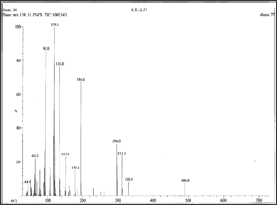
hereby in detail for the benefit of the readers. The molecular formula, C25H22N4O5S,
of 8e was established through it EI-MS spectrum showing molecular ion
peak at m/z 490 g/mol. The number of protons and in its 1H-NMR, and
number of carbon resonances in its 13C-NMR spectrum also supported this
assignment. The IR spectrum well supported the molecular functionalities
by distinct absorption bands at 3075 (Ar C-H), 2889 (R C-H), 1654
(C=O), 1585 (Ar C=C), 1201 (C-O-C), 1109 (C-N-C) and 655 (C-S). In
1H-NMR spectrum, signals of methylbenzamide moiety appeared at 5 7.53
(br.s, 1H, H-2”), 7.46 (d, J = 6.1 Hz, 1H, H-6"), 7.40 (t, J = 7.6 Hz,
1H, H-5"), 7.33 (d, J = 7.4 Hz, 1H, H-4") and 4.43 (s, 2H, CH2-8”). The
signals of protons for 4-hydroxyphenyl ring appeared at 7.71 (d, J = 8.3
Hz, 2H, H-2””, H-6””) and 6.86 (d, J = 8.4 Hz, 2H, H-3””, H-5””). Furan
ring showed three peaks in aromatic region at 5 7.52 (br.s, 1H, H-5),
7.04 (d, J = 3.4 Hz, 1H, H-3) and 6.47 (dd, J = 1.3, 3.0 Hz, 1H, H-4).
The eight protons of piperazine ring appeared at 5 3.82 (br.s, 4H,
CH2-3’, CH2-5') and 3. (br.s, 4H, CH2-2’, CH2-6') (Figure 1a &
Figure 1b). The structure was also thorough supported by its 13C-NMR
spectrum (Figure 2a &Z Figure 2b). The distinct peak at m/z 194 in
its EI-MS spectrum was related to
5-(4-hydroxyphenyl)-1,3,4-oxadiazol-2-thiol, the peak at m/z 119 was
related to 4-hydroxyphenylcyanide moiety while the peak at m/z 95 to
furoyl part of the molecule (Figure 3). So, on the basis of above
cumulative evidences, the molecule 8e was named as
{4-[3-({[5-(4-Hydroxyphenyl)-1,3,4-oxadiazol-2-yl]sulfanyl}
methyl)benzoyl]-1-piperazinyl} (2-furyl)methanone. Similarly, the
structures of all other synthesized derivatives were characterized by
aforesaid pattern.
Scheme 1: Outline for the synthesis of novel tri-heterocyclic benzamides. Reagents & Conditions: (I) Aq. Na2CO3 soln./pH 9-10/ stirring at RT for 4 hrs. (II) EtOH/H2SO4/refluxing for 3-4 hrs. (III) MeOH/N2H4 • H2O/refluxing for 4-6 hrs. (IV) EtOH/CS2/ KOH/refluxing for 3-6 hrs. (V) Acetonitrile/K2CO3/refluxing
for 0.5 hrs for activation of 7a-g (one in each reaction), followed by
addition of 3 and finally refluxing for 4-5 hrs to obtain 8a-g.
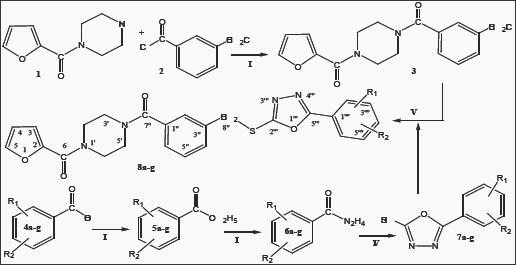
Figure 1a: Aromatic region of 1H-NMR for 8e.
Figure 1b: Aliphatic region of 1H-NMR for 8e.
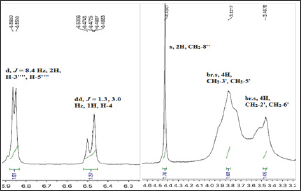
Figure 2a: Aromatic region of 13C-NMR for 8e.
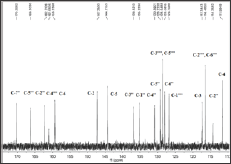
Figure 2b: Aliphatic region of 13C-NMR for 8e.
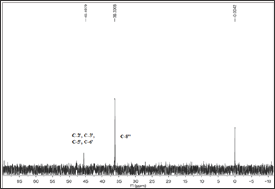
Figure 3: Mass spectrum of 8e.
Biological activities
The novel tri-heterocyclic molecules, 8a-g, were screened for
biological activities such as enzyme inhibition, hemolytic activity,
biological and fungal activity to ascertain their possible therapeutic
potential for the associated ailments.
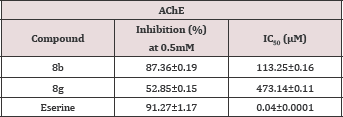
AChE inhibitory potential
All the synthesized compounds 8a-g was screened against acetyl
cholinesterase for enzyme inhibition potential. Among these synthesized
compounds, the molecule 8b and 8g exhibited inhibitory potential of
87.36±0.19 and 52.85±0.15 relative to serine 91.27±1.17, a reference
standard (Table 2).
Table 2: AChE inhibition of synthesized compounds, 8a-g
Antibacterial activity
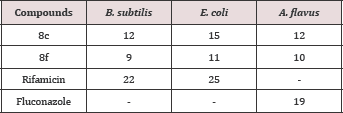
To study the antibacterial activity of the synthesized molecules,
8a-g was screened for antibacterial activity against Gram-positive stain
Bacillus subtilis and Gram-negative strain Escherichia coli. Rifamicin
was used as reference standard in this study (Table 3). Compounds 8c and
8f showed good inhibitory potential against the bacterial strains used
in this study, especially compound 31c with values of 12 μM and 15 μM
against B. subtilis and E. coli respectively.
Antifungal activity
The result of antifungal activity was also shown in Table 3. For
anti-fungal activity the synthesized molecules, 8a-g were screened
against A. flavus. The compounds 8c and 8f exhibited good antifungal
activity against fungal strain in addition to the antibacterial
activity. Fluconazole was used as reference standard in this study
(Table 3).
Table 3: Antibacterial and Antifungal activities (zone of inhibition, mm) of synthesized compounds, 8a-g.
Hemolytic activity
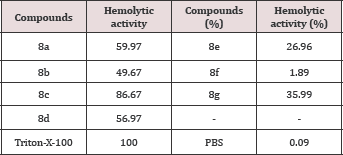
The results of hemolytic activity assay revealed that all tested
compounds ranged below the positive control Triton-X-100. Highest
hemolytic activity was shown by 8c (86.67 %) which was lower than the
positive control Triton-X-100 (Table 4). Other compounds mostly showed
low hemolytic activity. The lowest activity was shown by 8f (1.89 %) but
higher than the negative controls PBS- 0.09.
Table 4: Hemolytic activity of synthesized compounds, 8a-g.
Structure-activity relationship
Among the synthesized compounds, only two compounds remained potent
against the three microbial strains taken into account. The active
compounds were 8c and 8f bearing 3-nitrophenyl and 2,4-dichlorophenyl
groups, respectively. These compounds showed zone of inhibition as 12,
15 & 12 and 9, 11, & 10 mm against B. subtilis, E. coli & A.
flavus, respectively, with reference of 22, 25 & 19 mm. The
cytotoxicity of the synthesized molecules was also investigated through
hemolytic activity analysis. The highest hemolytic activity was shown by
8c (86.67 %) having bearing
3- nitrophenyl group but it was lower than the positive control
(Triton-X-100). The lowest activity in the series was exhibited by 8f
(1.89 %) which was incorporating 2,4-dichlorophenyl moiety in its
structure. Only two compounds, 8b and 8g, bearing 3-aminophenyl and
3,5-dinitrophenyl group, respectively, remained moderately low active
against AChE enzyme.
Conclusion
The structures of the synthesized novel tri-heterocyclic molecules,
8a-g, were thoroughly corroborated by spectroscopic analysis. The newly
synthesized compounds were screened for enzyme inhibition,
antibacterial, antifungal and hemolytic activity. The data in the (Table
1) indicated that among the synthesized compound 8b exhibit good enzyme
inhibition. Some of the compounds exhibited suitable antibacterial and
antifungal potential against B. subtilis, E. coli and A. flavus strains.
Particularly, 8c displayed the maximum inhibition. The cytotoxic
results have also been processed to evaluate the cytotoxicity of the
synthesized molecules and found a few of them toxic up to some extent
and others with less toxicity. From the results of various biological
activities it was concluded that these compounds would be of better use
in drug development to combat bacterial infections and as antifungal
agents in the future.
Read More About Lupine Publishers Journal of Organic and Inorganic Chemical Sciences Please Click on Below Link:
https://lupinepublishers-chemicalsciences.blogspot.com/