Lupine Publishers | Journal of Oncology
Abstract
Somatic mutations have been perceived as the causal event in the
origin of the vast majority of cancers. Advanced massively parallel,
highthroughput
DNA sequencing have enabled the comprehensive characterization of
somatic mutations in a large number of tumor samples for
precision and personalized therapy. Understanding how these observed
genetic alterations give rise to specific cancer phenotypes represents
an ultimate goal of cancer genomics. However, somatic mutations are also
commonly found in healthy individuals, which interfere with the
effectiveness for cancer diagnostics.
Keywords: Somatic mutation; Germline; Cell-free DNA; Liquid biopsy; Next-generation sequencing
Abbreviations: NGS: Next-Generation Sequencing ; cfDNA: Cell-free DNA; MAF: Mutant Allele Frequency
Introduction
Mutations in healthy individuals are not all germline
Over the course of our lifetime, there are many millions of cell
divisions in the body. By chance alone, mutations will definitely
occur. Indeed, spontaneous somatic mutations constantly occur
in individual cells. These background mutations arise either from
replication errors or from DNA damage that is repaired incorrectly
or left unrepaired, and have been detected in healthy tissues,
including blood, skin, liver, colon, and small intestine [1-3]. Deepsequencing
studies in normal tissues also surprisingly identified
cancer-driving mutations, e.g., in blood, driver mutations can be
detected in ~10%of individuals older than 65 years of age and
resemble patterns seen in leukemia patients. Individuals carrying
these driver mutations have an elevated future risk of blood
cancers [4-6], suggesting that these are genuine precancerous
clones. Further, a detailed analysis of 31,717 cancer cases and
26,136 cancer-free controls from 13 genome-wide association
studies revealed that the majority, if not all, of aberrations that
were observed in the cancer-associated cohort were also seen in
cancer-free subjects, albeit at lower frequency [7,8].
Somatic mutations in healthy individuals are very prevalent,
with an average mutation number of around 2–6 mutations/1 M
bases [9,10]. The baseline somatic mutation spectrum in healthy
population not only can help fill the gaps for the establishing early
cancer diagnosis strategies, but also argues against the idea of using
normal cells as germline control to make somatic mutation calls in
sequencing tests. Moreover, the same driver mutation could exist
in both tumor and normal cells yet with distinct biological effects,
we should not simply define the threshold of mutation detection by
removing the background mutations found in a healthy population.
Taken together, we need to incorporate and carefully calibrate the
background somatic mutations in healthy individuals; the fact is
they are not all germline mutations.
Somatic driver mutations found in healthy population
by liquid biopsy
With the dramatically decreased cost of next-generation
sequencing (NGS) in recent years, it is now practical to screen a
large number of individuals at ultra-deep sequencing depths to
identify cancer-related mutations. Cell-free DNA (cfDNA) in the
blood circulation of cancer patients (as liquid biopsy) have emerged
as key biomarkers for cancer monitoring and treatment decisionmaking
[11]. Both academic research groups and industry players
are chasing the pan-cancer screening by a simple blood draw.
However, the reliable and accurate application of cfDNA detection
requires better understanding of background somatic information
in healthy individuals.
We performed ultra-deep target sequencing on 50 cancerassociated
genes for plasma cfDNA from a cohort of 129 apparently healthy cancer-free subjects. To increase the confidence of the
called mutations, we here defined the mutation as the variant allele
frequency greater than 1% and the average depth more than 5,000 xs
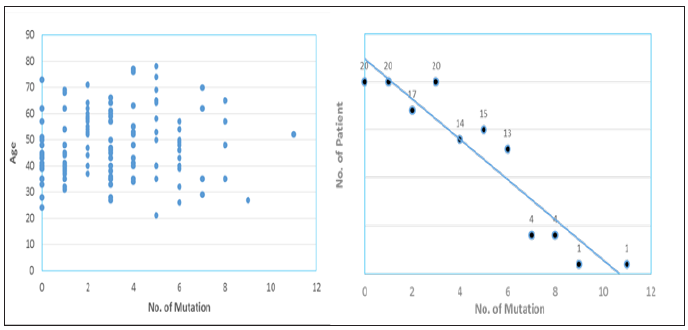
for demonstration. Our data revealed an age-independent mutation
spectrum with average 3.12 somatic mutations per subject (Figure
1). The most frequently mutated genes are TP53 (42%), KIT (6%),
KDR (5.5%), PIK3CA (5.5%), EGFR (5%) and PTEN (3.7%). These
results highlighted the prevalence of some cancer-associated driver
mutations in healthy individuals as background mutations. We also
demonstrated the concordance between our results and a recent
study for revealing the real somatic mutation in healthy population.
Figure 1: Distribution plots of somatic mutation detected in a cohort of 129 healthy subjects.
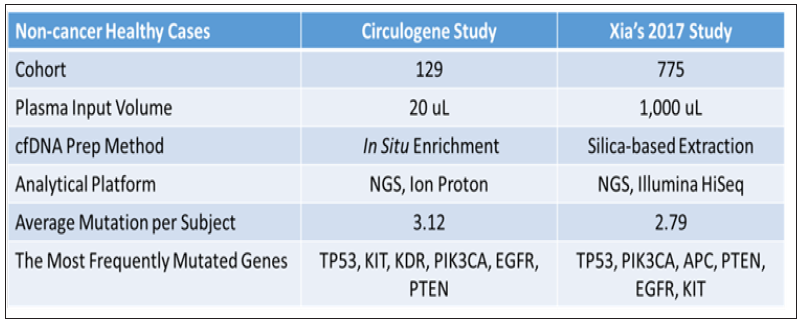
The study by Xia et al. [12] examined the background somatic
mutations in white blood cells and cfDNA in healthy controls based
on sequencing data from 821 non-cancer individuals with the aim of
understanding the baseline profile of somatic mutations detected in
cfDNA. The data comparison was summarized in Figure 2. Although
there are differences in study cohort composition, sample volume,
extraction methodology and analytical platform, the end results are
remarkably similar, i.e., average 3 mutations per subject with an
almost identical list of frequently mutated genes. Although varying
mutation spectra in cancers have often been attributed to cancerspecific
processes, our data suggest that at least a subset of these
mutations actually reflect normal tissue-specific processes. This
concept is consistent with the idea that a substantial fraction of the
mutations found in cancers occur in normal stem cells [13,14].
Figure 2: Comparison of somatic mutation detection in healthy population from two studies.
Normal tissue as a germline control not justified
There is evidence for the presence of tumor-derived cfDNA in
early cancers [15]. However, the real fraction of cfDNA that shed by
tumor rather than the background somatic mutations is not well
illustrated. For clinical application, the low level of tumor mutation
as well as the heterogeneity of background mutation present in
the circulation needs to be clearly addressed and differentiated
to achieve accuracy. Unfortunately, this goal can’t be achieved by
pushing detection limit of current advanced technology to below
0.01% mutant allele frequency (MAF). Contrarily, the higher
sensitivity will guarantee higher chance to pick up background somatic
mutations. Also, the clinical relevance of those lowpercentage
tumor mutations is still debatable in terms of treatment
decision or regimen change. Each human individual is unique.
Every cancer patient is different. No two tumors are the same
even resides within the same patient; to distinguish the definitive
cancer-specific mutations from background signals observable
in plasma is extremely daunting. Evaluation of specificity in
plasma cfDNA profiles from large numbers of healthy individuals
as representative controls for the cancer population seems farfetched
with uncertainty, especially when standardized protocol
and optimized technology are still lacking.
Unlike tissue genomic DNA, circulating cfDNA is so diluted
and dynamic with a relatively short half-life, making single-point
measurement not suitable for clinical application. We reason that
cfDNA in circulation is truly under a continuous selection pressure
to select for highly aggressive/proliferative clones, as disease
progressing the low-abundant tumor clones will either evolve and
dominate or vanish by the immune clean-up processes, therefore
longitudinal clinical follow-up should be performed to identify
the best time and target for precision therapy, meanwhile to filter
out contaminating background mutations. To achieve high clinical
specificity, a cfDNA-based test must be capable of distinguishing
between the background signals originating from non-cancer or
pre-cancerous processes and the invasive malignancy of clinical
interest. It is still possible that mutational signatures in cfDNA
could distinguish basic biological processes from malignant and
pathological processes.
Figure 3: A representative mutational trending curve after filtering out background mutations.
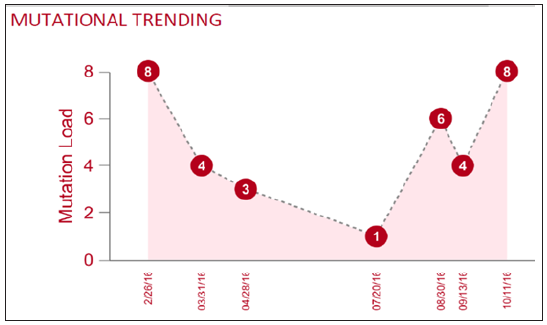
Here we propose a combined approach based on the tumor
evolutional principle of “survival and domination of the fittest”
in circulation that is to perform multiple time-point monitoring,
filter out potential background mutations (e.g., <1% MAF), reduce
sample input volume and interrogate multiple databases. A
representative mutational trending curve following our approaches
was shown (Figure 3). Our findings underscore the importance of
an assessment of the landscape of somatic mutations in cancerfree
population, and associated mutation signatures. Somatic
mutations and mosaicism in healthy individuals have implications
not only for early detection, diagnosis and treatment of cancer
using liquid biopsy but also emerging technologies in healthcare.
We recommend caution while extending the mutation conclusions
to cancer patients by employing matched normal tissue as germline
control. To increase sample input and push liquid biopsy sensitivity
toward <1% may not serve the interest of detecting low-frequency
mutant allele, but only to increase the chance of background
mutation contamination. Application of artificial intelligence,
machine-learning on big database to create an algorithm for highrisk
population screening of cancer is a good idea for preventive
medicine, yet the outcome is uncertain given the uniqueness of
every patient, each tumor - one size can’t fit all.
Read More Lupine Publishers Oncology Medicine Journal Please Click on Below Link
https://lupine-publishers-cancer-journal.blogspot.com/