Annotation
Studying the macro- and microelement composition of the soils of the
saline agrolandscape of the southern part of the
Prichanovskaya depression, it was established that meadow-chernozem
poorly saline sandy soil was formed in the eluvial position,
and low-saline solonchikovy clayey soil in the bottom. Of macronutrients
in them is dominated by silicon. Calcium is more than
magnesium, especially in the soil horizons of the lower position. The
content of trace elements in the soil of the lower position is
2-3 times higher than at the top due to their movement with surface and
groundwater. The content of arsenic, barium, boron and
strontium is several times higher than the MPC, which creates a
difficult situation in the area, which must be considered in the
production of agricultural products.
Introduction
Currently, agricultural production is undergoing great changes.
The main direction of use becomes its greening on a landscape
basis. The founder of this direction is BB Polynov [1]. The landscape
is a large and complex dynamic system of the earth’s surface, within
which interaction and interpenetration of the elements of litho,
hydro, and atmosphere occur [2]. In connection with the agricultural
use of the territory, a variety of landscape began to stand out-an
agroland landscape, which takes into account all its peculiarities
of development and existence-climatic, biological, lithological, soil,
etc. Such major scientists - soil scientists as VA Kovda [3], Kiryushin
VI [4], who were forced to look at this problem differently than
in the previous research period. Earlier, in the development of
zonal farming systems for the rational use of soil cover, zonal
features of the territory were mainly taken into account. It turned
out that with soils and living organisms in it and on it, scientific
substantiation, accuracy and thoroughness of agrotechnical and
ameliorative treatment is necessary. Underreporting and lack of
knowledge of natural conditions, especially of the soil cover, is
one of the reasons for low yields. With the scientifically based and
effective management of soil fertility, two difficult tasks are solved:
obtaining high and stable yields and increasing soil fertility. At
the same time, it is important to know the chemical composition
of soils belonging to a particular landscape and the direction of
geochemical processes within it. The purpose of these studies is
to study the chemical elemental composition of the soil and the
sanitary and hygienic situation in the saline agrolandscape of the
southern part of the Prichanovskaya depression, which is part of
the Barabinskaya plain.
Research Tasks
a) To study the macronutrient composition of catena
soils: meadow-chernozem ordinary low-power low-rich sandy
loam-eluvial (high) part of the agrolandscape and meadow-marsh
saline heavy clay-accumulative (low).
b) To determine the microelement composition of these
soils and to identify the sanitary and hygienic environment of the
studied saline agrolandscape. In fulfilling their goals and objectives,
they used modern approaches to study selected agrolandscapes
[4-6]. In 1990, an agromeliorative grouping of sone-almonds and
recommended measures for their improvement were developed
for sodic and saline soils in 1990 [7]. Currently, this group is
outdated. It does not match the approaches to the development of
adaptive-landscape farming systems. Therefore, an agroecological
typology of lands of the Barabinskaya lowland was proposed, which
underlies the present work [6].
Objects and Methods of Research
The studies were conducted in the southern part of the
Prichanovskaya depression of the Barabinskaya lowland, which
covers 65.5% of the territory of the Novosibirsk region or 11.7
million hectares. Here, in the immediate vicinity of Lake Chany, we
laid two soil cuts in a saline agrolandscape in the form of catena.
The incision (P40)-on the elevated mesorelief (eluvial position)
and the incision (P21)-in the lower part (accumulative position).
The Location of the P40 Soil Section is as Follows
Chistyozerny region of the Novosibirsk region, dry meadow,
eastern apical part of the margin of the mane (76° 45ʹ 09.08ʺ N).
Height above sea level-120 m. The soil is a meadow-chernozem
ordinary medium-power poorly mature sandy sand, and the P21
cut (54° 46ʹ 52.1ʺ.N., 76° 50ʹ 22.3ʺ E), height above sea level-103
m; grass-wormwood meadow, boils from HCL from the surface.
Groundwater-from 60cm. Soil: meadow-marsh saline, heavy clay
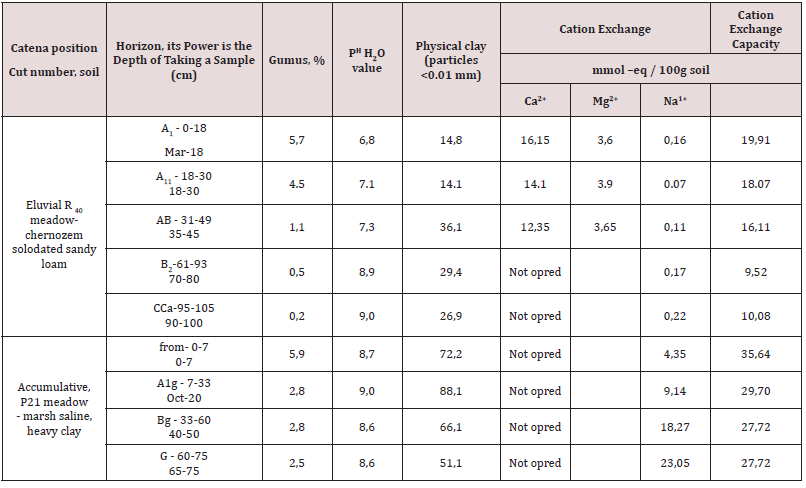
(Table 1) (Figure 1).
Figure 1: The location of the cuts on the saline agrolandscape (satellite image).
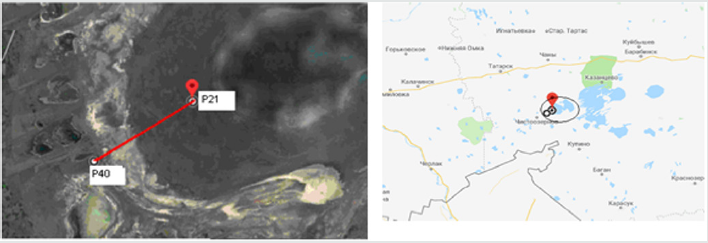
Table 1: Physico-chemical properties of catena soils in the saline natural landscape of the southern part of the Prichanovskaya
depression.
Discussion of the Results
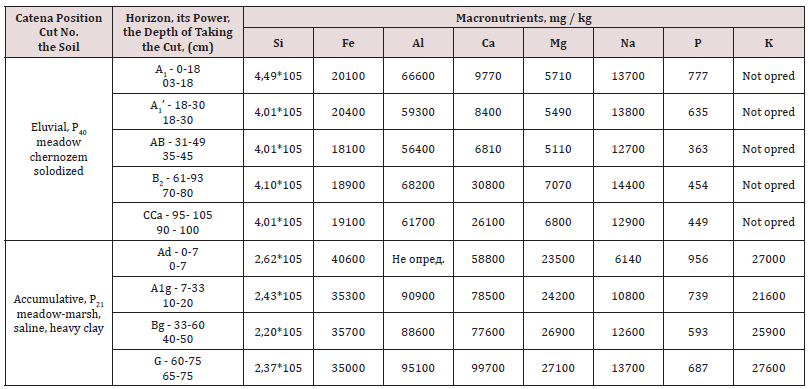
The gross content of 7 macroelements-Si, Fe, Al, Ca, Mg, Na,
P (Table 2) was determined. From the data of (Table 2) it can be
seen that the macro element Si dominates in the soils. On the
eluvial position, its catena is twice as large as in the accumulative
position, which is associated with weak leaching and movement of
silicon by surface flows. Somewhat different There were results on
the content of Ca and Mg. In both soils, the Ca content prevailed
over the Mg content. With depth along the profile, the amount of
calcium increased dramatically, especially in meadow-marsh saline
soil, since the latter is located in a modern lakeside belt, where
conditions are created for its enrichment in a biogenic way (during
spill, die-off mollusks, etc.) and due to soluble salts. The magnesium
content in both soils is distributed more or less evenly. With depth,
its amount gradually increases, and in the accumulative zone it is
almost 3 times more than in the eluvial one. The sodium content
in the upper horizons of the meadow-chernozem soil (eluvial
positions) exceeds the contents of Ca and Mg and is slightly less than
in the hell and Al horizons of the marsh, which indicates a periodic
enhanced leaching of these horizons during floods. Phosphorus
is slightly more contained in the salt marsh in the accumulation
zone, where natural conditions are created for its accumulation in
anaerobic conditions.
Table 2: The profile distribution of the gross content of macroelements in the saline natural landscape of the southern part of the
Prichanovskaya depression.
Summarizing the content of macronutrients in catena soils,
it can be noted that the eluvial positions in the natural saline
landscape in the hemihydromorphic soil profile contain less
macronutrients than the soil profile in the accumulative positions
by about 2-3 times. The issue of distribution of trace elements in
the soil scientists pay great attention. In particular, a number of
monographs on the Novosibirsk region and the city of Novosibirsk
were published [8-10], where the authors highlight the problem of
the great importance of trace elements in the life of plants, animals
and humans. A brief description of the biological role of individual
chemical elements, even those whose significance for living
organisms is not enough or little is known [8]. The authors of this
monograph conducted biogeochemical zoning of the territory of the
Novosibirsk region. Thus, within the region, two biogeochemical
provinces have been identified, which include 8 biogeochemical
regions (BR). They are significantly different in environmental
stress.
Object of Study
According to this regionalization, is located in the Barabinskaya
Plain in the extensive biogeochemical province 1 (BGHP-1). It is characterized by a wide distribution of saline rocks and soils,
mineralized groundwater, groundwater and surface water, a lack
of Co and Cu, an unfavorable ratio in Ca: Mg plants. Here the most
complicated biogeochemical situation has developed. This report
provides an analysis of 14 microelements and examined their
content depending on the position of the sections along the catenaupper
(eluvial) and lower (accumulative) positions.
Pb is lead. In medicine and in biology, interest in this element is
associated exclusively with its toxicity for all living things. However,
it has now been established that lead in small amounts (for plants
from 2 to 6mg/kg of dry matter and animals from 0.05 to 0.5mg/kg)
is necessary for their normal life activity [11,12]. Plant resistance to
excess lead is different-legumes are more resistant, and less so are
grains. Signs of toxicity to an excess of lead in plants for this reason
can occur when its total content in the soil varies from 100 to
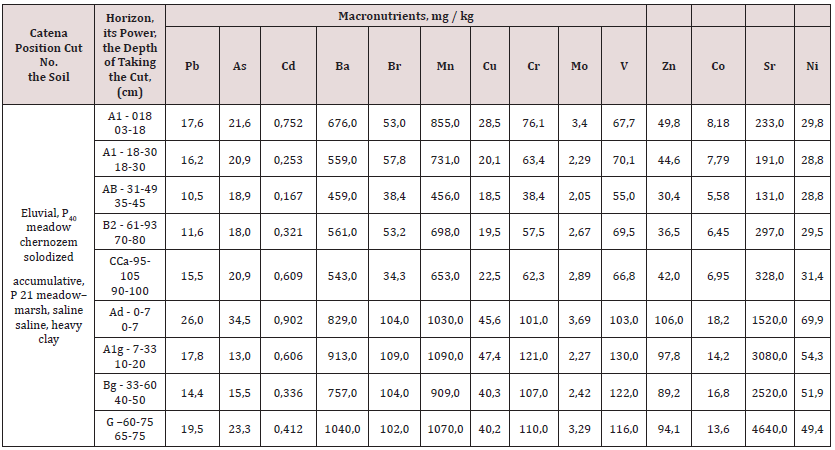
500mg/kg [13,14]. The data we obtained (Table 3) indicate that for
catena in eluvial and accumulative positions, the total lead content
ranges from 10.5 to 26.0mg/kg of soil. This amount is significantly
less than the MPC-100mg/kg [15]. In the upper humus horizons
its content is found more, and in the lower-somewhat less. In the
eluvial zone in the profile of the meadow-chernozem soil slightly
less than the accumulative. Our data indicate that there is no
significant change in the Pb content in the profile of both soils. Only
in the hell horizon of the meadow-marsh saline soil, the amount of
Pb increases to 26mg / kg of soil, which indicates its transformation
from the upper eluvial positions to the lower accumulative ones.
Table 3: The profile distribution of the gross content of trace elements in the soils of the saline agrolandscape of the southern part of
the Prichanovskaya depression.
As is arsenic. Arsenic has long been used both as a deadly poison
and as a medicine, since it has healing and tonic properties. He, like
other trace elements, in small quantities is necessary for living
organisms and extremely dangerous in high concentrations. The
biological role of arsenic is related to the fact that it is chemically
close to phosphorus and can replace it in separate biochemical
reactions. The phytotoxic threshold of arsenic in soils depends on
the particle size distribution and properties-on light, low-humus
soils with low absorptive capacity, it is 10-20mg/kg, and on heavy,
high-humus with high absorptivity, it can exceed 100mg/kg [12].
MPC of arsenic in sandy and sandy sour soils does not exceed 2;
in loamy and clay neutrals-10mg/kg. The arsenic data obtained
by us (Table 3) indicates that in the top positions in the meadowchernozem
soil along the profile it is distributed more or less evenly
and ranges within 18mg/kg in the B2 carbonate horizon and slightly
higher 21.6, which exceeds the MPC. More than 34.5mg/kg is found
in the accumulative zone in the horizon of arsenic hell. In the lower
horizons it is significantly less-13.0–15.5mg/kg. This is due to the
heavier particle size distribution of the soil and the alkaline reaction
of the environment. According to Russian regulations, these soils
have a high arsenic content.
Cd is cadmium. Cadmium is known as a toxic chemical element,
but recently it has been established that it stimulates the growth
of animals and humans in small quantities. The need for cadmium
for plants has not yet been established. Cadmium easily enters
the plants through the root system, and from the atmosphere into
the leaves. The main cause of cadmium toxicity for plants is that it
disrupts the activity of enzymes, inhibits photosynthesis and
makes it difficult for plants to enter a number of nutrients. MAC of
cadmium in soil in different countries ranges from 2 to 5mg/kg, in
water (mg/l) 0.05; in feed-1mg/kg of dry matter. According to Il’ina
VB and Syso AI [8] in the Novosibirsk Region there is no dangerous
entry of cadmium into plants from the soil, which is also confirmed
by our data (Table 3). The number of Cd in the soil profile of the
studied landscape is small. In the upper soil horizons of the eluvial
positions, its content is 0.8, and in the lower horizons it is 0.9 mg/
kg, then some decrease occurs. In soil-forming rocks, the amount of
cadmium increases in comparison with the middle horizons. There
is an increase in cadmium in accumulative positions.
Ba is barium. Despite the presence of barium in many plants
and animals, its physiological significance has not been established.
Due to chemical similarity and antagonism with calcium and
strontium, barium is able to displace them from plants. Plants easily
absorb Ba, especially from acidic soils, and are able to tolerate its
high concentrations. The MPC of barium in soils, food and feed has
not been developed, and in drinking water it is 0.1mg/l [16]. As
Ilyin VI and Syso AI noted [8] in the Novosibirsk region there may
be an excess amount of barium in plants and in living organisms
due to its high content in soils and waters. The data we obtained
(Table 3) suggests that the Ba content in eluvial positions is high
and varies along the profile of the meadow-chernozem soil from
543 in the parent rock to 676mg/kg in the humus horizon A.
Significantly higher is its quantity respectively 1040 and 829mg/
kg, which indicates leaching and movement of Ba down the catena
and accumulation in vegetation and living organisms.
B-bor. The biological functions of boron in plants are associated
with the metabolism of carbohydrates, the transfer of sugars through
membranes, the synthesis of nucleic acids and phytohormones.
However, the mechanism of its action is not fully understood. In the
south of Western Siberia there is practically no shortage of plant
boron. Soils are rich in this trace element, and an excess of boron
is a frequent occurrence here, especially in saline soils [17]. MPC
boron in drinking water-0.5mg/l. An excess of boron in the soils
of the Barabinskaya Plain is a serious environmental problem,
both for plants and for animals and humans. A high concentration
of boron in saline soils not only reduces the yield, but also causes
boric enteritis, an endemic disease of the gastrointestinal tract in
animals and humans. In the studied agrolandscape (Table 3), the
boron content in the eluvial position is 38–57.8mg/kg of soil, and
in the accumulative position, it is 2 times higher in the profile of
the meadow-marsh saline soil, which creates serious sanitary and
epidemic problems for this area of residence [18].
Mn is manganese. Manganese provides redox processes in
plants, since it is able to change valence easily and reversibly
transfer from Mn2+ to Mn7+. With a shortage or an excess of Mn,
these functions are violated [12,19,20]. In plants, manganese is
involved in the respiratory process, nitrogen metabolism, promotes
the formation of chlorophyll and the synthesis of nucleic acids. In
living organisms, manganese performs the same functions as in
plants, but at the same time new, specific ones appear. It is needed
for the body to produce insulin, the formation of the skeleton, the
work of the central nervous system. According to Ilyin VB and
Syso AI [8], in the Novosibirsk Region there are areas with both
low manganese content and high, and anthropogenic impact on
agricultural landscapes can increase both the deficit and excess of
this element. Our studies have shown that in the eluvial positions of
saline agrolandscape in the profile of meadow-chernozem soils, the
gross Mn content does not exceed 855mg/kg, which is lower than
the regulated sanitary and hygienic standards adopted in the soils of
Russia (1500-3000mg/kg). In accumulative positions in the profile
of meadow-marsh saline soil, the manganese content is somewhat
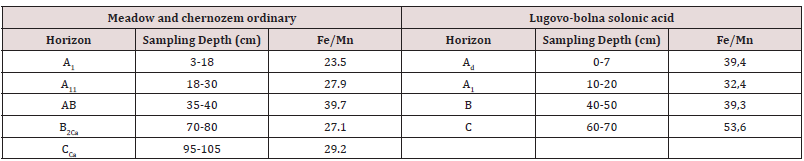
higher-up to 1090 mg/kg in horizon A1. However, the ratio Fe/Mn
is high and significantly exceeds the standard (1.5-2). This gives
reason to consider this area unfavorable for the cultivation of
cultivated plants (Table 4), because manganese deficiency is added
to other adverse conditions.
Table 4: Fe/Mn ratio in the studied soils.
Cu-copper. Copper is involved in many physiological
processes occurring in living organisms. In plants, these include
photosynthesis, hemoglobin synthesis, respiration, redistribution
of carbohydrates, etc. Such wide participation of copper in plant life
is associated with its ability, as well as Fe, Mn, Co and Mo to change
valence. Copper, like zinc, is responsible for reproductive functions.
Its lack leads to a decrease in grain and its quality.
In Russia, MPC of copper for soils is set depending on its particle
size distribution and pH value. In sandy and sandy soils, the MPC of
gross copper content is 33; in loamy and clay sour-66; loamy and
clay neutral and alkaline-132mg/kg. As can be seen from (Table
3), the gross copper content in the eluvial position in the profile of
meadow-chernozem solodized soil ranges from 18.5 in horizon AB
to 28.5mg/kg in horizon A. and more times more, which indicates the spatial movement of this element from the top to the bottom
where it accumulates. Copper content below MPC is typical for all
horizons of the studied soils.
Cr-chrome. Chromium, as a chemical element, is vital for living
organisms, since in the processes of carbohydrate metabolism, it
interacts with insulin, participates in the structure and function
of nucleic acids and, possibly, the thyroid gland. The chromium
content in plants ranges from 0.02-1.0mg/kg of dry matter. As a rule,
plants under normal conditions do not lack it. MPC for chromium in
Russia has not yet been developed. According to Kloke A [15], the
MPC in animal feed should not exceed 20mg/kg. In drinking water
in Russia, the MPC is 0.05mg/l. Researches by Ilyin VB and Syso
AI found that no high and dangerous concentrations of chromium
were found for the health of animals and humans in the soils of
the Novosibirsk Region [8]. Our studies have shown that in eluvial
positions, the gross chromium content in the meadow-chernozem
soil is below the MPC. According to the profile, its quantity changes
insignificantly and only in the horizon of AV it decreases sharply,
which, apparently, is connected with the processes of podzolization
and lassival. In accumulative positions in the profile of a meadowswamp
soil, the chromium content increases and is on the verge of
the MPC or slightly above it, especially in the A1 horizon-121mg/
kg, which may be due, on the one hand, to the movement of this
chemical element with surface and underground waters, and on the
other-with its accumulation due to the periodic flood of Lake Chany
during the flood season.
Mo-molybdenum. As an element with variable valence,
molybdenum in living organisms performs the function of electron
carrier. In plants, molybdenum takes part in nitrogen exchange. It
is a catalyst in the conversion of nitrites to nitrates, ensures the
fixation of atmospheric nitrogen by nodule bacteria of legumes.
The optimal ratio of Cu/Mo=4: 1. With a higher ratio, grazing
diarrhea syndrome appears in cattle. As evidenced by the results
of the research of Il’in VB and Syso AI, in the soils and plants of the
Novosibirsk Region both a deficiency and an excess of molybdenum
are possible. Its content in feed and plants below 0.2-2.5mg/kg
of dry matter is considered critical, and non-dangerous-10mg/
kg. The MPC in soils is 5mg / kg [15]. Our research suggests that
the molybdenum content in both the top and bottom positions is
low and well below the MPC-from 3.6 to 2.05mg/kg (Table 3). It is
about the same and its accumulation in the accumulative positions
does not occur. However, there is a high ratio between Cu/Mo-up to
20 (Table 5). Consequently, in this natural landscape, the balance
between copper and molybdenum is disturbed, which can cause
diseases in animals and people.
Table 5: Cu/Mo ratio in catena soils of the saline natural landscape.
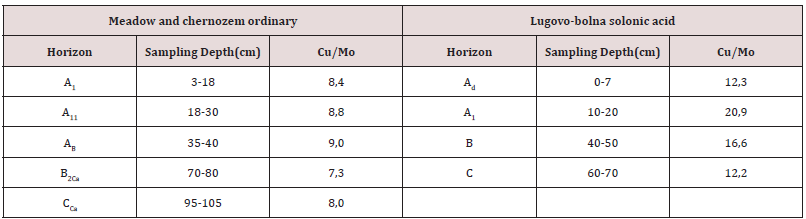
(Table 5) Cu/Mo ratio in catena soils of saline natural-Vvanadium.
Vanadium is a necessary chemical element for living
organisms, and for plants its significance remains unexplained.
In plants, vanadium contains a little-up to 2mg/kg of dry matter,
whereas in soils it is quite a lot. Vanadium was found to be involved
in plant photosynthesis. With its lack of plants, the amount of
chlorophyll is reduced. Like molybdenum, vanadium is a catalyst in
the processes of nitrogen fixation from the air by nodule bacteria
of legumes of the plant landscape In the Novosibirsk region in the
diets of animals neither vanadium deficiency nor phytotoxicity is
observed. According to Kloke A [15], the MPC of vanadium in soils is
100mg/kg; in Russia-150mg/kg, for food-5mg/kg and for drinking
water-0.1mg/l. Our data indicate that the content of vanadium in
the upper positions of catena in the profile of meadow-black earth
soils varies from 55.0 to 70.1mg/kg. The profile distribution of
vanadium is more or less evenly, except for the horizon AB, where
a decrease in its content is observed. In accumulative positions
there is its accumulation, but in quantities much smaller MAC.
The maximum content of vanadium falls on the A1 horizon of the
meadow-marsh saline soil and is 130mg/kg (Table 3).
Zn is zinc. Zinc is involved in many functions of living
organisms. It is part of various enzymes involved in the metabolism
of carbohydrates, proteins and phosphates and in the reproduction
process. In higher plants, Zn, as a rule, accumulates in the seeds,
where it is concentrated in the germ. The MPC of zinc in soils
according to Kloke A [15] is 300mg/kg. In Russia, depending on
the granulometric composition of the APC (gross) zinc in sandy
and sandy soils-65; in loamy and clay (acidic)-110; in loamy and
clay (neutral)-220mg/kg. In the studied agrolandscape, the total
zinc content in eluvial positions ranges from 30 to 50mg/kg,
which is significantly lower than the MPC. In the upper horizons it
contains up to 50mg/kg (Table 3). In the horizon AB its quantity
decreases and in the parent rock it increases again to 42mg/kg. In
accumulative positions, the zinc content increases almost 2 times.
Its maximum amount is typical for the upper horizon A. The bottom
of the Ziz content is Zn, but the decline is weak.
Co-cobalt. It is established that cobalt has a positive effect on
the growth and development of plants and ensures the ability of
leguminous crops to capture molecular nitrogen from atmospheric
air. In addition, cobalt is part of provitamin B12, which is formed in
plants and is necessary for animals and humans. It is established
that if the cobalt concentration is reduced to 0.1mg/kg of dry
matter and lower, the use of cobalt fertilizers gives a positive result.
Co deficiency in soils can cause carbonate, alkalinity, including
podzolization and solubility, as well as a high content of humus,
iron oxides and manganese. MPC of this element in soils-50mg/
kg, in drinking water-0.1mg/l, in feed-10mg kg of dry matter. In
the studied saline agrolandscape (Table 3), no excess of cobalt
was found in the soils. In the eluvial positions in the profile of the
meadow-chernozem soil, its maximum amount falls on the upper
humus horizons A1 and A1-8.5-7.8mg/kg, in the horizon ABdecreases
to 5.8, and then its content again slightly increases. On
alluvial positions in the profile of meadow-marsh saline soil, the
amount of gross Co is almost 2mg/kg falls on the upper horizon
of Hell, which can be explained by the movement of Co from upper
positions to lower ones with surface and subsurface waters. The
cobalt content in the studied soils is significantly lower than the
MPC.
Sr-Strontium. Gross strontium is a toxic chemical element for
plants and animals. In addition, it can cause a negative effect. For
example, iodine in the presence of strontium becomes inaccessible
to living organisms in which iodine deficiency begins to develop,
with all the negative consequences that follow [21]. Currently,
MPCs for strontium have been developed for drinking water up to
2mg/l [16]. For soils, MPCs of strontium have not been established,
but according to the studies of Kovalsky VV [21], 600mg/kg should
be considered a critical level of strontium content in the soil. The
strontium - calcium balance expressed by the Ca/Sr ratio in the
most prosperous areas, for example, in the Kursk Region is 200,
and in the endemic areas of the Amur Region it decreases to 3.5.
According to the data of researchers [8,22,23], the saline soils of
the Barabinskaya plain contain high amounts of Sr, which is an
antagonist of Ca. The results of our early studies convincingly
indicate that the distribution of the total strontium content is
characterized by its accumulation in accumulative positions and
a decrease in eluvial concentrations [24]. Our data are consistent
with the results of previous researchers. From (Table 3) it can
be seen that on the eluvial position, the content of strontium in
the upper horizon is 233mg/kg. In the AB horizon, it decreases
to 131, and in the parent rock again increases to 328 mg/kg.
In the accumulative position, its amount increases many times.
Maximum-4640mg/kg-accounted for the parent rock. Such amount
of Sr indicates its high content in the territory of the saline natural
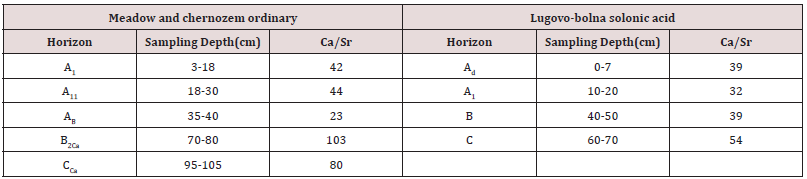
landscape. It was established that the average Ca/Sr ratio in the
soils of the Barabinskaya Plain is 26-52. In the area under study, it
also fluctuates within the same limits (Table 6). This ratio between
Ca/Sr indicates a significant imbalance of their content in the soil
and in plants. An increase in strontium concentration in soils is one
of the main factors increasing them in plants and then in animals
and humans. The optimal balanced ratio of Ca/Sr in feed and food
is considered to be 80 [24].
Table 6: Ca/Sr ratio in soils of a saline agrolandscape of the southern part of the Prichanovskaya depression.
Ni-Nickel. The need for this chemical element for the life
of living organisms has been recently established [8]. It is
indispensable in the composition of urease and is consumed by
bacteria of legumes, stimulates the processes of nitrification and
mineralization of nitrogen compounds, positively affects the
activity of nitrate reductase, which contributes to the recovery of
nitrates and nitrogen fixation. In living organisms, nickel is involved
in the structural organization of DNA, RNA and proteins [25-26]. In
the Novosibirsk region, there is no natural shortage or excess of this
chemical element for plants and animals.
The Regulated Nickel Content in the Soils of Russia is as
Follows
APC in sandy and sandy soils-20; in loamy and clayey (sour-40);
in loamy and clay (neutral)-80mg/kg. MPC for plant products in
feed grain-1, in coarse and succulent feeds-3 mg/kg of dry matter.
MAC in drinking water in many countries of the world is 0.1mg/l. In
the studied saline natural landscape, the nickel content in the soils
of the catena under consideration is significantly lower than the
established JDC. At the eluvial position in the meadow-chernozem soil,
the nickel content is more or less evenly distributed over the
genetic horizons, while at the accumulative position its content
increases almost twice, especially in the upper horizon of the hell
meadow-marsh saline soil up to 70mg/kg, gradually decreasing
with depth, reaching 49mg/kg in the C horizon. The obtained data
convincingly indicate that nickel is easily washed away by surface
waters from the soil profile of the upper landscape positions to the
lower ones and accumulates in the upper soil horizons.
Conclusion
a) A profile study of the macro-and microelement
chemical composition of soils was carried out in one of the EPA of
a saline agrolandscape in the southern part of the Prichanovskaya
depression by catena, in which eluvial (upper) and accumulative
(lower) positions were distinguished. At the top position, the soil is
represented by a meadow - chernozem plain poorly malignant, and
at the bottom - by a meadow – marsh salt marsh.
b) The study of the content of Si, Fe, Al, Ca, Mg, Na, and
P macronutrients showed that silicon prevails in both eluvial
and accumulative positions, but its eluvial positions are 2 times
higher than in accumulative ones. In both soils, the Ca content
predominates over the Mg content, especially in the carbonate
horizons of the lower position, where conditions are created for
its accumulation in a biogenic way. The Na content in the upper
horizons of the meadow-chernozem soil exceeds the Ca content.
c) Mg and slightly less than in the hell and A horizons
of the meadow-marsh soil due to the periodic flushing of these
horizons.
d) In the lower positions of the salted agrolandscape, more
microelements accumulate (2-3 times or more) than in the upper
positions due to their movement with surface and groundwater.
Basically, their content is below the established MPC, which
indicates the absence of natural pollution by them. The exceptions
are trace elements-arsenic, barium, bromine, and strontium, whose
content is several times higher than the MPC. Especially dangerous
for animals and humans is the low Ca/Sr ratio in the soils of this
region, both in eluvial (23-103) and accumulative (21-39) positions
at a rate of 200. Therefore, it is necessary to take measures to
increase the Ca content or decrease Sr in soils.


