Lupine Publishers | Journal of Veterinary Science
Amaranthus, collectively known as amaranth or pigweed, is a
cosmopolitan genus of herbs. Approximately 60 species are
presently recognized, with inflorescences and foliage ranging from
purple and red to gold. Because of recent concerns about global
food security and malnutrition scientists all over the world are engaged
in exploring the plant biodiversity to broaden the crop list.
Due to described agricultural advantages, unique nutritional properties
and versatile usage, grain amaranth (Amaranthus spp.) has
gained increased attention. Amaranth seeds have a high content of
storage proteins (14-19%) whose amino acid composition is rich
in lysine and methionine, two limiting amino acids in cereals and
legumes, respectively. Amaranth (Amaranthuscaudatus), quinoa
(Chenopodium quinoa) and ka~niwa (Chenopodiumpallidicaule) are
originally from the Andes of South America where they have
remained a staple since Pre-Hispanic times. Due to its good protein
quality which is comparable to casein, high fibre content and
bioactive compounds, and these gluten-free grains are formidable food
alternatives for celiac patients and/or those suffering from
gluten-sensitivity.
Introduction
Amaranthus is recognized as a promising plant genus that may
provide high-quality protein, unsaturated oil, and various other
valuable constituents. Amaranths are valued as leaf vegetables and
cereals.It is noted not only for its environmental hardiness but also
for the excellent nutritional quality of its seeds (Bejosano, [1]). Due
to its unique nutritional properties and versatile usage, grain amaranth
(Amaranthus spp.) has gained increased attention. Amaranthus,
collectively known as amaranth or pigweed, is a cosmopolitan
genus of herbs. Approximately 60 species are presently recognized,
with inflorescences and foliage ranging from purple and red to
gold. Most species are considered as opportunistic weeds and only
three of them, Amaranthuscaudatus, Amaranthuscruentus and Amaranthushypochondriacus,
are commonly consumed by humans as a
seed or used as a functional ingredient in foods (Gamel). Amaranth
is a pseudocereal because of its flavor and cooking similarities to
grains. The word “Amaranth” comes from the Greek amarantos, the
‘one that does notwither’ or the never-fading flower. It contains
high content of fibre and bioactive compounds Repo-Carrasco [2],
these gluten-free grains are formidable food alternatives for celiac
patients and/or those suffering from gluten-sensitivity. It also provides
a good source of dietary fiber and dietary minerals such as
iron, magnesium, phosphorus, copper, and especially manganese.
Amaranth was recognized as gluten-free and is therefore suitable
for diets of celiac disease patients (Fasano and Catassi [3]; Thompson
[4]. The seeds are eaten as a cereal grain. They are ground
into flour, popped like popcorn, cooked into porridge, and made
into a confectionery called alegría. The leaves can be cooked like
spinach, and the seeds can be germinated into nutritious sprouts.
The leaves are variable in size, green or purple, with slender stalks.
These are alternate, usually simple, with entire margins and distinct
markings, depending on species. Amaranth species are also
cultivated and consumed as a leaf vegetable in many parts of the
world. In India the leaf is added in preparation of a popular dal
called thotakurapappu. In China the leaves and stems are used as
a stir-fry vegetable. In East Africa amaranth leaf is known as mchicha-
“a vegetable for all”. The seeds are used as a source of lipids
and a material for the production of flour, flakes, popped seeds, several
sorts of bread (Januszewska-Jóźwiak and Synowiecki, [5]) and
confectionery Sindhuja [6].
Chemical Composition and Nutrition Value
The small seeds are usually shiny black in colour, in contrast
to those of grain types which are cream-coloured. There are up to
3 000 seeds per gram. The tiny, lens shaped seeds are usually pale
in colour.A seed of grain amaranth is on average composed of 13.1
to 21.0% of crude protein; 5.6 to 10.9 % of crude fat; 48 to 69%
of starch; 3.1 to 5.0% (14.2 %) of dietary fibre and 2.5 to 4.4 %
of ash Grobelnik [7]. Enzyme inhibitors and allergens are known
to be present in cereals. Protein isolated from wheat, rice, maize
and barley may cause allergic reaction, a gliadin fraction isolated
from wheat causes celiac disease. But these components are not
available in pseudocereals and legumes such as soybean and amaranths
Kuhn [8]. Furthermore, amaranths contain dietary fibre in
high proportion, which improves lipid metabolism. Its nutritional
value is mainly due to its protein fraction (Gorinstein [9] Oleszek
[10]). Amaranth, a pseudocereal, is an unconventional and interesting
source of proteins. Its seeds contain a large amount (14-17%,
w/w) of high nutritional quality proteins (Bolontrade [11]), whose
amino acid composition is rich in lysine and methionine, two limiting
aminoacids in cereals and legumes, respectively [4,5]. Amaranth’s
balanced amino acid composition is close to the optimum
protein reference pattern in the human diet according to FAO/
WHO requirements. Protein is high in amino acid lysine but low
in leucine. This is the opposite of most other grains. Thus mixing
would form an almost perfect protein (Good ratio of unsaturated
fat to saturated fat that is beneficial for hypertension and coronary
heart disease).The nutritional quality of amaranth seed is high because
of its high protein content and balanced essential amino acid
composition (Oszvald [12]). Moreover, amaranth grain protein is
rich in lysine, which is usually deficient in cereal grains. Proteins
have high digestibility (approx. 90%) and are rich with lysine (4.9
to 6.1g/100 g protein) which usually appears in grains as a limiting
amino acid. This high lysine concentration is complemented with
elevated levels of sulphur amino acid content (2 to 5%), which is
higher than that measured in the most important legumes (1.4% on
average), such as peas, beans and soybeans (Gorinstein and Moshe,
[13]). Leucine, isoleucine, valine, the limiting amino acids in amaranth,
are not considered a serious problem since they are found
in excess in most common grains, and therefore, amaranth is well
suited for blending with cereals.The main protein fractions present
in the amaranth grain are albumins, 11S-globulin, P-globulin, and
glutelins .
Amaranth starch is of promising use. The features of starch like
high solubility and digestibility are due to its uniquely small size
which is about one-tenth the size of cornstarch and therefore offer
new possibilities for food processing, pharmacology and cosmetics
Resio [14]. The total mineral content has been reported to be
generally higher than that observed in cereal grains, especially
calcium and magnesium Alvarez-Jubete [15]. On the other hand,
it is characterized by higher dietary fibre and lipid content than
most cereals and also contains between 50 and 60g of starch per
100 g of grains Alvarez-Jubete [15]. Amaranth has recently become
a focus of interest for its high nutritive values and great potential
as a functional food given its cholesterol-lowering effect observed
in animal models Mendonça [16]; Plate &Arêas [17]. According
to Becker [18] seed of grain amaranth is a rich source of iron (72
to 174mg/kg), calcium (1,300 to 2,850mg/kg), sodium (160 to
480mg/kg), magnesium (2,300 to 3,360mg/kg) and zinc (36.2 to
40mg/kg) as well as vitamin riboflavin (0.19 to 0.23mg/100g of
flour) ascorbic acid (4.5mg/100g), niacin (1.17 to 1.45mg/100g),
and thiamine (0.07 to 0.1mg/100g). Amaranth oil is reported to have
high levels of tocotrienols and squalene, which are natural organic
compounds that are involved in the metabolism of cholesterol and
that could play an important role in lowering LDL-cholesterol in
blood. Amaranth lipid is unique with high squalene content ranging
from 2.4 to 8.0% of the total oil contents (Rodas and Bressani, [19].
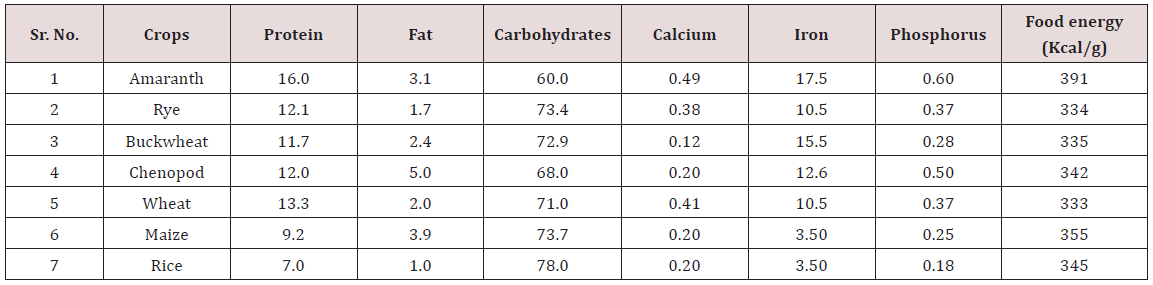
A comparative account of nutritive value of grain amaranths and
other cereals is presented in Table 1. On the average pale-seeded
amaranths contain 8% of dietary fibre and black coloured 16% with
soluble fibre rate of 30 to 40% and 18 %, respectively (Schnetzler
and Breene [20], Tosi [21] reported 14.2% of dietary fibre in the A.
cruentus flour (8.1% soluble, 6.1% insoluble).
Table 1: Comparative account of nutritive value of grain amaranths and other cereals.
Health Benefits
Amaranth leaves are a good source of energy in the body sicne
the crude protein content in the leaves ranges is very high i.e.20
to 32%, on a dry weight basis. Amaranth leaves are a good source
of elements like manganese, iron, copper, calcium, magnesium,
potassium and phosphorus necessary to maintain adequate
electrolyte balance in the body. People suffering from gluten intolerance or those suffering from celiac diseases can get daily
recommended dose of protein from amaranth greens. Compared to
other plant sources, such as wheat and rice amaranths are glutenfree
and contain 30% more protein with complete set of amino
acids. It can improve the digestive system and reduce constipation
due to the high content of dietary fibre which is three times that of
wheat. The protein in the leaves helps to reduce insulin levels in
the blood and also releases a hormone that lessens hunger pranks
and prevent over eating. One of the key health benefits of vegetable
amaranth leaves is their cholesterol-lowering capacity. Due to the
high fibre content, this leafy vegetable is effective in reducing LDL
levels in the blood and promotes weight loss. Tocotrienols, a type of
vitamin E available in vegetable amaranths, also contributes to its
cholesterol lowering ability. Iron-rich (five times that of wheat) red
amaranth leaves promote coagulation and increase haemoglobin
content and red blood cell counts. It is also an excellent source of
folic acid which is necessary to increase the blood haemoglobin
level. Amaranth leaves are excellent dietary source of phytosterols
that lowers blood pressure and prevents heart ailments including
stroke. The presence of lysine (anessential amino acid) along with
vitamin E, iron, magnesium, phosphorus, potassium and vitamin
C helps to fight against free radicals responsible for ageing and
formation of malignant cells which helps in fighting against cancer.
The high calcium present in amaranth leaves (two times that of
milk) is helpful to reduce risk of osteoporosis and other calcium
deficiency- related disorders. Amaranth leaves are excellent source
of β-carotene. Inclusion of amaranth leaves in the daily diet can help
to prevent vitamin A deficiency. It was reported that the incidence
of blindness in children due to malnutrition has been reduced with
the consumption of 50-100 g of amaranth leaves per day Das [22].
Bioactive Components and Medicinal Properties
The health benefits of amaranths have always been recognised
in homoeopathic and Ayurvedic medicines. Both the seeds
and leaves of amaranth are used as herbal remedies and have
nutraceutical value. Amaranth protein contains a low proportion
of prolamins which makes it a safe ingredient for people with
celiac disease and recent studies have shown that amaranth
peptides displayed antihypertensive and anti-inflammatory
activity. Peptides contained in amaranth seed proteins have shown
various biological activities. Some studies using amaranth flour
and protein isolates reported the occurrence of peptides with
biological activities such as anti-hypertensive, anti-oxidant, anti
thrombotic,anti-proliferative among others. Amaranth is ranked
as one of the top five vegetables in antioxidant capacities Walter
[23]). It contains ample amount of bioactive components, such as
L-ascorbic acid, betacarotene, polyphenol, anthocyanins and lutein
Walter[23]. It has been used as an antipyretic to reduce labour
pain in Indian and Nepalese traditional medicine, as astringent,
diuretic, haemorrhage and hepatoprotective agent (Kirtikar and
Basu [24]. Amaranths have also been used to treat bladder distress,
piles, toothache, blood disorders and dysentery (Madhav [25]. The
health beneficial antioxidant activities are related to their bioactive
components. The cholesterol- lowering effects in amaranth may be
due to unsaturated fatty acids. Being a good source of magnesium
which is effective to relax blood vessels and prevent constriction
and rebound dilation, it helps to fight migraines. Cooking had no
deleterious effect on total bioactive component except for the
reduction of anthocyanins content. Home cooking increases the
antioxidant activities and the contents of arytenoids, especially
by steaming. Both simmering and blanching increased the
betacarotene and lutein in the cooked amaranth (Han and Xu [26].
Food Uses of Amaranth
Vegetable amaranths are widely consumed as leafy vegetables in
India and other Asian and Southeast Asian countries, also in African
countries where as in North and South America grain amaranths
are widely consumed. Amaranth leaves are a good source of high
amount of protein, vitamins, minerals and dietary fibre. Chopped
plants can also be used as forage for livestock. Amaranth seed oil
has been reported to contain large amount (7-8% and 11%) of
squalene which is often used in cosmetics and medicine, where olive
oil contains only 1% of squalene. Amaranth oil is also a rich source
of tocotrienols which is very effective to lower the LDL cholesterol
(Becker [27] Plate and Areas [17]. In India A. hypochondriacus
is known as the ‘king grain’ and is often popped to be used in
confections. Amaranth grain may be processed in various ways,
like grains can be popped, flaked, extruded and ground into flour.
Popped amaranth can be enjoyed on its own or can be served with
milk or soymilk and fruit for a healthy breakfast. Amaranth can
be used as a substitute in porridge, stirred into soups; Amaranth
grains can be cooked whole in a pot, rice cooker or pressure cooker
to prepare breakfast porridge or savory ‘polenta’. The grain flour
or flaked grains are combined with wheat or other flours to make
cereals, cookies, bread and other baked goods. As per general
recommendation, amaranth grain flour should contribute only
10-20% of the mixed flour blended with wheat flour. But it has
been shown that amaranth grain flour blended up to 50-75% of
the mixed flour, it will still retain functional properties as well as
flavour.
Processing
Amaranth is cleaned with screens, by winnowing, with a fan or
other blowing device. After harvesting, it is important to further
dry the crop to ensure it won’t spoil during storage. It can be left on
trays in the hot sun or placed near an indoor heat source. Amaranth
has no hulls to remove unlike beans or true grains, Amaranth is
relatively a small sized grain with average diameter of about 1mm.
The embryo part accounts for about 25% of the kernel and situated
in the peripheral region. The kernel consists of storage tissue or per
sperm and the endosperm part is present as a two layered tissue
Coimbra and Salema [28]. The seed coat of the amaranth grain is
smooth and thin. Amaranth seed contains 26% of bran and germ
components and 74% of flour. The nutrients are not uniformly distributed throughout the grain like other cereals. Nutrients are
concentrated in bran and germ fractions of the grain. The amaranth
grain can be toasted, popped, extruded or milled into flour and can
therefore be consumed as such or included in other cereal products
such as bread, cakes, muffins, pancakes, cookies, dumplings, crepes,
noodles and crackers [29-84].
Conclusion
Amaranths especially the grain amaranths are considered
as the golden crop of future. Much of the research activities done
on amaranths has focussed on its exceptional nutritive value. The
health benefits of amaranths have been recognized in homoeopathic
and Ayurvedic medicines. Both the seeds and leaves of amaranth
are used as herbal remedies and have nutraceutical value.