Tuesday, 10 October 2023

Lupine Publishers | Post-Breast Cancer Chronic Wounds with Solid Calcifications Treated with Cu/SiO2-TiO2 Nano Biocatalyst

 Lupine Publishers| Journal of Modern Approaches on Material Science


Abstract

Objective: To describe patient outcomes with respect to the use of Cu/SiO2-TiO2 nanoparticles embedded in a polymeric gel as treatment for post-breast cancer chronic wounds with solid calcifications.

Methods: The nanoparticles were synthesized by the sol-gel method. The compound was incorporated into a polymeric gel matrix. SEM and TEM microscopy studies were carried out to evaluate grain size, morphology, and texture of the pure nanoparticles. The chronic wounds were treated by applying zinc oxide as emollient, Triticum vulgare (Italdermol®) and the Nano biocatalyst. The wound was covered with Solvaline® N dressings for the absorption of the exudate.

Results: The Cu/SiO2-TiO2 nanobiocatalyst displayed average particle size between 5 and 10 nm with high particle dispersion. Ordered arrangement of the nanoparticles was observed in TEM micrographs suggesting anatase crystalline structure. Microcalcifications extracted from the wound were suspected to be calcium carbonates and calcium oxalates, exhibiting sizes of the order of 20 μm. The administration of the nanoparticles with Triticum vulgare enhanced granulation tissue formation and revascularization by limiting bacterial infection. After 8 months of the first application the wound had completely healed in an atrophic scar, with no sign of inflammation or infection. No adverse effects were observed in the patient.

Conclusions: Post-breast cancer chronic wounds were successfully treated with Cu/SiO2-TiO2 nanoparticles. Good outcomes were observed in terms of tissue regeneration, wound healing, and infection hindering. Calcifications were eliminated. The nanoparticles can be used as a primary apposite to stimulate the autolytic debridement of injures due to their excellent local absorption and bactericide action.

Declaration of Interest: The study’s sponsors were not involved in the study design, the collection, analysis and interpretation of the data, the writing of this manuscript and the decision to submit this article for publication. The views express in this article are those of the authors.

Keywords: Cu/SiO2-TiO2, Chronic wounds, Breast cancer, Microcalcification, Tissue regeneration

Key Points:

a. A nanobiocatalyst based on mixed-oxides impregnated with transition metals was synthesized by the sol-gel method for the treatment of a post-breast cancer chronic wound.
b. The nanobiocatalyst presented displayed average particle size between 5 and 10 nm with high particle dispersion and ordered particle arrangement suggesting anatase crystalline structure as observed by SEM and TEM.
c. The post-breast cancer wound exhibited the formation of microcalcifications (20 μm) composed of calcium carbonates and calcium oxalates.
d. The administration of the nanobiocatalyst enhanced the formation of granulation tissue and revascularization by limiting bacterial infection.
e. The 30-years-old wound completely healed in an 8-months period, with no adverse effects detected.
f. The microcalcification formation was eliminated after tissue regeneration.

Introduction

Despite recent advances in the detection and treatment of metastatic breast cancer, mortality related to this disease remains as one of the highest due to the emergence of therapy-resistant cancer cells [1-5]. In 2018, an estimated 2 million new global cases were diagnosed representing 23% of all cancers, incidence rates varying from 19.3 per 100,000 women in Eastern Africa to 89.7 per 100,000 women in Western Europe [6]. By 2030, the number of deaths in Latin America is expected to achieve 74,000 per year [7]. The Globocan 2018 estimated that in Mexico the incidence for breast cancer was 39.5 cases per 100,000 habitants, with a total of 27,283 new cases and 6,884 deaths [8,9]. Common treatments for nonmetastatic breast cancer include endocrine therapy and cytotoxic chemotherapy [10]. The main surgical approach for cancer of the breast in all stages, early or late, is a radical and total mastectomy, breast-conserving surgery, and breast reconstruction, all followed by irradiation [11]. Possible side effects of surgery include seroma, hematoma, lymphoedema, cording, restricted range of movement in the shoulder, nerve pain, tissue necrosis, microcalcification formation, and surgical site infection [12-15]. The incidence of wound complications after breast cancer surgery are substantial, ranging from 6 to 30% [16-19]. There are several factors related to increased risk of complications in post-surgical patients, including patient risk factors (e.g., diabetes, obesity, and smoking), [20,21] surgical technique, [22] and type of surgery. [23] In fact, it has been suggested in previous studies that radiation increases the risk of complications, both in patients receiving breast implants, [24-29] and in those treated with autologous reconstructions. Murthy et al. [30-32] proposed that delayed wound healing is associated with an increased rate of systemic recurrence after primary breast cancer excisional surgery, [33] therefore one main point of attention in postoperative care must be the control of wound-closure-hindering infections.

In past studies, we have evaluated the healing properties of copper nanoparticles stabilized in a titania-silica mixed oxide matrix (Cu/SiO2-TiO2) as a treatment for chronic diabetic foot ulcers [34,35]. The nanoparticles prepared by the sol-gel process allowed to avoid a programmed supracondylar amputation in the patient, with favorable clinic evolution of the chronic ulcer by enhancing tissue regeneration and wound healing.

Aim of the Study

The aim of this study was to determine the wound healing properties of the Cu/SiO2-TiO2 nanoparticles for the management of breast-cancer-related chronic wounds in combination with Triticum vulgare (used as a treatment of oral mucositis by radiotherapy and chemotherapy in cancer patients) [36] and Solvaline® N (wound dressing).

Materials and Methods

Ethanol (99.8%), copper acetylacetone (97%), sulfuric acid (98%), phosphoric acid (98%), tetraethyl orthosilicate (98%) and titanium butoxide (98%) were purchased from Sigma Aldrich Company (Saint-Louis, MO, USA). Solvaline® dressings were purchased from Lohmann & Rauscher (Milwaukee, WI, USA), and aqueous extract of Triticum vulgare (Italdermol®) was obtained from Italmex (Mexico City, CDMX, Mexico).

Preparation of Cu/SiO2-TiO2 Nanoparticles

The nanoparticles were synthesized following the procedure of secrecy No. 101/100/014/13. A flask with deionized water and ethanol was kept at room temperature and constant stirring, the adequate amount of copper acetylacetonate was added to this mixture, then the pH was adjusted to pH 1 with sulfuric and phosphoric acids. During a period of 4h, tetraethyl orthosilicate and titanium butoxide were added dropwise to the mixture under stirring. Once the alkoxides were completely added, the temperature was increased while stirring until gelation. The nanoparticles were obtained when the gel dried. The compound was incorporated into a polymeric gel matrix.

Scanning and transmission electron microscopy studies

The grain size, morphology, and texture of the pure nanoparticles with no polymeric gel matrix were characterized by scanning electron microscopy (SEM) in a JEOL JSM-6010LV microscope equipped with an energy dispersive spectroscopic (EDS) microanalysis system (OXFORD). The nanoparticles’ size was determined by transmission electron microscopy (TEM) in a JEOL JEM-2100F, operated at 120 kV voltage. The images were obtained using a CCD Mega Vision (III) camera.

Clinical Study

Patient Clinical History

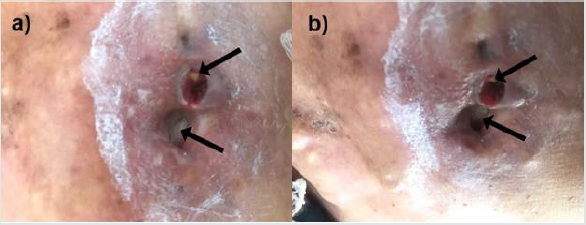
A 78-years-old female patient from Mexico City presents a family history of diabetes mellitus and hypertension, as well as cases of chronic venous insufficiency and deep vein thrombosis, from both mother and father lineages. She presents type-2 diabetes mellitus for 15 years treated with biguanide and insulin 30-0-20, with medication non-adherence problems. The patient refers previous history of mixed dyslipidemia and hypertension. Furthermore, the patient was diagnosed with Invasive Ductal Carcinoma (IDC) in the left breast thirty years ago, which conducted to total mastectomy and irradiation. The breast cancer exhibited total remission for 30 years. The patient reported to medical consultation for presenting small wounds in the chest and secondary calcifications that were growing inside and outside the injury since the beginning of irradiation therapy. During first physical exploration blood pressure was 140/90 mmHg, heart frequency had a rate of 76 beats per minute, respiratory rate of 18 breath per minute, temperature was 36.9°C. The patient denies fever, general discomfort, asthenia, and adynamia. The size of the wound located in the left thorax is 2.0 x 1.0 x 1.5 cm with macerated borders (Figure 1a&1b), the perilesional skin showed edema, erythema, and hyperpigmentation, with yellow exudate and foul odorous suppuration, visible calcifications were identified inside the wound. She exhibits a scar due to the previous total mastectomy of the left breast. The patient refers moderate pain at palpation and during wound cleaning.

Figure 1: Post-breast cancer chronic wound with solid calcifications. The size of the wound is 2.0 x 1.0 x 1.5 cm with macerated borders. Calcifications are identified with black arrows.
Lupinepublishers-openaccess-material-science-journal

Clinical Diagnosis

Chronic radiation-induced ulcer in the chest wall after surgery in breast cancer. Risk factors for systemic recurrence: female, total mastectomy, chronic untreated ulcers, type-2 diabetes mellitus, hypertension.

Treatment

Advanced wound care was initiated by applying zinc oxide (ZnO) on the macerated skin due to its epithelialization and infection-control properties [37]. The Cu/SiO2-TiO2 nanoparticles embedded in a polymeric matrix were applied in combination with Triticum vulgare inside the wounds to generate granulation tissue and limit bacterial infection. The wound was covered with Solvaline® N dressings for the absorption of the exudate. Additional management included prophylaxis antibiotics on one occasion and analgesics each 12 hours when pain was presented.

Results

Electronic Microscopy Studies Of The Nanoparticles

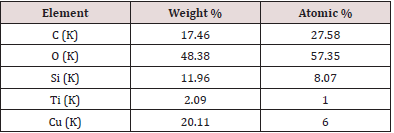
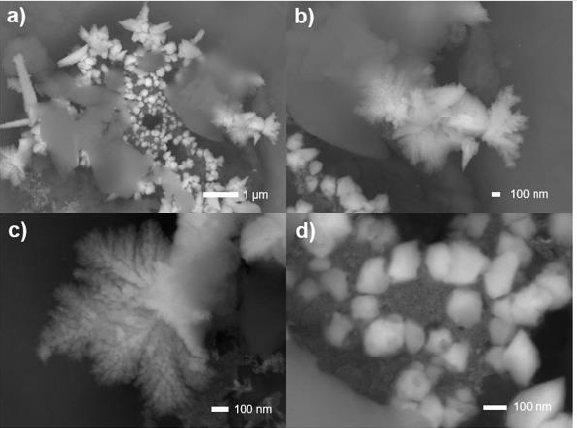
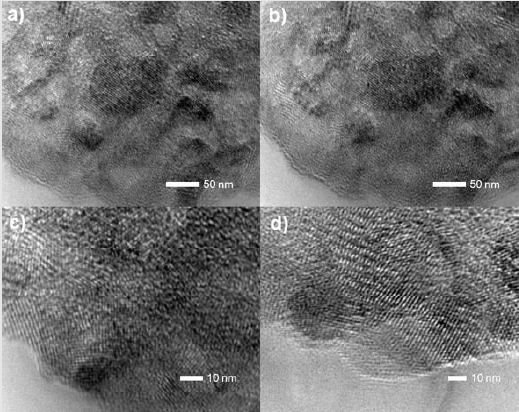
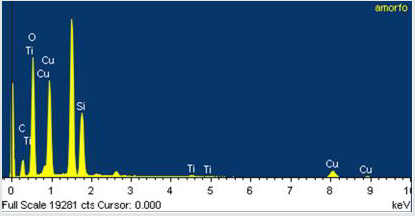
SEM images showed Cu/SiO2-TiO2 nanoparticles formed conglomerates with visible crystalline structure and average particle size between 0.1 and 1 μm, as shown in (Figure 2a). The conglomerates exhibit a flake morphology with a flustered arrangement of the nanoparticles. A deeper analysis increasing magnification to 37,000x (Figure 2b), 70,000x (Figure 2c), and 100,000x (Figure 2d) allowed to observe individual nanoparticles with sizes ~ 10 nm grouped in 100-nm conglomerates. A further study of TEM (Figure 3) allowed to corroborate individual particle size to be of the order of 5 nm. Particle arrangement observed in TEM images suggest the presence of crystalline structure, possibly microcrystalline anatase with grain sizes of 10-30 nm as observed in previous XRD studies regarding the SiO2-TiO2 mixed oxide matrix [38-40] (the diffractograms are not shown in this paper for the sake of brevity). EDS measurements in the conglomerates showed homogeneous distribution of the elements present in the compound with atomic percentages as expected (Figure 4). The atomic composition is shown in Table 1.

Table 1: Atomic percentage composition of the nanoparticles.
Lupinepublishers-openaccess-material-science-journal

Figure 2: SEM micrographs of the Cu/SiO2-TiO2 nanoparticles at 15,000 x (a), 37,000 x (b), 70,000 x (c), and 100,000 x (d). Nanoparticle conglomerate formation with sizes 0.1–1.0 μm is observed. Individual nanoparticles exhibit average particle size of 5-10 nm.
Lupinepublishers-openaccess-material-science-journal

Figure 3: TEM micrographs of the Cu/SiO2-TiO2 nanoparticles with dimensions 50 nm (a, b) and 10 nm (c, d). Individual particle size was identified to be < 10 nm. The nanoparticles exhibit crystalline structures with grain sizes of 10-30 nm. Particle arrangement suggests an anatase crystalline structure.
Lupinepublishers-openaccess-material-science-journal

Figure 4: EDS measurement in the conglomerates with the presence of Ti, Si, O, and Cu, elements that compose the Cu/SiO2-TiO2 nanoparticles. Carbon peaks correspond to the carbon tape in which the sample was placed.
Lupinepublishers-openaccess-material-science-journal

Microcalcification Analysis

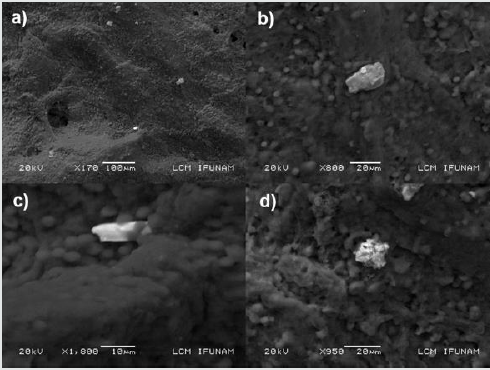
Microcalcification accompanies several benign and malignant alterations in breast parenchyma [41,42]. Most commonly the calcifications (5 μm to 100 μm) are composed of hydroxyapatite (Ca10(PO4)6(OH)2), which forms concentric concretions and amorphous masses, [43] exhibiting grey-white, opaque, and ovoid form or fusiform shapes with irregular surfaces [44]. Less often, calcium oxalate dihydrate (Weddellite) is deposited, forming single crystals up to 1 mm long, [44,45] which are amber in color, partially transparent and form pyramidal structures with relatively planar surfaces [46]. Before treatment with Cu/SiO2-TiO2 nanoparticles and Triticum vulgare, the wound was cleaned, and intern calcifications were removed. After a few applications, internal calcifications emerged from the wound, which captured our attention. For a better understanding of the properties of the calcifications obtained, the crystals were analyzed by SEM and EDS techniques to identify morphology, texture, and composition. In (Figure 5) a sample of epithelial tissue is observed with the presence of individual calcifications with sizes of the order of 20 μm. The masses exhibit amorphous structures with no visible presence of crystal twinning. According to bibliography revised, [15,43-45] our hypothesis is that the calcifications are composed of calcium carbonate (CaCO3), calcium oxalate (Ca(CO2)), or hydroxyapatite (Ca10(PO4)6(OH)2); the aforementioned is intended to be corroborated in a further EDS study. Calcium oxalate has been shown to be associated with benign lesions of the breast or at most non-invasive lobular carcinoma in situ [47]. Calcium carbonate microcalcifications identified with breast tissues grow in calcite and aragonite crystal structures [48].

Figure 5: SEM micrographs of the calcifications observed in the wound-tissue sample. Individual calcifications with sizes of the order of 20 μm are observed surrounded by erythrocytes deposited in the surface of the epithelial tissue.
Lupinepublishers-openaccess-material-science-journal

Clinical Study

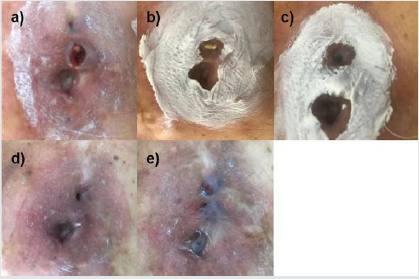
Administration of Cu/SiO2-TiO2 nanoparticles with Triticum vulgare enhanced granulation tissue formation by limiting bacterial infection as early as two months after the first application. The wound was dry and clean, with sharp edges and edema reduction. After four months of treatment, the size and depth of the chronic wound had reduced significantly, presenting an erythematous clean bed and a decrease in calcification formation. At the 6-months mark, granulation tissue was observed with optimal reepithelization and no fibrin due to revascularization and fibroblast production. After 8 months of the first application, the wound has completely healed in an atrophic scar. No inflammation was observed. The healing process is observed in (Figure 6).

Figure 6: Evolution of the chronic wound with Cu/SiO2-TiO2 + Triticum vulgare treatment at time 0 (a), after 2 months (b), after 4 months (c), after 6 months (d), and after 8 months (e). The white film observed corresponds to the zinc oxide applied as emollient.
Lupinepublishers-openaccess-material-science-journal

Discussion

The clinical case presented several risk factors that seriously complicated the wound healing process and represented a possible systemic recurrence: chronic untreated ulcers, hypertension, and type-2 diabetes mellitus. In healthy patients, the healing process involves coordinated interactions between diverse immunological and biological systems, which are divided into four time-dependent steps: (i) coagulation and hemostasis, (ii) inflammation, (iii) proliferation, and (iv) wound remodeling [49-55]. The four steps are essentially dependent on a proper blood irrigation to the wound for the transport of the cells (endothelial, thrombocytes, neutrophils, etc.), nutrients, and coagulation and inflammatory factors that will intervene in the process [56-59]. Diseases that lead to compromised microcirculation, such as diabetes, inhibit the delivery of oxygen and nutrients to tissue injuries, impairing wound healing [60] and causing the development of chronic wounds on account of impaired growth factor production, angiogenic response, collagen accumulation, fibrosis, and abnormal blood pressure [61]. Furthermore, due to chemotaxis and impaired leukocyte function and inadequate migration of neutrophils and macrophages to the wound, [62-64] diabetic patients develop a preponderance for infections such conditions demand for wound healing treatments that enhance reepithelization while reducing infection progression [65,66].

Titania-silica mixed oxide nanoparticles with high specific surface areas (up to 645 m2/g) have been studied regarding their catalytic properties for a broad variety of applications, [38,40,67- 69] including absorption of organic pollutants, [70] drug delivery, [71,72] and catalysis [73-75]. The incorporation of transition metals (such as platinum and copper) in the mixed matrix has been reported to enhance the antibacterial properties of the compound. [34,35] For the treatment of the chronic wounds the patient exhibited, we synthesized Cu/SiO2-TiO2 nanoparticles with catalytic and antibacterial properties. The nanoparticles were obtained by the sol-gel process through a hydrolysis catalyzer to achieve acid conditions in the gelation process, and thus, to obtain acid nanomaterials. The development of acidic properties in binary mixed metal oxides in terms of Lewis and Brønsted acidic sites has a direct impact on the catalytic properties of the nanoparticles. [38,76,77] The nanoparticles’ size observed in SEM and TEM studies (5-10 nm) makes them capable to traverse the plasmatic membrane of the bacteria through passive diffusion [78]. Once inside the bacteria, due to synthesis method used and their functionalized surface, the nanoparticles are able to catalyze the breakage of C-C and C-N bonds present in DNA and RNA nitrogenous bases hence destabilizing the structure of the molecule and inhibiting the bacterial reproduction [79]. This biocatalytic process is believed to generate molecular oxygen which enhances the proliferation of fibroblast activity, [80] collagen synthesis, [81] and inflammation, [82] hence improving the generation of granulation tissue and reepithelization, and significative decreasing the time of recovery.

The patient’s wounds treated with the Cu/SiO2-TiO2 nanoparticles exhibited total recuperation after 8 months since the first application. Through the healing process, internal solid calcifications emerged from the wound. They were removed and analyzed by SEM technique. The presence of calcium compounds in the breast is related to benign lesions, as the chronic wounds the patient exhibited. After the application of the nanoparticles, the calcification formation was reduced and eliminated as a sign of lesion recovery [41,83]. The successful outcome achieved with the treatment meant a significant improvement in the patient’s quality of life, eliminating the possibility of a systemic recurrence of breast cancer [18].

Conclusion

Post-breast cancer chronic wounds were successfully treated with Cu/SiO2-TiO2 nanoparticles in a patient with the menace of systemic recurrence due to risk factors such as hypertension and type-2 diabetes mellitus. Good outcomes were observed in terms of tissue regeneration and wound healing. The therapy with the nanoparticles embedded in a polymeric gel hindered infection formation allowing wound reepithelization and healing with a time of recuperation significantly reduced (8 months in a 30-years-old chronic wound). Furthermore, calcifications present in the wound were removed and the recurrent formation was eliminated after the treatment. No adverse effects were observed in the patient. Scientific evidence supporting the efficacy and safety of the Cu/ SiO2-TiO2 therapy is hereby shown. The nanoparticles can be used as a primary apposite to stimulate the autolytic debridement of injures, due to their physical-pharmaceutical properties: excellent local absorption because of its nanoparticulate composition and bactericide action that helps control local infections. Yet, future studies must be carried out to further confirm the efficacy of the nanoparticles.

Reflective questions

a. Microcalcification formation elimination is related directly with the catalytic effect of the nanoparticles or with the wound healing process?

b. Do we need to assess the effectiveness the nanobiocatalyst in the real world and not simply rely on clinical trial data?
c. What can be done to improve wound healing rates?
d. How can the efficiency of health-care delivery be improved?

Author Contribution

All authors contributed to the study conception and design. The design and synthesis of the nanoparticles were executed by TL, PR and FJPG. The characterization techniques were made by EGL. The patient’s treatment was carried out by VSB. The first draft of the manuscript was written by FJPG. All authors commented on previous versions of the manuscript and critically revised it. FJPG was responsible for compiling the final draft. All authors read and approved the final draft.

Funding

This study was funded by the Autonomous Metropolitan University – Xochimilco and NANOTUTT S.A. de C.V.

Compliance With Ethical Standards

Conflict of Interest: The authors declare that they have no conflict of interest.

Ethics Approval: This study was performed in line with the principles of the Declaration of Helsinki. Necessary ethical clearance was obtained from the ethical committee office code number JUDI- 01/07 CDMX under the protocol: [“Security and efficacy of the local application of Pt/SiO2-TiO2 nanomaterials in patients with diabetic foot ulcers” Education and Investigation Direction], and the study was conducted in accordance with the ethical Good Clinical Practice.

Declarations

Consent to participate. Informed consent was compulsory for contribution in the study. The staff notified the contributor with the objectives, dates, drugs, diet, possible risks, and general activities through the clinical study.

Consent to Publish: No personal data of the patients was mentioned in the study.

ORCID ID

1. Tessy López: https://orcid.org/0000-0002-6048-0419
2. Francisco J. Padilla-Godínez: https://orcid.org/0000- 0002-9253-2463

Read More About Lupine Publishers Journal of Modern Approaches on Material Science Please Click on the Below link:

https://lupine-publishers-material-science.blogspot.com/

Monday, 9 October 2023

Lupine Publishers | Plant Extracts as An Alternative to Synthetic Medicines

 Lupine Publishers | Journal of Drug Designing & Intellectual Properties


Abstract

Mankind first medicines were extracts from plants. However, over the years, mankind has resorted to the use of synthetic medicines. Whilst, synthetic medicines have fulfilled their roles and save millions of people around the globe, there is still a need to promote the use of herbal medicines, considering that synthetic medicines have severe side effects when administered and the cost of synthesising drugs, is an expensive endeavors for developing countries like Guyana. Guyana has an adundant of diverse flora, whose extracts have been shown by us and others to have potent and selective antimicrobial activities and antidiabetic activities. However, there is a need to promote the isolation of antimicrobial, antidiabetic and anti-cancer drugs from plants, an elucidation of their structure and modulation of their medicinal activities. This entails significant finance to aid in the purchase of requisite equipment etc. in Novel Drug Discovery. The Guyanese Diaspora and the Entrepreneurship Sector can promote such research in Guyana via the provision of finance to purchase “State of the Art” equipment to conduct such research or the establishment of a National Herbal Research Institute. Such an institute will promote further research on our current herbal medicines and also on the discovery of new Herbal medications.

Keywords: Medicines antimicrobial activities Antidiabetic activities Anti-cancer activities Diaspora Entrepreneurship

Introduction

Mankind first medicines were extracts from plants. Plants have had a long history in modern medicine [1-18]. For example, long before the advent of modern medicine, the Peruvians were fending off malaria with the Cinchona bark from the “quinaquinas” tree. It was given as a cure to a Spanish countess who fell ill with the disease in Lima in around 1630. Then Bernabe Cobo, a Spanish missionary and naturalist was the first to bring the bark to Europe. Quinine was purified from the bark by a team of French pharmacists19. Over the years, mankind has resorted to the use of synthetic medicines. Whilst, synthetic medicines have fulfilled their roles and save millions of people around the globe, there is still a need to promote the use of herbal medicines, considering that synthetic medicines have severe side effects when administered and the cost of synthesising drugs, is an expensive endeavours for developing countries like Guyana.

Antimicrobial endeavours

Guyana, has an adundance of diverse flora, whose extracts have been shown by us and others to have potent and selective antimicrobial activities against human pathogens such as E.coli, S.aureus, K. pneumoniae, B. subtilis and Candida albicans. We have also shown that selected plant extracts exhibited antidiabetic activities. Our initial efforts to evaluate the antimicrobial properties of plant extracts focuses on the leaves and stem extracts of plants. These were inclusive of those of Samanea Saman, Smilax schomburgkiana, Mormordica charantia, Phyllanthus Acidus, Sphagneticola Trilobata and Doliocarpus Dentatus [10-15]. Later on, we focused our antimicrobial studies of fruits. The idea is that a fruit is edible and so an evaluation of its antimicrobial properties, singly and in combination, would eventually lead us to find some good natural antimicrobials, without the need for clinical trials. In all our studies on antimicrobial activity of leaves, stems and fruit extracts, the diameter of Zone of Inhibition, DZOI and the Area of Zone of Inhibition, AZOI were used as guage of antimicrobial studies. Amongst the fruits investigated were passion fruit (passiflora edulis), Vicia faba L [16-20]. In search for natural antimicrobials, our aim is to find leaves, stems and fruit extracts that would be selective and potent as synthetic antimicrobials such as penicillin, aminoglycosides, and tetracyclines etc.

Antidiabetic endeavour

Diabetes mellitus is a chronic health problem around the world and in Guyana with long term consequences that are potentially preventable. It is a heterogeneous group of disease, characterized by high blood glucose levels resulting from impaired insulin secretion, impaired insulin action, or both [20-27]. In a hyperglycemic state, the body tries to remove excess glucose by excreting in the urine. This increases urine output, causing glycosuria and result in frequent thirst. In addition, the body is deprived of glucose energy and seeks alternative energy sources such as fats and muscle tissues, leading to weight loss [23]. A diminishing growth effect and increased predisposition to certain infections, may also be present with chronic hyperglycemia 4. These combinations along with polyuria, polydipsia, polyphagia, and blurry vision produces the common symptoms of diabetes [24]. As this disease progresses, vascular damage ensues leading to severe diabetic microvascular and macrovascular complications [25]. Therefore, diabetes covers a wide range of diseases which are the major causes of chronic morbidity and death in diabetic subjects [26,27].

Selected plants are a potential complementary source of hypoglycemic drugs to combat diabetes, in addition to the use of synthetic drugs: insulin, metformin etc. We have shown that the aqueous extract of the fruits of Psidium guajava, Averrhoa bilimbi and the peel of Tamarindus indica exhibited hypoglycemic effect on normoglycemic guinea pigs. Administration of extracts of Psidium guajava, Tamarindus indica and Averrhoa bilimbi resulted in a marked hypoglycemic (reduction) activity in blood glucose levels when compared to the control and Glibenclamide treated group on the 12th day: Psidium guajava (90 ± 3.0 to 75.7 ± 3.5mg/dL), Tamarindus indica (89.0 ± 5.6 to 70.7 ± 2.1mg/dL) and Averrhoa bilimbi (110.0 ± 9.2 to 86.7 ± 10.0mg/dL). Glibenclamide also resulted in a reduction (88.0 ± 2.0 to 67.3 ± 3.5mg/dL) as compared to the control [27].

Antidiabetic effect of the ethanolic extract of Phyllanthus emblica fruits in evan rats has been reported and is dose dependent [28]. The anti-hyperglycemic effect of Quercetin, a major constituent of the methanolic extracts of Phyllanthus emblica fruit in Streptozotocin (STZ) induced diabetic rats were determined [29]. There are several herbs that are used to treat diabetes in Guyana and internationally [30-34]. Locally Momordica charantia [30], an herbaceous, tendril-bearing vine contains a compound called charantin, which have hypoglycaemic effect. It has been found to increase insulin sensitivity. A daily dose of 100mg per kilogram of body weight is comparable to 2.5mg/kg of the anti-diabetes drug glibenclamide taken twice per day. Other compounds in M. charantia have been found to activate the AMPK, the protein that regulates glucose uptake. The whole plant is used as a decoction for diabetes. The dry leaf and stem are boiled, and the water drunk as an anti-diabetic. The fruit is cooked and eaten as an anti-diabetic. Use with almond oil for a vulnerary. Tablets of M. charantia extract are sold in the United Kingdom.

Phyllanthus niruri [30] contains alkaloids, flavonoids and triterpenes. The whole plant is used as a blood purifier (bitter tonic) to reduce blood sugar level. It’s available as capsules. Cajanus cajan [30]. Pigeon peas contain high levels of protein and the important amino acids methionine, lysine, and tryptophan. Leaves and flowers are boiled for a diuretic and diabetes remedy. The whole plant of Desmodium barbatum [30] is use to reduced blood sugar level. The wood of the plant, Telitoxium [27]. is used for diabetes. The active adaptogenic constituents of Tinospora cordifolia [30] are diterpenoid compounds: polyphenols, and polysaccharides, including arabinogalactan polysaccharide. T. crispa and T. rumphii are used in Thailand and Philippines for treatment of diabetes. A decoction of the leaves of Azadirachta indica [30], Neem is used as a bitter tonic for treating diabetes and jaundice. Internationally, the juiceof the leaves of Abrus precatorius [31-34] are given to diabetic patients. Achyranthes aspera [32-34] is used as a decoction in the treatment of diabetes mellitus. Likewise, the roots of Catharanthus roseus is used as decoction in the treatment of diabetes mellitus. The entire plant ofCentella asiatica [32-34] is also used as a decoction in the treatment of diabetes mellitus. [32-34] Curcuma longa is a rhizomatous herbaceous perennial plant which is used in the treatment of diabetes mellitus. Phyllanthus emblica [32-34]. Edible fruits are antidiabetic in nature. Piper bettle [32-34] lea extract is used in the treatment for diabetes mellitus. Sphaeranthus indicus [29-31].

Anticancer endeavours

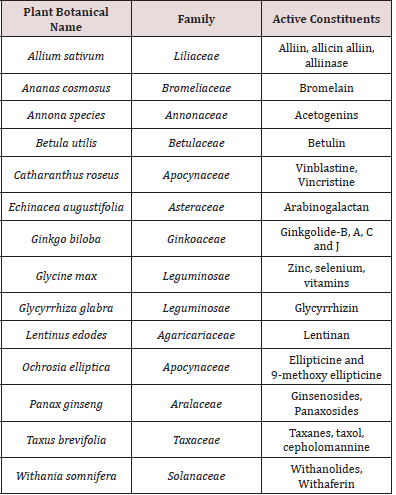
Table 1: Some selected anticancer plants and their active constituents.

lupinepublishers-openaccess-drug-designing-journal

While plants have been tested over the years for their anticancer activities abroad and proven positive, such research is lacking in Guyana. There is a need to screen plants in Guyana for their anticancer activities. This stem from the fact that cancer is on the rise in Guyana. Cancer has been a constant battle globally with a lot of development in cures and preventative therapies. Cancer is the uncontrolled growth in human cells and will result in the formation of tumours of malignant cells with the potential to be metastatic35. Treatments include chemotherapy, radiotherapy and the use of synthetic drugs such as cis-platin. Using chemotherapy can put patients under a lot of strain and further damage their health. Thus, there is a need for an alternative complimentary medicine in herbal treatments36.However, this research is hampered by the lack of cancer research equipment. There needs to be the establishment of a cancer research unit in Guyana, to assess the anticancer proficiency of plants. (Table1). shows a list of plants tested abroad for their anticancer proficiency [37-45].

Diaspora role in promoting herbal medicines in Guyana

However, there is a need to promote the isolation of antimicrobial, antidiabetic and anti-cancer drugs from plants, an elucidation of their structure and modulation of their medicinal activities. Also, an investigation of their activities. This entails significant finance to aid in the purchase of requisite equipment etc in Novel Drug Discovery. A separate research laboratory, with modern equipment and instrumentation is necessary at the University of Guyana to realize the above. Also, lacking in Guyana is the equipment to conduct anticancer and antiviral studies A step can be taken further by the Government in the establishment of a National Herbal Research Institute to further explore our herbal folklore medicines and undiscovered herbal medicines. Such an institute will promote further research on our current folklore or traditional herbal medicines and also on the discovery of new Herbal medications. The Guyanese Diaspora, Entrepreneurship Sector and Foreign investors can promote such research in Guyana via the provision of finance to purchase “State of the Art” equipment to conduct such research. Our whole objectives is that we can be a leading exporter of herbal medicines in the Caribbean and one of the best in the world. Guyana has a richbiodiversified flora, whose herbal proficiency needs to be further investigated.

Read More About Lupine Publishers Journal of Drug Designing & Intellectual Properties Please Click on the Below Link:

https://lupine-publishers-drug-designing.blogspot.com/

Saturday, 7 October 2023

Lupine Publishers | Laparoscopic Ovarian Cystectomy Hemostatic Maneuvers Impact and Influence on Ovarian Reserve Parameters and Indices

 Lupine Publishers | Journal of Genecology and Women's Healthcare 


Abstract

Background: Electrocoagulation during performing laparoscopic ovarian cystectomy as a method used for hemostasis is one of the most commonly and preferred methods due to simplicity and speedy applicability. Fertility outcomes after ovarian cystectomy is a global concern that should be respected and investigated by further research efforts trying to elucidate the best method and protocol in surgical practice.

Aim: To investigate the impact and influence of hemostatic methods implemented in laparoscopic ovarian cystectomy on ovarian reservoir function.

Methodology: A prospective research clinical trial conducted on 72 research study subjects from January 2017 till April 2018. Research study subjects were recruited for the study having unilateral or bilateral ovarian cysts they were equally categorized into research groups according to the hemostatic method implemented during the surgical procedure.

Results: There was no statistical significant difference as regards the ovarian reserve parameters observed before surgery between both electrocoagulation and suture research groups as regards FSH, LH, E2, AMH, AFC, PSV (P value =0.229, 0.063, 0.475, 0.068, 0.609, 0.187 consecutively) after 1 month follow up there was statistically significant difference between suture and electro surgical research groups as regards the FSH, E2, AMH (P values =0.002,<0.001,0.028 consecutively) being more favorable within suture research group ,finally at 6 months follow up there was statistically significant difference between suture and electro coagulation research groups as regards FSH, E2, AMH, AFC, PSV (P values =<0.001, 0.013, 0.023, 0.027, 0.012 consecutively).

Conclusion: Further research efforts are required to evaluate if the difference is clinically significant concerning fertility potential and premature ovarian failure by implementing larger study samples putting in consideration the age and racial differences among the observed cases.

Keywords: Laparoscopic; Ovarian cystectomy; Anti mullerian hormone

Introduction

Ovarian cysts are a frequent form of ovarian lesions that could carry concerns to gynecologists according to their sonographic and histopathological characteristics [1,2].

One of the cornerstone issues and chief factors particularly in child bearing age is the impact of ovarian cystectomy on ovarian reserve function. The hemostatic methods that are implemented during the surgical procedure could influence the functional performance of the ovary at physiological, cellular and molecular levels due to the healing process that follows performance of the hemostatic method [3,4].

Electrocoagulation during performing laparoscopic ovarian cystectomy as a method used for hemostasis is one of the most commonly and preferred methods due to simplicity and speedy applicability. Research debate and many unanswered questions around the clinical and reproductive outcome that various hemostatic methods on ovarian reservoir function such as suturing and electrocoagulation [5,6].

 Fertility outcomes after ovarian cystectomy is a global concern that should be respected and investigated by further research efforts trying to elucidate the best method and protocol in surgical practice that would preserve the best ovarian functional reservoir after surgery [7,8].

Aim

To investigate the impact and influence of hemostatic methods implemented in laparoscopic ovarian cystectomy on ovarian reservoir function.

Methodology

A prospective research clinical trial conducted on 72 research study subjects from January 2017 till April 2018. Egyptian research study subjects from Zagazig Governate were recruited for the study having unilateral or bilateral ovarian cysts with good clinical general condition they were equally categorized into research groups according to the hemostatic method implemented during the surgical procedure 36 cases within suture research group and 36 cases within electrocoagulation research group. Inclusive research criteria were as follows in which cases recruited for the research study had an age range 21 to 36 years old, 28-35 days menstrual cycle length; ovarian cyst diagnosis by B- mode sonography; cyst diameter was 5 to 8 cm , no past history of gynecological surgery; no coexisting endocrinological diseases e.g. DM ,hyperthyroidism, and no hormone usage within the previous 6 months before the surgical intervention.

Surgical intervention

After anesthetic induction, the cases have been positioned in supine position, head down and hip up. After classic laparoscopic preliminary steps Pneumoperitoneum have been accomplished observed ovarian cortex covering the cyst wall have been incised in which the ovarian tissue have been observed to be characterized by being thin with few blood vessels. The surgical incision was performed in a manner to be located away from the ovarian hilum anatomical zone. The cyst wall has been stripped off from the normal ovarian tissue using blunt dissection and exteriorized using an endobag. Ovarian tissue hemostasis has been accomplished using bipolar electrocoagulation within the electrocoagulation research group. The probe was in contact with the bleeding points no more than 3 sec, causing the heat to achieve hemostasis. After performing electrocoagulation hemostatic procedure, no suturing was performed for the residual ovarian tissue left, and the ovarian edges have been left to heal by the process of secondary intention. The suture research group ovarian tissue bleeding has been managed by usage of 4-0 absorbable sutures. The surgical incision has been sutured in a manner perpendicular in direction to the ovarian longitudinal axis using a continuous suturing needle was running close to but not via the ovarian cortical tissue.

Ovarian reserve parameters observed

Biochemical 3rd menstrual cycle FSH, LH, E2, AMH were assayed preoperatively,1 month and 6 months after the surgical procedure by using radioimmune assay. Sonographic vaginal color Doppler sonographic assessment after 6 months from performing the surgical intervention the following was obtained as research data to be statistically analyzed involving the following basal antral follicle count in both ovaries (number of antral follicles within early menstrual cycle measuring less than 10 mm in diameter), peak systolic velocity of ovarian stromal blood flow was observed, ovarian volume.

Statistical analysis

Research data was collected, revised, coded and entered to the Statistical Package for Social Science (IBM SPSS) version 23. The quantitative data were presented as mean, standard deviations and ranges when parametric and compared between two independent groups using Independent t-test. Also, qualitative variables were presented as number and percentages and compared between groups using Chi-square test and/or Fisher exact test when the expected count in any cell found less than 5. The confidence interval was set to 95% and the margin of error accepted was set to 5%. So, the p-value was considered significant at the level of < 0.05.

Results

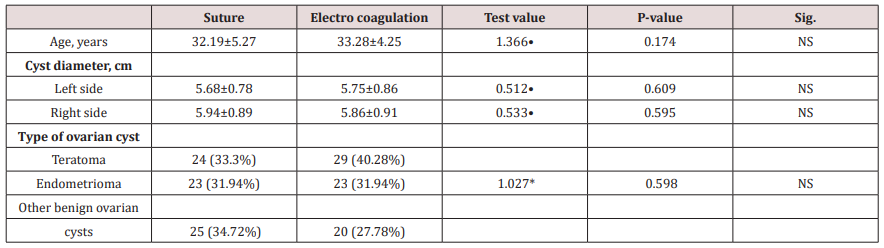
(Table 1) reveals and displays the age, cysts diameters mean +/-SD on left and right sides type of ovarian cysts in which there was no statistically significant differences between both research groups (p values=0.174, 0.609, 0.595, 0.598 consecutively).

Table 1: Cases age, cyst diameter and type.

lupinepublishers-openaccess-journal-gynaecology-women-health-care

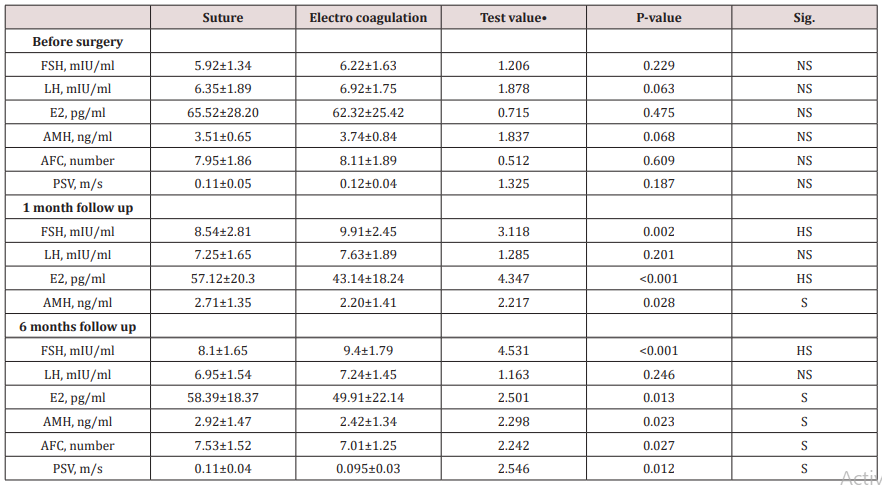
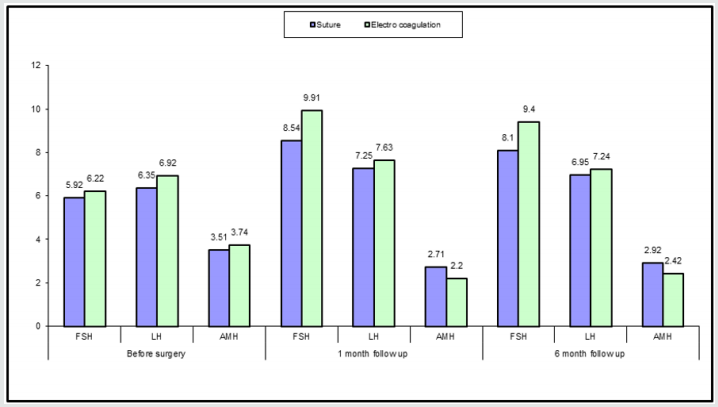
(Table 2) and (Figure 1) reveals and displays the that there was no statistical significant difference as regards the ovarian reserve parameters observed before surgery between both electrocoagulation and suture research groups as regards FSH, LH, E2, AMH, AFC, PSV (P value =0.229, 0.063, 0.475, 0.068, 0.609, 0.187 consecutively) after 1 month follow up there was statistically significant difference between suture and electro surgical research groups as regards the FSH, E2, AMH (P values =0.002,<0.001, 0.028 consecutively) being more favorable within suture research group, finally at 6 months follow up there was statistically significant difference between suture and electro coagulation research groups as regards FSH, E2, AMH, AFC, PSV (P values =<0.001, 0.013, 0.023, 0.027, 0.012 consecutively).

Table 2: Ovarian reserve parameters and indices in suture and electrocoagulation research groups before surgery, 1 month, 6 months after surgery.

lupinepublishers-openaccess-journal-gynaecology-women-health-care

•: Independent t-test

Figure 1: Ovarian reserve parameters in both research groups (FSH, LH, AMH) before ,1 month,6 months after surgery.

lupinepublishers-openaccess-journal-gynaecology-women-health-care

(Table 3) reveals and displays that there was no statistically significant difference between both suture and electrocoagulation research groups as regards cyst diameter and pregnancy occurrence within 1 year (p values =0.073,0.729 consecutively).

Table 3: Ovarian cysts diameter and occurrence of pregnancy within 1 year after surgery among both suture and electro coagulation research groups.

lupinepublishers-openaccess-journal-gynaecology-women-health-care

*: Chi-square test

Discussion

Ovarian reserve function after ovarian cystectomy remains the cornerstone research debate issue among infertility practitioners all over the globe, requiring the balance between the best management protocol that preserves the residual ovarian function for infertility management and occurrence of conception after the procedure [9,10].

Hemostatic maneuvers implemented are necessarily required during performance of ovarian cystectomy that needs to have minimal negative impact on ovarian reserve. Ovarian follicular damage and release of inflammatory mediators besides the affection of ovarian vasculature integrity are all proposed negative impacts that could affect the ovarian function particularly after ovarian cystectomy [11,12].

Reproductive potential of cases is measured by various indices and parameters that reflect the ovarian function such as Anti mullerian hormone, antral follicular count, peak systolic velocity among others are affected by age and surgical interventions affecting the ovarian structural integrity [13,14].

There is no single assay that could reflect ovarian reservoir function with 100% precision. Integrated assessment of various parameters and indices have shown by various prior research groups of investigators to be more precise for ovarian reserve predictability [15,16].

Interestingly a prior research systematic review compared and contrasted the impact of suturing and surgical energy hemostasis implemented during ovarian cystectomies on ovarian reserve function statistical analysis of the pooled research data powerfully supports the usage of suturing rather than surgical energy (e.g. bipolar coagulation) for hemostasis since it offers enhanced ovarian function preservation during ovarian cystectomy. In which ovarian reserve markers AMH, AFC, PSV, ovarian volume have been revealed and displayed to have a positive correlation to suturing usage the research team of investigators in harmony and similarity to the current research study findings have revealed that suturing for ovarian cystectomy hemostasis is superior to electrocoagulation for ovarian function preservation [1,3,7].

A previous similar research study to the current study investigated, suturing and electrocoagulation as hemostatic methods, to control ovarian wound bleeding during laparoscopic ovarian cystectomy performance, and assessment of ovarian reserve after intervention was conducted by the research team of investigators. The serum levels of E2, FSH and AMH have statistically significant at 1- and 6-months post procedure between both research groups (P values <0.05). Further more it was observed that the blood flow of the ovarian stroma, antral follicular count and peak systolic velocity post- procedural indices among the electrocoagulation research group was lower in comparison and contrast to the suture research group, in a statistically significant fashion (P values <0.05). The research team to the conclusion that hemostatic suturing during laparoscopic ovarian cystectomy is superior in maintenance of the follicles and cortical blood supply within the residual ovarian tissue. on the other hand, electrocoagulation hemostasis caused a reduction in of ovarian functional performance in a more considerable manner than hemostatic suturing. those research findings in addition show great harmony and similarity to the current research study findings [4,6,15].

Conclusion and Future Research Recommendations

Further research efforts are required to evaluate if the difference is clinically significant concerning fertility potential and premature ovarian failure by implementing larger study samples putting in consideration the age and racial differences among the observed cases.

Read More About Lupine Publishers Journal of Gynaecology Please Click on Below Link:
https://lupinepublishers-gynecology.blogspot.com/

Friday, 6 October 2023

Lupine Publishers | Relationship Between the Relational Coordination Model and Quality in the UTEQ

 Lupine Publishers | Journal of Psychology and Behavioral Sciences


Abstract

The objective of this study was to build an organizational typology that explains the relationship between relational coordination (RC) and satisfaction in higher education. 4,000 cases were analysed in diverse socioeconomic contexts. 19 RC variables were measured. By applying factor analysis, 6 factors have been obtained that explained a 66.23% of variance. The first three factors were more relevant and are linked to coordination with administration, representative`s cooperation and lectures´ cooperation. Discriminant analysis results showed a strong relationship between RC and quality. Quality exhibited high discriminating power in the model (71.64%), which used 6 factors of RC. The cluster analysis assigned high quality to group 3, associated to high levels of coordination with administration and representatives’ coordination. It evidences that an improvement of RC allows reaching best results in terms of quality in higher education

Keywords: Relational coordination; satisfaction; higher education; shared objectives; mutual respect; communication; quality

Introduction

La Coordinación Relacional (CR) es un proceso comunicativo que busca la integración de tareas a través de la comunicación efectiva y las relaciones entre los agentes de la organización [1-5]. Entendiendo la Universidad como organización, con la aplicación del modelo se busca una mejora de la calidad en la Educación Superior. Actually, la higher education es un elemento clave en la sociedad. Con mejores profesionales, todas las organizaciones contarán con un capital humano más cualificado, lo que supondrá mejores resultados productivos [6,7]. La comunicación entre los distintos agentes de una organización está estrechamente ligada con el nivel de calidad de los resultados que ésta produce [8,4]. La Universidad Técnica Estatal de Quevedo, localizada en Ecuador, es una universidad centrada en titulaciones acordes a las exigencias de su entorno, tales como Ciencias Agrarias, Ciencias Pecuarias, Empresariales, Ciencias Ambientales o Ciencias de la Ingeniería. It is graded with “B” category by the CEAACES (Council of Evaluation, Accreditation and Quality Assurance of Upper Education), in a classification from “A” up to “C”, in a decreasing scale. El objetivo de este estudio fue construir una tipología basada en factores obtenidos de la observación del modelo de RC en la UTEQ así como conocer la relación entre relational coordination and Quality [5].

Methods

Se tomó una muestra de 4,000 alumnos de Universidad Técnica Estatal de Quevedo (Ecuador) durante el curso académico 2014 configurada. Se aplicó un cuestionario que recoge las dos dimensiones de CR. A la dimensión de comunicación pertenecen las variables comunicación precisa, comunicación oportuna y comunicación para la resolución de problemas. A la dimensión de relación pertenecen las variables conocimientos compartidos, respeto mutuo y objetivos compartidos. Los perfiles sobre los que se preguntó fueron personal de administración, profesores, compañeros, representación de estudiantes y “yo mismo” [4].
Se realizó un análisis factorial (AF) como una forma de reducir el número de variables y revelar un modelo de CR mediante relaciones entre variables. Para probar la adecuación del tamaño de la muestra se utilizaron las pruebas de Kaiser-Meyer-Olkin (KMO) y Bartlett [2,6]. El coeficiente alfa de Cronbach, que se calculó aplicando un análisis de confiabilidad en factores designados, indicó alta consistencia interna (α=0.92) [5]. Posteriormente, se construyó una tipología de modelos organizativos a través de una análisis clúster. Por último. se relacionaron los elementos obtenidos en los análisis previos con la calidad percibida por los estudiantes [8].

Results

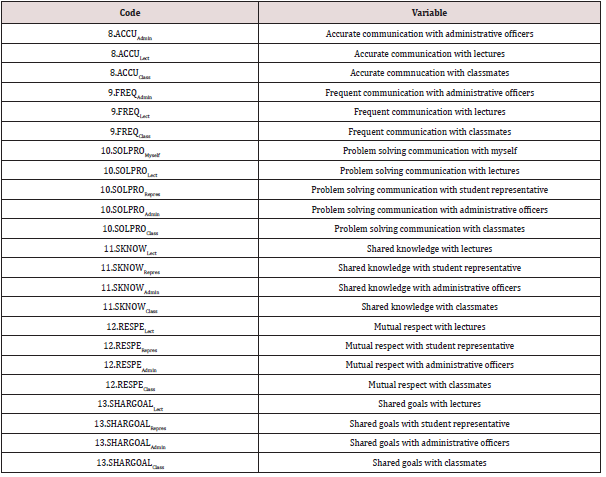
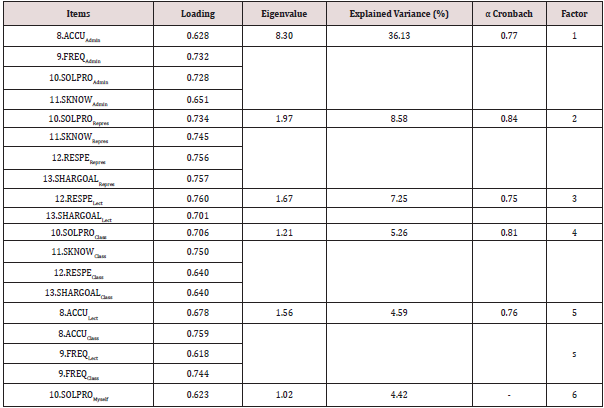
Applying factor analysis (FA), variables were assigned to 6 factors than explained a 66.23% of variance with an eigenvalue under one (Tables 1 & 2). Factor 1 represents a 36.13% of the variance. It´s composed by variables of both RC dimensions. It shows highest values invariables likre accurate communication, fequent communication, solving problem communication and shared knowledge. All of these variables are related with the profile of administrative officers. This factor is called coordination with administration. Second factor explains a 8.58% of the variance. It contains variables of both RC dimensions, too. Solving problem communication, shared knowledge, mutual respect and shared goals are the variables of thise factor. The prevailing selected profile in the variables was the one representing students ´representatives, and it`s called representatives ´coordination. Third factor represents the 7.25% of the variance. It shows high scores invariables of relartionship dimensión, lie mutual respect and shared goals, all of them related with lectures profile. In this way, this is lectures`cooperation factor. Fourth factor explains a 5.26% of variability and, it is associated to variables related to solving problem communication and some variables of relationship RC dimension like shared knowledge, mutual respect and shared goals with classmates. Highest scores in this factor are related to the need to proportionate higher levels of solving problem communication and shared knowledge. This factor represents classmates´ coordination. The fifth one explains a 4.59% of the variance. This factor showed high scores in the profiles related to lecturers and classmates in the items of accurate and frequent communication. This factor represents classroom communication. Finally, the sixth factor, with the 4.42% of the variabce, is related to the individual capacity to solve problems and it is named autonomy.

Table 1: Relational coordination dimensions.

Lupinepublishers-openaccess-journals-psychology-behavioral-science

Table 2:Factor loading matrix of rotated components.

Lupinepublishers-openaccess-journals-psychology-behavioral-science

Table 3: Centroids for each cluster.

Lupinepublishers-openaccess-journals-psychology-behavioral-science

Note: a,b,c,d Within row, averages with different superscript differ significantly according to indicated value p.

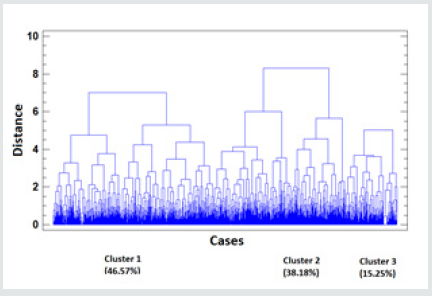
Cluster analysis which presented the most significant results, was the solution of four groups with Ward’s method, based on the Euclidean distances (Figure 1). Table 3 shows the main characteristics of each organisational type. Cluster 1 comprised 46.57% de los casos. Estre grupo muestra valores intermedios en práticamente todos los factores. Destaca levemente un valor más bajo correspondiente al factor autonomy (factor 6), aunque no supone una gran diferencia con el resto de factores. Cluster 2 comprende el 38.18% de los casos. Es el grupo que present valores negativos encodes los factories. Predominant los factories coordination with administration and representatives` coordination. Los valores medias se Encuentros end lectures’ cooperation, classmates’ coordination, classroom communication. El valor más alto dentro de Este grupo avarice end el factor autonomy. Cluster 3 comprende el 15.25% de los casos. Aunque es el grupo de manor tamanu, present los valores más altos. Desta can las atlas punctuations en coordination with administration and representatives’ coordination. Medium values are found in lectures’ cooperation, classmates’ coordination, classroom communication and to a lesser extent to student’s autonomy.
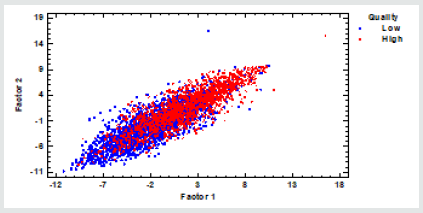
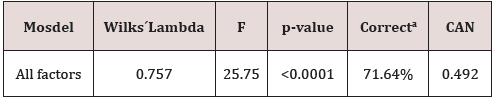
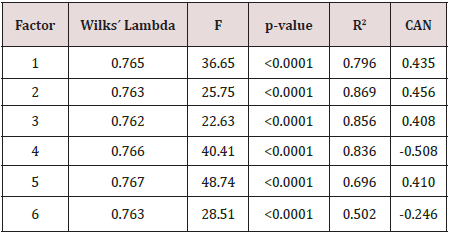
Table 4 shows the general results of the canonical discriminant analysis with all the variables measured [1,7]. In this case, discrimination power was evident because the F statistics of the Wilks’ lambda were significant for the discriminant variables. The Model classifies 71.64% of the cases correctly. Figure 2 shows the distribution of cases with respect to factors 1 and 2. The higher values of quality correspond to high scores of both factors. Table 5 shows the results of the canonical discriminant analysis for each factor. Wilkes´ Lambda indica el alto poder discriminante de la calidad referido a cada factor de forma individual. Coeficientes foro canonical variables muestran una alta relación entre la mayor parte de los factores, destacando coordination with administration and representatives’ coordination. On the otear hand, los factores classmates’ coordination and autónomo shows valores más bajos, indicando una menor relación con la calidad. Mahala Nobis distances indicant la relation existents entre los dos gropes de collided observations (low and high), mestranol una distances de 1.278 entre ambos, con un p-value <0.0001.

Figure 1: Relational coordination clusters.

Lupinepublishers-openaccess-journals-psychology-behavioral-science

Figure 2: Representation of cases according first and second factors and quality level.

Lupinepublishers-openaccess-journals-psychology-behavioral-science

Table 4: Results of the canonical discriminant analysis.

Lupinepublishers-openaccess-journals-psychology-behavioral-science

Note: aPercent correctly classified into farms assignment (R2=1-tolerance); (-) Non-significant values for this canonical component.

Table 5: Results of the canonical discriminant analysis for each factor.

Lupinepublishers-openaccess-journals-psychology-behavioral-science

Note: aPercent correctly classified into farms assignment (R2=1-tolerance); (-) Non-significant values for this canonical component.

Discussion

El análisis factorial muestra 6 factores extraidos de las variables del modelo de RC. Los factores con mayor incidencia en el modelo son coordination with administration representatives’ coordination and lectures’ cooperation, que suponen más del 50% de la varianza. Los dos primeros factores son los asociados a una mayor calidad de la universidad. El sexto factor, autonomy, se asocia con peores niveles de calidad. De la tipología se extraen tres modelos organizativos. El primer modelo, de mayor tamaño muestra una presencia general de todos los factores organizativos. De este modo, se observa una calidad media generalizada en la universidad. El segundo modelo, de tamaño intermedio, muestra valores negativos en todos los factores. Destacan como más bajos los factores coordination with administration and representatives’ coordination. Según se observa en el análisis discriminante, estos dos factores están asociados a mayores niveles de calidad en la universidad. Por otra parte, el valor más alto de este grupo se encuentra en el sexto factor, autonomy, que está asociado a niveles más bajos de calidad. De este modo, este grupo representa el sector con menor calidad en la universidad. En el tercer modelo, el más pequeño, el factor autonomy presenta una baja puntuación, mientras que los factores con más peso son coordination with administration and representatives’ coordination. Por lo tanto, este grupo está asociado a niveles altos de calidad universitaria.

Conclusion

Existe una relación directa entre calidad y el modelo de RC, de este modo se verifica este modelo para la UTEQ. Según este estudio, la calidad de la universidad se encuentra en un punto medio. Muestra valores balanceados en sus elementos, aunque la autonomía de los estudiantes y la actividad comunicativa de los alumnos en clase son bajas. Para conseguir un mayor nivel de calidad se propone centrar la atención en elementos que mejoren la comunicación con el personal de administración y con la respresentatives´students. Una mejora de las TICs podrá suponer una comunicación más fluida entre esos perfiles y el alumno.

Read More About Lupine Publishers Journal of Psychology Please Click on Below Link:
https://lupine-publishers-psychology-journal.blogspot.com/

Wednesday, 4 October 2023

Lupine Publishers | The Characteristics of Korean Traditional Fabric of Saekdong

 Lupine publishers | Journal of Latest Trends in Textile and Fashion Designing


Abstract

The origin of Saekdong is assumed from Kyung-Geum of Ancient Joseon of Korea. Kyung-Geum is warp faced multiple colored weave with patterns of relatively thick dense silk fabric and was precious in that time. It’s patterned with the shapes of cloud, antler, swirling objects with gorgeous thick end-curved lines. Go-Joseon is very civilized society focusing Joyang and Geum-Ju near Balhae Bay civilization providence and the people wore colorful clothing trimmed with animal furs with jade and bronze decoration buttons. They produced a variety of yarns and Geum fabrics, and they had various colored design of tripod pottery as well as Saekdong or modernized Kyung-Geum, inferring to their high level of dyeing technique and eye for beauty. And from bronze mirror with delicate-pattern, violin-shaped bronze dagger, and fan-shaped hatchet with elegant curves as well as high-quality Geum design we found out they had high experties in delicate casting and craft skill.

Keywords: Warp Double Fabric of Silk; Antler Pattern; Balhae Civilization; Color Sensation; Pattern Design

Introduction

Sericin, which is the name of silk protein originates from the word ‘Seres’, which is Roman for East Asian fabric merchants and their land. Henry Yule(1820-1889), a Scottish orientalist, about BC 5th century ‘Seres, Serica’ and their land, “Their Country is expansive in size reaching from Bactria, Imaus in the west to the coasts of East Asian seas. They are frugal, and good tempered in nature, they are educated and open-minded people avoiding unnecessary conflicts to neighbor countries but not actively engaging in intimate relations. Also, they were never stingy about trading away their manufacture goods, such as silk, fur and high quality of iron”. Some view ‘Seres’ as the Qin (BC221-206) or Qin people of China, but we believe otherwise, ‘Seres’ is from ‘Suksin 肅 愼 or Joseon’, first country of Korea, because,

a. BC 5th century, the Warring states period, Qin of China did not border coasts of East Asian seas.

b. Chinese imported fur not exported fur.

c. Contrary to the peaceful nature of the Seres people, Jin actively engaged in wars and conquest.

Silk road had its shortest cut of east end to Joyang near Balhae sea for northern hemisphere and topography. Go-Joseon had high manufacturing techniques of iron, fur, dyes and silk as well as horse riding, astronomy and archery skills. Silk road can not be studied without research of north horse-riding people, who was one of tribes of Go-Joseon(古朝鮮), ancient Joseon of Korea. It is told that Geum is first made in East Asia, and it is assumed that Geum was introduced to the western world around the Warrior states period (BC403~BC221)[1]. By Herodotos, Greek and Persian merchants visited East Asia at BC 6-5th century. And Geum silk of Ancient East Asia was spread to Central Asia, north Africa, and Rome. Geum(錦) is silk fabric with beautiful patterns woven using multi-colored warp threads, differing to Ki(綺) which is one colored. The letter of Geum (錦) is a combination word of two different characters meaning of expensive gold(金) and total silk fabric (帛)[2]. The first historical record mentioning Geum is found in the Odes songs (詩經, about BC1000-200), for example, 錦衣狐裘 Geum apparel decorated with fox fur, 裳錦 Geum skirt, 錦衣 Geum apparel, and 貝錦 luxurious Geum.

Kyung-Geum of Ancient Joseon (BC2333~)

While China was going through its Warring state period, GoJoseon(古朝鮮), ancient Joseon of Korea which had an expansive land, located north of China was at its golden age, controlling power East Asia[3]. Go-Joseon has much lower tax than China, and salubrious. Kyung-Geum(經錦), which colored threads are warps, earliest form of Geum, is being massively discovered in the historical site of Joyang, Liaoning (朝陽, 遼寧市), one of the capitals of Go-Joseon. Joyang is not only a big city of Go-Joseon but also the center of cultural development of Balhae bay(渤海灣), which was the center of Hongshan(紅山) or Liao river(渤河) Civilization (BC 5000). And we call this civilization as Balhae civilization or Go-Joseon people. As known, here is the Lelang Commandary(渤 浪), Dangun Joseon(檀君 朝鮮, BC2333~108), Buyeo(夫餘, BC200- AD494), early Goguryo(高句麗) and early Baekje(百濟). The Liao ha river ran besides, and Joyang has lots of rivers running along the city which make the soil rich, and one of those rivers was called Joseon ha (朝鮮河) and the name was changed to Jo ha (潮河) after Ming Dynasty(1368-1644) [4]. In ancient record, Suksin, Jusin or Siksin 息愼 are the names used interchangibly, and the word Joseon originates from Suksin [5].

Silk is told to be originated from Sil-kurry(실꾸리), which ‘Sil’ means threads in Korean(실) and ‘kurry’ means spool(꾸리) or reel from ancient Joseon or Goguryeo time. When Persian merchants saw silk or silk bobbin of Goguryeo, they might call this as silk. Go-Joseon was very rich abundant society and produce enormous quantities of silk, various furs and good iron. Records indicate that even Confucious said hoping peoples good manner that he wanted to live in a peace in Go-Joseon. The Yellow river downstream and neighboring Balhae bay which were both rich and productive soil allowing for Mulberry field, every household had a facility for culturing silk worms[The Odes]. Among the Kyung-Geum being discovered till today, those discovered in Joyang have the longest history [2]. Even these are very small pieces of fabrics, they are high value as first excavated warp double silk woven of multicolored. In Chinese and Japanese historical records, they said the origin of Kyung Geum is unknown, or maybe from Xinjiang Uyghur(新疆). But for the above reasons we believe the origin of Kyung Geum is Joyang region of Balhae or Go-Joseon civilization. Here we have lots of relics proofs from Wee-young-ja (Chaoyang Wei-ingts, 朝陽 魏 營子, BC 13-10C), and Sip-i-dae-young-ja (Chaoyang Sier Tai-ingts remains, 朝陽 十二大營子 遺蹟, BC 9-6C) [6].

Geum-Ju (錦州), which was the center of Geum production, is in the Joyang region. San-hae-kwan(山海關), called as 天下第 一關, the first or number one gate in the world was located near Joyang as international trade harbor BC 9th century as well [7]. This wonderful city of Joyang is possible because Balhae, Hongsan or Liao river civilization existed almost 1000~1500 years ago before Yellow river civilization. And we think Xinjiang Uyghur is more trading center rather than a place of cultivation of silk worms or manufacture of Kyung Geum, which cumulated wealth after activated silk roads between the west and the east. The record says that diplomats from Buyeo(夫餘) which was main country of GoJoseon wore the apparels made of Geum and Kye, wool Geum and overcoat of fur during visits to other countries [8]. Fabrics from Goryeo (高麗, 918-1392) after Goguryo had beautiful patten of luxury Geum(貝錦, PaeGeum) resembling precious sea shells, its patterns and colors were of superior beauty compared to Chinese Donghwa-po(橦華布), its woven pattern were splendid and highly detailed, Jeo-po(苧布) and Mapo(麻布) were as white as fresh snow according to the praises from Chinese emperor of Later Jin 後晋 (936-946) [7]. Therefore, fabrics from ancient Korea has a great value of research due to its beauty and complex weaving techniques, distinct from the fabrics of neighboring countries. But this area of ancient Korean fabrics has never been studied carefully and is mostly unknown. Thus, we will like to collect concrete evidences for the visualization of the clothing and lifestyle of Go-Joseon people.

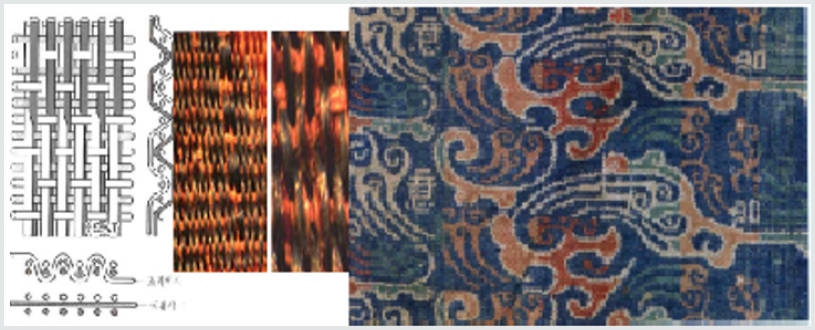
Figure 1: Model of Warp double fabric & Kyung Geum with colored stripe band of Go-Joseon.

Lupinepublishers-openaccess-journals-Textile-Fashiondesigning

In Figure 1, it has overlapping colored yarns as vertical warp threads –creating patterns through occasional emergence of different colored thread layers to the surface (warp faced double rib structure). Thus the fabric is dense and thick, which was not for the hot and humid weather. This fabric swatch was excavated in Sinkiang relic, and we assume that it is of Go-Joseon origin. The warp yarns are ordered as green, yellow, red, green, yellow and green, having constant widths and its own rule of color arrangement. These colored stripes in the Geum pattern are rhythmical yet natural, containing traces of whimsical randomness. The orderly and rhythmical pattern makes Geum aesthetically pleasing through its simpleness, while the randomness incorporated within gives a natural and organic feeling. The Tibetians have similar color stripes in their costume, but theirs are not always vertical, nor have the same thickness throughout the whole pattern (Figure 1) [2]. The weaving technique for the Kyung-Geum travelled to western Asia around AD 0. During this process, the weaving technique was modified to use colored thread as the filling thread. This technique produced a new form of Geum, Wee-Geum(緯錦). Wee-Geum started to replace Kyung-Geum from Balhae dynasty(AD700) [8].

The bigger patterns and curves of Wee-Geum gained more popularity over the traditional Kyung-Geum and Kyung Geum disappeared for its complex manufacture process. But it has survived in Korea as the form of Saekdong, which is warp faced satin with vertical colored band and with simple pattern. The ancient Kyung Geum had its own beautiful characteristics. The patterns were often decorated with vibrant portrayals of clouds, whirlpools and antlers. The fabric consisted of complex combinations of straight and curved lines within the patterns. The Geum pattern also often contained pictures of great beasts, and ancient characters “韓” Han means Korea and “王” wang means king[8]. Art depicting great beasts is characteristic of the Northern horseback-riding tribes’ culture. The records say Goguryeo (BC237-AD668) had lots of Kyung Geum such as beautiful Cloud Geum 雲錦, King letter Geum 王字文錦, and Geum tent or wide long shawl fabrics of Geum [7].

The uniform widths of the stripes represent equality, a valued characteristic of the Go-Joseon people. They valued the virtues of equality, peace, worshiping the heavens, justice, manners, and Hongik Human 弘益人間- Wide goodness for Human [3]. also the stripes composed of five to seven different colors, the garment of the gods. The Mongolians have called the Goryo(高麗) people “Solongus,” meaning “rainbow” in their tongue. From this evidence, we can infer that Goryeo people had a colorful and vibrant culture. The Saekdong consists of colored stripes of uniform widths. The vertically woven warp threads are the main color threads, just like the Geum. The repeated color stripe pattern of Saekdong is rhythmic, concise, natural and elegant – rather than fancy and gorgeous. Within the vertical colored stripes, Geum had gorgeous and complex patterns that symbolize the power of the king or gods. But as it evolved into the Saekdong pattern, the complex designs were simplified in order to emphasize the restrained beauty and order of the striped pattern itself. The color stripes are emphasized, and the patterns are minimalized, opposite to the characteristics of Geum.

Kyung-Geum of Baekje Socks (~AD660)

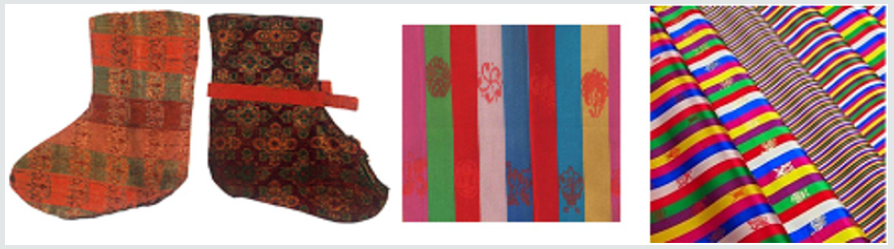
The Figure 2 shows the Kyung Geum socks(Mal, 錦襪) from Baekje, which went oversea to to island and build Nara dynasty in Asuka period. we assume this was worn by Baekjae King Family. After this royal family of Baekje died, Shosoin temple (正倉院, 東大 寺) wanted to keep all of the royal family’s belongings in storehouse as their own treasures. But the Japanese say that this sock belonged to the musicians of temple ceremony, and they sent people all over the world to learn the weaving techniques of Geum and Neung ( 陵, twill) in AD 711 in order to produce their own Geum[9]. But we think that only the skillful master of Geum could make this gorgeous fabric, and because it was precious it was only worn by a royal family. Both socks have colored stripes and small patterns: the purple one has Buddha with lotus, whereas the orange one has curly haired lion’s head (symbol of Buddha). These Geum socks of Baekjae represent religious values as well as the prosperity of Baekjae (Figure 2)[9].

Figure 2: Baekje socks of Kyung Geum, Saekdong of 1950’s, and current of Korea.

Lupinepublishers-openaccess-journals-Textile-Fashiondesigning

Color Beauty of Saekdong

Red, yellow and blue were used as warp thread in Geum. Red represents fire, the sun and summer, while blue represents the supernatural or sky. According to the Yin-Yang theory [10], when these two extremes meet, they support each other through synergy and produce a power of revitalization [11,12]. Additionally, the third color yellow means center, earth, brightness, peace, gold and hope. Using these three colors together, the Go-Joseon people invited good luck and protected themselves from evil [13]. We can easily find Saekdong of three basic colors, but today’s Saekdong includes a larger variety of colors. Adding white creates space and a sense of relaxation, also emphasizing the pattern and accentuating the neighboring colors. And adding colors on the opposite side of the color wheel enhances the color scheme. The Go-Joseon people were ingenious in assembling the Saekong pattern with their unique aesthetics. The vivid color is bordering another vivid color, but they do not collide with each other, forming a harmonious mood [14]. This type of arrangement is crucial in making patterns, since a wrong arrangement can induce a sense of discomfort. Saekdong pattern cleverly avoids this, and on top of being harmonious, it even has delightful touch to it. Even with only 2-3 colors, the complex arrangement of it makes the Saekdong pattern far from monotonous. Recent Saekdong has smaller patterns and longer intervals, compared to the Geum.

Conclusion

As a result of tracing the history of Kyung-Geum - a famous fabric of East Asia –many evidences were found to confirm that Kyung-Geum originated from Go-Joseon around B.C. 500. Joyang, Geum-Ju and Balhae civilization has exposed its oldest swatches. Kyung-Geum is double-woven with vertical colored threads (warp double rib fabric), and it is characteristic for its repeating vertical stripe patterns. The fabric itself is rather thick with a high thread count and was a major export to other surrounding nations during the period. The stripe patterns have a uniform width, as it is with the current Saekdong. Saek dong is a warp satin, and it is a simplified and modernized version of the ancient Kyung-Geum. The Saekdong consists of complementary colors, and its color scheme is harmonious, delightful, simple yet active. Since Saekdong was thought to produce supernatural powers, it is still being used in shaman’s costumes, and in children’s hanbok for a purpose of warding off evil spirits. Go-Joseon was governed through eight major laws (8條禁法), and the people led a prosperous life. Because Geum was so abundant in Go-Joseon, everyone from the king to the common people wore it as daily clothes. During the cold seasons, they would add a layer of fur on top or bottom of their Geum clothing or wool Geum, Kye.

From the excavation sites of Go-Joseon, a variety of spindles were found threads of various thickness were produced to weave all kinds of complex fabrics, and the clothes were decorated by numerous jade gems and bronze buttons. The trims of the fabrics were decorated with furs of tigers, leopards, foxes, and weasels. The Go-Joseon people were fond of using multiple colors: the fashion back then was to wear mismatching colors for top and bottom, pants for riding purpose - which is one of unique styles in the world, colorful pottery of tripod as well as Kyung-Geum fabrics of multiple colored stripes were very popular. The color scheme used by the Go-Joseon people closely resemble the vibrant and complementary color scheme of the modern Saekdong. The Go-Joseon people had an eye for aesthetics and color, which also contributed to their development of advanced fabric dyeing techniques. The cloud and antler patterns present in the Kyung-Geum fabrics can also be found with the bronze mirrors with fine lines and violin-shaped bronze daggers of the Go-Joseon excavation site. These exquisite designs made by the skillful craftmanship highlight and represent the prosperity and elegance of the Go-Joseon people.

Acknowledgment

The research was supported by the National Research Foundation of Korea (NRF) (NRF2016-R1D1A 1B01015336).

Read More About Lupine Publishers Journal of Latest Trends in Textile and Fashion Designing Please Click on the Below link:

https://fashion-technology-lupine-publishers.blogspot.com/