Showing posts with label Fashion Technology Textile Engineering Open access Journal. Show all posts

Tuesday, 18 October 2022

Lupine Publishers| Role of Family Support & Technical Training in Women Empowerment

 Lupine Publishers| Journal of Textile and Fashion Designing


Abstract

Purpose: The purpose of this research is to explore the role of family support through the support of TVET towards women empowerment and socio-economic growth. This research has highlighted the challenges being faced by women and the recommendations to overcome those challenges and getting the required targets positively.

Design/Methodology/Approach: This is a quantitative study. The target population for the study is the women getting technical training from different readymade garment training institute Lahore. Total number of respondents are 130. A questionnaire was developed in close consultation with industry and academia experts and was used for the data collection. Data is collected using convenience approach. The questionnaire was based on the seven-point Likert scale. Reliability and Validity was checked through factor loading, composite reliability, average variance extracted etc. ADANCO software was used to test the hypothesis through regression analysis.

Findings: The findings showed that family support has significant impact on TVET. TVET has significant impact on Women Empowerment and Women Empowerment has significant impact on socio-economic growth.

Research Limitations/Implications: The research is limited to Lahore, whereas the same can be expanded to all over Pakistan for a deeper insight to understand the importance of TVET sector towards economic growth.

Practical Implications: This research can help understand the different aspects of empowering women and how it will support the socio-economic growth of a country. It will also help in understanding the weak areas to be considered and settle down.

Originality/Value: There are extensive research done on women empowerment, but there is little research done on the women empowerment with the mediating effect of family support and TVET sector in context of Pakistan. The model used in the research are original and designed by researchers themselves.

Keywords: Socio Economic Growth; Family Support; TVET Sector; Women Empowerment

Introduction

When basic necessities of life are not full filled than it develops socio economic problems in a country. Basic needs are basically food, clothing and shelter. Pakistan is the developing country and facing such kind of socio-economic challenges. The actual issue is not these problems, but the week policies been implemented presently [1]. The literacy rate of Pakistan remains static at 58 percent with 70 percent of males and 48 percent of females in it [2].

Pakistan is facing high level of unemployment in different sectors due to significant skill gap despite of the massive growth of the growth of TVET sectors in Pakistan. Industry is facing major hindrances due to non-availability of skilled workers. TVET sector has huge potential in reducing skill gap. Annual growth rate of 1.8% the proportion of (15-29) year population is around 28% with Male 51% and female 49%. It is reported that 3581 (vocational: 2,647 & technical: 934) public & private TVET institutions are found in Pakistan with annual supply of skilled labor force of 314,176 to labor market. This is relevant to mention that private institutions are contributing 11% in technical skills while 55% are share of vocational trade in skilled workforce [3].

Technical and vocational education has been defined as practically demonstrated occupational skill for different fields of technical and vocational training in fields like business, agriculture, cooperate and services sectors, health, marketing, trade etc. [4]. In order to attain sustainable economic growth, the key element is the TVET education in any developing countries. The importance of TVET sector recognized in terms of skill development. It helps to overcome the socio-economic challenges faced by women in their life. Skill development is not only improving the standards of person but also contribute in the growth of economy [5]. The role of industries is essential in producing quality people for job market. The government alone can’t produce needed workers for job market without the help of industry. The skills are not enough for the development but there is a need of place to show the results of that skills [3].

The major hurdle in solving these challenges are lack of education and the family support towards getting education. Major researches revealed that family support plays a major role in getting education and skills for both males and females equally. Many families are not in favor of technical education and not considered it suitable to work in industries especially for females [6]. Parents support and influence considered as important factor towards technical education. Research revealed that females having family support and encouragement are more successful their career [7].

Empowerment means the expansion in people’s ability to make strategic life choices in a context where this ability was previously not available to them. The term ‘Empower’ means to give legal power or authority to act” [8]. Women empowerment means equal opportunity in education, employment, rights and giving secure working environment. It means giving them enough confidence to participate and give suggestions to any discussion relating to them [8]. It has been explained that technical & vocational education and training in women empowerment process specifically in local level not only provide self-employment opportunity to the women but also trigger capability to exercise control over their personal and family life, make choices to improve well beings and take active role in decision making [4]. For economic development of a country, education and skill development play a vital role. TVET is basically a technique for overcoming socio economic challenges and promoting economic growth [9].

Research Objectives

The objective of this research is to analyze the women empowerment from different dominations.

a) Skill development is a powerful and short-term way towards women empowerment.

b) To analyze family support as major variable towards approval of female’s education.

c) Skilled women can financially support herself but also family.

d) Technical education and women empowerment contribute towards socioeconomic growth.

Research Questions

There are three research questions

a) Does Family support has a positive impact on TVET Sector towards skill development?

b) Does TVET sector has a positive association with women empowerment?

c) Does Women Empowerment has a positive impact on Socio economic growth?

Literature Review

Women Empowerment

When women has the capability to prosper and develop economically and the confidence to make decisions for benefits of the economy are known as empowering women economically. Women empowerment is important to understand their rights and increase the standard of their household/family and also for the growth of the economy. Empowering women is also helpful in attaining development goals like poverty reduction, unemployment, increasing productivity and efficiency, health, education and growth of economy [10].

To prosper the economy and increase the growth of economy, development programs put more focus on women empowerment. Economically strong is considered as one of the most influential tools to achieve their targets. When women have the skills, they can avail opportunities equally and contribute more towards their families and nation. Basically, women have good business sense and by their skill development they can contribute towards market and business growth for sustainable economic development [11].

TVET Sector

The research revealed that for sustainable economic development the education and vocational training are major pillars. Technical training plays a key role to meet the new challenges of developing economy and achieving the development goals essential for prosperity of nation. TVET sector contributes a lot by producing quality skilled workforce to meet the demands of industry by working effectively and efficiently. In era of globalization, development is also helpful in achieving goals regarding advancement of technology [12].

The research report revealed two main reasons of the technical and vocational skills towards its contribution in economic growth. Profitability and growth are two main purposes of any organization and for enhancement of both technical and vocational training are becoming core requirement of any company. Growth of enterprise is basically the development of economy. So, the first reason is the demand of skilled workforce due to competition in markets, technology advancement and change in working structure. The second reason for skill development is growth and prosperity of the individual herself. Technical training means direct entry in the job market or upgrading the career and bring increase in earning which help one’s to improve their standard of living by overcoming the challenges faced by them in daily life [13].

Family Support

Result of this research revealed that one of the demotivated factors towards technical education is lack of family support. All because is of the lack of knowledge and interest regarding technical education. Family support have shown significant impact towards economic growth. Empowering women leads towards economic growth by giving women the self-employment opportunities. All this is possible through technical and vocational training as TVET means direct and upgraded entry in to the job market [7].

Women Empowerment, TVET Sector and Economic Growth

To empower women with the skills to participate fully in the development process technical training and basic education are most important techniques. Technical education is fast track entry route towards availing opportunities and economic growth. If they women are educated, they can be aware of the opportunities around them, take care of their health and can change the standards of themselves and of family. The paper stated that in developing countries empowering women means minimizing socio economic challenges and bring major change in growth of economy [14].

Women are energetic and potentially human resourced and with skills they become more efficient in productivity and become driving force for social growth and economic development of country. This paper revealed that TVET sector is best opportunity to empower women which helps them to overcome the socioeconomic challenges, improving their standards of living and contribute towards sustainable socio-economic growth [15].

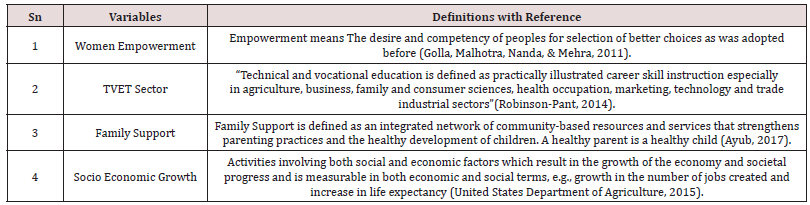
Operational Definitions

Table 1: Definitions.
Lupinepublishers-openaccess-journals-Textile-Fashiondesigning

Conceptual Model

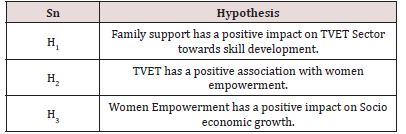
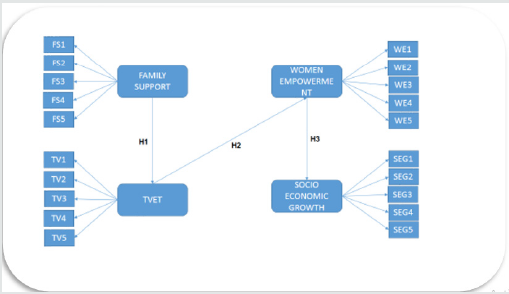
Figure 1 is presenting the conceptual Model adopted [16] and amended. It shows that family support has positive association with TEVT. TEVT has positive association with women empowerment and women empowerment has positive association with socioeconomic growth. Table 2 is presenting the hypotheses. There are three hypotheses which have been tested in the research study.

Figure 1: Conceptual Framework.
Lupinepublishers-openaccess-journals-Textile-Fashiondesigning

Table 2: Research Hypothesis.

Lupinepublishers-openaccess-journals-Textile-Fashiondesigning

Research Methodology

This paper performs a quantitative study. The population of this study is females’ students of a technical training institutes. Convenience sampling method is used for data collection and has been gathered from sample selected from the area specified for the research.

The research is comprised of Technical education in Garment sector and is conducted covering the area of Lahore, Punjab Pakistan. It takes almost two months to complete the study. Total number of respondents are 130. Data is collected from female students of technical institutes of Garment Sector through survey by using closed ended questionnaire based on 7-point likert scale included 20 items with a 7 points likert-scale of strongly disagree to strongly agree.

130 sets of questionnaires were distributed out of which 116 received and 15 were incomplete. Total response received was 102 and are analyzed using ADANCO [17]. The research includes four latent variables Women Empowerment (WE), Socio Economic Growth (SEG), Family Support (FS) and TVET Sector (TEV). To check the internal consistency of model, the Cronbach’s alpha is used, where Cronbach’s alpha ranged from 0.9274 to 0.7515 above the acceptable value of 0.7 which shows that instrument used in this research is highly reliable and suitable for analysis.

Read More About Lupine Publishers Journal of Textile and Fashion Designing Please Click on Below Link: https://fashion-technology-lupine-publishers.blogspot.com/

Monday, 20 December 2021

Lupine Publishers| Future Prospect for Sustainable Luxury Textiles from Pineapple Leaf Fibre - An Agro Waste

 Lupine Publishers| Journal of Textile and Fashion Designing


Abstract

The treasure of Major natural fibres belongs to cotton, jute, wool, silk, flax, sisal and Manila hemp which are extensively used across the globe. Besides, a large number of fibres grown in lesser quantities throughout the world have local economic importance and are consumed locally. Utilization of underexploited, unexplored natural fibres from crop waste are not only critical issues in the international scenario but are also the need of the hour in developing countries like India to search out a suitable avenue for which separate spinning system is not widely available or established. Pine apple leaf fibre successfully tested as a base material for conveyor belts in the early eighties, could well have been the magic yarn of the day. Pineapple leaf fibre extracted from the green pineapple leaf, an agro waste reveals its immense potentiality in the field of textiles particularly due to the disposal problem after harvesting for cleaner and green environment.

PALF is well known for its silky lustre which possesses some advantageous physical and chemical properties like high tensile strength, dimensional stability, considerable resistance to heat and fire, and good dyeability while the demerits are coarseness, inextensibility. Besides, it is a low cost renewable resource and eco-friendly material. If the apparent demerits can be masked, a diverse range of products can be developed by exploiting the intrinsic properties of PALF. One of the ways of masking is blending of PALF with natural and synthetic fibres. It is felt that such binary blending will help development of textiles with better functional properties by combining positive features of the constituent fibres. Therefore, binary blending will give a wider application for production of value added diversified products which are the need of the hour.

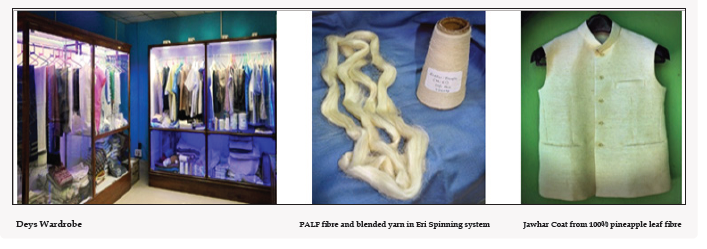
The paper also delineates suitable processing technique for blending of PALF with different natural and synthetic fibres for conversion into textiles using existing fibre processing system since there is no specialized spinning system available for pineapple and their possible commercial utilization. The PALF blended yarn has a bright future prospect for sustainable luxury textiles like fancy apparel products (Figure 1).

Lupinepublishers-openaccess-journals-Textile-Fashiondesigning

Introduction

Wealth from waste is no more a slogan in 21st century but achieved successfully turning pineapple leaves into wealth which not only creates green environmental sense but also turns waste into wealth. Resource depletion and global warming have driven each industry to move toward a greener and sustainable industry. Lignocelluloses, the most abundant renewable biomass is composed of cellulose, hemicelluloses and lignin, as well as other minor components. Pine apple leaf fibre successfully tested as a base material for textiles in the early eighties, could well have been the magic yarn of the day. Research work on pineapple leaf fibre, an agro waste reveals its immense potentiality in the field textiles particularly technical textiles. Sufficient fibre will be available to arouse interest if the fibre is extracted commercially. Due to non-availability of specialized spinning system for PALF in India, it will be much easier to promote PALF in any of the existing spinning systems provided an appropriate processing technology is developed.

Major natural fibres belongs to cotton, jute, wool, silk, flax, sisal and Manila hemp which are extensively used across the globe possess suitable processing technology and developed machinery. Besides, a large number of fibres grown in lesser quantities throughout the world have local economic importance and are consumed locally The pineapple plant AnanasComosus (L) is a member of the family Bromaliaceae of the monocotyledonous, containing 1,300 species; most of which are native to tropical America. Although over nearly 90 varieties of the plants cultivated in various parts of the world, only 3 varieties, namely, Kew, Queen and Mauritius are cultivated commercially. The form of pineapple leaves varies and depends on the position of the stem and age.

According to the data available, Pineapple fibre can be profitably produced in Tripura as well as Siliguri in West Bengal, where extensive pineapple farming takes place. In India, Pineapple leaves are never cut off, and are cleared when the plants naturally shed them. As a result, fewer pineapple plants are grown in India, as the leaves cover a lot of space. In countries like Brazil where extensive pineapple farming is done the leaves are cut away to make space for more plants. "We have gone through the science of it- Interestingly, cutting away of the leaves does not harm the plant and in fact helps it grow bigger fruit, as the leaves normally draw away a lot of the nourishment” says Dr. S. K. Dey, Senior Scientist of ICAR-CIRCOT, Mumbai. Indian farmers mostly throw away the leaves. Research on plantation has established that the leaves can be cut three times a year, without harming the harvest and suitably designed industry for pineapple leaf fibre, can run the year-round on these supplies.

The philosophy of blending between two fibres depends on two basic principles which apparently appear to be a bit contradictory.

    a) PALF may be blended with cheaper fibres so that a cheaper product mix becomes feasible. In this category, blending of ramie with jute, ramies, Mesta, banana, Roselle hemp appear to be worth pursuing.

    b) PALF is often blended with synthetic fibres to produce diversified blended fabrics which are expected to fetch higher prices per unit weight of ramie and consequently higher profitability.

PALF is well known for its silky lustre which possesses some advantageous physical and chemical properties like high tensile strength, dimensional stability, considerable resistance to heat and fire, and good dyeability while the demerits are coarseness, inextensibility. Besides, it is a low cost renewable resource and eco- friendly material.

Normally, the fibre is as fine as the finer quality jute, although about ten times as coarse as cotton. Unlike jute, its structure is without mesh, filaments are well separated and it is two and a half times more extensible with superior bundle strength and L/B ratio. Both the flexural and torsional rigidity of pineapple leaf fibres are comparable with jute fibres of less rigid quality. An interesting characteristic was observed in the case of pineapple leaf fibre and yarn when their tensile properties were studied in wet condition. The bundle strength of pineapple leaf fibre decreases by 50% when in a wet condition but the yarn strength increases by about 13%. A detailed research reveals that the frictional property of pineapple leaf fibre is very high in the wet condition and it predominates over the fall in tensile strength of the fibre so as to increase the wet strength of the yarn.

Different Stages of Blending Process

The development of blended yarn from PALF with natural and synthetic fibres can be achieved in the three stages of processing as given below.

    a) Blending at carding or drawing.

    b) Blending at spinning

    c) Union blending i.e. at fabric stage.

Blending at Carding or Drawing

    I. Jute Spinning System: The processing technology of pineapple leaf fibre in jute, cotton, semi-worsted and flax systems as well as to compare performance, research work was undertaken at Jute Technological Research laboratories which later on renamed as National Institute of Research on Jute and Allied Fibre Technology, Kolkata.

    II. Performance of jute/Pineapple Leaf Fibre on Jute Spinning System: When the golden fibre blends with pineapple, a magic yarn is born. The fibre is best used as decorative material. Firstly, the natural colour is creamy white-hence unlike jute it does not need bleaching. We have tried various combinations of the fibre at our pilot plant and blended it with jute and synthetic material. When blended with synthetic material, the product is an extra fine material. It can work wonders with jute. If pineapple fibre is blended with jute up to 20-25% fine yarn of linear density of 69 tex or less can be created. This is very difficult to achieve with Indian jute alone.

    III. PALF-Ramie Blended Yarn: PALF and ramie yarns spun in dry and wet spinning systems are comparable but wet spun yarns reveal better performance than dry spun yarns due to better inter fibre friction in the wet spinning system. By gradual increase in the percentage of PALF in the blend, a gradual decrease in tenacity of the blended yarn has been observed. And this may be due to the difference of fineness of the two fibres.

    IV. PALF-Viscose Blended Yarn: 100% viscose yarn spun in jute spinning system shows higher tenacity for wet spinning and lower extension compared to dry spinning. Gradual increase of PALF in the blend brings about gradual improvement in the tenacity of the blended yarns due to higher strength of PALF. The wet spun blended yarn from PALF-viscose show better performance than corresponding blended yarns spun on the dry spinning system.

    V. PALF-Polypropylene Blended Yarn: Binary blending of PALF -Polypropylene for its use in sophisticated area of textiles, Polypropylene fibre of 15 denier and 120 mm length was used. Both PALF and Polypropylene fibres were processed separately in Flax Finisher card with the developed technology of processing the above fibres and a linear density of 138 tex was spun with 5.5 T.P.I in both dry and wet spinning system. Binary blending of the carded material was achieved at Mackie's First Screw Gill Drawing frame with a blend proportion of 75:25, 50:50 and 25:75. No difficulty was encountered during spinning of blended yarn and control yarn.

    VI. PALF-Acrylic Blended Yarn: PALF: Acrylic: 50:50 blended yarns having linear density of 84 tex with a T.P.I of 7.5 were developed in jute spinning system in dry and wet spinning conditions. Four blended yarns were spun by blending PALF and acrylic at four different stages of Jute processing viz, carding and three drawing frames. The performance of the blended yarns was studied to evaluate the optimum stage of mechanical processing for binary blending of PALF and acrylic.

Wet Spinning Technology

Wet spinning brings about improvement in short-term weigh irregularity of the yarns resulting in better regularity of yarn diameter. This is chiefly due to better control of fibres in the drafting zone of the spinning frame during wet spinning. The diameter of wet spun PALF yarn of equivalent linear density is lower and its packing coefficient is also higher than that of the dry spun one. The tenacity of the wet spun yarn is higher than that of the dry spun one as the regularity of wet spun yarn is better and the higher packing coefficient is expected to generate transverse pressure during tensile loading. The strength C.V % of wet spun yarn was also lower compared to dry spun yarns. There was no significant difference in breaking elongation of dry and wet spun yarns.

Short staple Cotton Spinning System

Pineapple leaf fibre was first stapled to 32 mm, opened in a single opener machine, blended with Indian cotton in two proportions

A. 67% cotton: 33% Pineapple leaf fibre

B. 80% cotton: 20% pineapple leaf fibre and yarn of a coarse count 14s spun. The performance of the blended yarns showed that on increasing the proportion of pineapple leaf fibre in the blend, the count strength product and regularity deteriorated and a higher percentage of droppings of fibre was noticed in the blow room and carding machine. Spinnability of PALF improves after chemical treatment which was not achieved from cotton/raw PALF (67:33) blend composition. It is clear that the Spinnability increased from 14s to 22s with higher blend composition of PALF: Cotton:: 70:30. Yarn performance indicates that the C.S.P of the blended yarn is lower compared to cotton yarn. The cohesiveness of chemically treated PALF needed higher twist multiplier than normal cotton yarn of same count.

Semi-Worsted Spinning Systems

PALF were blended with Chokla variety of coarse Indian Wool at Central Sheep and Wool Research Institute, Avikanagar, Rajasthan, a sister concern of Indian Council of Agricultural Research. Yarns of nominal linear density of 138 tex were spun on the semi-worsted spinning system by varying the blend proportion of PALFs. Blending of PALFs by 25% could bring about a sharp drop in breaking elongation of yarns and blending by 50% results a sharp increase in tenacity of blended yarns. Besides, by blending PALF with wool at 25:75,the bulk resilience of yarn decreased only by 10% as compared to all wool yarn. The blended materials of PALF-Wool, all PALF and all wool were processed separately on the semi worsted spinning systems.

Eri Silk Spinning Systems

Latest finding reveal that pineapple leaf fibre was successfully processed and blended with red eri available in north eastern region only using Chinese silk processing facilities available at Fabric Plus, Guwahati. Red eri and softened pineapple leaf fibre were processed through the sequence as follows:

Floss Cutter - First Circular Dressing - Second Circular Dressing - Third Circular Dressing - First Spreader - Second Spreader - Slivering - First Drawing-Second drawing - Third Drawing- Roving - Ring spinning - Winding - Twisting - Conditioning - Singeing - Package.

Finer linear density of PALF: Red Eri blended yarn reveals its immense potentiality to be used in the field of Luxury textiles. Finest blended yarn could not be spun except this spinning system. The mechanical properties of the blended yarn were up to textile quality.

Conclusion

Investigation on pineapple leaf fibre clearly indicates that the agro waste can be suitably processed into useful products. Development of appropriate processing technologies for generating yarn with improved properties can widen the application ofthis agro waste.The extractor can effectively be used to extract the fibre from the agro waste of pineapple leaves and the residual sludge obtained after scratching the leaves can be used for vermicomposting successfully. Investigation on pineapple leaf fibre clearly indicates that the agro waste can be suitably processed into useful products. Development of appropriate processing technologies for generating yarn with improved properties can widen the application of this agro waste. The integrated technology for the extraction of pineapple leaf fibre and the vermicomposting altogether becomes remunerative to pineapple cultivators which can be adopted by all pineapple growers not only for additional income but also proper utilization of wastes particularly agricultural wastes which is an important factor in planning the economic progress of a developing country like India.

Read More About Lupine Publishers Journal of Textile and Fashion Designing Please Click on Below Link: https://fashion-technology-lupine-publishers.blogspot.com

Monday, 17 May 2021

Lupine Publishers| An Infrared Technique for Rapid Analysis of Pineapple leaf fibre-Acrylic Blends

 Lupine Publishers| Latest Trends in Textile and Fashion Designing (LTTFD)


Abstract

An infrared technique used to analyze pineapple leaf fibre-acrylic blends of different blend compositions is reported. Blend estimations are effectuated from a calibration plot between the absorption of the 2235 cm-1 band (C≡N) and the composition percentages of acrylic fibres. The theoretical and actual blend composition by chemical method divulges matching with each other.

Introduction

Usage of unexplored lesser known natural fibres in the international arena are not only the burning issues but simultaneously to search out a suitable avenue for which separate spinning system is not widely available or established in developing countries like India. Pineapple leaf fibre is another unexplored natural fibre extracted from the green pineapple leaf; an agro waste reveals its immense potentiality for use as a fibre in the arena of sustainable fashion textiles particularly due to the disposal problem after harvesting for cleaner and green environment. PALF is well known for its silky lustre which possesses some advantageous physical and chemical properties like high tensile strength, dimensional stability, considerable resistance to heat and fire, and good dye ability while the demerits are coarseness, inextensibility. It is a low cost renewable resource and eco-friendly material. Due to non-availability of specialized spinning system for PALF in India, it will be much easier to promote PALF in any of the existing spinning systems provided an appropriate processing technology is developed.

Several workers have reported blending of pineapple leaf fibres alone or in blends with other fibres [1-4], but scanty work has been reported on the analysis of PALF blends since the early work by Dey et al [5]. Numerous methods are available for analyzing fibre blend composition, of which the chemical method is commonly employed when a sufficient sample is available. It is more desirable to opt for a micro technique that requires smaller samples of the order of a few milligrams. Such samples can be analyzed unambiguously in order to identify variations in blend composition from place to place for quality control and investigation of fabric defects that cause streaks or depth-of-shade variations in fabric.

Polyester and cotton or wool and acrylic fibres are complimentary to each other due to their versatility. Since PALF is often blended with acrylic fibres to improve performance and hand, information on specific changes that occur during blending should be of interest. The infrared spectrophotometer is a vital instrument for both qualitative and Quantative analysis of polymer blends. The occurrence of non-overlapping absorption bands in IR spectra makes such analysis easier and more reliable. Various examples of quantitative determinations of fibre blends have been reported including ramie/acrylic by Dey et al, cotton/Dacron by O’Conner [6], wool/ Terylene by Clark and Hickie [7], cotton/polyester by BhamaIyer et al. [8], and acrylic/wool by Soosamma et al [9]. In this paper, the authors report a simple technique based on an IR method for quantitative analysis of PALF/acrylic blends.

Materials and Methods

Specifications of Acrylic fibres-no shrinkable, 3 denier, 120 mm long, from Indian Petrochemicals Corporation limited (I.P.C.L) Baroda and pineapple leaf fibre from ICAR-Central Research Institute for Jute and Allied Fibres, Sorbhog, Assam procured for this research work. All chemicals were analytical grade. The average fineness and tenacity of the pineapple leaf fibre were 2.67 tex and 271.84mN/tex respectively. Acrylic fibres in this experiment having liner density of 0.33 tex and tenacity of 241.52 mN/tex. Decorticated PALF and acrylic fibres were blended at the first drawing stage in five different blend compositions 83:17, 67:33, 50:50, 33:67 and 17:83. Yarns of 84 tex were spun on a rove spinning machine using modified conventional jute processing machinery with blend proportions of PALF ranging from 17 to 83%. Samples need to be taken from all parts of the bulk sample in order to obtain representative test samples for blend analysis; this is known as zoning [10] and is an important step in preparing test samples.

Sample preparation and calibration plot

Acrylic and PALF fibres were finely cut with scissors and sieved through a 100 mesh screen. Acrylic/pineapple leaf fibre blends of predetermined compositions were prepared by carefully weighing finely cut fibres. The fibre mixture was mixed thoroughly with 400 mg spectral grade KBr powder by grinding for 5 minutes with a mortar and pestle. The sample-KBr mixture was placed in a die and pressed for 5 minutes under a pressure of 421.85 Kg/cm2. The sample was also subjected to evacuation in the die for 5 minutes prior to pressing. The pellets were taken from the die and mounted on a magnetic pellet holder. These pellets transmitted in the range of 20-80% while being scanned. A standard calibration plot was obtained by measuring the absorbance of the nitrile (C≡N) band.

a) Blend analysis: The same procedure was followed to analyze the blend composition of five different blended yarn samples. A known quantity of the sample was powdered thoroughly and mixed well and 4 mg of the sample was weighed accurately and mixed with 4oo mg of KBr. For each sample, two sets of pellets were prepared as described earlier (Figure 1).

Figure 1: Calibration Plot for determination of Acrylic content in Pineapple leaf fibre/acrylic blends by measurement of Absorbance of (C≡N) band.

b) Spectra Recording: Spectra of the Pellets were recorded by a Shimadzu double beam model IR PRESTIGE-21 spectrophotometer from 4000 to 400 cm-1 under a normal slit program and a scanning speed of nearly 19s/100cm-1. A KBr pellet without the sample was used in the reference beam. For each pellet, the nitrile band at 2243 cm-1 was scanned twice, the second scan corresponding to rotation of the pellet through 90°in its own plane with reference to the first position. If the transmittance differed by more than 1%, this was taken to indicate no uniformity of mixing the samples. Fresh pellets were prepared again discarding such samples and their spectrum was recorded. The peak intensity (absorbance) in each case was measured by the baseline technique [11].

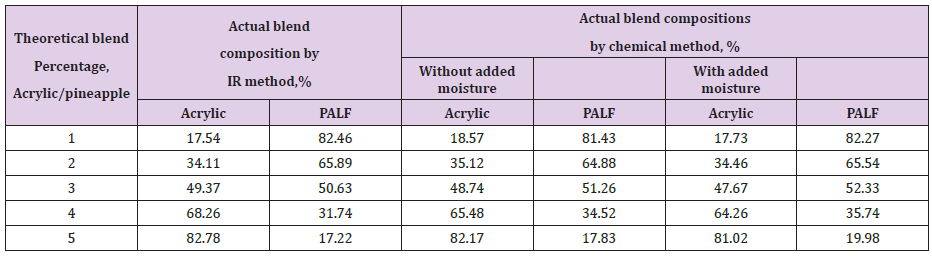
c) Chemical Analysis of Blends: The actual blend proportions were determined chemically as per the method IS: 3421-1966 for blend estimation [12]. All samples were extracted with a benzene-methanol (3:2) mixture to remove oil and any finishing materials that had been added during processing. Each blended sample was analyzed twice and the average value was reported in Table 1. Dey et al reported that the blend compositions of ramie-acrylic blends can be unambiguously assessed using infrared spectra with the help of calibration plot15. These compositions match those obtained by chemical methods (Table 1).

Results and Discussion

Acrylic fibres exhibit a strong nitrile band (C≡N) with a maximum at 4.48μ (2235 cm_1). This band is used for estimating the acrylic composition in blends. Regardless the origin of acrylic fibres, the position and intensity of the nitrile band are not much affected. The nitrile band is also independent of other functional groups, and so blend analysis by means of the infrared absorption spectra of the (C≡N) band is justified. Measurements of the intensity of the nitrile band for a series of acrylic/Palf blend samples yielded a calibration plot, shown in Figure 1. The individual points fall very much on a straight line, and scattering from the KBr disks is no problem. The calculated correlation coefficient is 0.9986 which is highly significant. BhamaIyer et al. observed that particle size plays a very important role in the peak intensity of the C=O stretching band of the carbonyl group in polyester, the absorption band recommended for analysis of cotton/polyester blends [13,14].

Table 1: Blend Extimation by Chemical Method.

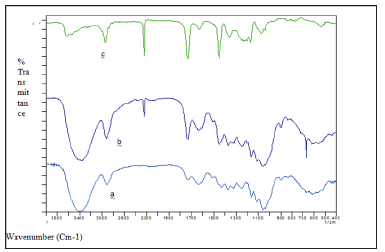
Figure 2: Infrared spectra of (a) PALF, (b) 50/50 PALF/ acrylic, and (c) acrylic fibre.

The absorbance of the C=O band versus composition does not yield a straight line. Soosamma et al. reported in their earlier work that the intensity of the (C≡N) band remains unchanged during ball milling period. This indicates that below a certain particle size, ball milling does not have any effect on the (C≡N) band. Hence, the absorption of the (C≡N) band versus composition gives a straight line. From such a calibration plot, the actual composition of any blend sample can be obtained rapidly with high accuracy. Blend compositions of the yarns based on the theoretical blend compositions of PALF/acrylic yarns spun on the jute spinning system measured by means of calibration plots and chemical methods are enumerated in Table 1. Figure 2 reveals the nature of the infrared spectra of PALF, 50%/50% PALF/acrylic blend and acrylic fibres. The results obtained with the infrared method using a calibration graph show the true compositions as given by the chemical method to a high degree of accuracy. After gaining some familiarity with the spectra of fibres, IR spectroscopy can provide a good technique for estimating blend composition-rapidly, reliably and with reasonable sensitivity.

Conclusion

The calibration plot will help to assess the blend compositions of acrylic/PALF blends unambiguously using their infrared spectra. The theoretical and actual blend composition by chemical method unveils matching with each other.

Read More About Latest Trends in Textile and Fashion Designing (LTTFD) Please Click on Below Link: https://fashion-technology-lupine-publishers.blogspot.com/