Showing posts with label fashion design journals. Show all posts

Tuesday, 28 February 2023

Lupine Publishes| Online and Brick-and-Mortar Strategy in Fashion Industry: Co-Existence or Cannibalization?

  Lupine Publishers| Journal of Textile and Fashion Designing


Abstract

Since the 1990s the Internet affected different industries and forced firms to change their business models and pushed toward the adoption of new strategies. The same happened in fashion industry, where e-commerce, personal computers, and smartphones created the opportunity for fashion firms to be closer to their customers, adopting CRM, and multichannel or omnichannel strategies. The main aim of this study is to analyze the potential conflicting presence of online and brick-and-mortar strategies in the fashion industry. We used a representative sample of 19 large firms in Europe, operating in the retailing brand fashion industry. Our data analysis shows how leading firms, facing a disruptive technology (the emergence of e-commerce), have been able to absorb it, in a context of co-existence between online and brick-and-mortar strategies.

Keywords:Innovation; Fashion Industry; Brick-and-Mortar; Commerce Online; Business Model

Introduction

Since the 1990s, many firms working in retailing adopted innovations spurred from Internet, such as e-commerce, to better service their customers. After a while, the entire fashion industry started using the online channel, either as exclusive channel or adopting multichannel or ominchannel strategies. Scholars focused on the adoption of e-commerce in fashion, studying the market structure [1-3], the use of the Internet, and the development of multichannel or omichannel selling modes [4-7]. Analyzing the changes occurred in the retailing industry, they showed the emergence of new business models among firms operating in the market [6,8-11].

The aim of this work is to provide some evidence about the effect of a disruptive technology like e-commerce, showing that this is still not cannibalizing the market of fashion. In section 2 we will shortly present the main research questions, in section 3 we will go through a short literature review. In section 4 we will present the methodology adopted. In section 5 we will present and discuss our data, and, finally, in section 6 we will conclude this paper.

The Aim of this Study and the Main Research Questions

The aim of this study is to show the disruptive effect of the entry of new technologies (e-commerce) in the fashion industry. Are we assisting to the failure of the main incumbents? Are firms operating in the fashion market suffering because of the presence of the e-commerce? Are existing large incumbents in the fashion industry able to absorb the new technology? All these questions can be summarized just in one main research question: do we have a cannibalization process between online and brick-and-mortar business models? In order to provide an answer, we collected data about the international investments made by a sample of 19 large fashion retailing firms operating in Europe.

Literature Review

Christensen, in his book “The innovators dilemma” [13], used the term disruptive technologies to explain why companies, that stay at the top of their industry, fail when they face a technological change. He provided evidence about the fact that it is costly for existing firms to adopt a new innovation and/or change the market. In contrast, Tripsas [14], using the history of the typesetter industry, provided some evidence about the fact that incumbents may survive, being able to absorb the new technology, due to their technical capabilities in learning from the new technology and in developing complementary assets. Many scholars agree on the fact that the introduction of radical and breakthrough innovations tends to stimulate the change of the incumbent business models [15-25]. Today, there is a general consensus on the idea that the transformation of a firm’s business model is crucial for firms’ renewal [26].

During the 1990s, in fashion retail, we saw the rise of new internet-based firms [27], but simultaneously a large reorganization of the firms’ value chains occurred. Increasingly, due to the complexity of ICT adoption, users developed an unpredictable pattern of hybrid forms [28-31]. Thus, nowadays, we may observe not only the rise of new internet-based firms (e.g. the German Zalando or the French Vent-PrivĂ©e), but also new “reorganized” traditional fashion brand retailers [9-12]. Socrescu et al. [6] and Vorhoef et al. [8] have underlined how ICT allowed firms to be closer to their customers, increasing brand awareness and customers’ loyalty [4-7]. The use of the multichannels modality, allowed firms to develop new business models, integrating in their operative activity the online business, selling on-line [4,32,33] through ample catalogues and through the shops (where on-line orders could be collected). In more recent years, the “omni-channel” opportunity become more significant, thanks to the use of mobile apps linked to different devices: smartphones, tablets, and other devices [34-36].

An interesting contribution to the explanation why “hybrid” business model (on-line and offline) are successful has been provided by Bernstein et al. [24]: firms do not benefit very much from online sales (in terms of profits’ growth), but consumers do; thus, traditional retailers have to adopt the online new commercial channels for strategic purposes.

Methodology

Starting from information available in the FDI Markets database, provided by the Financial Times Group, which collect individual firm FDI operations, we selected a sample of the largest retailers firms, operating the in fashion retail industry in Europe, sampling both luxury and low costs large retailers. The unit of analysis is the FDI specific investment. Then, using Thomson Reuters database, we add the information on yearly sales, and number of shops opened and closed in the world. Where some data where incomplete, we filled the gap looking at the annual financial report. We included in our sample 19 large retailers. When it was possible, we unbundle data for the specific brand of the group. The period analyzed was 2008-2016.

Data Analysis

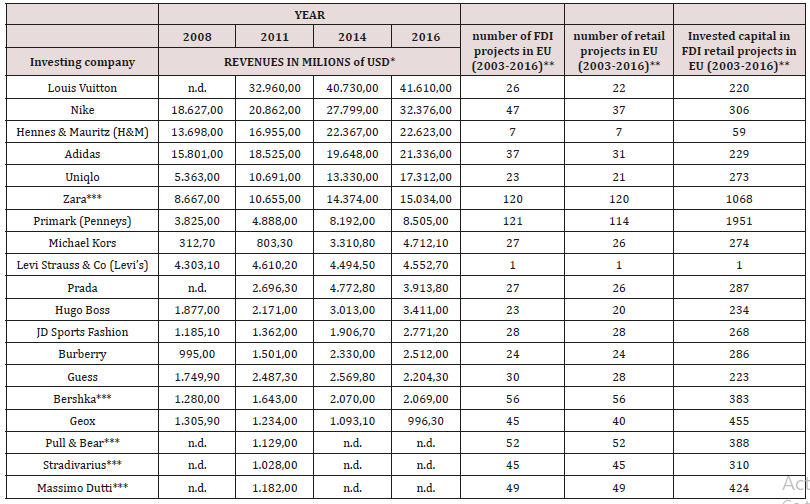
Table 1: List of fashion retailers by sales (2008 - 2016) millions of dollars.
Lupinepublishers-openaccess-journals-Textile-Fashiondesigning

n.d. : no data are available

*Data available on Thomson Reuters

**Data from FDI Markets Database

***Inditex group

Source: authors’ elaboration on Thomson Reuters data

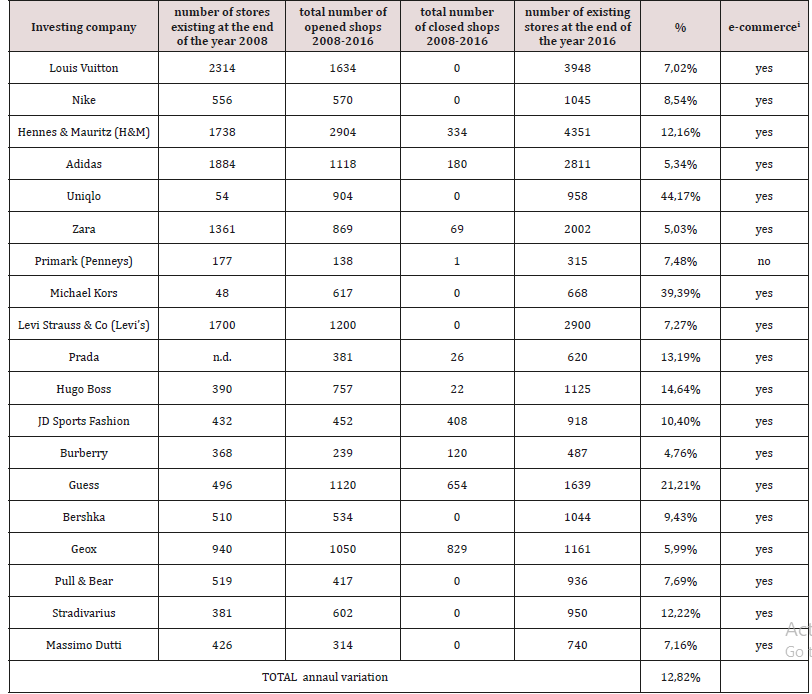
Table 1 shows the list of the largest investing company and the revenues expressed in millions of US dollar. The largest firms analyzed are Louis Vuitton (luxury segment), Nike, H&M, Adidas and Zara. Their sales oscillate from 40 billion to 17 billion. The typical firm in the luxury market is smaller with sales ranking from 4 to 2 billion (Prada, Hugo Boss, and Michel Kors). All firms, in this period, showed an increasing growth trend, with the exception of Geox. The biggest firms in terms of number of shops are H&M (4351), Louis Vuitton (3948), Levi Strauss &Co (2900), Adidas (2811) and Zara (2002). In our database is also included a large Japanese retailer, Uniqlo. In the period observed all firms showed a very positive increase in the number of shops opened (Adidas opened 927 new shops, Bershka 534, Pull&Bear, 417, Massimo Dutti and Stradivarius 569). Even if the introduction of e-commerce affected the market, the old brick-and-mortar business model is not dying. As it is shown, all firms (with the exception of Primark) adopted the e-commerce and transformed themselves into on-line/offline retail organizations. They both adopted new models of selling, opening on average each year more than 12% of new shops.

Table 2: Number of shops opened and closed per each firm in the world, the total number of shops at the end of the period, and e-commerce presence.
Lupinepublishers-openaccess-journals-Textile-Fashiondesigning

i: our analysis on firms’ web sites. Source: authors’ elaboration on Thomson Reuters data.

Thus, even if new players entered the market (such as Amazon, Zalando, Yoox, and many others), large incumbents did not fail. Sales through e-commerce are disclosed by firms in the financial reports. Zara, Adidas and Hugo Boss, declared a percentage of e-commerce sales on total sales between 5 and 7% in the last years (Table 2).

Conclusion

The aim of this paper was to analyse the impact of e-commerce on traditional retailing. In the first part of the paper, we went through a short literature review, showing how e-commerce is an innovation which can deeply transform the fashion industry. In the same vein, this literature highlights how this topic can be analysed from different approaches (e.g. business model, innovation, and others). In the second part of this work we showed some data obtained by two different databases. Data support our idea that there is no cannibalization among the online and brick-and-mortar channels. This work has some limitations. The number of firms chosen for this analysis in not too large. Then, another limitation is due to the fact that official databases contain only few information about online business.

Read More About  Lupine Publishers Journal of  Textile and Fashion Designing Please Click on Below Link:  https://fashion-technology-lupine-publishers.blogspot.com/ 

Monday, 27 February 2023

Lupine Publishes| Development of Woven Fabrics with High-Count and Cooling Collagen

 Lupine Publishers| Journal of Textile and Fashion Designing


Abstract

The 60’s cooling collagen viscose rayon blended yarn was fabricated by using ring spinning system. The blended yarn constitutions included 50wt% of regular viscose rayon with 1.5d and 38mm, 35wt% of cooling viscose rayon with 1.25d and 38mm, and 15 wt% of collagen viscose rayon fibers with 1.5d and 38mm. As mension above 60’s cooling collagen viscose rayon ring yarn was used as filling yarn. The 60’s Model Rayon(60wt%) ring yarn was used as warp yarns. The grey cloth specifications included warp density 198 ends/ 2.54cm and filling density 146 picks/2.54cm as well as the fabric width is 170cm which was produced by Picanol air-jet shuttleless loom. From the experimental results, the finished woven fabric was fabricated throuth souring, bleaching, dyeing, finishing, and heat setting processes. The color fastness of woven fabrics with high-count and cooling collagen achieved grade 4-5 according to CNS1494 testing standard.

Furthermore, the Functional Properties of Finished Woven Fabric were Processed as Follows

The instant cooling feeling value (Qmax) achieved 0.206W/cm= according to CNS 15141 testing standard. The static thermal image temperature difference achieved 1.3℃ according to FTTS-FA-010 testing specification which was draw up Functionality and Industrial Textiles Certification and Verification Review Committee in Taiwan. The Anti-pilling achieved grade 4 according to CNS 15141 testing standard. The electrostatic voltage caused by friction achieve grade 2 (100≤V< 500). The woven fabrics with highcount and cooling ccollagen blended yarn can be used in bedding, shirts, jackets, scarves, pants, pajama, etc.

Keywords: Cooling collagen viscose rayon ring blended yarn; Instant cooling feeling (Qmax); Static thermal image temperature difference; High count woven fabric

Introduction

The development, manufacture and design of Taiwan’s functional home bedding fiber products, main problem lies in the functional design of the bedding fiber products, fashion design, cost assessment and comfort. The advantages of cotton fiber made bedding products include good water absorption and air permeability. However, there are disadvantages of large shrinkage rate and wrinkle after washing. The advantages of polyester fiber made bedding products include not easy to wrinkle and shrink, and high heat resistance, but it is easy to generate static electricity and contaminate dust and has the disadvantage of being stuffy when used. The advantages of cellulose series fiber-made bedding products included better moisture absorption and dyeing, which are suitable for blending with other fibers such as polyester, and polyamide, but it is easy become longer after hanging, easy to shrink after laundry, and dry cleaning is required. The advantages of acrylic fabrics fiber made home bedding products, included nonwrinkle, better chemical resistance, sunlight resistance and thermal insulation, but have the disadvantages of easy raising, worse heat resistance and sultry heat in summer. Especially on the printed cloth, it is not suitable for the strong sunlight. Due to long-term sunlight radiation, it will cause the pattern on the fabric to fade. It is recommended to install it in a cool and ventilated place in the house. The jacquard woven fabric was weaved according to the predesigned pattern, which is visually elegant and textured. Therefore, it is suitable for installation in the bedroom, study, and elder room are also high-priced products. The long-term use of home furnishings and bedding products mainly emphasizes the beauty, style and brand. Due to the problems of comfort and functionality, the development of woven fabrics with high counts of cooling collagen bedding has stagnated and lacks interest. Therefore, the development of this case uses the advantage of blending rayon fibers with cooling collagen fibers to improve the general use of materials such as cotton and polyester to improve the quality, comfort and structural design of the bedding. Improve and declare the quality, comfort and structural design of bedding products, which is the future path for the development of international bedding product market.

In recent years, the collagen is more important in the fields of health food, cosmetics, medicine and man-made fiber. In the field of collagen textile fiber production in recent years, the additive is mainly composed of papolis, collagen extracted from milkfish scales, bone-extracted collagen and artificial collagen [1]. Collagen is a natural substrate in the natural ecology, which has the following three aspects of health effects on the human body.

a) Comfort - collagen is composed of 18 kinds of amino acids, which has excellent biocompatibility with the human body.

b) It has humidity regulation function, because collagen is rich in hydrophilic groups such as many amine groups (-CONH) and amino groups (-NH2), the structure is porous, easy to diffuse water molecules, and can be adjusted in humid air as well as have a certain amount of water.

c) Tryptophan and Tyrosine in collagen absorb ultraviolet rays, and ultraviolet rays are harmful to the skin, so collagen can protect the skin from ultraviolet light radiation [2-7]. The special collagen formula and the polymerization method of the innovative process to enhance the performances of collagen rayon staple fibers such as heat resistance, durability, moisture retention, skin-friendly and comfort, etc., and have higher added value and economic benefits [8].

Experiment

The 60’s cooling collagen viscose rayon blended yarn was spun by ring spinning method. The cooling collagen yarn constitution was made from 50wt% regular viscose rayon, 35% cooling viscose rayon and collagen viscose rayon through ring spinning sytem which through scoutching and opening, carding, combing, 3-passage drwaing, roving, ring spinning, and autocorner processes to fabricate the blended yarn. Furthermore, 60’s cooling collagen viscose rayon blended yarn was used as filling yarn (40wt%) and 60’s Model rayon yarn as the warp yarn(60wt%). The grey cloth specifications included warp density 198 ends/ 2.54cm and filling density 146 picks/2.54cm as well as the fabric width is 170cm and fabricated by Picanol air-jet shuttleless loom. The fabric structure is sateen, weight is 213g/yd and width 157cm (62in).

Results and Discussion

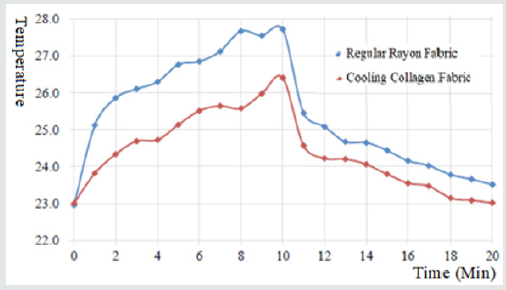
Figure 1: Comparison the thermal absorption and diffusion between cooling collagen and regular knitted fabrics.

Lupinepublishers-openaccess-journals-Textile-Fashiondesigning

The color fastness of woven fabrics with high-count and cooling collagen achieved grade 4-5 according to CNS1494 testing standard. The finished woven fabric passed through souring, bleaching, dyeing, finishing, and heat setting processes. Furthermore, the functional properties of finished woven fabric were processed as follows: Quality specifications in accordance with FTTS-FA-019 testing specification [11], instantaneous cooling value of woven fabric with high count and cooling collagen could be achieved 0.206W/cm2. The static thermal image temperature difference achieved 1.3℃ according to FTTS-FA-010 testing specification [10] which was draw up Functionality and Industrial Textiles Certification and Verification Review Committee in Taiwan. The Anti-pilling achieved grade 4 according to CNS 15141 testing standard. The electrostatic voltage caused by friction achieve grade 2 (100≤V< 500). The water absorption height along warp and filling direction was 59mm and 51mm respectively according to FTTS-FA-004 testing specification [9]. The thermal absorption and diffusion behaviors between cooling collagen and regular woven fabrics was shown in Figure 1. After irradiating by a 500W halogen lamp, there is a tendency to gradually increase the temperature as the irradiation time increases since thermal absorption behavior. The halogen lamp is turned off, after the irradiation for 10 minutes, and the temperature gradually decreases as time increases since thermal diffusion behavior. Furthermore, the higher thermal absorption and diffusion of regular viscose rayon woven fabric than cooling collagen woven fabric, since the lower moisture content and absorption of regular viscose rayon woven fabric than cooling collagen woven fabric. It is probably because the collagen has much more amino acid and hydroxyl functional groups, so the moisture content and absorption ability would be better. Due to superior functionality, physical and chemical properties, the woven fabrics with high-count and cooling collagen staple yarns can be used in bedding, shirts, jackets, scarves, pants, pajama, etc.

Conclusion

The yarns and woven fabrics with high-count and cooling collagen performance was fabricated successfully. The spring and summer bedding used woven fabrics are designed as the product, and the related physical and chemical properties (washing dyeing fastness test- faded and stained, anti-pilling, etc.) and functionality (instant cool heat flow, static thermal image, water absorption height, electrostatic voltage caused by friction, etc). The experimental results show that the physical and functional properties can meet the basic requirements of bedding used woven fabric in spring and summer. The development of spring and summer bedding is in line with the industrial upgrading and transformation and industry innovation research and development theme, including the combination of upstream (functional fiber), midstream (yarn, fabric), downstream (dyeing and finishing) industry and women’s products to integrate cooperated supply chain. The cooling collagen woven fabric has lower temperature than regular viscose rayon fabric. Due to superior functionality, physical and chemical properties, the woven fabrics with highcount and cooling collagen staple yarn could be used in bedding, shirts, jackets, scarves, pants, pajama, etc.

Acknowledgement

Much appreciated to the Industrial Bureau, Ministry of Economic of the Executive Yuan in Taiwan for providing financial support for this project (B10710200). This industrial- academicals project is jointly developed by Dong Chu International Textile Co., Ltd. and Textile and Materials Industry Research Center of the Feng Chia University (TMIRC). During the implementation of this project, we are very grateful to the supply chain manufacturers for their assistance in mass production and finished product design and testing method of woven fabrics. We would also like to thank the students from the Organic and Inorganic Composites Laboratory, Department of Fiber and Composite Materials (FCM) of Feng Chia University (FCU) and the colleagues of TMIRC for their assistance in testing and experiments.

Read More About  Lupine Publishers Journal of  Textile and Fashion Designing Please Click on Below Link:  https://fashion-technology-lupine-publishers.blogspot.com/


Monday, 16 January 2023

Lupine Publishers| Fashion and Sustainability

 Lupine Publishers| Journal of Textile and Fashion Designing


Opinion

The fashion industry is one of the oldest industries in the world. It is responsible for thousands of jobs and it generates thousands of billions of dollars and euros every year. But the apparel manufacturing is interconnected with many sustainability and environmental issues, such as, water consumption, energy, heavy metals, professional diseases, low wages, waste of raw materials, etc. The fashion industry must to have concerns about the issue of sustainability and environmental impacts. Many brands are already sensitive to these issues, but others are still not. If you ask me if it is feasible fashion be sustainable, I reply: yes, fashion must be sustainable. But there is a lot of work to do and many rules to follow. “The times when sustainability was a ‘nice to have’ are gone. These days it is a ‘must have’, an inevitable trend and subsequently a competitive advantage” [1]. According Georg Kell [2], “the $2.5 trillion fashion and apparel industry is an economic heavyweight. One of the largest consumer industries, it employs over 60 million people along its global value chain. For many emerging markets it is a stepping stone out of poverty with women making up over 70% of the supply chain.”

To correct the huge environmental disasters, we must be alert and wide-eyed. Stacey Dooley [3] uncovers the shocking environmental impact caused by an insatiable appetite for cheap clothing. Thus, cotton cultivation for the fashion industry is responsible for the almost disappearance of the Aral Sea near Uzbekistan, where river water has been diverted to cotton cultivation. Due to cotton of our clothes, where before there were fish, wildlife, tourists, employment, vegetation, etc., there is now a huge desert, a lot of sand, some camels, diseases, climate change, unemployment, toxic dust, etc. Without water there is not life. They are necessary 10,850 liters of water to produce one jeans pants 2,700 liters of water to produce one cotton t shirt [4]. Thus, by some estimates, the fashion industry is responsible for up to 10% of global CO2 emissions, 20% of the world’s industrial wastewater, 24% of insecticides and 11% of pesticides use [2].

We cannot ignore environmental disasters such as the Indonesian River Citarum, which supplies 28 million people with water, but where heavy metals such as mercury, lead, cadmium and arsenic, among others, are dumped. In this dirty river many children take a bath and have fun. It is perhaps the most polluted river in the world, an open sewage to where all kinds of toxic waste from about 400 textile factories is dumped [3]. Other countries such as Bangladesh or China also have huge environmental problems.

It is imperative to find solutions to these problems. The planet earth is our common home. Humans have no other planet where they can live. Why not collaborate with those who provide us with the materials of which our clothes are made? Why not help them get their space clean? Is it far? and our conscience do not alert us? or do we live in the world of hypocrisy where the problems of others do not interest us? Governments of affected countries and industry’s leading executives of fashion brands have to face these problems. Namely, heads of government must contribute to their resolution, subsidizing those who wish to collaborate and punishing those who are only interested in profit at any price.

If Corporate Social Responsibility (CSR) is not voluntarily accepted, there must be laws that impose it. And there must be consequences for those who do not comply. We cannot continue to wear our clothes and ignore the problems that have arisen in the countries that supply the materials. We cannot continue to send the dirtiest jobs to more distant places and we pretend no one sees them.

But solutions to this complex world begin to appear. On the one hand, after the appearance of standard ISO 14001-Environmental Management Systems (EMS) in 1996, environmental problems have declined, particularly in Western countries where laws and rules are more respected. Hence, it is feasible in most cases to implement the ISO 14001 Environmental Management System at Indonesian, Uzbekistan, Bangladesh, China and other countries chemical companies. On the other hand, the Fair Fashion Center (FFC) located on the Glasgow Caledonian New York College campus, is proving the business case for sustainability by turning global issues into industry opportunities. The FFC develops market-based solutions that combine economic value creation with environmental stewardship, social inclusion, and sound ethics. The goal is nothing less than the Re-design of Fashion [5]. Overcoming challenges created by gaps in traditional ecosystems, the FFC creates the enabling space for cross-sector collaboration, yielding innovative solutions and unique partnerships. With guidance from public sector organizations like the United Nations and various other subject matter experts, the priorities of the FFC have been established together with the industry’s leading executives. The FFC moves company initiatives beyond CSR, empowering organizations to embed sustainable practices across all business functions [5].

Other interesting solution is supported by CITEVE - a Technology Center, a private non-profit organization, based in Vila Nova de FamalicĂŁo - Portugal. STeP (Sustainable Textile Production) is a certification system for manufacturers, retailers and brands in the textile supply chain, who wish to communicate to consumers the results of sustainable production in a transparent, credible and clear way. This certification is applicable to production facilities of all stages of textile processing, from fibber production, spinning, weaving, knitting to finishing and confection [6]. The goal of STeP certification is the permanent implementation of environmentally friendly production processes, safe, healthy and socially acceptable working conditions. In addition, the dynamic development of the STeP standard and its benchmarks enable certified companies to continually improve their environmental performance and CSR, as well as, their efficiency. This, in turn, allows them to achieve the best position possible in the market in competitive terms.

Many companies have embraced a CSR framework, but it is known that there are still very few in the universe of the fashion industry. According Kozlowski et al. [7], to reduce the social and environmental impacts of apparel throughout its life-cycle, CSR policies developed by fashion companies are increasing. Hence, developing policies is an important step but implementation and integration of the policies is vital. The design and development stages in the fashion industry can play a pivotal role in incorporating these policies and/or strategies.

On the other hand, the main benefits gained from the EMS certification are, among others [8]: prevention of environmental risks; environmental protection; improvement of company image; most SMEs with certified EMS fulfil legal requirements, thus ensuring compliance with legislation; effective use of natural resources; promoting recycling; awareness of employees regarding environmental, decreased waste generation; clear, organised work environment; decreased consumption of energy and materials. Sustainability involves complex and changing environmental dynamics that affect human livelihoods and well-being, with intersecting ecological, economic, and socio-political dimensions, both globally and locally [9]. Thus, process and product innovation is vital for businesses to achieve sustainable development. Important requirements are needed imposed, or not, by government regulation, among others [10]: Respect for people (at all levels of the organization), the community, and its supply chain; respect for the planet, recognizing that resources are finite; and generating profits that arise from adhering to these principles. Very important also is a sense of a moral obligation and the opportunity presented by ‘ethical’, ‘green’ or ‘eco’ marketing in response to consumer demand [7]. The potential to realize cost reductions-particularly related to production materials, waste handling and/or liability is also very important.

The rapid development of technology, communications and business, has reduced the distance between nations and shortened the time from order to delivery. Hence, today’s economy is global. Thus, in today’s global markets, issues related to environmental sustainability, ethics, working environment conditions and safety, stakeholders’ relations and the protection of workers’ rights must have greater importance on business performances, also in the fashion industry. The adoption of CSR strategies by a company can bring benefits, of which we highlight [11]: facilitated hiring’s; increase in staff motivation; increase in transparency towards stakeholders ; greater control over the Supply Chain; improvement in customer loyalty; improvement of the relationship with employees; improvement of corporate image and reputation; improvement of productivity and management efficiency; achievement of economic benefits; reduction of labour conflicts; reduction of risks at work; reduction in absenteeism; development and consolidation of partnerships; achievement of a competitive advantage over competitors. The fashion industry, being the saving of jobs in developing countries, cannot be, simultaneously, the terror of pollution and occupational diseases. Fashion brands, especially the most important ones must to take into account the working conditions of those who provide them with the materials and cheap labour for their products. They must do so in a timely manner, so that workers do not get sick because of pollution.

In the recent years, the fashion and apparel industry has seen intense competition and increasing production quantity, along with growing concern about the sustainability issues and the environmental impacts. Many companies in fashion supply chains have tried various approaches to be “greener” and procurement is one of the most important functions which influences supply chain sustainability, because procurement does not only affect the supply chain output but also change the supply chain structure [12]. It is show that, punishing can only reduce the order size, while subsidizing may induce the retailer to change its procurement strategy from control to agency, when the subsidy exceeds a threshold. Thus, the objectives of improving sustainability and maximizing social welfare may be conflicting, so it is an important task to find a balance between them for the government [12]. In developed countries, suppliers of fashion brands have to fulfil all the requirements of environmental legislation and many requirements of social responsibility. Brands, looking for a bigger profit, are going to stock up in countries where environmental and social responsibility rules are not fulfilled. This is not ethically correct, even because suppliers who fulfil these requirements regarding the environment and social responsibility lose competitiveness. We are hopeful that the fashion industry will fulfil its obligations and contribute to sustainability and a better world.

Read More About  Lupine Publishers Journal of  Textile and Fashion Designing Please Click on Below Link:  https://fashion-technology-lupine-publishers.blogspot.com/

Monday, 5 September 2022

Lupine Publishers| “Architecture and Fashion”: Something in Common

 Lupine Publishers| Journal of  Textile and Fashion Designing


Abstract

“Architecture and Fashion - Something in Common”, is exploring the parallels between one of the most two influential fields in the creative design industry; which are “Architecture” and “Fashion”. The purpose of the research work introduced in this paper is to find the common elements between architecture and fashion. “Design” and “Creativity” are major common elements between architecture and fashion, where both fields involves; imagination, art, visualization, creativity, and skill. On the other hand, architects develop a variety of creative design skills during their undergraduate studies in addition to learning their major in “Architecture”, such diversity of skills expands the realm of their job market, so that those who did not manage to find jobs in their field of major as architects may be able to find jobs in fields where they have developed creative design skills, during their undergraduate years of study2. The paper is aiming towards integrating learning fashion design principles as part of the undergraduate architecture syllabus, which in turn may facilitate numerous job opportunities for architects quitting their major field of study but still wish to work in the fashion industry which is a field where they can express and practice their creative design skills. Research introduced in this paper found that most famous and influential fashion designers were architects before they switched to fashion design, it was also found that there were many fashion designers who made architecture designs and great buildings, similarly, many famous and influential architects made great fashion designs.

Keywords: Fashion and Architecture; Fashion Architect; Fashion Designers; Architectural Fashion; Building Fashion

Problem

Job market statistics in USA and Europe found that salaries of fresh graduate architects are very low compared to other professional jobs that require creativity and design skills; also, it was found that finding a job opportunity for a fresh graduate to work as an architect in a design firm is scarce, which caused many fresh graduates to accept working as “Interim architects”1. in the beginning, without receiving any salary for a period of time that may; in many cases, extend to two or three years after graduation, in hope that they will be able to have a permanent employment in the firm at the end. For the above reasons; the concept of expanding the job market for architects have been adopted in many schools of architecture around USA and Europe. Since architects develop a variety of skills during their undergraduate studies in addition to learning their major in “Architecture”, they learn graphic design skills which allow them to work as graphic designers, and in the field of publication design, they also learn 3Dimensional visualization skills so that they can work as visualization specialists, rendering specialists, and animators.

And in some architecture schools; they learn interior design, theatre, and cinema plateau design, web design, multimedia design, and some industrial design principles. This diversity of skills expands the realm of their job market, so that those who did not manage to find jobs in their field of major as architects may be able to find jobs in fields where they have developed creative design skills, during their undergraduate years of study. Since “Design” and “Creativity” are major common elements between architecture and fashion, where both fields involves; imagination, art, visualization, creativity, and skill; integrating learning fashion design principles as part of the undergraduate architecture syllabus may facilitate numerous job opportunities for architects quitting their major field of study but still wish to work in the fashion industry which represents a field where they can express and practice their creative design skills.

Literature Review

The literature introduced in this research paper is exploring the common elements between architecture and fashion, through introducing examples of fashion designs influenced by architectural buildings, and vice versa. It also introduces some of the most famous fashion designers whose background study was architecture, and architects who worked as both architects and fashion designers.

An “Interim job” is a temporary occupation where a worker is employed for a specific period of time, and without the notion for changing such working status into a permanent employment. “Interim architects” are usually fresh graduates who are temporary hired by design firms, as the later prefers those fresh graduates above experienced, or intermediate, and senior architects due to their higher salary rates. However, in some cases the word “Interim architect” is used for describing undergraduate students of architecture who spend some time receiving a “Training opportunity” in a design firm, where the time they spent has been calculated as part of the completion of their credits in order to be eligible for graduation. In general, “Interim employment opportunities” are characterized by its no, or very small compensation.

One of the major working issues that aroused in USA and Europe since 2000 is that major architecture firms started to heavily depend on “Interim architects” as the main back office workforce in order to minimize their major running expenses represented in salaries. Instead, the firm in many cases gives the “Interim architect” a certificate of experience with a little compensation. This situation caused many fresh graduate architects to quit the field and start using skills they learned during their undergraduate years of study to work in the creative design industry, as free lancers, or finding better job opportunities as employees.

Research Goal

The goal of this research is to find the common elements between architecture and fashion, for the purpose of integrating learning fashion design skills in architecture syllabus, especially at the under graduate level, where architecture students developed various creative design skills.

Research Scope

The research work introduced in this paper is focusing on exploring attributes that may be common between architecture design and fashion design. Subjects like “Fashion Cycles” and/or “Fashion Trends” are not within the scope of work introduced in this research paper.

Methodology

In order for the research paper to fulfill its goals; the paper started with an overview about the nature of fashion design, then the paper discussed the following topics:

a) Fashion Designers with Architectural Background

b) Examples of Fashion Designers who Make Architectural Designs

c) Examples of Architects who Make Fashion Designs

d) Examples of Fashion Designs Influenced by Architecture

e) Examples of Architectural Designs Influenced by Fashion

Discussion

Overview

Fashion designs are inspired from all sources; Fine arts, society, culture, nature, architecture, etc. There is a great synergy between architecture and fashion. While architecture provides spaces for living, work, entertainment, learning, health, etc. Fashion provides wearable art. Many Fashion designers use their materials as building blocks, constructing all types of dresses and garments in the same way architects utilize concrete, cement, and glass to build up their structures Stewart Jessica [1].

Fashion Designers with Architectural Background

Fashion giants such as the late “Pierre Balmain”, “Gianfranco FerrĂ©”, “Fernando Garcia”, and “Coco Chanel”; they all came from an architectural background. Also, famous classic fashion designers like “Versace, “Cardin”, and many others studied architecture before switching to fashion.

Balmain: “Pierre Alexandre Claudius Balmain”, or “Balmain” [May 1914–June 1982], was a famous French fashion designer and founder of the leading post-war fashion house “Balmain”, he was known for his sophisticated and elegance fashion designs. “Balmain” studied architecture at the “École des Beaux-Arts” in Paris, France. While in 1934, he switched from architecture to fashion when he was offered a job at the “Edward Molyneux” fashion studio Elle- Balmain [2]. “Balmain” was clear in his words for incorporating architectural elements into his designs, stating that: “Dressmaking is the Architecture of Movement”.

Gianfranco FerrĂ©: “Gianfranco FerrĂ©’s”, [August 1944 – June 2007], was a famous Italian fashion designer who studied architecture at the “Milan Polytechnic Institute” in Milan, Italy. He was also known as “The architect of fashion” for his background study as an architect, and his original attitude towards creating fashion design. BBC News [3]. “FerrĂ©” began his fashion career in 1970 by designing accessories, and then worked as a raincoat designer from 1972 to 1974. Afterwards, he started his own company “Baila” in 1974 and launched his signature collection for women in 1978. His first men’s collection appeared in 1982, followed by his first couture collection in Rome in 1986. Then in 1989, “FerrĂ©” was chosen by “Bernard Arnault” the owner of “Christian Dior”3 to replace its director “Marc Bohan”. (Blanchard Tamsin [4].

Fernando Garcia: “Fernando Garcia” is a famous fashion designer, who grew up traveling between the “Dominican Republic” and “Northern Spain”. His love for drawing on napkins led him to study architecture at the University of “Notre Dame” in USA. Being a creative artist and architect made him switch into fashion design. He found the opportunity to work at “Oscar de la Renta” fashion studio in New York where he built his reputation as a recognized fashion designer; he won with Laura Kim the “Swarovski Award for Emerging Talent for Monse” fashion design award. In his opinion about the interrelation between fashion and architecture he said: CFDA [5]. “I Find A Building’s Façade, For Example, To Be Similar to When I’m Trying to Find A Balance in Designing Any Garment “

Coco Chanel: “Coco Chanel”, or “Gabrielle Bonheur Chanel”, [August 1883 –January 1971] was a famous French fashion designer and businesswoman. She was the founder of the famous “Chanel brand”. “Chanel” was nominated on “TIME” magazine’s list of the 100 most influential people of the 20th century. Her fashion design for females was recognized as the feminine standard of style of the post-World War I era. In her opinion about the interrelation between fashion and architecture she said: (Horton, R. Simmons, and Sally [6]. “Fashion Is Architecture: It Is A Matter of Proportions”.

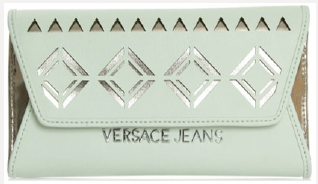
Versace: “Gianni Versace” [1946-1997] one of the most innovative fashion designers of the 20th century, being inspired by studying architectural drafting and the ancient Greek and Roman architecture in his early age; Versace entered the world of fashion with his clothes designed using architectural materials like metals, plastics, and leathers. He was awarded the best fashion designer of the year [1982-83] for his fall/winter collection called the “L’Occhio d’Oro”, or the “Golden Eye”, for designing women garments made of metals cut by laser technology. (Encyclopedia of World Biography [7] (Figure 1).

Figure 1: Showing the “ Selena White Laser Cut Cross- Body Bag” introduced by “Versace” in his Spring 2008 Collection, the bag is made of: White Faux Leather, Silver Hardware, a Popper Snap Closer, with a Detachable Chain Strap, the design was cut by laser and came under the “Versace Jeans” Branding in 2008, Source: Daniel Footware [38].

Lupinepublishers-openaccess-journals-Textile-Fashiondesigning

Cardin

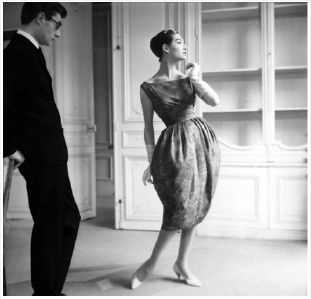
“Pietro Cardin”, also known as “Pierre Cardin”, is a famous Italian-French fashion designer who moved with his wealthy parents from Italy escaping “Fascism”4 to settle in France. In 1945, and after the end of World War II, he studied architecture in Paris. Yet with a great passion for fashion design; he worked with many famous fashion houses like “Paquin”5 “Elsa Schiaparelli”6 and also became the head of design department at “Christian Dior’s” atelier in 1947. “Cardin” founded his fashion house in 1950. United Nations Educational, Scientific and Cultural Organization [8]. Being influenced by his architectural background study; “Cardin” was known for his inclination towards applying geometrical shapes and motifs in his fashion design and often ignoring the female form. He was also known by his “Avant-Garde” style [7]and “Space Age” designs 8. In 1954, he introduced his famous “Bubble Dress” design inspired by the geometrical shapes of ellipsoids and spheres. Pierre Cardin [9] (Figure 2).

Figure 2: Showing “Cardin’s” 1954 Bubble Dress design that was inspired by the geometrical shapes of the ellipsoids and spheres Source: Pierre Cardin [9].

Lupinepublishers-openaccess-journals-Textile-Fashiondesigning

“Christian Dior” is one of the most famous and biggest fashion houses of the twentieth century, founded by the French fashion designer “Christian Dior”, who lived between [January 1905 and 24 October 1957]

“Fascism” is a political ideology that was developed after World War I in Italy and Germany, it was characterized by its extreme nature, almost classifying human beings as superior nations and others that should be dominated by military invasion, “Fascism” was a very oppressive political form of dictatorship that was against “Liberalism” and “Socialism”. The ideology was adopted by “Benito Amilcare Andrea Mussolini” who was the leader and Prime Minister of Italy from 1922 to 1943, “Fascism” was one of the major political ideologies that influenced the beginning of world war II in 1939, (Grimsley Shawn [10]

“Paquin” is a leading French fashion design house founded in Paris by “Jeanne Paquin”. She lived between [1869 and 1936], and she was considered one of the female pioneers in the fashion industry, (Brenda Polan, Roger Tredre [11].

“Schiaparelli” Designs, was a famous fashion house founded by the Italian fashion designer “Elsa Schiaparelli” [1890–1973], she was also considered as one of the most female pioneers in fashion design between world war I and II. Her clients included many prominent figures and celebrities like “Heiress Daisy Fellowes” and actress “Mae West” Bradley Laura, Watt Judith [12].

“Avant-Garde” is an intellectual, artistic, and cultural movement lead by many writers, critiques, artists, and social activists who challenged the main stream of thinking in both their societies and their professional fields. The “Avant-Garde” movement dates back to early 1850’s. And it had great influence on art, writing, architecture, and many other social related fields. Gongini Barbara [13].

“Space Age” is a term defining the time period where the space science technologies began to evolve and introduced to the main stream media, the space age is marked by the launch of “Sputnik” space ship in 1957” Garber Steve [14]

Examples of Fashion Designers Who Make Architectural Designs

What follows are some examples of famous fashion designers who make architectural designs

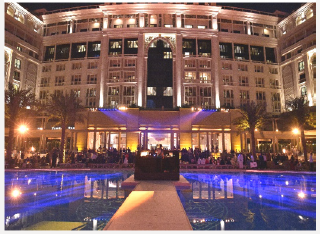
Versace: “Versace” inc. was commissioned by “ENSHAA PSC”; a major real estate developer in UAE to design a luxury 130,000 square meters [1,400,000 sqft] seven stars “Palazzo Versace Dubai” hotel in Dubai, the United Arab Emirates, the hotel consists of 215 hotel rooms and suites, and 169 residencies, together with main entrance, high ceilings, multipurpose halls, restaurants, spa, landscaped gardens with promenades, terraces, water features, reflection pools, and other amenities. The hotel was aimed to reflect the “Versace” lifestyle. Its public spaces and hallways were designed to showcase the artwork, sculpture, featured sketches, and artifacts of the atelier “Versace” gowns, while every interior detail in the hotel including furniture in the hotel rooms and other hotel spaces were exclusively designed by “Versace” to create an immersive experience of his lifestyle Marcellous Jones [15] (Figure 3).

Figure 3: Showing the “Palazzo Versace Dubai” hotel in Dubai, the United Arab Emirates, designed by “Versace”, Source: (Marcellous Jones [15].

Lupinepublishers-openaccess-journals-Textile-Fashiondesigning

Virgil Abloh: “Virgil Abloh” is an American creative fashion designer, and founder of the Milan-based fashion label “Off- White” [9] “Abloh” also studied architecture at the Illinois Institute of Technology. In addition to running a famous fashion line, he collaborated with “IKEA”, to create a capsule furniture collection, and planned to publish a series of books that showcase his clothes alongside iconic structures by “Le Corbusier” and “Mies Van Der Rohe”. (Figure 4). “Abloh” quoted in an interview with the “Architectural Digest”, Maria Bobila [16], Mathew Taylor [17]. “The Idea Is to Teach My Demographic — The Younger Generation Who’s Immersed in Fashion — About Architecture Through These Sites.” Moreover, the style director at the “Architectural Digest” “Jane Keltner De Valle”, an established longtime fashion editor in both the “Women’s Wear Daily”, and “Elle” magazines, after moving to work in the “Architectural digest”; She interviewed “Abloh” and cited him as: “The Brains Behind Off-White and another Designer Who Heavily References Architecture in His Work”. In her personal opinion about the interrelation between fashion and architecture she stated that: Tyler Mccallnov [18]. “I think we’re going through such a seismic Cultural shift right now”.

Read More About Lupine Publishers Journal of Textile and Fashion Designing Please Click on below Link: https://fashion-technology-lupine-publishers.blogspot.com/

Monday, 25 July 2022

Lupine Publishers| Use of Hemp Fiber in Textiles

 Lupine Publishers| Journal of Textile and Fashion Designing


Opinion

The number of companies manufacturing and selling textiles based on hemp fibers are gradually increasing worldwide. Hemp fabric or hemp textiles are made from cannabis sativa fiber or industrial hemp. Being a natural, renewable and biodegradable material, hemp enjoys obvious advantages over synthetic textile materials like acrylic, polyester, nylon and spandex used for making fabrics.

Hemp creates one of the most eco-friendly fabrics in the world. Hemp requires no pesticides or herbicides, controls erosion of the topsoil, and produces oxygen. It is a renewable resource that can be cultivated in as little as 100 days and is the world’s most versatile fiber. In comparison, cotton is more water-intensive and takes longer to reach harvest age and produces less fibers per acre. Hemps’ tensile strength is eight times that of cotton fiber which accounts for its historical use in sails and rope for the British and American Navies. It is an exceptionally durable fabric - longer lasting than cotton - and does not lose shape easily.

Fabrics made from hemp are hypo-allergenic and non-irritating to the skin. Hemp has the look and feel of classic linen. Hemp materials also soften with age and with each washing. Like linen and cotton, hemp is a cool choice for summer. It breathes well and is recommended for warm, humid climates as the fabric resists mildew and absorbs moisture. It is also UV resistant.

However, there are some associated disadvantages as well. For instance, hemp wrinkles easily and can be somewhat scratchy (depending upon the blend), so it is often blended with other fabrics like linen, cotton and silk to give it a softer feel. Hemp is also not colorfast. Given that mainstream brands like Adidas, Quiksilver, Patagonia and others have added products made of hemp to their repertoire has helped popularize hemp as a garment fiber. Today, there are many brands like Woolrich, Cannabeings Designs, Hemp Authority and others that specialize in hemp clothing and accessories that are available through mainstream commercial channels like Amazon and others.

Some examples of commercial products available are hemp blended yarn with cotton/organic cotton by Hemp Active, an Austrian company. A few companies in Europe are selling hemp/ polyester 60/40 blends and hemp/wool/polyester 40/40/20 blends. Hemp Textiles, Canada, supplies blend of hemp/wool 50/50. A blend of the natural strength of hemp, the soft elasticity of cotton or the smooth texture of silk creates a whole new spectrum of textiles for fashion design.

Read More About Lupine Publishers Journal of Textile and Fashion Designing Please Click on Below Link: https://fashion-technology-lupine-publishers.blogspot.com/


Tuesday, 25 January 2022

Lupine Publishers| Creative Process in the Design and Creation of Textile Manufacture

 Lupine Publishers| Journal of Textile and Fashion Designing


Introduction

Creative process

Man has his creative manifestations through his individual aspirations, thoughts and idealization. The need is a motivating factor that drives the search for knowledge, problem solving and satisfaction, Santis [1]. For Lobach [2] "The conduct of the human being is also driven by multiple and varied needs. The emergence of needs is not always logical, especially when other activities or processes have occasional preference. "Necessity seeks satisfaction; aspiration is the spontaneous will to obtain something that comes from idea or visualization. The aspiration consists in the desire to obtain something that can be reached or not. Needs and aspirations accompany the evolution of technology, information tools and economic development. Lobach [2] states that design consists of a systematized design, plan or method that includes problem solving incorporating ideas, innovation, sketching, samples, models to make concrete the solution found.

Over the centuries, the needs in its evolution have been accompanied by the development of instruments, methods and systems. The constant evolution through research and events show that innovative creativity has played a key role. The development of the human creative process has also been marked by various frustrations, problems in creativity and with innovation; these problems are constantly reported by various scholars. Several researchers and researchers [2] have already been affected by creative inertia, difficulty in exposing ideas, fears, and lack of innovation or even problems that seemed unsolvable. Even so, the creative process has become an important tool for resource development. And the stimulation and organization of the creative process is being studied in theories, techniques and tools such as: Design Thinking, Design Methodology, and Inventive Problem Solving Theory. These are applied for the development of textile products.

Product Development

Ostrower [3] states that the ability to understand, assimilate, configure, and signify is the creative act. Creating is a way of establishing a new relationship between the human mind and the object in order to understand meaning or to redefine (giving a new meaning, a new practice, the ability to perceive an object through a different vision). Already the creative process derives from the structuring of cognition (knowledge of facts), intelligence (human characteristic composed of logical thinking, communication, knowledge, sensibility, problem solving, emotional control, etc.), creation ability (giving meaning to something or something) and innovation (creating something unknown). To meet the new type of consumer coming from social and communication changes, manufacturers seek to align existing needs with functionality and aesthetics by creating values that can be applied to technological fabrics.

Barbará [4] calls the process a set of ordered and integrated actions for a specific productive purpose that at the end of the cycle generate products, services or information. In the process of manufacturing with synthetic fibers began the decade of 30, the developed fibers become part of the manufacture of fabrics and clothing. To give a small notion of what we call fiber, I find it interesting to contextualize the historical beginning, recalling some important facts. In this sense, the textile manufacturing manufacture uses the fibers to compose the yarn, and the woven yarn becomes fabric and various stamping and dyeing techniques. The textile production manufacture is divided into three cores: the yarn manufacturing, the fabric manufacture and the confection. According to Sanches [5] the fiber consists of the smallest element of the composition of the fabric in any natural or manufactured substance that has suitable characteristics that allow its processing. Being, the smallest component of hairy nature, which can be extracted or separated from a tissue.

In wire manufacturing, the breeding process establishes the mixing of the materials for processing. The processing consists of a rational part that modifies the form of a structure or system for the construction of a mixture, an irrational part that is compounded by bringing together psychological, emotional, innovative, creative and personal aspects. This means that the transformation depends on the creative aspects to innovate in the fiber blend. The creation procedure promotes finding strategies that encourage the production of new means of mixing the components, which can motivate, add capacity and add value to the basic and secondary functions of the product or service to generate probabilities of more interactive information in the market, Santis [6]. The set of productive operations or manufacturing should have as main focus of improvement; increase in productivity and also in quality.

On an industrial scale (manufacturing sizing) in the contemporary, the good use of the methodology of the project presents some techniques that promote to encourage the application processes of the project methodology consist of the interaction of tools, resources and manpower converted into energy that perform the connection between procedures and tasks, Santis [1]. The manufacturing of textile the object of study of this research produces knitted fabric, working in the circular knitting industry, among its articles produced we can mention: knitwear for fitness, linings, beach and microfiber. Knitted textile manufactures that also serve as object for this research have a tradition in the Brazilian economy and, considered as one of the great s manufactured in Latin America, consisting of several business units in the country, its most common products made of fabric composed of combinations of polyamide, cotton and elastane (synthetic filament) in circular and straight looms.

Thus, actions constitute a form of processes that are interconnected in a physical or virtual structure, which establishes a set of ordered processes in operations to modify the resources in products. For Agostinho [7]. The fixation of the scripts and manufacturing processes fix the knowledge manufacturing, or how to do it, being considered the pillar of fixation of manufacturing knowledge. Following the scripts and manufacturing processes, it is determined the times required for each operation of the script, consequently of the parts and set of parts that make up the product [8-52].

Finally, the manufacturing and creative processes interrelate in a chain of interdependent functions, considering (external environment) and dependent variables (internal environment). This functional interrelationship facilitates the systematization of the production of goods and services. Each function has a sequential operation flow for the development of an operation from the inflow of resources to the exit of the goods or services. The set of actions in the creative process developed by a sequence of operations establishes the construction of a product, whether it is a consumer good or a service and this facilitates innovation in creative development.

Read More About Lupine Publishers Journal of Textile and Fashion Designing Please Click on Below Link: https://fashion-technology-lupine-publishers.blogspot.com/

Monday, 20 December 2021

Lupine Publishers| Future Prospect for Sustainable Luxury Textiles from Pineapple Leaf Fibre - An Agro Waste

 Lupine Publishers| Journal of Textile and Fashion Designing


Abstract

The treasure of Major natural fibres belongs to cotton, jute, wool, silk, flax, sisal and Manila hemp which are extensively used across the globe. Besides, a large number of fibres grown in lesser quantities throughout the world have local economic importance and are consumed locally. Utilization of underexploited, unexplored natural fibres from crop waste are not only critical issues in the international scenario but are also the need of the hour in developing countries like India to search out a suitable avenue for which separate spinning system is not widely available or established. Pine apple leaf fibre successfully tested as a base material for conveyor belts in the early eighties, could well have been the magic yarn of the day. Pineapple leaf fibre extracted from the green pineapple leaf, an agro waste reveals its immense potentiality in the field of textiles particularly due to the disposal problem after harvesting for cleaner and green environment.

PALF is well known for its silky lustre which possesses some advantageous physical and chemical properties like high tensile strength, dimensional stability, considerable resistance to heat and fire, and good dyeability while the demerits are coarseness, inextensibility. Besides, it is a low cost renewable resource and eco-friendly material. If the apparent demerits can be masked, a diverse range of products can be developed by exploiting the intrinsic properties of PALF. One of the ways of masking is blending of PALF with natural and synthetic fibres. It is felt that such binary blending will help development of textiles with better functional properties by combining positive features of the constituent fibres. Therefore, binary blending will give a wider application for production of value added diversified products which are the need of the hour.

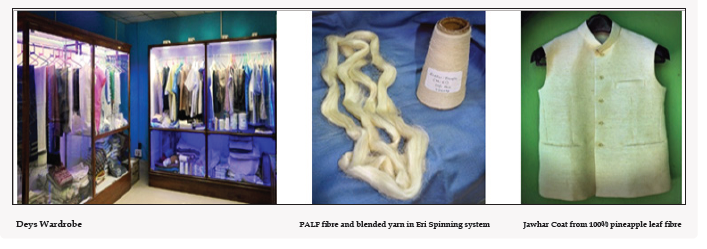
The paper also delineates suitable processing technique for blending of PALF with different natural and synthetic fibres for conversion into textiles using existing fibre processing system since there is no specialized spinning system available for pineapple and their possible commercial utilization. The PALF blended yarn has a bright future prospect for sustainable luxury textiles like fancy apparel products (Figure 1).

Lupinepublishers-openaccess-journals-Textile-Fashiondesigning

Introduction

Wealth from waste is no more a slogan in 21st century but achieved successfully turning pineapple leaves into wealth which not only creates green environmental sense but also turns waste into wealth. Resource depletion and global warming have driven each industry to move toward a greener and sustainable industry. Lignocelluloses, the most abundant renewable biomass is composed of cellulose, hemicelluloses and lignin, as well as other minor components. Pine apple leaf fibre successfully tested as a base material for textiles in the early eighties, could well have been the magic yarn of the day. Research work on pineapple leaf fibre, an agro waste reveals its immense potentiality in the field textiles particularly technical textiles. Sufficient fibre will be available to arouse interest if the fibre is extracted commercially. Due to non-availability of specialized spinning system for PALF in India, it will be much easier to promote PALF in any of the existing spinning systems provided an appropriate processing technology is developed.

Major natural fibres belongs to cotton, jute, wool, silk, flax, sisal and Manila hemp which are extensively used across the globe possess suitable processing technology and developed machinery. Besides, a large number of fibres grown in lesser quantities throughout the world have local economic importance and are consumed locally The pineapple plant AnanasComosus (L) is a member of the family Bromaliaceae of the monocotyledonous, containing 1,300 species; most of which are native to tropical America. Although over nearly 90 varieties of the plants cultivated in various parts of the world, only 3 varieties, namely, Kew, Queen and Mauritius are cultivated commercially. The form of pineapple leaves varies and depends on the position of the stem and age.

According to the data available, Pineapple fibre can be profitably produced in Tripura as well as Siliguri in West Bengal, where extensive pineapple farming takes place. In India, Pineapple leaves are never cut off, and are cleared when the plants naturally shed them. As a result, fewer pineapple plants are grown in India, as the leaves cover a lot of space. In countries like Brazil where extensive pineapple farming is done the leaves are cut away to make space for more plants. "We have gone through the science of it- Interestingly, cutting away of the leaves does not harm the plant and in fact helps it grow bigger fruit, as the leaves normally draw away a lot of the nourishment” says Dr. S. K. Dey, Senior Scientist of ICAR-CIRCOT, Mumbai. Indian farmers mostly throw away the leaves. Research on plantation has established that the leaves can be cut three times a year, without harming the harvest and suitably designed industry for pineapple leaf fibre, can run the year-round on these supplies.

The philosophy of blending between two fibres depends on two basic principles which apparently appear to be a bit contradictory.

    a) PALF may be blended with cheaper fibres so that a cheaper product mix becomes feasible. In this category, blending of ramie with jute, ramies, Mesta, banana, Roselle hemp appear to be worth pursuing.

    b) PALF is often blended with synthetic fibres to produce diversified blended fabrics which are expected to fetch higher prices per unit weight of ramie and consequently higher profitability.

PALF is well known for its silky lustre which possesses some advantageous physical and chemical properties like high tensile strength, dimensional stability, considerable resistance to heat and fire, and good dyeability while the demerits are coarseness, inextensibility. Besides, it is a low cost renewable resource and eco- friendly material.

Normally, the fibre is as fine as the finer quality jute, although about ten times as coarse as cotton. Unlike jute, its structure is without mesh, filaments are well separated and it is two and a half times more extensible with superior bundle strength and L/B ratio. Both the flexural and torsional rigidity of pineapple leaf fibres are comparable with jute fibres of less rigid quality. An interesting characteristic was observed in the case of pineapple leaf fibre and yarn when their tensile properties were studied in wet condition. The bundle strength of pineapple leaf fibre decreases by 50% when in a wet condition but the yarn strength increases by about 13%. A detailed research reveals that the frictional property of pineapple leaf fibre is very high in the wet condition and it predominates over the fall in tensile strength of the fibre so as to increase the wet strength of the yarn.

Different Stages of Blending Process

The development of blended yarn from PALF with natural and synthetic fibres can be achieved in the three stages of processing as given below.

    a) Blending at carding or drawing.

    b) Blending at spinning

    c) Union blending i.e. at fabric stage.

Blending at Carding or Drawing

    I. Jute Spinning System: The processing technology of pineapple leaf fibre in jute, cotton, semi-worsted and flax systems as well as to compare performance, research work was undertaken at Jute Technological Research laboratories which later on renamed as National Institute of Research on Jute and Allied Fibre Technology, Kolkata.

    II. Performance of jute/Pineapple Leaf Fibre on Jute Spinning System: When the golden fibre blends with pineapple, a magic yarn is born. The fibre is best used as decorative material. Firstly, the natural colour is creamy white-hence unlike jute it does not need bleaching. We have tried various combinations of the fibre at our pilot plant and blended it with jute and synthetic material. When blended with synthetic material, the product is an extra fine material. It can work wonders with jute. If pineapple fibre is blended with jute up to 20-25% fine yarn of linear density of 69 tex or less can be created. This is very difficult to achieve with Indian jute alone.

    III. PALF-Ramie Blended Yarn: PALF and ramie yarns spun in dry and wet spinning systems are comparable but wet spun yarns reveal better performance than dry spun yarns due to better inter fibre friction in the wet spinning system. By gradual increase in the percentage of PALF in the blend, a gradual decrease in tenacity of the blended yarn has been observed. And this may be due to the difference of fineness of the two fibres.

    IV. PALF-Viscose Blended Yarn: 100% viscose yarn spun in jute spinning system shows higher tenacity for wet spinning and lower extension compared to dry spinning. Gradual increase of PALF in the blend brings about gradual improvement in the tenacity of the blended yarns due to higher strength of PALF. The wet spun blended yarn from PALF-viscose show better performance than corresponding blended yarns spun on the dry spinning system.

    V. PALF-Polypropylene Blended Yarn: Binary blending of PALF -Polypropylene for its use in sophisticated area of textiles, Polypropylene fibre of 15 denier and 120 mm length was used. Both PALF and Polypropylene fibres were processed separately in Flax Finisher card with the developed technology of processing the above fibres and a linear density of 138 tex was spun with 5.5 T.P.I in both dry and wet spinning system. Binary blending of the carded material was achieved at Mackie's First Screw Gill Drawing frame with a blend proportion of 75:25, 50:50 and 25:75. No difficulty was encountered during spinning of blended yarn and control yarn.

    VI. PALF-Acrylic Blended Yarn: PALF: Acrylic: 50:50 blended yarns having linear density of 84 tex with a T.P.I of 7.5 were developed in jute spinning system in dry and wet spinning conditions. Four blended yarns were spun by blending PALF and acrylic at four different stages of Jute processing viz, carding and three drawing frames. The performance of the blended yarns was studied to evaluate the optimum stage of mechanical processing for binary blending of PALF and acrylic.

Wet Spinning Technology

Wet spinning brings about improvement in short-term weigh irregularity of the yarns resulting in better regularity of yarn diameter. This is chiefly due to better control of fibres in the drafting zone of the spinning frame during wet spinning. The diameter of wet spun PALF yarn of equivalent linear density is lower and its packing coefficient is also higher than that of the dry spun one. The tenacity of the wet spun yarn is higher than that of the dry spun one as the regularity of wet spun yarn is better and the higher packing coefficient is expected to generate transverse pressure during tensile loading. The strength C.V % of wet spun yarn was also lower compared to dry spun yarns. There was no significant difference in breaking elongation of dry and wet spun yarns.

Short staple Cotton Spinning System

Pineapple leaf fibre was first stapled to 32 mm, opened in a single opener machine, blended with Indian cotton in two proportions

A. 67% cotton: 33% Pineapple leaf fibre

B. 80% cotton: 20% pineapple leaf fibre and yarn of a coarse count 14s spun. The performance of the blended yarns showed that on increasing the proportion of pineapple leaf fibre in the blend, the count strength product and regularity deteriorated and a higher percentage of droppings of fibre was noticed in the blow room and carding machine. Spinnability of PALF improves after chemical treatment which was not achieved from cotton/raw PALF (67:33) blend composition. It is clear that the Spinnability increased from 14s to 22s with higher blend composition of PALF: Cotton:: 70:30. Yarn performance indicates that the C.S.P of the blended yarn is lower compared to cotton yarn. The cohesiveness of chemically treated PALF needed higher twist multiplier than normal cotton yarn of same count.

Semi-Worsted Spinning Systems

PALF were blended with Chokla variety of coarse Indian Wool at Central Sheep and Wool Research Institute, Avikanagar, Rajasthan, a sister concern of Indian Council of Agricultural Research. Yarns of nominal linear density of 138 tex were spun on the semi-worsted spinning system by varying the blend proportion of PALFs. Blending of PALFs by 25% could bring about a sharp drop in breaking elongation of yarns and blending by 50% results a sharp increase in tenacity of blended yarns. Besides, by blending PALF with wool at 25:75,the bulk resilience of yarn decreased only by 10% as compared to all wool yarn. The blended materials of PALF-Wool, all PALF and all wool were processed separately on the semi worsted spinning systems.

Eri Silk Spinning Systems

Latest finding reveal that pineapple leaf fibre was successfully processed and blended with red eri available in north eastern region only using Chinese silk processing facilities available at Fabric Plus, Guwahati. Red eri and softened pineapple leaf fibre were processed through the sequence as follows:

Floss Cutter - First Circular Dressing - Second Circular Dressing - Third Circular Dressing - First Spreader - Second Spreader - Slivering - First Drawing-Second drawing - Third Drawing- Roving - Ring spinning - Winding - Twisting - Conditioning - Singeing - Package.

Finer linear density of PALF: Red Eri blended yarn reveals its immense potentiality to be used in the field of Luxury textiles. Finest blended yarn could not be spun except this spinning system. The mechanical properties of the blended yarn were up to textile quality.

Conclusion

Investigation on pineapple leaf fibre clearly indicates that the agro waste can be suitably processed into useful products. Development of appropriate processing technologies for generating yarn with improved properties can widen the application ofthis agro waste.The extractor can effectively be used to extract the fibre from the agro waste of pineapple leaves and the residual sludge obtained after scratching the leaves can be used for vermicomposting successfully. Investigation on pineapple leaf fibre clearly indicates that the agro waste can be suitably processed into useful products. Development of appropriate processing technologies for generating yarn with improved properties can widen the application of this agro waste. The integrated technology for the extraction of pineapple leaf fibre and the vermicomposting altogether becomes remunerative to pineapple cultivators which can be adopted by all pineapple growers not only for additional income but also proper utilization of wastes particularly agricultural wastes which is an important factor in planning the economic progress of a developing country like India.

Read More About Lupine Publishers Journal of Textile and Fashion Designing Please Click on Below Link: https://fashion-technology-lupine-publishers.blogspot.com

Monday, 22 March 2021

Lupine Publishers| Future Trends in Production and Consumption in Textile and Fashion Design: The Fourth Industrial Revolution

 Lupine Publishers| Latest Trends in Textile and Fashion Designing


Opinion

Designers create products, services and systems to fulfill the society’s needs and desires. The adoption of Information Technology (IT) has changed the way designers develop new products. The collaborative work environment is a new paradigm of product design that integrates designers to quickly build, evaluate, optimize and select the best solution to complex problems [1]. In the last 20 years, internet has changed the way people communicate. The first era (1995), internet was an integrated hypermedia, in the second era (2000) internet had a programming media approach, that changed to people’s web service in the third era (2005), and the fourth era - which encompasses nowadays – represents a new level of organization and management of the entire value chain on the products’ life cycle. The Industrie 4.0 or Fourth Industrial Revolution is an integrative cyber-physical system based on modern control systems, embedded software systems and Internet addresses. This industrial revolution is based on improvement of brainwork, especially in engineering activities, and fast decision-making [2].

According to the German Academy of Science and Engineering (Deutsch Akademie der Technnikwissenschaft - Acatech), the Industrie (Industry, in German) 4.0 is the next industrial revolution. The main goal is to improve the value chains among the product´s lifecycle. In this context, the improvement of industrial competitiveness is achieved by organizing and controlling value, new business models and networks creation process [3]. The result of the Fourth Industrial Revolution will be the Smart Factory, where Cyber Physical Systems (CPS) and Internet of Things (IoT) are the key technologies for achieving the production goals. In a smart factory, humans, machines and resources communicate with each other as easily as in a social network [4,5].

The CPS interconnects the physical world with the information technology. CPS are technical systems containing both virtual (cyber) and real (physical) systems. By “cyberizing the physical” and “physicalizing the cyber”, it is possible to specify physical subsystems with software-controlled behavior [3,6]. The IoT is an approach to equip real systems with embedded systems so that they become interconnected in the so-called “smart systems”. The IoT intends to attach technology to devices and to integrate networks with the internet to enable the creation of a global network ubiquitous computing [3].

Kitchin [7] states that data are the key element for our contemporary society. Big Data include information from a multitude of sources, including social media, smart phones, data sharing, sensor-oriented machines and devices for the consumer (wearable computers). The origin of the textile production is closely related to the origin of humanity, and is considered a basic human need. In addition, it is a form of self-expression and sense of belonging that becomes even more important for individuals and social groups [8]. Once this field plays an important role in the Industrial Revolution, the Industrie 4.0 will modify the way clothing are made and consumed.

New management strategies can generate valuable data for product development, online marketing and campaigns. Manufacturing, supply chain and logistics will benefit from the adoption of digital sensors and smart tags that will offer visibility, flexibility and control of product flows. Two production models are examples from those new strategies: smart factory and minifactory. The smart factory integrates stakeholders in a virtual and collaborative environment, while mini-factories are based on ondemand production. The yarn and fabric production processes will be remote monitored using QR Code (Quick Response Code) and RFID (Radio Frequency IDentification).

The steps of cutting and sewing are the biggest problems of textile manufacturing. In this sense, initiatives such as the adoption of artificial intelligence and genetic algorithm, intelligent hybrid systems, robots and fully automated and intelligent lines represent new directions for the textile industry in the context of Industrie 4.0. Smart machines that are able to predict failure or quality problems, and organize their decision-making process and self-optimization are another scenario for the Industrie 4.0 [9].

Internet, Virtual and Augmented Reality will support the buying experience. In addition, 3D scanning will provide consumers the opportunity to scan, build a 3D model and begin ordering custom clothing. Technology tends to be incorporate in fibers, yarn, fabrics and clothing in the form of functional materials, which includes biomedical and electronic textiles. The textile production processes offer the possibility of creating a new generation of materials and products, which interact with different electronic devices. It is important to highlight that the textile industry must follow all these innovations that will not only affect production, but also models of education, business, consumer habits and social and cultural aspects in the coming years.

Read more about Lupine publishers Latest Trends in Textile and Fashion Designing please Click on below Link https://fashion-technology-lupine-publishers.blogspot.com/