Showing posts with label Pediatric Dentistry Journal with High Impact Factor. Show all posts

Thursday, 11 February 2021

Lupine Publishers | Anterior Open Bite Using Simões Network in Growing Patient: A Case Report

 Lupine Publishers | Journal of Pediatric Dentistry


Abstract

The anterior open bite is characterized by the negative vertical overhang occurring in the anterior region. It consists of a discrepancy in the vertical direction and is one of the malocclusions with greater aesthetic-functional impairment, besides dental and skeletal alterations. It has a high prevalence in the deciduous and mixed dentition and its etiology is multifactorial, highlighting the deleterious oral habits as the most prevalent. The objective of this study was to present the clinical case of a growing female patient presenting an anterior open bite associated with thumb sucking, by means of treatment with the functional orthopedic device Simões Network (SN3). During the first 12 months follow-up, we observed facial and intraoral oral changes and forward, the improvement of functional and craniofacial relationships, observed through complementary tests.

Keywords: Open Bite; dentition, mixed; orthopedics

Introduction

The balance of soft tissue growth and facial changes are important for the craniofacial development. Mineralized bone is formed through a process known as ossification by the membrane activity providing the function of remodeling and displacement. Breath, chewing, phonation and swallowing functions are prior to the regular growth development [1]. Thumb or pacifier sucking, and tongue thrusting may cause a disorder knowing as an anterior open bite. The severity of the malocclusion will be according to the magnitude, frequency and time of the habit [2]. Prolonged breastfeeding will be recommended to avoid nonnutritive sucking habits, as the sucking of fingers, pacifiers and bottle feeding [3,4]. Anterior open bite (AOB) is defined as the lack of incisal contact between anterior teeth in centric relation. AOB creates aesthetics problems, speech disorders and tongue thrusting habit [5]. This malocclusion requires early treatment due to all the etiological factors mentioned before. The stability will be achieved in a long term; thus, the pediatric dentist must be alert and minimize the problem as soon as possible in attempt to decrease the time of the treatment and to maintain the stability 5. The auto correction index is low when the correct habits are achieved [6,7]. The prevalence in the population ranges from 1,5% to 11%. Some authors also describe that 17% to 36% of those seeking orthodontic treatments feature AOB [8-11]. This malocclusion may also occurs due to a skeletal component classified open bite into dental and skeletal, associated with excessive molar height, divergent upper and lower occlusal planes, steep mandibular plane angle, increased gonial angle, short mandibular ramus, downward rotation of posterior part of the maxilla or palatal plane tipped up anteriorly, increased lower anterior facial height and decreased upper anterior facial height. According to severity, modalities of treatment are required: growth modulation; orthodontic mechanotherapy and the combination with orthognathic surgery [12-14]. Orthopedics devices is a therapy to readapt the muscular system which is very efficient in growing patients resuming the facial balance [15]. This article presents a clinical case of growing female patient, with anterior open bite treated with the functional orthopedic device Simões Network (SN3) [16].

Case Report

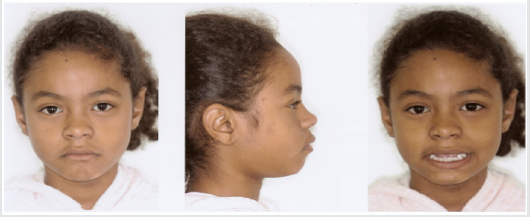
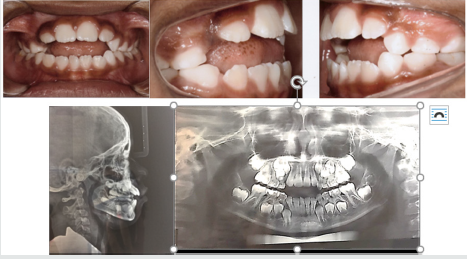
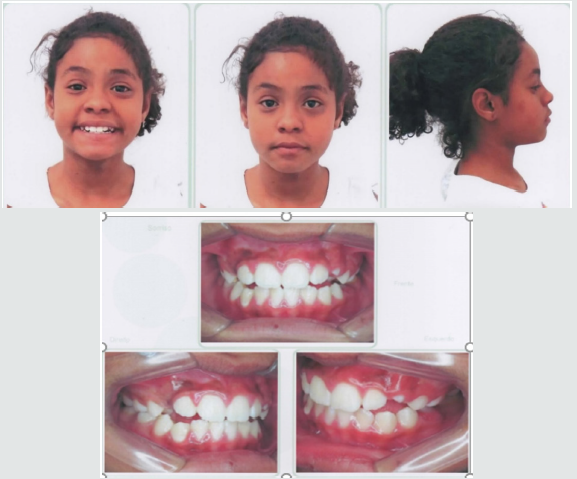
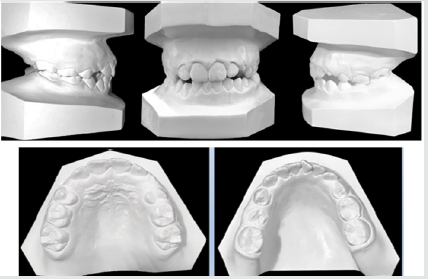
A female patient, 8 years and 4 months of age, melanoderma, came for treatment at the Postgraduate Course in Orthodontics of Brazil University (São Paulo, SP, Brazil). A facial analysis detected convex facial profile, lack of lip closure, and a decrease in nasolabial angle (Figure 1). The patient exhibited thumb sucking habit, mixed breathing, atypical swallowing and speech. shows angle class II malocclusion, 6 millimeters of an anterior open bite, mild crowding and a supernumerary Figures 2&3 tooth in the anterior lower jaw with mandibular midline deviation to the right. Cephalometric Rx shows proclined upper incisors due to the thumb sucking the objetives

Figure 1: Convex facial profile, a decrease in nasolabial angle and the upper lip covering the incisor.
Lupinepublishers-openaccess-pediatric-dentistry-journal

Figure 2: Anterior open bite, mild crowding and a supernumerary tooth in the anterior lower jaw and proclined upper incisors.
Lupinepublishers-openaccess-pediatric-dentistry-journal

Figure 3: Angle class II malocclusion, supernumerary tooth in the anterior lower jaw and an 6mm open bite.
Lupinepublishers-openaccess-pediatric-dentistry-journal

for the first phase of the treatment were to eliminate the thumb sucking, the open bite, dental deviations, provide arch expansion and the extraction of the supernumerary tooth.

Treatment Progress

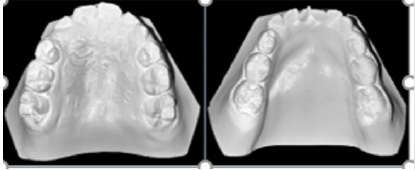
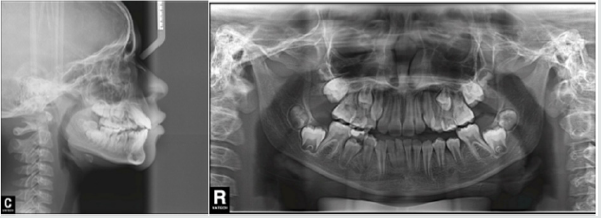
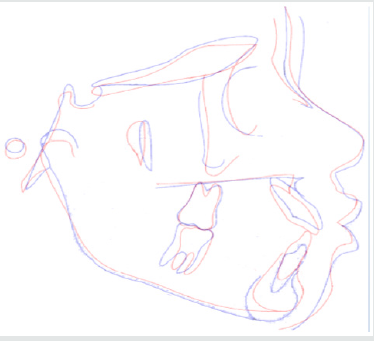
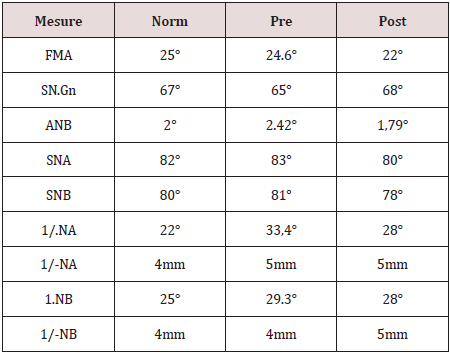
A removable appliance known by Simões Network (SN3) composed with a stainless steel bimaxillary grid (“lower winglets model”) that simulates the incisors occlusion and provides the correct tongue position [15] (Figure 4). The screw was expanded with one-quarter turn biweekly. After 3 months of the treatment beginning o, we added a lip bumper to improve lip seal (Figure 5). We recommended the use for 10 or 12 hours a day. The supernumerary extraction was performed 7 months of the treatment beginning. Figure 6 shows the final of the first stage. Figure 7 shows Angle class I malocclusion and Figure 8 shows the Cephalometric and panoramic Rx after 23 months with the orthopedic appliance. Cephalometric superimposition (Figure 9) and analysis (Table 1) indicated dentoalveolar open bite pretreatment and the correction posttreatment.

Figure 4: SN3 appliance, bimaxillary anchorage with “lower winglets model”.
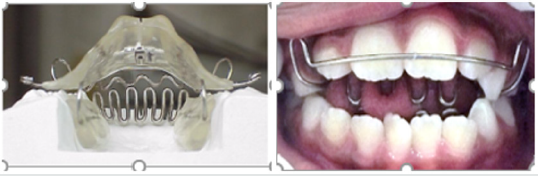
Lupinepublishers-openaccess-pediatric-dentistry-journal

Figure 5: A lip bumper was added to improve lip seal.
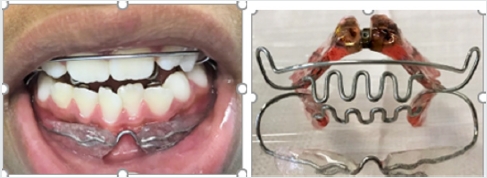
Lupinepublishers-openaccess-pediatric-dentistry-journal

Figure 6: The correction of open bite and the improvement of the alignment.
Lupinepublishers-openaccess-pediatric-dentistry-journal

Figure 7: The arch expansion and molar Class I.
Lupinepublishers-openaccess-pediatric-dentistry-journal

Figure 8: Cephalometric and panoramic Rx after 23 months of treatment.
Lupinepublishers-openaccess-pediatric-dentistry-journal

Figure 9: Cephalometric superimposition revealed maxillary incisor retrusion and mandibular incisor in normal bite.
Lupinepublishers-openaccess-pediatric-dentistry-journal

Table 1: Summary of cephalometric measures.
Lupinepublishers-openaccess-pediatric-dentistry-journal

Discussion and Conclusion

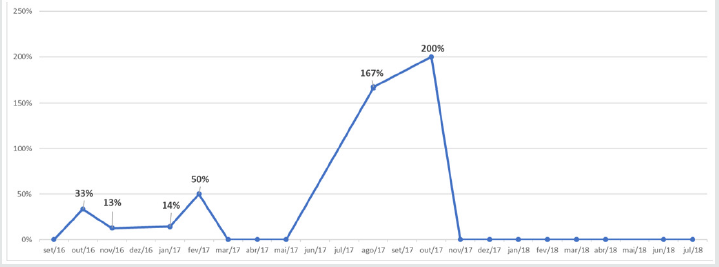
According to the authors, AOB is a challenge daily faced because and it can result speech and swallows’ problems, tongue posture and imbalance between jaw postures [17-19]. Bonna 2016 alerts that the orthodontics or orthopedic devices are fundamental but without family support the habit suppression will not be achieved [20]. The objective for the first phase of treatment were to eliminate thumb sucking, open bite and arch expansion with orthopedic appliance Simões Network SN3 and after a lip bumper was included to improve seal lip. These goals were achieved during the first stage. Graphic 1 shows best fit reduction open bite from May to November 2017. Even pubertal increments offer best time for orthopedic treatment helping determine the predictability, growth direction, patient management and total treatment time, we did not wait to treat because the disadvantages of the open bite [21]. This reported case was successfully treated with SN3 remained stable after the AOB correction. For the second phase with fixed orthodontic treatment will be necessary [22-29].

Graphic 1: Closure open bite variation during time.
Lupinepublishers-openaccess-pediatric-dentistry-journal


Friday, 8 January 2021

Lupine Publishers | Pediatric Dentistry Condition- A Mini Review

 Lupine Publishers | Journal of Pediatric Dentistry


Abstract

Tooth decay is the most common chronic childhood disease and the World Health Organization has identified it as a worldwide problem with 60-90% prevalence among school-age children. Dental caries is a topical contagious infectious disease that affects people of all ages and in any area of the world. Oral hygiene is a part of public health and oral and dental diseases affect different aspects of quality of life. DMFT is one of the indicators that the World Health Organization has introduced to determine the severity and prevalence of caries. One of the goals of the World Health Organization is to keep the DMFT index of students at less than 2. Different factors are effective in occurrence of dental and interdental caries that we discuss about them in this mini review.

Keywords: Decay Missing Filled Index, Dental Caries, Oral Hygiene, Tooth Decay

Abbreviations: WHO: World Health Organization; DMFT: decay-missing-filled index; BSS: Basic Screening Survey

Introduction

Tooth decay is the most common chronic childhood disease and the World Health Organization [WHO] has identified it as a worldwide problem with 60-90% prevalence among school-age children [1]. According to statistics in European countries, 6.1% of children aged 6-12 have at least one decayed or missed tooth, and due to the prevalence of tooth decay in all social classes, this disease can impose heavy costs on society [2]. Also, according to the statistics in Iran, decay-missing-filled index [DMFT] was 0.2% among 6 to 9-year-old children and 0.9% to 1.5% among 12-yearold children. Also, DMFT was 1.7% in 3 to 6-year old children and 3.3 to 4.8% in 9-year old children [3]. Four important factors: host, germs of the oral environment, food and time, has a role in tooth decay, without each of which, tooth decay will not occur [4]. Therefore, oral hygiene is very important in preventing it. Prevalence of dental caries in 6 to 12-year old children is one of the most important health problems. This can directly and indirectly impair the health of children and teenagers, and this problem is common among low-income groups and groups that do not comply with oral hygiene standards, such as not using toothbrushes and floss, dental caries is much more severe and acute [5].

Dental Caries

Dental caries is a topical contagious infectious disease that affects people of all ages and in any area of the world. Oral hygiene is a part of public health and oral and dental diseases affect different aspects of quality of life [6,7]. DMFT is one of the indicators that the World Health Organization has introduced to determine the severity and prevalence of caries. Nowadays, general dental health programs are usually only concerned with determining the prevalence of dental caries. Therefore, to measure the prevalence of dental caries and to determine oral health status in the society, especially in teenagers, appropriate indicators have been introduced by reputable authorities such as the Association of State and Territorial Dental Directors [2011]. This indicator is called Basic Screening Survey. The main purpose of using this indicator is to provide a framework for obtaining cheap and easy oral health information. On the basis of this indicator, people are classified into two parts, and it is ultimately determined whether or not they have caries [8,9].

Dental caries in Iranian students

One of the goals of the World Health Organization is to keep the DMFT index of students at less than 2. There are many studies on the calculation of DMFT in Iran, including Hamisi et al. which studied 323 students in Qazvin and showed that the prevalence of non-caries was 14.3% and their DMFT was 12.1%. [10]. Also, in a study on 12-year-old children in Tehran and Isfahan, DMFT was 11.2, which was the highest rate of caries [11]. In another study, the rate of DMFT in children in Isfahan was reported 3.41, and the conclusion of this study was that it showed a high proportion of DMFT in decay [12]. A study in Sirjan [a city in Kerman province] showed that the prevalence of non-caries state in 12-year-old students was 34.1%, which means that about 60% of 12-yearold students in this city due to various reasons, particularly not using toothbrush and floss, had dental and interdental decay [13]. Also, in the U.S Department of Health and Human Services in New Hampshire, a large evaluation of oral health status among public school students was done using the BSS index and it showed that approximately 2.3% of students had dental caries [14].

Are There Any Differences Between Girls or Boys in Caries Status?

The results of some studies show that there is no significant relationship between the prevalence of caries in male and female students. Among these studies, we can mention Nabipour et al., Who did not report a significant difference in caries status between male and female students [15]. However, in some studies, such as the study by Boroumand et al., Caries in 3-6-year-old boys was less than that of girls [16]. However, in some studies, such as the study by Boroumand et al., Caries in 3-6-year-old boys was less than that of girls [16]. Also, Loyola-Pontigo et al. and Rosado-Casanova et al. reported a higher incidence of caries in girls than boys [17,18].

Some Other Effective Factors of Children’s Caries Status

Another factor affecting dental and interdental caries is the level of parents’ education. In a study by Campus et.al, there was a significant relationship between parents’ education and lower incidence of caries in children [19]. Ismail and Sohn also stated in their study that children whose parents had a college education had significantly lower dental caries than children whose parents had lower educational level [20]. Also, the differences in socioeconomic status of families can lead to a different status of caries in children, as Primosch in a study in this regard observed a changing status of caries in families with different structures and concluded that this difference may be the result of the different socio-economic status of families, which may affect children’s dietary habits as well as hygiene [21].

Acknowledgement

The authors thank Farzanegan Hazrat Zeinab High School of Rey city and student research center of Basirat especially Dr. Salmani for their supports.

Read More Lupine Publishers Pediatric Dentistry Journal Articles:
https://lupine-publishers-pediatric-dentistry.blogspot.com/

Tuesday, 11 February 2020

Lupine Publishers | Varied clinical and Oral Presentation of Beckwith – Wiedemann Syndrome - Report of a Case from Saudi Arabia

Lupine Publishers | Journal of Pediatric Dentistry Impact Factor


Abstract

Beckwith – Wiedemann syndrome is congenital, genetic and epigenetic pathologies with low prevalence and diverse clinical presentations. It is characterized by triad of omphalocele, macroglossia and gigantism. This syndrome has been widely studied with a current emphasis on improvement of prenatal diagnostic techniques and a multidisciplinary approach towards treatment. We report a case of BWS from Saudi Arabia, with unique presentations and misleading history which delayed diagnosis, due to cultural and religion constraints.
Keywords:Congenital; Epigenetic; Genetic; Prenatal

Introduction

Genetic and epigenetic changes or a human genomic imprinting disorder is characterized by phenotypic variability which might shows its occurrence either as sporadic or inherited. The pathology presents wide range of effect on psychological and social wellbeing of patients and families. One such congenital, multigenic, multisystem human genomic imprinting disorder with complex molecular etiology and variable complex phenotype is Beckwith – Wiedemann Syndrome (BWS). Beckwith-Wiedemann Syndrome is most common overgrowth syndrome described by Beckwith in 1963 and Wiedemann in 1964 with similar findings. It is rare congenital deformity with low prevalence but at same time have high prevalence within genetic abnormalities of overgrowth [1]. The presentation of triad features of omphalocele (exomphalos), macroglossia and gigantism was described earlier as EMG syndrome which now is referred as Beckwith – Widemann Syndrome. The incidence of BWS reported is approximately 1:13700 births and the major cause is thought till date is genetic and epigenetic defects within the chromosome 11p15.5 regions [2].
BWS presents wide array of clinical manifestations such as congenital abdominal wall defects as hernia (exomphalos), gigantism, macroglossia, nevus flammeus, ear pits/hearing loss, midface hypoplasia, cardiac anomalies, hemihypertrophy, genitourinary anomalies and musculoskeletal abnormalities. To standardize the diagnostic criteria various attempts have been made to classify the major and minor criteria. Elliot et al described the diagnosis of BWS with the presence of either three major features (abdominal wall defect, macroglossia, gigantism) or two major and three minor features (ear pits, nevus flammeus, hemi hyperplasia, nephromegaly, neonatal hypoglycemia) [3]. In spite of diverse clinical presentations of BWS, most of the cases do not show characteristic features at birth but develop later in life. Also, children with BWS have significantly increased risk of cancer during early childhood which need strict follow up and monitoring. Here, we present a case of BWS with unique dental and medical presentation and its differential diagnosis with literature review.

Case Report

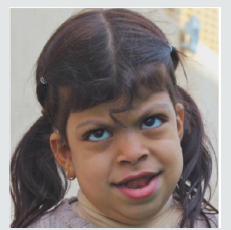
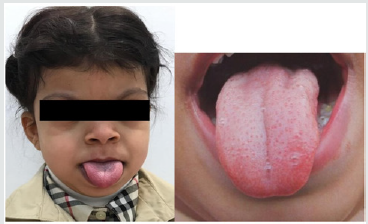
A 5-year-old female patient, accompanied by her mother, presented to the dental unit with complaint of decay tooth in upper front region of mouth. Extra oral examination revealed dysmorphic features, coarse facies and developmental problems (Figure 1). Intra oral examination of hard tissue showed high arched palate, decayed teeth in relation to 51, 52, 55, 61, 62, 74, 75, 84,85. Oral soft tissue examination revealed macroglossia, enlargement of fungiform papillae and mild loss of filiform papillae (Figure 2). Speech and feeding difficulty were noticed due to macroglossia. History revealed she is the youngest 7th child born out of consanguineous marriage in 30th week by cesarian section. She has a chronic history of constipation for 9 months of age. She passes hard stool once in every 8 to 10 days, by spending long time in washroom. It is associated with decrease in appetite and abdominal pain. She was given Movicol (half the adult dose) twice a day for constipation without any medical prescription. She was also tried with lactulose, glycerin suppository and mineral oil. Under medical supervision fleet enema and contrast enema were performed to relieve constipation and to rule out Hirschsprung disease.
Figure 1: Photograph showing dysmorphic features and hypertelorism.
Lupinepublishers-openaccess-pediatric-dentistry-journal
Figure 2: Macroglossia with enlarged fungiform papillae and loss of filiform papillae.
Lupinepublishers-openaccess-pediatric-dentistry-journal
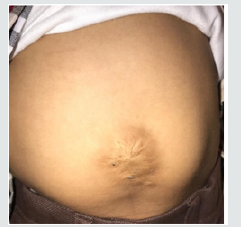
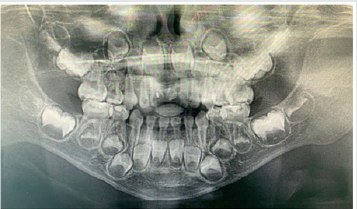
Other medical findings noticed omphalocele, ear pits, large child at 90th centiles, large rounded eyes with hypertelorism, abdominal soft lax, enlargement of kidney, distention of left renal pelvis with significantly distended urinary bladder, abnormal anatomy of the colon located in left abdomen and partial colonic non – rotation with no evidence of obstruction (Figure 3). Based on the clinical and past medical history a diagnosis of Beckwith – Wiedemann Syndrome (BWS) was made. Series of laboratory investigation were reviewed which presented negative urine examination, alpha – fetoprotein, karyotype, microarray and methylation analysis for BMS. Patient was advised for gene analysis and targeting testing for parents. The gene analysis of CDKN1C gene showed heterozygous alteration consistent with BWS but targeting gene tests were refused by parents. Panoramic radiograph was advised considering the patient chief complaint, which revealed multiple developing permanent tooth buds, protrusion of anterior teeth, open bite and increase in mandibular dimension (Figure 4). Under preventive measures the patient was treated for the decayed teeth and is under follow up from past 6 months.
Figure 3: Photograph showing abdominal wall defect with surgical scar.
Lupinepublishers-openaccess-pediatric-dentistry-journal
Figure 4: Panaromic radiograph showing multiple developing permanent tooth buds, open bite and increased mandibular dimension.
Lupinepublishers-openaccess-pediatric-dentistry-journal

Discussion

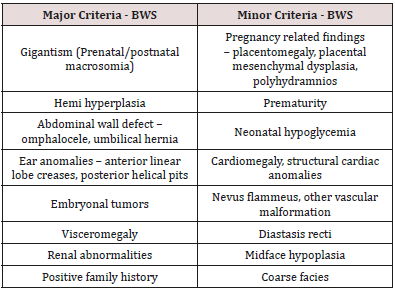
Diagnostic criteria for BWS is still a matter of research due to its varied clinical presentations and overlapping features with other various conditions. The presence of major and minor findings is generally helpful in establishing the clinical diagnosis (Table 1). The oral findings as mentioned in the literature and observed in our case has been tabulated in Table 2 [4,5]. The incidence of BWS is difficult to assess in Saudi Arabia, as most of the cases goes undiagnosed and unnoticed. Also attributed to its diverse clinical presentation and difficulty in diagnosing. In the present case, features of macroglossia, macrosomia, omphalocele, abdominal wall defect (treated immediately after birth and surgical scar observed clinically), Renal involvement, ear crease, high arched palate, open bite and increased mandibular dimension, leads to the diagnosis of BWS. Various molecular mechanisms and alterations have been involved in BWS such as abnormal methylation of H19DMR, loss of imprinting of IGF2, chromosomal rearrangements, loss of imprinting of LIT1, uniparental disomy of 11p15 and CDKN1C mutations [2]. The full gene analysis of CDKN1C gene profile were suggestive of BWS in our case and the alteration is thought to be located in the allele inherited from the mother. Parental testing was advised which was refused by the parents. There are various endocrine and overgrowth syndromes that was considered in the differential diagnosis. These included Simpson-Golabi-Behmel syndrome (mutation in X-linked gene, GPC3), Perlman syndrome (Increased risk of neonatal mortality), Costello syndrome (missense mutation in HRAS), Sotos syndrome (Mutation in NSD1) and Mucopolysaccharidosis type IV (lysosomal storage disorder) [6]. Oral findings like macroglossia of BWS needs differentiation from other lesions like lymphangioma, idiopathic muscular hypertrophy, hemangioma, rabdomyomas, amyloidosis, cretinism and acromegaly.
Table 1: Presenting major and minor features of BWS.
lupinepublishers-openaccess-pediatric-dentistry-journal
Table 2: Oral findings of BWS.
lupinepublishers-openaccess-pediatric-dentistry-journal
The overall risk of BWS for tumor development/malignancies is estimated to range from 4 – 21%. The tumors reported with BWS are mainly embryonal tumors such as Wilms tumor, hepatoblastoma, rabdomyosarcoma, adrenocortical carcinoma and neuroblastoma [7]. The prenatal diagnosis with current technology is increasing representing an important tool to determine some features of BWS before birth. In our case, parents were highly orthodox and refuse to share the detailed prenatal and ultrasonic reports. Few misguided information’s were given by mother which was later clarified with the reports from the subsequent medical hospitals. Patient’s parents were advised for periodic follow up with genetic counselling and the possibility of surgical interventions in the medical units, but they refused to follow and changed the hospitals every time. Hence, an effort was put forward to retrieve the information’s related to the patient while giving her the primary treatment for which she reported to our dental unit. This suggest the need of awareness required in the country like Saudi Arabia, where most of the cases goes unreported/unnoticed or parent’ consent not given or the cultural and religion barriers that prevent reporting such cases. Though the patient was treated with dental fillings, the follow up of the patients is been restricted by the family members.

Conclusion

Beckwith – Wiedemann Syndrome patients usually grow and do well despite being at increased risk of childhood cancer. Hence, strict follow up, awareness of parents and cancer screening is mandatory. Families, physicians and dentists should determine screening schedule including abdominal ultrasound in every three months, blood test to measure alpha-fetoprotein in every six weeks, dental check-up in every six months and other symptomatic treatment schedule as and when required.

Read More Lupine Publishers Pediatric Dentistry Journal Articles : https://lupine-publishers-pediatric-dentistry.blogspot.com/
Read More Lupine Publishers Articles : https://lupinepublishers.blogspot.com/