Showing posts with label Robotics Engineering. Show all posts

Tuesday, 15 February 2022

Lupine Publishers | Thermodynamics of Irreversible Process, Computerized Animated Visualization for Multi Component Mass Transport Sorption Problems in Nanocomposites

 Lupine Publishers| Journal of Robotics & Mechanical Engineering


Mini Review

There is presented the author’s mini Review of the realized theoretical investigation of the Multi (n=6)-component Mass Transfer (MMT) kinetics of the process inside the modern combined sorption “Nano-Composite” (NC) materials. The visual NC examples considered in the author’s manuscripts may be represented by the selective bi-functional NC as the “Metal0-Ion Exchangers (IEx)” planar NC L-membrane matrix where the inner active zero charged “NP0-nano-sites” (i.e. Nano Particles, Me0-agglomerates) are imbedded into the final combined NC-IEx sorption matrix resulting after the preliminary synthesis of the final NC L-matrix considered. The computer simulation for the modelling of the MMT NC kinetics is based here on the foundations of the irreversible thermodynamics such as multi(n)-component mass balance n (6)-Eqns. in partial differentials characterized fundamentally by the newk(2) (6)-“thermodynamic variance” (k-parameter). The k(2)- “variance parameter” describes the well kown thermodynamic “degree of freedom” of the multi(n=6)-component MMT NC kinetic system considered. The another fundamental characteristics of the irreversible thermodynamics are also included, namely the key wave concept (W) of the propagating mode of the multi (n=6)-component {Xn(L,T)}-concentration waves-distributions (n=1,2,..6); Mass Action Laws (MALS); “sink-source” mass transformation selective mechanism during the MMT NC kinetic process; the fundamental Nernst-Plank flux equations, electro-neutrality relations and some others.

The theoretical computer simulation is based on the two various bi-functional k(1,2)-NC Models elaborated for MMT NC kinetics previously (prevk(1)=5), and in this manuscript (newk(2)=6). The computer simulation based on the expanded newk(2)(6)- NC Model here brings the final results: the propagating mode of the multi (n=6)-component {Xn(L,T)}-concentration wavesdistributions in the NC L-membrane. The multi-component (n=6) {Xn(L,T)-concentration waves describe the MMT NC kinetics on the basis of the fundamental wave (W)-concept mentioned.

The n(6)-components of the {Xn}-concentration composition (n=1,2(R0p)+; (3,4)p+ ; j-5; 6R0) are participants of the MMT NC kinetics inside the bi-functional NC planar L-matrix with the two coexisting (I1,2&II-MMT routes), and put together the MMT newk(2)(6)- NC Model elaborated. The expanded MMT NC system considered with the new bi-functional newk(2)(6)-NC Model comprises the four {3,4pXm1,2(R0p)}={2pX2m}-principal paired components-participants, namely the two diffusing (3,4)p+-sorbate ions-principals (D3,4>0) together with the corresponding fixed m1,2-principals (D1,2=0) participated in the sorption(Ia⇀)-desorption(Id↽)stages of the (I1,2)-selective MALS reactions. The details of the MMT bi-functional (I1,2-Selectivity & Diffusivity, II) newk(2)-NC Model are illustrated via the conceptual visual diagrams in the full author’s publications [SM&EI J. v.2,N4, 2018 pp.128-132; MAMS J. 2019, in preparation]. The availability of the five {m1,2; (3,4)p; 6R0}-principal components namely, the four paired {2p X2m}-principals including the last introduced and crucial (k=6R0)-principal 6th-component which is fundamentally important for the investigation of the interference of the peculiar {X1,2,6(L,T)}-travelling concentration waves calculated during the computer simulation elaborated. The key fundamental principal component (6R0) denotes the 6R0- “NP0-nanosites” with the various [6R0]-concentrations of the “NP0-nanosites” (see above). The cardinal, fixed 6R0-principal in the NC L-membrane is introduced purposely into the theoretical MMT NC kinetic system consideration in the full version of the author’s manuscript [MAMS J., in preparation]. In addition to the (I1,2)-MMT selective route in the NC matrix it is included into consideration the second, {D3- 5}-multi-Diffusion (II)-MMT co-route for the two diffusing (3,4)p+- sorbate principals with taking into account the diffusing (D5>0) 5th-co-ions (j-5). The j-5-co-ionic component maintains the electroneutrality in the bi-functional combined MMT NC system namely, (I1,2)-selective sorption (for sorbed m1,2)&(II)-{D3-5}-multi-Diffusion (for (3,4)p+,j-5-components, D3-5>0) described in the full version of the author’s manuscripts [MS&EI ; MAMS J.,in preparation]. The interference of the peculiar {X1,2,6(L,T)}-travelling concentration waves during the computer simulation brings the chromatographic Displacement Development (DD)-behavior of the two interfering X1(L,T)-displacer, and X2(L,T)-displaced concentration waves [MS&EI J. 2].For the MMT NC kinetics there is displayed visually (via the multi-colored “captured video”, illustrated in the full versions [MS&EI J. v.2(4) 2018; MAMS J., in preparation, 2019] that the reason for the atypical and peculiar {X1,2,6(L,T)}-concentration waves behavior consists in the combined property expressed by the bi-functionality of the NC matrix via the combination of the (selectivity, I1,2) & (II, Diffusivity)-MMT co-routes considered. The influence of the two principal (3,4)p+-sorbate participants-diffusants properties (with D3,4>0-mobility) is transferred to the peculiar Xm(1,2) (L,T)-concentration waves for the in-diffusible m(1,2)(Rp)+-principal components-complexes (where D1,2=0). The several illustrations and References for the given mini-Review including the structure of the NC bi-functional matrices; the various (peculiar1,2,6 and diffusing3,4) multi(n)-components {Xn(L,T)}-principal concentration waves, and finally “pictures-frames” of the travelling {Xn(L,T)}-concentration waves are presented in the author’s manuscripts mentioned above.

Conclusion

a) Computer simulation by the mass balance n(6)-Eqns. for a number of variants includes the contemporary and bifunctional Nano-Composite, k(2)(6)-NC Models elaborated.

b) Numerical results of the computerized modeling bring the interference of the multi-n(6)-component {Xn(L,T)}- travelling concentration waves in the NC planar L-membrane.

c) Phenomenological wave W-concept is extended to a sorption M(n=6)MT phenomena in the bi-functional L-NanoComposites (NC).

d) Visual computerized sci. animations created show clearly the interference of the Xn-concentration waves for the paired 3,4p & m1,2-principal components sorbed onto 6R0-nano-sites.

e) Computerized Visualized Simulation results show the interference of the principal peculiar {X1,2,6(L,T)}-waves in the NC via the phenomenological wave (W)-concept.

Read More About Lupine Publishers Journal of Robotics and  Mechanical Engineering Please Click on Below Link: https://robotics-engineering-lupine-journal.blogspot.com/

Monday, 7 June 2021

Lupine Publishers| Processing and Analysis of Large-Scale Seismic Signal in Hadoop Platform

 Lupine Publishers| Advances in Robotics & Mechanical Engineering (ARME)


Abstract

Through the usage of fifteen noteworthy ventures by the International Seismological Bureau, world has fabricated a seismic observing system, which makes all local and global seismic information that can be observed to published on a week after week for the client download. Given the immense measure of data on this information, Hadoop stage has possessed the capacity to oversee and capacity productively, and to break down more significant data. It has received appropriated storage to enhance the literacy rate and grow the capacity limit, also it has utilized MapReduce to coordinate the information in the HDFS (Hadoop Distributed File System) to guarantee that they are broke down and prepared rapidly. In the interim, it likewise has utilized excess information stockpiling to guarantee information security, in this way making it an instrument for taking care of extensive information.

Introduction

Seismic data are the data extracted from the digital readings of seismic waves. Seismic waves are similar to the recorded echoes what we make on the top of rigged cliff. The only difference is that these seismic waves propagate downwards. In our modern society, information increases in high speed and a large amount of data resides on cloud platform. Over 1/3rd of total digital data are produced yearly which needs to be processed and analyzed. Hugelive digital data like seismic data, where even a small amount of information impacts greatly to human life has to be analyzed and processed to obtain more valuable information [1]. Thus, Hadoop ecological system comes into picture, which is easy to develop & process applications of mass data, has high fault tolerance nature, being developed on java platform and an open source, and ensures deployment of system [2].

Hadoop Architecture

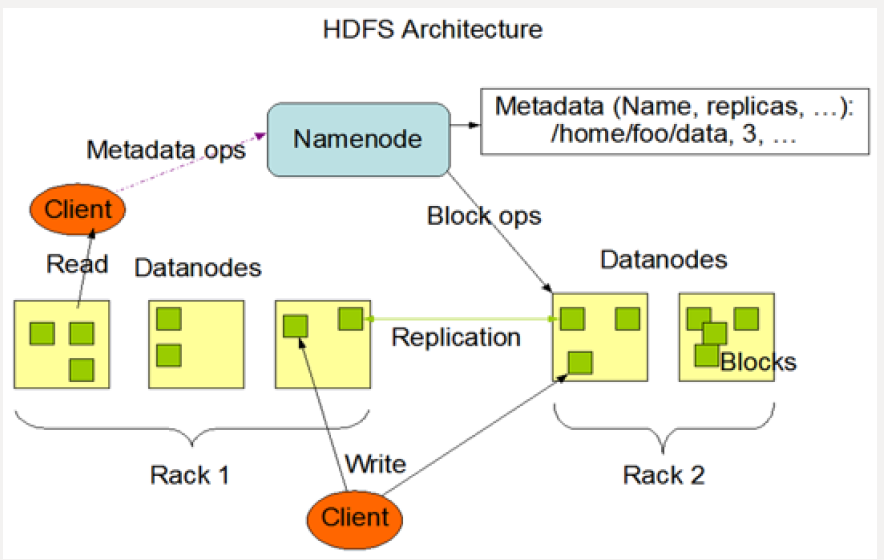
Hadoop supports a traditional hierarchical file organization. HDFS & MapReduce are 2 cores of Hadoop. The Base support of Hadoop is Distributed storage through HDFS and the Program support of Hadoop is Distributed Parallel processing through MapReduce. This HDFS architecture is developed with features like high fault tolerance, expansibility, accessibility, high throughput rate to meet the demand of stream mode and processing superlarge files, which can run on cheap commercial servers. It is Master/ Slave architecture [3].

Master:

a) It has one Name Node (NN).

b) It manages namespace of file system and client’s access operation on file

c) It is responsible for processing namespace operation of file systems (open, close, rename etc.) and also mapping of blocks to Data Node (DN).

Slave:

a) It has several data nodes i.e. one per node in a cluster.

b) It manages storage data.

c) It is responsible for processing file read-and-write requests, create, delete and copy the data block under unified control of NN.

d) The presence of single node NN in a cluster extraordinarily streamlines the structural design of the framework.

e) NN acts like repository for all HDFS metadata.

f) System is designed that never ever the user data flows through NN.

MapReduce Architecture:

a) It is a software structure for effectively composing applications which process immense measure of information like multi-terabytes informational collections in parallel on vast clusters in the sense thousands of nodes of commodity hardware in a dependable adaptation to non-critical failure way [4].

b) A MapReduce job, parts the information into autonomous pieces which are processed by map tasks in a total way.

c) Map task is the input data always is in a key-value pair is sorted by mapper function and resulting key-value pair is fed to reducer.

d) Both input and output undertakings are arranged in a document frameworks and system deals with scheduleling tasks, checking them and re-executing the fizzled tasks [5].

e) MapReduce is a circulated computing with single master node called job - tracker and one slave undertaking tracker per cluster node.

Data Preparing and Processing

MapReduce Architecture:

The data is downloaded from China Earthquake Scientific Share Data Centre. Digital data is stored in the form of excel spread sheets which we are going to download. Before the data is being stored in HDFS, the data should be kept in the CSV format. Over 300000 pieces of data are collected by the observation of various earthquake regions all over China since January 1st, 2015, only to record many small earthquakes every day. This paper counts and analyzes the earthquake statistics according to occurrence time and location with the use of MapReduce framework and pseudodistributed platform of Hadoop.

Data Processing

Data processing environment is based on pseudo-distributed platform of Hadoop and its Master/Slave architecture. There are 4 major steps [6];

a) Data pretreatment: download the required data and keep it in .csv format.

b) Store data: store the data set into default input path of Hadoop i.e. bin/hadoopfs –put earthquake_data.csv/usr/input

c) Run the program: locally run the MapReduce program to obtain analysis result.

Figure 1: HDFS Architecture.

Lupinepublishers-openaccess-robotics-mechanical-engineering-journal

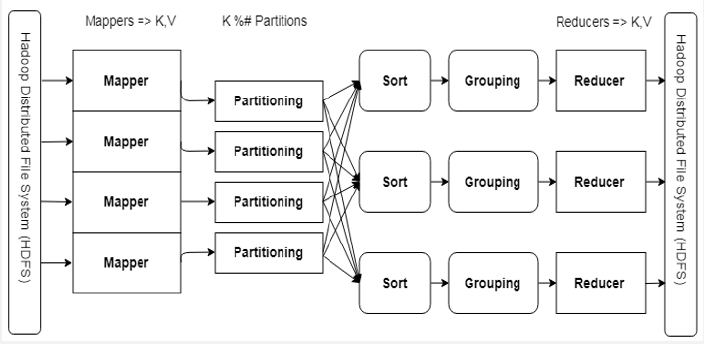
Figure 2: The MapReduce Pipeline.

Lupinepublishers-openaccess-robotics-mechanical-engineering-journal

A mapper receives (Key, Value) and outputs (Key, Value).

A reducer receives (Key, Iterable [Value]) and outputs (Key, Value).

Partioning/Sorting/Grouping provides the Iterable [Value] & Scaling.

Figure 3: Earthquake data set processing flow chart.

Lupinepublishers-openaccess-robotics-mechanical-engineering-journal

d) Check the results: check the operation results in output directory of HDFS (Figures 1-3).

Proposed System

After the collection of required data there are two major steps for implementation. They are;

Analysis of CSV file:

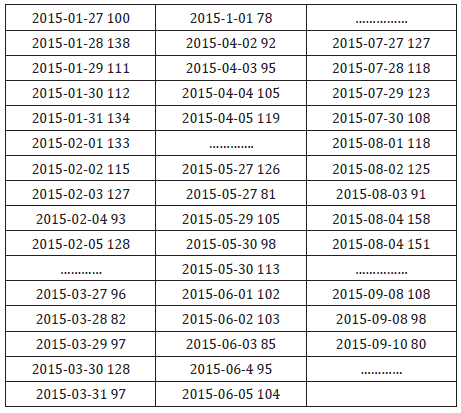
a) Excel file looks like a table format but when it is converted to CSV it has only 3 lines.

b) First 2 lines are headers and third line have actual data separated by commas.

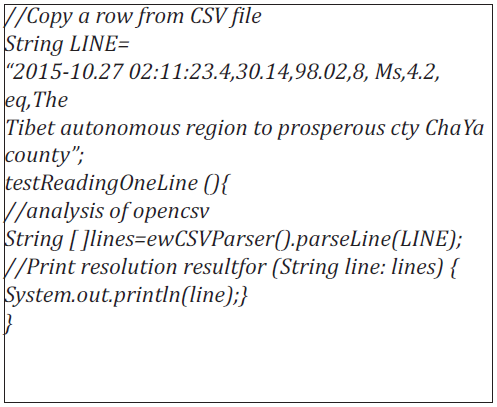
c) To analyze this file, this paper has used open source library called “opencsv”, this works like;

Lupinepublishers-openaccess-robotics-mechanical-engineering-journal

The result of the test analysis is shown below;

Lupinepublishers-openaccess-robotics-mechanical-engineering-journal

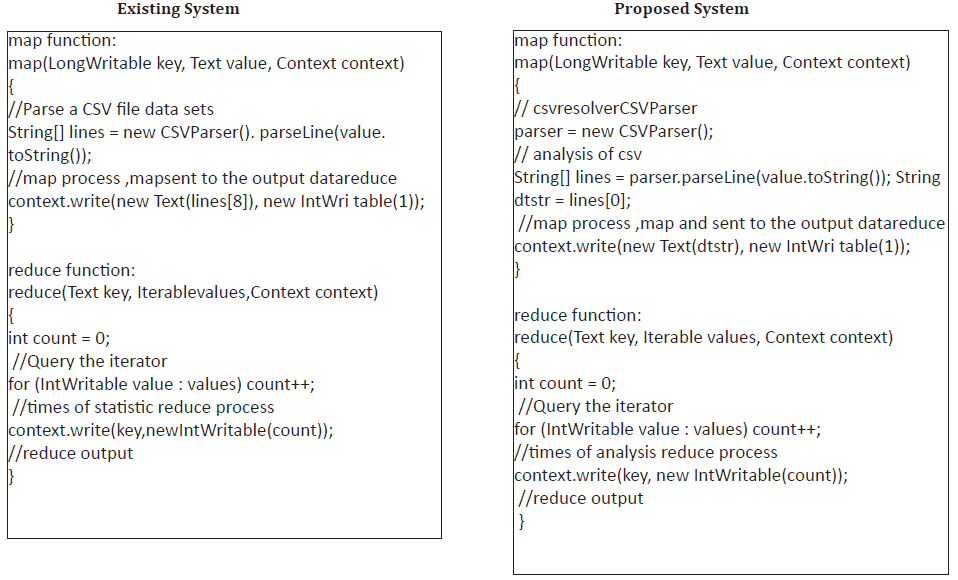
The Processing of Map and Reduce Functions [7]:

The Processing of map and reduce When processing data with MapReduce, firstly the data set file should be led into HDFS file system, and then the program will automatically divide the file into several pieces (default size 64MB) and read line by line [8-10]. Function map will analyze, preset the keyword in advance, and form into intermediate key-value pair. The program will automatically combine the key-value pairs of same key value, several corresponding values packaged in iterator, and the combination has been taken as the input key value of reduce processing. Reduce function accumulates to accumulate intermediate key/value pair which has been outputted at the form of, finally the total times of keyword in data set has been obtained [11].

Lupinepublishers-openaccess-robotics-mechanical-engineering-journal

Table 1: A copy of one row data in data set.

Lupinepublishers-openaccess-robotics-mechanical-engineering-journal

Experimental Analysis and Results

Environment of Experiment:

a) Hardware configuration – CPU= Intel® Core™ i7- 4510U @2.00GHz 8.00GB of memory.

b) The virtual machine environment configuration [12]: installing OS – Ubuntu12.04.

a) Hadoop version- Hadoop2.7.1

b) IDE – eclipse 4.3.0

Result: Based on region to region & on daily basis

Graphical Representation:

a) Graph on daily basis statistics graph from the data of (Table 2)

Table 2: Statistics experiment on total no. of earthquake from region to region.

Lupinepublishers-openaccess-robotics-mechanical-engineering-journal

b) Regional basis statistics graph from the data of (Table 3)

Table 3: Statistics experiment on total no. of earthquakes on daily basis.

Lupinepublishers-openaccess-robotics-mechanical-engineering-journal

c) Geographical representation of statistics.

Experimental Analysis and Results

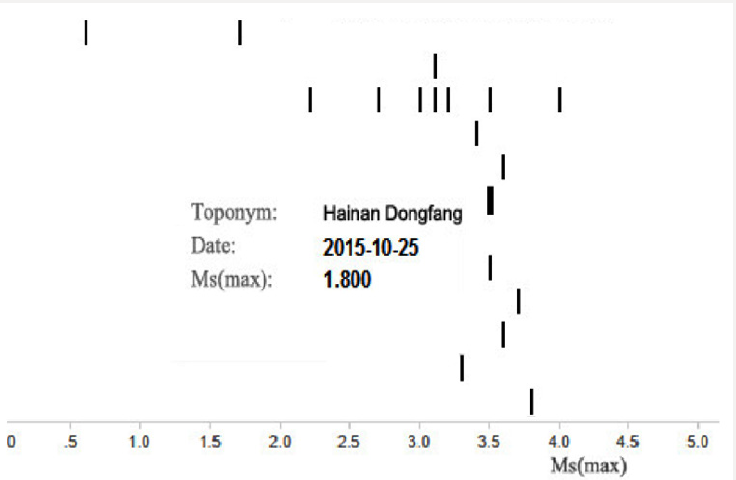
Hadoop is broadly notable system for information investigation for vast datasets that gives execution because of its capability of datasets examination in parallel and distributed environment [13]. Hadoop Distributed File System (HDFS) and the MapReduce are the modules of Hadoop. HDFS is responsible of information stockpiles while MapReduce is responsible of information handling. Tremendous informational index, such as web logs can be handled for investigation by Hadoop [14]. Here the paper utilizes the Hadoop Pseudo disseminated framework stage to break down and deal with the seismic data released by the National Earthquake Monitoring Station. The examination and testing are taken in the Hadoop. In other words, the procedure of Hadoop is taken by isolated Java. Local host node is as the NameNode and DataNode [15]. With the assistance of Hadoop MapReduce, it is conceivable to process the real time huge digital data and analyze effortlessly. It can get the number of the earthquake in all districts from the outcome since 2015, which helps us to think about where the earthquake inclined zones in that period are and furthermore the season of seismic tremor from 2015, which encourages us to know the season of earthquake in a year [16]. It additionally demonstrates the season of earthquake and the level of seismic tremor, in Figure 4.

Figure 4: Number of earthquakes everywhere.

Lupinepublishers-openaccess-robotics-mechanical-engineering-journal

Figure 5: The information of earthquake everywhere.

Lupinepublishers-openaccess-robotics-mechanical-engineering-journal

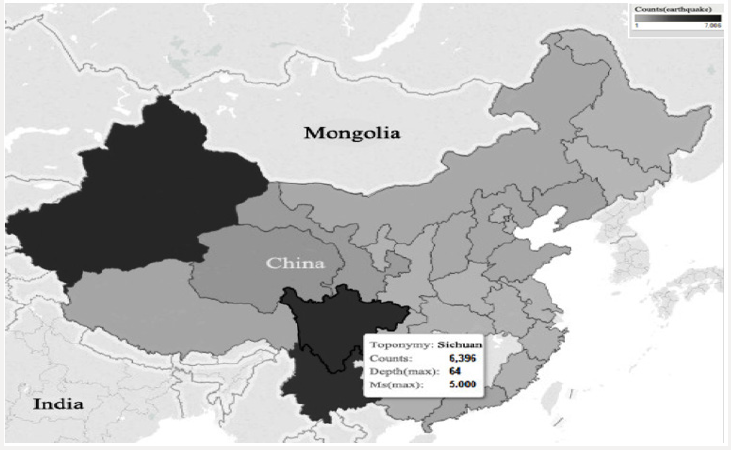
It can likewise specifically demonstrate the territories of nation from 2015 [17]. The more profound shading implies the more circumstances of seismic tremor there. Else, it can demonstrate the data the biggest level of earthquake and the most profound quake as in the Figure 5. Results are to such an extent that it can be seen easily to fundamental man by its direct section wise portrayal depiction of yield. One can undoubtedly send out Hadoop yield records to few apparatuses like R, Tableau and so on to produce reasonable graphs and report [18]. The investigation made by Hadoop stage is extremely encouraging with higher productivity and down to earth esteem and are anything but difficult to extend. Otherwise, the theory and practical application of Hadoop, yet in addition mirrors the high unwavering quality and productivity of the Hadoop stage to manage information [19]. In outline, the utilization of Hadoop stage to analyze and process huge informational indexes has higher effectiveness and reasonable esteem, and simple to grow [ 20].

Read More About Lupine Publishers Advances in Robotics & Mechanical Engineering (ARME) Please Click on Below Link: https://robotics-engineering-lupine-journal.blogspot.com/


Friday, 12 July 2019

Lupine Publishers - Advances in Robotics & Mechanical Engineering


Abstract


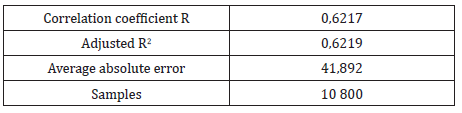
This investigation approaches the artificial neural networks applied to the ore drying process in carbonate-ammonia leaching. To carry out this research, the main variables that characterize the process were identified. Besides, it was collected the data that comprise a whole month of facility´s operation. Furthermore, it was developed a regression analysis backwards, step by step, which allowed to determine that the linear correlation coefficient did not reach values higher than 0,62. In addition, it was pinpointed a two layered feed - forward back propagation neural network to model the temperature. Thins one reached the correlation coefficient values of 0,97 during its training and 0,95 in validation, as well as 0,87 in its generalization.
Keywords: Artificial Neuronal Network; Regression; Feed-Forward Backpropagation; Mineral Drying

Introduction


In a global context, nowadays, modern control systems play a fundamental role when developing solutions to issues or problems presented in domestic and industrial applications. The main contributions of modern control systems at industrial level contribute to technological innovation, profitability and maintainability of the controlled processes. Within the advanced control strategies under investigation to automate complex processes are: adaptive control, predictive control based on models, robust control, and intelligent control, among others. Intelligent control relies on several techniques such as: fuzzy logic, evolutionary algorithms, and artificial neural networks. Artificial neural networks can be used effectively and accurately for modeling systems with complex dynamics, especially for nonlinear processes that vary over time. The growing interest in neural networks is due to its great versatility and the continuous advance in network training algorithms and hardware [1-4]. The nickel producing companies have continuous processes of great complexity that require automation to achieve a greater efficiency in their productions. In the process of ore preparation, it is important to maintain a temperature control at the outlet of the dryer evacuation chamber, in order to obtain the mineral drying with an established humidity level of 4 to 5,5 %. It must also be ensured that the temperature at the outlet of the electrofilters is above the dew point temperature; to prevent the deterioration of electrofilters, which leads to high economic losses, from accelerating considerably. The inefficiencies in the control of the outlet temperature of the dryer evacuation chamber in the ore preparation process are taken as a research problem and as an objective to obtain an artificial neural model for the outlet temperature on the basis of the main input variables, using Matlab as a calculation tool.

Materials and Methods


Description of the Mineral Drying Process

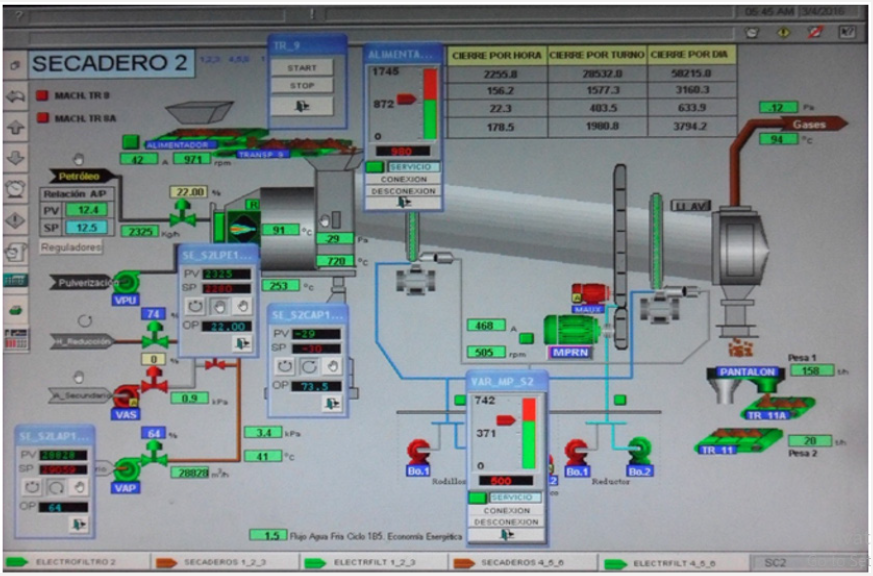
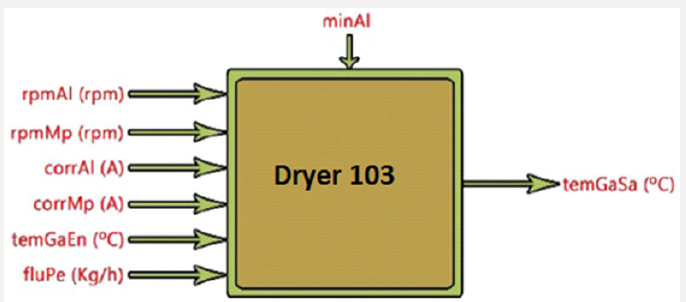
The drying of the ore is carried out in elongated cylinders formed by a combustion chamber where the hot gases that dry the ore are produced, and by the cylinder where the ore will receive the drying process. These drums (Figure 1) have in their interior lifting elements that are responsible for allowing the transfer of heat between the hot gas and the mineral, in addition the dryer drum has a motor system coupled to the body of this which allows it to rotate on its axis. The dryer drum externally rests on two wheels that has two pairs of roller. Internally the dryer is formed near the combustion chamber by guides or baffles welded to the body of the drum that are the ones that direct the mineral towards the outside of the cylindrical part of the drum [5]. The mineral dryer is a complex physical-mathematical modeling object with a large number of input and output parameters which are in a complex interdependence (Figure 2).
Figure 1: Schematic diagram of the dryer.
Lupinepublishers-openaccess-robotics-mechanical-engineering-journal
Figure 2: Structural diagram of the mineral drying process.
Lupinepublishers-openaccess-robotics-mechanical-engineering-journal
The Input Parameters in the Process are:
a) rpmAl - Feed motor speed [rpm].
b) rpmMp - Speed of the main motor [rpm].
c) corrAl - Feed motor power [A].
d) corrMp - Power of the main motor [A].
e) temGaEn -Temperature in incoming gases [ºC] (coming from the Reduction Furnaces Plant).
f) fluPe - Oil flow at the burner inlet [kg/h].
The Output Parameter is:
a) temGaSa - Oulet gas temperature [ºC].
In addition to the input and output parameters, it is important to highlight a specific disturbance of this process that influences it, which is: minAl - Mineral fed to the dryer. It is known that there are other parameters that are involved in the drying process of the ore and that in turn influence the temperature of the exhaust gases in the evacuation chamber (granulometry in the entrance mineral, humidity of the entrance mineral, exact amount of mineral fed to the dryer), but due to the process itself, they are not registered. Due to the automation existing in the process, the values of the process parameters are sensed by the instrument corresponding to each of them and the signal is sent to the computer located in the process control office. The data obtained along 1 month of operation, were recorded every 240s and processed with the Stat graphics Plus V 5.1 software.

Artificial Neural Networks

The determination of the type of artificial neural network, the number of layers and the number of neurons in each layer that best characterize the process of ore drying process was carried out through a trial and error process that plays with the number of neurons and the maximum permissible error. Through Matlab’s Toolbox (nnstart), the performance of artificial neural models was evaluated by using the mean square error and the correlation coefficient between the real values and those obtained by the network [6]. The objective was to provide the network with an adequate number of neurons in the hidden layer to learn about the characteristics of the possible relationships between the sample data. Through the trial and error process, it was identified the feedforward back propagation structure that provided better results. The proposed network consists of two layers: a hidden layer and an output layer. The output layer will only have one unit, which will indicate the value of the oulet gas temperature associated with each input vector presented to the network. The hidden layer will have a variable number of neurons.

Results and Discussion


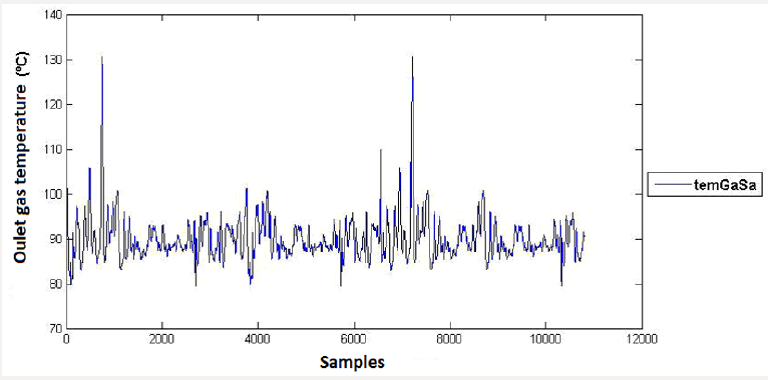
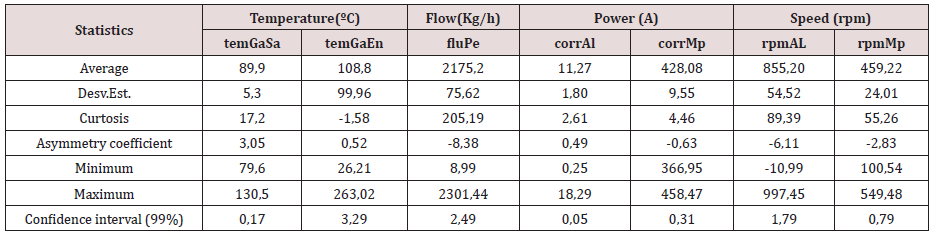
Figure 3 shows the behavior of the exhaust gas temperature in the evacuation chamber, between its minimum and maximum values of 79,59 and 130,51°C, respectively, for the month of work. Once the database was analyzed, the sample functions that evaluate the measures of central tendency and dispersion of the sample were determined through a descriptive statistical analysis (Table 1). The mathematical model that best represents the relationship between the variables analyzed. Table 2 shows the regression analysis for the output pulp density, where a 0,7correlation coefficient is observed.
Figure 3: Control chart for the dependent variable.
Lupinepublishers-openaccess-robotics-mechanical-engineering-journal
Table 1: Summary of the sample´s descriptive statistical analysis for one month.
Lupinepublishers-openaccess-robotics-mechanical-engineering-journal
Table 2: Regression analysis summary.
Lupinepublishers-openaccess-robotics-mechanical-engineering-journal
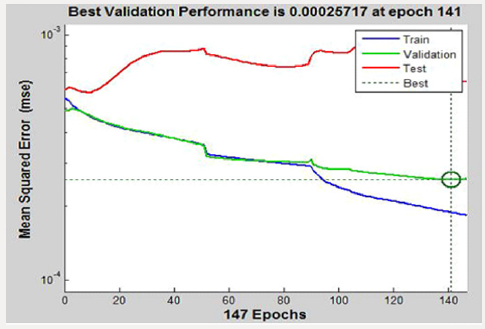
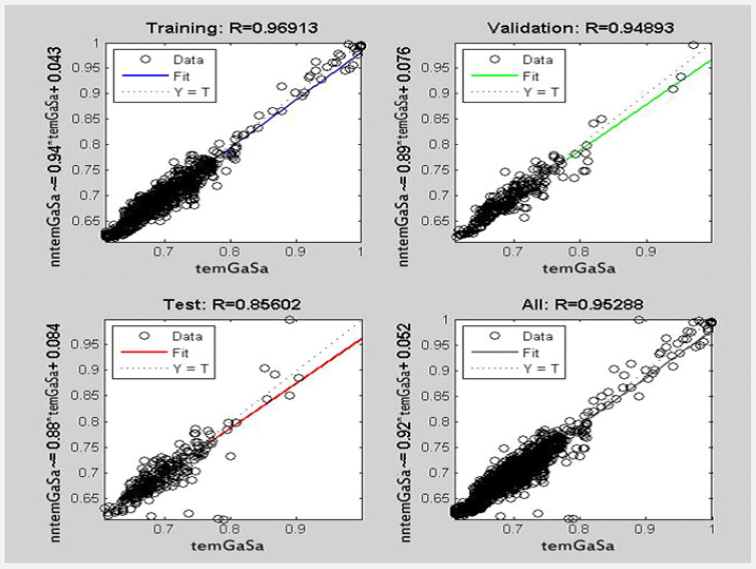
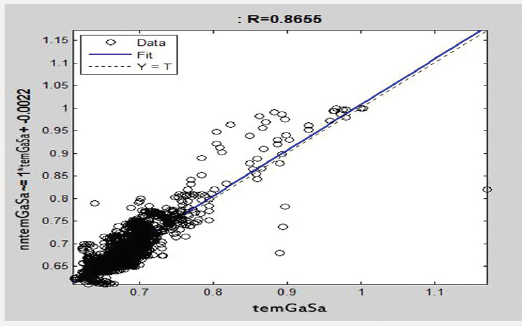
Figure 4 shows the training behavior of the network for the learning process, observing the training, validation and test curves, which converge to the iterations for an error of 0,00026. Figure 5 shows the behavior of the correlation coefficients for the training, validation, testing and adjustment of the artificial neuron network (it is assumed as an artificial neuronal model for the oulet gas temperature in the ore drying process “nntemGaSa” and the real temperature “temGaSa”). Figure 6 shows the generalization of the network with 1767 data not presented during training, where a 0,87correlation coefficient is observed.
Figure 4: Behavior of training and validation of the neural network.
Lupinepublishers-openaccess-robotics-mechanical-engineering-journal
Figure 5: Correlation coefficients of the neural network.
Lupinepublishers-openaccess-robotics-mechanical-engineering-journal
Figure 6: Network Generalization.
Lupinepublishers-openaccess-robotics-mechanical-engineering-journal

Conclusion


The capacity of the feed-forward back propagation network for the simulation of pulp sedimentation processes in the industry was demonstrated. The structure that best characterizes the behavior of the temperature in the exhaust gases of the evacuation chamber is characterized by two layers with 50 neurons in the hidden layer and one in the output layer, with the Levenberg Marquart learning method (trainlm), and the log-sigmoidal (logsig) and sigmoidal hyperbolic tangent (tansig).

For more Lupine Publishers Open Access Journals Please visit our website:

Thursday, 27 June 2019

Forces Acting on A Bearing of an Electric Motor for The Railway Carriage Rounding A Curve (ARME)-Lupine Publishers

 
Forces Acting on A Bearing of an Electric Motor for The Railway Carriage Rounding A Curve by Ryspek Usubamatov in ARME in Lupine Publishers


Recent  investigations  in  gyroscope  effects  have  demonstrated  that  their  origin  has  more  complex  nature  that  represented  in  known publications. On a gyroscope are acting simultaneously and interdependently eight inertial torques around two axes. These torques are generated by the centrifugal, common inertial and Coriolis forces as well as the change in the angular momentum of  the masses of the spinning rotor. The action of these forces manifests the inertial resistance and precession torques on any rotating objects.  New  mathematical  models  for  the  inertial  torques  acting  on  the  spinning  rotor  demonstrate  fundamentally  different  approaches for solving of gyroscope problems in engineering. This is the very important result because the stubborn tendency in engineering  is  expressed  by  the  increasing  of  a  velocity  of  rotating  objects.  The  numerous  designs  of  the  movable  machines  and  mechanisms contain spinning components like turbines, rotors, discs and others lead to the proportional increase of the magnitudes of inertial forces that are forming their processes of work. This work considers the inertial torques acting on the on a rotor of an electric railway carriage rounding a curve, which expresses the gyroscopic effects.

https://lupinepublishers.com/robotics-mechanical-engineering-journal/fulltext/forces-acting-on-a-bearing-of-an-electric-motor-for-the-railway-carriage-rounding-a-curve.ID.000104.php


For more Lupine Publishers Open Access Journals Please visit our website


Tuesday, 12 March 2019

Robotics Engineering - #ARME- #Lupine Publishers


The problem of using Blockchain technology in multi-level robotic systems is considered. The management of the robotic systems faces significant difficulties in transferring large amounts of information, securities, metadata, and intellectual contracts. The blockchain technology, based on a decentralized system of distributed registries, allows solving data transfer problems quickly and safely. New digital blockchain-based queuing systems can be effectively used in multi-level control tasks.
For more Lupine Publishers Open Access Journals Please visit our website
For more automation engineering articles Please Click