Abstract
Background: The National Cochlear implant program in Tanzania
was established in the year 2017. Prior to this, very few
children with Profound Sensorineural Hearing Loss benefited from this
surgery abroad through grants from the Ministry of Health.
Since the establishment of the local program, there is an increased
awareness amongst parents’, and many are seeking to benefit
from this initiative. The challenge, however, remains the measurements
of expectations of the parents and the actual outcomes after
the surgery. This is mainly due to the perspective of the parents which
comes about from their understanding of the whole process
of surgery and the rehabilitation after surgery that determines expected
outcomes.
Aim: This study aims to establish a direct link between the
parental perspective pre and post cochlear implant surgery.
Participants: A total of 18 children between ages of 3 years and 6
years, divided in two groups, G1=children who have been implanted
for 1-2 years (n=8) and G2=children who have been implanted for 0-1
years (n=10).
Method: A non-standardized closed ended questionnaire with questions on perspectives of three domains i.e. Communication,
Listening Skills and Speech and Language development was administered to the parents, pre-implantation and 1year post
implantation for G1 and 6 months post-implantation for G2.
Results: In all of the 18 cases, pre-implantation expectations
were higher than the actual perspectives post-implantation.
However, G1 parents had higher scores than G2 i.e. The preimplantation
expectations were somehow met after 1 year of implantation.
Conclusion: The study demonstrates the ability of Cochlear
Implantation to meet the parental expectations in the 3 outcome
domains i.e. communication, listening skills and the development of
speech and language. However, this is subject to the time frame
post implantation i.e. the longer the time, the better the pre-implant
perspectives are met.
Introduction
Cochlear implants, as prosthetic devices designed to replace the
function of the inner ear, have become a widely used intervention
method for people with severe to profound sensorineural
hearing losses who gain little or no benefit from conventional
hearing aids. Since their approval by the United States Food &
Drug Administration (FDA) in 1990 for children as young as the
age of two [1], pediatric cochlear implantation has become an
increasingly routine procedure in numerous countries worldwide
as a management option for permanent childhood hearing loss. The
foundation of cochlear implant programs for these patients began
in developed countries and over time the devices, surgical methods,
and rehabilitation programs improved, which thus led to their
initiation in developing countries. Prior to the commencement
of locally performed cochlear implant surgeries in Tanzania,
candidates for implantation had to travel to other countries for the
procedure. This was a costly and intensive process for privately and
government funded patients alike, a factor that fueled the need for
a local program. In 2017, six children were implanted for the first
time at Muhimbili National Hospital in Dar es Salaam, Tanzania, and
to date a total of thirty patients have been implanted altogether.
Over the time, since the first surgeries, local professionals and
rehabilitation centers have become more proficient in evaluating
and caring for these patients, and an increased awareness of hearing
impairments as a whole has been observed. Perceptions regarding
cochlear implants of health professionals, the general public, and in
particular parents of implantees and potential candidates have also
been seen to change, becoming more informed and understanding.
Candidacy for cochlear implants is assessed on a case-by-case
basis, with referrals for assessment primarily made according to
candidacy criteria set out by the Cochlear Implant Group Tanzania
[2].
Currently, the indications for cochlear implantation from
an audiological perspective are as follows; bilateral severe to
profound sensorineural hearing loss (typically >90dBHL at
2kHz and onwards), limited benefit from hearing aids, and the
absence of contraindications for implantation. The candidates
undergo thorough examinations by audiologists, speech-language
pathologists, radiologists, otorhinolaryngologists, pediatricians,
social services, psychologists, and other professionals where
necessary. This process is not unlike guidelines in other countries
with cochlear implant programs, and the National Institute for
Health and Care Excellence (NICE) in the United Kingdom make
similar recommendations, although in 2018 with suggestions from
the British Cochlear Implant Group (BCIG) updated the eligibility
criteria to define severe to profound deafness as only hearing sounds
greater or equal to 80dBHL at two or more frequencies between
500Hz and 4kHz [3]. These recommendations and procedures
differ slightly between countries and programs and may also
change depending on whether the candidate is privately or publicly
funded. Outcomes for pediatric cochlear implantation worldwide
have encouraged their use as an intervention method for hearing
impairments, reinforced by their widespread success and relatively
low rate of complication [4]. A prospective longitudinal study of
spoken language development in children implanted before the age
of five, conducted over a period of three years, revealed significant
improvements in spoken language performance (comprehension
and expression) particularly over the first three years of device use.
Greater improvements were seen in younger children and children
with more residual hearing prior to implantation, although in all
children outcomes surpassed the improvements predicted by their
pre-implant assessment baseline scores [5]. A retrospective study
evaluating the outcomes of cochlear implantation in relation to age
of implantation conducted by Govaerts et al. [6] studied children
with congenital deafness who were implanted before the age of
six with a multichannel cochlear implant, evaluating them using
Categories of Auditory Performance (CAP) scores and correlating
outcomes with age of implantation.
All children demonstrated an increase in scores postimplantation,
appearing to benefit from the device. The study
identified that implantation between the ages of two and four
always resulted in age-appropriate CAP scores after three years of
implant usage, while implantation before the age of two years always
resulted in immediate normalization of CAP scores. Implantation
after the age of four, however, hardly resulted in normal CAP scores,
signifying the importance of early intervention in preventing losses
of auditory performance following the procedure, and only 20%
to 30% of these children were eventually fully integrated into
mainstream primary schools [6]. While this study reinforces the
significance of age at implantation as a predictor of auditory and
language outcomes, it also demonstrates the efficacy of cochlear
implants as intervention for pre-lingually deafened children; even
in patients implanted later than recommended, significant benefits
were observed and a percentage of these patients developed the
ability to integrate into mainstream education.
An integral part of the process towards pediatric implantation is
continued counselling of parents of patients regarding their child’s
impairment, amplification, the device, the surgery, rehabilitation,
and of their expectations and outcomes. Parental expectations
prior to implantation are considered a key factor in the process
of candidacy assessment, so much so that they have been used
previously as a criterion in the evaluation of the child’s eligibility for
an implant [7]. Without the appropriate counselling and guidance,
parents can be led to believe that the implant will work on its
own, and that the child will be able to hear and speak shortly after
switch-on [8]. Kampfe et al. [7] identified that these expectations
can be influenced by the fact that the device is very expensive and
high-tech, leading to unreasonable expectations. They also suggest
that these expectations can also be partly due to the influence of
the media, which presents the implant as an immediate change to
hearing – often showcasing only significant reactions of patients
in response to sounds [7]. Twenty-six years later, this statement
still holds truth, as videos of ‘sensational’ reactions to sounds by
implantees are spread on social media and on the news, particularly
in countries where programs are in their infancy. These can lead to
unrealistic expectations, subsequent stress, and disappointment
when their expectations are not met. Families’ stress in relation
to cochlear implants has been looked at in numerous studies and
is due to a number of sources [9]. One such source is the surgical
procedure itself. Although the procedure is quite safe with a low
chance of complications [4], it is still a surgical procedure that has its
risks, and this results in some anxiety or worry experienced by the
parents [9]. It is vital that the procedure is explained appropriately
to parents, and sources of clear information about it and the risks
it may pose are made easily available. Another source of stress,
as previously identified, is the parent’s perceptions when their
expectations are not immediately met [10]. Over time this lessens
as a stressor particularly as children begin to show improvements.
In order to better understand parental expectations, it is important
for clinicians to be aware of the reasoning behind their choice in
going forward with implantation. A study by Sach & Whynes [11]
interviewed 216 parents of children implanted at the Nottingham
Pediatric Cochlear Implant Programmes using a mix of structured
and open-ended interview formats. When asked about the decision
to implant their child, 38% of parents stated that the benefit they
expected was ‘improved hearing’, 23% anticipated psychosocial
and behavioural benefits, 19% mentioned greater opportunities
later in life while 16% cited improvements in speech [12].
In most cases outcomes were reported to be in line with their
expectations, and 93% of interviews mentioned ‘improved hearing’
as an outcome of implantation. When interviewed about their
expectations, 5% of parents admitted to having high and unrealistic
expectations, while 16% mentioned that initial expectations had
been low. With its large sample size and extensive data collection,
this study has provided an insight into parental perspectives of
cochlear implantations and the effect various factors can have on
stress, expectations, and outcomes [12]. A study by Hyde et al.
investigating parental expectations and [13] experiences related to
their children’s outcomes with implants, surveyed 247 parents in
eastern Australia, and compared reports of pre-implant expectations
with post-implant outcomes. Findings from this study indicated that
while parents had relatively high expectations, these had mostly
been met by their children’s outcomes post-implantation. 10% of
parents, however, reported that expectations had not been met.
Furthermore, the study established that professionals generally did
a good job in providing parents with realistic expectations prior to
implantation and during rehabilitation [13].
A child’s home and family environment can lead to variations
in outcomes seen in implanted children [10,14,15]. Perspectives of
parents and guardians towards the device and their children can
influence development of the implanted child, as they can affect
factors such as the level of support given at home, roles undertaken
by family members in therapy, their interactions with the child,
and organization and control in homes [14]. Amongst outcome
predictors such as duration of deafness and learning style, family
structure and support has been identified as a significant predictor
of outcome following cochlear implantation as demonstrated by
use of the Nottingham children’s implant profile (NChIP) to assess
children, family, and support services prior to implantation [16].
Various studies into predictors of spoken language development and
good outcomes with cochlear implantation have supported these
findings. Better outcomes have been associated with lower ages
at implantation [17], early identification of hearing impairment,
number of active electrode channels effectively ‘mapped’, and
bilateral implantation when compared with unilateral or bimodal
stimulation [17]. Boons et al. [17] divide predictors of language
development in pediatric cochlear implant recipients into three
categories:
a) Auditory factors such as age of implantation or
identification,
b) Child-related factors such as the presence of other
disabilities and etiology of hearing loss, and
c) Environmental factors such as parental involvement and
socioeconomic status.
A retrospective study into these factors involving 288 prelingually
deaf children with cochlear implants was conducted
through the use of numerous validated outcome measures and
standardized questionnaires. The study identified that amongst
the factors that can influence outcomes of cochlear implantation,
environmental factors related to parental characteristics played
an important role. One such factor was the communication mode
between parents and their child, as participants were asked
whether communication was oral, total (using signs along with
spoken language), or bilingual. Another factor looked at whether the
parents’ involvement in the rehabilitation process was ‘sufficient’,
as it would be in a well-functioning family, or ‘insufficient’ if parents
were seen to be unmotivated or unable to fulfill commitments in
relation to the child (Table 1).
Table 1: The DR lesion types descriptions.
Boons et al. [17]acknowledge the oversimplification of
these classifications and have identified that while it is not a
validated measure of parental involvement it can suggest an
undesirable attitude of parents towards the child’s impairment
and rehabilitation. 96% of parents in this study were seen to be
sufficiently involved in their child’s rehabilitation, but in 4% of
cases issues were mentioned highlighting insufficient involvement
in the process. This factor did not show a significant variation in
outcomes in the first two years following implantation, but after
a certain amount of time the study identified that the advantages
and possible positive effects of a supportive environment become
measurable. Multilingualism in communicating with the child also
consistently correlated with lower language scores over time and
was accompanied by low parental involvement in rehabilitation.
These findings suggest that the effects of environmental factors
increased as time went on and were more measurable after two
years post-implantation [15,17] also reported more significant
individual variations in outcomes in children over time and found
that levels of parental involvement in the rehabilitation process
was associated with children’s linguistic ability four years after
implantation [15]. In comparison, higher language achievement
in implanted children was associated with parents reporting
lengthier and detailed processes in deciding about the implant
pre-implantation and who showed a higher level of involvement
and commitment with the child’s rehabilitation post-implantation
[15]. This correlation was also identified by Niparko et al. [5], who
found higher parent-child interaction scores being significantly
associated with greater rates of increase in comprehension and
expression of spoken language [5]. These findings are supportive
of the conclusion that variability in parental involvement, quality
and quantity of parent-child interactions, and commitment to
rehabilitation are significant factors in outcomes of children with
cochlear implant and can lead to significant measurable differences
in spoken language development after longer periods of time.
Objectives
This paper aims to study the perspectives of parents and
guardians of children implanted in Dar es Salaam, Tanzania.
As identified previously, parental perspectives can be a factor
contributing to a child’s outcomes particularly in the first few
years after implantation. It is important therefore that parents
have realistic expectations and information and are aware of
their role in children’s development. Being a young program, it
is believed that an insight into parental perspectives regarding
cochlear implantation in Tanzania will aid clinicians in further
understanding the factors that can cause variations in outcomes of
these children, particularly in relation to family and social support,
and will also show the extent to which parent’s expectations have
been met post-implantation. This article therefore aims to address
the following research questions:
a) What are parents’ expectations of cochlear implantation
for their children prior to implantation with regards to listening
without lip-reading, communicating with others, and the
development of speech and language?
b) Post-implantation, what are parent’s experiences with
their implanted children? Have they noticed positive changes in
communication with others, listening without lip-reading, and
in spoken language?
c) How do the changes noticed by parent’s post-implantation
relate to their expectations in those specific domains?
d) Are parents still concerned about their children’s
development in communication, listening without lip-reading,
and spoken language at one-year post-implantation?
e) Are there any differences in parental perspectives of
noticeable changes across the identified domains and in their
concerns about the child’s development between parents of
patients who have been implanted for longer when compared
to more recent implantees?
Materials and Method
A prospective longitudinal study design was adapted to collect
data from the parents of twenty-one children with a bilateral
severe to profound hearing impairment who underwent cochlear
implantation in Tanzania. A quantitative approach to data collection
and statistical analysis was determined appropriate due to the
advantage of quantitative research in giving an overview of the
area being studied, allowing a description of parental perspectives
towards cochlear implantation to be discerned. As this is the first
study to research this domain in Tanzania, it is believed that the
employment of quantitative data analysis will aid in guiding future
qualitative studies that may be required to explore the topic in more
detail (Kelle, 2006). Parent’s expectations pre-implantation and
perspectives on outcomes post-implantation were thus recorded
using a quantitative survey.
Participants
The participants of the survey were parents of children who
underwent cochlear implantation in Tanzania between June 2017
and January 2019 (n=21). All children underwent comprehensive
assessments as part of the candidacy evaluation for cochlear
implantation outlined by recommendations made by the Cochlear
Implant Group Tanzania (CIGT), undergoing extensive audiology,
radiology, medical, psychological, and social assessments before
being selected as suitable candidates [2]. Three children were
excluded from this study; one child with auditory neuropathy
spectrum disorder (ANSD) identified through an audiological
evaluation that revealed an abnormal auditory brainstem response
and present otoacoustic emissions, which can be taken as evidence
of ANSD [18]. Due to the variety of pathologies and wide variability in
outcomes in children with auditory neuropathy spectrum disorder
seen in other studies and the absence of an electrically evoked
electrophysiology testing to predict benefit from implantation [13],
outcomes and thus parental perspectives may be different from
other children. The other child was identified by a pediatrician and
a speech and language pathologist as a child with autism spectrum
disorder, which can also result in different experiences and
outcomes with cochlear implants when compared to the general
pediatric implant population [19]. The third child to be excluded
from the study suffered from a post-operative surgical site infection
ten months post-implantation that resulted in inconsistent and
eventually non-use of the processor, and subsequent explant of the
device due to exposure of the implant.
All children (n=18) were implanted unilaterally with the twelve
channel MED-EL Sonata Ti100 implant in combination with the
31.5mm ‘standard’ electrode array. All patients use the MED-EL
Opus 2 behind-the-ear speech processor, have undergone mapping
and follow up as clinically appropriate. The programming of their
MAPs was conducted by audiologists trained in cochlear implant
programming through a combination of behavioral and objective
methods, using electrically evoked stapedial reflex thresholds
(eSRTs) in fifteen children and electrically evoked compound
action potentials (eCAPs) in three children. In patients with
whom reliable feedback through behavioral techniques for speech
processor programming is not obtainable, objective methods such
as eSRTs and eCAPs have been shown to correlate significantly with
behavioral thresholds and thus are useful with these populations,
especially in pediatric implantees [20,21]. Out of these 18 children,
8 were male (44.4%) and 10 were female participants (55.6%). The
mean age of all participants at the time of the post implant survey
was 4.8 years, ranging between 4.1 years and 6.6 years. The mean
age at implantation was 3.6 years, ranging from 2.3 years to 5.9
years. Between Group 1 and Group 2, the mean age at the time of
the survey was the same (4.8 years). Age at implantation, however,
varied significantly; the mean age at implantation for group 1 (n=8)
was 3.0 years while the mean age at implantation for group 2 (n=10)
was 4.1 years. The age ranges also varied between the two groups;
group 1 participants ranged between 2.3 years to 3.7 years at the
time of implantation, while group 2 participants ranged between
3.4 years to 5.9 years when implanted.
Measures
A questionnaire devised by Nikolopoulos, Lloyd and Archbold
(2001) was determined suitable for the purpose of this study
(Appendix 1), adapted from an article titled “Pediatric Cochlear
Implantation: The Parent’s Perspective” (Nikolopoulos, Lloyd, &
Archbold, 2001). The survey was administered after the completion
of the patient’s candidacy assessment and decision to continue with
implantation, having undergone all the necessary investigations
outlined previously. Parents completed this questionnaire in
writing within the final two weeks pre-implantation. Either one
or both parents were present at this time. The pre-implantation
survey required parents to respond regarding their expectations in
three main areas;
a) Their expectations about the child’s communication with
others
b) Listening to speech without lipreading
c) Their expectations of the implant’s effect on their child’s
development of speech and language.
Post-implantation, questions were asked in relation to these
three domains. The questionnaires were administered postimplantation
with data collection from patients dependent on date
of implantation. The patients have been divided into two groups;
Group 1 (G1) being children who have been implanted for between
one to two years, and Group 2 (G2) being children implanted for
between six to twelve months. Surveys were once again completed
in writing with either one or both parents. The three areas identified
previously were enquired about in two subsets; the first asking
parents if they noticed any positive changes in relation to
a) communication with others,
b) Listening to speech without lipreading and
c) development of speech and language, while the second
enquired about the parent’s concerns about the child’s
development in
i. Communication with others
ii. Listening to speech without lipreading and
iii. Spoken language
The format of the questions was the same as utilized by
Nikolopoulos, Lloyd and Archbold [22], using a five-point Likert
scale that allowed patients to choose an answer between ‘certainly
yes’, ‘mostly yes’, ‘mostly no’, ‘certainly no’, or ‘unable to answer’
[22].
Results
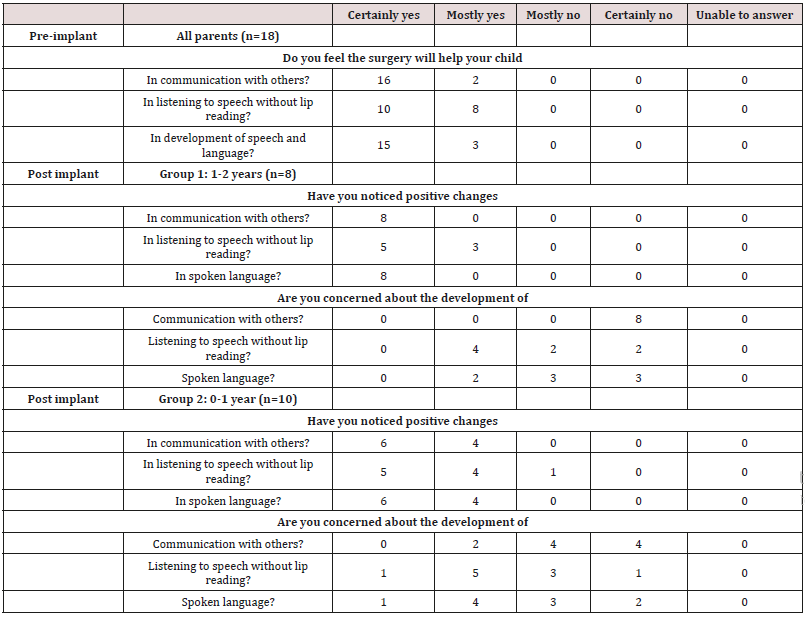
Prior to the intervention, all parents responded positively to
all three questions when asked whether they believe the device
will help their child in communication with others, listening to
speech without lipreading, and in the development of speech and
language. 100% of responses (n=54) were either “Certainly Yes”
(n=41, 75.9%) or “Mostly Yes” (n=13, 24.1%). Expectations were
much higher with regards to communication and the development
of speech and language, with 31 out of 36 responses across these
two domains (86.1%) being “Certainly Yes”, signifying that the
parents expected a definite improvement in these two areas after
implantation. Much lower were the expectations of benefit in
listening to speech without lip reading, as 10 out of 18 parents
(55.6%) expecting a definite improvement (“Certainly Yes”), with
the remaining 8 parents answering “Mostly Yes”. In communication
with others when surveyed post implantation, 100% of parents
were satisfied to some extent; 14 out of 18 parents responded
“Certainly Yes” when asked if they noticed positive changes in this
domain, while the remaining 4 parents responded “Mostly Yes”. An
important difference can be noted between the responses from the
two groups, with respondents from group 1 (who have been using
the device for over one year) all answering “Certainly Yes” (n=8),
while in group 2 (implant use less than one year) 60% of parents
responded “Certainly Yes” and the remaining 40% responded
“Mostly Yes”. These responses allow an insight into parent’s
experiences of benefits with the device over time, as all parents
perceived a difference in the child’s ability to communicate post
implantation, but over time this difference was more noticeable
and parents were more assured of the positive changes caused by
the intervention. They also demonstrate that parental expectations
prior to the surgery were sufficiently met by their experiences with
the child’s ability to communicate with others post implantation in
both groups.
A similar result was obtained when asking about noticeable
positive changes in spoken language. All parents (n=18) responded
either “Mostly Yes” (22.2%) or “Certainly Yes” (77.8%) to this
question. The difference between the two groups was the same as
with the question regarding communication with others: 100% of
group 1 (n=8) parents noticed a definite improvement in spoken
language in their children, while in group 2 (n=10) 60% of parents
responded “Certainly Yes” and 40% responded “Mostly Yes”. These
responses highlight that an improvement in spoken language also
becomes more apparent as time of implant use increases, and
that parental expectations in this domain are sufficiently met post
implantation.
When asked about their experiences with their child’s ability
to listen to speech without lip reading, less parents in both
groups gave a definite “Certainly Yes” answer. Overall, 10 parents
(55.6%) gave this answer, while 7 parents answered, “Mostly Yes”.
These positive responses accounted for 94.4% of answers, as one
parent answered, “Mostly No”. Looking at the individual groups, in
group 1 five parents answered, “Certainly Yes” and the remaining
three answered “Mostly Yes”. In group 2, five parents (50% of
respondents) answered “Certainly Yes”, four parents answered,
“Mostly Yes”, and one parent answered, “Mostly No”. This was the
only instance where such an answer was recorded for questions
related to positive changes noticed by the parents. It is possible
that this may have been due to the parent’s high expectations of
the child being able to understand speech without visual cues
post implantation, or because of the relatively short duration of
implant use and rehabilitation making changes in this domain less
noticeable. This particular patient was the oldest implantees in the
study, being implanted at the age of 5.9 years and having built up
a reliance on lip reading even while wearing conventional hearing
aids prior to implantation. To further look into parent’s perspectives
post implantation, the next set of questions aimed to get an
insight into their concerns regarding their child’s development in
communication with others, listening to speech without lip reading,
and spoken language. In Group 1, 54.2% of responses across all
three domains were “Certainly No”, with all eight parents denying
any concerns in communicating with others.
This highlights the benefits perceived from the surgery – all
children were seen to be better at communicating, and parents were
not worried about the development of this ability. In concerns about
developing spoken language, 3 parents (37.5%) answered “Certainly
No” and a further 3 answered “Mostly No”, while 2 parents (25%)
answered “Mostly Yes”. This showed that even over a year after the
surgery, parents still had some concerns about spoken language,
although more qualitative studies would be needed to discern the
exact areas of concern in this regard. For concerns about listening
to speech without lip reading, 50% of parents selected “Mostly Yes”
as their answer while the other 50% selected either “Mostly No”
or “Certainly No”. This could be indicative of higher expectations
in the child’s ability to listen without visual support. More parental
concerns were noted in children implanted for less than one year. In
Group 2, two (20%) parents answered, “Mostly Yes” with regards to
concerns about development of communication with others, with
the other eight parents answering, “Mostly No” and “Certainly No”.
Five parents answered, “Mostly Yes” (50%) about their concerns
in listening to speech without lip reading, and one parent in this
domain answered “Certainly Yes”; 60% of responses in this area
were therefore in the affirmative. With regards to development
of spoken language, 40% of responses in this group were “Mostly
Yes” and one parent answered “Certainly Yes”. The higher number
of affirmative responses about concerns in the child’s development
in Group 2 suggest that while parents may have noted a general
improvement in some of their child’s abilities, they were still
worried about development in other aspects, and that the outcomes
perceivable by these parents in the time period post implantation
may not have fully met their expectations of the benefit they may
have thought they would see.
Discussion
The support an implanted child receives from their parents,
environmental factors, and social surroundings are considered
as influential factors on developmental outcomes, especially
as time goes on [15]. Parental expectations of the surgery and
their perspectives on the benefit can influence their attitudes
towards rehabilitation and communication with the child, along
with commitment to appointments, therapy, and home-based
exercises. These expectations are swayed by a number of things:
parent’s hopes that the implant will enable the child to develop and
function normally [11], their observations of other implantees or
hearing-impaired people, their experiences with the professionals
they have met, the portrayal by the media of cochlear implants
as a ‘cure’ for deafness [7], and the counselling they receive both
pre-operatively and post operatively. Results obtained from this
survey show that pre-implantation expectations for most, if not all,
parents are quite high. They expect that the surgery will help the
child in communication with others and in speech and language
development, and most parents do not doubt the device’s ability to
assist their children in this regard. This is consistent with findings
from the study performed by Nikolopoulos et al. [21], wherein 81%
and 86% of parents responded “Certainly Yes” in these two fields
respectively. Although in listening to speech without lip reading
only 35% of parents responded similarly, another 40% of parents
responded “Mostly Yes” for this domain i.e. 75% of patients believed
they will help the child in this domain to some extent [21].
Post implantation responses from parents in both groups
generally show that their experiences with their children indicate to
them that there are positive changes due to use of the device. Across
both groups, 70.4% (38 out of 54) responses over all three domains
were “Certainly Yes”, suggestive of a definite positive change being
noticeable in the child. A further 27.8% (15 out of 54) responses
were marked “Mostly Yes”, and only one response was “Mostly No”.
This response was recorded in response to the ‘listening to speech
without lip reading’ question by a parent from group 2 (0 – 1 years
since implant), and therefore may be due to the relatively short
time since implantation. As shown by the responses recorded by
parents in group 1, after a year of implant use parents largely report
positive changes in this domain too. This suggests that cochlear
implantation has significantly met parental expectations recorded
prior to implantation, possibly further reinforcing their efforts in
rehabilitation and in support of the child. As time progresses, it
can be deduced that parents see more of their expectations being
met. Alternatively, this could also mean that parent’s expectations
are lowered and more realistic as they realize the limitations of the
device and the challenges posed to implantees, even though the
surgery is seen to be greatly beneficial to the recipient.
Are parents still concerned about their children’s development
in communication, listening without lip-reading, and spoken
language at one-year post-implantation? The answers received
about future concerns regarding the children’s development allow
us to further understand expectations and perspectives, especially
as time progresses and implant use increases. In group 1, 6 out of
24 (25%) answers were in the affirmative (all being “Mostly Yes”. 4
out of these 6 responses were with regards to listening to speech
without lip reading. Meanwhile, in group 2, 13 out of 30 (43.3%)
responses were in the affirmative, and 2 of these 13 answers
were “Certainly Yes”. This answer was given by the parent of the
oldest implantees across both groups (5.9 years being the age at
implantation) when asked about concerns regarding development
of listening to speech without lip reading and spoken language. Age
at implantation being a significant factor in influencing outcomes
post implantation [6,17], it could be a contributing factor in the
parents’ concerns about their child’s development, particularly
as professionals would ideally have made them aware of age’s
influence on outcomes. Parent’s reports of their concerns also
indicate that as implant use increases, they are less worried and
concerned about outcomes. Boons et al. [17] found that over time,
some of their study participants reported that their expectations
changed over time, as they saw the child progress. A large variety
was seen in parental expectations, with some parents reporting high
expectations while others reported low expectations. Most parents
noted that outcomes were largely in line with their expectations.
This study had a relatively low sample size, and therefore a higher
sample size would be desirable in generalizing the results to a wider
population. A more long-term study could also be undertaken to
highlight and understand variability in outcomes and parent’s
experiences with their implanted children [23].
Conclusion
Between the results seen in both groups, a higher percentage
of parents in group 1 have noticed positive changes across all
three domains and have also reported being less concerned in all
areas than parents of children in group 2. As time passes, children
generally can be said to meet parent’s expectations more than at
earlier stages after implantation. From the three areas considered
in this study, they seemed to be more concerned about their child’s
ability to listen to speech without lip reading, noticing a slower
rate of improvement in this area than in the other domains. In
conclusion, this study has given an insight into parental perspectives
of cochlear implantation in Tanzania. Results are largely correlating
with findings from studies in other countries and programs.
However, further research is needed into other factors affecting
outcomes, perspectives of implantees, and those of their families.
Qualitative research into other factors influencing these influences
on outcomes and expectations is needed, in order to highlight areas
where professionals and parents can further collaborate in the
process of cochlear implant and its rehabilitation.
Read more about Scholarly Journal of Otolaryngology please click on below link
https://lupine-publishers-otolaryngology.blogspot.com/