Lupine Publishers- Environmental and Soil Science
Abstract
Introduction
Study Area
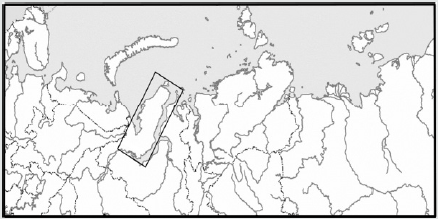
The study of birds started at the forest-tundra the hospital, “Harp”, located 13 km from the town of Labytnangi (66°30N 66°25E.), continued in the polar Urals (the Sob ‘ hospital, 66°40N 60°50E.), then research was moved to the valley of the Ob river, on the left a native beach in the vicinity of Oktyabrsky 5 km below the city of Labytnangi (Figure1). The boundaries of the ranges of the species discussed on the Yamal Peninsula were determined during expeditions in 1974-1982 to the southern, Middle and Northern Yamal.
Figure 1: Location of the research area.
Method of Research
Experimental work was carried out in 1985-1989 and 1999- 2012 on birds taken from nests found in the Lower Ob and middle Yamal. From 10-14-day-old Chicks or adult birds to Supplement with formula or fed artificially. The aim was to form three groups of birds of 5-20 individuals: short-day photoperiod (16C:8T), photoperiod, natural for the latitude of the Polar circle and longday photoperiod (24C:0T). The purpose of these studies is to study the features of photoperiodic and temperature control of the summer part of the annual cycle of birds with different types of development of high latitudes - penetrating the Subarctic, mastered the Subarctic, mastered the Subarctic and the Arctic. In the processing of quantitative materials used conventional statistical methods to assess the reliability of differences used student criterion. Differences were considered significant At p < 0.05. All calculations are performed in Microsoft Excel 2003 and Statistica V. 6.0 (StatSoft, Ink., 1984-2001).
Results and Discussion
Environmental Determinants of Latitudinal Boundaries of the Habitats of the Horned Lark Eremophila alpestris and Snow Buntings Plectrophenax nivalis
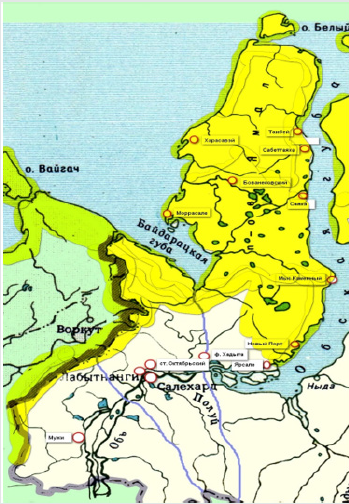
The southern boundary of the habitat of the Horned Lark Eremophila alpestris and Snow Buntings Plectrophenax nivalis on the maps of the Yamal Peninsula conducted at the same points parallel to the southern border of shrub tundra. On the Ural ridge, the area of the Northern subspecies of the Horned Lark Eremophila alpestris (Figure 2) does not extend beyond the latitude of the Polar Circle (66°30´N). Most South registration litter of Snow Buntings Plectrophenax nivalis in the Subpolar Urals in the hillside Sable (64°30´N) [6]. To the North, the occurrence of these birds in the mountains increases, at the end of the Polar Urals, at the outcrops of rocks, the Snow Buntings Plectrophenax nivalis are ubiquitous [6]. On the plain of the Yamal Peninsula, the Horned Lark Eremophila alpestris are found from the southern subarctic tundra to the Arctic tundra of the Northern tip of Yamal and The white island. Snow Bunting Plectrophenax nivalis in the wild, on the plains of Yamal, is found in the Northern half of the subzone of the Arctic tundra and on the island of White in accordance with Figure 3, mainly, along the coasts [7].At the Bottom Ob the first Snow Buntings Plectrophenax nivalis flew between 24.03 and 2. 05, average 7.04 (n = 39). Night temperatures these days fell to -23°C, the day was somewhat warmer. The average temperature in the first decade of April was -15.9° ± 1.2°C. (n = 10) the Flight lasted until the end of May - beginning of June. The first flocks included only males, the last - females with a small share of males. No changes in the start of the flight over the past 40 years have been detected, in contrast to the terms of the flight of Horned Larks Eremophila alpestris. In the 70’s-the first half of the 80’s. the Larks of Eremophila alpestris are met between 1.05-29.05, the average date of the first meeting is 13.05 (n=11), the mass flight was observed before the ice drift and intensive snow melting on plakor. By the mid-1980s, the migration of this species had shifted from the first half of May to the second half. In the 90-ies [8] arrival of these larks Eremophila alpestris began between 11.05-30.05, the average date - 22.05 (n = 13). Currently, Eremophila alpestris‘ horned larks often fly over an icefree river and snow-free tundra. The average daily temperature on the day of the first registration of Horned Larks in the period 1978- 1983 was 9°C ... -3.1°C, an average of 1°C (n = 5).
Figure 2: Distribution of Eremophila alpestris in the Lower Ob-region and Yamal.
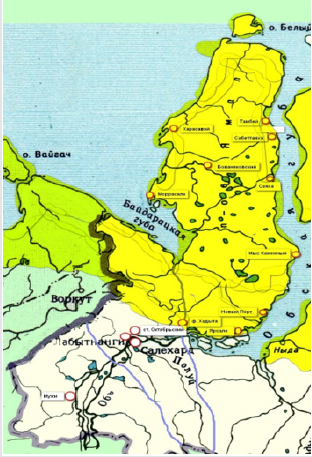
Figure 3: The distribution of Plectrophenax nivalis in the Lower Ob- region and in Yamal.
Nesting sites at the polar stations of the Middle and Northern
Yamal males Snow Buntings Plectrophenax nivalis held in April.
Females arrived much later, in May. Migrating flocks Of Eremophila
alpestris larks included birds of both sexes; some pairs may be
formed on migration. Snow Buntings Plectrophenax nivalis from
pairing to the laying of the first egg as the weeks pass, larks-days.
Despite the early occupation of the nesting areas, the bunches
of Plectrophenax nivalis laid eggs in time, common with other
passerines, including larks Eremophila alpestris, in some years
somewhat earlier. In Northern Yamal oviposition was found in
the nests of Plectrophenax nivalis and Lapland Longspur Calcarius
lapponica in 1974 he started and 17.06 22.06 (calculated according
to the age of the Chicks). In the polar Urals, south of the Arctic circle,
the Plectrophenax nivalis fledglings occurred after 10.07. 2000, and
fledglings of other birds, the estimated start date of oviposition of
Plectrophenax nivalis June 2-3, [6]. On the middle Yamal in 1990,
the author observed simultaneously fledglings plantain Calcarius
lapponica, Motacilla alba, Plectrophenax nivalis and Eremophila
alpestris between 5-9.07. From the Passeriformes of Yamal, the
Horned Larks of Eremophila alpestris had a minimum laying size of
2-5 eggs, with an average of 4.12 ± 0.06 eggs (n = 98). 4-7 eggs were
found In the nest of Plectrophenax nivalis, with an average of 5.42
± 0.18 eggs (n = 19). Differences between species are significant at
p ≤ 0.05. Larks Eremophila alpestris begin to hatch from the 2nd
egg when laying 3-4 eggs. Duration of incubation from the first egg
to the first nestling is 11-14 days, average 12.8 ± 0.42 days (n=7);
duration of nestling - 9-12 days, average 10.4 ± 0.6 days (n = 9). The
total duration of the period from the first egg to the last nestling is
21-24, on average 22.3 ± 0.48 days (n=6). For North Рasseriformes
this is the shortest period. The Horned Lark Eremophila alpestris is
the only one of the Passeriformes subarctic species, part of the pairs
of which after feeding the Chicks of the first brood build a new nest
and feed the second brood. Nenets name of the species “Sidnigy”
translates as “nesting twice.” On the middle Yamal Peninsula of 8
ringed with coloured rings couples twice on his site bred 2 pairs
[2]. In case of loss of the first nest birds also nest again on the site.
After leaving the nest, the broods were fed for a decade, so the
breeding season of Eremophila alpestris, considering the second
clutch in the subarctic tundra of Yamal, lasts more than two months
(65-75 days) and ends in mid-August. The breeding season of the
Snow Buntings Plectrophenax nivalis lasts less than two months
(35-45 days). Females began incubation with the last egg, some
earlier; incubation lasts 12-13 days, nestlings sit 9-15 days, more
often 12-13 days. The total duration of the period from the first egg
to the departure of the last chick is 27-33 days.In the annual cycle of larks Eremophila alpestris one molt, postjuvenile the first years, postnuptial adults in the breeding range. In the annual cycle of Snow Buntings Plectrophenax nivalis two molting: postjuvenile young, postnuptial adults in the breeding range, prenuptial moult from immature and adult individuals in the field of hibernation. Postjuvenil molt at larks Eremophila alpestris full. Examination of the two extracted on the middle Yamal young birds, and inspection of the tail of the carcasses of young North lark (n = 5) of the ornithological collection of the Zoological Museum of Moscow state University shows that the flight feathers in birds, Northern populations are replaced completely, probably completely replaced by contouring and feathering, at least in birds, moulting in normal terms. The age of the beginning of molting is not established, but the first-year Eremophila alpestris caught in the area of Seyaha settlement (70°10N 72°30E) 1.08 was at the 4th stage of molting (from 11 stages). Based on the terms of hatching in this area, the age of the bird was 30-35 days, ie molting he started at the age of not older than 30 days. Replacement of plumage in Horned Larks Eremophila alpestris, due to the large volume, cannot last less than 45-55 days. At birds of the second brood, (hatching 20.07-30.07) at duration of a molt of 40-45 days, for timely departure the beginning of a molt has to be shifted on age 25-30 days. Probably, the timing and pace of this shedding is controlled by the photoperiod, i.e. the shorter the day, the sooner it starts and ends faster, which is especially important for the second brood. Molting individual’s Balkan subspecies of the horned lark Eremophila alpestris began in 38 days (26.07), lasted 80 days, to 14.10. [9].
Viewing the carcasses of adult northern larks Eremophila alpestris from the ornithological collection of the Zoological Museum of Moscow University (n = 13) and a small number of birds shot on the middle Yamal (n = 5) indicate the beginning of post-marital molting from 10.07 to 10.08. The average calculated duration of molting - 68 days, beginning -2.07, end - 7.09. In birds with a second clutch, shedding should be combined with feeding the Chicks. In a cage of four birds contained in the spring. Two males of Eremophila alpestris began moulting in the second decade of July, two - in the third, and finished it in the third decade of September, after 65-75 days. The female began molting 12.07, finished after 68 days, 18.09. The post-marital molt of the Balkan subspecies began on 22.06 and ended on 92 days, on 22.09 [9]. Postjuvenile molt of Plectrophenax nivalis partial. As a result of its individual wears a mixed first winter outfit consisting of a youthful flight feathers of the wing, the wing, tail feathers and succeeding in a result of shedding of part of the wing coverts, contour feathers of the head and torso. In a cage under short-day birds have not replaced the large upper coverts of the secondaries, i.e. the completeness of molt is determined by photoperiodic conditions. In the natural photoperiod of middle Yamal, molting of young birds began at the age of 33-44 days on average 37.4 ± 2.1 days (n =5), between 24.07- 30.07. When the photoperiod 16C:8T Snow Buntings have started moulting to 29, 31, 32 days, an average of 30.7 days. Despite a small sample, there is reason to believe that the timing of the molt is controlled by the photoperiod, because with a short day molt began earlier. The molting rate is also controlled by the photoperiod. Under lighting conditions close to the natural Middle Yamal birds replaced plumage for 48-51 days, an average of 49.4 ± 0.6 days. and finished it between 10.09-15.09. With a short day of molting lasted 37, 39, 40 days, an average of 38.7 days, ie. the shrinking day stimulates not only a shift in the timing of the beginning of molting on earlier dates, but also earlier its end (24.08-30.08) by reducing the number of replaced feathers. Very early on 5th or 6th molt stages (7 stages), poultry has gained the “average” fat reserves. In early October, 3 young birds were examined in the forest-tundra. Two of them have finished shedding, one was in the last stage; in the middle of October all 6 examined birds were in the new feather. The period of post-juvenile molting in the population of Yamal punches of Plectrophenax nivalis continues 2-2.5 months.
Postnuptial moult of Plectrophenax nivalis full. In enclosures hospital October Snow Buntings (n=7) started moult between 12.07-25.07 average date 18.07. In Yamal male moult apparently begins in the third decade of July, but some birds can start it in the second decade. Perhaps some males, like other Northern Bunting [10], started the replacement of feathers prior to fledging from the nest; with supplemental foods juvenile moult must combine all males and some females because of the summer time, it remains small. In Greenland [11] some moulting males fed female and nestlings always combined with supplemental foods moult juveniles; females always started moult after leaving the nests hatchlings. Molting of Plectrophenax nivalis aviary punches lasted 51-65 days, on average-57.8 ± 2.0 days (n=7), which is twice the duration of molting of Plectrophenax nivalis in Greenland (720 N) - 28 days [11]. Usually in the aviary molt is somewhat delayed, but two-fold differences in the rate of molting Plectrophenax nivalis indicate that the Yamal birds shed really slower than the Greenland. Starting molting in late July - early August, they finished it in mid- September, at the same time with young birds. However, they did not lose the ability to fly, unlike the birds of Greenland [11]. Through the Bottom Ob the adult birds are flying without a trace of molt.
Departure of larks Eremophila alpestris from the forest-tundra falls on the period from 18.09-15.10. Snow Buntings Plectrophenax nivalis appear in the forest after the first snowfall, in the third decade of September - early October. The main period of migration Plectrophenax nivalis mid-late October, ends in November. Near the city of Labytnangi the average duration of the migration period of Plectrophenax nivalis 23 days. The unifying features of the ecology of the studied species include, first of all, high resistance to low air temperatures. It is supported by wintering in the lowsnow continental zone, where night temperatures -20°... -30°C are very common. Arriving in spring to the North of the subarctic and Arctic, Snow Buntings Plectrophenax nivalis and larks Eremophila alpestris do not go beyond the lower limits. Resistance to low temperatures and, probably, dense hatching, allows early risers to keep the eggs and Chicks in a relatively shallow socket with low thermal insulation qualities. By the Ural mountains Snow Buntings penetrate to the South to the highlands without going down to the foothills, where there are mountain tundras, but apparently too warm. Horned Larks need to better endure summer temperatures than Snow Buntings because other species inhabit the lower latitudes, but in the subarctic region South of the July isotherms 12°C they do not nest. High density nesting of Eremophila alpestris within July isotherms of 5-10°C, Plectrophenax nivalis - 2-5°C . No. Beetles [12] revealed similarities to the southern boundary of the area of the Eremophila alpestris with the isotherm of July 10°C. Perhaps in the Arctic lark Eremophila alpestris and Plectrophenax nivalis for stimulation of oogenesis enough temperatures close 0°C. or required additional signals (ready biotope, abundance of feed).
A significant role in the formation of the fauna of the subarctic is played by the duration of the frost-free period. When feeding two broods in part of the larks Eremophila alpestris breeding period should last up to 2 months. On the white island and on Novaya Zemlya (73°N) the second brood is probably not present, because the frost-free period is short there. In Western Siberia, the area of larks Eremophila alpestris is in the limits of frost - free period 70 days (68°N) - 35 days (75°N.), that in the subarctic tundra allows you to feed two broods in the Arctic-one.
A characteristic feature of high latitudes - summer polar day. Northern migratory birds with increasing length of the day faced on the wintering grounds and during spring migration. But already on approach to a Polar circle they get to conditions of constant 24- hour day. The reduction of the day length in the subarctic begins much later than in the temperate latitudes, in the middlelate summer, and in the Arctic - in late autumn. In the spring-autumn part of the annual cycle of Northern birds there are two critical points depending on the length of the day: the period of gonad formation and the period of molts. For full maturation of gonads, based on the photoperiod of the extreme southern nesting point in the circumpolar Urals, Plectrophenax nivalis need a short stay (exposure) at the photoperiod 24C: 0T (occurs only during the summer solstice), so nesting should begin at the end of June. Indeed, G. Boyko [13] in XP. The saber (the southernmost nesting point, 64°30N60°E), met several adult punches of Plectrophenax nivalis with ingots 3.08, i.e. the oviposition of these birds began after the summer solstice. North of the Arctic circle, where the polar day begins in the first decade of May, the registration of broods falls on the first - second decade of July, birds were exposed long before the summer solstice. On the Arctic Islands, where the polar day lasts almost six months, the photoperiod does not prevent the early start of egg laying, but there are no external nesting conditions: weather, fodder, biotopic. Horned Lark for the maturation of the gonads is necessary more long stay under continuous light. In spring the birds fly over the forest-tundra at the photoperiod of 24C: 0T to the southern border of the area in the tundra zone, where the gonads reach full maturity. The period from the appearance of an individual in the polar day zone to arrival at the nest site in the shrub tundra, due to the very slow migration through the forest tundra, lasts a few days; to the Arctic tundra larks Eremophila alpestris fly 5-10 days (based on the dates of arrival in North Yamal). The likely duration of exposure 24-hour day for sexual activity-3-5 days.
Molt of Snow Bunting in the polar Urals and flows starts with shrinking the bottom, in the Northern sub-Arctic and Arctic-at a constant 24-hour day. Photoperiodic control of the time and rate of post-juvenile molt is adaptive to the light conditions of the polar Urals, where in August the day is rapidly decreasing, but in the Northern and main parts of the area photoperiodic control does not work, i.e. there is no need for such a reaction. Age and rate of molting in the bottom of the Arctic controlled by the endogenous, but the young from the second egg laying and their parents with the onset of dark nights enabled the photoperiodic reaction. In the Arctic, due to the need for departure in late September - the first half of October, but before the beginning of the dark nights in mid-October, shedding should occur accelerated endogenously controlled pace. In this regard, an interesting 28-day duration post-nuptial moult, Plectrophenax nivalis in Greenland. G. Green, R. Summers [11] in discussing such moult rates suggested that they increase to the North, because Greenland, unlike Iceland, punches Plectrophenax nivalis lose the ability to fly due to the rapid moult of the flight feathers, which “indicates further adaptation to a shorter season at higher latitudes.” The moult of Eremophila alpestris in different photoperiodic conditions has not been studied, but probably in the southern tundra the terms and rates of molts are controlled by the decreasing day, and in the conditions of the long polar day (in the Northern subarctic and Arctic tundra) the terms and rates are controlled endogenously, by the internal rhythm. Only in this case the larks Eremophila alpestris at 75°N (range limit on the island of Novaya Zemlya) are able to finish a complete molt and fly away for the winter in the middle-end of September.
Ecological differences between species belong to the nesting period. Acquiring resistance to low summer temperatures and adaptation to the light regime, larks Eremophila alpestris did not change the requirements for breeding habitat, have not started to build a warm and sheltered from the winds of the nest, but for food for the Chicks learned to fly in the floodplain, to find earthworms, larvae and imago Tipulidae, larvae of sawflies, i.e. the preference for large invertebrates. The expansion of their range at the expense of the Arctic Islands prevents the whole range of Arctic conditionsthe lack of suitable for nesting biotopes, the lack of the required number and mass of large invertebrates, a short period of positive temperatures. Plectrophenax nivalis are distinguished by nesting in shelters and a large nest, which protects the clutch and brood from low temperatures, a wide range of feed biotopes, from garbage dumps to sea shores and the composition and size of invertebrates - from the tailings to beetles and sea crustaceans. The nesting of Plectrophenax nivalis on all Arctic Islands indicates that there are currently no limiting factors for the species.
Environmental Factors that Determine the Latitudinal Boundaries of the Areas of Red-throated Pipit and Meadow Pipit
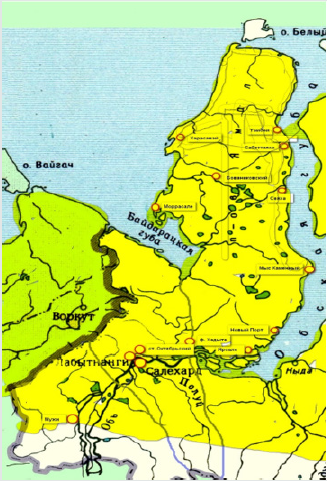
Red-throated Pipit Anthus cervinus is associated with the origin of the Subarctic, its nesting area is mostly limited to the forest-tundra strip, sometimes penetrates into the Northern taiga. In our area nests (Figure 4) in the band from the Northern tip of Yamal (73°N) to the Western Saleda ridge (65°N) in the polar Urals. Tundra Red-throated Pipits everywhere, with the exception of riparian forests, and avoided deciduous woodland of placore. In the southern subarctic tundra, Anthus cervinus skates were found in all biotopes, in the Northern subarctic tundras they were found regularly in floodplains, and in open tundras on plains and on the southern slopes of hills and ravines. In the South of the Arctic tundra of Red-throated Pipits Anthus cervinus was recorded in dry lichen tundra, cut by ravines of small streams and in areas of bumpy rather dry tundra.
Figure 4: Distribution the Anthus cervinus in the Lower Ob- region and in Yamal.
Meadow pipit Anthus pratensis at the beginning of the twentieth
century. nesting to Salekhard (66°31N 66°53E), but not North; in
the middle of the century skates nesting in the middle reaches of
the river Pike (67°N) [14]. In 1974-1976 nesting Pipits greeted us
at the village of Mys Kamennyy (68°40N 73°10E.) and to the North,
the middle reaches of the R. Mardiah (69°50N.). But they were not
on the 70th latitude on the West coast near the polar station of
Marre-Sale, on the East coast near the village of Seyaha (70°10N
72°30E) and 30 km from the coast, in the middle reaches of the
Yasaveyaha river [2]. In 1988-1990 Meadow Pipits Anthus pratensis
continued to meet in the middle reaches of the river Mardiah, and
in 2006 they are found nesting in the vicinity of the settlement of
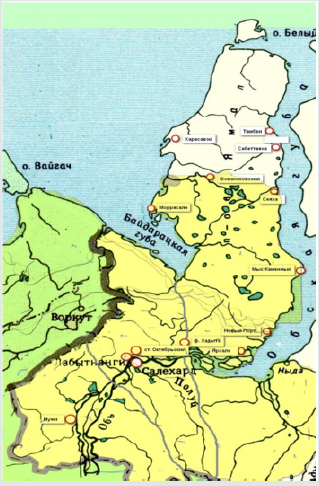
Seyakha [15]. Thus, over the last 100 years, the species has moved
to the North by more than 300 km, to the 70th parallel (Figure 5). At
the same time, the area to the East is expanding. The Eastern border
of the Anthus pratensis nesting in the middle of the last century
was carried out along the Ob valley (63°50N).; somewhat later, the
species was found in the upper reaches of the Kazym and Nadym
rivers [16]. Currently, as a rare breeding species Meadow Pipit
Anthus pratensis found on the right tributary of the lower Pelvis-p.
Russian (67°20 n 82°E) [17].
Figure 5: The distribution of Anthus pratensis in the Lower Ob-region and in Yamal.
The arrival of the first Red-throated Pipits Anthus cervinus in
a neighborhood of the city of Labytnangi in the period 1971-2014
was observed between 10.5-7.06. The earlier spring began, the
earlier the first birds appeared. The air temperature on the day
of registration of the first bird in the forest tundra was 0.1-5.8°C,
on average 2.3°C (n=6); in Yamal, the arrival also began at positive
temperatures. For the forest-tundra period 1970-2004. the average
date of the meeting of the first Anthus pratensis-25.05, the earliest
date-3.05.1982, late-4.06.1978. the air Temperature on the day of
the meeting of the first bird was 0.2°C...-11.4°C, an average of 3.0°C
(n = 8), in the late spring birds flew with the first wave of warm air.
Meadow Pipit Anthus pratensis always arrived before the Anthus
cervinus for 1-10 days. Easter S. [18] showed that in the Lower
Ob area of Meadow Pipits and Red-throated Pipits in 1986-2001. began to
arrive significantly earlier (P ≤ 0.05) than in the previous
15 years.In Red-throated Pipit from the first in the season of birds encountered before oviposition, forest tundra passed 13-20, an average of 16.0 days (n = 8), in the middle Yamal this period lasted 7-13 days, an average of 10 days (n = 4). In the Meadow Pipit the duration of the pre-breeding period in the forest-tundra, from the first in the season encountered birds to the beginning of laying in the forest-tundra reached 12-27 days, an average of 7 years-18.7 ± 2.1 days. Oviposition in Anthus cervinus began after 8-13 days, an average of 9.8 days (n = 5) after the transition of the average daily temperature through 0°C the average Daily temperature on the day of the beginning of egg laying in the forest tundra in different years was 6.0-11.5°C (n = 5). In the Lower Ob the earliest date of the beginning of the period of egg laying by the Red-throated Pipit Anthus cervinus 9.06. 1973, the latest-21.06.1972g, average 16.06. (n = 5). On the Middle Yamal these dates are as follows: 5.06.1990 - 29.06.1987 and 1992, the average date is 14.06 (n = 9), on the North Yamal 9.06.1988 - 1.07.1992 and 1994, the average date is 21.06 (n = 6). In some years, with the advance to the North, the timing of the beginning of egg laying is also shifted to later dates. In 1990 at the 69th parallel oviposition began 5.06, 70 10.06, in the 71st - 13.06. In other years, the delay in the beginning of the egglaying season on the 71st parallel compared with the 69th was 4 (1988) - 15 (1991) days.
In the Lower Ob in 1971-1990 the first eggs in the nests of Meadow Pipit Anthus pratensis appeared between 7.06.1989 and 18.06.1971, the average for 9 years of observations the date of the beginning of oviposition-14.06. On the Middle Yamal Peninsula in 1974-1992 years and the earliest date of oviposition - 13.06.1989, the beginning of masonry in Ob - 8.06.1989. The latest date the beginning of masonry on the Middle Yamal - 19.06.1974, with the beginning of oviposition in the Lower Ob - 16.06.1974. Masonry of the bulk of females begins in the first 6 days: in the forest tundra 98 masonry of 112 (87.5%); in the middle Yamal 126 of 160 (78.7%), in the North Yamal - 12 of 26 (46%). The total duration of the laying season in the forest tundra is 14-21 days, average 16.8 ± 1.3 days (n = 5), average 9.8 ± 1.0 days in the tundra of the middle Yamal (n = 9), 13-28 days in the Arctic tundra of the Northern Yamal, average 18.8 ± 2.9 days (n = 5). The stretch of the season connected with the finding of subsequent clutches.
In the masonry of the Red-throated Pipit Anthus cervinus 2-7 eggs. In The lower Ob in the clutch was 5.34 ± 0.06 eggs (n = 209): in the Northern Yamal the average size of the clutch was 5.46 ± 0.14. The increase in masonry from the forest-tundra to the tundra Of the Middle Yamal is highly significant (t ≤ 11.1) and is associated with an increase in the proportion of masonry with 7 eggs, but in the Northern Yamal masonry value decreases again due to the reduction in the proportion of nests with 7 eggs. In the nests of Meadow Pipit in the Lower Ob ‘ region and in the Southern Yamal Peninsula was 5.41 ± 0.09 eggs (n = 101). On the Middle Yamal there were 5.88 ± 0.06 eggs (n = 58). The differences are significant (t = 4.7, P ≤ 0.01) due to the absence of clutches with 2-4 eggs in the sample. Thus, both types of skates with promotion to the North, the number of eggs in a clutch increase.
According to the results of instrumental measurements, the female of the Red-throated seahorse Anthus cervinus starts to incubate regularly after laying the 2nd-3rd egg with 5-6 eggs. The duration of incubation from the last egg to the first nestling on 28 nests is from 10 to 13 days, on average 11.5 ± 0.15 days. Hatching is stretched for 1-3 days, more often for 2 days, on average 1.8 ± 0.15 (n = 13). The Chicks sat in the nest 9-13, on average, 11.6 ± 0.29 days. (n = 26), ingots from large broods left the nest earlier. The duration of the breeding season Anthus cervinus tundra 36-43, on average, 38.8 ± 1.0 days. (n= 6). At the meadow ridge incubation begins with the penultimate or last egg. From the last eggs before the first Chicks in the control nests of meadow Pipits Anthus pratensis took place 12-15 days, an average of 13.9 ± 0.19 (n=16). In the nest the Chicks were sitting 9 to 14 days, on average 10.9±0.4 days (n = 16). The total duration of the breeding season at the Polar circle latitude from the first egg to the departure from the control nests of the last nestling in different years: 38-44 days, on average - 41.5 ± 1.6 (n = 8). On the Middle Yamal the breeding season of Anthus pratensis lasted 43-50 days, on average 46.7 (n = 3).
Up to 20-22 days of age, Anthus cervinus Red-throated Pipit fledglings were in the area of the breeding area and were fed by adult birds. The disintegration broods Red-throated Pipits occurs at 23-25 days and the birds leave the nesting area in the process of dispersion of the dispersion. Older this age re-caught 2 seahorses at the age of 35 and 39 days. In the forest tundra adult Meadow Pipits was worried at nesting sites until the beginning of August. Of the 20 ringed Chicks in the nests in the area of the nesting area, 2 birds were caught at the age of 33 and 54 days, i.e. after the disintegration of the broods, most of the young birds are included in the dispersion spread, but some remain in the birth area for a long time. Postjuvenile moult Red-throated Pipit partial, minimal among the Northern Motacillidae completeness: replaced a part of the contour feathers of the head and trunk down on apteryx and some wing coverts. Postjuvenile molt Meadow Pipit partial, but more complete than the Red-throated Pipit. Coverts moult of the head and torso, grew up in the nest, and part of wing coverts, where everyone is viewed on the secondary stages of molting birds were replaced by a small upper-coverts of secondaries, upper and lower opacity brush, wing-coverts, tertials coverts lower, secondary lower coverts of secondaries.
The moult of the Anthus cervinus begins at an early age, in birds older than 20 days of age. Of the 11 skates ringed in nests and caught at the age of 20-38 days, molting was 4 individuals: the horse at the age of 25 days was at the 1st stage, at the age of 28 days at the 2nd stage, 2 birds at the age of 33 and 38 days were at the 3rd stage.The rest, at the age of 20-25 days did not shed. In experimental conditions molting began in 22-25 days at a short day (23.4 ± 0.4; n=8), in 24-25 days at natural (24.4 ± 0.2; n = 5) and 24-26 days (25.0 ± 0.2; n = 9) at a long day, i.e. the age of onset of moult in this species is controlled by endogenous. Meadow Pipit Anthus pratensis, ringed in nests and caught in nature at the age of 22-30 days, did not start molting. Skates, fed and overexposed at the natural day, began shedding at the age of 36-45, an average of 38.0 ± 1.4 days (n = 6). Under short-day molt started no earlier than 27 (27 to 36 days, averaging 31.8 ± 1.1; n = 8), the long - not later than 50 (45 to 50 days, averaging 46.7 ±.0; n = 5). The differences in the age of molt onset are significant between all groups: short-day and natural day (t-criterion = 4.04, P ≤ 0.01); natural day and long-day (t-criterion = 4.53, P ≤ 0.01); short-day and long-day (t-criterion = 10.1, P ≤ 0.01). Thus, the timing of post-juvenile molting in meadow skates Anthus pratensis controlled photoperiod, in contrast to the Anthus cervinus.
The rate of shedding is controlled by the photoperiodic response in both species. Molt Meadow Pipits Anthus pratensis under short-day regime molt lasted 30 to 36 days, averaging 34.0 ± 0.8 (n = 8); natural 37-40 days, averaging 38.5 ± 0.8 (n = 5); the long-day regime 40-55 days, averaging 45.0 ±1.6 (n = 9). The differences are significant between the groups of short and long days (t-criterion = 3.0, p ≤ 0.05). the period of post-juvenile molting in the population of Red-throated Pipit Anthus cervinus of The lower Ob should last 45-55 days. By the time of its completion, the young skates fly away from the Lower Ob. Molt Anthus pratensis under short-day molt lasted for 35-45 days, an average of 39.7 ± 1.2 (n = 8); natural 44-49 days, averaging 46.0±1.6 (n = 6); the long - 58- 62 days, averaging 59.5 ± 0.5 (n = 6). The differences are significant between the groups of short-day and natural day (t-criterion = 3.15, p ≤ 0.05); natural day and long-day (t-criterion = 8.08, P ≤ 0.01); short-day and long-day (t-criterion = 15.2, P ≤ 0.01).
Young Red-throated Pipit usually started shedding without leaving the nest surroundings and the last stages of shedding the skates combined with migration. Migration from Meadow probably starts after the completion of the moult, because in the third week of September in the vicinity of Labytnangi appeared regularly flocks are skates; in 1982, in the last five days of September caught 7 birds, 3 of them have finished molting, 4 were in new plumage. Season postjuvenile shedding Anthus pratensis in the tundra lasts 2 months, a third longer than the Anthus cervinus. Full post-nuptial molt in both species, Anthus cervinus partially simultaneously with the feeding of the Chicks. In the second half of the molting period, the skates partially lose their ability to fly [19]. According to the results of the regression analysis, the average date of the beginning of the post - marital molt of the Red - throated Pipit Anthus cervinus falls on July 22, the end of the growth of the flight feathers-on August 19, the duration of the molt of the flight feathers-29 days, contour plumage finishes molting not earlier than a week. The actual duration of the post-nuptial moult is 37-45 days. It is necessary to pay attention to high rates of replacement of flight feathers: in 25-30 days after its beginning birds are able to begin migration. The slow rate of formation of contour feathers does not prevent flights. The season of post-marital molting in the population of red-throated skates Anthus cervinus of The lower Ob region lasts 45-50 days. Post-marital molting in Meadow Pipit Anthus pratensis began in the second half of July - early August. The first shedding pipit caught 23.07, the average calculated date of the beginning of molting - 27.07; in the old plumage of birds caught up to 5.08. The duration of molting in the first beginners of her skates 45-50 days. Males, overexposed from spring (n = 4) in the aviary, shed 56-65 days, on average 59 days; female, taken with Chicks, completely replaced the plumage for 49 days. The average end date of molting in nature 3.09, the average duration of molting regression 39 days, the duration of the season of post-marital molting 60-70 days.
Red-throated Pipits Anthus cervinus fly away from the forest before the meadow. Maximum span in 1975 was observed 2.09. The last meeting of the young birds on the tour in 1975 have on 17.09, adults - 8.09, the departure period lasted about a month. In 1980 from the Enzor-Yakha and Baydarata rivers (68°15N 69°10°E) the departure of red-throated skates Anthus cervinus ended in the last days of August [20]. The departure of the Anthus pratensis begins at the end of August and ends at the end of September. The most recent meetings in the Lower Ob are 21.09.1980, 28.09.1982, 25.09.1984. One flock met on the first snow. N. N. Danilov [21] attributed the Meadow Pipit Anthus pratensis species have mastered the southern sub-Arctic. Currently, in Western Siberia, the species is developing the Northern subarctic And quite well mastered the “middle” Subarctic-sub-zone of the subarctic tundra of Yamal and Tazov Peninsula. V. S. Zhukov [12] the Northern boundary of the range of Anthus pratensis correlates with the isotherm in July is +6°C. V. A. Utkin [22] when building the model, the gradient of the range of Meadow Pipit Anthus pratensis southern border holds for the boundaries of the territory with a relatively short summer nights and the July isotherm of + 20°C. July isotherm of the southern border of the Red-throated ridge -15°C, the Northern border of the area-3°C. the Main part of the area lies in the polar day from mid-May to late July, i.e. photoperiod 24C:0T. The southern limits of the area pass through the territory of the polar day only during the summer solstice.
In the forest-tundra and southern tundra Anthus pratensis arrive with developed gonads in connection with the stimulation of” long “ day on the approach to the Arctic circle, they can engage in reproduction in the forest-tundra and southern tundra, especially in late spring or return of cold weather, which is not uncommon in the North. But in the early spring, which happens more often, birds continue to migrate and expand the area to the North. Red-throated Pipit Anthus cervinus have higher requirements for the length of the light phase, as arrive with underdeveloped gonads. The polar day probably stimulates an increase in the fertility of both types of skates, because on the middle Yamal the number of eggs in the clutches of both species is higher than in the Ob.
The timing of the post-juvenile molting of the Anthus cervinus is associated with age (22-25 days), the molting rate is high, which allows birds to start flying before the onset of cold weather even from the southern Arctic. Adult birds combine molting with reproduction, conduct it at a high rate, which also provides a fairly early flight. Photoperiodic control of moult in the meadow ridge Anthus pratensis shifts its origin in the forest-tundra to the first decade of August, in the Northern subarctic tundra to the second decade. Despite the low completeness postjuvenile molting, it lasts more than a month even in the tundra - to mid-September, and in the Northern tundra, in connection with the late start and the slow pace at longer bottom until the third decade of September, in some years until early winter. Adult skates are also in no hurry to start shedding, because they separate it from feeding. But since the rate of post-marital moult of Anthus pratensis is very high, the late departure is probably also associated with the late formation of the migration state, as in the first years. For this reason, the migration starts later than the departure of other insect-eating birds of the tundra.
The penetration of meadow Pipit Anthus pratensis in the taigatundra part of Asia is facilitated by the absence of interspecific territorial competition [23] and increased fertility in the zone of Sunny nights, creating a sufficiently high abundance for movement to the East. Currently, the North-Eastern tip of the area reaches the Ob-Yenisei watershed, and the entire part of the area in Western Siberia is in the zone of white nights. It is unlikely that there are factors that significantly impede the expansion of the species range to the East, at least on the plain to the Yenisei. But further, the movement in Central Siberia, with its mountainous terrain, also should not be an obstacle, because in the mountains of the Northern, polar and Polar Urals Meadow Pipit Anthus pratensis one of the background species.
Conclusion
The limits of penetration to the North of the Horned Larks Eremophila alpestris are determined by a set of biotope and feed factors and temperature lows, allowing to penetrate into the Arctic, but not to master most of it. In the conditions of further warming the larks of Eremophila alpestris will master all Arctic Islands but will drop out of the list of birds of the southern subarctic tundra. The southern limits of distribution of the Red-throated Pipit Anthus cervinus are limited by the zone of the polar day defining maturation of gonads, mountain tundras of the polar Urals and tundra-like bogs of the West Siberian plain. The limits to the North, apparently, the readiness of biotopes to the beginning of arrival (the presence of invertebrates, thawed tundra). As heat moves to the North, replacing the tundra Arctic deserts, the species will expand its range.
The limits of penetration to the North of the Horned Larks Eremophila alpestris are determined by a set of biotope and feed factors and temperature lows, allowing to penetrate into the Arctic, but not to master most of it. In the conditions of further warming the larks of Eremophila alpestris will master all Arctic Islands but will drop out of the list of birds of the southern subarctic tundra. The southern limits of distribution of the Red-throated Pipit Anthus cervinus are limited by the zone of the polar day defining maturation of gonads, mountain tundras of the polar Urals and tundra-like bogs of the West Siberian plain. The limits to the North, apparently, the readiness of biotopes to the beginning of arrival (the presence of invertebrates, thawed tundra). As heat moves to the North, replacing the tundra Arctic deserts, the species will expand its range.