Showing posts with label Agriculture open access journals. Show all posts

Monday, 5 August 2019

Experimenting with New Crops at the Peri-Urban Fringe | Lupine Publishers

Agriculture open access journals | Lupine Publishers


Farming at the Peri-Urban Fringe

As the world’s human population increases, so too does the demand for food and fibers. However, our ability to meet such demand is challenged by the decline in high quality farmland due to soil degradation, de-agrarianisation and the expansion of urban development [1]. The peri-urban fringe the transition area where rural and urban features and functions intersect and coexist [2]. experiences unique economic, social, and environmental changes [3]. The peri-urban fringe is an area of substantial ecological pressure in relation to space, frequently characterized by land fragmentation, loss of prime agricultural space, and resulting decline in biodiversity [4]. Conversely, as a socio-economic space of great ecological value, it can be seen as a place of opportunities, where human and natural systems co-exist and resulting ecosystem services become strongly linked to anthropogenic practices and decisions. For example, a dynamic and integrative approach to farming—multifunctional agriculture—emerges at the peri-urban fringes and points to a promising new array of both ecosystem services and socio-cultural benefits reimagining older, more entrenched methods of food production [5]. Notably, many commercial farmers only marginally understand the complex set of relationships linking farmland and residential land use despite the enormous potential for profitability, ecological sustainability, novel socio-cultural connections, and food justice resolution.
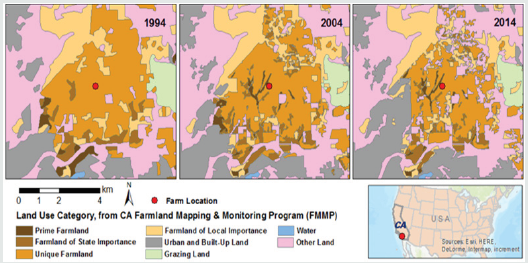
Figure 1: Land use change in the period 1994 - 2014 showing pressure of urban development on agricultural land. The red dot in each panel indicates one of the farms in San Diego Co. that has experimented with coffee-avocado intercropping.
Lupinepublishers-openaccess-Agriculture
Ranked #1 in U.S. crop production and accounting for over 12% of the U.S. population [6,7]. the state of California (CA), serves as a prime example of the challenge described above. The state has long provided a significant proportion of the fruits and nuts consumed in the U.S., and it alone accounts for 86% of national avocado production. Demographic pressure is at the root cause of CA’s rapid land use change. Recent census data indicate that in the period from 1990 to 2000 CE alone, over 10 million housing units were added in the state, highlighting the trend of sustained urban growth (Figure 1). Estimates suggest that, by 2050, over 12 million acres of farmed land or rangeland will be lost to development in CA [4]. According to recent data (FMMP; www.conservation.ca.gov), prime irrigated farmland characterized by high soil quality and large contribution to the food market—has been the most vulnerable of all agricultural land to urbanization, likely due to the fact that a large portion of this fertile land is located in the proximity of developed areas [8]. Land loss to residential development threatens the longterm sustainability and profitability of CA’s tree crop agriculture, but so too does the ongoing drought and future impacts of climate change. Improving soil health by building soil organic carbon (SOC) in these agricultural systems can act as critical tools to increase resilience to drought and offset greenhouse gas (GHG) emissions. If adopted with limited water application, intercropping—the practice of simultaneously growing two crops on the same land [9]. can represent an ecologically and financially valuable solution to issues pertaining to food sourcing and resource use. Intercropping boosts productivity, increases SOC, and enhances nutrient and water retention [10].

The Case for California Grown Coffee

A newcomer to Southern California, coffee represents a niche cultivar. Faced with extreme competition, some growers have innovated by introducing an alternative additional crop to existing high value production systems to remain successful and economically viable without expanding their footprint. Coffee and avocado growers are thus poised to lead a new transformation in the CA foodscape—indeed a new agricultural boom that relies on sustainable organic food production. In the past decade, approximately thirty producers in the coastal region of Southern California have introduced organic coffee intercropping in their well-established avocado orchards, and California coffee has grown in visibility and demand within the world’s Specialty Coffee sector. The intercropping of coffee and avocados provides substantial environmental and economic potential for growers in California. For example, intercropping could lead to two valuable crop harvests on the same land while maintaining—or only slightly increasing—water application. Coffee-avocado intercropping has already brought positive results in terms of crop yield and quality. Notably, costal Southern California has developed into a region experiencing enormous urbanization pressure, therefore exposing the novel coffee-avocado intercropping practice to the unique set of challenges and opportunities of the peri-urban space.
Like many self-described pioneers, new coffee farmers in coastal California employ various approaches to sustainability, community development, and organic growing. All of these actions take place on historical landscapes that have experienced various forms of agricultural and urban or suburban development. California is a major breadbasket, fruit dish, and salad bowl while simultaneously becoming the most urbanized landscape in the country [11]. Scarcity (water, land, population pressures, restricted zoning) has imposed constraints but also foresight on growers, leading to new models of innovation and sustainability. Similar to other niche, high-end cultivars endemic to CA agriculture (i.e. wine, almonds), sustainable coffee is intricately linked to consumers interested in provenance, methods, and compelling stories connecting them to their food. This, too, is another integral part of what has become known as California Cuisine pioneered in the 1970s by Alice Waters. Growers espouse and practice various agrarian philosophies related to sustainability, community development, and organic growing. These farmers also face common challenges related to city and county zoning, other farmers, wine producers, citrus growers, and even residents with different visions of what CA landscapes should look like.

Conclusion

Through an informed understanding that farmland is not simply about producing food, new conversations can emerge between seemingly disparate stakeholders. Concepts like ecosystems services are becoming increasingly part of the public lexicon and educational efforts can help peri-urban communities understand and value the various benefits of their unique landscapes. Several layers of information, from historical assessment, landscape analyses, and direct observations, can provide tools to overcome barriers to collective dialog.

For more Lupine Publishers Open Access Journals Please visit our website: https://lupinepublishersgroup.com/


For more agriculture open access journals Please Click Here:
https://lupinepublishers.com/agriculture-journal/


To Know More About Open Access Publishers Please Click on Lupine Publishers

Wednesday, 22 May 2019

Lupine Publishers-Agriculture open access journals


The authors note that currently in the country from the total turnover of land large areas are excluded that are unsuitable for agricultural production because of the construction of individual buildings and structures, the rise of the groundwater level, the development of various types of erosion and for both reasons. At the same time, there is an acute shortage of water in the country. Consequently, through the introduction of scientifically significant advanced irrigation technologies and methods of agricultural techniques (minimum depth) of soil treatment, it will allow the development of additional areas of sloping terrain, which will enable it to cope with this problem and achieve its goals. To know more go through the below link.


For more Lupine Publishers Open Access Journals Please visit our website: http://www.lupinepublishers.com/

For more agriculture open access journals articles Please Click Here: https://lupinepublishers.com/agriculture-journal/


Thursday, 28 March 2019

Agriculture open access journals-Lupine Publishers

by RAE ZH Aliyev in CIACR in Lupine Publishers.

The article gives the results of studies of the effect of soil and fertilizer treatment on the productivity of winter wheat in the Ganja-Gazakh zone of Azerbaijan (Figure 1). The positive effect of fertilizers on plants of winter wheat is manifested only in well-cultivated soils with a reaction of the environment close to neutral. At the same time it is proved that between the intensity of the application of mineral fertilizers and the productivity of grain crops around the world, a close direct dependence is established. Consequently, the highest yield of grain here was obtained in the variant of dung 10t / ha + N90P90K60 57.1 c / ha, an increase of 24.3 c / ha or 74.1%, where the yield increase by 40-50% is due to the application of fertilizers.To know more click on below link.


For more Lupine Publishers Open Access Journals Please visit our website: http://www.lupinepublishers.com/

For more Agriculture open access journals articles Please Click Here: 

Wednesday, 5 September 2018

Plant Based Protein Sources and Extraction: (CIACR) - Lupine Publishers


In the context of accelerating interest in novel protein sources, plants gain importance day by day. Vegans, vegetarians, people with gluten-restricted dietary necessities are looking forward to new protein sources from novel plant products. However, concerning protein extraction methods from plants have many influential points to consider. This mini-review below represents the current situation for protein extractions and implements solutions to some drawbacks in plant protein extraction issues. Hopefully, the solutions below will be a guide for industrial and technologic aspects of plant protein extraction.

Friday, 17 August 2018

Traditional Knowledge on Mushroom Consumption Habits of Amhara Region in Four Selected Districts - Mecha, Fogera, Bahirdarzuria and Zege: (CIACR) - Lupine Publishers


Population growth coupled with increase in demand for food, domestication and scientific cultivation of wild edible mushroom is alternatives means to alleviate food shortage and malnutrition. The purpose of this study was to assess traditional wild mushroom consumption habit in four selected districts of Amhara region, Mecha, Zege, Fogera and BahirDar Zuria. In this study 115 adult individuals 81 males & 34females were selected and used as information source. Data were collected using structured open and close ended questionnaire, interview as well as personal observation. The study result indicated that (90.43%) of the Mecha, Zege and Bahirdar Zuria Woreda residents have awareness about wild mushroom consumption and its various benefits. About 9.57% of the residents do not have an awareness especially Fogera district. Wild mushroom collection was done mainly from cultivated farmland (65.21%) followed by termite nests (14.78%), uncultivated land (13.04%), forest vicinity (5.21%). All family members, children, women and men were involved in mushroom collection. However, none of the inhabitants was found to cultivate mushrooms artificially in scientific ways due to various reasons, 63.48% respondents said lack of awareness on artificial mushroom cultivation method. 33.04% respondent said non-availability of the well-known mushroom species, 3.47% responded due to religion pressure.
All the inhabitants have stated the status of wild mushroom distribution has been sharply decreasing from time to time since the past two decades.They mentioned the cause of reduction are climate change (49%), urbanization (13.51%), chemical pollution (12.57%), over overgrazing (9.57%), unknown reason (13.91%) followed by deforestation (8.79%) reported by the respondents. From the current study, it is concluded that the majority of inhabitants like eating wild mushrooms traditionally and well aware about the current decrease in wild edible mushrooms distribution, they have neither cultivated nor are aware about the possibility of cultivating mushroom artificially, implying that there is an urgent need to initiate and create awareness among the inhabitants to adopt cultivation and conservation of such very important non-timber forest product in order to protect the decreasing status of the wild mushroom. As well as to decrease the lake Tana basin ecosystem destruction, Furthermore, such awareness and cultivation process could also be important to use the mushrooms for serving to diversify agricultural activity and supplement diet as well as income generation in the long run for the local farming community. It is requiring to domesticating wild edible mushroom through exploration and conservation of this bio resource fungi of the country at national fungal culture collection center.

Diagnosis of Phytophthora in Soil Samples by Polymerase Chain Reaction: (CIACR) - Lupine Publishers


Phytophthora infestans is the most notorious causing Late blight of potato and tomato, globally. The word Phytophthora is derived from the Greek word: Phyto = plant, phthora = destroyer. Potato is a native of the North Andes (South America) and the late blight of potato was initially an endemic disease but in the mid1800s, late blight caused wide spread crop failures throughout the Northern Europe including Ireland where it was responsible for the Irish famine [1]. The genus Phytophthora represents a large group of plant pathogenic fungi responsible for crop losses in temperate and tropical climate [2]. Many species of Phytophthora are soil borne pathogens and spread through the movement of infested soil, or by water flow through infested soil [3]. A key element in the management of such diseases is the ability to detect the pathogen in soil and water. However, DNA extracted from soil contains substances such as humic acids, lignins, carbohydrates, resins, and so on which are very inhibitory to PCR amplification [4,5]. The amounts of inhibitory substances will vary widely with soil type, vegetation type, and composition of the soil micro flora. As the micro flora varies even over small distances (1 m scale) [6], the efficiency of PCR amplification is likely to vary widely even over small distances. It is therefore critical that an internal standard is used for PCR analysis of soil samples [7]. Recorded positive detection of P. infestans for up to twelve months from soil in which infested leaf tissue had been buried and for up to 24 months from soil containing leaf tissue infected with both mating types.


On the Role of Systems of Small Intensive Irrigation in Solving the Problems of Mineral Farming in Azerbaijan: (CIACR) - Lupine Publishers


The authors note that currently in the country from the total turnover of land large areas are excluded that are unsuitable for agricultural production because of the construction of individual buildings and structures, the rise of the groundwater level, the development of various types of erosion and for both reasons. At the same time, there is an acute shortage of water in the country. Consequently, through the introduction of scientifically significant advanced irrigation technologies and methods of agricultural techniques (minimum depth) of soil treatment, it will allow the development of additional areas of sloping terrain, which will enable it to cope with this problem and achieve its goals.

Comparative Evaluation of the Effects of Soil and Fertilizer Treatment on Winter Wheat Cultivation: (CIACR) - Lupine Publishers


The article gives the results of studies of the effect of soil and fertilizer treatment on the productivity of winter wheat in the Ganja-Gazakh zone of Azerbaijan (Figure 1). The positive effect of fertilizers on plants of winter wheat is manifested only in well-cultivated soils with a reaction of the environment close to neutral. At the same time it is proved that between the intensity of the application of mineral fertilizers and the productivity of grain crops around the world, a close direct dependence is established. Consequently, the highest yield of grain here was obtained in the variant of dung 10t / ha + N90P90K60 57.1 c / ha, an increase of 24.3 c / ha or 74.1%, where the yield increase by 40-50% is due to the application of fertilizers.