Lupine Publishers| Journal of Textile and Fashion Designing
Abstract
“Architecture and Fashion - Something in Common”, is exploring the
parallels between one of the most two influential fields in
the creative design industry; which are “Architecture” and “Fashion”.
The purpose of the research work introduced in this paper is
to find the common elements between architecture and fashion. “Design”
and “Creativity” are major common elements between
architecture and fashion, where both fields involves; imagination, art,
visualization, creativity, and skill. On the other hand, architects
develop a variety of creative design skills during their undergraduate
studies in addition to learning their major in “Architecture”,
such diversity of skills expands the realm of their job market, so that
those who did not manage to find jobs in their field of major
as architects may be able to find jobs in fields where they have
developed creative design skills, during their undergraduate years
of study2. The paper is aiming towards integrating learning fashion
design principles as part of the undergraduate architecture
syllabus, which in turn may facilitate numerous job opportunities for
architects quitting their major field of study but still wish to
work in the fashion industry which is a field where they can express and
practice their creative design skills. Research introduced in
this paper found that most famous and influential fashion designers were
architects before they switched to fashion design, it was
also found that there were many fashion designers who made architecture
designs and great buildings, similarly, many famous and
influential architects made great fashion designs.
Keywords: Fashion and Architecture; Fashion Architect; Fashion Designers; Architectural Fashion; Building Fashion
Problem
Job market statistics in USA and Europe found that salaries
of fresh graduate architects are very low compared to other
professional jobs that require creativity and design skills; also, it
was found that finding a job opportunity for a fresh graduate to
work as an architect in a design firm is scarce, which caused many
fresh graduates to accept working as “Interim architects”1. in the
beginning, without receiving any salary for a period of time that
may; in many cases, extend to two or three years after graduation,
in hope that they will be able to have a permanent employment in
the firm at the end. For the above reasons; the concept of expanding
the job market for architects have been adopted in many schools
of architecture around USA and Europe. Since architects develop
a variety of skills during their undergraduate studies in addition
to learning their major in “Architecture”, they learn graphic design
skills which allow them to work as graphic designers, and in the field
of publication design, they also learn 3Dimensional visualization
skills so that they can work as visualization specialists, rendering
specialists, and animators.
And in some architecture schools; they learn interior design,
theatre, and cinema plateau design, web design, multimedia
design, and some industrial design principles. This diversity of
skills expands the realm of their job market, so that those who did
not manage to find jobs in their field of major as architects may
be able to find jobs in fields where they have developed creative
design skills, during their undergraduate years of study. Since
“Design” and “Creativity” are major common elements between
architecture and fashion, where both fields involves; imagination,
art, visualization, creativity, and skill; integrating learning fashion
design principles as part of the undergraduate architecture
syllabus may facilitate numerous job opportunities for architects
quitting their major field of study but still wish to work in the
fashion industry which represents a field where they can express
and practice their creative design skills.
Literature Review
The literature introduced in this research paper is exploring
the common elements between architecture and fashion, through
introducing examples of fashion designs influenced by architectural
buildings, and vice versa. It also introduces some of the most famous
fashion designers whose background study was architecture, and
architects who worked as both architects and fashion designers.
An “Interim job” is a temporary occupation where a worker
is employed for a specific period of time, and without the notion
for changing such working status into a permanent employment.
“Interim architects” are usually fresh graduates who are temporary
hired by design firms, as the later prefers those fresh graduates
above experienced, or intermediate, and senior architects due to
their higher salary rates. However, in some cases the word “Interim
architect” is used for describing undergraduate students of
architecture who spend some time receiving a “Training opportunity”
in a design firm, where the time they spent has been calculated as
part of the completion of their credits in order to be eligible for
graduation. In general, “Interim employment opportunities” are
characterized by its no, or very small compensation.
One of the major working issues that aroused in USA and
Europe since 2000 is that major architecture firms started to heavily
depend on “Interim architects” as the main back office workforce
in order to minimize their major running expenses represented in
salaries. Instead, the firm in many cases gives the “Interim architect”
a certificate of experience with a little compensation. This situation
caused many fresh graduate architects to quit the field and start
using skills they learned during their undergraduate years of study
to work in the creative design industry, as free lancers, or finding
better job opportunities as employees.
Research Goal
The goal of this research is to find the common elements
between architecture and fashion, for the purpose of integrating
learning fashion design skills in architecture syllabus, especially at
the under graduate level, where architecture students developed
various creative design skills.
Research Scope
The research work introduced in this paper is focusing on
exploring attributes that may be common between architecture
design and fashion design. Subjects like “Fashion Cycles” and/or
“Fashion Trends” are not within the scope of work introduced in
this research paper.
Methodology
In order for the research paper to fulfill its goals; the paper
started with an overview about the nature of fashion design, then
the paper discussed the following topics:
a) Fashion Designers with Architectural Background
b) Examples of Fashion Designers who Make Architectural
Designs
c) Examples of Architects who Make Fashion Designs
d) Examples of Fashion Designs Influenced by Architecture
e) Examples of Architectural Designs Influenced by Fashion
Discussion
Overview
Fashion designs are inspired from all sources; Fine arts, society,
culture, nature, architecture, etc. There is a great synergy between
architecture and fashion. While architecture provides spaces for
living, work, entertainment, learning, health, etc. Fashion provides
wearable art. Many Fashion designers use their materials as
building blocks, constructing all types of dresses and garments in
the same way architects utilize concrete, cement, and glass to build
up their structures Stewart Jessica [1].
Fashion Designers with Architectural Background
Fashion giants such as the late “Pierre Balmain”, “Gianfranco
Ferré”, “Fernando Garcia”, and “Coco Chanel”; they all came from an
architectural background. Also, famous classic fashion designers
like “Versace, “Cardin”, and many others studied architecture before
switching to fashion.
Balmain: “Pierre Alexandre Claudius Balmain”, or “Balmain”
[May 1914–June 1982], was a famous French fashion designer and
founder of the leading post-war fashion house “Balmain”, he was
known for his sophisticated and elegance fashion designs. “Balmain”
studied architecture at the “École des Beaux-Arts” in Paris, France.
While in 1934, he switched from architecture to fashion when he
was offered a job at the “Edward Molyneux” fashion studio Elle-
Balmain [2]. “Balmain” was clear in his words for incorporating
architectural elements into his designs, stating that: “Dressmaking
is the Architecture of Movement”.
Gianfranco Ferré: “Gianfranco Ferré’s”, [August 1944 –
June 2007], was a famous Italian fashion designer who studied
architecture at the “Milan Polytechnic Institute” in Milan, Italy. He
was also known as “The architect of fashion” for his background
study as an architect, and his original attitude towards creating
fashion design. BBC News [3]. “Ferré” began his fashion career
in 1970 by designing accessories, and then worked as a raincoat
designer from 1972 to 1974. Afterwards, he started his own
company “Baila” in 1974 and launched his signature collection
for women in 1978. His first men’s collection appeared in 1982,
followed by his first couture collection in Rome in 1986. Then
in 1989, “Ferré” was chosen by “Bernard Arnault” the owner of
“Christian Dior”3 to replace its director “Marc Bohan”. (Blanchard
Tamsin [4].
Fernando Garcia: “Fernando Garcia” is a famous fashion
designer, who grew up traveling between the “Dominican Republic”
and “Northern Spain”. His love for drawing on napkins led him to study
architecture at the University of “Notre Dame” in USA. Being
a creative artist and architect made him switch into fashion design.
He found the opportunity to work at “Oscar de la Renta” fashion
studio in New York where he built his reputation as a recognized
fashion designer; he won with Laura Kim the “Swarovski Award for
Emerging Talent for Monse” fashion design award. In his opinion
about the interrelation between fashion and architecture he said:
CFDA [5]. “I Find A Building’s Façade, For Example, To Be Similar
to When I’m Trying to Find A Balance in Designing Any Garment “
Coco Chanel: “Coco Chanel”, or “Gabrielle Bonheur Chanel”,
[August 1883 –January 1971] was a famous French fashion
designer and businesswoman. She was the founder of the famous
“Chanel brand”. “Chanel” was nominated on “TIME” magazine’s list
of the 100 most influential people of the 20th century. Her fashion
design for females was recognized as the feminine standard of style
of the post-World War I era. In her opinion about the interrelation
between fashion and architecture she said: (Horton, R. Simmons,
and Sally [6]. “Fashion Is Architecture: It Is A Matter of Proportions”.
Versace: “Gianni Versace” [1946-1997] one of the most
innovative fashion designers of the 20th century, being inspired by
studying architectural drafting and the ancient Greek and Roman
architecture in his early age; Versace entered the world of fashion
with his clothes designed using architectural materials like metals,
plastics, and leathers. He was awarded the best fashion designer of
the year [1982-83] for his fall/winter collection called the “L’Occhio
d’Oro”, or the “Golden Eye”, for designing women garments made of
metals cut by laser technology. (Encyclopedia of World Biography
[7] (Figure 1).
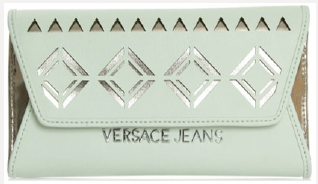
Figure 1: Showing the “ Selena White Laser Cut Cross-
Body Bag” introduced by “Versace” in his Spring 2008
Collection, the bag is made of: White Faux Leather, Silver
Hardware, a Popper Snap Closer, with a Detachable
Chain Strap, the design was cut by laser and came under
the “Versace Jeans” Branding in 2008, Source: Daniel
Footware [38].
Cardin
“Pietro Cardin”, also known as “Pierre Cardin”, is a famous
Italian-French fashion designer who moved with his wealthy
parents from Italy escaping “Fascism”4 to settle in France. In 1945,
and after the end of World War II, he studied architecture in Paris.
Yet with a great passion for fashion design; he worked with many
famous fashion houses like “Paquin”5 “Elsa Schiaparelli”6 and
also became the head of design department at “Christian Dior’s”
atelier in 1947. “Cardin” founded his fashion house in 1950. United
Nations Educational, Scientific and Cultural Organization [8]. Being
influenced by his architectural background study; “Cardin” was
known for his inclination towards applying geometrical shapes and
motifs in his fashion design and often ignoring the female form.
He was also known by his “Avant-Garde” style [7]and “Space Age”
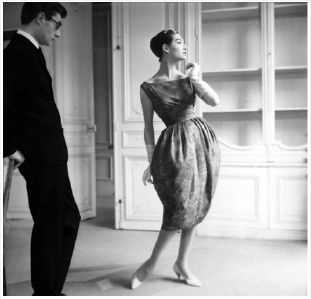
designs 8. In 1954, he introduced his famous “Bubble Dress” design
inspired by the geometrical shapes of ellipsoids and spheres. Pierre
Cardin [9] (Figure 2).
Figure 2: Showing “Cardin’s” 1954 Bubble Dress design
that was inspired by the geometrical shapes of the
ellipsoids and spheres Source: Pierre Cardin [9].
“Christian Dior” is one of the most famous and biggest fashion
houses of the twentieth century, founded by the French fashion
designer “Christian Dior”, who lived between [January 1905 and 24
October 1957]
“Fascism” is a political ideology that was developed after World
War I in Italy and Germany, it was characterized by its extreme
nature, almost classifying human beings as superior nations and
others that should be dominated by military invasion, “Fascism”
was a very oppressive political form of dictatorship that was
against “Liberalism” and “Socialism”. The ideology was adopted by
“Benito Amilcare Andrea Mussolini” who was the leader and Prime
Minister of Italy from 1922 to 1943, “Fascism” was one of the major
political ideologies that influenced the beginning of world war II in
1939, (Grimsley Shawn [10]
“Paquin” is a leading French fashion design house founded
in Paris by “Jeanne Paquin”. She lived between [1869 and 1936],
and she was considered one of the female pioneers in the fashion
industry, (Brenda Polan, Roger Tredre [11].
“Schiaparelli” Designs, was a famous fashion house founded by
the Italian fashion designer “Elsa Schiaparelli” [1890–1973], she
was also considered as one of the most female pioneers in fashion
design between world war I and II. Her clients included many
prominent figures and celebrities like “Heiress Daisy Fellowes” and
actress “Mae West” Bradley Laura, Watt Judith [12].
“Avant-Garde” is an intellectual, artistic, and cultural movement
lead by many writers, critiques, artists, and social activists who
challenged the main stream of thinking in both their societies and
their professional fields. The “Avant-Garde” movement dates back to
early 1850’s. And it had great influence on art, writing, architecture,
and many other social related fields. Gongini Barbara [13].
“Space Age” is a term defining the time period where the space
science technologies began to evolve and introduced to the main
stream media, the space age is marked by the launch of “Sputnik”
space ship in 1957” Garber Steve [14]
Examples of Fashion Designers Who Make Architectural
Designs
What follows are some examples of famous fashion designers
who make architectural designs
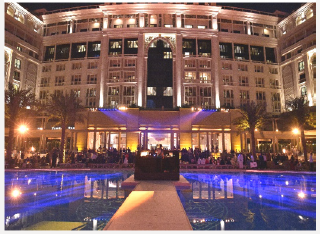
Versace: “Versace” inc. was commissioned by “ENSHAA PSC”;
a major real estate developer in UAE to design a luxury 130,000
square meters [1,400,000 sqft] seven stars “Palazzo Versace Dubai”
hotel in Dubai, the United Arab Emirates, the hotel consists of
215 hotel rooms and suites, and 169 residencies, together with
main entrance, high ceilings, multipurpose halls, restaurants, spa,
landscaped gardens with promenades, terraces, water features,
reflection pools, and other amenities. The hotel was aimed to reflect
the “Versace” lifestyle. Its public spaces and hallways were designed
to showcase the artwork, sculpture, featured sketches, and artifacts
of the atelier “Versace” gowns, while every interior detail in the
hotel including furniture in the hotel rooms and other hotel spaces
were exclusively designed by “Versace” to create an immersive
experience of his lifestyle Marcellous Jones [15] (Figure 3).
Figure 3: Showing the “Palazzo Versace Dubai” hotel in
Dubai, the United Arab Emirates, designed by “Versace”,
Source: (Marcellous Jones [15].
Virgil Abloh: “Virgil Abloh” is an American creative fashion
designer, and founder of the Milan-based fashion label “Off-
White” [9] “Abloh” also studied architecture at the Illinois Institute
of Technology. In addition to running a famous fashion line, he
collaborated with “IKEA”, to create a capsule furniture collection,
and planned to publish a series of books that showcase his
clothes alongside iconic structures by “Le Corbusier” and “Mies
Van Der Rohe”. (Figure 4). “Abloh” quoted in an interview with
the “Architectural Digest”, Maria Bobila [16], Mathew Taylor [17].
“The Idea Is to Teach My Demographic — The Younger Generation
Who’s Immersed in Fashion — About Architecture Through These
Sites.” Moreover, the style director at the “Architectural Digest”
“Jane Keltner De Valle”, an established longtime fashion editor in
both the “Women’s Wear Daily”, and “Elle” magazines, after moving
to work in the “Architectural digest”; She interviewed “Abloh” and
cited him as: “The Brains Behind Off-White and another Designer
Who Heavily References Architecture in His Work”. In her personal
opinion about the interrelation between fashion and architecture
she stated that: Tyler Mccallnov [18]. “I think we’re going through
such a seismic Cultural shift right now”.
Read More About Lupine Publishers Journal of Textile and Fashion Designing Please Click on below Link: https://fashion-technology-lupine-publishers.blogspot.com/